
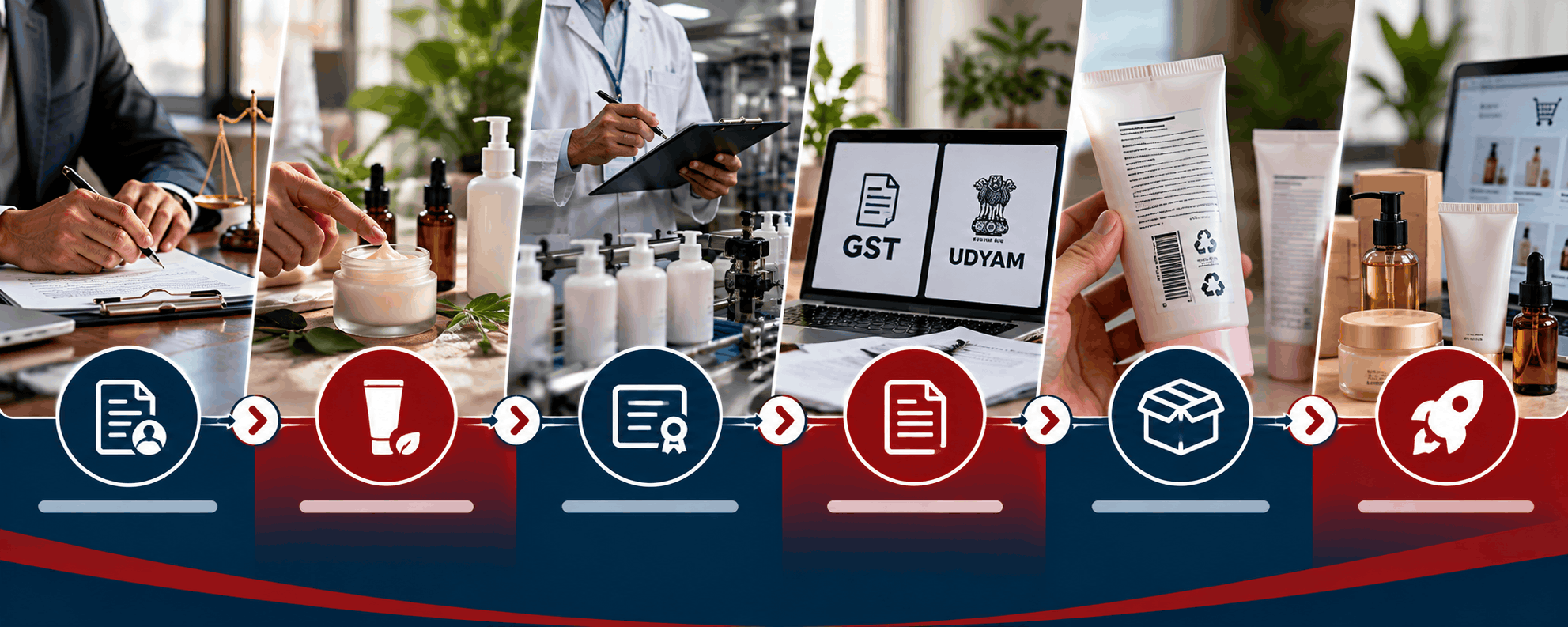
Here is how to start a personal care business in India. Register your business, pick a name you can trademark, and decide who will make your products. Own a factory? Get a cosmetic manufacturing licence. Using a contract manufacturer? Get a loan licence. Then add GST, a compliant label and Legal Metrology registration.
Soap, shampoo, face cream, hair oil and perfume are all cosmetics under Indian law. The Cosmetics Rules, 2020 govern how you make, label and sell them. This guide walks through each step in the order a new founder usually needs it.
What Does It Take to Start a Personal Care Business in India?
Cosmetics business legal requirements fall into three layers.
The first layer is the business itself. You choose a structure, register it, and add GST and Udyam registration where they apply. The second layer is the product. You need a licence route, a compliant label and, for some categories, BIS standards. The third layer is the brand. Your name, logo and pack design need protection before you spend on marketing.
Two authorities matter most. The State Licensing Authority issues manufacturing and loan licences. The Central Drugs Standard Control Organisation (CDSCO) handles import registration. The Cosmetics Rules, 2020 sit under the Drugs and Cosmetics Act, 1940. The government amended them on 29 July 2025.
Here is a pattern worth knowing. Many first-time founders finish packaging and a photoshoot before they check the licence route. A wrong claim or a missing declaration then forces a reprint. Work in this order: structure, claims, licence route, label, brand protection, launch.
Is Your Product a Cosmetic or a Drug?
Your claims decide. Indian law treats cosmetics as articles meant for cleansing, beautifying, promoting attractiveness or altering appearance. A product that claims to treat or prevent a disease, or to change how the body works, can be treated as a drug.
Compare two label lines. "Leaves skin soft and fresh" reads as a cosmetic claim. "Cures eczema in seven days" reads as a drug claim. The second line can push you towards a drug licence and a very different approval path.
Regulators watch claims closely. The Drugs Controller General of India has warned the industry against unusual claims.
Write your product claims before you pick a licence route. Marketing copy can change your legal category.
Which Business Structure Suits a Personal Care Brand?
Your structure decides who carries the risk and how easily you can raise money. This table compares the common options.
|
Structure |
Separate legal entity |
Owner liability |
Best for |
Yearly compliance |
|
Sole Proprietorship |
No |
Unlimited |
A solo founder testing a pilot range |
Income tax return, plus GST returns if registered |
|
Partnership Firm |
No |
Unlimited for partners |
Family or friends launching together |
Income tax return, plus GST returns if registered |
|
LLP |
Yes |
Limited to agreed contribution |
Small teams wanting limited liability |
Annual filings with the ROC |
|
One Person Company |
Yes |
Limited to the company's assets |
A solo founder who wants company status |
ROC annual filings |
|
Private Limited Company |
Yes |
Limited to shareholding |
Brands planning investors and a growing team |
ROC annual return and audited accounts |
A solo founder with two or three products often starts as a sole proprietorship. Partners can choose a partnership firm or an LLP. Expecting outside investment? A private limited company is the usual route. A solo founder who wants company status can look at a One Person Company.
One tip on names. A company name cleared by the MCA gives you no trademark rights. Check both before you print anything, and read our tips on choosing a company name.
Should You Make Your Own Products or Use a Contract Manufacturer?
This choice shapes your costs, your control and your licence. If you are wondering how to start a cosmetics business on a small budget, look at the contract route first.
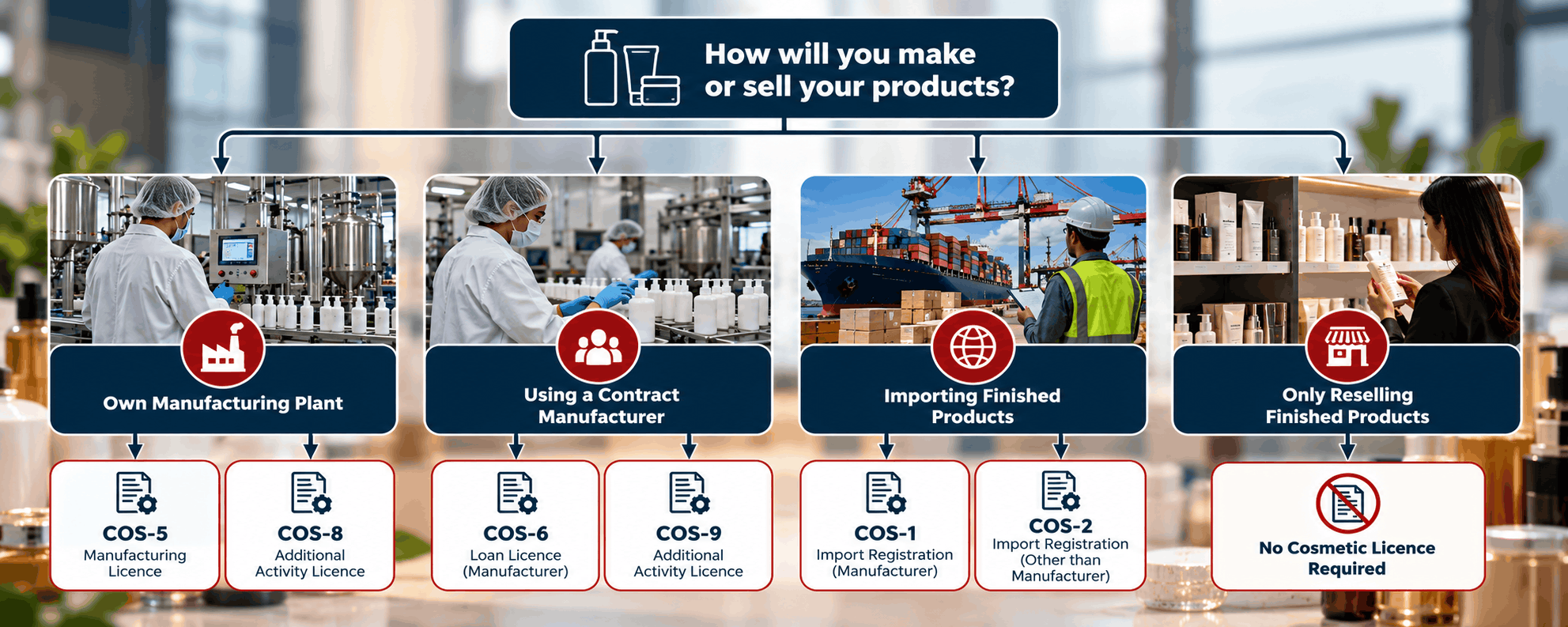
Own manufacturing. You run a plant. Your premises, equipment and technical staff must meet the GMP conditions in the Seventh Schedule of the Cosmetics Rules. You apply in Form COS-5 and receive a licence in Form COS-8.
Contract manufacturing. You use a licensed manufacturer's facility. You apply for a loan licence in Form COS-6 and receive Form COS-9. You skip the factory, but the licence still carries your name.
Importing. You bring in finished products after CDSCO registration.
|
Route |
Who it suits |
Forms (application, then licence) |
Issued by |
Validity |
|
Own manufacturing licence |
Founders with their own plant |
COS-5, then COS-8 |
State Licensing Authority |
Perpetual, with a retention fee every five years |
|
Loan licence |
Brand owners using a licensed contract manufacturer |
COS-6, then COS-9 |
State Licensing Authority |
Perpetual, with a retention fee every five years |
|
Import registration |
Brands bringing in finished products |
COS-1, then COS-2 |
Central Licensing Authority (CDSCO) |
Perpetual, with a retention fee every five years |
|
Reselling only |
Shops and distributors buying lawful products |
Generally no cosmetic licence |
Not applicable |
Not applicable |
For a small first range, the loan licence usually costs less upfront than building a plant.
Watch out for repackaging and relabelling. Putting your brand on someone else's finished product can count as manufacturing. If a supplier offers ready "white label" stock, ask which licence covers the rebranded pack before you pay.
What Is a Cosmetic Manufacturing Licence, and What Does It Cost?
A cosmetic manufacturing licence lets you make cosmetics for sale or distribution at named premises. The State Licensing Authority grants it under the Cosmetics Rules, 2020. Our guide to the cosmetic manufacturing licence covers each form in more detail. Personal care product licensing in India rests on these key facts:
-
Forms: COS-5 and COS-8 for your own site. COS-6 and COS-9 for a loan licence.
-
Fee: The Third Schedule sets ₹10,000 for up to ten items in each category, plus ₹500 for each additional item, according to the Delhi Drugs Control Department's fee table. Check your state portal for the current amount.
-
Validity: The licence stays valid as long as you pay the retention fee every five years.
-
Late payment: The retention fee plus 2% of the licence fee per month applies. If you miss the 180-day grace period, the licence stands cancelled, as ChemLinked's summary of the Rules explains.
-
Premises: Each manufacturing site needs its own licence.
Count your products by category before you file. A complete list at the start saves you add-on applications later.
How Do You Apply for a Cosmetic Licence, Step by Step?
-
List your products. Group them by cosmetic category.
-
Lock your premises. Choose a GMP-ready site of your own, or a licensed manufacturer's site.
-
Name your technical staff. The Rules require competent staff to supervise manufacture.
-
Gather your documents (checklist below).
-
File the application. Use Form COS-5 for your own site or COS-6 for a loan licence. File on the State Licensing Authority's online portal and pay the fee.
-
Wait for the decision. The Rules give the authority 45 days to grant or reject. An incomplete application can be rejected.
-
Prepare for inspection. The authority may inspect within 30 days of grant to check your GMP self-declaration. If it does not inspect within that window, the licence stands valid.
-
Keep records. Store batch records for three years or six months past expiry, whichever is longer.
Document checklist:
-
Proof of your constitution (incorporation certificate, partnership deed or proprietor ID)
-
Ownership or rent papers for the premises
-
GMP self-declaration in Form COS-7
-
Details and qualification proof of your technical staff
-
Your product list by category
-
For a loan licence: a copy of the manufacturer's valid licence and your agreement with the manufacturer
How Does a Loan Licence Work With a Contract Manufacturer?
A loan licence lets you sell under your own name while a licensed manufacturer produces the batches. Your application needs the manufacturer's valid licence, the agreement between you both, and details of the technical staff.
The licence names specific products and premises, so confirm that your manufacturer's licence covers your product types. A shampoo licence does not automatically cover a hair dye.
As the licensee, you carry responsibility for the products you sell. Agree on paper who keeps the batch records and the formulation files. Add an exit clause too, so you can move production without losing your formulas.
Our vendor assessment service and due diligence support help you vet a manufacturer before you sign.
Do You Need a Licence to Import or Resell Cosmetics?
Importers register their products with CDSCO. You apply in Form COS-1 and receive a certificate in Form COS-2. The certificate stays valid in perpetuity, subject to a retention fee. The Third Schedule charges US dollar fees per category, per manufacturing site and per variant. New cosmetics need prior permission from the central authority. You also need an Import Export Code. Read our note on CDSCO requirements for details.
Retailers and resellers who only buy and sell lawful products generally need no cosmetic licence. The picture changes if you repackage or relabel.
Which Registrations Does a Personal Care Brand Need?
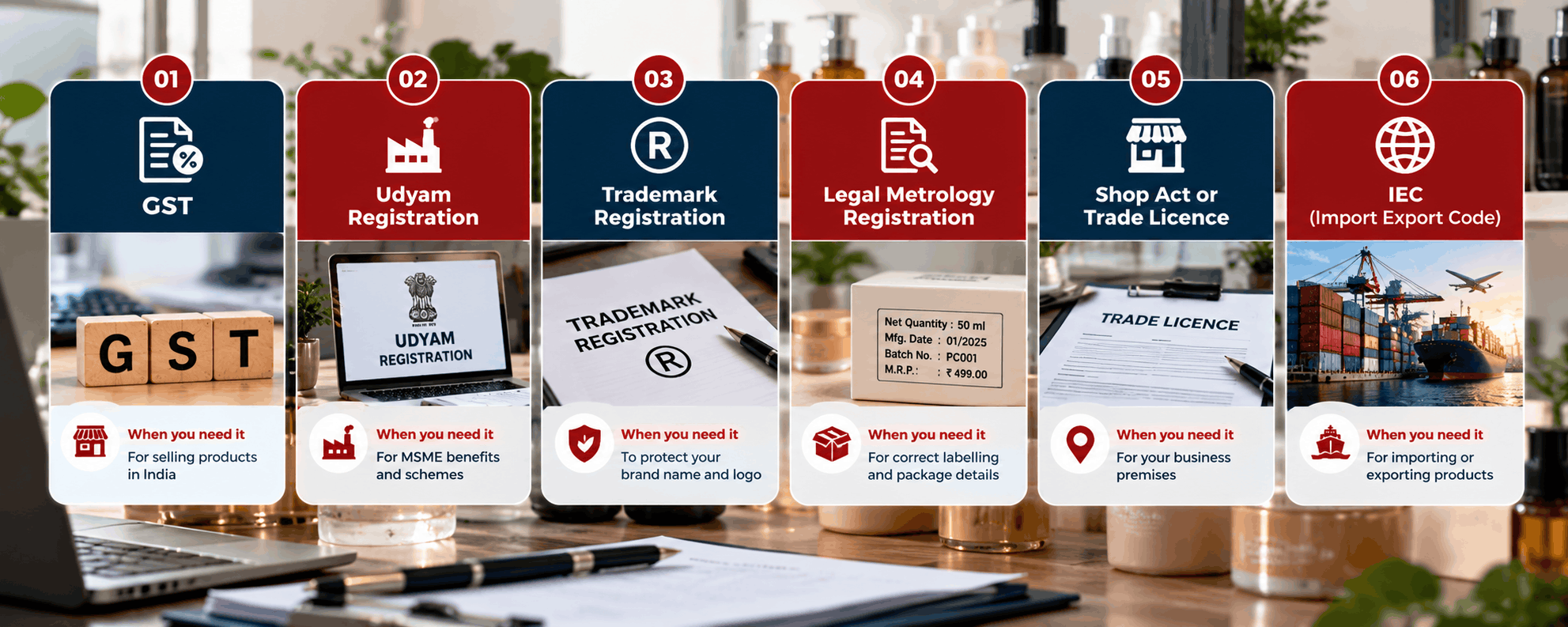
Personal care brand registration involves several separate filings. Use this checklist:
-
GST registration: Requirements depend on turnover and the type of supply. Our GSTIN guide explains the format and checks. Registered brands also need regular GST filing.
-
Udyam registration: This gives you MSME recognition for lender and scheme purposes. You apply on the Udyam portal.
-
Startup India registration: Eligible brands can apply for DPIIT recognition. Our guide on startup tax exemption explains one benefit.
-
Legal Metrology registration: Manufacturers, packers and importers of packaged goods register under Rule 27 of the Legal Metrology (Packaged Commodities) Rules, 2011. Read our LMPC certificate guide and the Legal Metrology overview.
-
Shop Act licence or trade licence: You may need one for an office, store or warehouse.
-
IEC code: Needed for imports and exports.
-
Staff compliance: Once you hire, check PF registration, ESI filing and our labour law compliance service.
A bookkeeper helps from day one. Our accounting services for small businesses keep your records ready for GST and audits.
How Is GST Charged on Personal Care Products?
The GST Council cut rates on several everyday items with effect from 22 September 2025. Rates differ by product, and classification depends on the HSN code. This table shows the commonly cited split, based on a Khaitan & Co review of the changes.
|
Product |
GST rate |
|
Hair oil |
5% |
|
Shampoo |
5% |
|
Toilet soap bars |
5% |
|
Face cream and moisturiser |
18% |
|
Sunscreen |
18% |
|
Serum |
18% |
|
Lip balm |
18% |
|
Hair conditioner |
18% |
|
Body wash and liquid soap |
18% |
Confirm the HSN-wise rate before you invoice, since rates can change. Gift sets need extra care. A kit that mixes a 5% item and an 18% item can fall under composite or mixed supply rules. Run your numbers with our GST calculator.
How Do You Protect Your Brand Name, Logo and Packaging?
Register your brand name as a trademark. Personal care brands usually look at three classes. Class 3 covers non-medicated cosmetics, soaps and perfumery. Class 5 covers medicated products. Class 35 covers retail services, including an online store. Our trademark classes list and trademark class search help you pick.
Start with a clearance search. A refused or opposed name can force a rebrand after you have printed your packs. Our expert trademark review checks your name before you file, and trademark registration takes it through the IP India process. Use the ™ symbol while your application is pending. Use ® only after the Registry registers the mark.
Other tools help too:
-
Logo designing gives you an original mark to register.
-
Design registration can protect a distinctive bottle or pack shape.
-
Copyright registration covers label artwork.
-
Our types of intellectual property guide shows how they fit together.
Once you own a mark, read about trademark protection, what a trademark certificate proves and how to act on a trademark infringement. DPIIT-recognised startups can also look at IP reimbursement schemes.
What Must Go on a Personal Care Product Label?
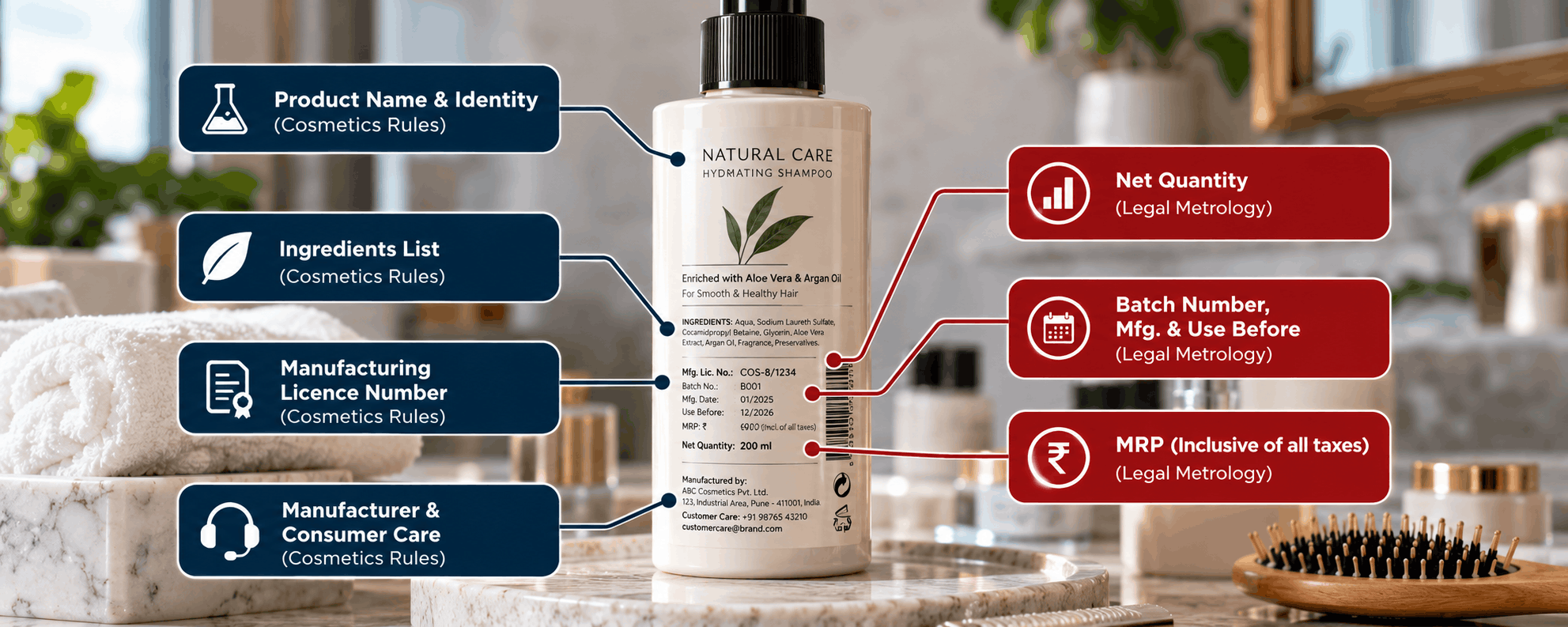
Two sets of rules shape your label. Rule 34 of the Cosmetics Rules covers cosmetic details. The Legal Metrology (Packaged Commodities) Rules, 2011 cover trade details.
Under the Cosmetics Rules:
-
Product name
-
Manufacturer's name and full address of the manufacturing site
-
Batch number
-
Manufacturing licence number, usually preceded by "M." or "M.L. No."
-
"Use before" date or expiry date
-
Directions for use and precautions
-
Ingredient list, with warnings for ingredients that need caution
Under Legal Metrology:
-
Net quantity in metric units
-
Month and year of manufacture, packing or import
-
MRP inclusive of all taxes
-
Consumer care details (a contact person's name, address, phone and email)
-
Country of origin for imported goods
-
Declarations in Hindi (Devanagari) or English
The 2025 amendment clarified what "use before" and "expiry date" mean. Confirm the date format with your manufacturer against the amended rule. Hair dyes carry special warnings, so check the Rules for your category.
One more tip. Online listings need the declarations too. The Ministry of Consumer Affairs' FAQs on e-commerce say sellers must show the mandatory declarations on the platform, except the manufacturing month and year.
Which Quality Standards and Ingredient Rules Apply?
GMP is mandatory. The Seventh Schedule sets the conditions, and you file a self-declaration in Form COS-7. Our GMP certification page explains the basics.
BIS standards apply to covered categories. The Ninth Schedule lists 37 BIS standards, with examples such as hair oils, shampoos, hair creams, hair dyes and toilet soaps. Covered products must meet the matching standard before manufacture or import. Read our BIS certification guide for background. Reports say the government is considering a wider BIS quality control order for cosmetics. Check the current position before you launch.
ISO and other certificates are optional. ISO 22716 is the cosmetics GMP standard, and ISO 9001 covers quality management. Organic certification and halal certification can add trust with some buyers.
Ingredients and testing have limits. India prohibits certain substances, including mercury compounds and hexachlorophene, and bans testing cosmetics on animals. Licensees must also keep batch records for raw materials and finished goods.
How Much Does It Cost to Start a Personal Care Business?
Your total depends on your route, your range and your state. Use this budget checklist:
-
Entity registration, which varies by structure
-
Cosmetic licence fee (₹10,000 for up to ten items per category, plus ₹500 per additional item)
-
Product testing and BIS compliance where your category is covered
-
Label design and printing
-
Trademark filing, charged per class
-
GST, accounting and filing
-
Premises costs, or advance payments to a contract manufacturer
Ask for an itemised quote from every adviser. It makes comparison simple.
For funding, a lender usually wants a project report. Our project report preparation service covers that. Then compare a business loan, a working capital loan and the Pradhan Mantri MUDRA Yojana loan. Our guide on CGTMSE vs MCGS-MSME helps if you need credit guarantee support.
What Happens If You Sell Without the Right Licence?
Selling without a licence can lead to seizure of stock, suspension or cancellation of your licence, and prosecution under the Drugs and Cosmetics Act, 1940. The 2025 amendment added Rule 31A, which sets the procedure for suspension or cancellation.
Distributors and marketplaces also ask to see your documents. A missing licence can stall your sales channel long before an inspector arrives. If a distributor delays payment later, our payment recovery under MSME service can help.
What Will Legal Babu Do for Your Personal Care Brand?
Legal Babu handles the paperwork so you can focus on the product. Our team will:
-
Review your product list and claims, then recommend an own licence, a loan licence or import registration
-
Register your company, LLP or proprietorship, and arrange GST, Udyam and Startup India registration
-
Prepare your documents, file your cosmetic licence application, coordinate with the licensing authority and follow up until approval
-
Prepare you for inspection and support renewals and post-licence compliance
-
Search, file and protect your trademark, and design your logo
-
Guide you on GMP, ISO 22716, BIS and LMPC requirements
-
Vet contract manufacturers through vendor assessment
-
Take over GST filing, accounting and ongoing compliance
-
Prepare a project report and guide you on loans
Browse our registration services or business advisory services, or talk to our team for a free consultation.
FAQS
FAQs About Personal Care Business
-
Can I start a personal care business from home in India?
You can run the business side from home. That covers planning, branding, orders and customer care. Production is the hard part. Your premises must meet the GMP conditions in the Cosmetics Rules, and the licensing authority can inspect them. A common workaround is the loan licence route, where a licensed contract manufacturer produces your batches. Also check whether your landlord or housing society allows business use before you register the address.
- Can I sell handmade soap or skincare on Instagram without a licence?
- Should I register my company first or apply for the cosmetic licence first?
- Can I sell herbal or Ayurvedic personal care products under a cosmetic licence?
- Can I trademark a name like
- Do I need lab test reports before I launch?
- Can I sell my products on Amazon or Flipkart as a new brand?
- Can I export personal care products from India?
- Can an NRI or foreign national start a personal care business in India?
- How long does it take to launch a personal care brand legally?


