
Business advisory services for startups give founders year-round guidance on legal, tax, HR, sales, IT, operations and strategy. LegalBabu assigns one relationship manager who learns your business and brings in the right specialist when a question needs one. You ask early, get a clear answer, and avoid penalties and lost deals.
Most founders start with a CA for taxes, a lawyer for contracts and a friend for HR questions. Each person knows one slice of the business. Nobody sees the whole picture. This page shows what LegalBabu's yearly advisory covers, who handles your questions and how the year runs.
What Are Business Advisory Services for Startups?
Business advisory services give a founder steady access to experts across every function a young company must run at once. Think of it as a standing conversation instead of a single filing. You bring a question. An adviser answers it or finds the person who can.
LegalBabu's yearly service works this way. It covers seven areas. One relationship manager ties them together. It sits beside LegalBabu's wider consulting and advisory services, such as CFO services, due diligence and labour law compliance.
The need is real. The Press Information Bureau reports that 2,12,283 entities held DPIIT startup recognition on 31 January 2026. Each one faces the same mix of tax, legal and hiring choices.
What Are the Benefits of Business Advisory Services?
Business advisory services give founders more than answers to individual questions. They provide a structured way to make financial, operational and strategic decisions with the right expertise available when needed.
For a growing business, the benefits include:
-
Better financial decision-making: Advisory support helps you review cash flow, budgets, costs, funding requirements and financial risks before making major decisions.
-
Clearer growth planning: An adviser can help assess expansion plans, new products, new markets and the resources required to support growth.
-
Access to finance expertise: Startups can get guidance on financial planning, funding requirements, business projections and investor-related preparation without immediately hiring a full-time finance team.
-
Support for acquisitions: If you plan to acquire another business, advisory support can help coordinate financial analysis, due diligence, valuation, legal review and transaction planning.
-
Investment advisory support: When evaluating an investment opportunity or preparing for an investment round, advisers can help review the financial and commercial aspects of the decision and identify information that needs further analysis.
-
Reduced decision-making gaps: A relationship manager connects legal, tax, HR, finance and business strategy instead of treating each issue as a separate problem.
-
Early identification of risks: Regular reviews can identify compliance, financial, contractual and operational issues before they become expensive problems.
-
Better use of specialist expertise: You do not need to know which specialist to approach for every issue. Your relationship manager can route the question to the appropriate team.
The biggest advantage is coordination. A financing decision can affect tax, ownership, contracts and cash flow. An acquisition can involve valuation, due diligence, legal documentation and integration planning. An investment decision can require financial analysis alongside commercial and legal review. Business advisory services bring these connected issues into the same decision-making process.
Why Do Startups Need Annual Advisory Instead of One-Off Help?
Rules change while you build. Three changes from the past year show how fast.
-
Labour law. The four Labour Codes came into force on 21 November 2025 and replaced 29 central labour laws, the Government of India announced.
-
Startup recognition. DPIIT revised the startup definition in February 2026. The turnover limit rose from ₹100 crore to ₹200 crore. The 10-year age limit stayed. LegalBabu's guide to the new startup recognition and deep tech rules has the details.
-
Data protection. The DPDP Rules were notified on 14 November 2025. Main business duties were set to start after 18 months, around May 2027. Dates can still shift, so treat that one as a planning marker.
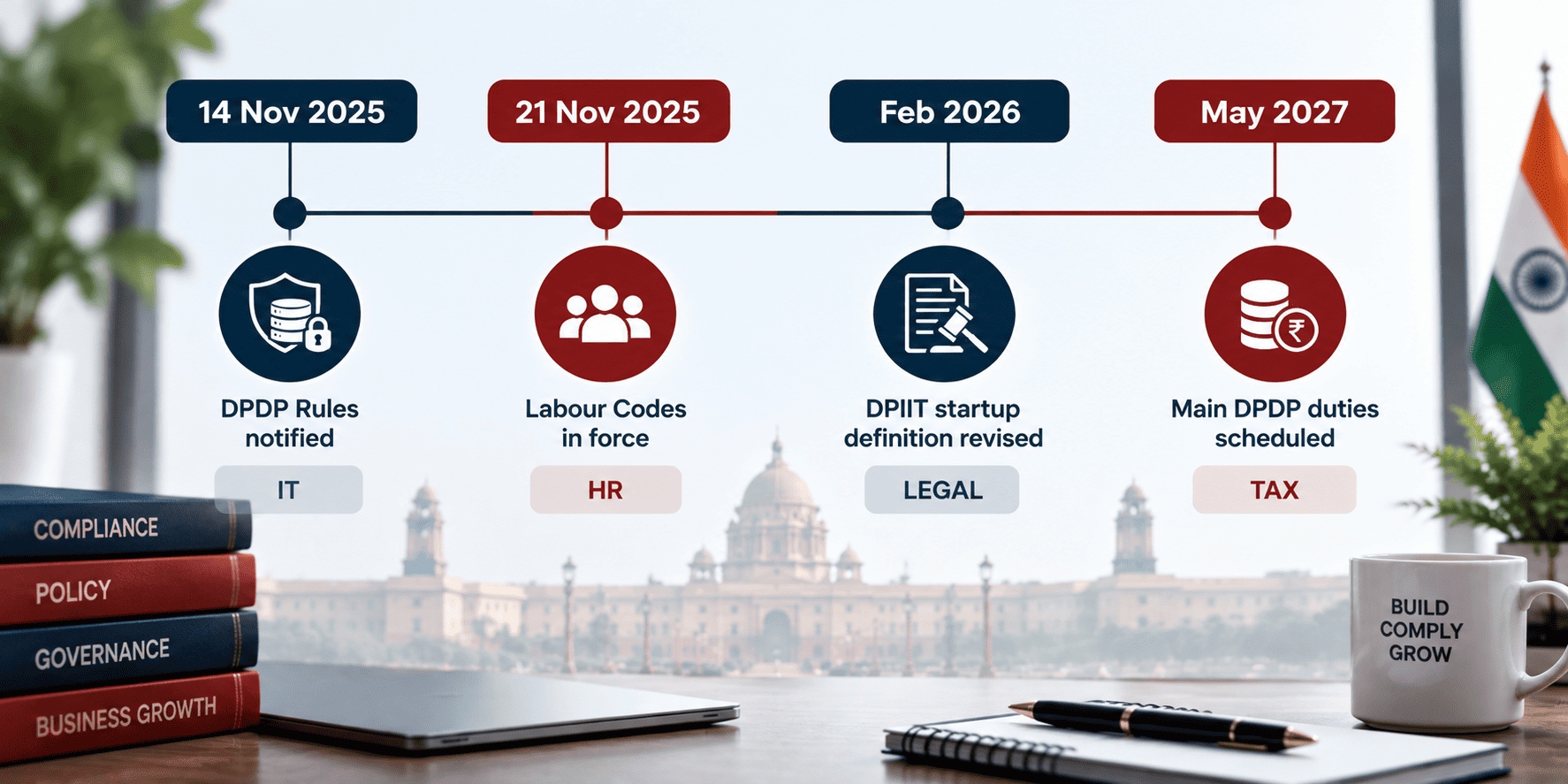
Each change lands on a different desk. HR, tax, legal and IT all feel something. A one-time consult answers the question you had that day. It cannot warn you about the next change. A yearly service keeps someone watching the whole board.
In practice, small problems start as small questions nobody asked. A founder signs a contract without a review. Someone hires without a written employment document. A filing slips because no one owns the calendar.
Take a first hire. One offer letter touches employment papers, payroll tax, HR policy and, in many cases, PF registration. That is four functions in one decision. A relationship manager sees all four at once.
What Does LegalBabu Cover in Its Annual Business Advisory Service?
LegalBabu builds the service around seven areas. The table shows the question you might bring and what LegalBabu does with it.
|
Advisory area |
Typical founder question |
What LegalBabu does |
|
Legal and Compliance |
"Can I sign this contract as it is?" |
Reviews contracts, explains regulatory requirements, licences and corporate compliance, and answers legal queries |
|
Taxation and Finance |
"Which GST or TDS step am I missing?" |
Guides you on GST, income tax and TDS, coordinates accounting and gives tax advice |
|
Finance Advisory |
“How much funding do we need?” |
Supports financial planning, cash-flow review, projections, funding requirements and coordination with finance specialists |
|
Acquisition Advisory |
“Should we acquire this business?” |
Coordinates due diligence, valuation, financial analysis, legal review and transaction support |
|
Investment Advisory |
“Should we invest in this opportunity?” |
Helps review financial and commercial information, risks, valuation and the areas requiring specialist analysis |
|
HR and Labour |
"What belongs in an employment letter?" |
Supports employment documents, HR policies and labour-law compliance |
|
Sales and Marketing |
"Why is my pipeline flat?" |
Reviews your sales process, marketing plan and performance with you |
|
IT and Technology |
"Which tool should we buy?" |
Advises on technology processes, software selection, data security and IT efficiency |
|
Operations |
"Where do we lose time?" |
Reviews workflows and vendors and suggests process improvements |
|
Business Strategy |
"Should we expand this year?" |
Reviews challenges, expansion plans, risks and opportunities on a periodic basis |

How Does Each Advisory Area Work in Practice?
How does LegalBabu handle legal and compliance questions?
Bring the contract before you sign it. LegalBabu reviews it and explains what it means for your business. The team also tells you which rules and licences apply to you and keeps company filings on a calendar.
Here is an early example. A new company with share capital must file a start-of-business declaration (Form INC-20A) within 180 days of incorporation. Miss it and the company faces a ₹50,000 penalty. Each officer in default can face ₹1,000 a day, capped at ₹1 lakh. A manager who knows your incorporation date can flag it early. The same goes for your yearly ROC annual return.
How does LegalBabu support taxation and finance?
LegalBabu guides you on GST, income tax and TDS. It also works with whoever keeps your books. If you already have an accountant, your manager works beside them.
Ask tax questions before you price a product or agree a vendor deal. A GST or TDS issue found after the invoice costs more to fix than one found before it. LegalBabu's GST filing, TDS filing and income tax filing pages show what each return needs. The TDS rate chart helps you check deduction rates.
How does LegalBabu help with HR and labour matters?
This area covers employment papers, HR policies and labour-law rules. Since the new Labour Codes took effect, old templates may need a fresh look.
Check one thing first. The Labour Codes use a single, wider meaning of wages. That changes how gratuity and some other benefits are worked out. Compare your salary structure and offer letter template against it. LegalBabu's labour law compliance service goes deeper. The ESI filing and professional tax filing pages cover two payroll filings founders meet early.
How does LegalBabu review sales and marketing?
LegalBabu sits down with you to review your sales process, your marketing plan and the numbers behind both. You get a clear read on what brings customers in and what slows them down.
Bring three numbers to the first review: leads per month, leads that turn into buyers, and the cost of winning one customer. Rough figures work. They give the talk something solid to build on.
How does LegalBabu help with IT and technology?
Founders pick tools fast. Few check what each tool does with customer data. LegalBabu helps you compare software, tidy up tech processes and think through data safety. That matters more now that the DPDP Rules are in place.
Start with a list of every tool that stores customer data: your CRM, payment gateway, email platform and cloud storage. That one list is the first step of any data plan. When you want a formal check later, LegalBabu also offers a cyber security audit and ISO 27001 certification.
How does LegalBabu improve operations?
Here LegalBabu looks at how work moves through your company: your processes, your vendors and your daily routines. Pick one workflow that keeps causing delays, such as order fulfilment or client onboarding. Map it step by step with your manager.
Then ask which step depends on a single person or a single vendor. That step is your weak point. LegalBabu's vendor assessment service helps when you want to check a supplier more closely.
The strategy review happens on a regular basis. You look at your current challenges, expansion plans, risks and chances. Your manager brings in what the other six areas have found, so the talk rests on facts from your own records.
Planning a bigger move, such as a new product line or an investor round? LegalBabu can link you with its teams for project report preparation, a valuation report or merger and acquisition services. Before any big move, write the three biggest risks on one page. Legal, tax and HR each tend to add one.
How Can Business Advisory Services Support Finance, Acquisitions and Investments?
As a startup grows, financial and strategic decisions become more complex. A founder may need to raise capital, evaluate an acquisition, invest in another business or decide whether a major expansion is financially viable. These decisions often involve several areas of expertise at the same time.
Finance Advisory
Finance advisory helps you understand the financial position of the business before making important decisions. This can include reviewing cash flow, budgets, financial projections, funding requirements, costs and financial risks.
For example, before taking on external funding, you may need to understand how much capital the business actually requires, how the funds will be used and what the expected financial position will look like after the investment. LegalBabu can coordinate finance-related support with its accounting and virtual CFO services where deeper financial management is required.
Acquisition Advisory
If you are planning to acquire another company or business, the decision should not be based only on its purchase price. You need to examine its financial records, liabilities, contracts, ownership, compliance position and other risks.
Business advisory support can connect the acquisition process with due diligence, valuation, financial analysis and legal review. LegalBabu also provides merger and acquisition services for businesses that need specialist support during a transaction.
This helps the founder understand what is being acquired, which risks need attention and what additional professional review may be required before proceeding.
Investment Advisory
Investment decisions also require more than looking at potential returns. Before investing in another business, project or opportunity, you may need to examine the financial position, commercial assumptions, risks, valuation and supporting documents.
Investment advisory can help structure this review and identify areas that require deeper financial, legal or commercial analysis. For startups preparing to receive investment, the same approach can be used from the opposite side: reviewing company records, financial information, contracts and ownership documents before investors conduct their own due diligence.
For larger transactions, LegalBabu can connect business advisory with transaction advisory services, valuation reports and due diligence.
The value of this approach is coordination. Finance, acquisition and investment decisions can affect taxation, ownership, contracts, compliance and operations. Reviewing these areas together gives the founder a clearer picture before committing to a major transaction.
Who Is the LegalBabu Relationship Manager, and What Do They Do?
Your relationship manager is the single point of contact for your startup. They learn how your business earns money, who is on your team and where you want to be in a year. When a question needs deeper skill, they work with the right LegalBabu specialist.
Here is what that gives you:
-
One person to call or write to for any business question
-
A working grasp of your business, so you skip the re-explaining
-
Specialists in legal, tax, HR and other areas, brought in behind the scenes when needed
A manager works with what you tell them. If a founder shares a problem after the deadline, the options shrink. Share early, even when you doubt a matter is important.
How Does the Annual Advisory Engagement Work?
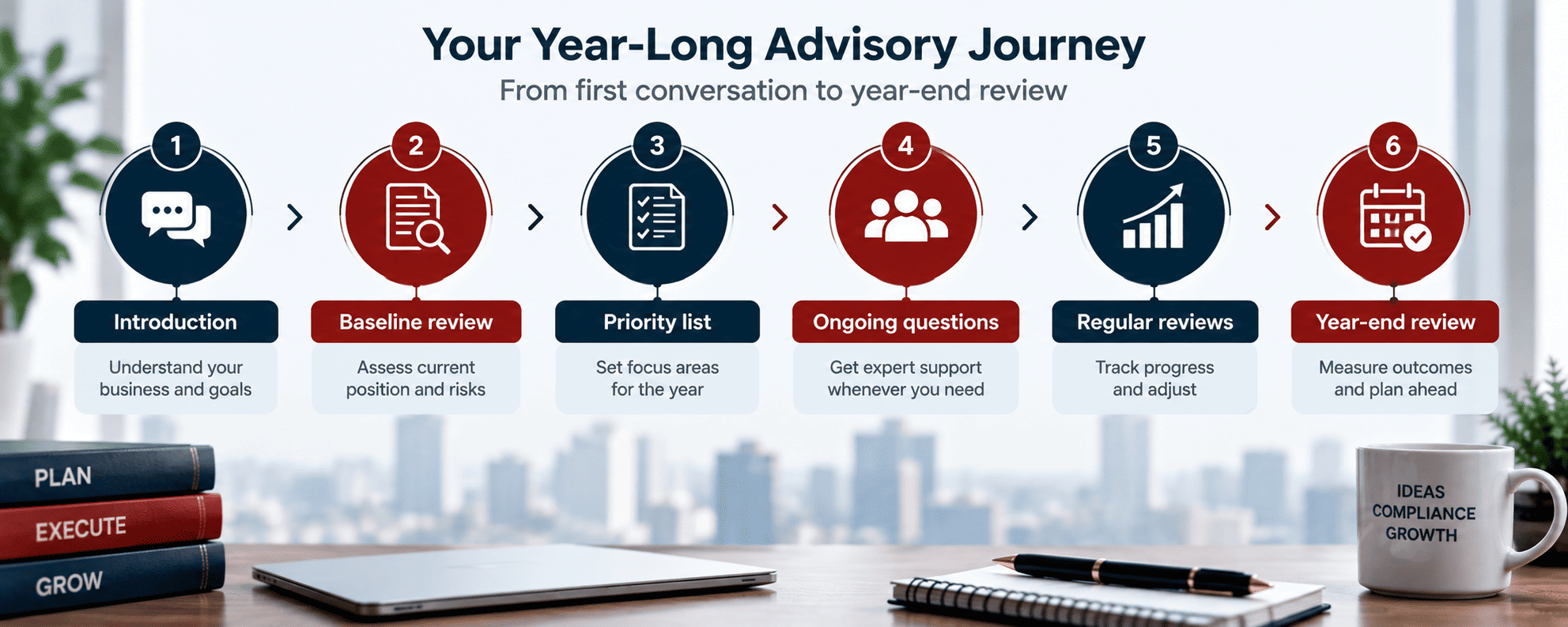
The year follows six steps. Your manager agrees the review schedule with you.
-
Introductory chat. Your manager learns your business model, team, stage and goals.
-
Baseline review. You share basics such as incorporation papers, registrations, key contracts and recent filings. LegalBabu reads them across the seven areas.
-
Priority list. You get a short list of what needs attention now and what can wait.
-
Ongoing questions. You send questions as they come up. Your manager answers them or brings in the right specialist.
-
Regular reviews. You and your manager talk through sales, operations and strategy on a set schedule. Risks and new chances come up there.
-
Year-end review. You look back at what changed, what stayed open and what to plan for next year.
Which Startups Benefit Most From Annual Business Advisory Services?
Any startup without in-house legal, finance or HR staff can use it. Some cases fit best. Tick the ones that sound like you:
-
You have no in-house lawyer, accountant or HR lead
-
You are about to make your first hire or your next batch of hires
-
You plan to raise funds in the next year
-
You plan to apply for DPIIT recognition through Startup India registration
-
Your contracts, licences and filings sit in different folders or with different people
-
You plan to add a product line, a city or a state
-
Several advisers help you, and they never talk to each other
Three or more ticks mean one coordinator will save you time. One honest limit: a solo founder with no product live and no staff may not need all seven areas yet. Company registration (private limited or LLP) and basic tax setup can come first. Advisory pays off once decisions start to pile up. Still choosing a structure? Read LegalBabu's comparison of a private limited company and a sole proprietorship.
How Is Annual Advisory Different From Hiring a CA, a Lawyer or a Virtual CFO?
A CA, a lawyer and a virtual CFO each go deep in one field. Annual advisory ties the fields together. The table shows the gap.
|
Feature |
Separate professionals |
Full-time hires |
LegalBabu annual advisory |
|
Coverage |
One field each |
One or two fields |
Seven areas |
|
Who coordinates |
You |
You or the hire |
Your relationship manager |
|
Business context |
Rebuilt for each expert |
Deep but narrow |
Built once, used across areas |
|
A new question arrives |
You search for the right expert |
Depends on the hire's field |
Your manager routes it to the right specialist |
Advisory works next to specialists, not in place of them. If you need daily bookkeeping, LegalBabu's accounting services handle it. If you need finance leadership, look at virtual CFO services.
What Should You Prepare Before the First Call?
Gather these and the first talk moves fast:
-
Certificate of incorporation, PAN and TAN details
-
GST registration details, if you have them
-
Copies of key contracts with customers, vendors and co-founders
-
A list of team members with roles and pay structure
-
Licences and registrations you hold or plan to get
-
Your last filed tax and ROC returns
-
Any open government notices
-
Your top three worries
The last item matters most. A short list of worries gives your manager a better starting point than any folder of papers.
When Should a Startup Start Annual Business Advisory?
Early is easier. Right after incorporation gives you a clean baseline. Even so, the best trigger is a decision, not a date. Think of the first hire, the first big contract, the first investor talk or the first move into a new state.
Filings also run on separate clocks. GST returns, TDS returns, ROC filings, income tax returns and labour filings each follow their own schedule. One missed filing rarely hurts. The trouble starts when small misses pile up. A manager who sees all the clocks together can keep them in order.
FAQS
Have questions about Business Advisory Services?
We have you covered:
-
Do I need DPIIT recognition to use annual business advisory services?
No. You can use this service without it. Recognition is a separate, optional step that opens access to government schemes. It also leads to the startup tax holiday. Per the PIB, eligible startups get a 100?duction on profits for any three consecutive years within ten years of incorporation. Conditions apply. The Inter-Ministerial Board must certify the startup, and it must be incorporated by 31 March 2030.
- Do I have to replace my existing CA or accountant?
- What should my startup do now to prepare for the DPDP Rules?
- What documents do investors ask for, and can my manager help me prepare?
- What happens if my startup needs a licence or registration?
- What should I do if a government notice arrives mid-year?
- Can my relationship manager help with trademark and brand protection?
- How much do annual business advisory services cost?
- How do I get the most out of my relationship manager?
- Can annual advisory help me plan expansion into a new state?


