
Table of Content
- What is Revival of a Company?
- Why are Companies Struck off and Why is Their Revival Important?
- What is the Difference Between Revival and New Company Registration?
- What are the Legal Provisions Governing Revival of Struck-off Company?
- Who can Apply for Revival of a Company?
- When Should You Opt for Revival Instead of New Registration?
- What is the Step-by-Step Process for Revival of Strike-off Company?
- What are the Post-Revival Compliance Requirement?
- What are the Documents Required for Revival of Strike-off Company?
- What is the Role of NCLT in Revival of a Company?
- What is the Time Limit for Filing Revival Application?
- What is the Cost of Revival of a Company?
- What are the Key Challenges in Revival of a Strike-off Company?
- How Legal Babu Can Help you in Revival of Your Company?
What is Revival of a Company?
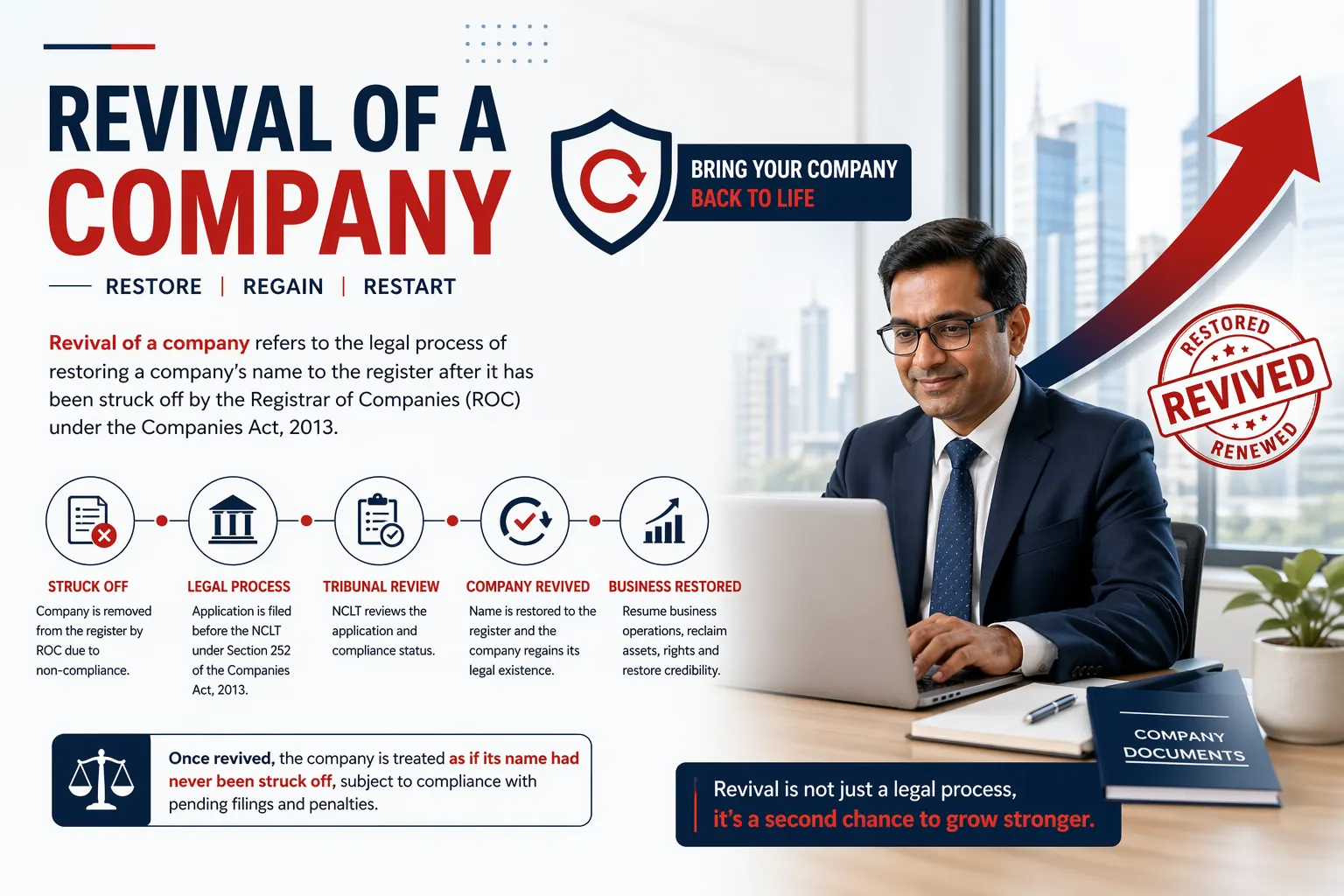
Revival of a company refers to the legal process of restoring a company’s name to the register after it has been struck off by the Registrar of Companies (ROC) under the Companies Act, 2013. When a company is struck off, usually due to non-compliance, such as failure to file annual returns or financial statements, it ceases to exist as a legal entity. Through revival, the company can regain its legal status, allowing it to resume business operations and reclaim its assets and rights. This process is carried out by filing an application before the National Company Law Tribunal (NCLT) under Section 252 of the Act. Once revived, the company is treated as if its name had never been struck off, subject to compliance with pending filings and penalties.
Why are Companies Struck off and Why is Their Revival Important?
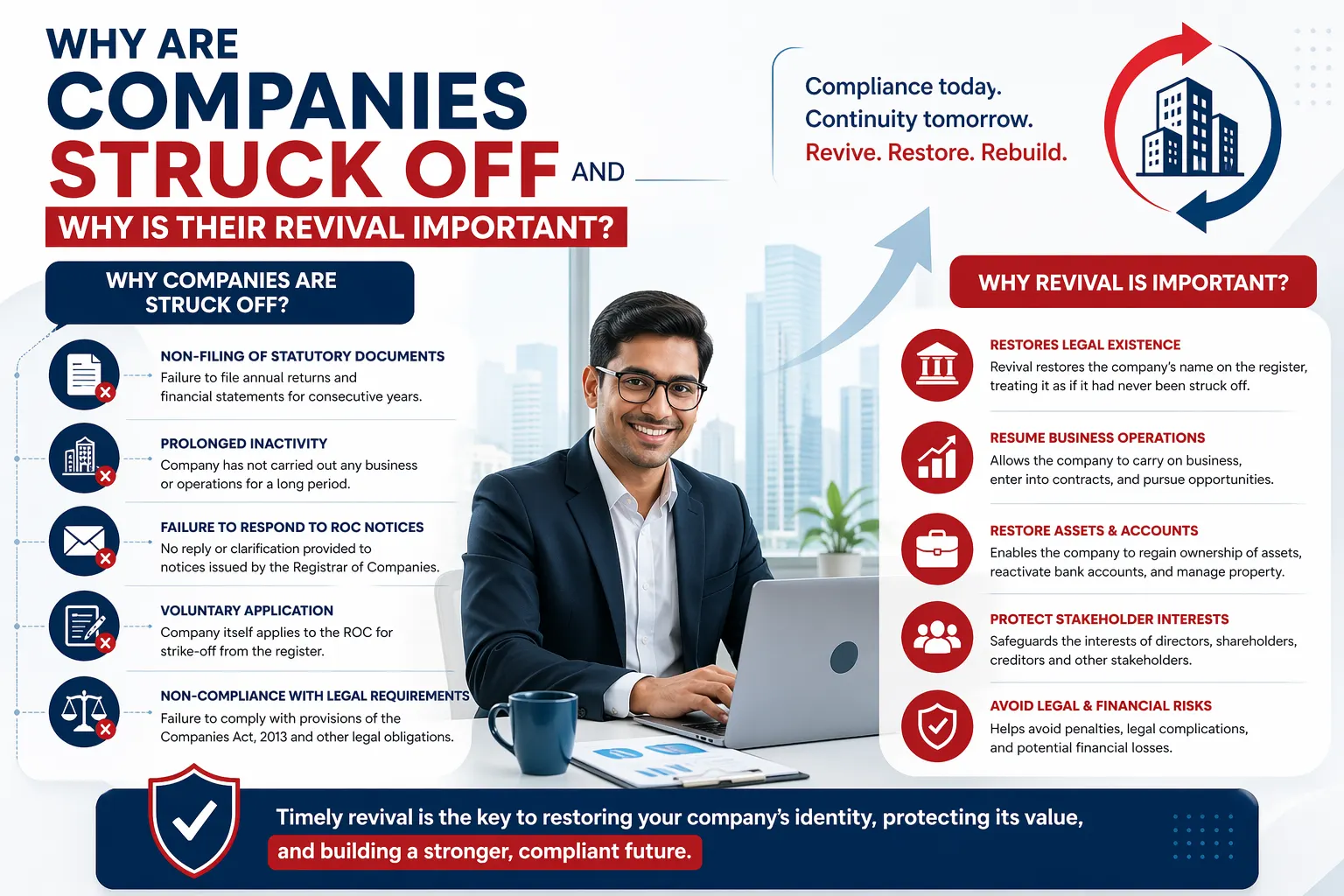
Companies are struck off from the register by the Registrar of Companies (ROC) under the Companies Act, 2013 when they fail to comply with statutory requirements or cease business operations. Common reasons include non-filing of annual returns and financial statements for consecutive years, prolonged inactivity, failure to respond to ROC notices, or voluntary applications for strike-off by the company itself. Such non-compliance signals that the company is either defunct or not maintaining proper legal and financial discipline, prompting the ROC to remove its name from the official records.
The revival of a struck-off company becomes important because strike-off leads to the loss of the company’s legal existence, meaning it cannot carry out business, own assets, or enforce legal rights. Through revival, the company regains its legal status as if it had never been struck off, allowing it to resume operations and restore ownership of its assets and bank accounts. It is also crucial for protecting the interests of directors, shareholders, and creditors, especially where the company has ongoing business, liabilities, or valuable assets. Timely revival helps avoid further legal complications, penalties, and potential financial losses.
What is the Difference Between Revival and New Company Registration?
Revival restores a struck-off company to its original legal status, while new company registration creates an entirely new legal entity. Revival is preferred when the existing company has assets, liabilities, or brand value that must be preserved.
|
Basis |
Revival of Company |
New Company Registration |
|
Legal Status |
Restores the same company that was previously struck off by ROC |
Creates a completely new company with fresh legal existence |
|
Identity |
Retains original CIN, company name, and complete historical records |
Generates new CIN, name approval, and independent company identity |
|
Assets & Liabilities |
Existing assets and liabilities continue under the same revived entity |
Assets and liabilities must be legally transferred to the new company |
|
Time |
Time-consuming due to NCLT proceedings and regulatory approvals involved |
Faster process with simple online incorporation through MCA portal |
|
Compliance |
Requires filing of all pending returns with additional penalties and fees |
Only initial compliance required after incorporation; no past filings involved |
|
Cost |
Higher cost due to penalties, legal expenses, and professional fees |
Lower cost as it involves standard registration and minimal compliance fees |
What are the Legal Provisions Governing Revival of Struck-off Company?
The revival of a struck-off company in India is primarily governed by the provisions of the Companies Act, 2013, which outlines the following legal framework for both striking off and restoration of companies:
|
Section 248 |
This section deals with the power of the Registrar of Companies (ROC) to strike off the name of a company from the register if it fails to commence business or does not carry on any business for a prescribed period, or defaults in statutory compliances. |
|
Section 252 |
This is the most important provision for revival. It allows an aggrieved party—such as the company, its members, creditors, or workmen—to file an application before the National Company Law Tribunal (NCLT) for restoration of the company’s name. The Tribunal may order revival if it is satisfied that the company was carrying on business or it is otherwise just to restore it. |
|
Section 250 |
This section explains the effect of strike-off, stating that the company ceases to operate except for limited purposes such as realising dues or discharging liabilities. |
Additionally, procedural aspects are governed by the Companies (Removal of Names of Companies from the Register of Companies) Rules, 2016, which prescribe forms, timelines, and compliance requirements for both strike-off and revival processes.
Who can Apply for Revival of a Company?
Under Section 252 of the Companies Act, 2013, the following persons can apply for revival of a company before the National Company Law Tribunal (NCLT):
- The Company
- Members (Shareholders)
- Creditors
- Workmen (Employees)
- Registrar of Companies (ROC)
When Should You Opt for Revival Instead of New Registration?
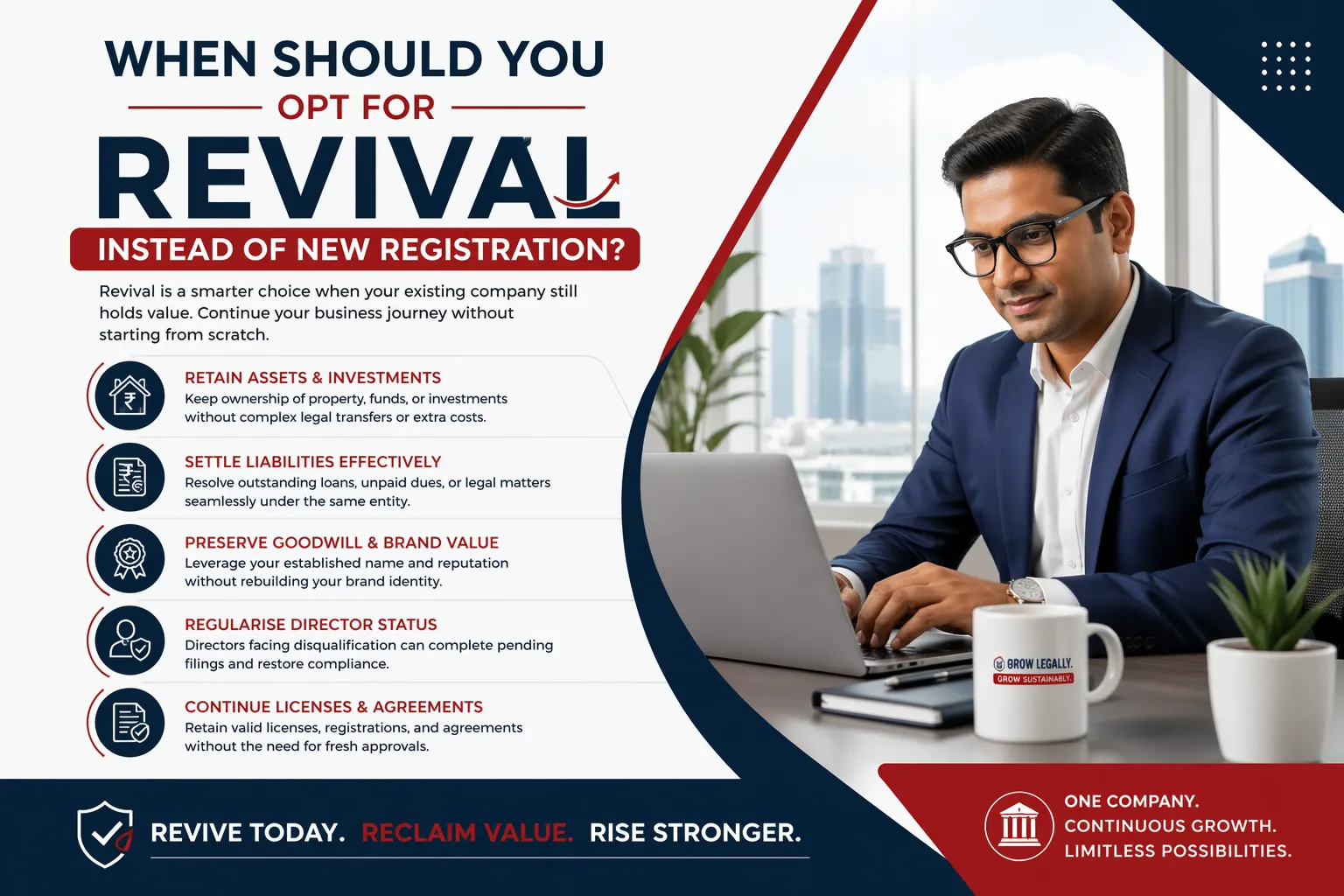
Revival is a better option than starting a new company when your old company still has value or importance. It helps you continue the same business without starting everything from the beginning. You should opt for revival in the following cases:
- If the company owns property, funds, or investments, revival helps retain ownership without the need for complex legal transfers or additional costs.
- If there are outstanding loans, unpaid dues, or ongoing legal matters, revival enables proper settlement under the same entity.
- If the company has an established name or goodwill in the market, revival helps you continue operations without rebuilding your brand identity.
- If directors are facing disqualification due to non-compliance, revival allows them to complete pending filings and regularise their status.
- If the company holds valid licenses, registrations, or agreements, revival ensures their continuity without the need for fresh approvals.
What is the Step-by-Step Process for Revival of Strike-off Company?
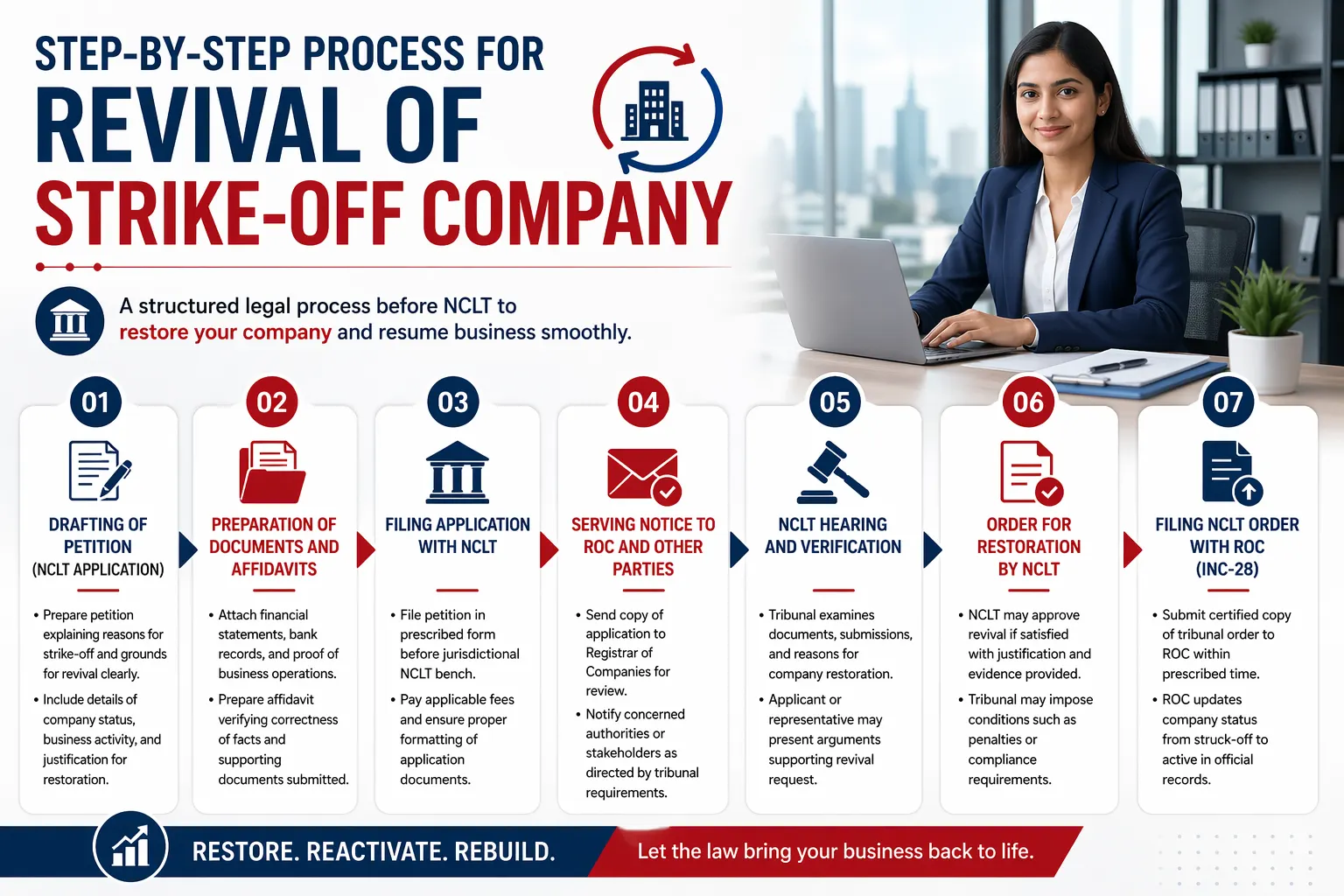
Here is the step-by-step process for revival of strike off company:
Step 1: Drafting of Petition (NCLT Application)
- Prepare petition explaining reasons for strike-off and grounds for revival clearly.
- Include details of company status, business activity, and justification for restoration.
Step 2: Preparation of Documents and Affidavits
- Attach financial statements, bank records, and proof of business operations.
- Prepare affidavit verifying correctness of facts and supporting documents submitted.
Step 3: Filing Application with NCLT
- File petition in prescribed form before jurisdictional NCLT bench.
- Pay applicable fees and ensure proper formatting of application documents.
Step 4: Serving Notice to ROC and Other Parties
- Send copy of application to Registrar of Companies for review.
- Notify concerned authorities or stakeholders as directed by tribunal requirements.
Step 5: NCLT Hearing and Verification
- Tribunal examines documents, submissions, and reasons for company restoration.
- Applicant or representative may present arguments supporting revival request.
Step 6: Order for Restoration by NCLT
- NCLT may approve revival if satisfied with justification and evidence provided.
- Tribunal may impose conditions such as penalties or compliance requirements.
Step 7: Filing NCLT Order with ROC (INC-28)
- Submit certified copy of tribunal order to ROC within prescribed time.
- ROC updates company status from struck-off to active in official records.
What are the Post-Revival Compliance Requirement?

After revival, a company must complete the following pending legal and regulatory requirements to remain compliant:
1. Filing of Pending Annual Returns and Financial Statements: The company must file all overdue returns such as financial statements and annual returns with the Registrar, along with applicable additional fees and penalties for delayed filings.
2. Payment of Penalties and Additional Fees: All penalties imposed by authorities, including late filing fees and tribunal-directed costs, must be cleared to regularize the company’s compliance status and avoid further legal consequences.
3. Updating Statutory Registers and Records: The company must update its statutory registers, including members, directors, and charges, ensuring all records are accurate, complete, and maintained as per legal requirements.
4. Regular Compliance with ROC Filings: After revival, the company must continue filing annual returns, financial statements, and other required forms on time to maintain active status and avoid future strike-off actions.
5. Restoration of Bank Accounts and Business Operations: The company should reactivate its bank accounts, resume business activities, and ensure all operational and financial transactions are properly recorded and compliant with regulations.
What are the Documents Required for Revival of Strike-off Company?
The following documents are required for the revival of strike-off companies:
- Certificate of Incorporation
- Memorandum of Association (MOA)
- Articles of Association (AOA)
- Financial Statements
- Income Tax Returns
- Bank Statements
- NCLT Petition (Form NCLT-9)
- Affidavit (Form NCLT-6)
- Board Resolution
- Proof of Business Activity
- Copy of Strike-Off Notice
- Identity & Address Proof of Directors
What is the Role of NCLT in Revival of a Company?
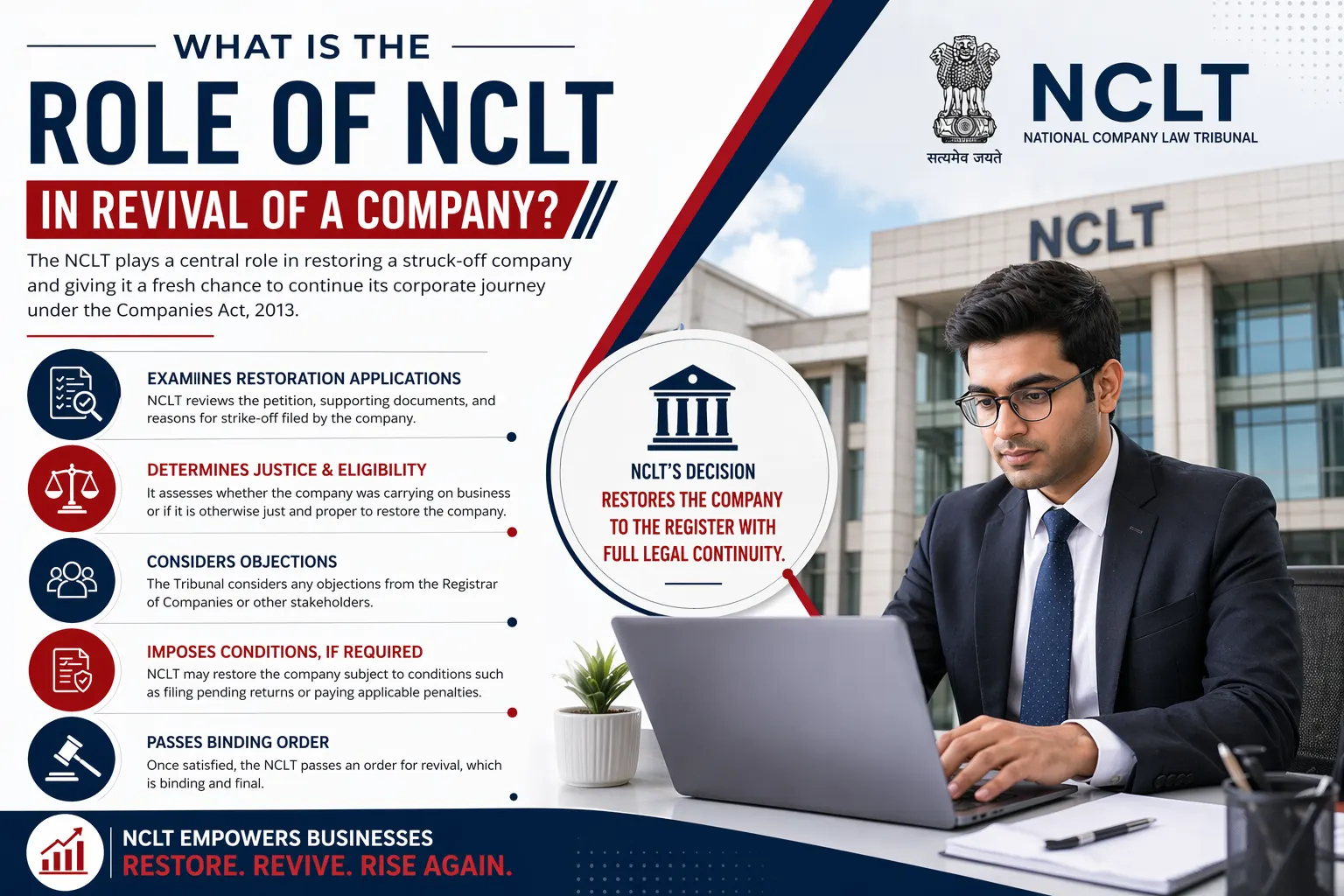
The National Company Law Tribunal (NCLT) plays a central role in the revival of a struck-off company under the Companies Act, 2013. It is the authority that examines applications filed for restoration of a company’s name after it has been removed by the Registrar of Companies. The NCLT reviews the petition, supporting documents, and reasons for strike-off to determine whether the company was carrying on business or if it is otherwise just to restore it. It also considers objections, if any, from the registrar or other stakeholders. If satisfied, the Tribunal may pass an order for revival, often subject to conditions such as filing pending returns or paying penalties. Its decision is binding, and upon approval, the company is restored to the register with legal continuity.
What is the Time Limit for Filing Revival Application?
The time limit for filing a revival application is governed by Section 252 of the Companies Act, 2013. An application can be filed within 3 years from the date of strike-off by the company, its members, or creditors. However, in certain cases, members, creditors, or workmen may apply for revival within 20 years from the date of publication of the strike-off notice, depending on the circumstances.
What is the Cost of Revival of a Company?
The applicant must file a certified copy of the NCLT order with the Registrar of Companies (ROC) within 30 days from the date of the order. A statutory fee of Rs. 1000 is required to be paid for filing the application for restoration of the company.
What are the Key Challenges in Revival of a Strike-off Company?
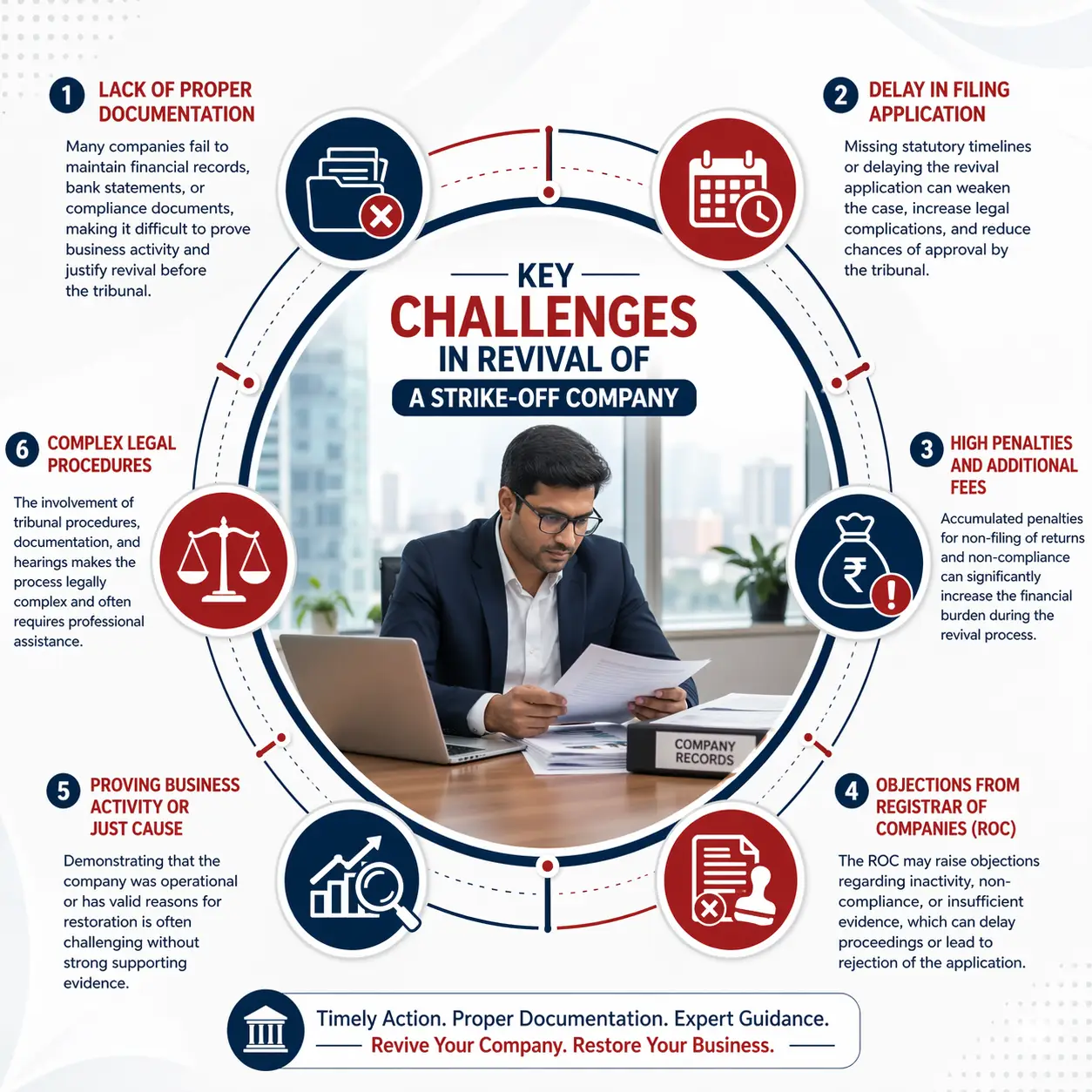
Here are the key challenges you may face while reviving a strike-off company:
1. Lack of Proper Documentation: Many companies fail to maintain financial records, bank statements, or compliance documents, making it difficult to prove business activity and justify revival before the tribunal.
2. Delay in Filing Application: Missing statutory timelines or delaying the revival application can weaken the case, increase legal complications, and reduce chances of approval by the tribunal.
3. High Penalties and Additional Fees: Accumulated penalties for non-filing of returns and non-compliance can significantly increase the financial burden during the revival process.
4. Objections from Registrar of Companies (ROC): The ROC may raise objections regarding inactivity, non-compliance, or insufficient evidence, which can delay proceedings or lead to rejection of the application.
5. Proving Business Activity or Just Cause: Demonstrating that the company was operational or has valid reasons for restoration is often challenging without strong supporting evidence.
6. Complex Legal Procedures: The involvement of tribunal procedures, documentation, and hearings makes the process legally complex and often requires professional assistance.
How Legal Babu Can Help you in Revival of Your Company?
We provide end-to-end assistance in the revival of your company, ensuring a smooth and hassle-free process. Our team of experts helps in preparing and filing the NCLT petition, drafting affidavits, and compiling all required documents accurately. We coordinate with the Registrar of Companies (ROC) and represent your case before the tribunal, ensuring timely follow-ups and compliance. We also assist you in completing post-revival filings, including pending returns and statutory requirements.
With our professional guidance, transparent pricing, and quick turnaround time, you can hassle-free revive your strike-off company and avoid unnecessary delays or legal complications.
FAQS
Have some questions about revival of a company?
We have got you covered:
-
Can a company be revived after voluntary strike-off?
Yes, a voluntarily struck-off company can be revived if valid reasons, assets, or liabilities justify restoration before the tribunal.
- Can revival application be rejected by NCLT?
- Can a dormant company be revived?
- Does revival restore GST registration automatically?
- Can multiple directors apply separately for revival?
- Can foreign shareholders apply for revival of a company?
- What happens to a company's PAN after a strike-off?
- Can a revival be filed online through the MCA portal?
- Does revival impact existing contracts signed before strike-off?
- Can revival help in reopening company bank accounts?


