
A business may need funds to buy machinery, maintain inventory, open a new location, recruit staff or manage delayed customer payments. The right Business Loan can support that requirement without disturbing ownership, but an unsuitable loan can create repayment pressure long before the investment begins producing returns.
There is no single approval rule for every Business Loan in India. Banks, non-banking financial companies and other eligible lenders use their own credit policies. The amount, rate, margin, collateral, tenure and documents depend on the applicant, the facility and the purpose. A new unit may be assessed through promoter experience, contribution and project viability. An operating business is more likely to be judged through bank transactions, tax returns, financial statements, repayment conduct and existing debt.
The first step is therefore not submitting an online form. It is defining why the money is required, how much is genuinely needed and which cash flow will repay it.
What is a Business Loan?
A business loan is credit used for a commercial purpose rather than personal consumption. It may be borrowed by a proprietorship, partnership firm, limited liability partnership, company, professional practice or another eligible business entity. Depending on the product, the lender may disburse a lump sum, provide a reusable credit limit or pay an equipment supplier directly.
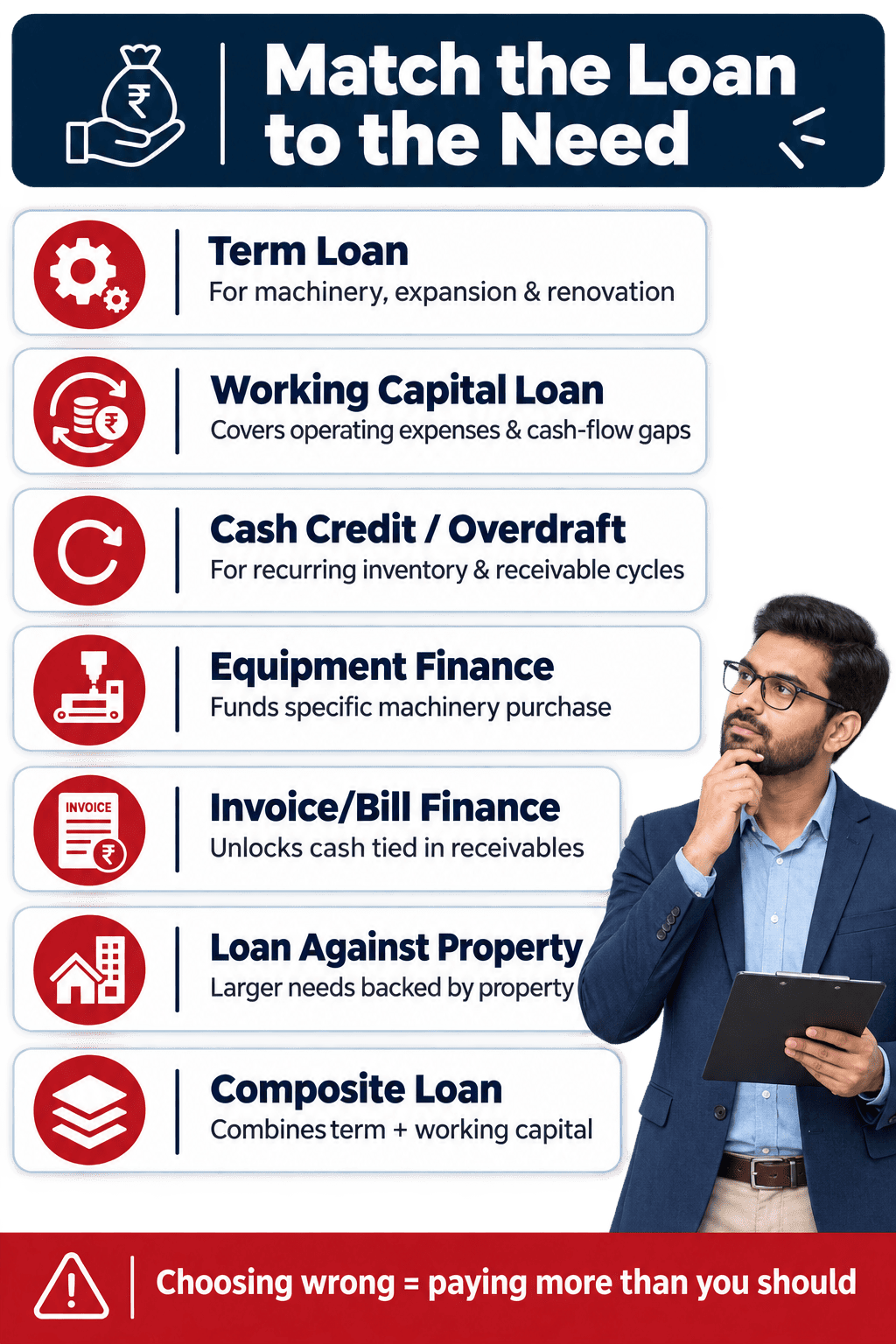
The funding structure should match the expenditure. A term loan is generally more suitable for an asset that will generate returns over several years. Cash credit or an overdraft may suit a recurring gap between supplier payments and customer collections. Invoice finance is linked to eligible receivables, while a loan against property can support a larger requirement backed by an acceptable property.
Borrowers should also distinguish primary security from collateral. Machinery purchased with loan funds may become primary security. A separate property offered in addition is collateral. A “collateral-free” facility does not cancel the debt or prevent a lender from seeking personal guarantees where permitted. The sanction letter and loan agreement-not an advertisement-determine the final obligation.
Which Type of Business Loan Should You Choose?
The purpose, operating cycle and useful life of the funded asset should guide the choice.
|
Facility |
Common use |
Typical repayment approach |
Security position |
|
Term loan |
Machinery, renovation, expansion or planned capital expenditure |
Scheduled instalments over an agreed tenure |
Secured or unsecured |
|
Working capital loan |
Wages, rent, stock and temporary operating shortages |
Product-specific instalments |
Secured or unsecured |
|
Cash credit or overdraft |
Recurring inventory and receivable cycles |
Interest usually applies to the utilised amount |
Often supported by stock, receivables or other security |
|
Equipment finance |
Identified commercial machinery or equipment |
Instalments linked to the asset and tenure |
Equipment commonly serves as primary security |
|
Invoice or bill finance |
Cash tied up in eligible unpaid invoices |
Adjusted when the receivable is collected |
Linked to invoices and buyer quality |
|
Loan against property |
Larger or longer business requirements |
Longer-term instalments |
Mortgage over eligible property |
|
Composite loan |
Term expenditure and working capital together |
Separate or combined components |
Depends on the lender and scheme |
Do not use a short, callable facility to finance a long-life asset unless cash flow can absorb the risk. Similarly, a long-tenure loan for a short inventory cycle may leave the business paying interest after the immediate requirement has ended.
Where lack of collateral is the main obstacle, a collateral-free loan under CGTMSE may be relevant for an eligible micro or small enterprise. The guarantee supports the lender; it is not a direct loan or a waiver of repayment.
Who Can Apply for a Business Loan in India?
Eligibility differs across lenders, but appraisal usually covers the following areas:
-
Legal identity: The applicant should have a clear business constitution, valid KYC and authorised signatories.
-
Permitted activity: The business must be lawful and acceptable under the lender’s sector and risk policy.
-
Operating history: Established operations give the lender evidence of sales and repayment capacity. New enterprises may instead need a stronger project case.
-
Turnover and cash generation: Revenue alone is not enough. The lender considers margins, cash flow, existing obligations and the proposed repayment.
-
Credit conduct: Business and promoter reports may show overdue accounts, settlements, write-offs, utilisation and recent enquiries.
-
Tax and banking consistency: GST returns, income-tax returns, financial statements and bank credits should broadly support one another.
-
Promoter contribution: Asset and project loans may require the borrower to fund part of the cost.
-
Security: A secured application requires acceptable ownership, valuation, title and enforceability.
The business structure also affects the documents and borrowing authority. A founder who has not formalised the entity can compare sole proprietorship registration, partnership firm registration, LLP registration and private limited company registration before applying. Registration alone will not secure approval, but an unclear constitution can stop the file at the verification stage.

Does Udyam Registration improve eligibility?
Udyam registration identifies an eligible enterprise as micro, small or medium for relevant benefits and schemes. It does not compel a lender to sanction a loan. The revised classification effective from 1 April 2025 uses both investment and turnover limits:
|
Classification |
Maximum investment |
Maximum annual turnover |
|
Micro |
₹2.5 crore |
₹10 crore |
|
Small |
₹25 crore |
₹100 crore |
|
Medium |
₹125 crore |
₹500 crore |
These limits are confirmed in the Government’s MSME classification update. Registration is free on the official Udyam portal. If the enterprise needs help checking its details, activity code or linked records before filing, use the Udyam registration process as a practical checklist.
What Documents are Required for a Business Loan?
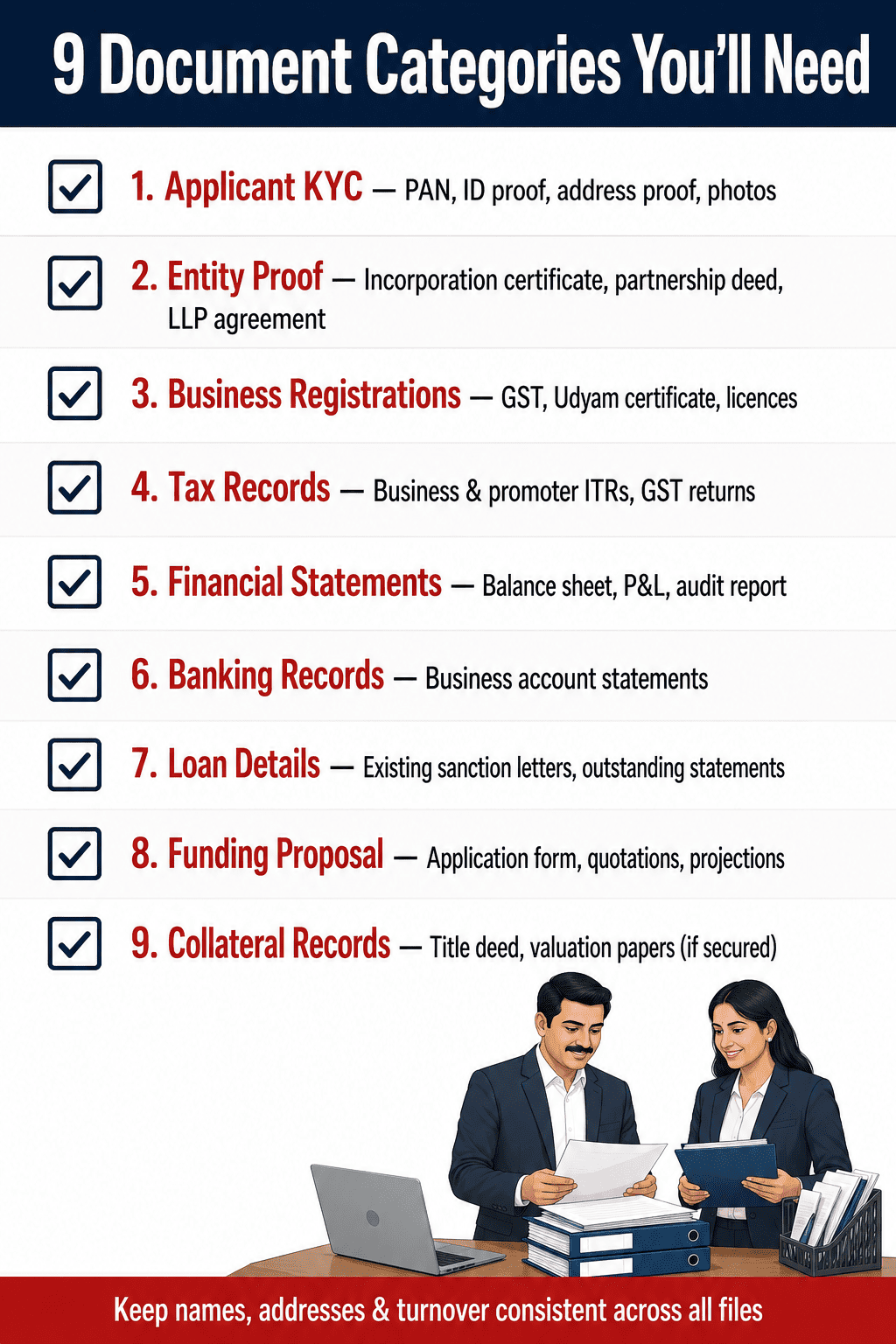
The final checklist depends on the lender, facility, amount, business constitution and security. The following groups are commonly requested:
|
Category |
Common records |
Purpose |
|
Applicant KYC |
PAN, identity proof, address proof and photographs |
Identity and regulatory checks |
|
Entity proof |
Incorporation certificate, partnership deed, LLP agreement or relevant registration |
Legal existence and constitution |
|
Ownership and authority |
Shareholding, partner list, board resolution or authority letter |
Ownership and borrowing authority |
|
Business registrations |
GST, Udyam and activity-specific licences, where applicable |
Operating and compliance verification |
|
Tax records |
Business and promoter ITRs, computation and GST returns for the required periods |
Declared income and turnover |
|
Financial statements |
Balance sheet, profit and loss account, cash-flow statement, schedules and audit report, where applicable |
Profitability, leverage and repayment ability |
|
Banking records |
Business account statements and, where requested, promoter statements |
Credits, obligations, returns and account conduct |
|
Existing debt |
Sanction letters, repayment schedules and current outstanding statements |
Total borrowing and repayment burden |
|
Funding proposal |
Application, purpose note, quotations, projections and project report |
Amount, use and repayment source |
|
Collateral records |
Title deed, tax receipts, approved plan, encumbrance records and valuation papers |
Ownership and enforceability |
Names, addresses, ownership, turnover and business activity should remain consistent across documents. A mismatch is not always fraud, but it demands an explanation and can delay appraisal. Regular GST filers can use the GST registration process to correct registration gaps, while the income-tax filing guide helps organise return-related records.
Financial statements should also reconcile with GST and banking data. Where books are incomplete or mixed with personal transactions, accounting services for small businesses can help build a clearer audit trail before the file reaches the lender.
How Much Does a Business Loan Cost?
The interest rate is only one component. Processing charges, documentation costs, legal scrutiny, valuation, insurance, stamp duty, security creation, renewal fees, commitment charges and prepayment conditions can materially change the total outflow. GST may apply to eligible fees. A borrower should compare the amount received after deductions and the total amount payable-not only the advertised rate.
Check whether the rate is fixed or floating, which benchmark applies, when it resets and whether a change affects the EMI or tenure. Also confirm penal charges, late-payment consequences, foreclosure conditions, margin requirements, guarantee obligations and the grievance channel. For an initial estimate, an interest calculator can illustrate borrowing cost, but the lender’s KFS remains the controlling disclosure.
How to Apply for a Business Loan in India
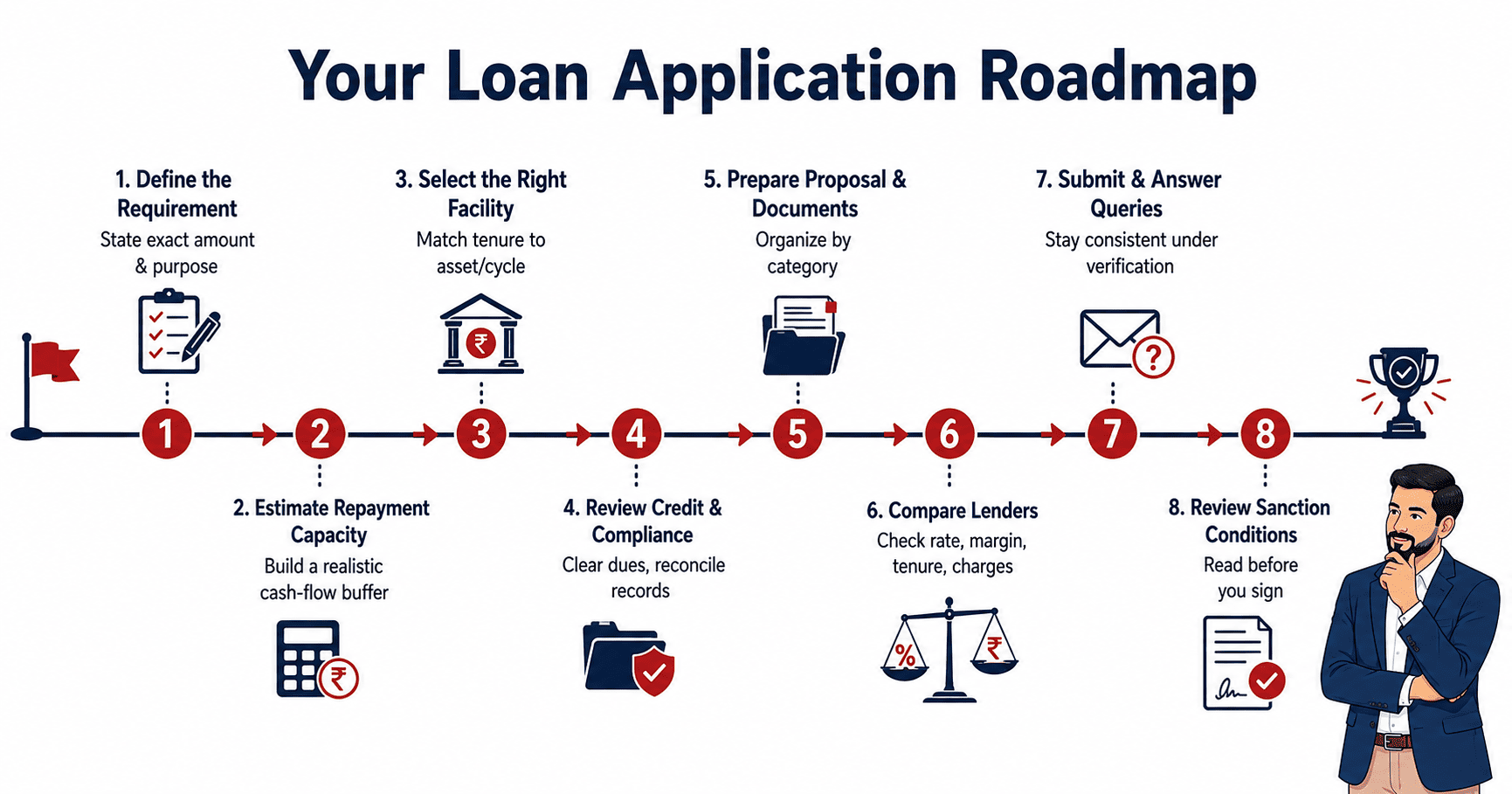
1. Define the requirement
State the exact amount, purpose and expected benefit. Support machinery purchases with quotations, working capital with an operating-cycle calculation, and expansion with capacity and sales assumptions. A rounded, unsupported amount appears less credible than a requirement built from evidence.
2. Estimate repayment capacity
Prepare a monthly cash flow that includes existing EMIs, tax payments, seasonal weakness and the proposed repayment. Test the plan against slower sales or delayed collections. If management accounts or forecasts are weak, CFO support can help organise cash-flow analysis and funding readiness.
3. Select the appropriate facility
Match the tenure with the asset life or cash-conversion cycle. Compare secured and unsecured options by amount, urgency, collateral exposure, flexibility and complete cost. Do not choose a product merely because its online application is shorter.
4. Review credit and compliance records
Check business and promoter credit reports, correct genuine reporting errors and disclose current obligations. TransUnion CIBIL explains that a Company Credit Report and CIBIL Rank reflect commercial credit behaviour; however, no single score or rank guarantees approval. Reconcile banking, GST, tax and accounting records before submission.
5. Prepare the proposal
Arrange the file by KYC, entity, tax, financial, banking, project and collateral sections. Explain one-time losses, unusual deposits and changes in turnover instead of leaving the lender to infer a reason. New ventures, machinery purchases and expansion proposals often need a structured project report covering costs, market assumptions, implementation and repayment.
6. Compare suitable lenders
Compare eligibility, annual percentage rate, margin, tenure, moratorium, security, processing expenses and prepayment rules. Apply selectively because repeated enquiries within a short period may require explanation. Ask for the lender’s document checklist and normal decision timeline before applying.
7. Submit and respond to appraisal
Complete the application accurately and retain the acknowledgement. The lender may verify premises, customers, suppliers, bank credits, licences and collateral. Respond consistently and promptly. RBI’s MSME lending guidance states that banks have been advised to decide complete MSE applications up to ₹25 lakh within 14 working days; other cases follow the lender’s approved timeline.
8. Review the sanction before acceptance
A sanction is an offer subject to conditions, not an automatic disbursal. Check the sanctioned amount, end use, interest basis, repayment, margin, security, guarantees, covenants and pre-disbursement requirements. Correct errors before signing and preserve invoices showing how the funds were used.
How Do Lenders Assess the Application?
Lenders test three broad questions: can the business repay, has it handled credit responsibly, and what recovery support exists if the account fails? Profit on paper does not always mean repayment cash. Receivables may be overdue, inventory may move slowly, or promoter withdrawals may absorb funds.
Bank credits are compared with declared turnover. Financial statements show margins, leverage, net worth and working-capital pressure. For a project, the lender tests cost, demand, contribution, implementation and debt servicing. For secured finance, it also checks legal title and value. A professional valuation report may support an asset-based proposal, although the lender can appoint its own valuer.
Where the borrower is a company and security creates a charge over its assets, statutory filing may be required. Section 77 of the Companies Act, 2013 covers the duty to register charges. The registration of charges process can be used to prepare the corporate records and filing steps.
For larger or complex proposals, a lender may investigate contracts, licences, litigation, ownership and related-party exposure. A pre-application due diligence review can identify issues before they become appraisal queries.
Which Government-Linked Loan Options Are Available?
Government support does not replace credit appraisal. Eligible banks, NBFCs, microfinance institutions or other approved lenders assess and sanction the facility.
Pradhan Mantri Mudra Yojana
PMMY supports eligible non-corporate, non-farm micro enterprises through four categories: Shishu up to ₹50,000; Kishor above ₹50,000 and up to ₹5 lakh; Tarun above ₹5 lakh and up to ₹10 lakh; and Tarun Plus above ₹10 lakh and up to ₹20 lakh for borrowers who have successfully repaid a Tarun loan. The official MUDRA also clarifies that MUDRA does not lend directly; borrowers apply through eligible lending channels.
CGTMSE
CGTMSE provides guarantee cover to eligible lenders for qualifying credit to micro and small enterprises. Its current credit-facility parameters cover eligible fund-based and non-fund-based facilities up to ₹10 crore, subject to scheme conditions. Under hybrid security, a lender may take collateral for one portion and seek guarantee cover for the remaining eligible portion. The borrower remains liable for the full debt and the lender still appraises viability.
PMEGP
PMEGP is a credit-linked programme for eligible new micro-enterprises. The official JanSamarth PMEGP page states project ceilings of ₹50 lakh for manufacturing and ₹20 lakh for services, with margin-money subsidy ranging from 15% to 35% subject to category and location. Contribution, education, activity, subsidy and bank-appraisal conditions apply.
Why Are Business Loan Applications Rejected or Delayed?
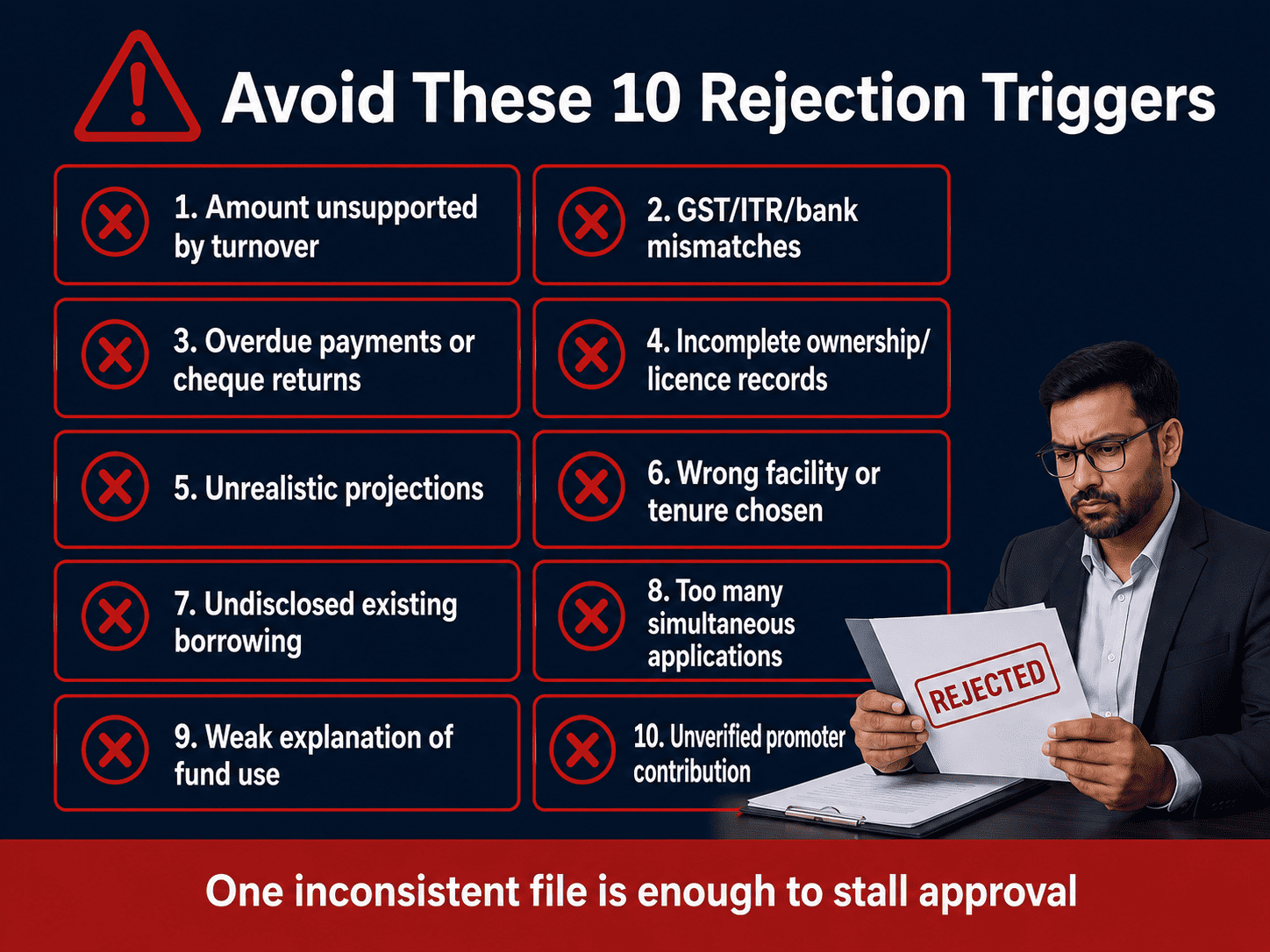
Most avoidable problems arise when the documents do not tell one consistent financial story. Common triggers include:
-
an amount unsupported by turnover or cash generation;
-
differences among GST returns, ITRs, accounts and bank credits;
-
overdue instalments, settlements or repeated cheque returns;
-
incomplete licences, ownership or collateral papers;
-
unrealistic projections copied from a template;
-
the wrong facility or tenure for the stated use;
-
undisclosed loans, guarantees or related obligations;
-
numerous simultaneous applications;
-
a weak explanation of fund use; and
-
promoter contribution that is borrowed or cannot be verified.
Fabricated invoices, altered statements or inflated valuations can lead to rejection and legal consequences. If the records are not ready, correcting them before reapplying is safer than submitting another inconsistent file.
How Can the Application Be Prepared More Effectively?
A well-prepared application connects the funding purpose with verified documents and a realistic repayment source. Support may include reviewing entity records, reconciling tax and accounting data, identifying document gaps, preparing projections, structuring a project report and checking corporate approvals or charge-registration requirements.
This work cannot guarantee approval, pricing or disbursal. It can, however, reduce avoidable queries and make comparison easier. Before accepting an offer, the borrower should understand the complete cost, repayment pressure, security exposure and consequences of default.
Conclusion
Getting a Business Loan in India begins with choosing finance that matches the purpose and repayment cycle. Define the requirement, reconcile records, check credit conduct and support every major assumption with evidence. Compare the annual percentage rate and complete terms rather than relying on a headline interest rate.
Government-linked schemes may widen access, but they do not remove appraisal or repayment. Read the KFS, sanction letter, security documents and guarantee clauses before signing. Good preparation cannot force a lender to approve the application, but it can prevent avoidable delays and help the business decline finance that would strain cash flow.
FAQS
FAQs About Business Loan
-
Can a new business get a Business Loan in India?
Yes. Some lenders and government-linked schemes consider new enterprises using promoter experience, contribution, quotations, licences, project viability and projected cash flow. Eligibility, security and sector conditions still apply.
- What credit score is required for a Business Loan?
- Can a business loan be obtained without collateral?
- How long does approval take?
- Is Udyam registration compulsory for every Business Loan?
- Is a project report always required?
- Are Business Loan interest rates fixed by RBI?
- What happens if a Business Loan EMI is missed?
- Can a proprietor use a personal bank account for loan assessment?
- What happens if a business loan EMI is missed?


