

A Loan against Property lets you borrow against an existing immovable property without selling it. The lender, however, does not sanction money merely because the property is valuable. It separately examines your income, existing debt, credit history, the property’s legal title and its realisable value.
This distinction matters. A mortgage provides security to the lender; it does not replace evidence that you can repay. Preparing both sides of the file-financial capacity and clean property records-is therefore central to getting a workable offer.
What is a Loan against Property?
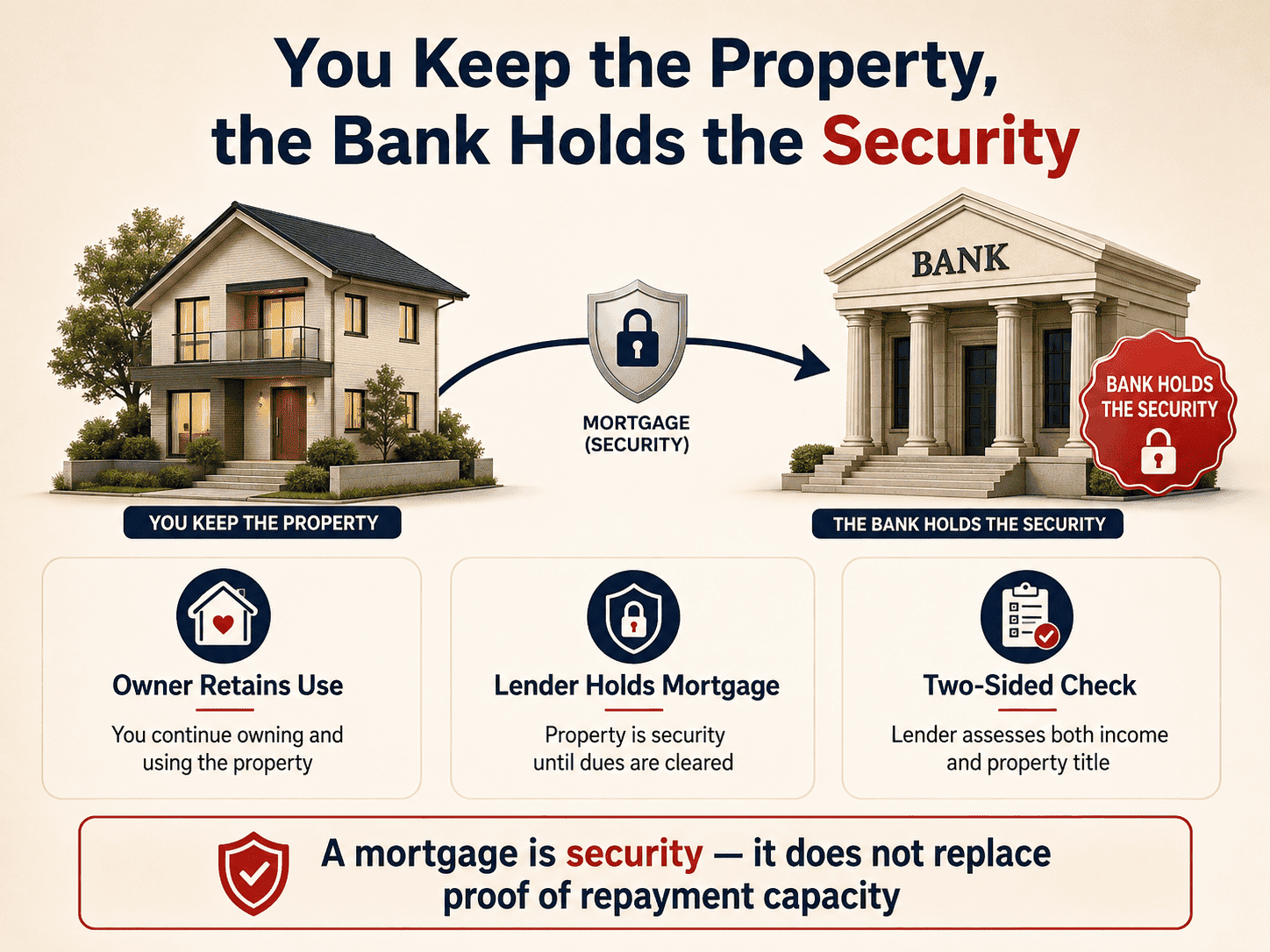
Under Section 58 of the Transfer of Property Act, 1882, a mortgage transfers an interest in specified immovable property to secure repayment of money or performance of an obligation. In a Loan against Property (LAP), you remain the owner and may normally continue using the premises, but the lender holds enforceable security until the dues are cleared.
Banks, housing finance companies and NBFCs may offer LAP to salaried people, professionals, self-employed applicants and businesses. Accepted property types, end-use restrictions, minimum loan size and tenure are product-specific.
When Does a Loan against Property Make Sense?
LAP can suit a large, planned requirement-business expansion, equipment, education, medical expenditure or debt consolidation-when repayment is predictable. It is usually a poor fit for speculative activity, recurring operating losses or an EMI that depends on an uncertain future sale.
|
Facility |
Security and purpose |
Practical distinction |
|
Loan against Property |
Existing property is mortgaged; permitted end use can be broad |
Property and repayment capacity are both assessed |
|
Home loan |
Finances purchase, construction or approved housing work |
Funds are tied to the housing purpose |
|
Unsecured business loan |
No property mortgage |
Pricing and eligibility depend more heavily on financial profile |
|
Property-backed overdraft |
Property secures a revolving limit |
Interest may apply to the utilised amount, subject to product terms |
An eligible micro or small enterprise unwilling to mortgage property can separately examine a collateral-free CGTMSE loan. It is a different route, and guarantee coverage does not mean automatic sanction.
Who Is Eligible for a Loan against Property?
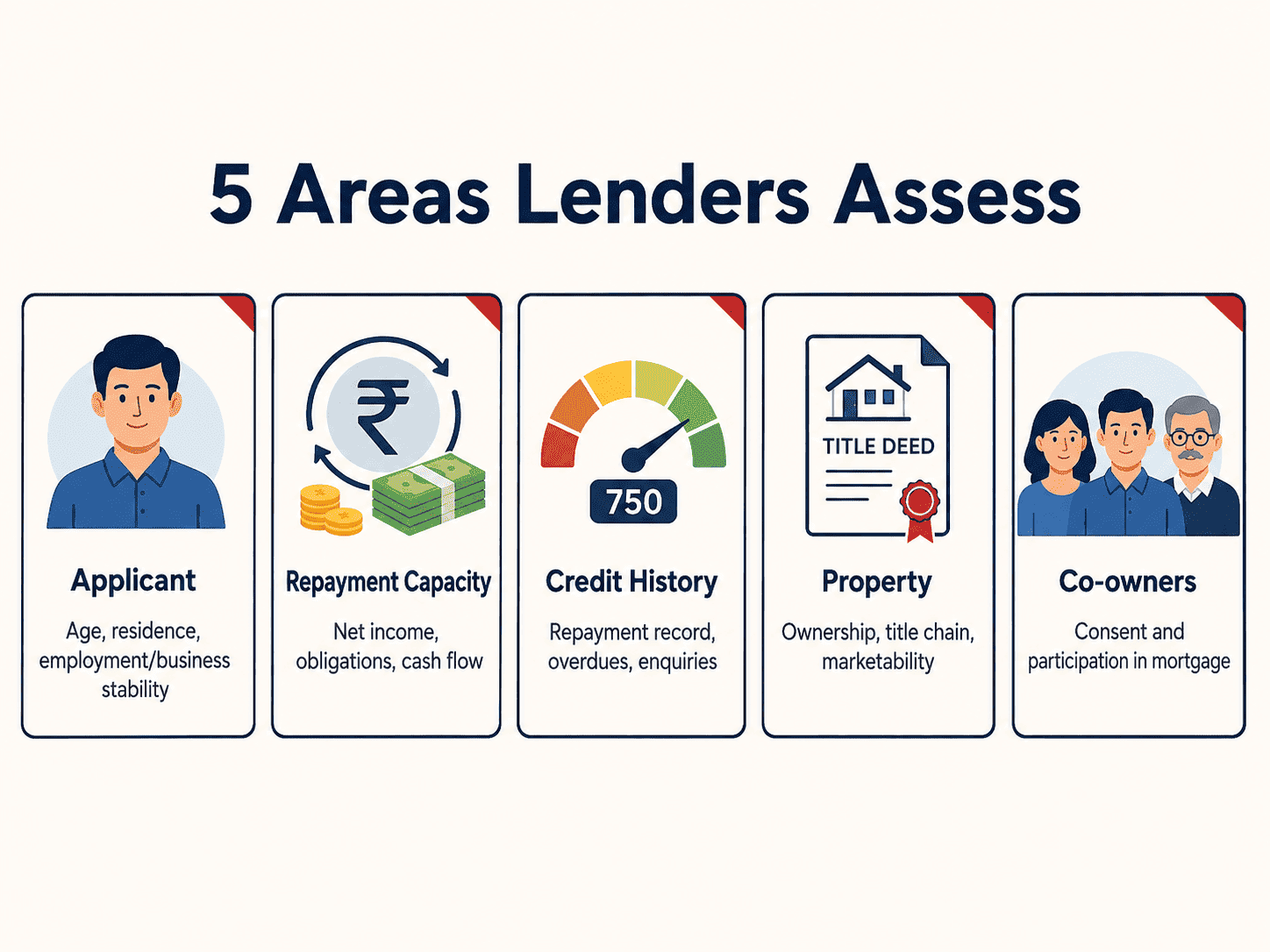
There is no universal age, income, turnover, business-vintage or credit-score threshold for every lender. Each institution applies its own policy. TransUnion CIBIL’s credit-score explain that consumer scores range from 300 to 900 and that a higher score improves approval prospects; they do not prescribe a universal LAP cut-off.
|
Assessment area |
What lenders commonly examine |
What strengthens the file |
|
Applicant |
Age at maturity, residence, employment or business stability |
Consistent identity, address and occupation records |
|
Repayment |
Net income, obligations, banking conduct and cash flow |
Sustainable EMI after existing commitments |
|
Credit |
Repayment history, enquiries, overdues and settlements |
Correct credit report and timely repayments |
|
Property |
Ownership, title chain, use, location, age and marketability |
Clear records, approvals and paid municipal dues |
|
Co-owners |
Consent and participation in the mortgage |
All required owners joining as co-applicants or mortgagors |
For business applicants, current tax returns, GST data and financial statements should tell the same commercial story. Gaps can be addressed through orderly small-business accounting records, income-tax filing records and, where applicable, GST registration documentation. An MSME should also check whether its Udyam registration details match its PAN, GST and activity records.
What Documents are Required for a Loan against Property?
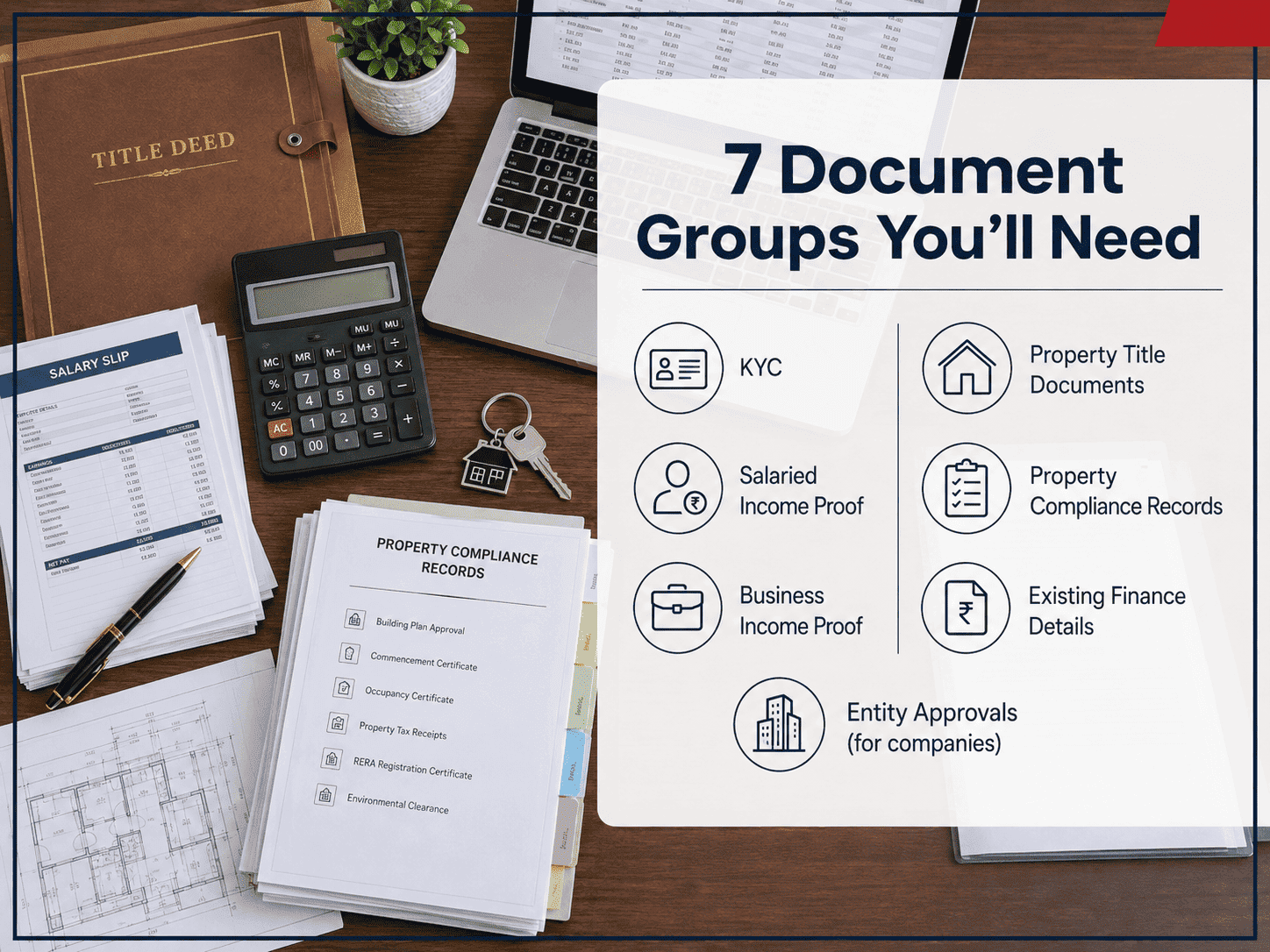
The exact checklist depends on the applicant, property and lender. The Bank of Baroda document checklist, for example, separates salaried and self-employed evidence and expressly asks for ownership records. Treat the list below as preparation guidance, not a universal rule.
|
Document group |
Typical records |
|
KYC |
Application, photographs, PAN and accepted identity/address proof |
|
Salaried income |
Salary slips, Form 16, employment evidence and bank statements |
|
Business income |
ITRs, audited or certified financials, GST returns, bank statements and business proof |
|
Property title |
Sale, gift, conveyance, partition or lease deed, plus prior title chain where required |
|
Property compliance |
Approved plan, occupancy/completion evidence, tax receipts, society or authority NOC where applicable |
|
Existing finance |
Sanction letters, repayment statements and foreclosure documents |
|
Entity approvals |
Incorporation records, constitutional documents, borrowing resolution and authorised-signatory proof |
Depending on the state and property, the lender’s advocate may also request mutation or revenue records, an encumbrance certificate, development-authority permissions, society documents or a legal-heir trail. A company’s incorporation documentation must identify the borrowing entity correctly.
Never submit altered statements, incomplete title chains or unexplained cash deposits. If a projected business expansion is the stated end use, a credible project report for bank finance can connect the requested amount with costs, cash generation and repayment.
What does the property title review check?
The legal review asks whether the applicant has a clear, transferable interest that can be mortgaged. The advocate traces ownership through prior deeds, checks whether names and property descriptions match, and examines recorded encumbrances, litigation, acquisition notices, leases and restrictions. For inherited property, succession documents and participation of all relevant heirs may become critical.
Technical inspection is different. The valuer compares the site with approved plans, measures the premises, considers condition and access, and estimates market and realisable value. A clean legal report cannot cure unauthorised construction; a high valuation cannot cure defective title. Obtain the lender’s specific written deficiency list.
How to Get a Loan against Property: Step-by-Step Process
1. Define the requirement
Fix the amount, purpose and affordable EMI before comparing lenders. Use an EMI calculator to test multiple rates and tenures, but remember that a longer tenure can reduce the instalment while increasing total interest.
2. Check borrower and property readiness
Review credit reports, existing EMIs, ITRs, GST returns and bank statements. Separately assemble the original title chain and approvals. Resolve name, address, area or ownership mismatches before application.
3. Compare complete offers
Compare the benchmark or fixed-rate structure, spread, reset frequency, APR, processing fee, legal and valuation costs, insurance, pre-payment rules and default charges. RBI does not set one LAP interest rate; its MSME lending states that credit pricing is deregulated and governed by lenders’ policies.
4. Apply and submit the file
Provide accurate borrower, income, end-use and property information. Keep an acknowledgement of documents handed over, especially originals. Multiple simultaneous applications may create credit enquiries without solving a weak file.
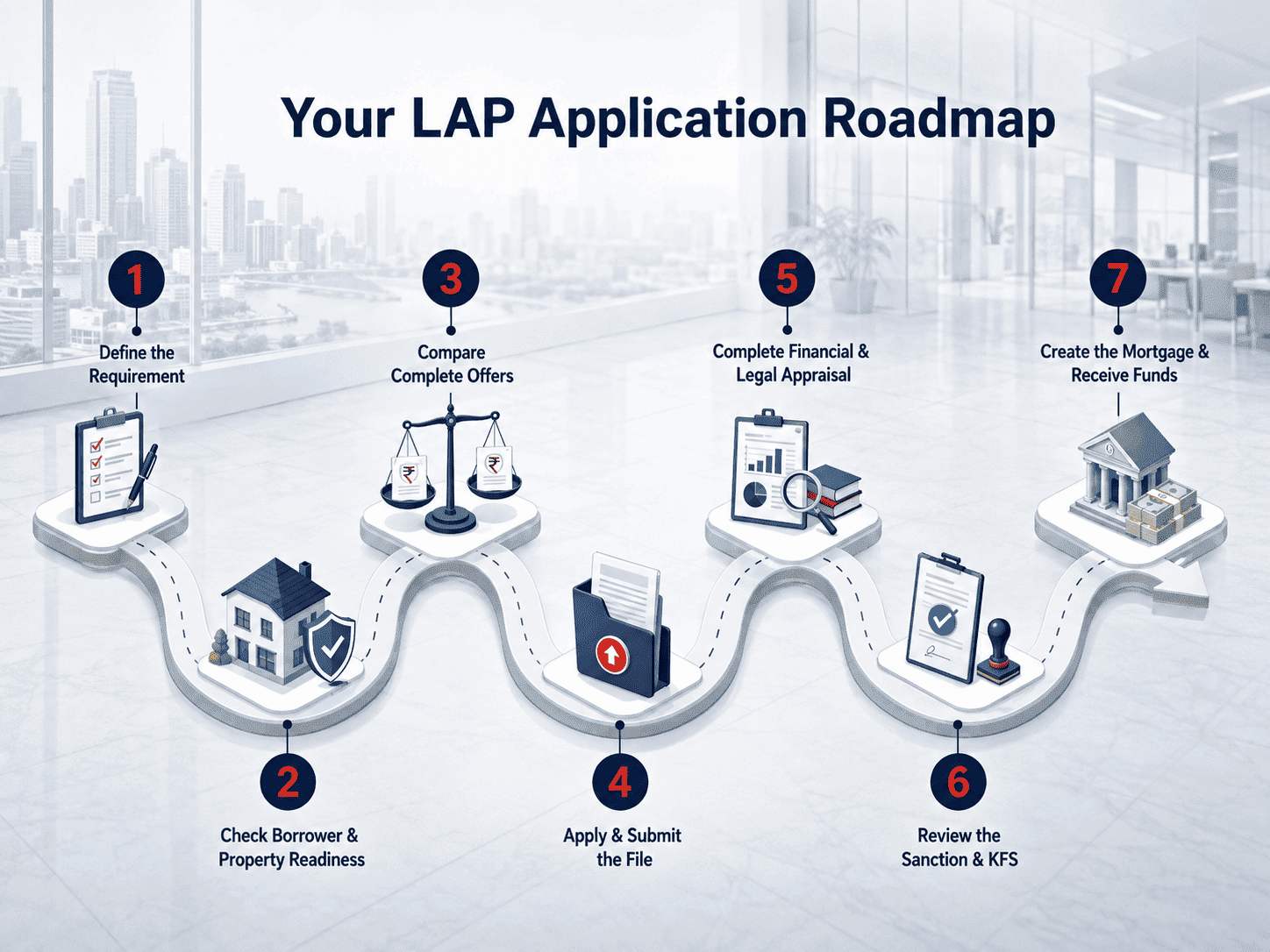
5. Complete financial and legal appraisal
The credit team tests repayment capacity and account conduct. A panel valuer inspects the property, while a legal professional reviews ownership, prior transfers, encumbrances, approvals and mortgageability. This lender valuation is not the same as a general business or asset valuation report.
6. Review the sanction and KFS
For retail and MSME term loans, RBI’s Key Facts Statement directions require a standardised KFS for loans sanctioned from 1 October 2024. It must show the APR, repayment schedule and charges; an undisclosed fee cannot later be imposed without the borrower’s explicit consent.
Check conditions precedent carefully. A sanction is not disbursal: the lender may still require originals, insurance, NOCs, execution of security documents, charge filings or closure of an earlier loan.
7. Create the mortgage and receive funds
Execute the loan and security documents, complete the applicable mortgage or title-deed deposit formalities and pay state-specific stamp or registration costs. Disbursal occurs only after the lender confirms compliance. Preserve the agreement, KFS, sanction letter, receipts and document inventory.
How Do Lenders Decide the Loan Amount?
The lower of two ceilings usually controls the outcome: the amount supported by repayment capacity and the amount supported by the lender’s permitted loan-to-value ratio. A ₹1 crore valuation does not entitle the owner to a fixed percentage if income supports a smaller EMI.
The lender may use a conservative realisable value rather than the owner’s estimate or a broker’s quote. Location, authorised use, age, occupancy, market demand, access, construction approvals and existing encumbrances can affect that value. Business applicants may benefit from CFO-level cash-flow planning when projections and existing obligations need reconciliation.
What Costs Should You Compare?
Interest is only one component. Ask for an itemised quotation and compare APR wherever the KFS regime applies.
|
Cost |
What to verify |
|
Interest |
Fixed or floating basis, benchmark, spread and reset terms |
|
Processing |
Rate or amount, tax and refundability if not sanctioned |
|
Property work |
Legal opinion, technical valuation and inspection costs |
|
Mortgage |
State-specific stamp duty, registration or memorandum charges |
|
Insurance |
Whether optional or required, insured risks and premium |
|
Servicing |
Statement, document retrieval, swap or conversion fees |
|
Early exit/default |
Pre-payment treatment, bounce charges and penal charges |
RBI’s penal-charge directions require a penalty for material non-compliance to be treated as a penal charge, not extra penal interest added to the loan rate; penal charges cannot themselves be capitalised.
For loans sanctioned or renewed on or after 1 January 2026, the RBI Pre-payment Charges Directions prohibit charges on floating-rate non-business loans to individuals. Their treatment of floating-rate business loans varies by borrower and lender category, including a ₹50 lakh protection threshold for specified institutions. Read the applicable clause rather than assuming every LAP is charge-free.
Interest used for business may qualify under Section 36(1)(iii) of the Income-tax Act, subject to purpose, timing and other conditions. LAP does not create an automatic tax deduction; maintain a traceable end-use trail and obtain tax advice.
Fixed or floating rate: what should you check?
A fixed rate offers payment certainty for the stated fixed period, but the agreement may permit later reset or conversion. A floating rate moves with the stated benchmark and spread, so the lender may change the EMI, tenure or both when the benchmark changes. Ask how resets are communicated and whether the spread can change.
Do not choose only by the starting rate. Compare the APR, benchmark history, reset frequency, conversion fee, pre-payment protection and effect of a rate rise on total repayment. Request an amortisation schedule for realistic higher-rate scenarios before signing.
What Legal and Borrower Protections Matter?
If a company creates security over its property, Section 77 of the Companies Act, 2013 generally requires registration of the charge with the Registrar within 30 days, subject to the statutory extension framework. The practical filing requirements are explained in the ROC charge-registration process. Existing ROC annual compliance records should also be consistent with the borrowing entity.
Default can put the mortgaged property at risk. Eligible secured creditors may enforce security under Section 13 of the SARFAESI Act, 2002, subject to the Act, notices and available remedies. A mortgage should therefore never be treated as harmless because the borrower retains possession initially.
After full repayment or settlement of a personal loan, RBI’s property-document release directions require regulated entities to return original documents and remove registered charges within 30 days. Delay attributable to the lender attracts compensation of ₹5,000 per day.
Raise service complaints with the lender first. If unresolved or the response is unsatisfactory, the RBI Integrated Ombudsman Scheme, 2026 provides a cost-free channel for eligible complaints, subject to maintainability and filing timelines.
Why Do LAP Applications Get Delayed or Rejected?
Common causes include:
-
repayment capacity that supports less than the requested amount;
-
recent overdues, settlements or excessive credit enquiries;
-
inconsistent income, GST, ITR and bank data;
-
missing title links, unrecorded inheritance or co-owner objections;
-
unauthorised construction, land-use issues or unpaid property dues;
-
an existing mortgage, attachment, litigation or restrictive lease;
-
unrealistic valuation expectations;
-
failure to meet sanction conditions within validity timelines; and
-
prohibited, unclear or poorly evidenced end use.
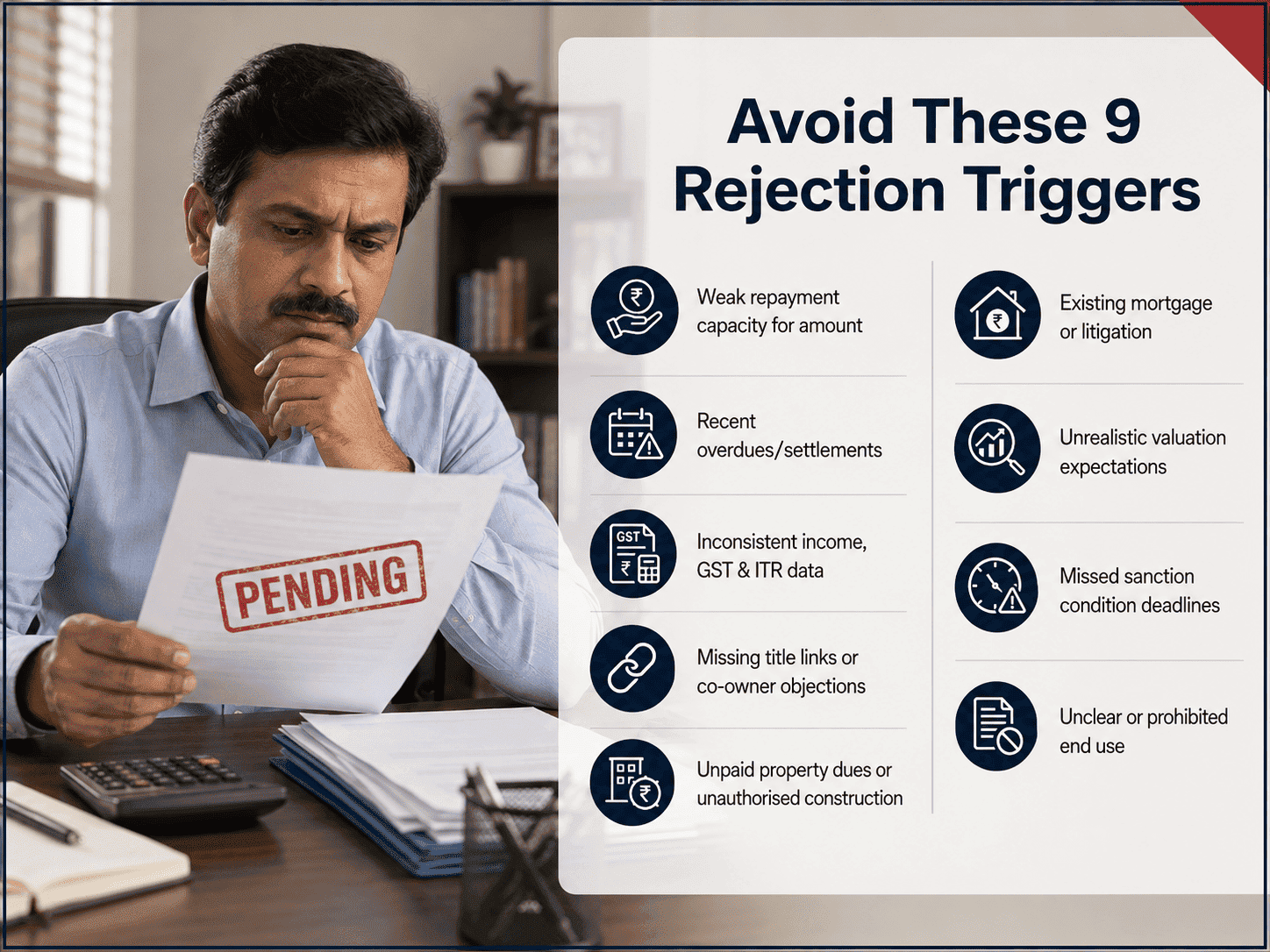
Do not respond by concealing the issue or applying everywhere. Obtain the reason, correct verifiable gaps and resize the request if cash flow cannot support it.
Conclusion
A Loan against Property works best when the property is legally mortgageable, the requested amount matches documented repayment capacity, and the total borrowing cost remains manageable. Compare the KFS and APR, satisfy security formalities only after understanding them, and keep a complete closure record so the mortgage and registered charges are removed promptly.
FAQS
FAQs on Loan against Property
-
Can I get a Loan against Property without income proof?
Some lenders consider alternative income evidence, but property alone does not prove repayment capacity. Bank credits, GST returns, rental receipts, contracts or a strong co-applicant may help where the product permits them. Never describe informal or unverifiable income inaccurately.
- What credit score is required for LAP?
- Can jointly owned property be mortgaged?
- Can rented property be offered for LAP?
- How long does loan-against-property approval take?
- Is a Loan against Property cheaper than a personal loan?
- Can agricultural land be used for LAP?
- Can I sell mortgaged property before repaying LAP?
- What should I collect after closing the loan?
- Can an existing property loan be refinanced through LAP?


