
A trade license is permission from your local municipal corporation to run a specific business at a specific address. Nearly every shop, restaurant, office or factory operating from physical premises in India needs one. You apply through your municipal corporation, pay a fee based on your trade category, and renew it every year.
Most first-time applicants expect this to be one quick form at one counter. It rarely works that way. Your state decides the exact rules, your trade decides which category you fall under, and your premises decide which extra approvals you need before the license actually gets issued. Here's how the whole system fits together.
What Is a Trade License, and Why Does India Require One?
A trade license is official permission from your local municipal corporation, municipality, or gram panchayat to carry on a specific trade or business at a specific address. It isn't a business registration, and it isn't a tax registration either. It's a civic permission, issued under your state's Municipal Corporation Act or Municipalities Act, confirming your business meets local health, safety, fire, and zoning standards before you open your doors.
Every state runs its own version of this law. Delhi works under the Delhi Municipal Corporation Act, 1957. Maharashtra has its own Municipal Corporation Act covering cities like Mumbai and Pune. Karnataka, Tamil Nadu, West Bengal, and every other state have their own Acts too. That's why a trade license application in Bengaluru looks a little different from one in Kolkata, even though the underlying idea stays the same everywhere: your local government wants to know who's trading within its limits, and it wants assurance that the trade won't create a nuisance or a hazard for the neighbourhood.
Trade license sits in the same family as your GST registration and your Shops and Establishment registration, but it answers a different question. GST asks whether you're collecting the right tax. Shops and Establishment asks whether your employees are treated fairly. Trade license asks something more basic: is it safe and legal for this specific business to exist at this specific address?
Who Needs a Trade License in India?
Almost anyone running a business from fixed commercial premises needs one, including:
-
Retail shops, showrooms and general stores
-
Restaurants, cafes, sweet shops and catering businesses
-
Wholesalers, distributors and traders
-
Manufacturing units, workshops and small factories
-
Warehouses, godowns and cold storage facilities
-
Clinics, diagnostic centres, pharmacies and nursing homes
-
Salons, gyms, spas and coaching centres
-
Offices of consultants, agencies and professional service providers
-
Hotels, lodges and guest houses
The test isn't your turnover or your company structure. A one-person proprietorship and a large private limited company follow the same basic rule: if you're carrying on a trade or business from a physical location within municipal limits, that location needs a trade license.
A home-based business sits in a grey zone. If you're baking from your kitchen and selling only online with no customer footfall, many municipal corporations won't expect a trade license. The moment customers start walking in to buy something, or you start storing stock in a way that looks commercial, that exemption tends to disappear. When in doubt, a quick call to your local municipal office settles it faster than guessing.
What Are the Different Categories of Trade License?
Municipal corporations don't issue one generic trade license. They sort every application into a category based on how risky or sensitive the trade is, and the category decides your fee, your inspection requirements, and which NOCs you need before approval. The exact names differ a little by state, but most corporations use some version of these groups.
|
Category |
Typical Businesses |
Extra Requirements |
|
General / Shop Trade |
Retail shops, offices, showrooms, consultancies |
Basic ID and address proof; usually no external NOC |
|
Food Establishment |
Restaurants, cafes, bakeries, sweet shops, catering |
FSSAI license, health department NOC, fire NOC |
|
Health Trade |
Clinics, pharmacies, diagnostic centres, nursing homes |
Drug license where applicable, health department NOC |
|
Industrial / Manufacturing |
Factories, workshops, processing units |
Pollution control board NOC, fire NOC, Factories Act compliance |
|
Dangerous & Offensive (D&O) |
Chemical storage, firecracker units, firewood depots, fuel storage |
Pollution control board NOC, fire NOC, sometimes police clearance |
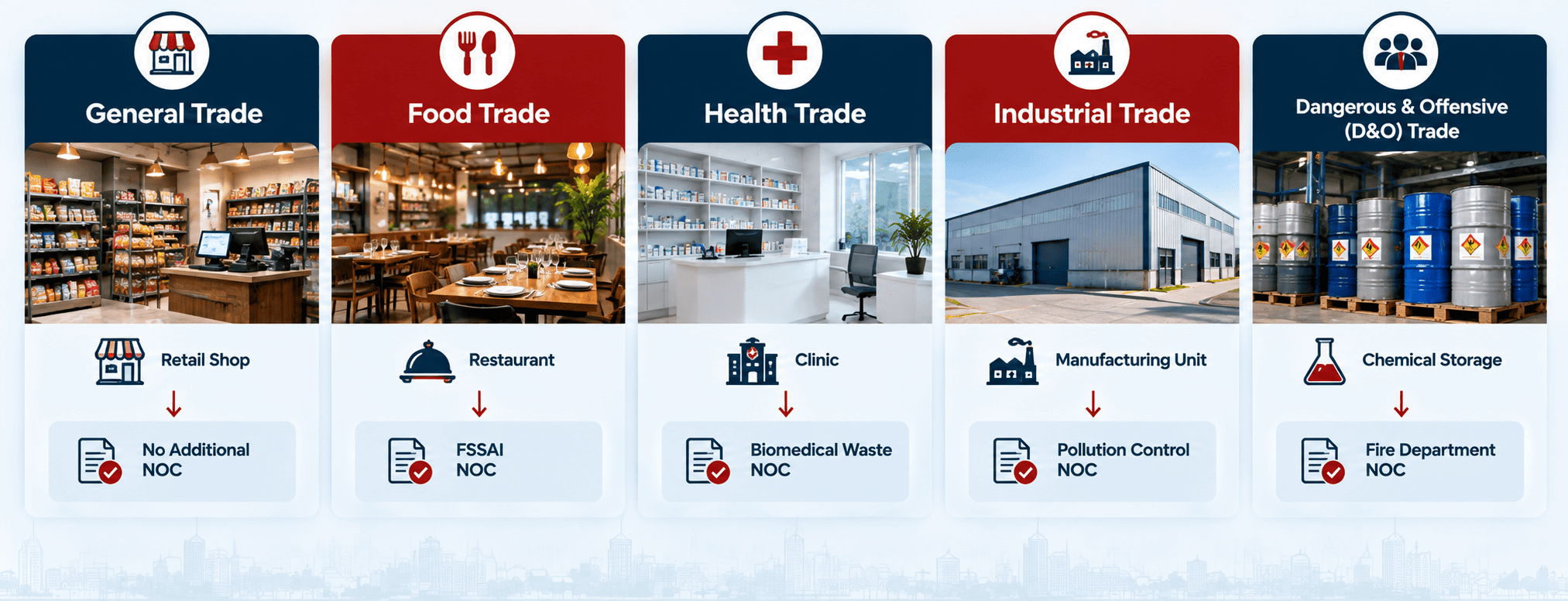
Get your category wrong and you'll usually hear about it during inspection, not before. A common mistake is filing a cloud kitchen or food delivery business under General/Shop instead of Food Establishment, just because there's no dine-in seating. Municipal inspectors look at what you're actually doing on the premises, not how the business feels casually. If food touches the premises in any commercial way, expect the Food Establishment category and its extra NOCs.
How Is a Trade License Different From GST Registration and a Shops & Establishment License?
This is where a lot of new business owners get stuck. All three sound like "business registration," and people assume having one means they don't need the others. They actually cover completely different ground.
| Feature |
Trade License |
GST Registration |
Shops & Establishment |
|
Issued by |
Municipal corporation, municipality, or panchayat |
GST department (central and state) |
State Labour Department |
|
Governs |
Permission to run a specific trade at a specific address |
Indirect tax on goods and services |
Employee working conditions, hours, leave |
|
Mandatory when |
You have physical business premises within municipal limits |
Turnover crosses the applicable threshold (typically ₹40 lakh for goods, ₹20 lakh for services in most states, lower in special category states) |
You employ staff or run a commercial establishment |
|
Governing law |
State Municipal Corporation or Municipalities Act |
CGST and SGST Acts |
State Shops & Establishments Act |
|
Typical validity |
One year, renewed annually |
Ongoing, no fixed expiry |
Varies by state, often one to five years |
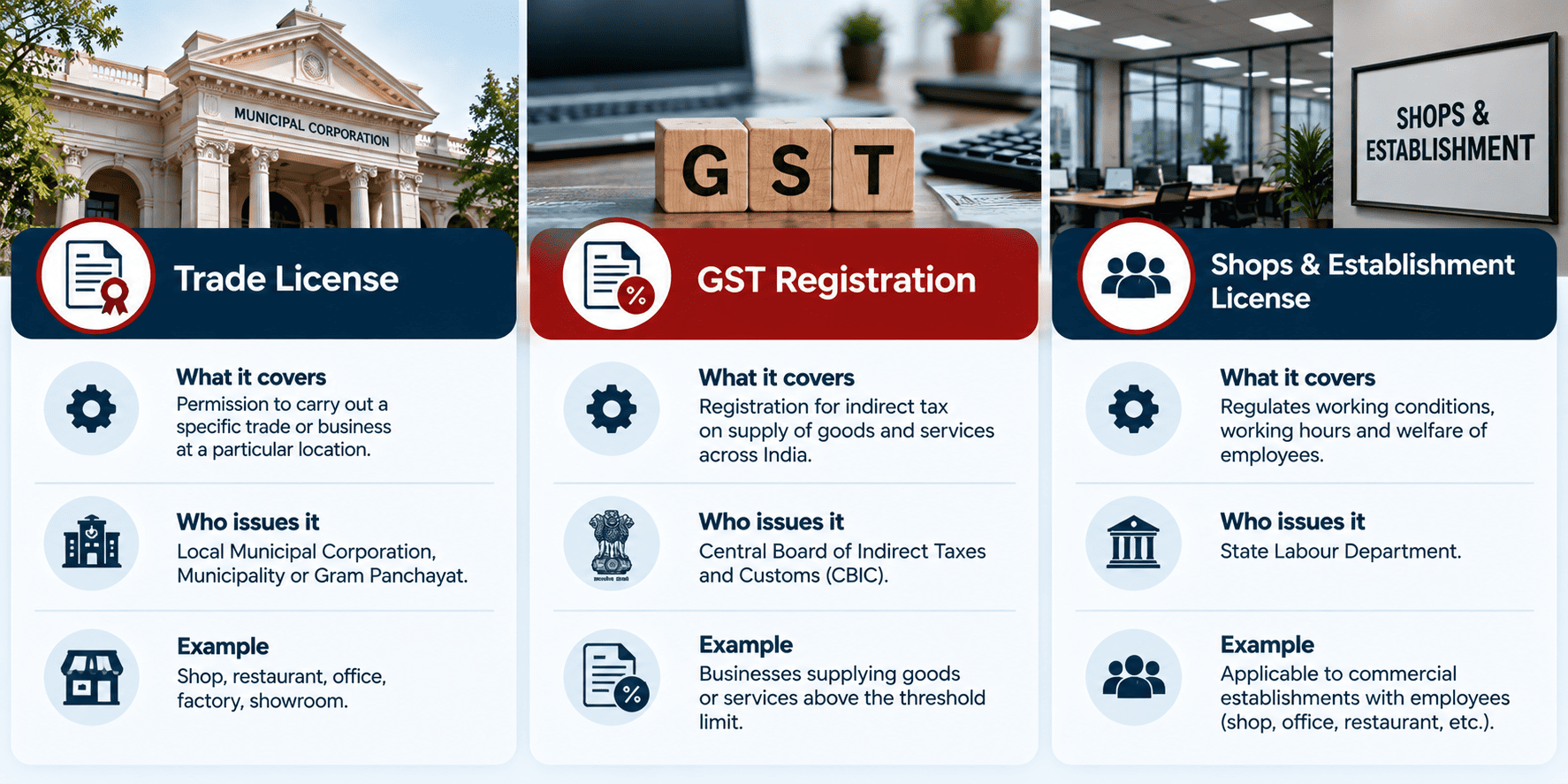
Most established businesses end up holding all three, plus whatever sector-specific license their trade needs on top of that, like an FSSAI license for food or a drug license for pharmacies. None of them substitutes for the other. A restaurant with a spotless GST filing record can still get shut down by the municipal corporation for trading without a valid trade license.
What Documents Do You Need to Apply for a Trade License?
Keep these ready before you start filing. Missing paperwork is the most common reason applications sit around for weeks.
-
Identity proof of the applicant, proprietor, partners, or directors (Aadhaar, PAN, passport, or voter ID)
-
Address proof of the business premises (property tax receipt, sale deed, or a rent or lease agreement with a No Objection Certificate from the landlord)
-
Passport-size photographs of the applicant
-
PAN card of the business or proprietor
-
Proof of business constitution (Certificate of Incorporation, LLP agreement, partnership deed, or proprietorship declaration, depending on how the business is set up)
-
Site or layout plan of the premises
-
GST registration certificate, if you already have one
-
NOC from the Fire Department, for trades that carry fire risk
-
NOC from the State Pollution Control Board, for manufacturing or Dangerous & Offensive trades
-
Proof of any sector-specific license the trade needs, such as an FSSAI license for food businesses or a drug license for pharmacies
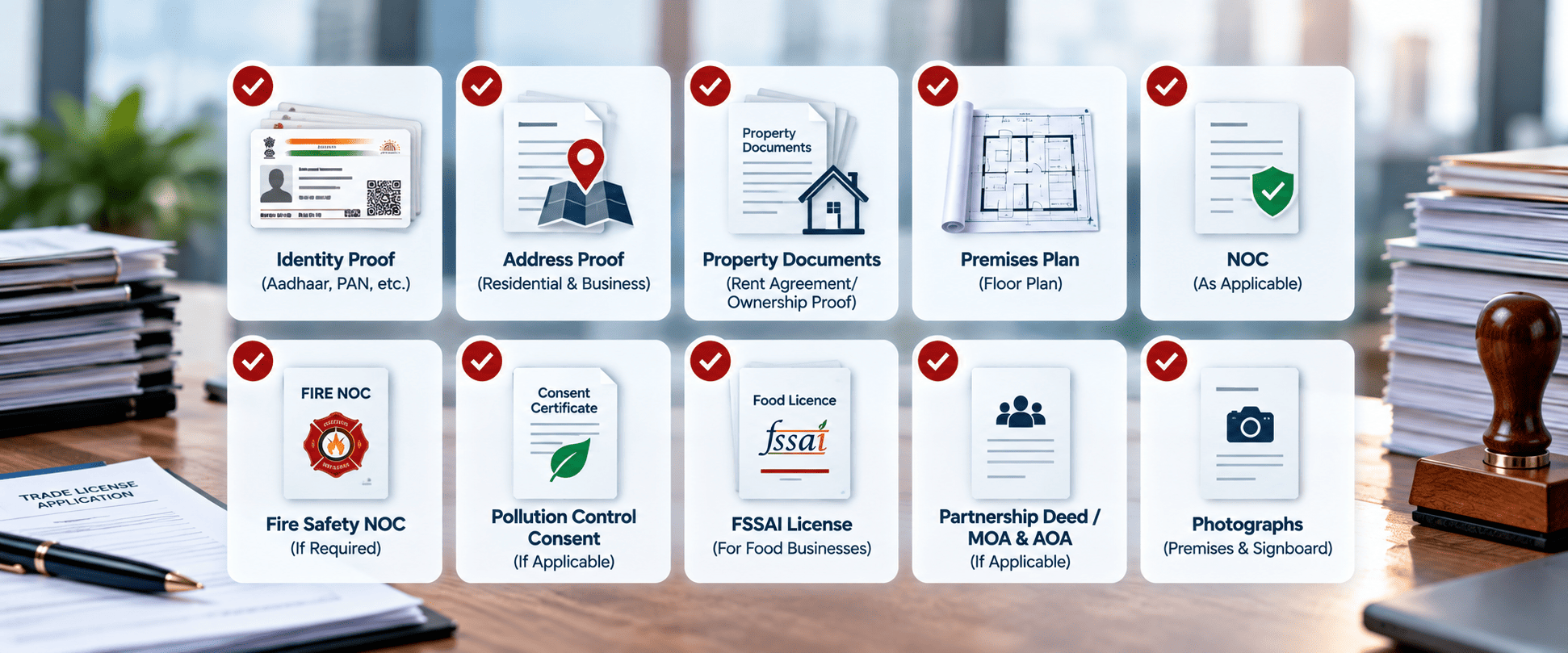
Keep your paperwork consistent. If your rent agreement lists one floor and your layout plan shows a different area, expect a query back before approval. Municipal officers cross-check documents against what they see on the actual site visit, not just what's on paper.
How Do You Apply for a Trade License in India?
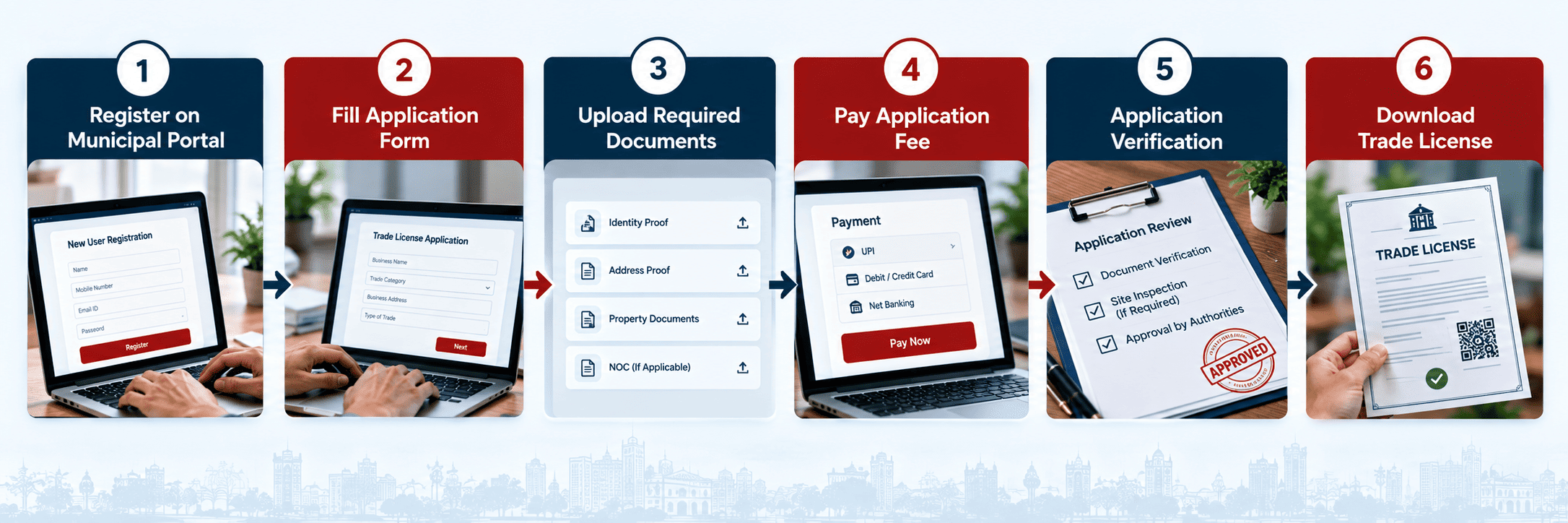
Applying Online
-
Find your municipal corporation's portal. Most metro corporations, like the BMC in Mumbai, the MCD in Delhi, the BBMP in Bengaluru, and the GHMC in Hyderabad, run their own citizen services portal.
-
Register as a new user with your basic details, mobile number, and email address.
-
Select the trade license service and choose your trade category from the dropdown.
-
Fill in your business and premises details, including the nature of the trade, floor area, ownership status, and business constitution.
-
Upload your documents, scanned clearly, matching the checklist above.
-
Pay the prescribed fee online through the portal's payment gateway.
-
Track your application number to check status and respond to any queries the corporation raises.
-
Site inspection, if required. A municipal officer may visit to confirm what's on paper matches what's on the ground.
-
Receive your license. Once approved, download the certificate and keep a physical copy displayed at your premises.
Applying Offline
You can still walk into the licensing department of your municipal corporation, collect a paper application form, attach the same documents, and submit it over the counter. Processing generally takes longer this way, and you'll need to follow up in person for status updates.
Some states also route new businesses through the National Single Window System, which won't issue the trade license itself but will tell you which state and central approvals your specific trade needs before you file anything, useful if you're juggling a trade license alongside other registrations.
How Much Does a Trade License Cost?
There's no single trade license fee for the whole country. Your state's Municipal Corporation Act sets the fee schedule, and most corporations calculate it using a mix of your trade category, the built-up area of your premises, and sometimes your location within the city. That's why the same kind of shop pays a different fee in Mumbai than it would in Nagpur.
As a rough guide, based on typical fee patterns reported across major cities:
|
Category |
Typical Fee Range |
|
General / Shop |
₹500 – ₹5,000 |
|
Food Establishment |
₹2,000 – ₹15,000 |
|
Health Trade |
₹2,000 – ₹10,000 |
|
Industrial / Manufacturing |
₹5,000 and up, based on scale |
|
Dangerous & Offensive |
₹5,000 – ₹50,000 or more |
Treat these as indicative, not final. Delhi's MCD has linked some trade categories to a percentage of your property tax. Bengaluru's BBMP uses risk-based slabs tied to premises size. The only way to get an exact figure is to check your specific municipal corporation's current fee notification, or have someone check it for you.
How Long Is a Trade License Valid, and How Do You Renew It?
A trade license is typically valid for one year and needs annual renewal. Most municipal corporations run their renewal cycle between January and March, so mark that window on your calendar rather than waiting for a reminder that might not come.
File your renewal application before your current license expires, generally at least 30 days ahead. You'll submit largely the same set of documents as your original application, pay the renewal fee, and in most cities the process moves faster the second time since your business is already on record.
Miss the deadline and you're not automatically shut down, but you are exposed. A lapsed license usually attracts a late fee on top of the normal renewal charge, and if the gap stretches too long, some corporations treat it the same as operating without a license at all. Don't let a renewal date slip just because the business has been running smoothly. Municipal inspections don't check whether you've been a good tenant. They check whether the certificate on your wall is current.
What Happens If You Operate Without a Valid Trade License?
This isn't a paperwork technicality your municipal corporation quietly overlooks. Trading without a valid license, or letting one lapse for too long, is treated as a violation of your state's Municipal Corporation Act, and the consequences can stack up quickly.
Depending on your city and trade category, you're looking at:
-
A monetary fine, which can run from a couple of thousand rupees to well over ₹50,000 for larger or higher-risk trades
-
A daily penalty for every day the violation continues, in many municipal acts
-
Sealing of your business premises
-
Cancellation of any related permits or approvals
-
Legal proceedings under the municipal act, in serious or repeat cases
Beyond the direct penalty, an unlicensed business runs into trouble in places you might not expect. Banks often ask for a valid trade license before opening a current account. Government tenders and many corporate vendor panels won't onboard you without one. Municipal corporations across the country have also stepped up enforcement drives in recent years, so "nobody's checked in years" isn't the safety net it used to be.
Do You Need Other Registrations Alongside Your Trade License?
Trade license covers your permission to trade at a specific address. It doesn't replace everything else your business needs.
-
Company, LLP, or proprietorship registration, depending on how you've structured the business, since your trade license application asks for this constitution proof anyway
-
GST registration, once your turnover crosses the applicable threshold or you want to bill corporate clients and claim input tax credit
-
Udyam registration for MSME benefits, easier loans, and access to government tenders
-
FSSAI license if food touches your premises in any commercial way, alongside your Food Establishment category trade license
-
A state pollution board NOC, like an MPCB license for industrial units in Maharashtra, if your trade generates waste, effluents, or emissions
-
Shops and Establishment registration from your state labour department, which most states require separately from your trade license once you employ staff
If your business also involves regulated services like pest management or fumigation, you'll likely need sector-specific approvals on top of these; our guide to the pest control license walks through one such example in detail.
What Mistakes Should You Avoid When Applying for a Trade License?
-
Filing under the wrong category to save on fees, then getting flagged at inspection and having to refile
-
Using a rent agreement or address that doesn't match your actual floor plan
-
Assuming your GST registration or company incorporation already covers this requirement
-
Starting operations before the license is actually issued, not just applied for
-
Forgetting to renew because the business has been running without any issues so far
-
Assuming a license from one branch automatically covers a new location
-
Skipping sector-specific NOCs, like fire or pollution clearance, because the application form didn't explicitly flag them upfront
Getting the category, the paperwork, and the NOCs aligned on the first attempt is most of what separates a smooth trade license approval from a back-and-forth that drags on for weeks. This is where Legal Babu's team comes in. We help you identify the right trade category for your business, pull together and verify your documents before submission, liaise with your municipal corporation through the application and inspection stages, and track your renewal date so it doesn't quietly slip past you.
FAQS
FAQs About Trade License
-
Do I need a trade license if I run my business from home with no customers visiting?
Usually not, as long as there's no commercial footfall or signage at the property. The moment you start receiving clients, customers, or regular pickups at the premises, many municipal corporations expect you to register. Rules differ by city, so a quick check with your local ward office is worth the five minutes it takes.
- I already have GST registration. Do I still need a trade license?
- Can one trade license cover two different businesses I run from the same shop?
- Does my trade license from one branch cover a new branch I am opening in another area?
- I missed my renewal date. Can I still renew, or do I have to start over?
- Is a trade license the same as a Shops and Establishment license?
- My business is 100% online with no shop front. Do I still need a trade license?
- Can a landlord's incomplete paperwork stop me from getting a trade license as a tenant?
- Is police verification needed for a trade license?
- Can I start operating while my trade license application is still pending?


