
Table of Content
- What is a Charge under the Companies Act, 2013?
- Why is Registration of Charges Important for Companies?
- What are the Different Types of Charges: Fixed vs Floating Charges?
- What is the Legal Framework Governing Charges under the Companies Act, 2013?
- What are the Mandatory Requirements for Registration of Charges with ROC?
- What is the Step-by-Step Process for Registration of Charge with MCA?
- What are the Documents Required for Registration of Charges?
- What is the Time Limits for Registration of Charge with the ROC?
- What are the Consequences of Non-Registration of Charges?
- What are the Common Mistakes to Avoid in Charge Registration?
- Final Thoughts: Ensure Hassle-Free Compliance with Expert Support!
What is a Charge under the Companies Act, 2013?

A charge under the Companies Act, 2013, refers to a legal security created by a company (whether private, public, OPC or Section 8 companies) over its assets or properties to secure the repayment of a loan or the performance of an obligation. It gives the lender (charge holder) a right or interest in the company’s assets, such as land, machinery, or inventory. Charges can be fixed (on specific assets) or floating (on changing assets). As per Section 77, every charge must be registered with the Registrar of Companies (ROC), ensuring transparency and protecting creditors’ interests in case of default or insolvency.
Why is Registration of Charges Important for Companies?
Registration of charge is issued by the Ministry of Corporate Affairs (MCA) through the Registrar of Companies (ROC) after a charge is successfully registered under Section 77 of the Companies Act, 2013. This certificate serves as conclusive evidence that the charge has been duly recorded, providing legal validity and public notice to all stakeholders. It protects the rights of lenders by ensuring their security interest is enforceable against third parties, including liquidators and creditors.
In case of insolvency, only registered charges are considered valid claims. Businesses can verify such registrations through the MCA Portal, enhancing transparency and credibility. Overall, the certificate is crucial for maintaining compliance, securing loans, and avoiding legal disputes.
Importantly, an unregistered charge becomes void against the liquidator and other creditors, even though the debt remains payable. Timely registration helps companies avoid penalties, maintain compliance, and build credibility with financial institutions and NBFCs, making it easier to secure future funding and ensure smooth business operations.
What are the Different Types of Charges: Fixed vs Floating Charges?
Under the Companies Act, 2013, charges are mainly classified into fixed and floating charges. A fixed charge is created on specific assets, restricting their disposal without lender consent. In contrast, a floating charge covers changing assets like inventory, allowing business use until it crystallises into a fixed charge upon default or specified events. Understanding this distinction between the two is crucial for companies, as it directly impacts asset control, borrowing flexibility, and the priority of creditors in case of default.
|
Basis of Difference |
Fixed Charge |
Floating Charge |
|
Nature of Assets |
Immovable or fixed assets (e.g., land, machinery) |
Current or circulating assets (e.g., stock, receivables) |
|
Control of Asset |
The company cannot dispose of assets without lender’s consent |
The company can use or dispose of assets in the ordinary course of business |
|
Crystallization |
No concept of crystallization |
Becomes fixed upon occurrence of specific events (e.g., default, winding up) |
|
Priority |
Higher priority over floating charge holders |
Lower priority compared to fixed charge holders |
|
Flexibility |
Less flexible for business operations |
More flexible and business-friendly |
What is the Legal Framework Governing Charges under the Companies Act, 2013?
|
Provisions |
Explanation |
|
Section 77 – Duty to Register Charges |
Companies must register charges with ROC within 30 days (extendable). Failure makes the charge void against liquidators and creditors, though the debt obligation remains valid. |
|
Section 78 – Application by Charge Holder |
If a company fails to register a charge, the charge holder may apply to the ROC for registration within the prescribed time to safeguard its security interest. |
|
Section 79 – Charges on Property Outside India |
Provisions of Section 77 apply to charges created on assets located outside India, ensuring that foreign assets are also covered under Indian charge registration requirements. |
|
Section 80 – Date of Notice of Charge |
Registration of charge acts as constructive notice to all stakeholders from the date of registration, making it binding on creditors, members, and other interested parties. |
|
Section 81 – Register of Charges by Company |
Every company must maintain a register of charges at its registered office, recording details of all charges, which should be available for inspection by stakeholders. |
|
Section 82 – Satisfaction of Charge |
Companies must inform the ROC within 30 days of repayment or satisfaction of the charge. ROC records satisfaction and issues a certificate confirming discharge of liability. |
|
Section 83 – Power of Registrar to Record Satisfaction |
ROC may independently record satisfaction of charge if sufficient evidence is provided, even if the company fails to notify or delays reporting the discharge. |
|
Section 84 – Intimation of Receiver or Manager |
The company must inform the ROC about the appointment of a receiver or manager over charged assets, ensuring transparency regarding enforcement actions taken by lenders. |
|
Section 85 – Inspection of Register of Charges |
The company’s register of charges must be open for inspection by members and creditors during business hours, promoting transparency and informed decision-making. |
|
Section 86 – Punishment for Contravention |
Non-compliance with provisions relating to charge registration, reporting, or maintenance attracts penalties on the company and responsible officers, ensuring strict legal enforcement. |
|
Section 87 – Rectification of Register of Charges |
The central government may allow rectification of omissions or misstatements in charge registration due to accidental errors or sufficient cause, ensuring fairness and compliance flexibility. |
What are the Mandatory Requirements for Registration of Charges with ROC?
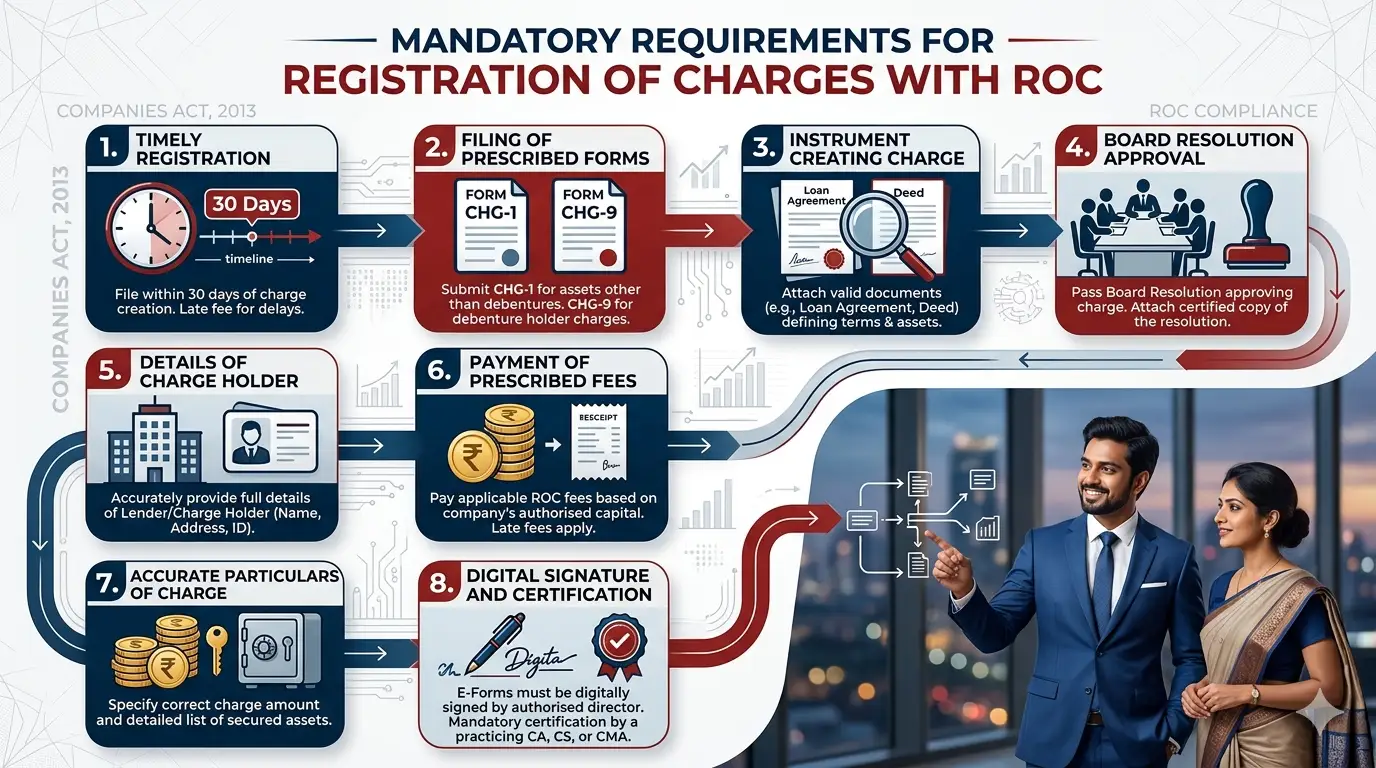
Registering a charge with the Registrar of Companies (ROC) is a crucial compliance requirement under the Companies Act, 2013. It ensures legal validity, protects lender interests, and provides public notice, making the charge enforceable against creditors and other stakeholders.
1. Timely Registration
- The charge must be registered within 30 days from the date of its creation.
- Delayed registration is permitted with additional fees, subject to prescribed extended timelines and approvals.
2. Filing of Prescribed Forms
- Companies must file Form CHG-1 for most charges created on assets other than debentures.
- Form CHG-9 is required specifically for charges created in favour of debenture holders.
3. Instrument Creating Charge
- A valid charge instrument such as a loan agreement or deed must be attached.
- The document should clearly define terms, conditions, and assets charged as security.
4. Board Resolution Approval
- The company’s board must pass a resolution approving the creation of the charge.
- A certified copy of the resolution must be attached with the ROC filing forms.
5. Details of Charge Holder
- Complete details of the lender or charge holder must be accurately provided in forms.
- This includes name, registered address, and identification details of the charge holder entity.
6. Payment of Prescribed Fees
- Applicable ROC filing fees must be paid based on the company’s authorised share capital.
- Additional fees are levied in case of delayed filing beyond the prescribed period.
7. Accurate Particulars of Charge
- The company must provide correct details of the charge amount and secured assets.
- Any incorrect or incomplete information may lead to rejection or legal complications later.
8. Digital Signature and Certification
- The e-forms must be digitally signed by an authorised director or company representative.
- Certification by a practising professional like CA, CS, or CMA is also mandatory.
What is the Step-by-Step Process for Registration of Charge with MCA?
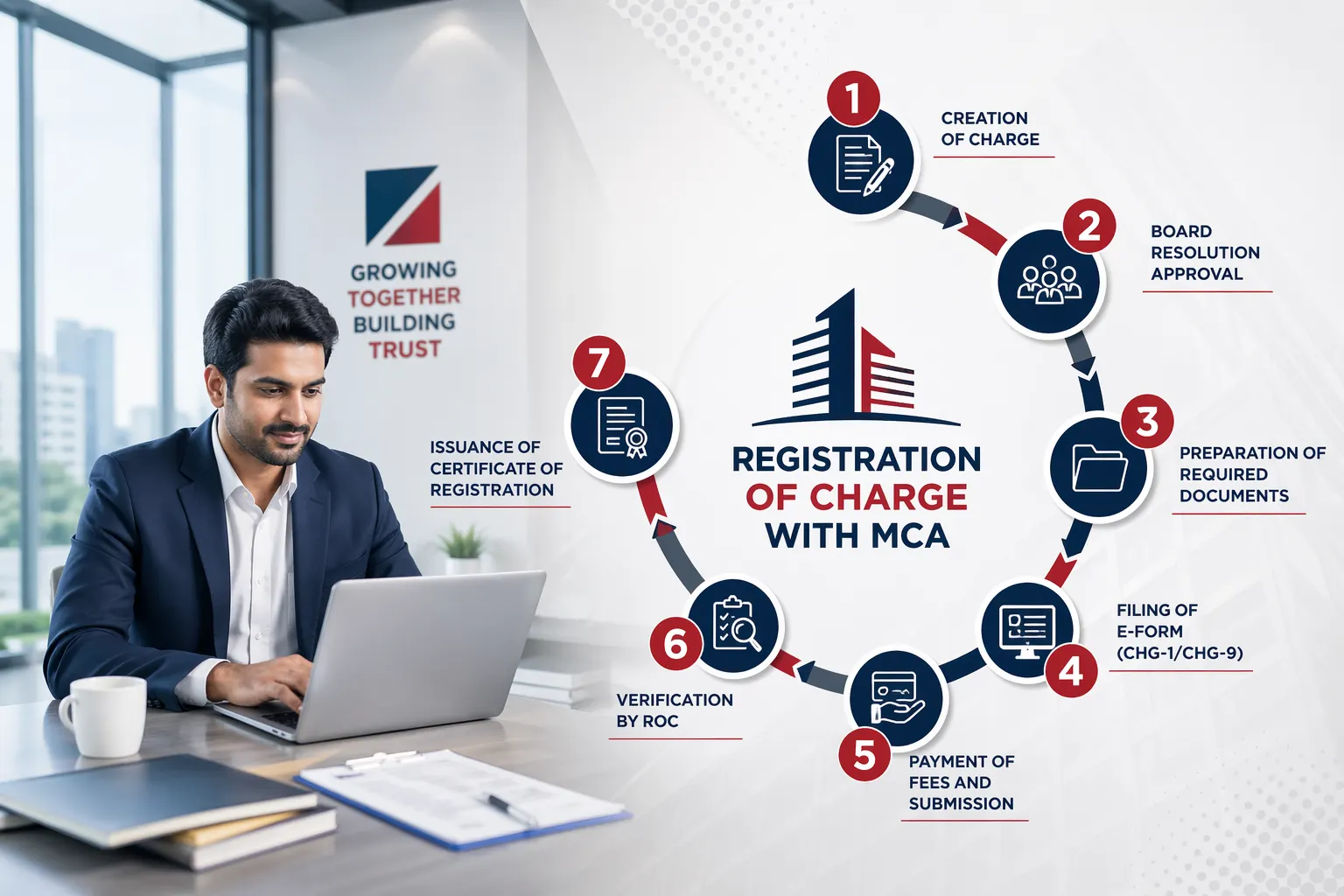
Here is the step-by-step process for the registration of a charge with the MCA:
1. Creation of Charge
The process begins when a company creates a charge over its assets in favour of a lender through a loan agreement or security document. This document clearly defines the terms, conditions, and nature of the charge, including the assets offered as security.
2. Board Resolution Approval
The company must pass a board resolution authorising the borrowing and creation of a charge. This resolution empowers directors or authorised signatories to execute documents and complete necessary filings with the Ministry of Corporate Affairs (MCA).
3. Preparation of Required Documents
All relevant documents, including the charge instrument, loan agreement, and details of the charge holder, must be compiled. Proper documentation ensures accuracy and avoids rejection during filing with the Registrar of Companies (ROC).
4. Filing of E-Form (CHG-1/CHG-9)
The company must file the appropriate e-form CHG-1 for most charges or CHG-9 for debentures on the MCA portal within 30 days of charge creation. The form includes details of the charge, lender, and secured assets.
5. Payment of Fees and Submission
After completing the form, the prescribed ROC filing fees must be paid online. Once submitted, the application is processed electronically, and a Service Request Number (SRN) is generated for tracking the status.
6. Verification by ROC
The ROC examines the application, documents, and details submitted. If any discrepancies are found, resubmission may be required. Proper compliance and accurate information help ensure faster approval without unnecessary delays.
7. Issuance of Certificate of Registration
Upon successful verification, the ROC issues a Certificate of Registration of Charge. This certificate serves as conclusive evidence that the charge has been registered and is legally enforceable against third parties.
What are the Documents Required for Registration of Charges?
The documents required for registration of charges includes the following:
- Loan agreement or sanction letter
- Instrument creating charge deed
- Board resolution copy
- Certificate of incorporation
- Details of charge holder
- Asset details and valuation
- Digital signature certificates (DSC)
- Director identification number (DIN)
- Authorization letter or power of attorney
- Any supplementary agreements or amendments
What is the Time Limits for Registration of Charge with the ROC?
Under the Companies Act, 2013, every company must register a charge with the Registrar of Companies (ROC) within 30 days of its creation. If this deadline is missed, registration is still allowed within an extended period of up to 300 days from the date of creation, subject to payment of additional fees. Beyond this period, registration can only be completed with the approval of the central government. Failure to register within the prescribed timelines may render the charge void against creditors and liquidators, although the underlying debt remains valid, exposing the company to legal and financial risks.
What are the Consequences of Non-Registration of Charges?
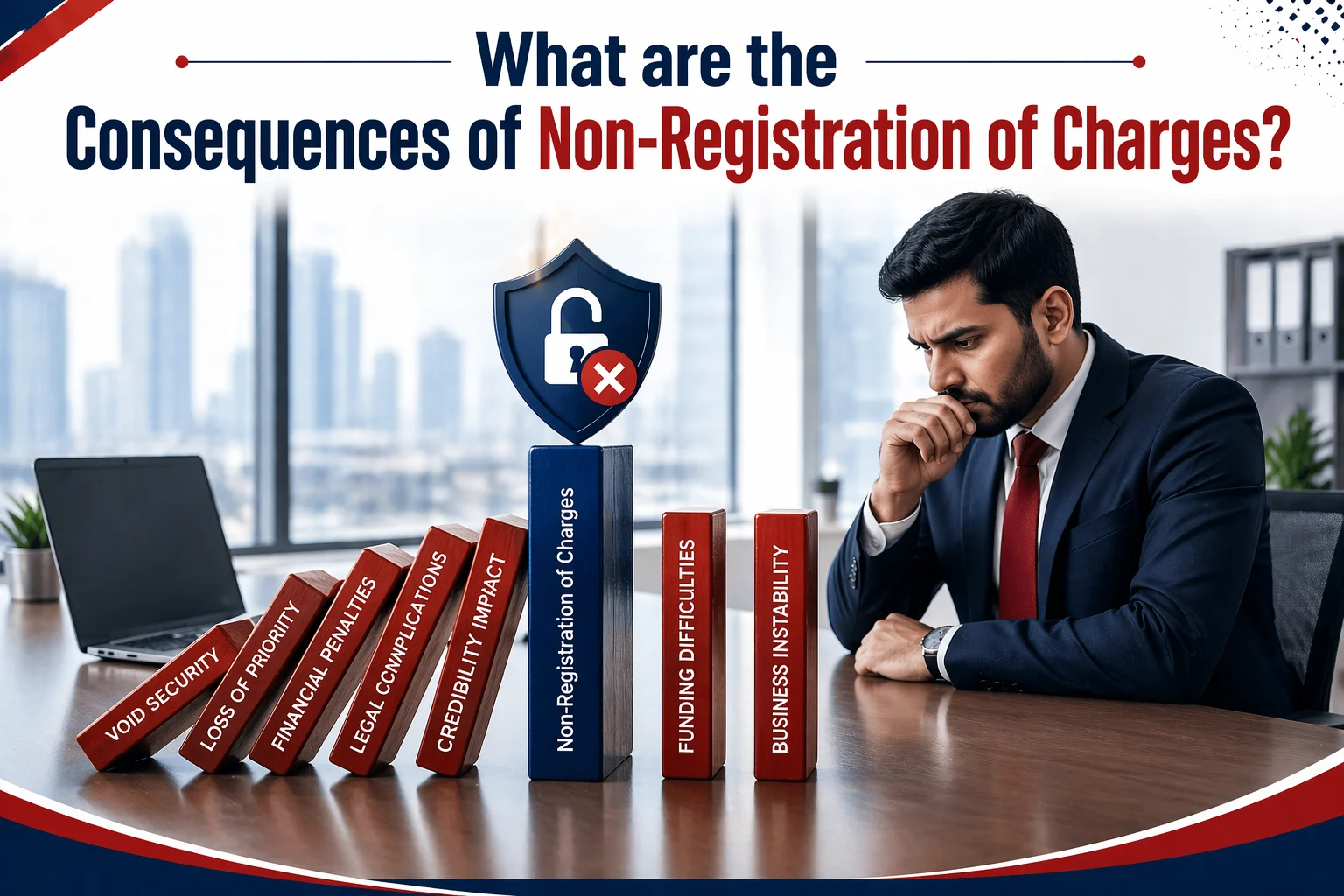
Non-registration of charges with the Registrar of Companies (ROC) can lead to serious legal and financial consequences for a company. Some of them are:
- Charge becomes void: An unregistered charge is not enforceable against liquidators and other creditors during insolvency proceedings.
- Loss of secured creditor status: The lender loses priority and is treated as an unsecured creditor during liquidation or winding up.
- Company remains liable for repayment: Non-registration does not affect the debt, and the company must still repay the borrowed amount.
- Penalties and fines: The company and responsible officers may face penalties for non-compliance with statutory charge registration provisions.
- Adverse impact on company credibility: Failure to register charges reduces lender confidence and negatively affects the company’s ability to secure future funding.
- Legal complications: Unregistered charges create legal uncertainty, making enforcement difficult and increasing risks during litigation or recovery proceedings.
What are the Common Mistakes to Avoid in Charge Registration?
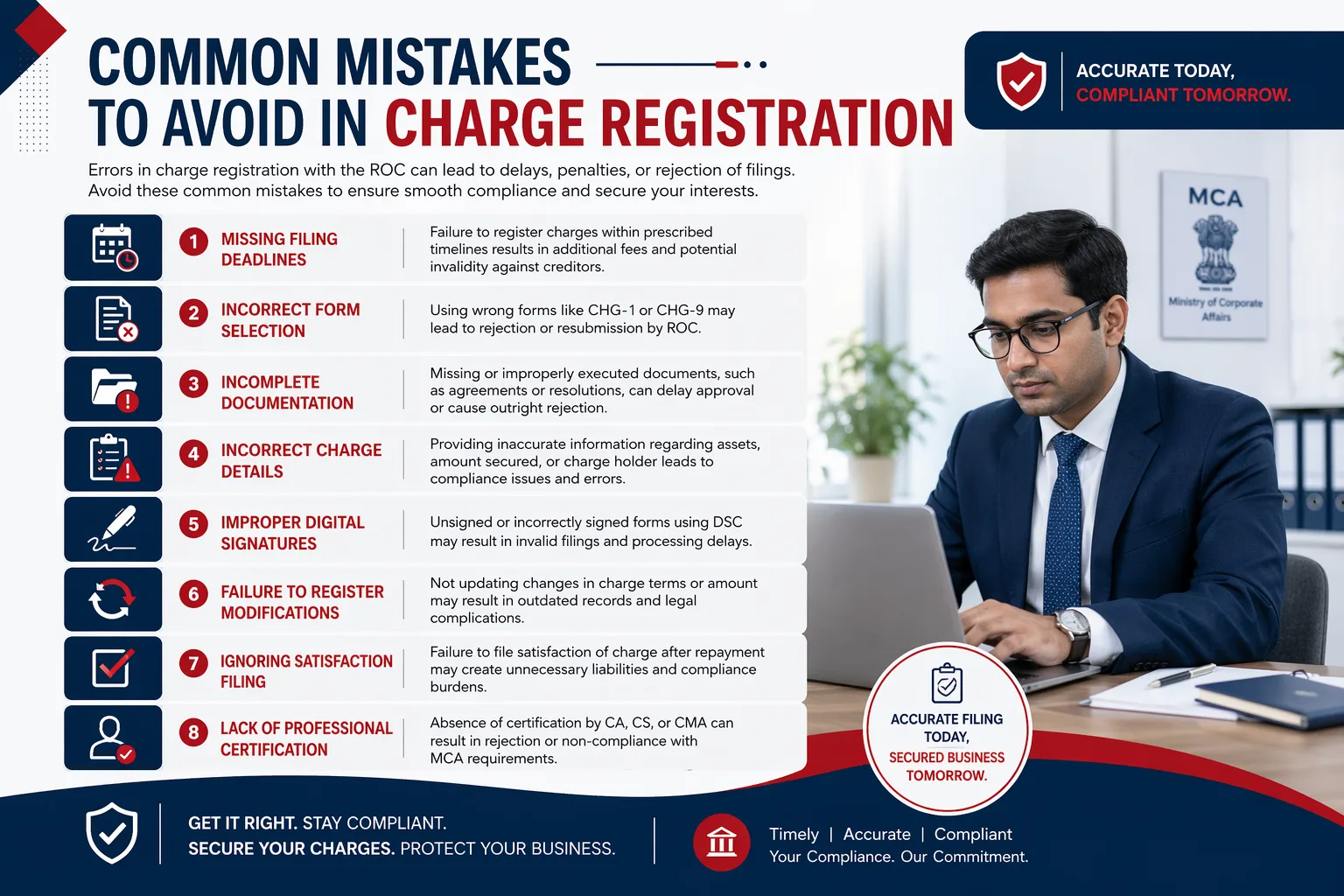
Errors in charge registration with the ROC can lead to delays, penalties, or rejection of filings. Understanding common mistakes helps companies ensure accurate compliance and maintain the validity of their security interests. Some of the key mistakes to avoid include the following:
- Missing Filing Deadlines: Failure to register charges within prescribed timelines results in additional fees and potential invalidity against creditors.
- Incorrect Form Selection: Using wrong forms like CHG-1 or CHG-9 may lead to rejection or resubmission by ROC.
- Incomplete Documentation: Missing or improperly executed documents, such as agreements or resolutions, can delay approval or cause outright rejection.
- Incorrect Charge Details: Providing inaccurate information regarding assets, amount secured, or charge holder leads to compliance issues and errors.
- Improper Digital Signatures: Unsigned or incorrectly signed forms using DSC may result in invalid filings and processing delays.
- Failure to Register Modifications: Not updating changes in charge terms or amount may result in outdated records and legal complications.
- Ignoring Satisfaction Filing: Failure to file satisfaction of charge after repayment may create unnecessary liabilities and compliance burdens.
- Lack of Professional Certification: Absence of certification by CA, CS, or CMA can result in rejection or non-compliance with MCA requirements.
Final Thoughts: Ensure Hassle-Free Compliance with Expert Support!
Registration of a charge is not just a statutory requirement but a critical step in safeguarding a company’s financial interests and maintaining transparency with stakeholders. Timely and accurate filing with the Registrar of Companies ensures that your security interests remain valid and enforceable while also enhancing credibility with lenders and investors.
From understanding legal provisions to managing documentation and deadlines, the process can be complex and time-sensitive. This is where expert assistance becomes valuable. With our professional support you can minimise errors, avoid penalties, and ensure seamless compliance. By choosing our services, you can focus on growth while ensuring smooth legal compliance.
FAQS
Have some questions about Registration of Charges?
We have got you covered:
-
Can a company create multiple charges on the same asset?
Yes, a company can create multiple charges, but priority depends on registration timing and specific terms agreed with lenders.
- Is registration of charge required for short-term loans?
- Who is responsible for filing charge registration with the ROC?
- Can a charge be modified after registration?
- Is stamp duty applicable on charge creation documents?
- Can foreign lenders hold a charge on Indian company assets?
- What happens if incorrect details are filed in CHG forms?
- Is charge registration required for unsecured loans?
- Can ROC reject a charge registration application?
- Can a charge be created on intangible assets?


