

Every business deal looks attractive on paper. The real picture only emerges once someone looks underneath the numbers. A target company may show healthy profits while quietly carrying undisclosed debt, unresolved litigation, or an expired license that could shut down operations overnight. This is exactly why due diligence services in India have become a non-negotiable step before any investment, acquisition, partnership, or major financial commitment.
At LegalBabu, we help businesses, investors, and entrepreneurs uncover what a balance sheet alone cannot tell them. Whether you're acquiring a company, entering a joint venture, raising funds, or simply vetting a new business partner, due diligence is the safeguard that stands between you and an expensive mistake. This guide walks you through everything you need to know, the types of due diligence in India, the due diligence process in India, a practical due diligence checklist India businesses rely on, realistic due diligence costs in India, and how to choose the right due diligence company India has to offer.
What Is Due Diligence and Why Does It Matter?
Due diligence is a structured investigation into a company's financial, legal, operational, and regulatory standing before a transaction is finalized. It is the process by which a buyer, investor, or lender verifies that what they are being told about a business is actually true - and that nothing material has been left out.
Both parties typically sign a Non-Disclosure Agreement (NDA) before the process begins, since sensitive financial records, contracts, and internal data are exchanged. From there, due diligence services in India are usually carried out by chartered accountants, company secretaries, legal experts, and specialized consulting firms like LegalBabu, who examine the target company in detail and present their findings in a formal report.
Skipping this step, or treating it as a formality, is one of the costliest mistakes a business can make. Consider what's at stake:
-
Hidden liabilities - undisclosed loans, pending tax demands, or contingent liabilities that surface only after the deal closes
-
Inflated valuation - paying a premium for a business that isn't actually worth it
-
Legal exposure - inheriting ongoing litigation, regulatory non-compliance, or contractual disputes
-
Operational gaps - discovering that the target company cannot scale or deliver on its projections
-
Compliance penalties - fines and legal action for non-compliance, the buyer didn't even know existed
If you're also evaluating the broader financial picture of a transaction - including valuation, tax structuring, and deal execution - our detailed guide on Transaction Advisory Services explains how due diligence fits into the larger deal lifecycle.
Types of Due Diligence in India
Due diligence is not a single, uniform exercise. Depending on the nature of the transaction, different specialists examine different parts of the business. Here are the main types of due diligence in India that LegalBabu's consulting team typically conducts:
|
Type of Due Diligence |
What It Examines |
Most Critical For |
|
Financial Due Diligence |
Audited financial statements, cash flow, receivables, debt schedules, and Quality of Earnings |
M&A, private equity investment, bank funding |
|
Legal Due Diligence |
Contracts, litigation history, regulatory filings, intellectual property, statutory registers |
Acquisitions, joint ventures, share transfers |
|
Operational Due Diligence |
Business processes, supply chain, IT systems, and workforce capacity |
Post-merger integration, scalability assessment |
|
Tax Due Diligence |
GST returns, income tax filings, TDS compliance, pending notices or assessments |
All transaction types |
|
Commercial Due Diligence |
Market position, competitive landscape, customer concentration |
Investment and expansion decisions |
|
HR and Labour Due Diligence |
Employment contracts, statutory compliance (PF, ESIC), and pending labour disputes |
Workforce-heavy acquisitions |
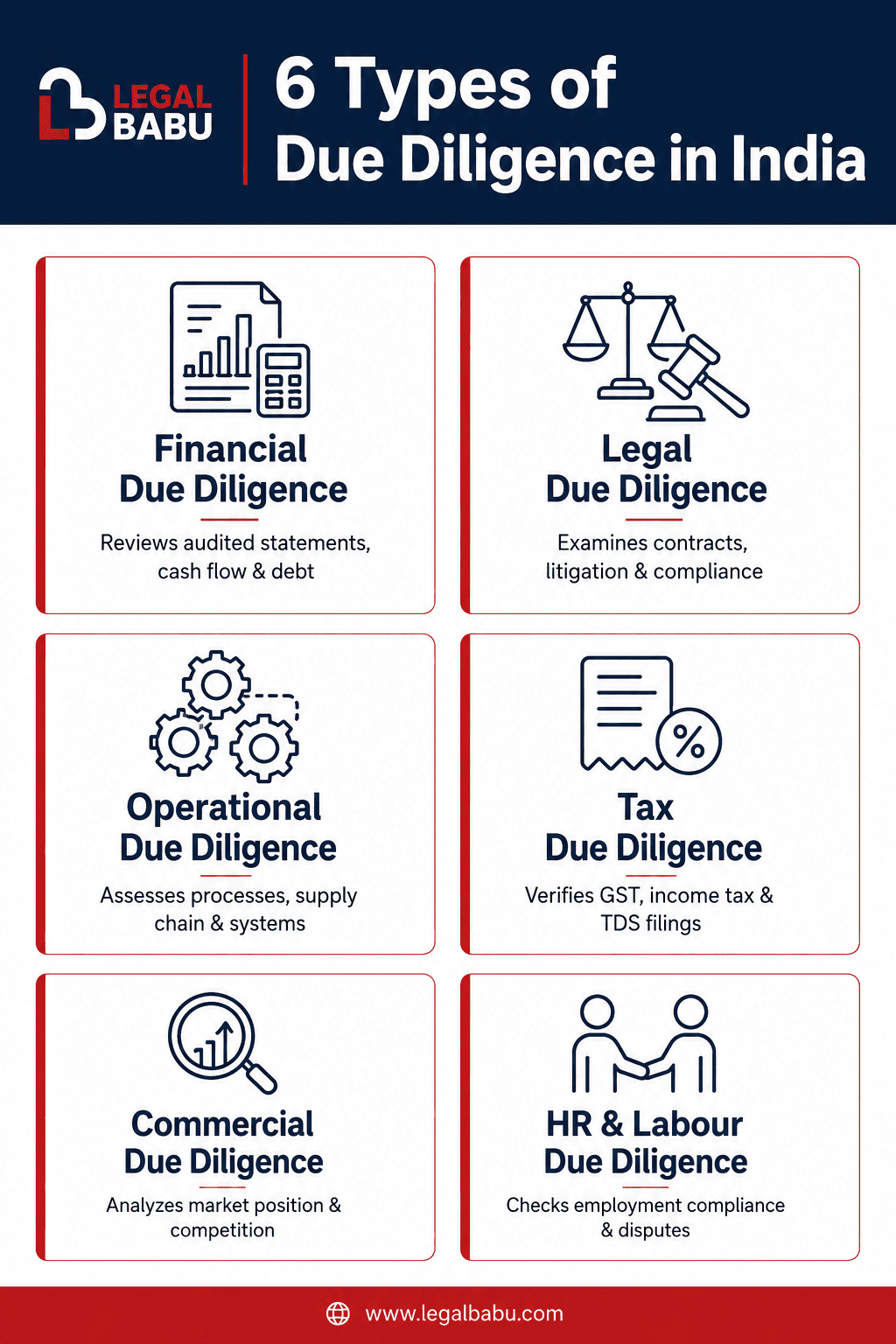
Financial due diligence services form the backbone of most transactions because they reveal whether the numbers a seller presents actually hold up under scrutiny. Legal due diligence services India providers offer go a step further, examining whether the company's legal foundation - its incorporation documents, shareholding pattern, and contractual obligations - is sound enough to support a clean transfer of ownership.
For businesses planning a sale, our resource on Business for Sale services explains how proper due diligence preparation can directly improve your negotiating position and final valuation.
The Due Diligence Process in India: Step by Step
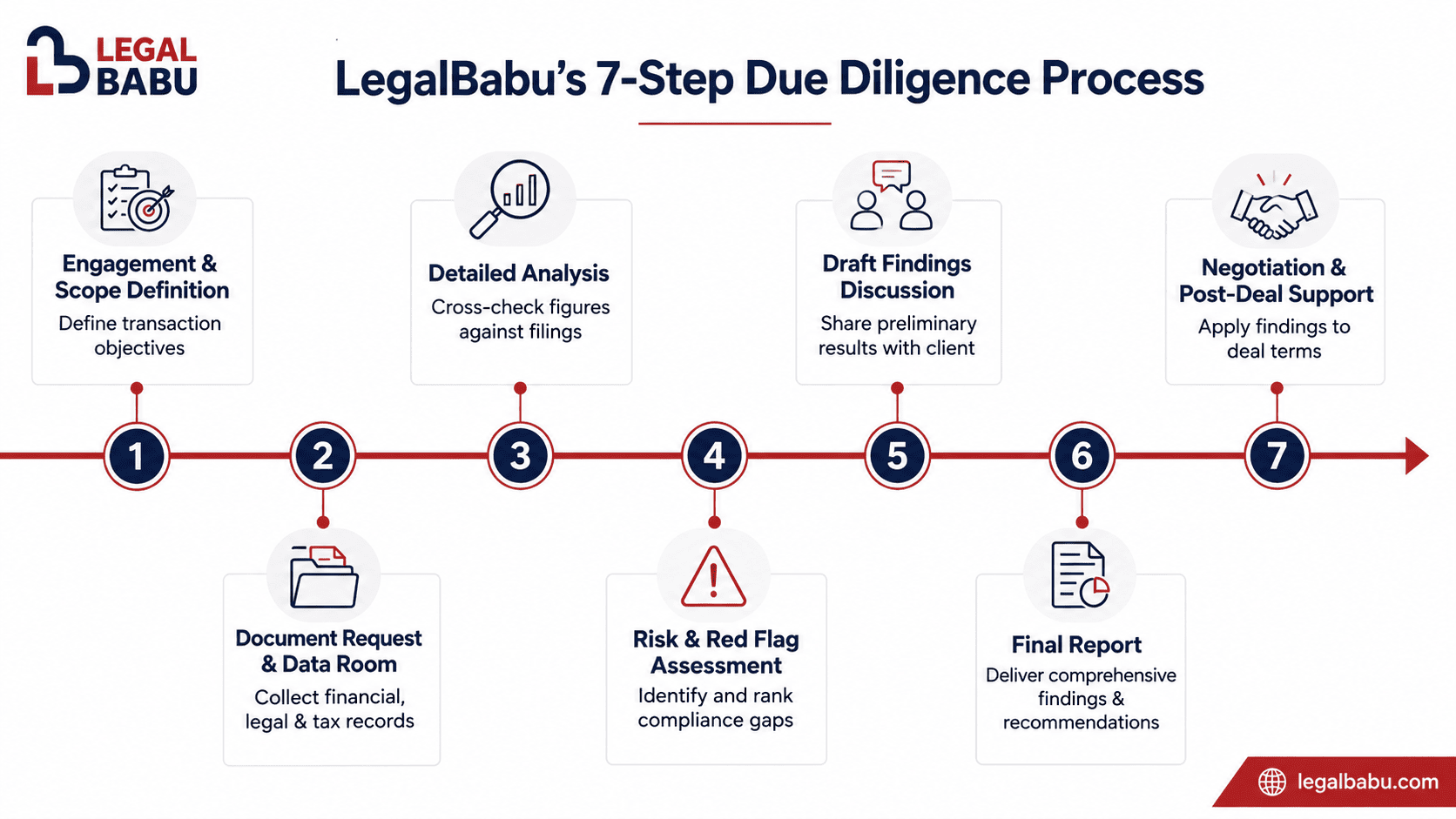
A well-executed due diligence process in India follows a structured sequence. While the exact scope varies by transaction size and complexity, LegalBabu's approach generally covers these stages:
-
Engagement and Scope Definition - We begin with a detailed consultation to understand the transaction objective and define exactly which areas of due diligence are required.
-
Document Request and Data Room Setup - The target company is asked to compile financial, legal, tax, and operational records into a secure data room for review.
-
Detailed Analysis - Our team examines each document category, cross-references figures against statutory filings, and flags inconsistencies.
-
Risk and Red Flag Assessment - Every irregularity, compliance gap, or disclosure issue is documented and ranked by severity.
-
Draft Findings and Discussion - Preliminary results are shared with the client so concerns can be addressed before the deal proceeds further.
-
Final Due Diligence Report - A comprehensive report is delivered, summarizing findings and offering practical recommendations.
-
Negotiation and Post-Deal Support - Findings are used to renegotiate terms, adjust valuation, or build protective clauses into the final agreement.
This structured methodology mirrors the broader deal framework we follow in our Transaction Advisory Services, which covers due diligence as one pillar of a complete pre-transaction strategy.
Due Diligence Checklist India Businesses Should Prepare
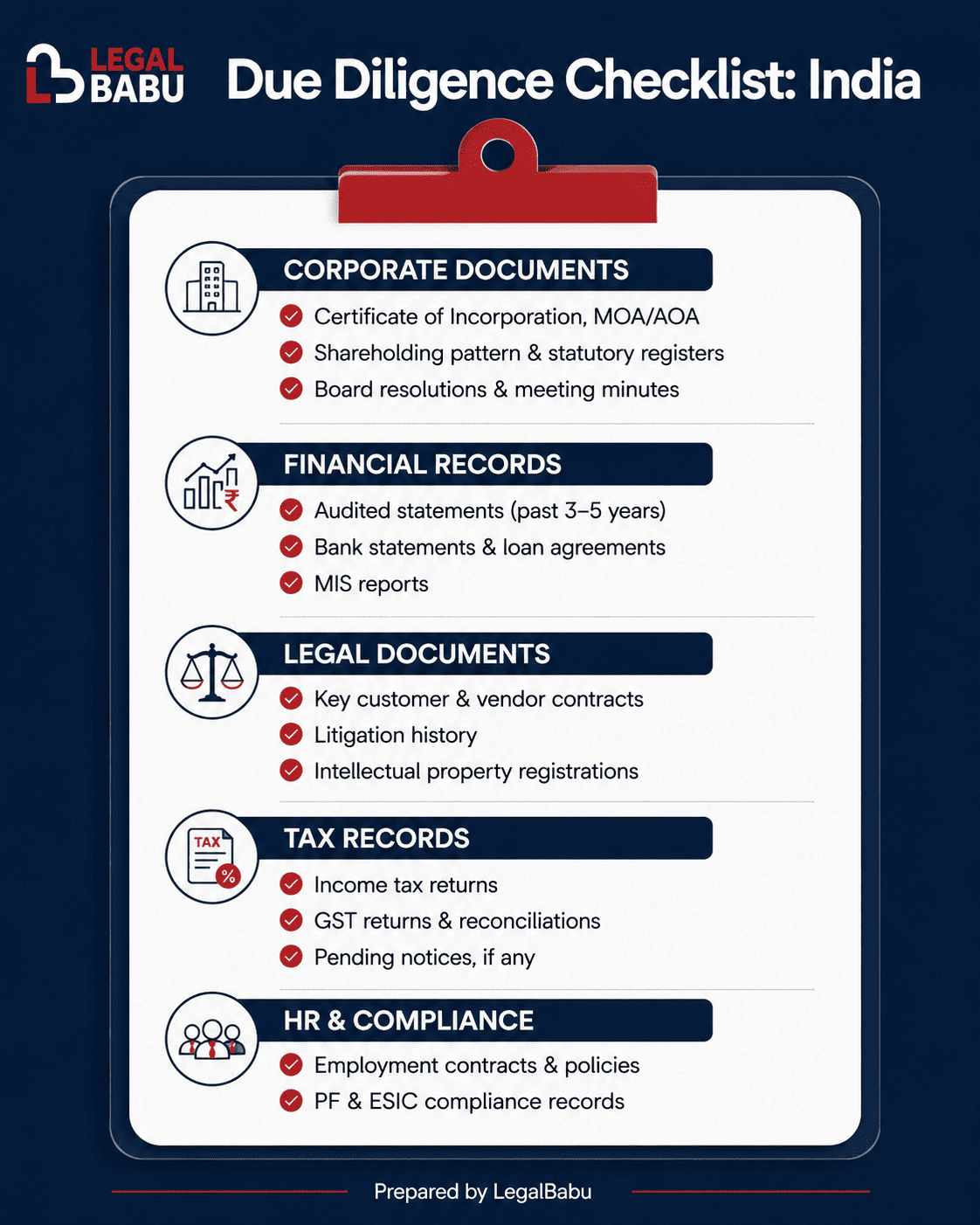
A clear due diligence checklist that Indian companies and investors can follow makes the entire process faster and less stressful. Here's what is typically requested:
Corporate Documents
-
Certificate of Incorporation, Memorandum and Articles of Association
-
Shareholding pattern and statutory registers
-
Board resolutions and minutes of meetings
Financial Records
-
Audited financial statements for the past 3–5 years
-
Bank statements, loan agreements, and debt schedules
-
Management Information System (MIS) reports
Legal Documents
-
Key customer, vendor, and lease agreements
-
Records of pending or past litigation
-
Intellectual property registrations
Tax Records
-
Income tax returns and assessment history
-
GST returns and reconciliation statements
-
Any pending notices from tax authorities
HR and Compliance
-
Employment contracts and HR policies
-
PF, ESIC, and labour law compliance records
If you're in the early stages of formalizing your business structure before a transaction, our guide on Private Limited Company Registration is a useful starting point, since a clean corporate structure makes due diligence significantly smoother.
Due Diligence Cost in India: What Influences Pricing
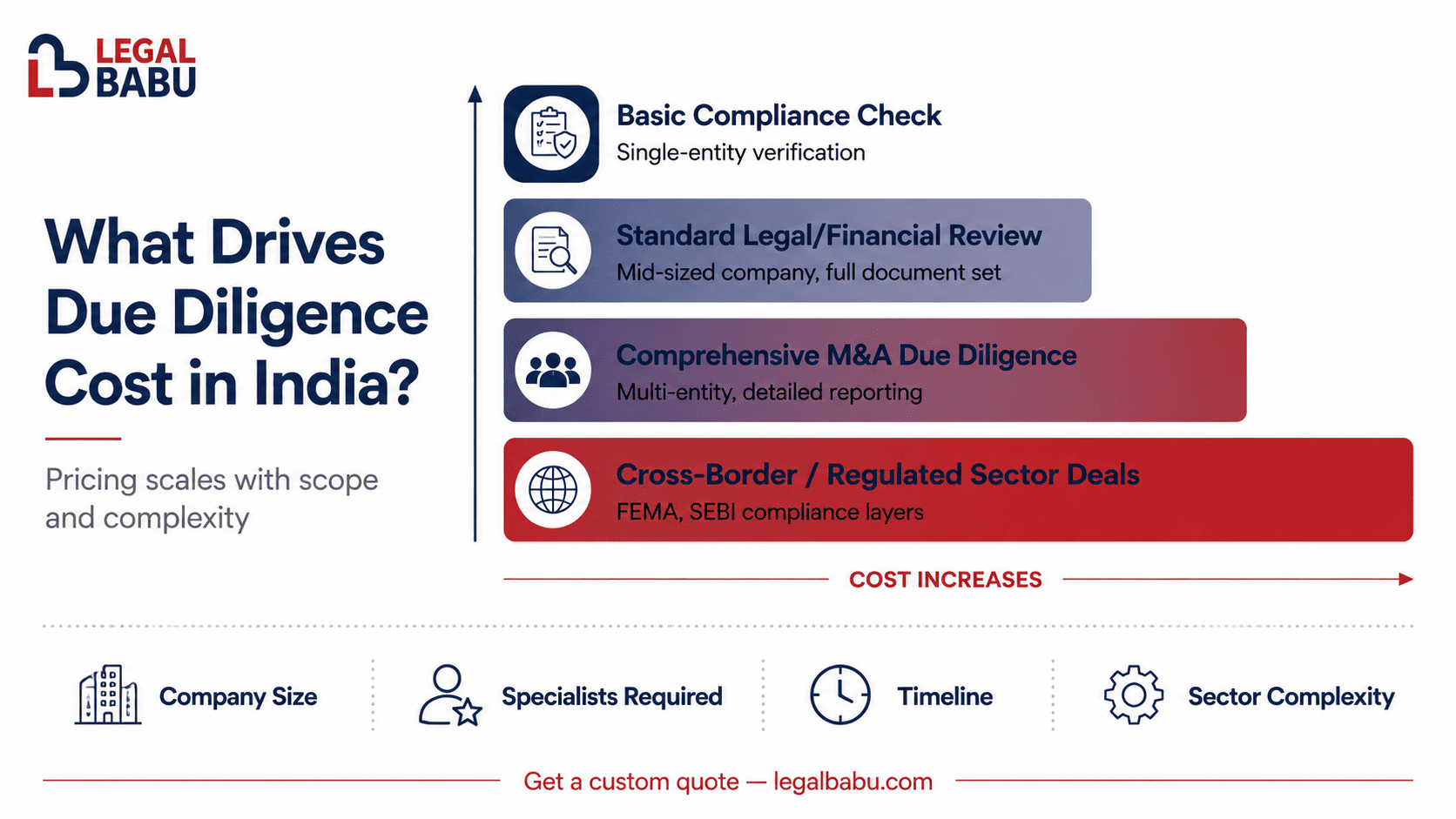
One of the most common questions businesses ask is about due diligence costs in India. There's no fixed, one-size-fits-all number - pricing depends on the scope, complexity, and depth of the engagement. That said, here's a general sense of how costs typically scale:
|
Engagement Type |
Indicative Scope |
Cost Range (Approximate) |
|
Basic compliance/background check |
Single-entity verification, limited document review |
Lower end of the spectrum |
|
Standard legal or financial review |
Mid-sized company, full document set |
Moderate, scope-dependent |
|
Comprehensive M&A due diligence |
Multi-entity, cross-functional, detailed reporting |
Higher, often quoted per engagement |
|
Cross-border or regulated-sector deals |
FEMA, SEBI, or sector-specific compliance layers |
Premium, based on complexity |
Key factors that influence the final quote include the size of the target company, the number of specialists required (legal, financial, tax, HR), the transaction timeline, and whether the deal involves cross-border or regulated-sector elements. LegalBabu does not believe in one-size-fits-all pricing - every engagement is scoped after an initial assessment, so you know exactly what you're paying for and why.
Regulatory Framework Governing Due Diligence in India
India's due diligence landscape is shaped by a layered regulatory framework. Understanding these laws helps explain why due diligence is not optional for serious transactions:
-
Companies Act, 2013 - Governs incorporation, statutory filings, shareholding records, and corporate governance. Most legal due diligence begins with verifying a company's filings on the Ministry of Corporate Affairs (MCA) portal, which maintains the official record of every registered company and LLP in India.
-
Income Tax Act - Mandates accurate disclosure of income, deductions, and tax liabilities. Tax due diligence typically cross-checks filings against records available through the Income Tax Department's official portal.
-
Goods and Services Tax (GST) Law - Indirect tax compliance is verified through return filings and reconciliation, with official records accessible via the GST Portal.
-
SEBI Regulations - For listed companies or those raising capital through public markets, compliance with SEBI's Listing Obligations and Disclosure Requirements (LODR) is essential. The Securities and Exchange Board of India (SEBI) website hosts all relevant circulars and regulations.
This regulatory backbone is why corporate due diligence services must be handled by professionals who understand not just the numbers, but the specific compliance obligations attached to each filing.
Due Diligence for Mergers and Acquisitions
Due diligence for mergers and acquisitions is arguably the most intensive form of this process, since the stakes - and the potential for hidden risk - are highest. In an M&A transaction, due diligence serves three critical purposes:
-
Verifying the deal rationale - Confirming that the target company's financial and operational claims match reality
-
Identifying negotiation leverage - Uncovered risks or undervalued assets often translate directly into better deal terms
-
Shaping the final agreement - Findings from due diligence are used to draft indemnity clauses, warranties, and price adjustments in the Share Purchase Agreement
For businesses navigating this process, understanding company structure differences is equally important. Our comparison guide on types of business structures in India can help you evaluate how an M&A target's legal form affects liability and deal complexity.
Due Diligence Before Business Acquisition: A Buyer's Safeguard
Due diligence before business acquisition is what separates a confident purchase from a regrettable one. Before you commit capital to acquiring a company, due diligence answers three fundamental questions:
-
Does the business actually own what it claims to own?
-
Are the financial statements accurate and sustainable?
-
Are there any undisclosed liabilities, disputes, or compliance gaps that could affect the deal?
Buyers who skip this step often discover problems only after the transaction has closed - at which point legal recourse is far more limited and expensive than catching the issue beforehand. This is why engaging a qualified due diligence company India trusts, before signing any binding agreement, is one of the smartest financial decisions a buyer can make.
How to Choose the Right Due Diligence Company in India
With the rising complexity of Indian business transactions, choosing the right partner matters as much as the process itself. Here's what to evaluate:
-
Sector expertise - A firm familiar with your industry will spot risks that generic reviewers miss
-
Turnaround time - Deals move fast; your due diligence partner should match that pace without cutting corners
-
Transparent reporting - Findings should be explained clearly, not buried in jargon
-
Cross-functional capability - The best providers combine legal, financial, and tax expertise under one roof
-
Post-deal support - A good partner doesn't disappear after the report is delivered; they help you act on the findings
LegalBabu's consulting team brings together chartered accountants, company secretaries, and legal professionals to deliver due diligence that's both technically rigorous and commercially useful.
Who Needs Due Diligence Services?
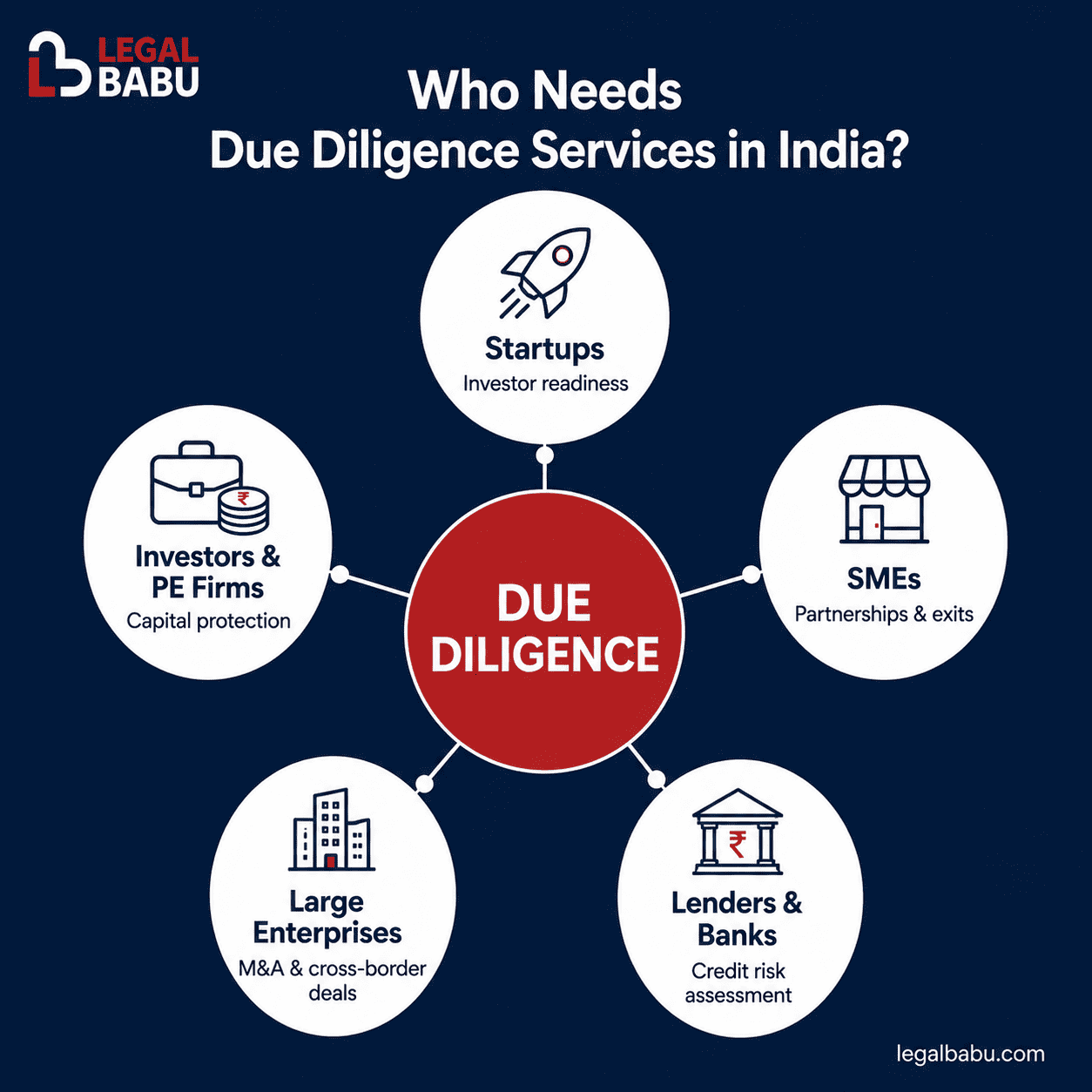
Due diligence isn't limited to large corporate transactions. Here's who relies on it most:
-
Startups - To validate growth metrics and prepare for investor scrutiny during funding rounds
-
Small and Medium Enterprises - Before entering partnerships, raising debt, or planning an exit
-
Investors and Private Equity Firms - To verify target companies before committing capital
-
Large Enterprises - For complex domestic and cross-border mergers and acquisitions
-
Lenders and Banks - Before extending significant credit facilities
LegalBabu's Due Diligence Services: What We Offer
At LegalBabu, our consulting services include end-to-end due diligence support tailored to your transaction:
-
Financial due diligence and Quality of Earnings analysis
-
Legal due diligence covering contracts, litigation, and compliance
-
Tax due diligence across GST, income tax, and TDS records
-
Operational and HR due diligence
-
Comprehensive due diligence reports with actionable recommendations
-
Post-deal negotiation and integration support
We also assist clients in preparing for due diligence - not just undergoing it. If you're planning to raise capital or sell your business, our guide on the differences between a Private Limited Company and Sole Proprietorship can help you understand how your business structure affects buyer confidence during diligence.
Conclusion
Due diligence is not a box-ticking exercise - it's the foundation of every safe, well-informed business decision. Whether you're acquiring a company, raising funds, or entering a new partnership, due diligence services in India give you the clarity to move forward with confidence or the evidence to walk away from a bad deal. LegalBabu combines financial, legal, and regulatory expertise to deliver due diligence that protects your capital and strengthens your negotiating position. Contact LegalBabu today to discuss your due diligence requirements and take the next step in your transaction with complete confidence.
FAQS
FAQs About Due Diligence service
-
What is the meaning of due diligence in business?
Due diligence is a structured investigation into a company's financial, legal, and operational standing, conducted before a transaction to verify that the information presented is accurate and complete.
- What are the main types of due diligence in India?
- How long does the due diligence process in India typically take?
- What is the difference between due diligence and an audit?
- Is due diligence legally mandatory for mergers and acquisitions in India?
- What documents are required for due diligence in India?
- How much do due diligence services cost in India?
- What happens if due diligence is not done properly?
- Who typically conducts due diligence for companies in India?
- What are common red flags discovered during due diligence?
- Can due diligence be done before signing a term sheet?
- Does LegalBabu sign a Non-Disclosure Agreement before reviewing financial documents?


