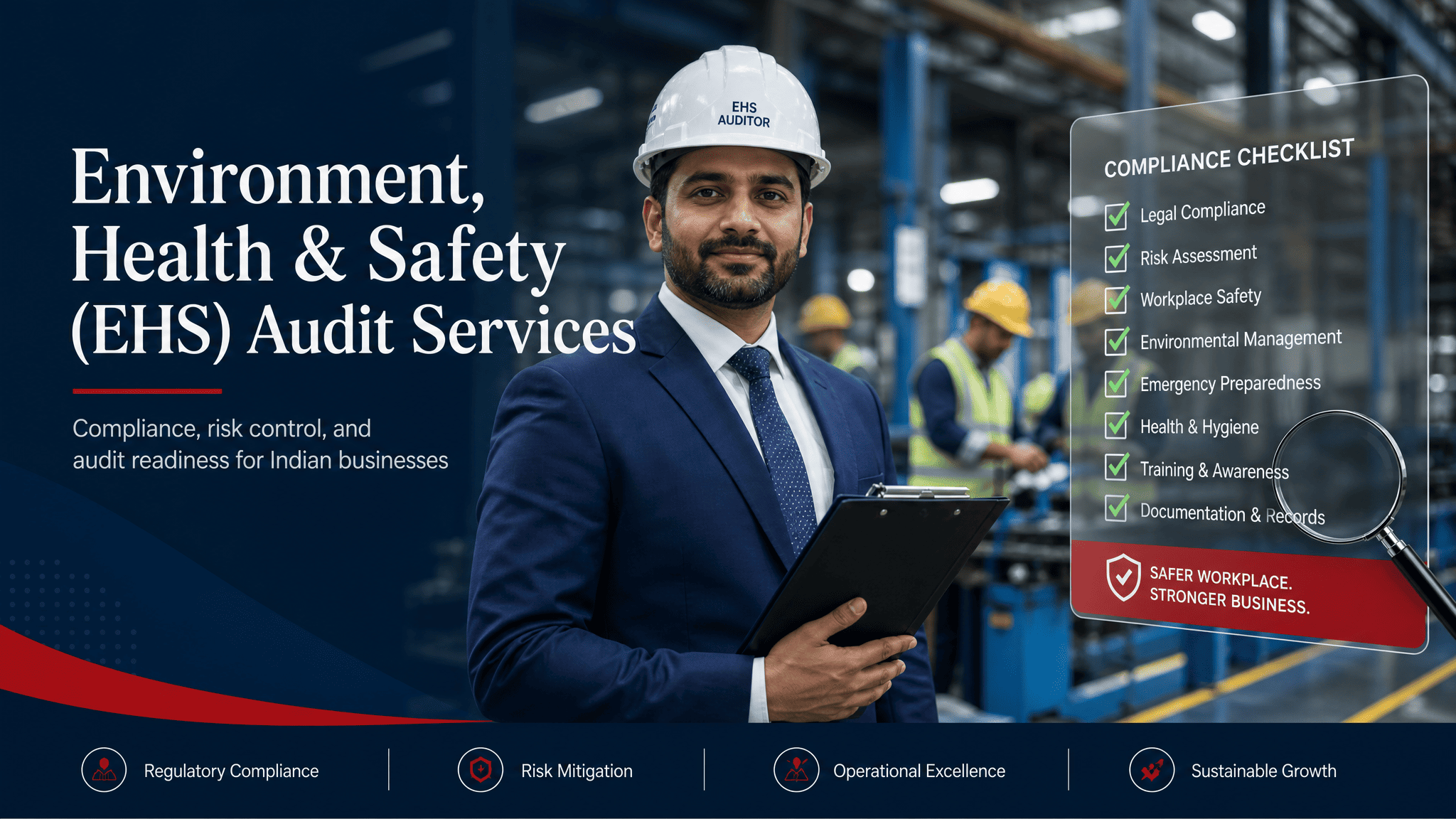
Running a business in India today means managing much more than production, manpower, and profitability. It also means managing legal compliance, workplace safety, environmental responsibilities, inspection readiness, documentation control, and operational risk. That is exactly where Environment, Health & Safety (EHS) audit services become essential.
At LegalBabu, our EHS audit services are designed for Indian factories, manufacturers, warehouses, service operators, contractors, exporters, and growing businesses that want to stay compliant, reduce risk, strengthen internal controls, and improve audit readiness. Whether your concern is statutory safety compliance, pollution-control documentation, customer due diligence, vendor risk review, or management-system preparedness, a well-executed EHS audit helps you identify gaps before they turn into penalties, delays, or operational disruption.
An EHS audit is a structured, evidence-based review of how your business handles environmental compliance, worker health, safety controls, statutory registers, hazardous processes, emergency preparedness, and ongoing governance. For businesses operating in regulated sectors, this is not just good practice. In many cases, it is deeply connected to occupier duties, worker protection, hazardous-process control, and regulator-facing documentation under Indian law (Factories Act, 1948 – India Code).
What Are EHS Audit Services?
EHS audit services are professional review and reporting services that examine whether a business is adequately managing three critical compliance pillars:
-
Environment - pollution control, waste handling, environmental statements, resource-use documentation
-
Health - worker welfare, hygiene, medical arrangements, occupational health measures
-
Safety - machine safety, PPE, hazard control, fire readiness, emergency response
In practical terms, an Environment, Health & Safety audit checks whether the organisation has the right systems, records, permits, controls, training, supervision, and follow-up mechanisms in place. A quality EHS audit service does not merely point out defects. It helps management understand what is legally required, what is operationally weak, what needs urgent correction, and what should be improved for long-term compliance maturity.
At LegalBabu, our audits focus on both legal exposure and business practicality. That means we do not look at safety in isolation. We connect EHS performance with documentation quality, compliance workflow, supplier risk, audit-readiness, and business continuity. This connects naturally with our other structured reviews such as Due Diligence Services, Vendor Assessment Service, and MCA Services.
Why EHS Audit Services Matter for Indian Businesses
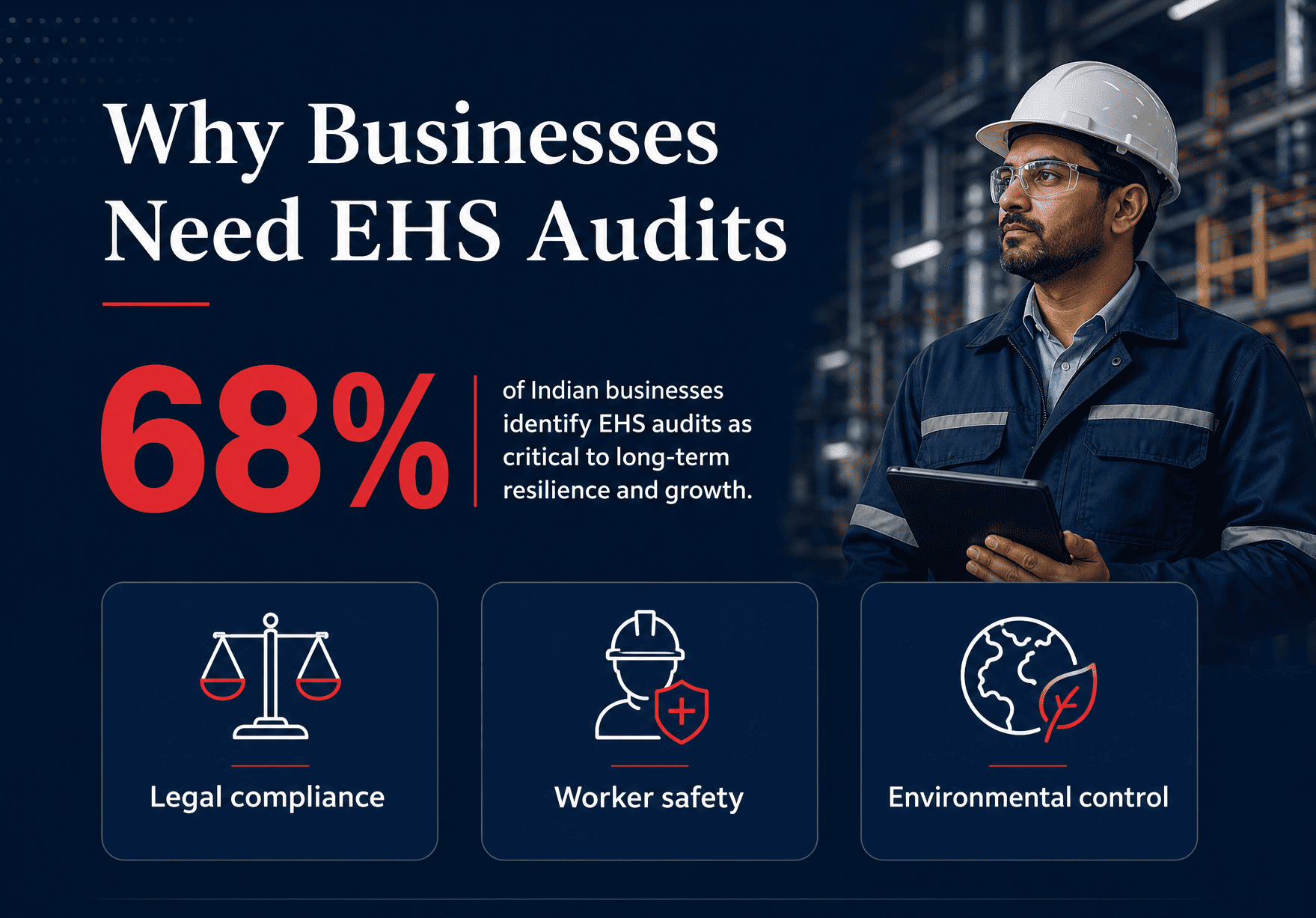
A lot of businesses wait for a notice, a customer query, a certification requirement, or an accident before they think about safety and environmental compliance. That approach is expensive. A proactive EHS audit helps you fix issues before they become regulatory findings or business losses.
Key reasons businesses opt for EHS audit services
|
Reason |
Why it matters |
|
Legal compliance |
Assesses duties under factory, safety, health, and environmental laws |
|
Risk reduction |
Identifies unsafe conditions, weak controls, and documentation gaps |
|
Inspection readiness |
Improves preparedness for labour, factory, and pollution-control scrutiny |
|
Customer confidence |
Supports onboarding for buyers, vendors, and institutional clients |
|
ESG readiness |
Helps listed and growing businesses prepare stronger disclosure records |
|
Liability control |
Good systems reduce avoidable incidents and internal exposure |
|
Management visibility |
Gives promoters and directors a clear compliance snapshot |
Under Section 7A of the Factories Act, 1948, the occupier must ensure - so far as reasonably practicable - the health, safety, and welfare of workers, including safe systems of work, proper handling of substances, necessary training, and a safe working environment (Factories Act – India Code).
The Occupational Safety, Health and Working Conditions Code, 2020, similarly places clear responsibilities on employers to maintain hazard-free workplaces, follow notified occupational safety and health standards, and support safety governance. It also empowers the government to notify third-party audit and certification schemes (OSH Code, 2020 – India Code).
For larger listed entities, sustainability disclosure expectations have also become more structured. SEBI's BRSR framework and phased BRSR Core applicability have pushed businesses to take workplace safety, environmental management, and governance documentation more seriously (SEBI BRSR Circular).
Types of EHS Audits
Not all EHS audit types are the same. Choosing the right one saves time and ensures relevance. Below are the six most common variants used in India.
|
Audit Type |
What It Covers |
Frequency |
|
Compliance Audit |
Legal & statutory conformance (Factories Act, CPCB, SPCB) |
Annually |
|
Management System Audit |
Annually |
|
|
Process/Operational Audit |
SOPs, permit-to-work, machine guarding |
Bi-annually |
|
Internal EHS Audit |
In-house team, continuous improvement |
Quarterly |
|
External EHS Audit |
Independent third-party audit - highest credibility |
Annually |
|
Due Diligence EHS Audit |
Pre-M&A, investment, or vendor onboarding |
Transaction-based |
For M&A transactions, an external EHS audit is usually combined with financial and legal reviews - see LegalBabu's Due Diligence Services for an integrated approach.
Who Should Get an EHS Audit Done?
LegalBabu's EHS audit services are relevant for:
-
Manufacturing units
-
Engineering plants
-
Chemical and hazardous-process facilities
-
Warehouses and logistics operators
-
Food processing businesses
-
Packaging units
-
Exporters and merchant manufacturers
-
Construction-linked businesses
-
Vendor-dependent businesses
-
Businesses preparing for customer audits, investor reviews, or internal governance upgrades
Even if a business is not facing an immediate regulatory trigger, an EHS audit remains valuable when management wants stronger operational discipline. It also supports businesses building internal compliance systems alongside other structured reviews available through Transaction Advisory Services and the broader resources published in LegalBabu Learn.
What LegalBabu Reviews During an EHS Audit
Our EHS audit services are tailored, but typically cover the following audit blocks:
1. Legal and statutory review
We check whether the business holds and maintains relevant registrations, approvals, consents, notices, and internal records connected with environmental and safety management.
2. Workplace safety controls
This includes machine guarding, access control, electrical safety basics, housekeeping, PPE use, emergency signage, fire-readiness, and unsafe-condition identification.
3. Hazardous-process and material controls
Where relevant, we review storage practices, chemical handling, hazard communication, emergency procedures, exposure controls, and related documentation.
4. Health and welfare systems
We assess whether the workplace is maintaining essential worker-health and welfare arrangements in line with applicable duties and operating realities.
5. Environmental compliance documentation
This includes pollution-control documentation, resource-use tracking, waste handling records, and annual environmental statement readiness. Form V under the Environment (Protection) Rules requires covered industries to furnish an environmental statement for the financial year ending 31 March on or before 30 September every year (Form V PDF).
6. Governance and reporting
We review whether management has a clear system for responsibilities, review, escalation, corrective action tracking, and audit closure.
Where businesses intend to build a long-term compliance framework rather than address one-off audit findings, LegalBabu also supports internationally recognised management systems, including ISO 45001 for occupational health and safety, ISO 14001 for environmental management, and ISO 50001 for energy management.
EHS Audit Scope Snapshot
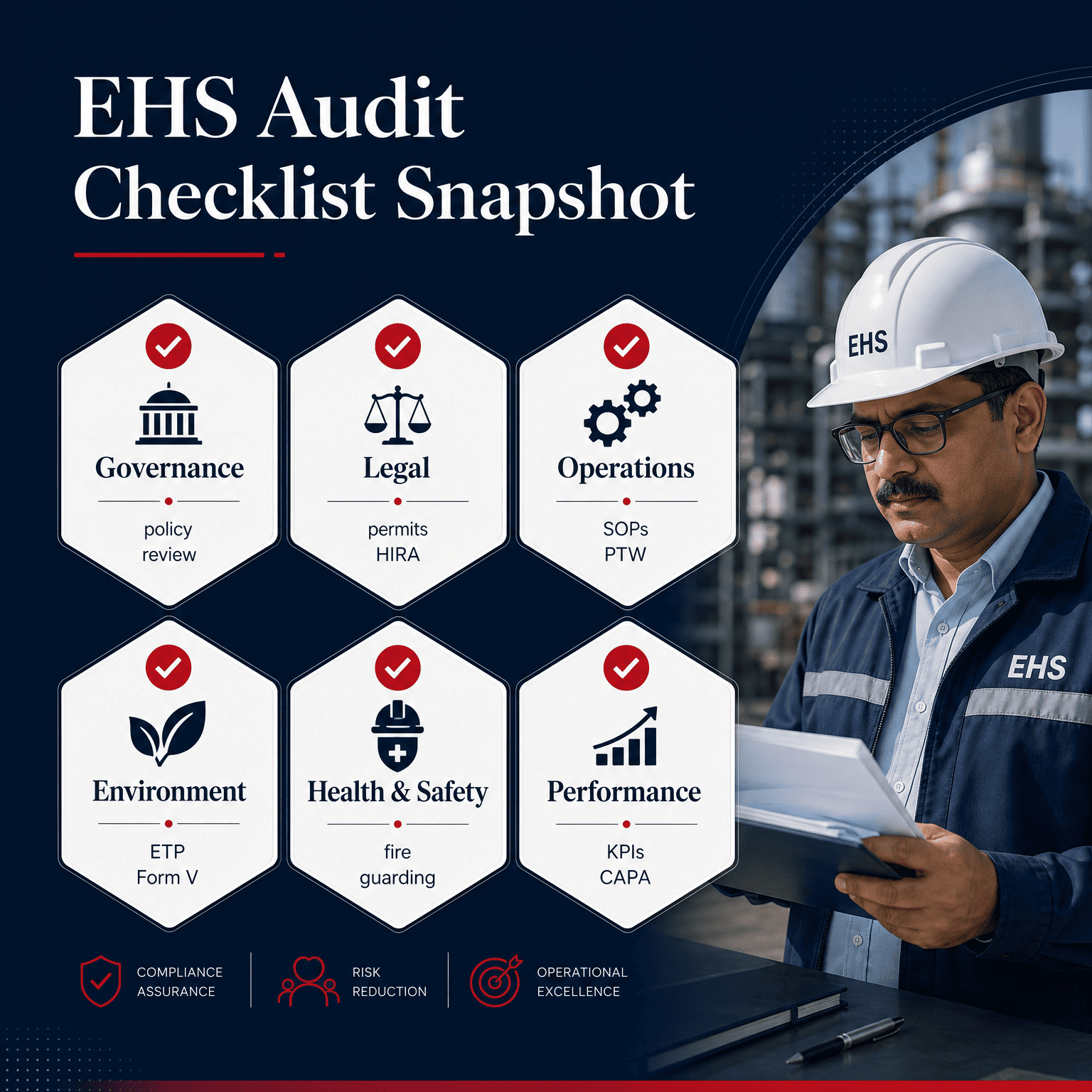
|
Audit area |
Typical review points |
|
Governance |
EHS policy, responsibility matrix, management review |
|
Safety |
PPE, signage, guarding, access, training, emergency response |
|
Health |
Worker welfare, medical support arrangements, hygiene controls |
|
Environment |
Waste handling, emissions/effluent records, Form V readiness |
|
Legal records |
Permits, registers, notices, internal records, evidence trail |
|
Corrective action |
Non-conformity tracking, ownership, timelines, closure status |
Why Environmental Compliance Is a Major EHS Component
Many businesses think EHS audits are only about hard hats and safety notices. That is incomplete. Environmental compliance is a core part of a proper Environment, Health & Safety audit.
The Central Pollution Control Board operates as the national technical body for pollution-control administration under the Ministry of Environment, Forest and Climate Change, and businesses often need to align their internal practices with pollution-control requirements, state board expectations, and environmental documentation norms (CPCB).
The broader statutory foundation continues to come from the Environment (Protection) Act, 1986, which empowers the framework for environmental standards, discharge and emission controls, and rule-making (MoEFCC).
Organisations planning to formalise their environmental management practices may also consider ISO 14001 Environmental Management Certification, which provides a structured framework for managing environmental risks, legal compliance, and continual improvement.
Our EHS Audit Process at LegalBabu
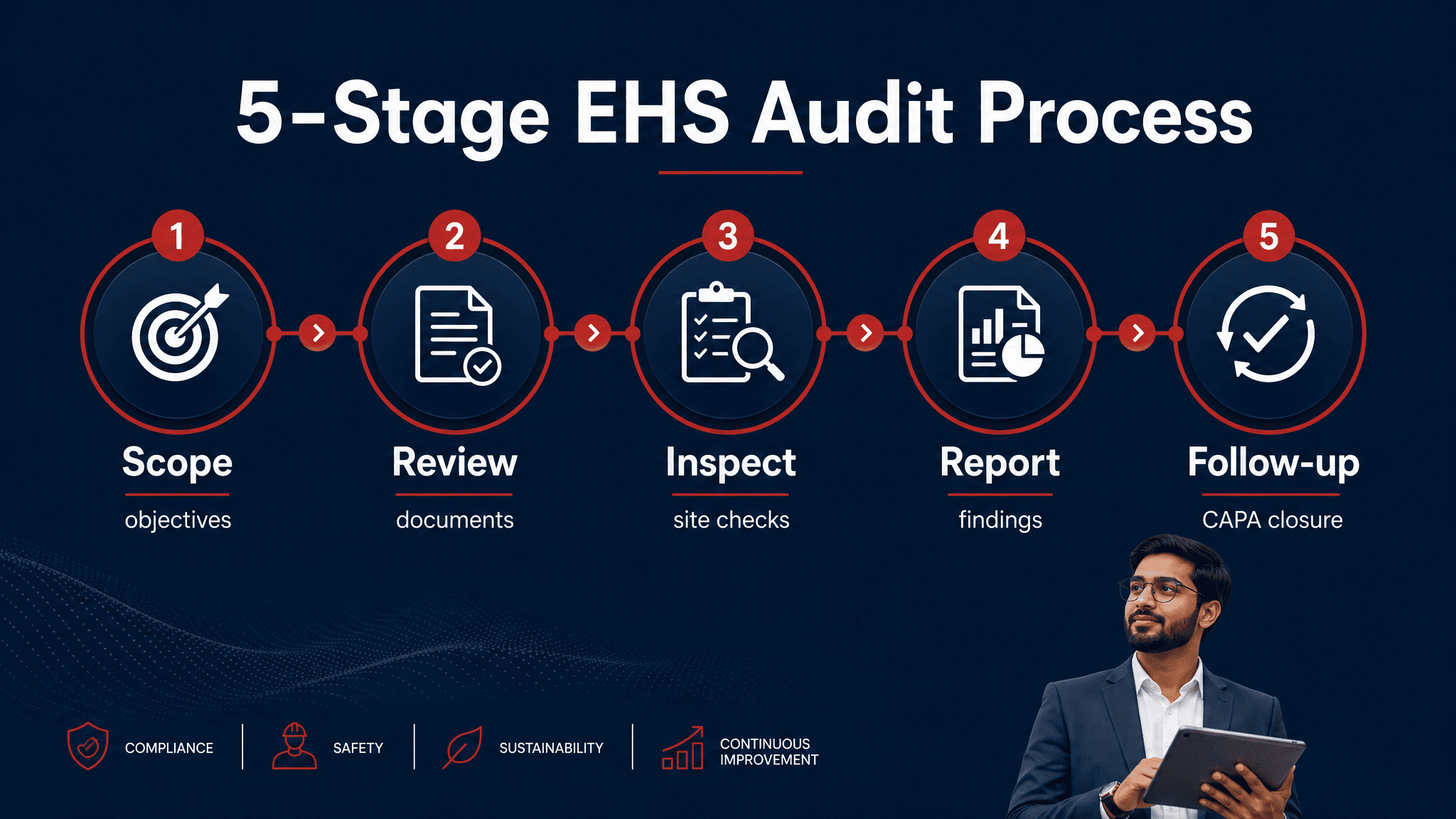
We keep the EHS audit process practical and business-friendly.
Step 1: Requirement scoping
We understand the type of unit, business activity, regulatory context, and audit objective.
Step 2: Document review
We review available licenses, registers, consent-related papers, operating documents, and internal compliance evidence.
Step 3: Site-level assessment
Where required, we conduct a structured on-site review of systems, workplace conditions, controls, and risk points.
Step 4: Gap analysis
We identify non-compliance areas, weak controls, documentation gaps, and improvement opportunities.
Step 5: Report and action roadmap
You receive a business-readable report with findings, priorities, and practical corrective action points - followed by CAPA (corrective and preventive action) closure support.
Where needed, LegalBabu can support next-step compliance work, corrective documentation, or linked services through Consulting, MCA Services, Due Diligence, and Vendor Assessment Service.
Penalties for Non-Compliance - Why an EHS Audit Pays for Itself
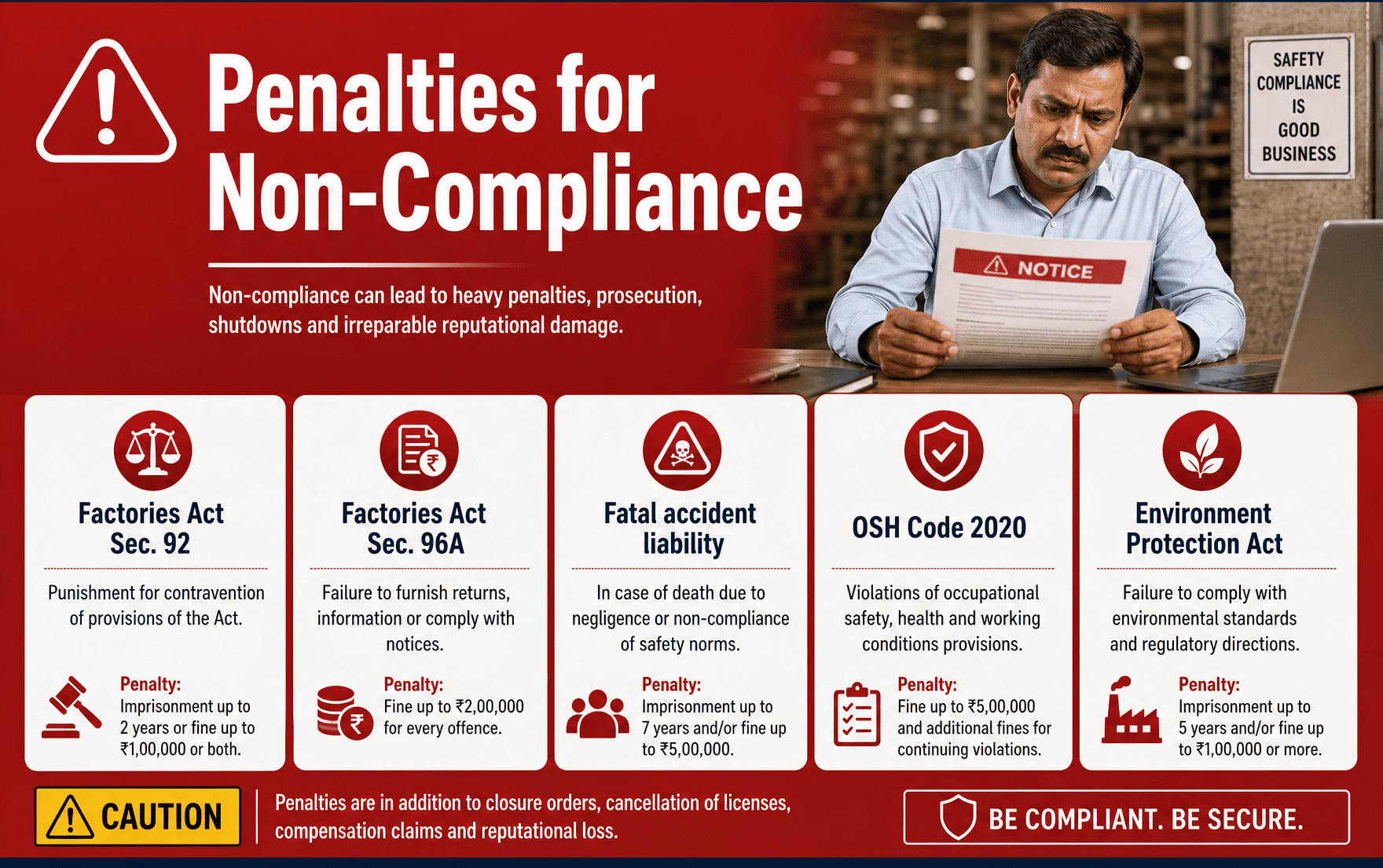
Skipping an EHS audit is not a saving - it is a deferred cost. Indian law imposes personal liability on the occupier and manager.
Under Section 92 of the Factories Act, 1948, contravention of the Act, rules, or written orders makes both the occupier and manager guilty of an offence, punishable with imprisonment up to two years or a fine up to one lakh rupees, or both. If the contravention continues after conviction, a further fine of up to one thousand rupees per day may be levied. Where a contravention of Chapter IV or Section 87 results in an accident causing death, the minimum fine is ₹25,000; for serious bodily injury, the minimum is ₹5,000 (Factories Act – India Code).
The OSH Code, 2020 brings in stronger enforcement powers of Inspector-cum-Facilitators, mandatory safety committees for larger establishments and hazardous processes, and a formal framework for third-party audit and certification (OSH Code, 2020 – India Code).
Business Benefits of EHS Audit Services
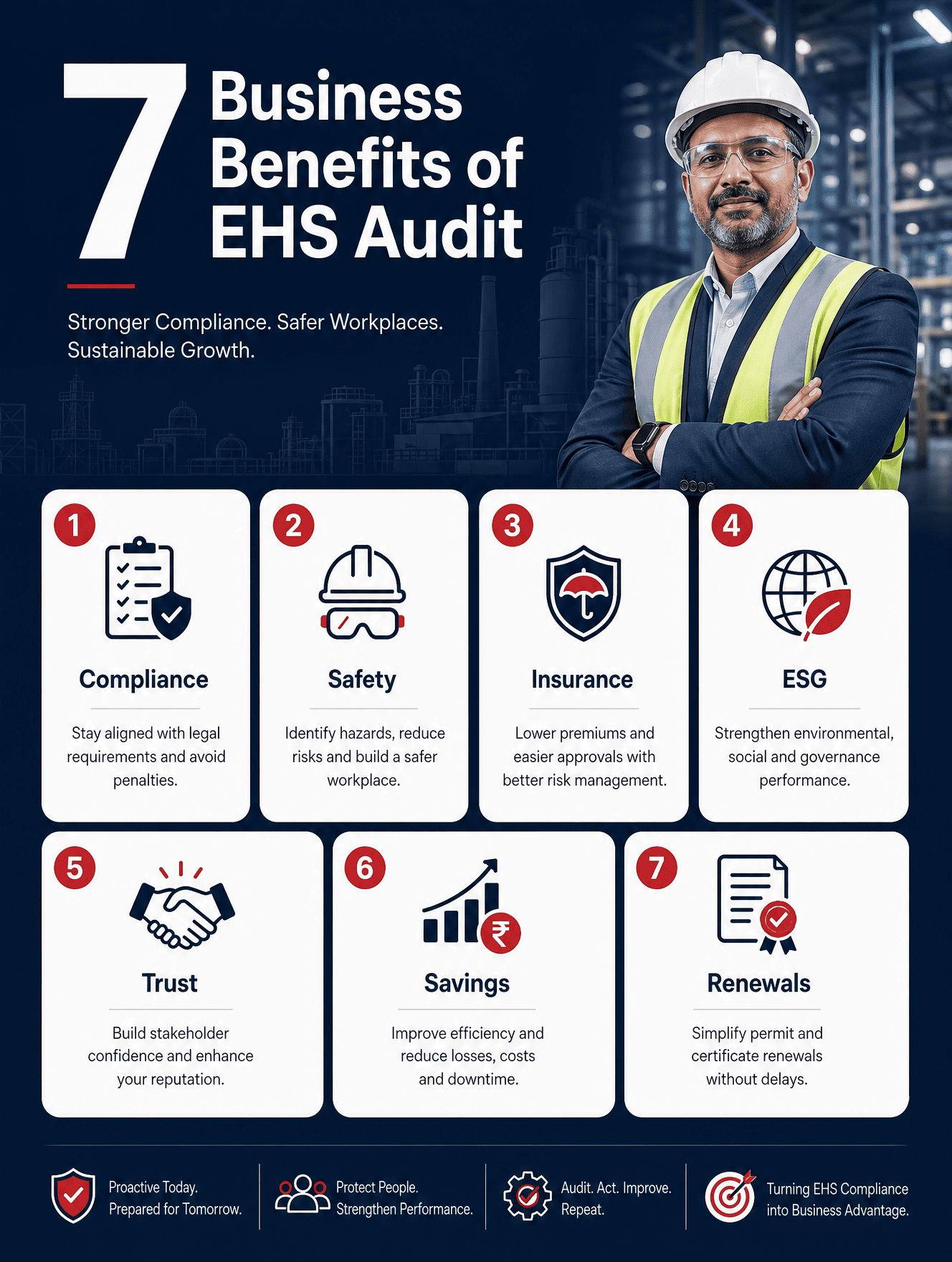
Beyond compliance, an EHS audit offers measurable business value:
-
Compliance - clear line of sight to statutory duties and evidence
-
Safety - fewer incidents, near misses, and lost workdays
-
Insurance - better risk profile can support insurance conversations
-
ESG - stronger documentation for sustainability and BRSR-linked disclosures
-
Trust - customer, buyer, and investor confidence in compliance discipline
-
Savings - early gap-closure is cheaper than penalty-driven correction
-
Renewals - smoother renewals and inspection cycles with pollution-control and factory authorities
Many organisations use the findings of an EHS audit as the foundation for implementing management systems such as ISO 14001, ISO 45001, and ISO 50001, helping improve environmental performance, workplace safety, and energy efficiency while supporting continual compliance.
Why Choose LegalBabu for EHS Audit Services
Many firms can hand you a checklist. Far fewer can help you convert an audit into a meaningful compliance upgrade. LegalBabu's advantage is that we see EHS audits not as an isolated technical exercise, but as part of your wider legal, operational, and governance position.
What makes LegalBabu different
-
We combine compliance understanding with practical business review
-
We connect EHS findings with documentation, due diligence, and vendor-risk realities
-
We write findings in a way that management can actually act on
-
We help businesses move from gap identification to closure support
-
We align EHS review with wider compliance priorities through our Compliance resources
For businesses already improving internal controls, related reading such as the MCA Compliance Relief Scheme 2026 Guide, AEO Registration in India, and RPSL Annual Compliance Service can also be helpful in building a broader compliance mindset.
Common Situations Where You Should Book an EHS Audit
You should strongly consider an EHS audit service if:
-
You are setting up or expanding a factory or plant
-
Your unit handles hazardous materials or hazardous processes
-
You are facing buyer or customer audits
-
You are onboarding large vendors or institutional clients
-
You are preparing for due diligence
-
You want to strengthen audit-readiness before a regulator visit
-
Your management wants better visibility on plant-level compliance
-
You have had near misses, recurring unsafe observations, or documentation gaps
-
You want stronger control before certification, investment, or scale-up
Conclusion
If your business wants to improve compliance confidence, reduce avoidable risk, strengthen operational discipline, and present itself better to regulators, buyers, investors, or internal leadership, EHS audit services are the right place to start.
LegalBabu helps Indian businesses convert EHS audits from a reactive, last-minute exercise into a structured advantage. From documentation and site review to compliance gap identification and audit-readiness support, our goal is simple: help you run a safer, stronger, and more defensible business.
FAQS
FAQs About EHS Audit
-
What are EHS audit services?
EHS audit services are professional reviews of a business's environmental, health, and safety controls, records, and compliance systems.
- Is an EHS audit the same as a safety inspection?
- Who needs EHS audit services in India?
- Does LegalBabu provide only audit reporting?
- Are EHS audits useful for vendor onboarding?
- Are EHS audit services useful for due diligence?
- What is reviewed in the environmental compliance section?
- What is Form V and why does it matter?
- What happens if safety duties are ignored?
- How do I get started with LegalBabu's EHS audit services?


