
Table of Content
- What is ROC Annual Return Filing?
- Why ROC Annual Return Filing is Mandatory for Companies in India?
- Which Businesses are Required to File ROC Annual Returns?
- What is the Difference Between ROC Annual Return and Income Tax Return?
- What are the Different ROC Forms for Annual Filing?
- What are the Key Requirements for ROC Annual Return Filing?
- What Documents are Required for ROC Annual Return Filing?
- What is the Due Date for ROC Annual Return Filing?
- What is the Procedure for ROC Annual Filing for Private Limited Company?
- What is the Procedure for ROC Annual Filing for LLP?
- What is the Procedure for ROC Annual Filing for OPC?
- What is the ROC Annual Return Filing Fees in India?
- What are the Penalties for Late ROC Filing?
- What are the Common Mistakes to Avoid During ROC Annual Filing?
What is ROC Annual Return Filing?
ROC annual return filing refers to the mandatory annual compliance process through which companies and LLPs registered in India submit their financial and statutory information to the Registrar of Companies (ROC). This process is governed by the provisions of the Companies Act, 2013. Under the act, every registered company, including private limited companies, OPCs, and LLPs, must file prescribed ROC forms such as AOC-4 and MGT-7 with the Ministry of Corporate Affairs after the completion of each financial year.
ROC annual return filings generally contain details relating to financial statements, shareholding structure, directors, registered office, annual general meeting, and other company compliances. It helps maintain legal transparency, ensures regulatory compliance, and keeps the company’s status active on MCA records. Failure to file annual returns within the prescribed due dates may result in heavy penalties, additional fees, and even director disqualification.
Why ROC Annual Return Filing is Mandatory for Companies in India?
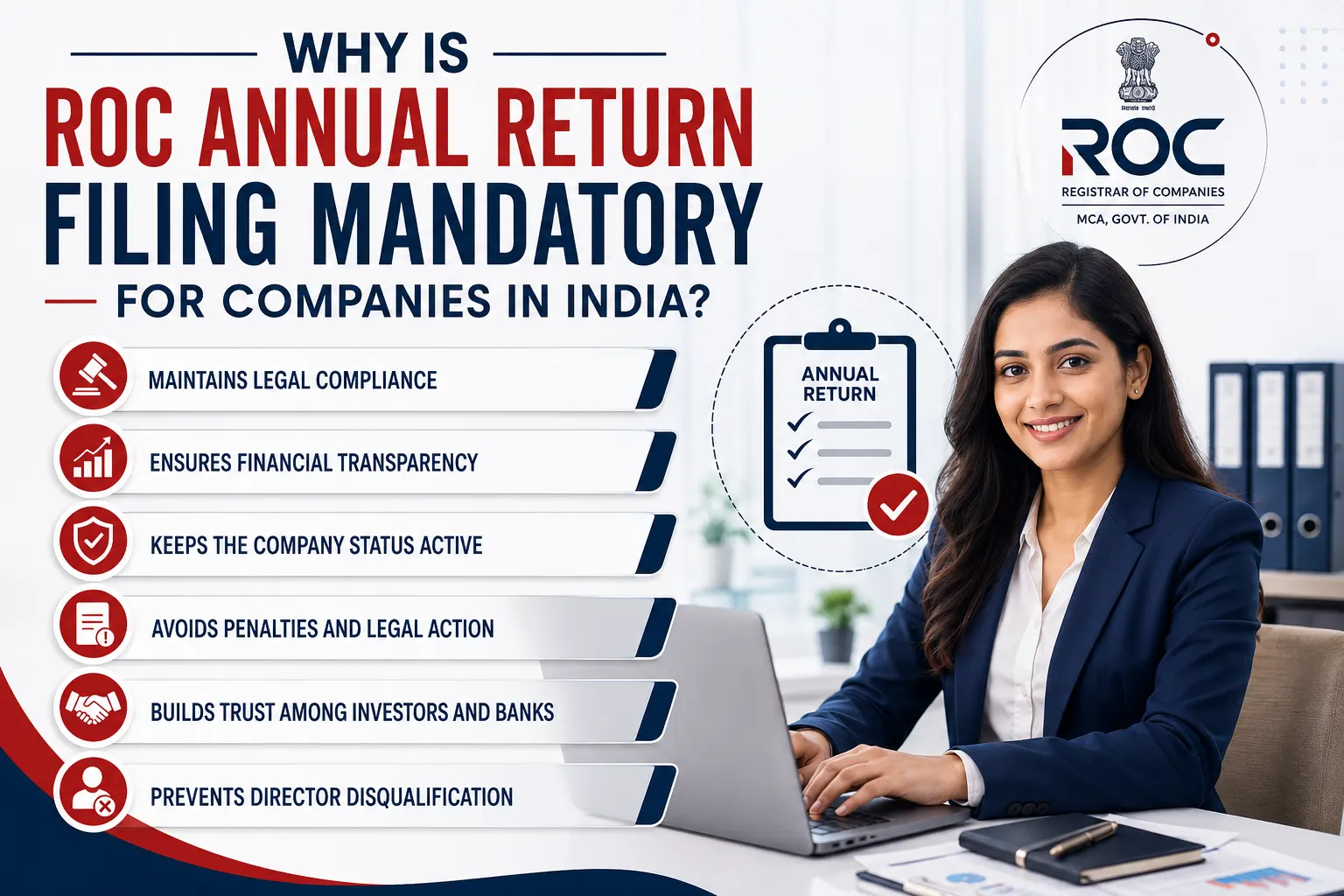
ROC annual return filing is mandatory to ensure that companies comply with the provisions of the Companies Act, 2013, and maintain transparency with the Ministry of Corporate Affairs. It further helps the government track the financial and legal status of companies.
It is mandatory because it:
- Maintains legal compliance
- Ensures financial transparency
- Keeps the company status active
- Avoids penalties and legal action
- Builds trust among investors and banks
- Prevents director disqualification
Which Businesses are Required to File ROC Annual Returns?
Various business entities registered under the Companies Act, 2013 and LLP laws are required to file ROC annual returns with the Ministry of Corporate Affairs, even if there is no business activity during the financial year. It includes:
- Private Limited Companies
- One-Person Companies (OPC)
- Public Limited Companies
- Limited Liability Partnerships (LLPs)
- Section 8 Companies
- Dormant Companies
- Foreign Companies registered in India
What is the Difference Between ROC Annual Return and Income Tax Return?
An ROC annual return and an income tax return are two different statutory compliances applicable to companies and businesses in India. ROC filing focuses on company compliance under the Companies Act, 2013, while income tax return filing relates to tax liability under income tax laws. Here is the difference between the two:
|
Basis of Difference |
ROC Annual Return |
Income Tax Return (ITR) |
|
Governing Law |
Companies Act, 2013 |
|
|
Filed With |
Filed with Registrar of Companies (ROC) through MCA portal |
Filed with Income Tax Department through the income tax portal |
|
Purpose |
Ensures company law and corporate compliance |
Reports taxable income and tax liability |
|
Objective |
Maintains corporate transparency and legal status |
Ensures proper assessment and collection of taxes |
|
Applicable To |
Companies and LLPs registered in India |
Individuals, companies, firms, LLPs, and taxpayers |
|
Information Covered |
Shareholding, directors, financial statements, company details |
Income, deductions, taxes paid, and tax calculations |
|
Penalty for Non-Filing |
Additional ROC fees, penalties, and director disqualification |
Interest, late fees, penalties, and legal notices |
What are the Different ROC Forms for Annual Filing?
Here is an overview of the different ROC forms required for annual filings:
|
ROC Form |
Applicable To |
Purpose of the Form |
|
Form AOC-4 |
Private Limited Companies, Public Companies, OPCs |
Used for filing financial statements with the ROC, including balance sheet, profit & loss account, cash flow statement, auditor's report, and board's report under the Companies Act, 2013. |
|
Form MGT-7 |
Private Limited Companies and Public Companies |
Filed as an annual return containing details of shareholders, directors, registered office, shareholding structure, meetings, and company compliances for a financial year. |
|
Form MGT-7A |
One Person Companies (OPCs) and Small Companies |
Simplified annual return form introduced for OPCs and small companies to reduce compliance burden while reporting essential company details to the ROC. |
|
Form ADT-1 |
All Companies appointing auditors |
Used to intimate the ROC about the appointment or reappointment of the company’s statutory auditor after the AGM. |
|
LLP Form 8 |
Limited Liability Partnerships (LLPs) |
Used for filing the Statement of Account and Solvency, which includes financial position, assets, liabilities, and the solvency declaration of the LLP. |
|
LLP Form 11 |
Limited Liability Partnerships (LLPs) |
Annual return form for LLPs containing details of partners, designated partners, contribution structure, and business information. |
What are the Key Requirements for ROC Annual Return Filing?
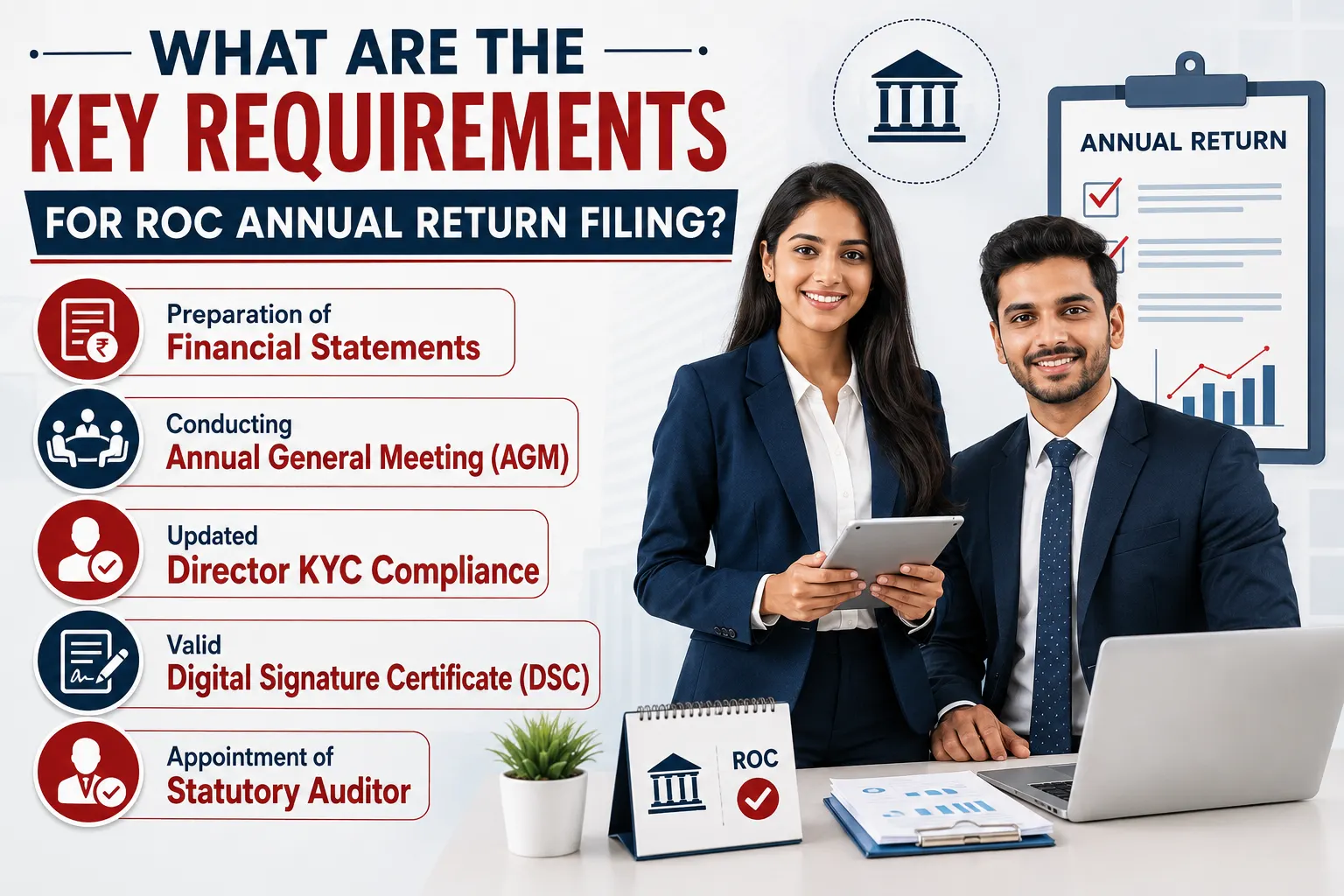
ROC annual return filing requires companies and LLPs to maintain proper financial records and complete mandatory compliances under the Companies Act, 2013. The key requirements under the act include:
- Preparation of Financial Statements: Companies must prepare a balance sheet, profit & loss account, cash flow statement, and related financial records accurately before filing annual returns with the ROC.
- Conducting Annual General Meeting (AGM): Companies are required to hold an AGM to approve financial statements, auditor reports, and other important corporate matters before annual filing.
- Updated Director KYC Compliance: Every director holding a DIN must complete DIR-3 KYC filing to keep their director identification number active and compliant.
- Valid Digital Signature Certificate (DSC): Directors and authorised signatories must possess an active digital signature certificate to digitally sign and submit ROC forms on the MCA portal.
- Appointment of Statutory Auditor: Companies must appoint a statutory auditor to audit financial statements and ensure proper compliance with legal and accounting requirements.
- Accurate Shareholding and Director Details: Annual returns must contain correct information regarding shareholders, directors, share capital, and the management structure of the company.
- Filing Prescribed ROC Forms Within Due Dates: Companies and LLPs must submit applicable forms such as form AOC-4 and form MGT-7 within the prescribed statutory timelines.
What Documents are Required for ROC Annual Return Filing?
The key documents required for ROC annual return filing include the following:
- Financial Statements and Balance Sheet
- Profit and Loss Account
- Director Identification Number (DIN) Details
- Digital Signature Certificate (DSC)
- Auditor’s Report
- Board Resolution, if applicable
- Shareholding Pattern Details
- List of Directors and Shareholders
- Registered Office/Address Proof
- AGM Details and Minutes
- PAN and CIN of the Company
What is the Due Date for ROC Annual Return Filing?
The due date for ROC annual return filing depends on your entity type, but it is generally tied to your Annual General Meeting (AGM) date. Companies must file audited financial statements within 30 days of the AGM, and the formal annual return within 60 days of the AGM.
Here is a detailed breakdown of the due date for ROC annual return filing:
Company Due Dates
- Form AOC-4 (Financial Statements): Within 30 days of the conclusion of the AGM.
- Form MGT-7/MGT-7A (Annual Return): Within 60 days of the conclusion of the AGM.
- General Deadline: Since AGMs must be held by September 30th each year, AOC-4 is typically due by October 30th, and MGT-7 is typically due by November 29th.
One Person Company (OPC) Due Dates
- Form AOC-4: Within 180 days from the closure of the financial year.
- Form MGT-7/MGT-7A: Within 60 days from the conclusion of the AGM.
LLP Due Dates
- Form 11 (Annual Return): Due by May 30th every year.
- Form 8 (Statement of Account & Solvency): Due by October 30th every year.
What is the Procedure for ROC Annual Filing for Private Limited Company?
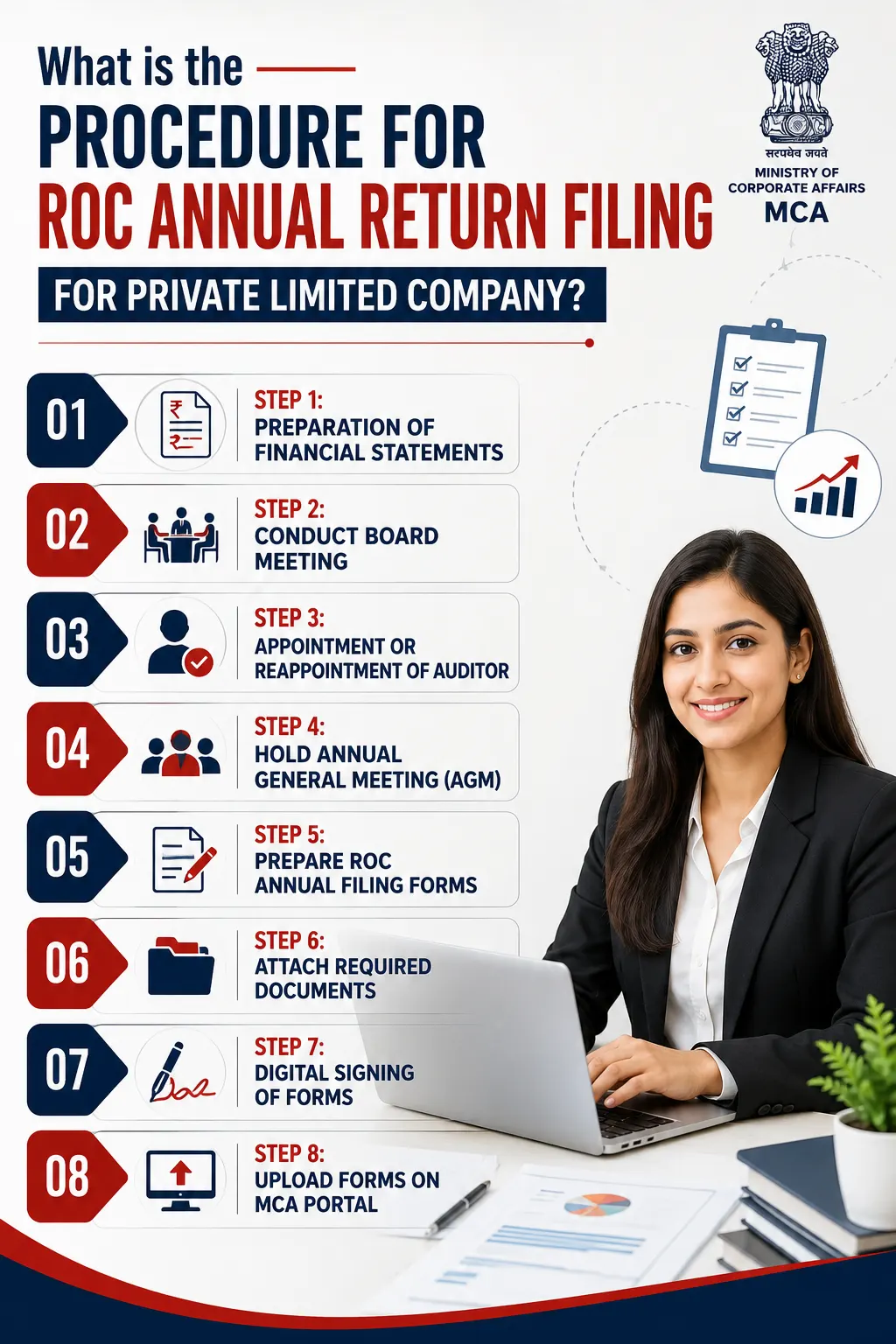
Here is the step-by-step process for ROC annual return filing in a private limited company:
Step 1: Preparation of Financial Statements
- Prepare balance sheet and profit & loss account for the financial year
- Finalize cash flow statements, notes, and supporting financial records
- Ensure that every financial statement complies with applicable accounting standards
Step 2: Conduct Board Meeting
- Convene a board meeting to approve financial statements and annual reports
- Authorize directors for ROC filing and compliance-related activities
- Approve date, time, and notice for Annual General Meeting
Step 3: Appointment or Reappointment of Auditor
- Appoint statutory auditor during the Annual General Meeting
- Obtain written consent and eligibility certificate from auditor
- File Form ADT-1 with the ROC within prescribed timeline
Step 4: Hold Annual General Meeting (AGM)
- Conduct AGM within statutory period under the Companies Act, 2013
- Present financial statements and auditor’s report before shareholders
- Obtain shareholder approval for annual accounts and company matters
Step 5: Prepare ROC Annual Filing Forms
- Prepare Form AOC-4 for financial statement filing
- Prepare Form MGT-7 for annual return compliance
- Verify all company details before final submission
Step 6: Attach Required Documents
- Attach audited financial statements and auditor’s report
- Include the board report and AGM-related documents
- Attach shareholding and director details wherever required
Step 7: Digital Signing of Forms
- Digitally sign ROC forms using valid DSC of directors
- Obtain professional certification from CA, CS, or CMA if applicable
- Ensure DSC registration on MCA portal is active
Step 8: Upload Forms on MCA Portal
- Upload completed ROC forms through MCA online portal
- Verify uploaded information before final submission
- Generate Service Request Number (SRN) after successful filing
Step 9: Payment of ROC Filing Fees
- Pay prescribed filing fees online through MCA portal
- Additional fees apply for delayed annual return filing
- Save payment challan and acknowledgment for future reference
What is the Procedure for ROC Annual Filing for LLP?
The following is the procedure followed for ROC annual return filing in LLPs:
Step 1: Maintain Proper Books of Accounts
- Record all financial transactions and maintain updated accounting records
- Prepare income, expenditure, assets, and liability statements accurately
- Ensure books are maintained according to LLP compliance requirements
Step 2: Prepare Statement of Accounts and Solvency
- Prepare statement of account and solvency for the financial year
- Verify financial accuracy before filing LLP annual compliance forms
- Obtain approval from designated partners of the LLP
Step 3: Conduct Partner Meeting
- Hold meeting of partners for approval of financial statements
- Discuss annual compliance and ROC filing responsibilities
- Authorise designated partners for ROC filing process
Step 4: Collect Required Documents
- Gather PAN, LLP Agreement, and partner identification documents
- Arrange financial statements and contribution-related information properly
- Keep registered office proof and DSC details ready
Step 5: Prepare LLP Form 8
- Fill LLP Form 8 with financial and solvency information
- Mention assets, liabilities, income, and expenditure details correctly
- Verify all disclosures before digital submission
Step 6: Prepare LLP Form 11
- Prepare LLP Form 11 containing annual return information
- Mention partner details and contribution structure accurately
- Verify changes in partners, if any, during financial year
Step 7: Upload Forms on MCA Portal
- Upload LLP Form 8 and Form 11 on MCA portal
- Cross-check details before final form submission online
- Generate SRN after successful filing completion
Step 8: Pay Applicable Filing Fees
- Pay prescribed ROC filing fees through MCA online system
- Additional fees apply for delayed LLP annual filings
- Save the challan and payment acknowledgment for future records
What is the Procedure for ROC Annual Filing for OPC?
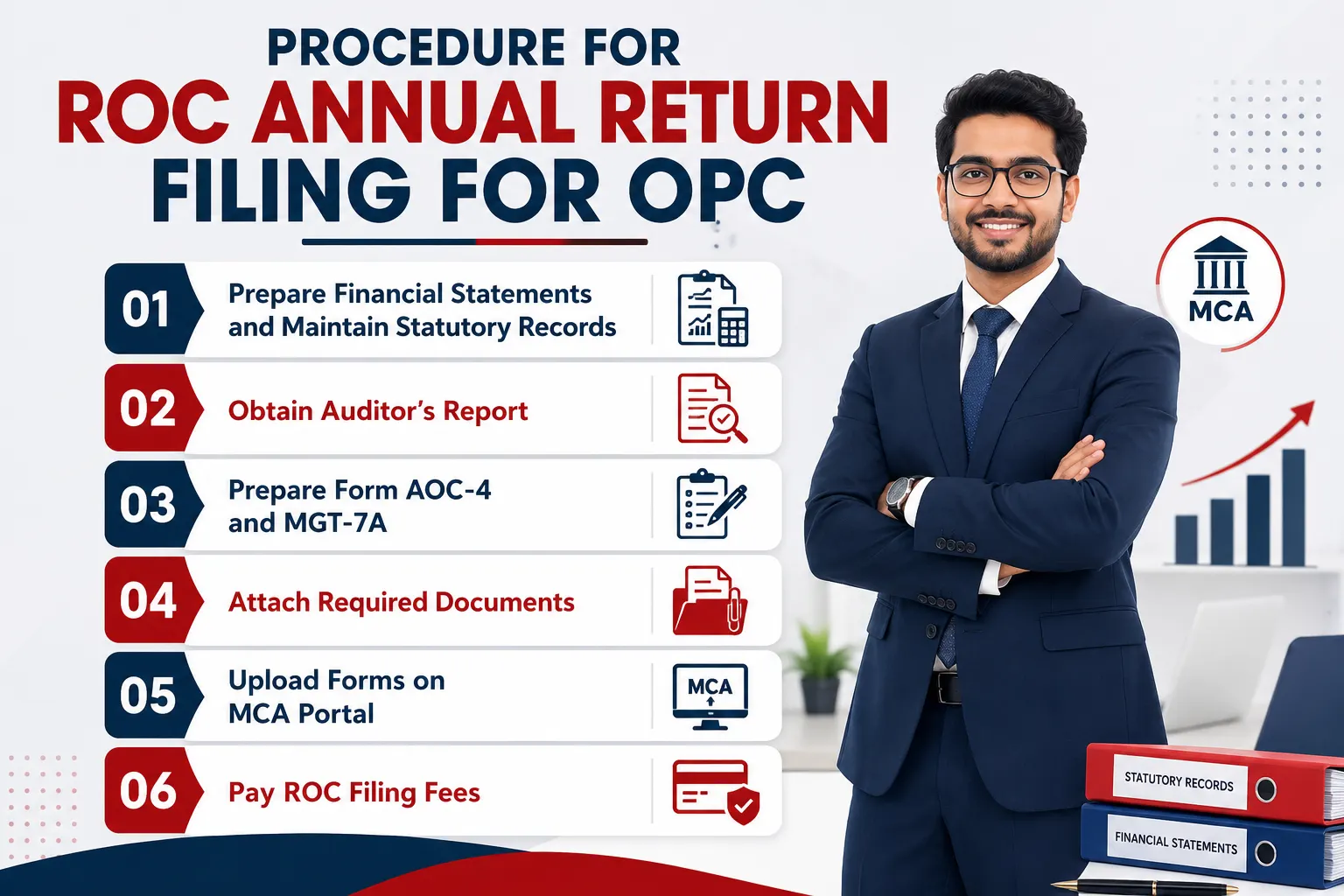
Here is the step-by-step process for filing ROC annual return filing for OPC:
Step 1: Prepare Financial Statements and Maintain Statutory Records
- Prepare Balance Sheet, Profit & Loss Account, and financial statements accurately
- Update statutory registers and maintain company compliance records properly
- Preserve accounting records, shareholder details, and registered office information
Step 2: Obtain Auditor’s Report
- Appoint statutory auditor for auditing company financial statements
- Obtain signed auditor’s report after completion of financial audit
- Verify financial accuracy before annual ROC filing process
Step 3: Prepare Form AOC-4 and MGT-7A
- Prepare Form AOC-4 for filing financial statements with ROC
- Prepare Form MGT-7A containing annual return and company details
- Verify attached information before submission on MCA portal
Step 4: Attach Required Documents
- Attach audited financial statements and auditor’s report carefully
- Include the board report and other supporting compliance documents
- Verify attachment format and mandatory filing requirements properly
Step 5: Upload Forms on MCA Portal
- Upload completed ROC forms through MCA online portal
- Review all entered details before final submission carefully
- Generate SRN after successful filing and verification process
Step 6: Pay ROC Filing Fees
- Pay prescribed government filing fees through MCA portal
- Additional penalties apply for delayed annual return filing
- Save payment challan and filing acknowledgment for reference
What is the ROC Annual Return Filing Fees in India?
ROC annual return filing fees in India are based on a company's authorised share capital, typically ranging from ₹200 to ₹600 per document for the mandatory forms (AOC-4 and MGT-7/MGT-7A). Here is the detailed overview of fee structure:
|
Authorised Share Capital |
Fees in Rs. |
|
Less than Rs. 1,00,000 |
200 |
|
Rs. 1,00,000 to Rs. 4,99,999 |
300 |
|
Rs. 5,00,000 to Rs. 24,99,999 |
400 |
|
Rs. 25,00,000 to Rs. 99,99,999 |
500 |
|
Rs. 1,00,00,000 and above |
600 |
What are the Penalties for Late ROC Filing?
Late ROC filing in India attracts strict penalties. Companies must file annual returns (Form MGT-7/MGT-7A) and financial statements (Form AOC-4) with the Ministry of Corporate Affairs (MCA) on time. Delays incur both a flat daily additional fee and severe adjudication penalties for the company and directors.
Here is a detailed structure of the penalties for late ROC annual return filing:
1. Daily Additional Fee
For each delayed form, the MCA charges a mandatory late fee.
- Late Fee: ₹100 per day, per form.
- Cap: There is no maximum limit, meaning the additional fees will accumulate indefinitely until the forms are successfully filed.
2. Adjudication Penalties
Aside from daily additional fees, the Registrar of Companies (ROC) can issue formal notices for non-compliance under the Companies Act, 2013.
- For Form AOC-4: The company and its directors are liable for a flat penalty of ₹100 per day of delay, up to ₹2,00,000. Additionally, officers in default face a flat ₹50,000 penalty.
- For Form MGT-7: The company and its officers are penalised a flat ₹50,000 plus ₹100 for every day the default continues, up to ₹5,00,000.
3. Severe Legal Consequences
Habitual or prolonged non-filing (2 or more consecutive years) triggers severe structural and legal actions:
- Company Strike-Off: The ROC can assume the business is closed and initiate the process to strike the company’s name off the registry. If this happens, bank accounts are frozen and contracts become unenforceable.
- Director Disqualification: Directors can be disqualified from serving on the board of any company for up to 5 years.
- Criminal Prosecution: The company and officers in default can face further criminal prosecution, including up to ₹5,00,000 in additional fines and imprisonment.
What are the Common Mistakes to Avoid During ROC Annual Filing?
The common mistakes that a company should avoid while filing an ROC annual return include the following:
- Incorrect Financial Information: Filing inaccurate or mismatched financial statements can lead to ROC notices, penalties, and rejection of annual filing forms.
- Missing Filing Due Dates: A delay in ROC annual filing results in additional government fees and increases the risk of legal non-compliance.
- Using Expired DSC: An expired Digital Signature Certificate (DSC) can prevent directors from digitally signing ROC forms, leading to errors or rejection during the online filing process.
- Incorrect Director Details: Mentioning the wrong DIN, name, or director information may cause form rejection and compliance discrepancies with ROC records.
- Non-Compliance with DIR-3 KYC: Failure to complete DIR-3 KYC may deactivate the director’s DIN and restrict MCA filing activities temporarily.
- Incorrect Form Selection: Filing incorrect ROC forms may create compliance issues, unnecessary delays, and rejection of annual return submissions.
- Improper Attachment of Documents: Missing, invalid, or improperly attached supporting documents may result in rejection of ROC annual filing forms.
- Failure to Conduct AGM: Not conducting the AGM within prescribed timelines violates the Companies Act, 2013 and attracts penalties.
Ensure Hassle-Free ROC Annual Return Filing with Legal Babu!
ROC annual return filing is an essential compliance requirement for companies and LLPs registered in India. Timely filing helps businesses maintain legal status, avoid penalties, and ensure smooth corporate operations under the Companies Act, 2013. Managing ROC compliance accurately can be complex and time-consuming without professional guidance. We at Legal Babu provide reliable support for preparing financial statements, filing ROC forms, maintaining MCA compliance, and handling annual return procedures efficiently. Whether you operate a private limited company, LLP, or OPC, our experts ensure accurate and timely ROC filing with complete compliance assistance tailored to your business requirements.
FAQS
Have some questions about ROC annual return filing?
We have got you covered:
-
Is ROC annual return filing mandatory for inactive companies?
Yes, ROC annual return filing is mandatory for all registered companies in India, regardless of their business activity, turnover, or profitability. Even inactive or dormant companies must file their yearly statements to maintain active legal status and avoid heavy penalties.
- Can ROC annual returns be filed after the due date?
- Is DSC mandatory for ROC annual return filing?
- What happens if ROC annual return is not filed for several years?
- Can a company file ROC returns without conducting an AGM?
- Can ROC annual return filing be revised after submission?
- Are foreign companies required to file ROC annual returns in India?
- What is SRN in ROC filing?
- Can ROC annual return filing be completed online?
- Can ROC filing affect company bank loan approvals?


