
What Is Income Tax Filing? Process, Documents & Deadlines Explained
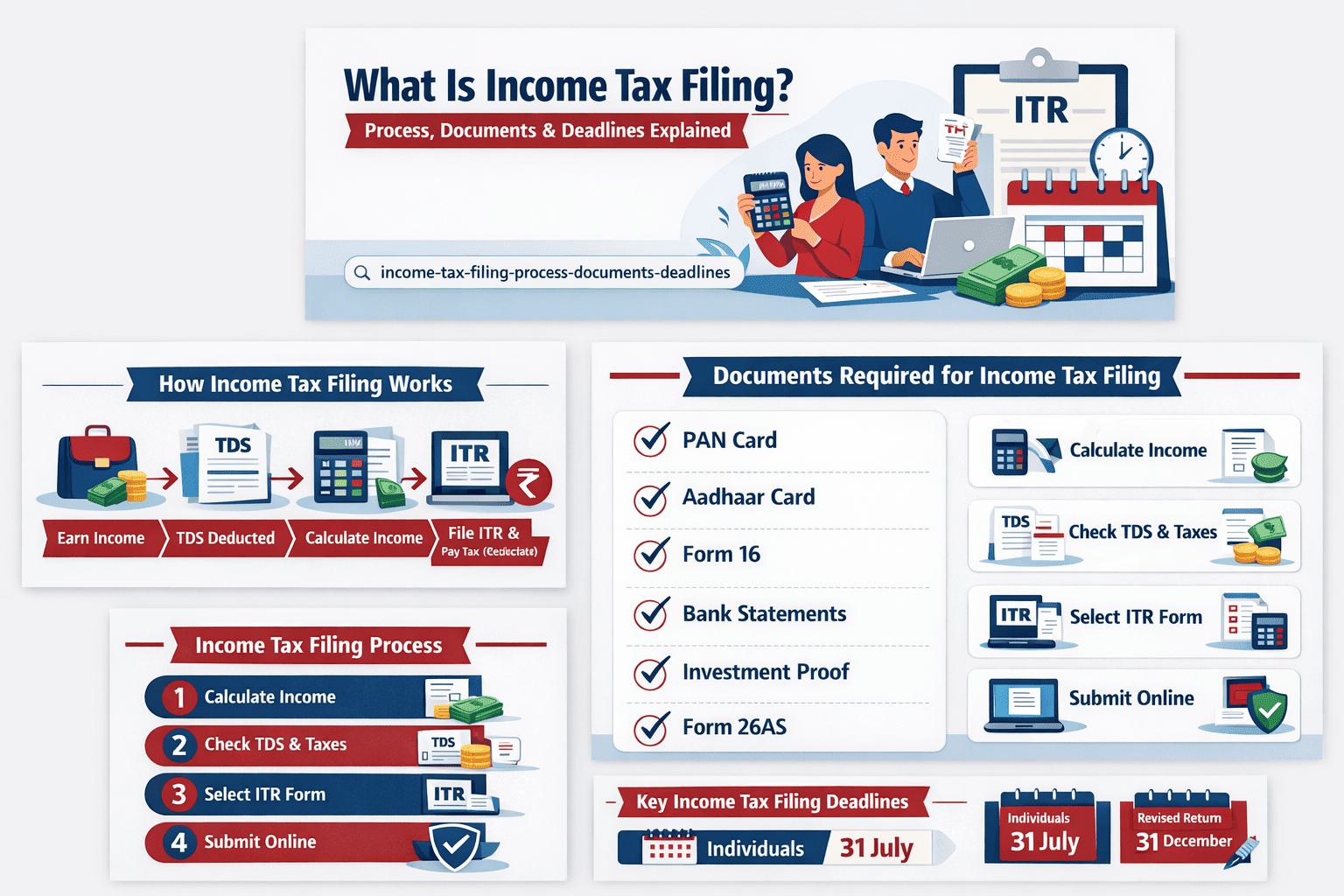
Income tax filing is the process through which individuals and businesses report their income, taxes paid, and tax liability to the government. In India, taxpayers must file their Income Tax Return (ITR) with the Income Tax Department every financial year.
Income tax filing ensures that taxpayers disclose their earnings, claim deductions, calculate tax liability, and receive refunds if excess tax has been paid. Whether you are a salaried employee, freelancer, business owner, or investor, income tax filing helps maintain financial compliance and transparency.
What Is Income Tax Filing in India?
Income tax filing refers to submitting an Income Tax Return (ITR) to the government, which contains details of:
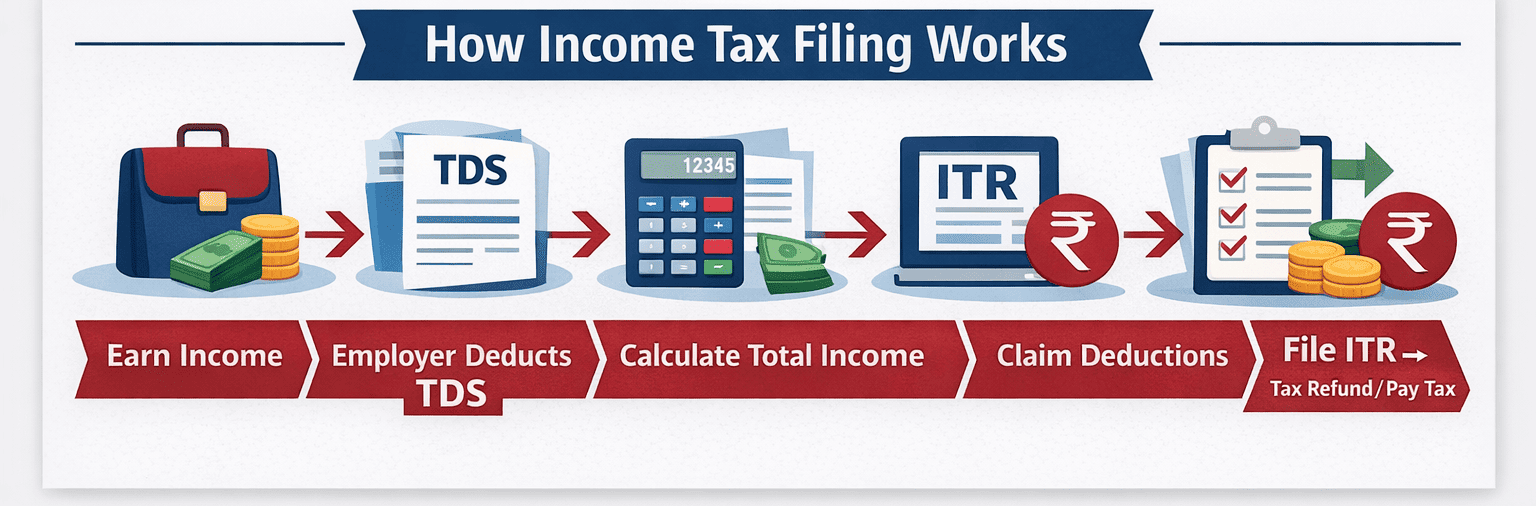
- Total income earned during the financial year
- Taxes already paid through TDS or advance tax
- Deductions and exemptions claimed
- Final tax payable or refundable
Income tax returns must be filed under the provisions of the Income Tax Act, 1961.
Income tax filing also helps the government track economic activity and fund public expenditure. If you want to understand how tax money is used, read about how the government earns and spends revenue.
Why Is Income Tax Filing Important for Taxpayers?
Filing income tax returns is essential for several financial and legal reasons.
Key Benefits of Income Tax Filing
| Benefit | Explanation |
| Legal Compliance | Filing ITR ensures compliance with income tax laws |
| Claim Tax Refund | Excess tax deducted can be refunded |
| Loan Approval | ITR is required for home, personal, or business loans |
| Visa Processing | Many countries require ITR records |
| Financial Record | Acts as proof of income |
Taxpayers should also understand which tax regime suits them. Learn about the new tax regime vs. the old tax regime before filing returns.
Who Needs to File Income Tax Returns?
Not every individual is required to file income tax returns. However, filing becomes mandatory if income exceeds the basic exemption limit.
Basic Exemption Limits
| Category | Income Limit |
| Individuals below 60 years | Rs. 2.5 lakh |
| Senior Citizens (60-80 years) | Rs. 3 lakh |
| Super Senior Citizens (80+) | Rs. 5 lakh |
Income tax filing is also mandatory if:
- TDS has been deducted
- You want to claim a tax refund
- You have foreign income or assets
- You are applying for a loan or a visa
What Documents Are Required for Income Tax Filing?
Before filing income tax returns, taxpayers should gather all necessary documents.
Important Documents for Income Tax Filing
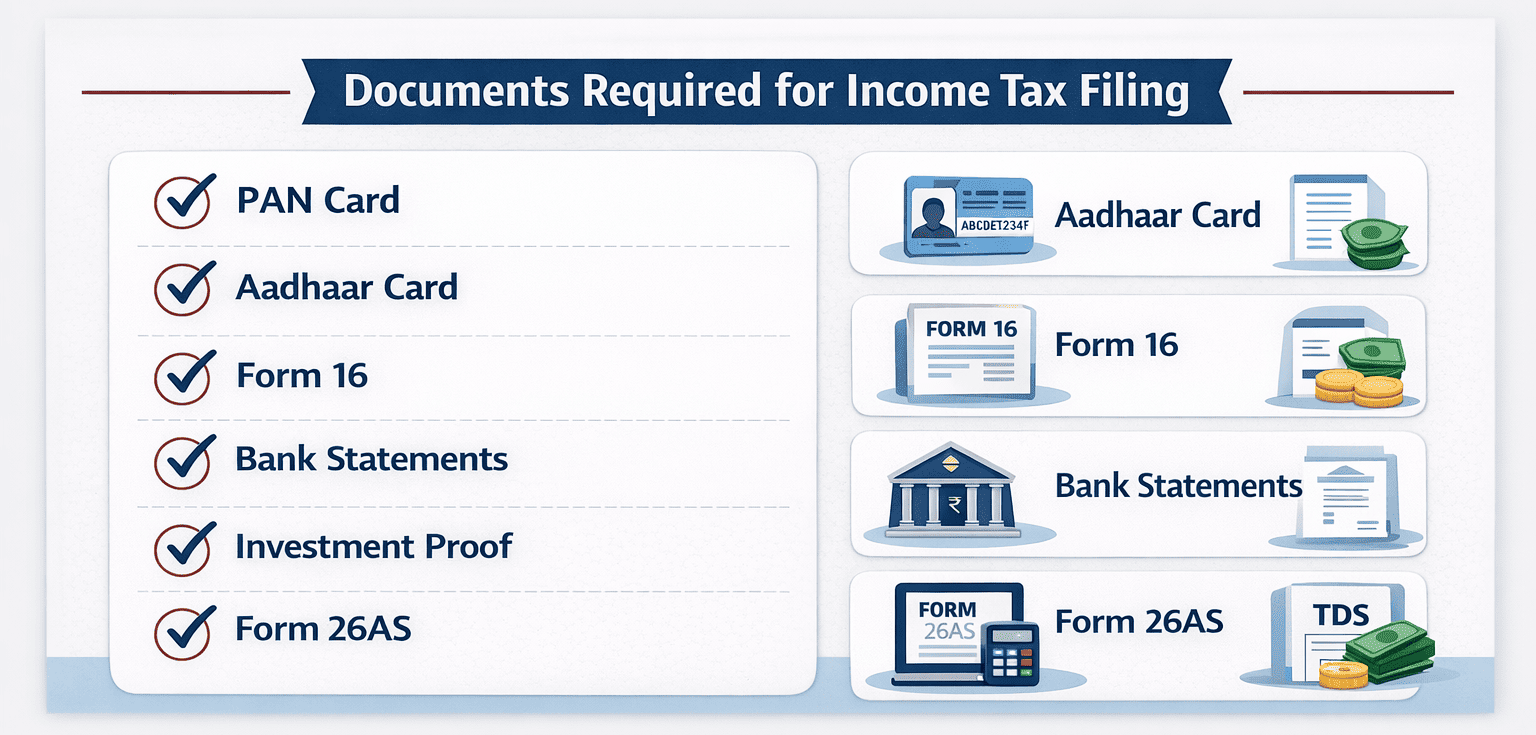
| Document | Purpose |
| PAN Card | Identification for taxpayers |
| Aadhaar Card | Mandatory linking with PAN |
| Form 16 | Salary and TDS details |
| Bank Statements | Income and financial transactions |
| Investment Proof | For claiming deductions |
| Form 26AS | Tax credit statement |
You can also check the latest TDS rate chart for FY 2025-2026 to understand tax deductions applicable during the year.
How to File Income Tax Returns Step-by-Step?
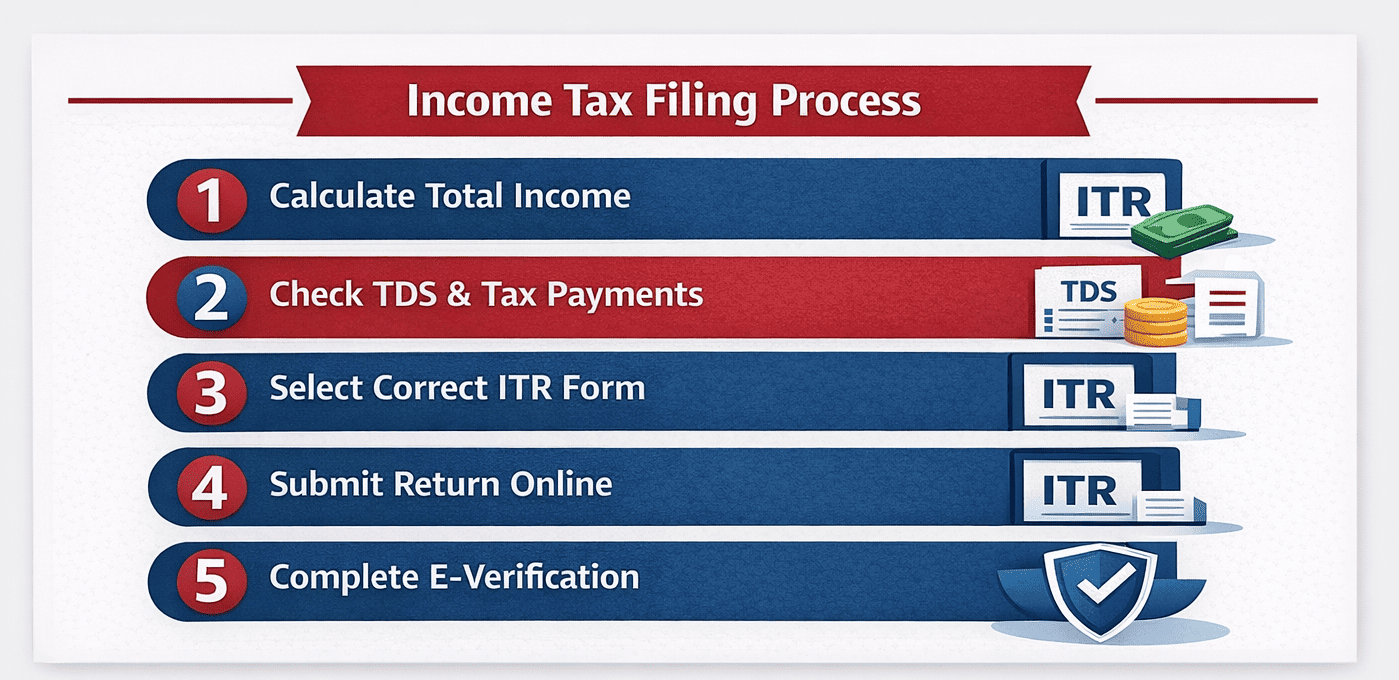
Income tax filing can be completed online through the official portal of the Income Tax Department of India. The process is simple if you keep all the required documents, such as PAN, Aadhaar, Form 16, and bank statements, ready before starting.
Below is a detailed explanation of each step involved in the income tax filing process.
Step 1: How Do You Login to the Income Tax E-Filing Portal?
First, visit the official e-filing website of the Income Tax Department of India and log in using your PAN number, password, and captcha code.
If you are a new user, you must register on the portal using your PAN, Aadhaar, mobile number, and email ID. After registration, verify your account using the OTP sent to your mobile.
Once logged in, go to “File Income Tax Return” under the e-file section.
Step 2: How Do You Select the Correct ITR Form?
After logging in, you must choose the correct ITR form based on your income type.
For example:
| ITR Form |
Suitable For |
| ITR-1 | Salaried individuals with income up to Rs. 50 lakh |
| ITR-2 | Individuals with capital gains or multiple income sources |
| ITR-3 | Individuals with business or professional income |
| ITR-4 | Presumptive taxation scheme for taxpayers |
Selecting the correct form is important because submitting the wrong form may lead to rejection or notices from the tax department.
Step 3: How Do You Enter Income Details?
In this step, you must enter details of your total income earned during the financial year. The portal may automatically fetch some information from Form 26AS and AIS.
You need to verify and fill in details such as:
- Salary income
- Income from house property
- Capital gains
- Business or professional income
- Interest income from bank deposits
Make sure all income sources are correctly reported to avoid discrepancies.
Step 4: How Do You Add Deductions and Exemptions?
After entering income details, you can claim deductions to reduce your taxable income.
Some common deductions include:
| Deduction Section | Example |
| Section 80C | LIC, PPF, ELSS, tuition fees |
| Section 80D | Health insurance premium |
| Section 80TTA | Savings account interest |
| Section 24 | Home loan interest |
Adding these deductions helps reduce your overall tax liability.
Step 5: How Do You Verify Tax Payable or Refund?
Once all income and deduction details are entered, the portal automatically calculates your total tax liability.
At this stage, you should check:
- Total tax payable
- TDS already deducted
- Advance tax paid
- Refund amount (if excess tax was paid)
If additional tax is payable, you must pay it through the challan payment option before submitting the return.
Step 6: How Do You Submit and E-Verify the Return?
After reviewing all details, click “Submit” to file the return.
However, the filing process is complete only after e-verification. You can verify your return using:
- Aadhaar OTP
- Net banking
- Bank account verification
- Demat account verification
E-verification confirms that the return was filed by the taxpayer. If you do not e-verify within 30 days, the return will be treated as invalid.
Understanding tax policy changes can also help you plan better. For example, see how Budget 2026 tax changes affect taxpayers.
When Is the Deadline for Income Tax Filing?
Income tax returns must be filed within the due dates prescribed by the Income Tax Department.
ITR Filing Deadlines
| Taxpayer Type | Due Date |
| Individuals (non-audit cases) | 31 July |
| Businesses requiring an audit | 31 October |
| Revised return | 31 December |
Late filing may attract penalties and interest under the Income Tax Act.

How Does Income Tax Filing Affect Businesses?
Income tax filing is equally important for businesses and startups. Companies and partnerships must maintain financial records and file annual tax returns.
If you are planning to start a business in India, you may consider services like:
- GST Registration for tax compliance
- LLP Registration for starting a partnership firm
- Trust Registration for non-profit organizations
Foreign companies entering India may also establish operations through:
These registrations ensure proper tax reporting and compliance with Indian laws.
What Happens If You Do Not File Income Tax Returns?
Failing to file income tax returns can lead to several consequences.
Penalties for Non-Filing
| Situation | Penalty |
| Delay in filing | Up to Rs. 5,000 |
| Interest on unpaid tax | Applicable |
| Loss of refund claims | Possible |
| Legal notice | In serious cases |
Therefore, timely income tax filing is crucial to avoid financial and legal complications.
Conclusion
Income tax filing is a crucial financial responsibility for individuals and businesses in India. It ensures compliance with tax laws, helps claim refunds, and serves as proof of income for loans and visa applications.
By understanding the income tax filing process, required documents, and deadlines, taxpayers can easily manage their tax obligations and avoid penalties.
Staying informed about tax regimes, TDS rates, and policy changes will further help in effective tax planning and financial management.
FAQS
Frequently Asked Questions
-
1. What is income tax filing?
Income tax filing is the process of submitting your Income Tax Return (ITR) to report income, taxes paid, and tax liability to the government.
- 2. Who needs to file income tax returns in India?
- 3. What documents are required for income tax filing?
- 4. When is the last date for income tax filing?
- 5. How can I file my income tax return online?
- 6. What are the different ITR forms?
- 7. What happens if income tax returns are filed late?
- 8. Can I revise my income tax return after filing?
- 9. Is income tax filing mandatory if TDS is deducted?
- 10. Why is income tax filing important?


