Table of Content
- What is AOA?
- What are the Main Clauses of AOA?
- Why is AOA Important for a Company?
- What is the Difference Between an Article of Association and an Article of Incorporation?
- What is Change/Alteration in AOA?
- What Changes/Alterations can you Make in AOA of Your Company?
- What are the Legal Provisions Governing Change in AOA?
- What is the Process to Change the AOA of Your Company?
- What Documents are Required to Change the AOA of Your Company?
- What is ROC Form MGT-14: Overview, Fees, and Penalties for Non-Compliance
- What are the Common Reasons for Changing AOA?
- What is Conversion of Company via Change in AOA?
- What is the Process for Conversion of a Company via Change in AOA?
- What are the Key Restrictions on Change/Alteration of AOA?
- What are the Key Considerations Before Changing AOA?
- How Legal Babu Can Help with Change in AOA of Your Company?
What is AOA?
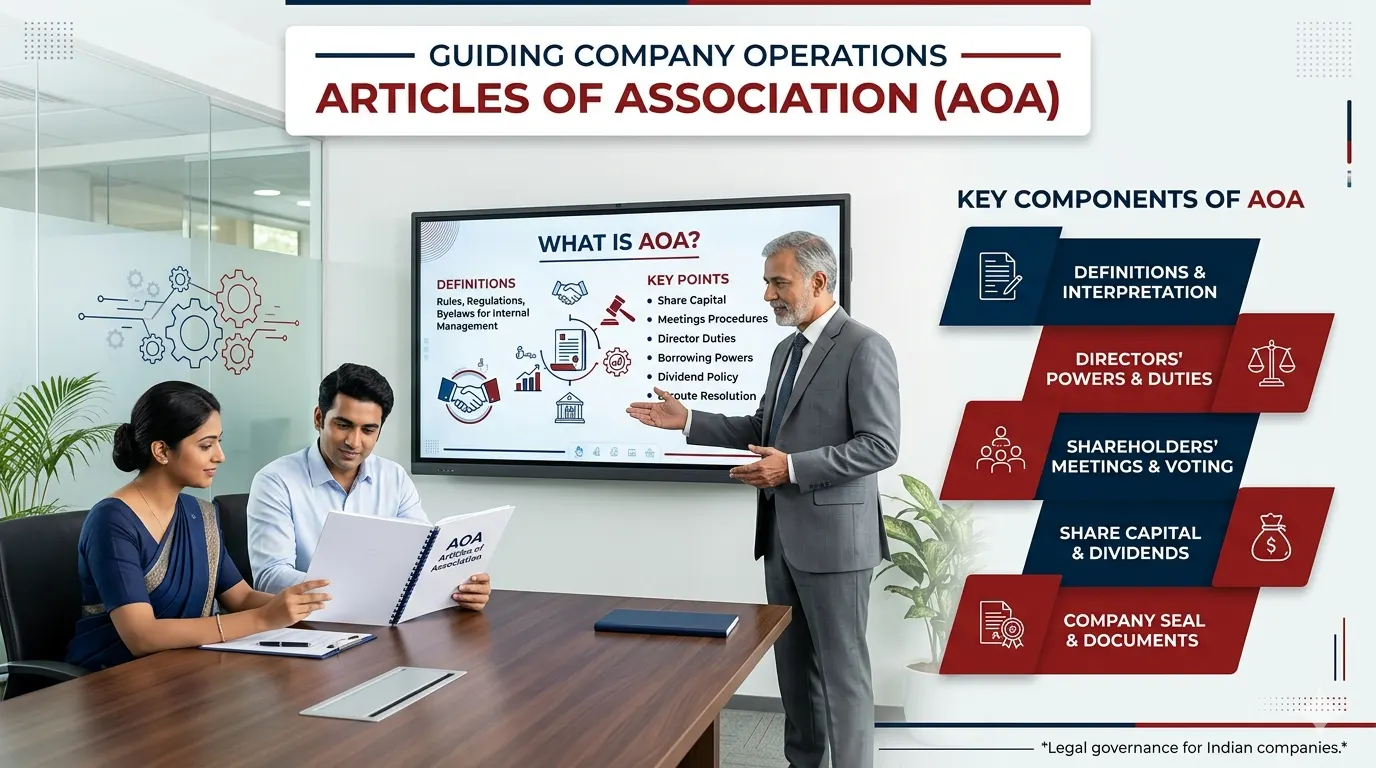
The Articles of Association (AOA) is a legal document that defines the internal rules and regulations for the management and operation of a company. It governs the relationship between the company and its members, as well as among the members themselves. The AOA includes provisions relating to the rights, duties, and powers of directors, conduct of meetings, share capital, voting rights, and dividend distribution. It acts as a guide for the day-to-day administration of the company. Registered under the Companies Act, 2013, the AOA ensures smooth functioning and compliance within the organisation.
What are the Main Clauses of AOA?
The Articles of Association (AOA) contains several important clauses that regulate the internal functioning of a company under the Companies Act, 2013. The main clauses are:
|
Particular |
Details |
|
Share Capital Clause |
Defines the company’s authorised share capital, types of shares, and rights attached to each class. |
|
Transfer and Transmission of Shares Clause |
Specifies the procedure for transferring shares and handling transmission in cases like death or insolvency of a shareholder. |
|
Directors' Clause |
Outlines the appointment, powers, duties, remuneration, and removal of directors. |
|
Meetings Clause |
Covers rules regarding general meetings, board meetings, notice, quorum, voting, and proceedings. |
|
Dividend Clause |
Explains how and when profits are distributed among shareholders as dividends. |
|
Borrowing Powers Clause |
Defines the company’s authority to borrow money and the limits or conditions attached. |
|
Accounts and Audit Clause |
Provides rules for maintaining books of accounts and conducting audits. |
|
Winding Up Clause |
Specifies the procedure for liquidation and distribution of assets upon winding up. |
|
Common Seal Clause (if applicable) |
Mentions the use and custody of the company’s common seal. |
Why is AOA Important for a Company?
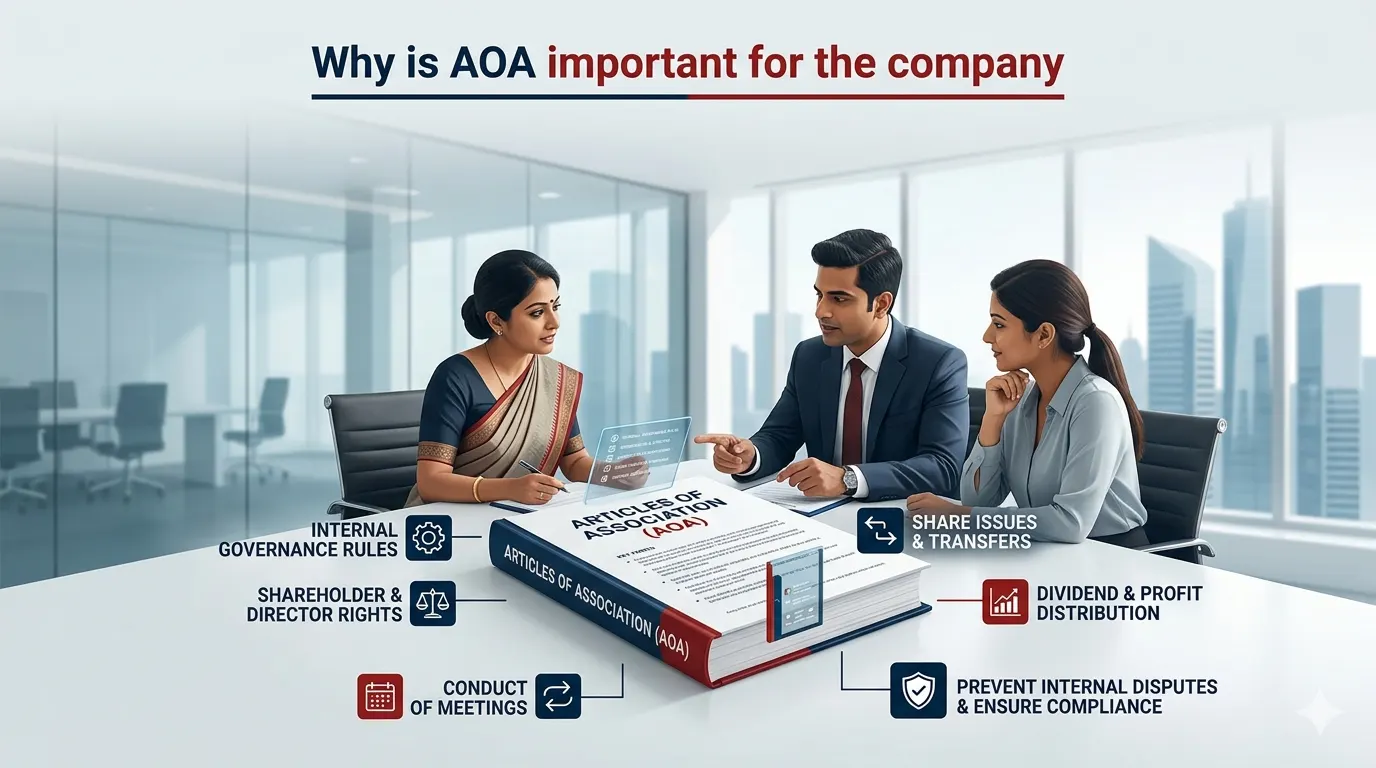
The Articles of Association (AOA) is a crucial document that governs a company’s internal management and operations. It ensures clarity in roles, decision-making, and procedures, helping prevent disputes while maintaining compliance with the Companies Act 2013 and ensuring smooth business functioning. It is important as it-
- Defines internal rules and regulations for company management and governance.
- Establishes rights, duties, and responsibilities of shareholders and directors clearly.
- Ensures proper conduct of meetings, voting procedures, and decision-making processes.
- Regulates issue, transfer, and transmission of company shares effectively.
- Provides framework for dividend declaration and profit distribution among members.
- Helps prevent internal disputes by setting clear operational guidelines.
- Ensures legal compliance and avoids penalties under corporate laws.
- Guides directors in exercising powers within defined limits and authority.
- Maintains transparency and accountability in company operations and management.
- Acts as a reference document in case of conflicts or legal issues.
What is the Difference Between an Article of Association and an Article of Incorporation?
Understanding the difference between the Articles of Association (AOA) and Articles of Incorporation is essential for grasping how companies are formed and governed. While both are foundational documents, they serve distinct purposes in defining a company’s structure, operations, and legal existence across jurisdictions. Here is the key difference between the two:
|
Basis |
Articles of Association (AOA) |
Articles of Incorporation |
|
Purpose |
Governs internal management and operational rules of the company |
Establishes the legal existence of the company |
|
Nature |
Secondary document, subordinate to incorporation document |
Primary document for company formation |
|
Content |
Includes rules on directors, meetings, shares, and voting rights |
Contains company name, address, purpose, and registered agent |
|
Scope |
Deals with internal affairs and management |
Deals with external identity and registration details |
|
Alteration |
Can be altered relatively easily by passing a special resolution |
Alteration is more complex and regulated |
|
Working Mecanism |
Works alongside the Memorandum of Association (MOA) |
Often combines features of MOA and AOA in one document |
What is Change/Alteration in AOA?
Alteration of Articles of Association (AOA) refers to the process of modifying the internal rules and regulations that govern a company’s management and operations. Under Section 14 of the Companies Act, 2013, a company may alter its AOA by passing a special resolution, subject to legal restrictions. Such changes may include amendments to share rights, director powers, meeting procedures, or company structure. The alteration must be bona fide, in the interest of the company, and consistent with the Memorandum of Association (MOA). Once approved, the altered AOA must be filed with the Registrar of Companies within the prescribed time.
What Changes/Alterations can you Make in AOA of Your Company?

The Articles of Association (AOA) can be altered to meet changing business needs, improve governance, or comply with legal requirements under the Companies Act, 2013, ensuring flexibility in managing the company’s internal affairs. Here are the key changes/alterations that can be made in AOA of the company:
1. Alteration in Share Capital Structure: A company can modify provisions related to authorised share capital, classification of shares, or rights attached to different classes. This helps in raising funds, restructuring ownership, or introducing new classes of shares.
2. Change in Rights of Shareholders: The AOA can be amended to revise voting rights, dividend entitlements, or other privileges of shareholders. Such changes must ensure fairness and often require consent from affected shareholders or classes.
3. Modification of Director Provisions: Companies may alter rules regarding appointment, removal, powers, or remuneration of directors. This ensures better governance, improved management control, and alignment with the company’s evolving leadership structure.
4. Alteration in Meeting Procedures: Provisions related to board meetings, general meetings, quorum, notice period, and voting methods can be revised. This helps improve decision-making efficiency and adapt to modern practices like virtual meetings.
5. Change in Borrowing Powers: The company can revise limits or conditions for borrowing funds. This allows flexibility in financing operations, expansion plans, or managing financial risks effectively.
6. Dividend Policy Changes: AOA may be amended to redefine how profits are distributed as dividends, including timing, rate, and conditions. This helps align shareholder expectations with the company’s financial strategy.
7. Insertion or Removal of Restrictive Clauses: Companies can add or remove restrictions on share transfers, business activities, or member rights. This is useful when transitioning from private to public status or easing operational limitations.
8. Adoption of New Governance Practices: The AOA can be updated to include modern corporate governance norms, compliance requirements, or regulatory changes. This ensures the company remains legally compliant and follows best industry practices.
What are the Legal Provisions Governing Change in AOA?
The legal provisions governing the change in Articles of Association (AOA) laid down under the Companies Act, 2013, are as follows:
|
Provision / Section |
Explanation |
|
Section 14 of the Companies Act 2013 |
A company can alter its Articles of Association by passing a special resolution in a general meeting. This ensures that a significant majority of shareholders agree to the proposed changes, maintaining transparency and accountability in corporate governance. |
|
Consistency with MOA & Act |
Any alteration in AOA must be consistent with the provisions of the Memorandum of Association and must not violate any provisions of the Companies Act, 2013. If inconsistency arises, such alteration becomes invalid and unenforceable. |
|
Legality of Alteration |
The changes made in the AOA should not be illegal, against public policy, or beyond the powers (ultra vires) of the company. Any such alteration is considered void and cannot be implemented legally. |
|
Conversion of Company Type |
In case of conversion between public and private companies, approval from the National Company Law Tribunal (NCLT) and registration with the Registrar of Companies (ROC) is mandatory. This ensures regulatory oversight and protection of stakeholders’ interests. |
|
Section 117 – Filing Requirement |
As per Section 117, the company must file the special resolution with the ROC within 30 days in Form MGT-14. Non-compliance may lead to penalties and affect the validity of the alteration. |
|
Bona Fide Requirements |
The alteration must be made in good faith (bona fide) for the benefit of the company as a whole, not for the personal advantage of any particular group of shareholders or directors. |
|
Effectiveness of Alteration |
The alteration becomes legally effective only after it is duly filed and registered with the ROC. Until then, the changes have no binding legal effect. |
|
Protection of Shareholder Rights |
Any alteration affecting shareholder rights must comply with applicable legal safeguards and provisions. It should not unfairly prejudice minority shareholders and must uphold principles of fairness and equity. |
What is the Process to Change the AOA of Your Company?
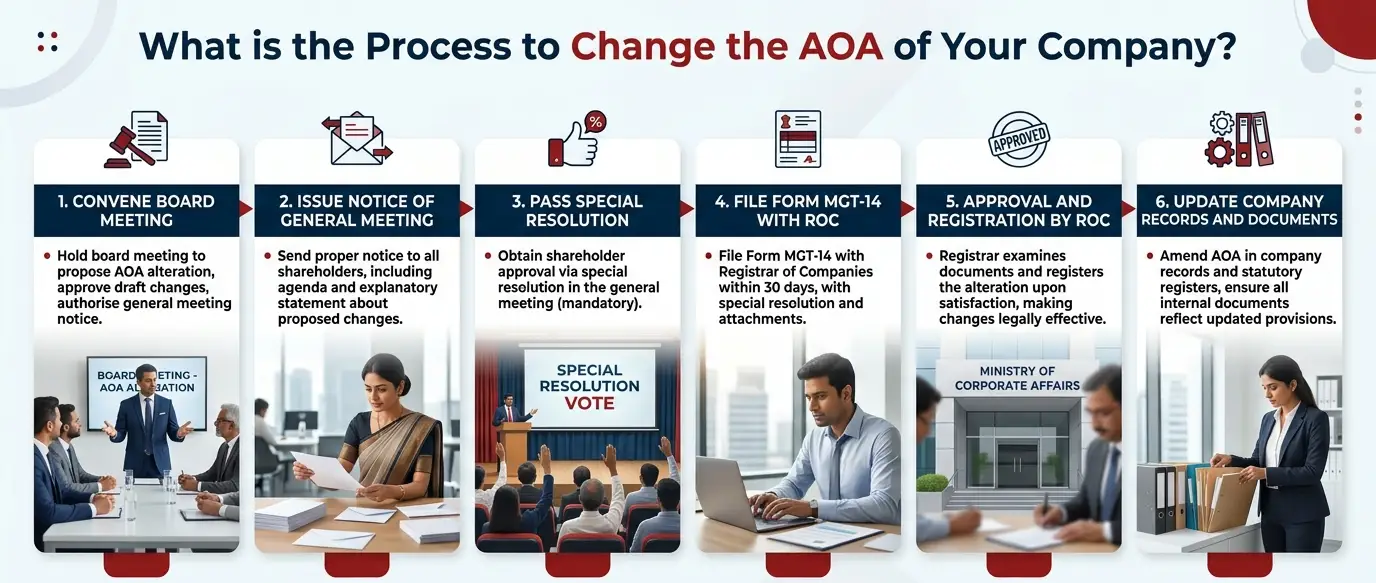
The process to change or alter the AOA of a company is governed by Section 14 of the Companies Act 2013. The key steps in the alteration of the AOA of the company include the following:
1. Convene Board Meeting
The process begins with holding a board meeting where directors discuss and approve the proposal for alteration of the Articles of Association. The board finalises the draft changes and passes a resolution to call a general meeting. It also authorises a director or company secretary to issue notices to shareholders and handle procedural compliances.
2. Issue Notice of General Meeting
A proper notice of the general meeting must be sent to all shareholders, directors, and auditors at least 21 clear days before the meeting, unless shorter notice is consented to. The notice must include the agenda, details of proposed AOA changes, and an explanatory statement under Section 102, ensuring full disclosure and transparency.
3. Pass Special Resolution
At the general meeting, the proposed alteration must be approved by shareholders through a special resolution, requiring at least a 75% majority. This step is mandatory under Section 14 and ensures that significant changes in company regulations are made only with substantial shareholder consent, protecting minority interests.
4. File Form MGT-14 with ROC
After passing the resolution, the company must file Form MGT-14 with the Registrar of Companies within 30 days. The form should include a certified copy of the special resolution, notice of meeting, explanatory statement, and altered AOA. Timely filing is essential to avoid penalties and ensure legal validity.
5. Approval and Registration by ROC
The Registrar of Companies examines the filed documents to ensure compliance with legal provisions. If satisfied, the ROC registers the alteration and records it in official registers. Only after such registration does the alteration become legally binding on the company and its members.
6. Update Company Records and Documents
Once approved, the company must update its Articles of Association in all statutory registers, records, and internal documents. Copies of the amended AOA should be maintained at the registered office. The company must also ensure that future operations, agreements, and decisions align with the revised provisions.
What Documents are Required to Change the AOA of Your Company?
Certain key documents required to legally alter the AOA under the Companies Act, 2013, include the following:
- Board Resolution Copy
- Special Resolution Copy
- Notice of General Meeting
- Explanatory Statement
- Altered Articles of Association Copy
- Form MGT-14
- Consent Letters (if required)
- Digital Signature Certificate (DSC)
What is ROC Form MGT-14: Overview, Fees, and Penalties for Non-Compliance
ROC Form MGT-14 is a mandatory filing prescribed under Section 117 of the Companies Act, 2013, used to submit certain resolutions and agreements to the Registrar of Companies (ROC). It is primarily filed for special resolutions, board resolutions, and agreements such as alteration of AOA or MOA.
- The form must be filed within 30 days of passing the resolution.
- The filing fees depend on the company’s authorised capital and may increase with delay. In case of non-compliance, a penalty of ?1,000 per day is imposed, subject to a maximum limit of ?1 lakh for the company and defaulting officers.
- Timely filing of MGT-14 ensures legal validity and compliance with corporate regulations.
What are the Common Reasons for Changing AOA?
Companies alter their AOA to adapt to changing business needs, legal requirements, and internal management structures for smooth functioning. The key reasons to change the AOA of the company include the following:
- To facilitate conversion between private company and public company structure
- To reflect changes in share capital or shareholders’ rights
- To redefine powers and responsibilities of directors for better governance
- To ensure compliance with updated legal and regulatory requirements
- To incorporate new business policies, strategies, or expansion plans
- To include or modify dispute resolution mechanisms within the company
- To correct errors, inconsistencies, or ambiguities in existing provisions
What is Conversion of Company via Change in AOA?
Conversion of a company through change in its Articles of Association (AOA) refers to the legal process of transforming one type of company into another by altering its internal rules. Under Section 14 of the Companies Act, 2013, a company can convert, for example, from a private company to a public company or vice versa by passing a special resolution and modifying its AOA accordingly. This alteration reflects changes in management structure, shareholder rights, and regulatory compliance requirements. The amended AOA must be filed with the Registrar of Companies within the prescribed time.
What is the Process for Conversion of a Company via Change in AOA?
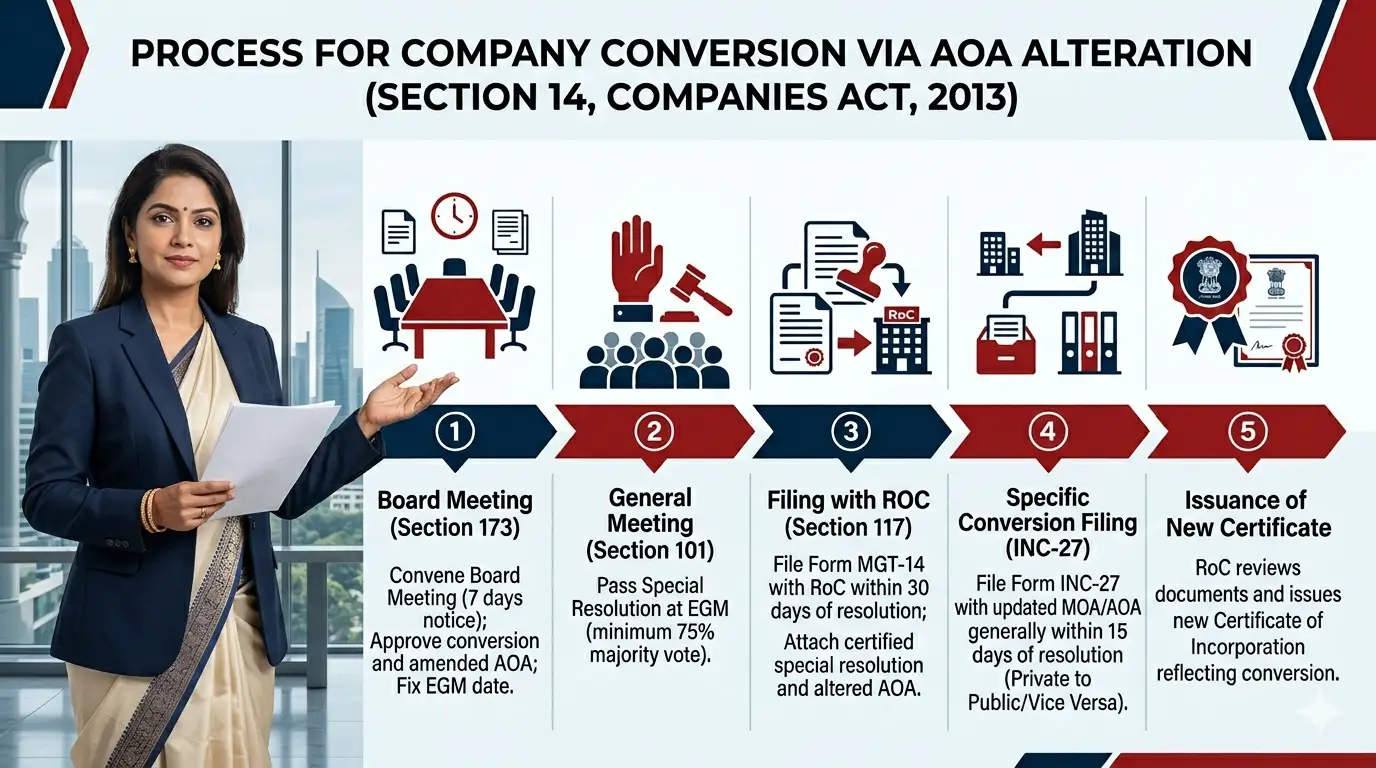
The conversion of a company via alteration of the Articles of Association (AOA) involves passing a special resolution in a general meeting, amending the AOA to reflect the new company structure, and filing Form MGT-14 with the Registrar of Companies (RoC) within 30 days, as per Section 14 of the Companies Act, 2013. Here is the step-by-step process for conversion via AOA alteration:
1. Board Meeting (Section 173)
- Provide a minimum of seven days’ notice to directors for convening the board meeting
- Approve the proposal for conversion along with draft amended Articles of Association
- Fix the date, time, and venue for the Extraordinary General Meeting (EGM)
- Authorise designated officials to handle procedural and regulatory compliances
2. General Meeting (Section 101)
- Issue proper notice to members along with agenda and explanatory statement
- Convene the EGM to consider proposed alteration and company conversion
- Pass the special resolution with requisite 75% majority of shareholder votes
3. Filing with ROC (Section 117)
- File Form MGT-14 with the Registrar of Companies within prescribed 30-day period
- Attach certified copies of special resolution and amended Articles of Association
- Include notice of meeting and explanatory statement as supporting documents
- Complete filing with valid digital signatures and required professional certification
4. Specific Conversion Filing (Form INC-27)
- Submit Form INC-27 for conversion between private and public company status
- Attach revised MOA and AOA reflecting updated structure and governance provisions
- Ensure filing within prescribed timeline, generally 15 days from resolution date
- Provide necessary declarations and approvals as required under applicable regulations
5. Issuance of New Certificate of Incorporation
- The registrar reviews submitted documents to verify legal and procedural compliance
- Issue fresh Certificate of Incorporation reflecting the converted company status
- Conversion becomes effective from the date mentioned in the certificate
- Update statutory records, company documents, and regulatory registrations accordingly
What are the Key Restrictions on Change/Alteration of AOA?
Alteration of Articles of Association (AOA) is subject to certain legal restrictions to protect shareholders’ rights, ensure fairness, and maintain compliance with the Companies Act, 2013. Key restrictions on change/alteration of AOA include the following:
- The alteration must not be inconsistent with the provisions of the Companies Act 2013 or any other applicable law.
- The alteration must remain within the scope of the Memorandum of Association and not override its fundamental conditions.
- The change must be made bona fide for the benefit and interest of the company as a whole.
- The alteration must not violate or unfairly prejudice the rights of minority shareholders.
- The company cannot include provisions that are illegal, against public policy, or contrary to judicial principles.
- Any alteration converting a public company into a private company requires approval from the central government.
- The alteration must follow the prescribed procedure, including passing a special resolution and filing with the Registrar of Companies.
What are the Key Considerations Before Changing AOA?
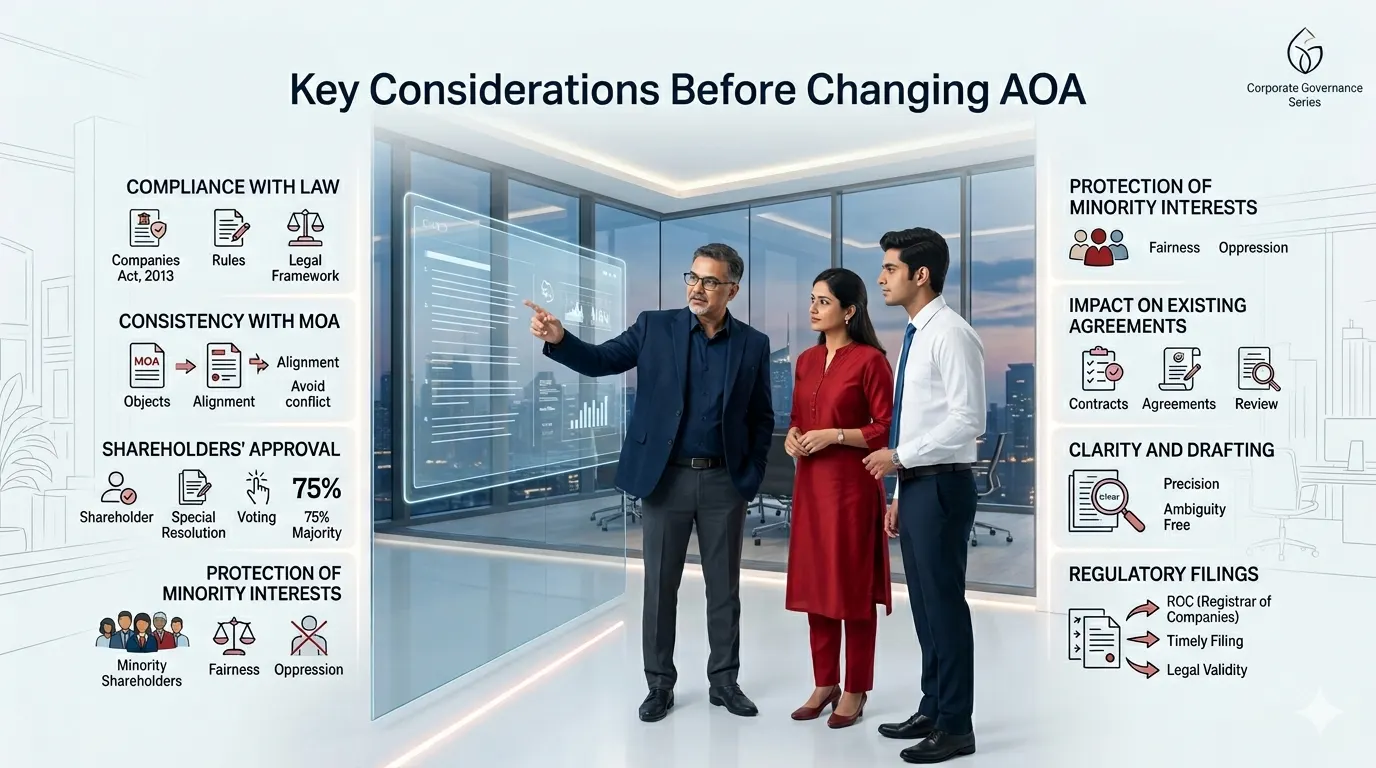
Before altering the Articles of Association (AOA), companies must carefully evaluate legal, financial, and operational implications to avoid future disputes or non-compliance. As governed by the Companies Act, 2013, any change should align with statutory provisions, protect stakeholder interests, and support long-term business objectives while maintaining transparency and corporate governance standards. Here are the key considerations you one should take care of:
- Compliance with Law: Ensure proposed changes strictly comply with provisions of the Companies Act, 2013 and related rules.
- Consistency with MOA: Alterations must not conflict with the Memorandum of Association, ensuring alignment with company’s core objectives.
- Shareholders’ Approval: Obtain approval through a special resolution, safeguarding the rights and interests of all shareholders.
- Protection of Minority Interests: Changes should not unfairly prejudice minority shareholders or result in oppression or mismanagement.
- Impact on Existing Agreements: Review contracts, shareholder agreements, and obligations that may be affected by AOA changes.
- Clarity and Drafting: Draft amendments clearly and precisely to avoid ambiguity, misinterpretation, or future legal disputes.
- Regulatory Filings: Ensure timely filing with the Registrar of Companies (ROC) to maintain legal validity and compliance.
How Legal Babu Can Help with Change in AOA of Your Company?
Legal Babu assists businesses in efficiently managing the change in Articles of Association (AOA) by providing end-to-end legal support. Our experts help in drafting and reviewing AOA amendments, ensuring compliance with the Companies Act, 2013, and preparing necessary resolutions and documents. We also handle timely filing of forms like MGT-14 with the Registrar of Companies, reducing the risk of penalties.
With our professional guidance, companies can smoothly complete the alteration process while ensuring legal accuracy and regulatory compliance!
FAQS
Have some questions about AOA of company?
We have got you covered:
-
Can AOA be altered after company incorporation?
Yes, AOA can be altered anytime after incorporation by passing a special resolution and complying with statutory requirements.
- Can AOA override the Companies Act, 2013?
- Is stamp duty applicable to AOA alteration?
- Can private company AOA be converted to public company AOA?
- What happens if AOA is not updated after changes?
- Can AOA restrict share transfer completely?
- Is a digital signature required for AOA filing?
- Can AOA changes affect company valuation?
- Can shareholders challenge AOA changes?
- Does AOA apply to third parties?


