
A Cyber Security Audit is a structured, evidence-based examination of an organisation's IT systems, applications, data flows, policies and people, benchmarked against recognised frameworks such as ISO/IEC 27001, ISO/IEC 20000, the NIST Cybersecurity Framework and India's CERT-In audit standards. This LegalBabu guide covers every dimension of a Cyber Security Audit - including the specialised Cyber Security Audit of Ships under DGMA (Directorate General of Maritime Administration) maritime cybersecurity requirements - so businesses on land and at sea can protect themselves with confidence.
What is a Cyber Security Audit?
A Cyber Security Audit is an independent, risk-based assessment of an organisation's information-security posture. Unlike a quick vulnerability scan, a Cyber Security Audit measures technical controls, administrative policies, physical safeguards and human behaviour against globally accepted standards.
At its core, a Cyber Security Audit answers three questions:
-
Where is the business exposed to cyberattacks?
-
How effective are the current security controls?
-
What must be improved to stay compliant and resilient?
A Cyber Security Audit is no longer a discretionary IT exercise - it is a legal, contractual and reputational necessity for every Indian enterprise, MSME, e-commerce operator and shipping company. Businesses looking to strengthen their overall compliance posture can also review the MCA Compliance Relief Scheme 2026 Guide for related regulatory clean-ups.
Why a Cyber Security Audit Matters?
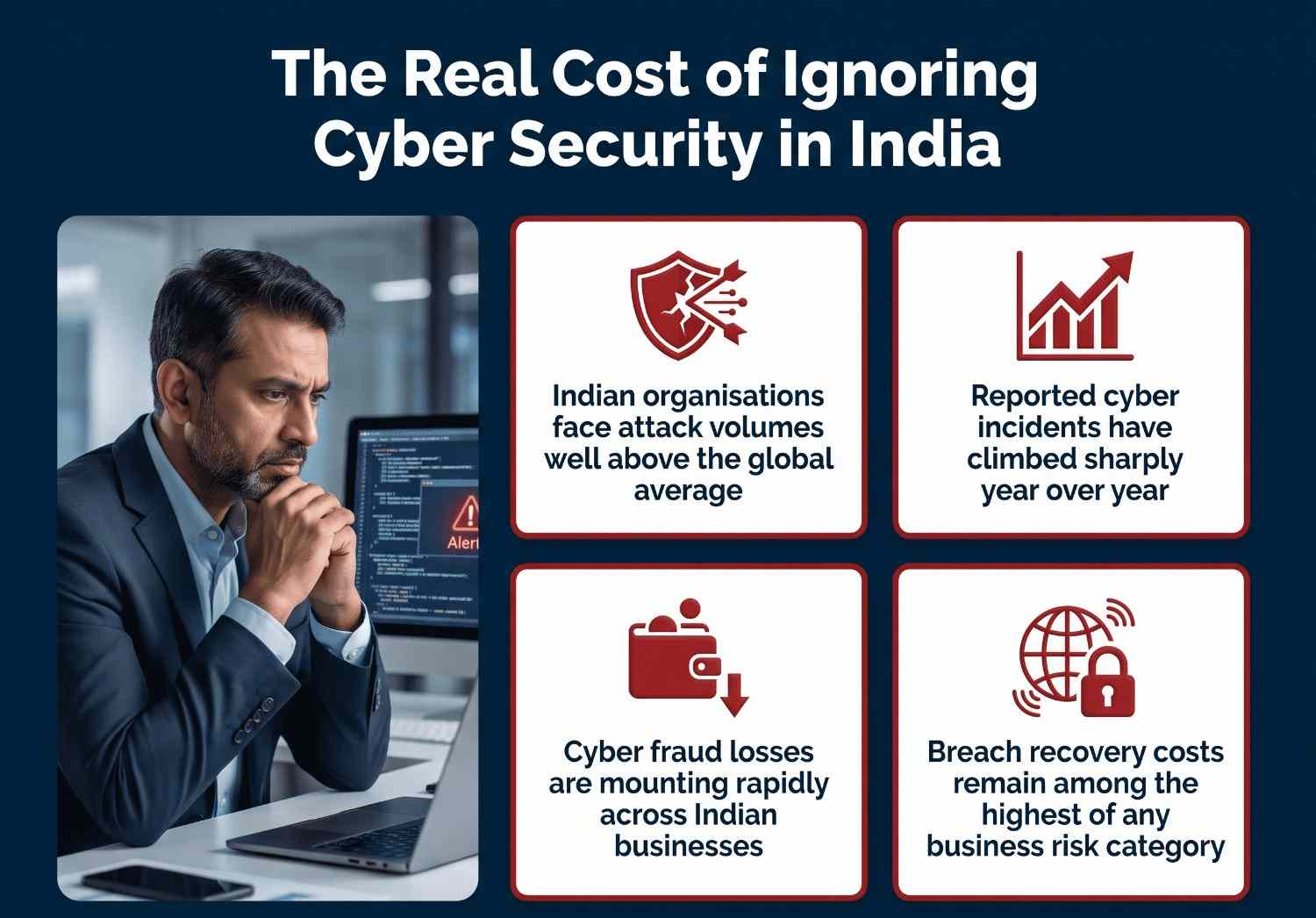
The threat surface for Indian organisations has expanded dramatically:
-
Indian organisations now face attack volumes well above the global average.
-
29,44,248 cybersecurity incidents in 2025 were officially tracked by CERT-In(PIB).
-
The Union Budget 2025-26 allocated ₹782 crore specifically for cybersecurity initiatives.
-
Global average breach cost stands at USD 4.44 million (IBM Cost of a Data Breach Report).
-
6,589,201+ financial fraud complaints were reported on NCRP from 2021 to 2025, involving ₹55,050+ crore reported amount, ₹8,189+ crore marked as lien, and 1,95,760+ FIRs registered. (PIB)
Official PIB data also notes that, in 2025 alone, CERT-In handled over 29.44 lakh cyber incidents, while issuing 1,530 alerts, 390 vulnerability notes, and 65 advisorie, underscoring both the scale of threats and the need for continuous cyber-risk review.
A well-scoped Cyber Security Audit protects a business by:
-
Identifying vulnerabilities before attackers exploit them.
-
Ensuring compliance with the DPDP Act, CERT-In directions and sector regulators.
-
Reducing financial exposure to ransomware, phishing and insider risk.
-
Building customer, investor and regulator trust through demonstrable safeguards.
-
Unlocking enterprise contracts that increasingly require ISO 27001 or CERT-In audit reports.
For growth-stage companies, this trust dividend also translates into commercial value - a theme explored in the Ease of Doing Business in India Growth Plan guide.
Cyber Security Audit for Businesses in India
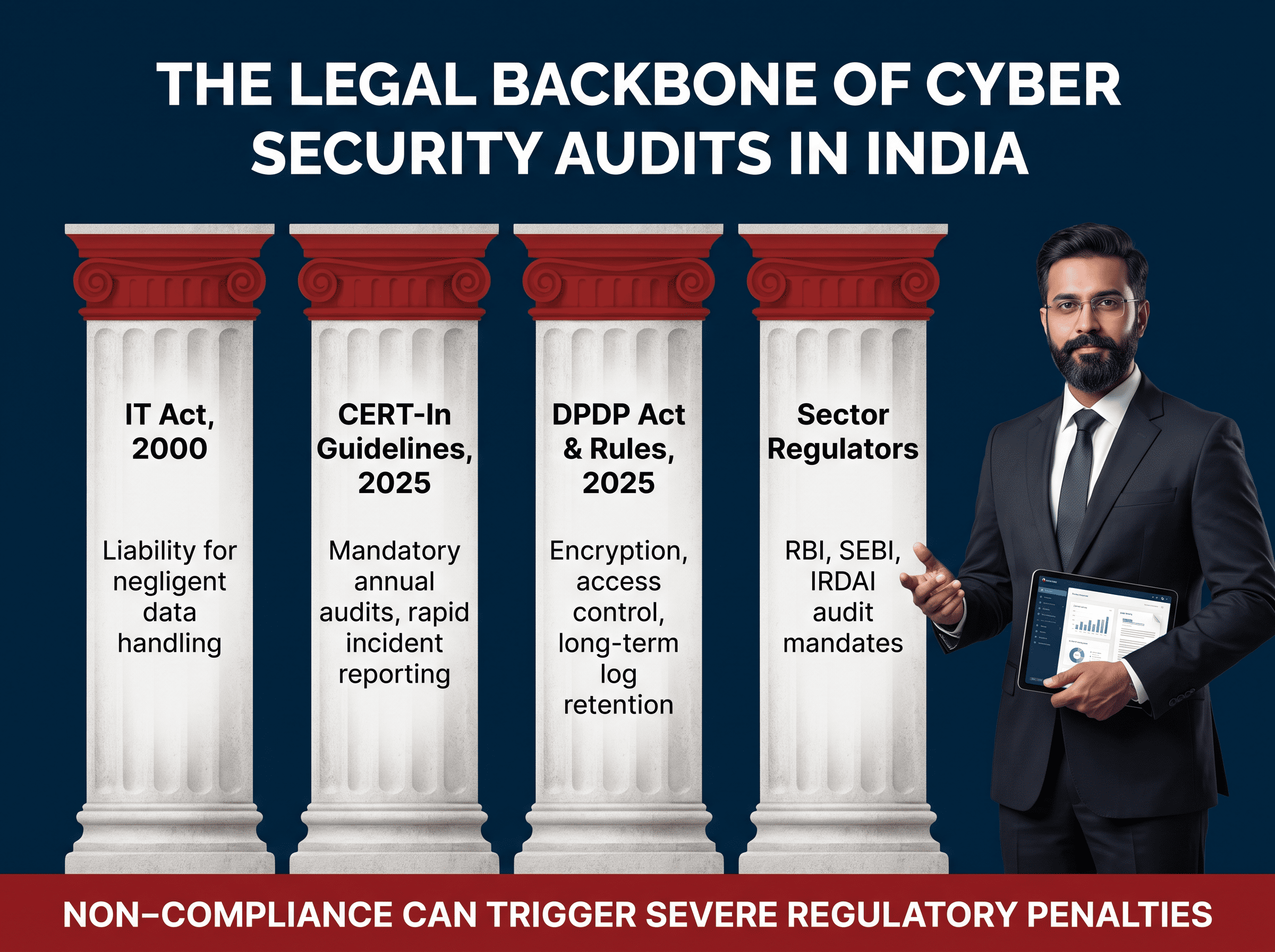
Indian cyber regulation has matured rapidly. Every business owner should understand four legal pillars:
1. Information Technology Act, 2000
The IT Act, 2000 is India's foundational cyber law. Section 43A holds companies liable for negligence in protecting sensitive personal data, making a Cyber Security Audit the first line of defence.
2. CERT-In Comprehensive Cyber Security Audit Policy Guidelines, 2025
The Indian Computer Emergency Response Team (CERT-In) issued its Comprehensive Cyber Security Audit Policy Guidelines in July 2025. These require:
-
Annual Cyber Security Audits at a minimum.
-
Pre-implementation audits before major infrastructure changes.
-
Audits by CERT-In empanelled auditors for critical sectors.
-
A six-hour reporting window for any cybersecurity incident.
3. DPDP Act, 2023 & DPDP Rules, 2025
The DPDP Rules, 2025, notified on 14 November 2025 by MeitY, mandate encryption, access control, breach notification and log retention of at least one year - all of which fall within the scope of a modern Cyber Security Audit.
4. Sector-Specific Mandates
-
RBI requires cybersecurity audits for banks and NBFCs.
-
SEBI requires listed entities (including SME IPOs - see the SME IPO Listing Requirements India guide) to complete annual cyber audits.
-
IRDAI enforces cyber audits for insurers.
-
DGMA governs cyber risk management for Indian-flagged vessels and maritime training institutes.
Non-compliance under the DPDP Act can attract penalties of up to ₹250 crore, which makes a proactive Cyber Security Audit the smartest compliance investment for any Indian business.
Recognised Certification Frameworks
Businesses commonly align their Cyber Security Audit with global certifications through LegalBabu:
-
ISO 27001 - Information Security Management System Certification: the gold standard for information security.
-
ISO 20000 Certification: the international benchmark for IT service management, closely coupled with security operations.
Cyber Security Audit of Ships & DGMA Maritime Cybersecurity Requirements
Shipping is one of the most digitally exposed sectors in India. Modern vessels carry ECDIS, AIS, GMDSS, VSAT, engine-control networks, cargo-management systems and satellite communications - all of which are targets for cyber intrusion. A specialised Cyber Security Audit of ships is now a regulatory expectation, not an optional exercise.
Why Ships Need a Dedicated Cyber Security Audit
-
Vessels blend Information Technology (IT) and Operational Technology (OT) systems, expanding the attack surface.
-
A single compromised navigation or propulsion system can endanger crew, cargo and the marine environment.
-
Port State Control inspections increasingly examine cyber-risk management records.
-
Ship-owners and operators are contractually bound to charterers, insurers and P&I clubs to maintain cyber resilience. Cargo-side exposure is covered further in the MTO Insurance Essentials: Cargo Liability Coverage for 2026 guide.
DGMA Maritime Cybersecurity Requirements
The Directorate General of Maritime Administration (DGMA) - India's maritime administrator - has aligned Indian-flagged vessels and maritime training institutes with the International Maritime Organisation's Resolution MSC.428(98), which requires cyber-risk management to be incorporated into the ship's Safety Management System (SMS) under the ISM Code. Practical expectations for a maritime Cyber Security Audit include:
-
Cyber risk assessment of every shipboard IT and OT system.
-
Documented policies covering onboard user access, removable media and remote support.
-
Segregation of critical OT networks (navigation, propulsion) from crew and business networks.
-
Incident response and reporting procedures aligned with the vessel's SMS.
-
Crew training on phishing, USB hygiene and social-engineering risks.
-
Regular technical audits, including vulnerability scanning of shipboard systems.
-
Vendor and third-party assessments for OEM remote-maintenance links.
International guidance from the IMO Maritime Cyber Risk portal and industry frameworks such as BIMCO's Guidelines on Cyber Security Onboard Ships underpin how a maritime Cyber Security Audit should be scoped and evidenced. For a deeper look at how DGMA audits work in practice, review the Comprehensive Inspection Programme for DGMA Maritime Training Institutes.
Scope of a Cyber Security Audit of Ships
|
Domain |
What is Audited |
|
Bridge Systems |
ECDIS, AIS, radar, GNSS/GPS integrity |
|
Communication |
VSAT, GMDSS, satellite links, crew Wi-Fi |
|
Engine Control |
Engine management, ballast, cargo control (OT) |
|
Administrative IT |
Ship-office PCs, email, ERP interfaces |
|
Access & Identity |
Onboard user accounts, privileged access, MFA |
|
Removable Media |
USB policy, patch delivery procedures |
|
Remote Support |
OEM VPNs, third-party diagnostic links |
|
SMS Integration |
Cyber risk within ISM documentation |
|
Incident Response |
Onboard playbooks, escalation to shore |
|
Crew Awareness |
Phishing tests, training records |
Ship-owners, managers and recruitment/placement service licensees relying on Indian tonnage tax, cabotage or coastal trade must be able to produce a defensible Cyber Security Audit trail. Related maritime compliance topics - including manpower licensing, technical consultancy and annual audits - are covered in the Maritime Technical Consultancy for RPSL & Startups in India and RPSL Annual Compliance Service resources.
Cyber Security Audit Process - 7 Key Phases
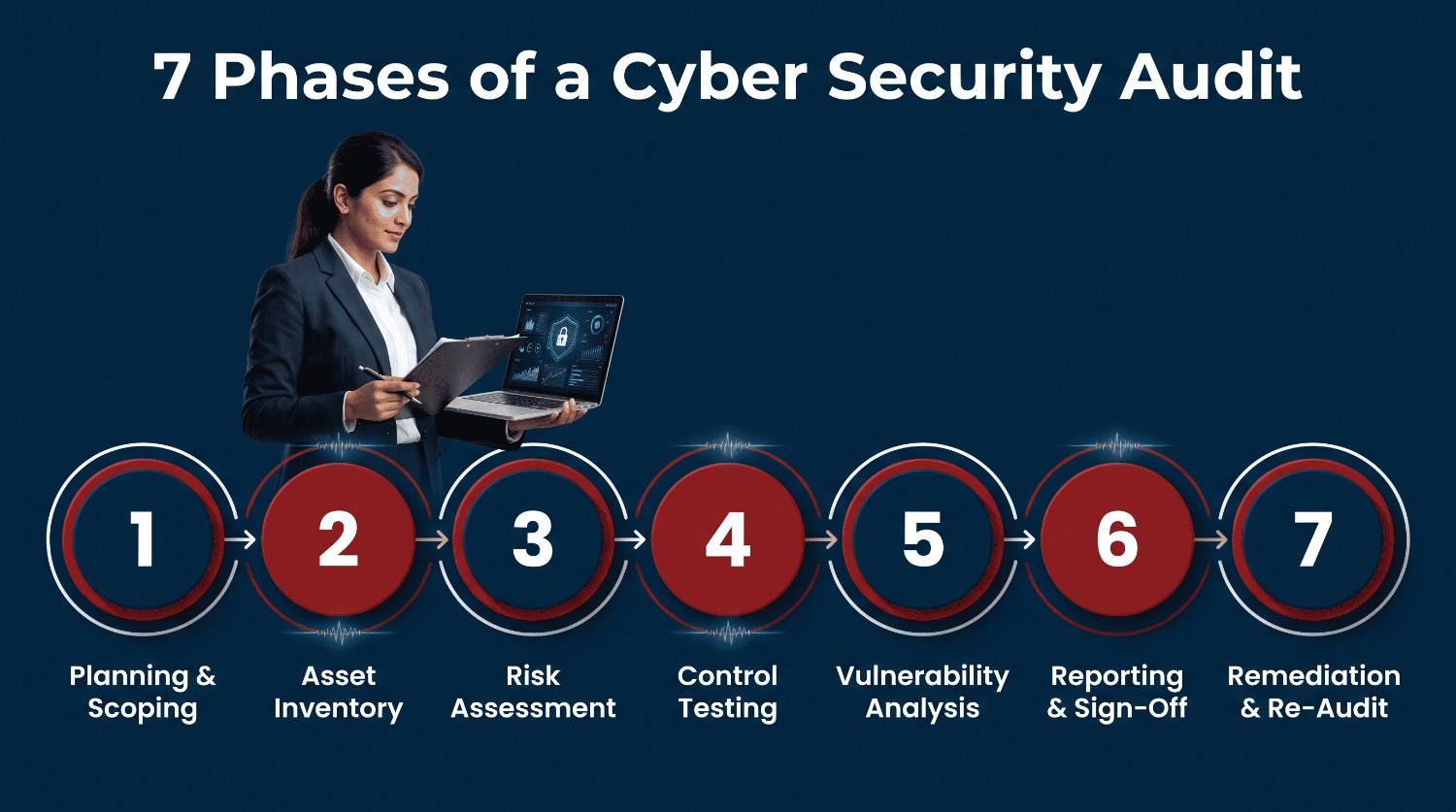
Every credible Cyber Security Audit - whether for a factory, a fintech or a fleet - follows a repeatable methodology:
Phase 1 - Planning & Scoping
Define which assets, systems and regulations are in scope. Set audit objectives, timelines and success criteria.
Phase 2 - Asset Inventory
Consolidate hardware, software, applications, APIs, endpoints, cloud services and OT devices. CERT-In's 2025 guidelines make this mandatory.
Phase 3 - Risk Assessment
Identify threats such as ransomware, phishing and insider misuse; rank them by likelihood × impact. For ships, include navigation-integrity threats and OT compromise scenarios.
Phase 4 - Control Testing
Evaluate technical controls (firewalls, MFA, EDR, network segmentation), administrative controls (policies, training) and physical controls. Include SAST and DAST for critical applications.
Phase 5 - Vulnerability Analysis
Tag findings with CWE, CVE and CVSS/EPSS scores as required by CERT-In. Categorise issues as Critical, High, Medium or Low.
Phase 6 - Reporting & Sign-Off
Deliver a formal audit report to leadership. Under CERT-In 2025, CXOs must sign off on residual risks - accountability now sits at the top.
Phase 7 - Remediation & Re-Audit
Fix vulnerabilities, re-test, and update policies. Any significant post-audit change triggers a fresh Cyber Security Audit.
Benefits of a Cyber Security Audit
A well-executed Cyber Security Audit delivers benefits across compliance, commercial and operational dimensions:
-
Regulatory Confidence - Demonstrable adherence to CERT-In, DPDP Act, RBI, SEBI, IRDAI and DGMA mandates.
-
Risk Reduction - Early detection of vulnerabilities before exploitation.
-
Financial Protection - Lower likelihood of ransomware payouts and breach-related losses.
-
Insurance Advantage - Improved cyber-insurance terms and eligibility.
-
Customer Trust - Verifiable data protection to reassure customers and partners.
-
Investor Readiness - A prerequisite for due diligence in fund-raising and M&A. See the Transaction Advisory Services guide for how cyber posture influences deal outcomes.
-
Contract Wins - ISO 27001, ISO 20000 and audit evidence unlock enterprise and government tenders.
-
Operational Resilience - Stronger incident response and business-continuity readiness.
-
Maritime Compliance - For shipping companies, alignment with DGMA and IMO expectations, keeping vessels port-ready.
-
Cultural Uplift - Cyber awareness embedded across employees and crew.
Cyber Security Audit Cost in India
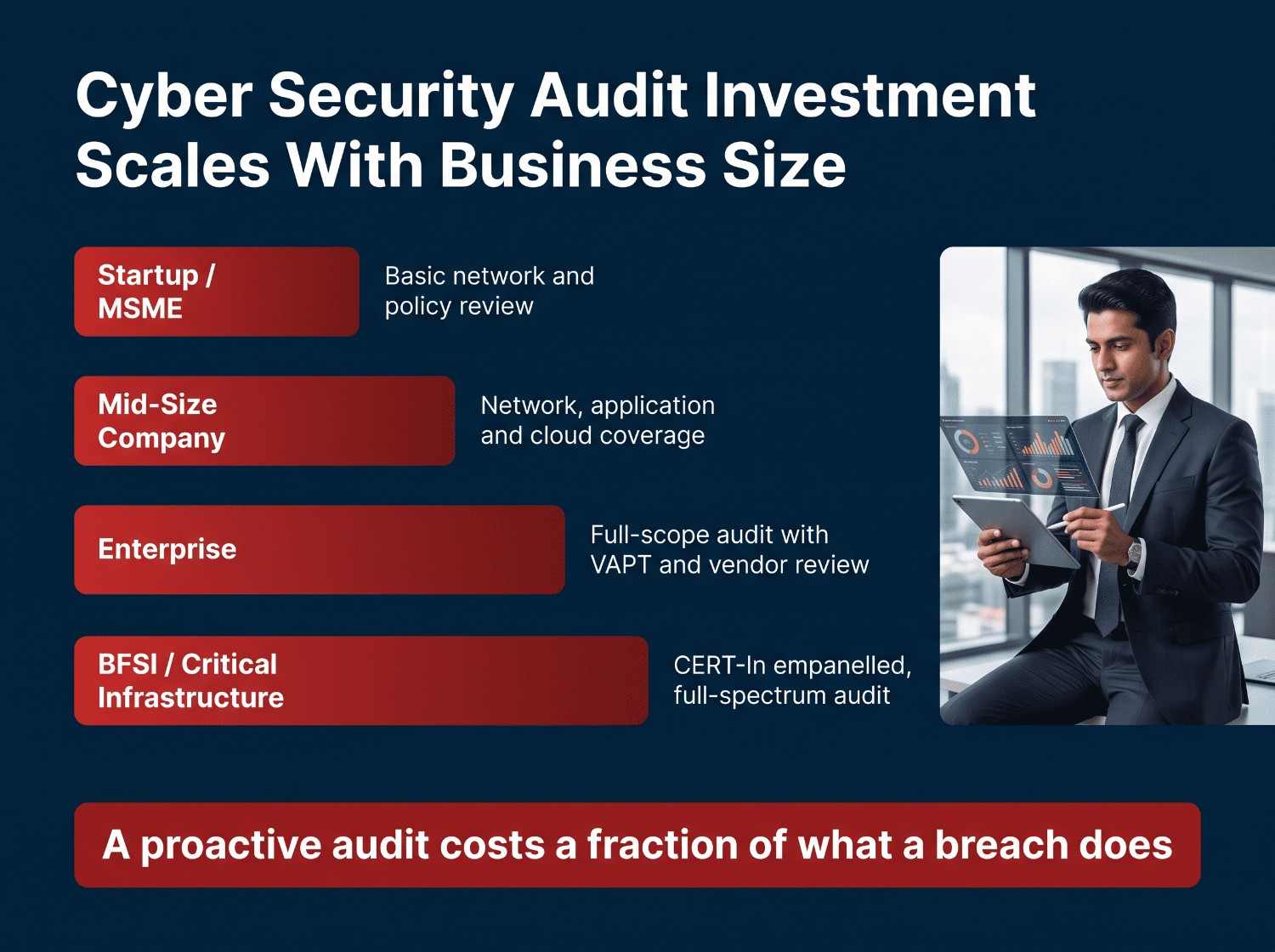
Costs vary with business size, scope and regulatory pressure. Indicative ranges for 2026:
|
Business Size |
Scope |
Typical Cost (₹) |
|
Startup / MSME |
Basic network + policy |
50,000 - 1,50,000 |
|
Mid-Size Company |
Network + apps + cloud |
2,00,000 - 6,00,000 |
|
Enterprise |
Full-scope + VAPT + vendors |
8,00,000 - 25,00,000+ |
|
BFSI / Critical Infra |
CERT-In empanelled audit |
15,00,000 - 50,00,000+ |
|
Shipping / Vessels |
Per-ship IT + OT + SMS review |
3,00,000 - 15,00,000+ |
Set against the multi-crore cost of a single breach or a detained vessel, a Cyber Security Audit is one of the highest-ROI investments a business can make. For a scoped quotation, contact LegalBabu here.
Types of Cyber Security Audit
|
Audit Type |
What It Covers |
Best Suited For |
|
Compliance Audit |
ISO 27001, ISO 20000, DPDP, CERT-In, PCI DSS |
All regulated businesses |
|
Network Security Audit |
Firewalls, routers, VPNs, and segmentation |
IT-heavy companies |
|
Application Security Audit |
Web/mobile apps, APIs, SAST/DAST |
SaaS, fintech, e-commerce |
|
Cloud Security Audit |
AWS, Azure, GCP configurations |
Cloud-first businesses |
|
Internal / External Audit |
Employee behaviour vs outsider threats |
Every organisation |
|
Penetration Testing (VAPT) |
Simulated attacker techniques |
Fintech, healthcare, SaaS |
|
Physical Security Audit |
Server rooms, access cards, CCTV |
Data centres, offices |
|
Third-Party / Vendor Audit |
Supply-chain risk |
Enterprises with vendors |
|
Maritime Cyber Audit |
Ship IT + OT + SMS integration |
Shipping companies, fleet operators |
Cyber Security Audit Readiness Checklist
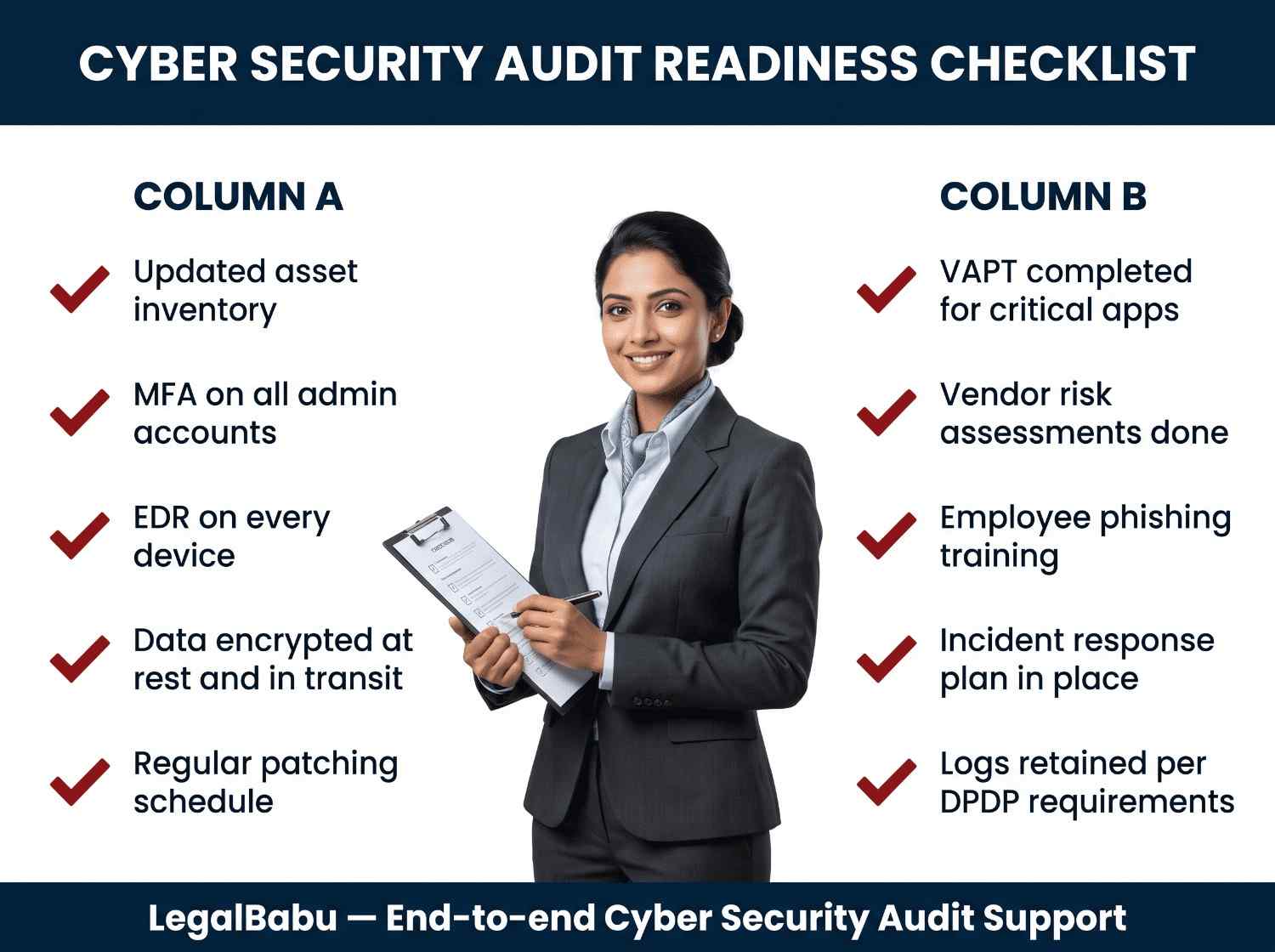
Use this checklist before, during and after a Cyber Security Audit:
-
Updated asset inventory and network diagram
-
Documented information security policy signed by management
-
Multi-Factor Authentication on all admin accounts
-
Endpoint Detection & Response (EDR) on every device
-
Firewall, IDS/IPS and email-gateway hardening
-
Encryption of data at rest and in transit (AES-256, TLS 1.3)
-
Regular patching schedule for OS, apps and firmware
-
Secure code review (SAST) and penetration testing (DAST)
-
Vendor and third-party risk assessments
-
Employee (and crew) cyber-hygiene training with phishing simulations
-
Incident response plan aligned with the CERT-In six-hour reporting rule
-
Quarterly backup and disaster-recovery drills
-
Least-privilege access controls
-
Log retention for at least one year (DPDP requirement)
-
For ships: OT segregation, USB policy, SMS-integrated cyber procedures
Consequences of Skipping a Cyber Security Audit
Ignoring a Cyber Security Audit exposes a business to:
-
Regulatory penalties up to ₹250 crore under the DPDP Act.
-
CERT-In enforcement action for failure to report incidents.
-
Data-protection lawsuits from affected customers.
-
Loss of enterprise contracts requiring ISO 27001 / ISO 20000 evidence.
-
Reputational damage that lingers long after a breach.
-
Cyber-insurance rejections and higher premiums.
-
Vessel detention or Port State Control observations for shipping companies under DGMA oversight.
-
Operational downtime averages around 24 days per ransomware event.
Prevention through a Cyber Security Audit is typically 30-50 times cheaper than remediation.
How LegalBabu Helps Conduct a Cyber Security Audit
LegalBabu is a trusted business consulting and advisory partner supporting Indian startups, MSMEs, enterprises and shipping companies since 2014. End-to-end Cyber Security Audit support includes:
-
Scoping the correct audit type (CERT-In, ISO 27001, ISO 20000, DPDP, VAPT, maritime).
-
Coordinating with CERT-In empanelled auditors.
-
ISO 27001 Information Security Management System certification.
-
DPDP Act readiness assessments and documentation.
-
Maritime cyber advisory aligned with DGMA and IMO expectations.
-
Post-audit remediation planning and re-audit follow-up.
-
Vendor and third-party assessments.
-
Ongoing compliance retainers so audits never lapse.
For a personalised discussion on scope, timelines and pricing, get in touch with LegalBabu or explore compliance guides on the LegalBabu Learn hub.
Conclusion
In 2026, cyber threats do not discriminate by size, sector or geography - and increasingly, not even by whether a business is on land or at sea. Whether the organisation is a two-person startup in Bengaluru, a listed manufacturer in Mumbai or a shipping company operating Indian-flagged tonnage, a Cyber Security Audit is the most cost-effective safeguard for revenue, reputation and regulatory standing.
The combination of the DPDP Act 2023, DPDP Rules 2025, CERT-In 2025 Audit Policy Guidelines, RBI/SEBI/IRDAI mandates and DGMA maritime cyber expectations has made India's cyber regime one of the most rigorous in Asia. Businesses that treat a Cyber Security Audit as a proactive strategy - rather than a reactive scramble - will win customer trust, attract investment and stay ahead of enforcement.
To scope, run and act on a Cyber Security Audit aligned with CERT-In, ISO 27001, ISO 20000, DPDP and DGMA obligations, contact LegalBabu today, or explore more compliance guides on the LegalBabu Learn hub.
FAQS
FAQs About Cyber Security Audit
-
What is a Cyber Security Audit in simple words?
A Cyber Security Audit is a structured review of a business's IT systems, policies and employee practices to identify security gaps and confirm compliance with laws such as the DPDP Act and CERT-In directions.
- Is a Cyber Security Audit mandatory in India?
- How often should a Cyber Security Audit be conducted?
- What is a Cyber Security Audit of Ships?
- Who regulates maritime cybersecurity in India?
- How long does a Cyber Security Audit take?
- Who can perform a Cyber Security Audit in India?
- What is the penalty for skipping a Cyber Security Audit?
- How does ISO 27001 fit into a Cyber Security Audit?
- What role does ISO 20000 play?
- How much does a Cyber Security Audit cost for an Indian startup?
- Does a Cyber Security Audit cover cloud services like AWS and Azure?
- Can LegalBabu help become CERT-In and DGMA compliant?


