
Trademark Infringement Notice in India: What It Means and How to Respond
A trademark infringement notice is a formal legal letter that tells someone to stop using a mark identical or deceptively similar to your registered trademark. Sent under Section 29 of the Trade Marks Act, 1999, it typically gives the recipient 15 to 30 days to comply before you move to a civil suit or a criminal complaint.
What Is a Trademark Infringement Notice?
A trademark infringement notice, sometimes called a cease and desist notice, is the letter a registered trademark owner sends to someone using a mark that is identical to or deceptively similar to theirs. It names the registration details, describes the infringing use, and demands that the recipient stop. Trademark rights sit alongside patents, copyrights, and designs as one of the core forms of intellectual property in India, and this particular notice only works within the trademark branch of that family.
The notice only carries legal weight if you actually hold a registered trademark. Section 29 of the Trade Marks Act, 1999 defines infringement specifically as the unauthorised use of a registered mark. If your brand name or logo is not yet registered, you do not have standing to allege infringement under this section, though you may still have a claim in passing off, a separate common law remedy covered later in this guide.
If your own registration is still pending, LegalBabu's guide to trademark registration walks through the filing process, and the trademark certificate you eventually receive becomes your primary proof of ownership the day you actually need to send a notice like this one.
What Counts as Trademark Infringement Under Indian Law?
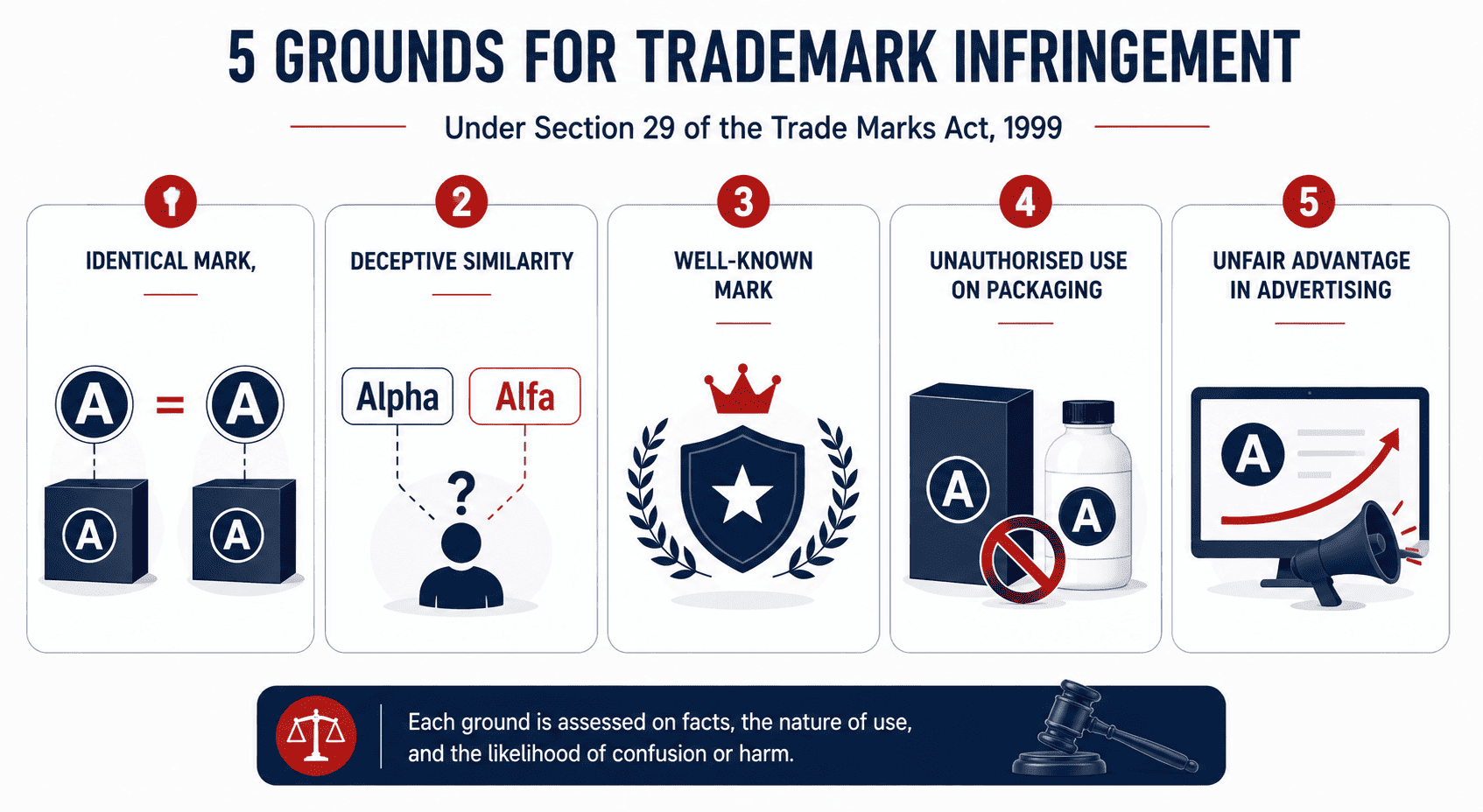
Section 29 sets out several distinct grounds, and a notice usually leans on one or more of them together.
-
Identical mark, identical goods or services. The clearest case. Someone uses the exact same word or logo on the exact same category of goods you are registered for.
-
Deceptive similarity that causes confusion. The marks do not have to be identical. If they sound alike, look alike, or carry the same meaning closely enough that an ordinary buyer could mix them up, that similarity is enough.
-
Similarity to a mark with an established reputation. A well-known mark gets broader protection. Even a use in an unrelated category can count as infringement if it takes unfair advantage of, or damages, the distinctive character of a reputed mark.
-
Unauthorised use on packaging or labelling. Printing someone else's registered mark on your product's box or label, without permission, is a direct violation on its own.
-
Unfair advantage in advertising. Using a competitor's registered mark in your own ads, in a way that borrows their goodwill or damages their reputation, falls under this ground too.
Not every similar-sounding use is actionable, though. Section 30 of the same Act carves out exceptions: using a mark to describe a product's own characteristics, use that stays within conditions the registration itself permits, and use by the proprietor or a properly licensed party. A trademark attorney weighing whether to send a notice checks these exceptions first, since a mark that falls squarely into one of them will not hold up as an infringement claim.
Trademark Infringement vs Passing Off: What's the Difference?
People use these terms interchangeably, but they run on different legal tracks. Infringement is a statutory right that only a registered proprietor can invoke. Passing off protects an unregistered mark through common law, and it asks for more proof.
|
Point |
Trademark Infringement |
Passing Off |
|
Legal basis |
Section 29, Trade Marks Act, 1999 |
Common law tort, preserved by Section 27(2) of the Act |
|
Applies to |
Registered trademarks only |
Unregistered marks and trade dress |
|
What you must prove |
The mark is identical or deceptively similar, used on the registered class |
Goodwill in the mark, misrepresentation by the defendant, and actual or likely damage |
|
Burden of proof |
Lighter. Similarity plus registration is usually enough |
Heavier. All three elements of the passing-off test must be shown separately |
|
Typical relief |
Injunction, damages or account of profits, delivery-up |
Injunction, damages, though courts weigh reputation evidence more closely |
A registered proprietor can often plead both causes of action in the same suit, which gives a stronger fallback position if the registration itself is ever challenged during the case.
When Should You Send a Trademark Infringement Notice?
A notice makes sense once your situation fits a few practical markers, not just a technical reading of Section 29.
-
Someone is using your mark, or something close to it, without your permission.
-
The similarity is close enough that a customer could genuinely confuse the two brands.
-
The infringing use covers goods or services that are the same as, or similar to, what your registration actually covers.
-
The use is commercial. A product listing, a shopfront sign, or an ad counts. A private, non-commercial mention usually does not.
-
The infringer has copied a substantial part of your mark, even if they have added minor tweaks or extra words around it.
A single Instagram post using your logo without any sales behind it is a weaker case than the same logo showing up on a rival product listed for sale on an e-commerce marketplace. Commercial use, not casual mention, is what the law is built to catch, and it is worth being honest with yourself about which situation you are actually in before you spend money on a notice.
What Should a Trademark Infringement Notice Include?
A notice that skips any of these pieces gives the recipient an easy reason to ignore it, or worse, to argue later that your claim was never properly made out.
-
Your name, address, and status as the registered proprietor of the mark
-
The infringer's name and address, as completely as you can establish it
-
Your trademark's exact registration number and the class of goods or services it covers, matched against LegalBabu's trademark class search if you need to confirm the class first
-
A description of the infringing mark and exactly how it is being used
-
A clear explanation of why the two marks are identical or deceptively similar
-
Evidence: screenshots, product photos, listing URLs, packaging images, dated wherever possible
-
A specific cease-and-desist demand, naming exactly what you want stopped
-
A response deadline, customarily 15 to 30 days, though the Act itself does not fix this figure
-
A statement of the legal consequences if the deadline passes without compliance
A notice that only threatens "legal action" without naming what that means reads as a bluff to anyone who has dealt with one before. Citing Section 29, and naming the actual remedies available under Sections 134 and 135, signals that you have genuinely consulted a lawyer, and that alone changes how seriously most recipients take the letter.
How Do You Draft and Send a Trademark Infringement Notice?
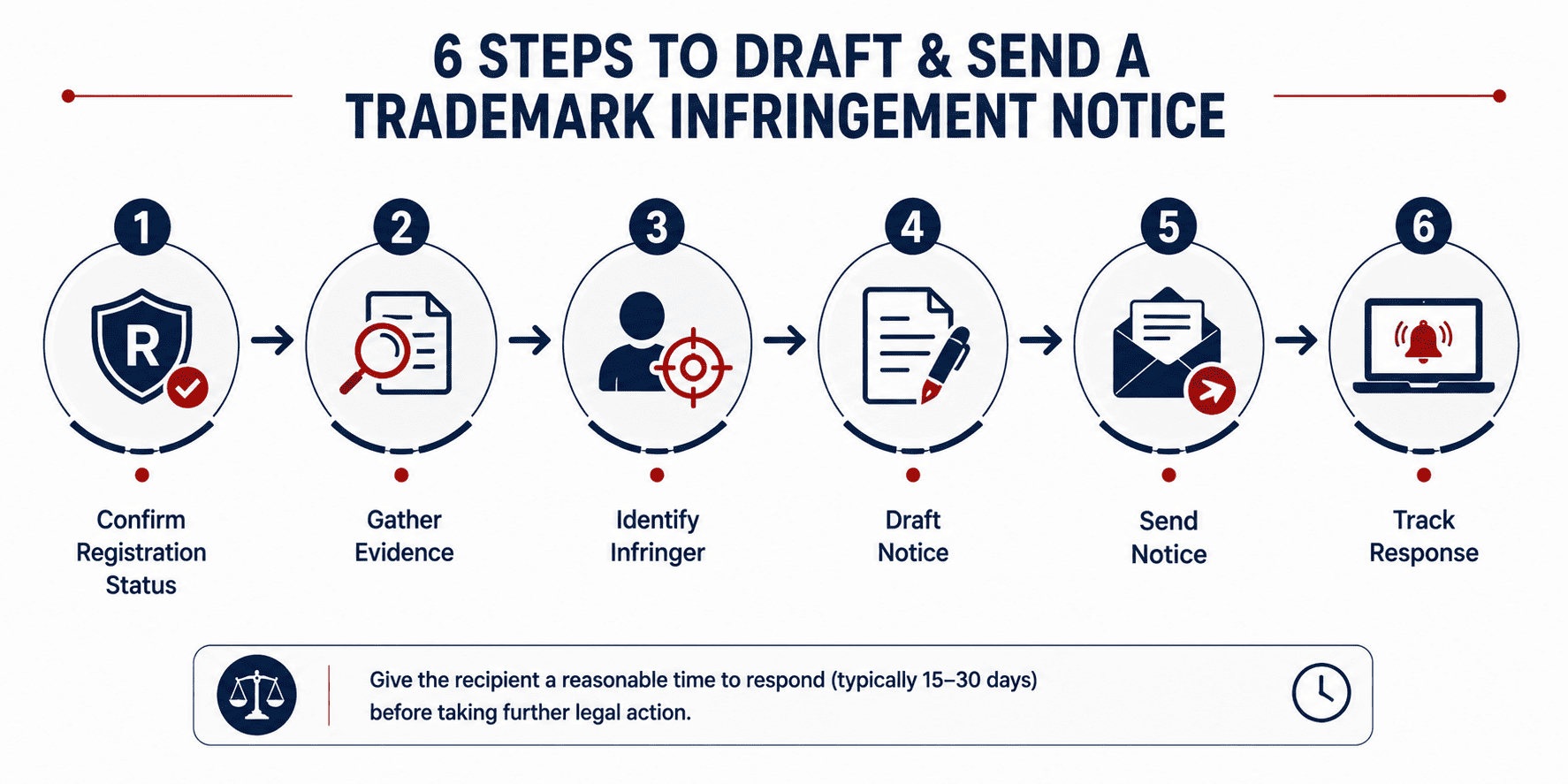
-
Confirm your registration status. Check your application or registration number on the IP India portal, and make sure your mark is actually registered, not merely applied for, and covers the same or a similar class as the infringing use.
-
Collect your evidence. Gather screenshots with visible dates, purchase receipts if you bought the infringing product yourself, and marketplace listing URLs. Save copies immediately, since listings and posts can disappear the moment the other side senses trouble.
-
Verify the infringer's identity and address. Pull their business registration details, GST number, or website ownership information, so the notice actually reaches the right party at a real address for service.
-
Draft the notice through an advocate. A trademark lawyer cites Section 29 correctly, matches the demand to the specific facts, and avoids overreaching language that could later expose you to a groundless-threat claim of your own.
-
Send it through two channels. Registered post with acknowledgment due gives you a physical proof of delivery. Email backs that up immediately and shows the recipient could not claim they never received it.
-
Track the response and plan your next move. If the infringer complies, get that agreement in writing. If the deadline passes with no response, that silence becomes useful evidence later, since it shows they were formally put on notice and chose not to act.
Civil Suit or Criminal Complaint: What Happens If the Infringer Ignores the Notice?
Ignoring a notice does not make the underlying problem go away. It just moves the dispute toward one of two tracks, and Indian law keeps both open at the same time.
A civil suit goes to a District Court, or the relevant Commercial Court for higher-value disputes, under Section 134. That section is unusually plaintiff-friendly: unlike the general civil procedure rule of suing where the defendant lives, you can file where you yourself reside or carry on business. Section 135 then sets out the relief available: an injunction, plus either damages or an account of the infringer's profits (you choose one, not both), along with an order for the infringing goods and labels to be handed over or destroyed.
A criminal complaint is available where the conduct involves actual counterfeiting, false trademark application, or a false trade description, under Sections 103 to 105. Police also hold search and seizure powers under Section 115(4) in these cases.
|
Point |
Civil Suit |
Criminal Complaint |
|
Governing provisions |
Sections 134 and 135, Trade Marks Act, 1999 |
Sections 103 to 105, Trade Marks Act, 1999 |
|
Who initiates it |
The registered proprietor, or a permitted licensee |
Any complainant, often supported by a police FIR |
|
Forum |
District Court or Commercial Court |
Magistrate's Court, with police powers of search and seizure |
|
Standard fact pattern |
Ordinary infringement, deceptive similarity, or passing off |
Counterfeiting, falsifying a mark, or a false trade description |
|
Outcome if successful |
Injunction, damages or account of profits, delivery-up |
Imprisonment of 6 months to 3 years, fine of ₹50,000 to ₹2,00,000 (higher for repeat offenders) |
Most trademark suits also count as "commercial disputes" under the Commercial Courts Act, 2015, which normally requires attempting mediation before you can file, unless your plaint seeks urgent interim relief. In October 2025, the Supreme Court clarified in Novenco Building and Industry A/S v. Xero Energy Engineering Solutions that ongoing infringement carries urgency built into the wrong itself, so a plaintiff facing continuing infringement is usually not forced through a mediation window first. This is a fairly recent clarification, and it matters in practice: a genuine, live infringement rarely needs to sit through mediation before reaching a judge.
The notice itself carries some risk too, worth knowing before you send one. Section 142 of the Trade Marks Act lets someone who receives a baseless threat sue the sender for a declaration that the threat was unjustified, along with an injunction and damages, unless the sender can show the mark is genuinely registered and the complained-of use would actually infringe it. This protection generally falls away once a real suit is filed with due diligence, but it is a real reason not to send a notice you cannot actually back up in court.
What Should You Do If You Receive a Trademark Infringement Notice?
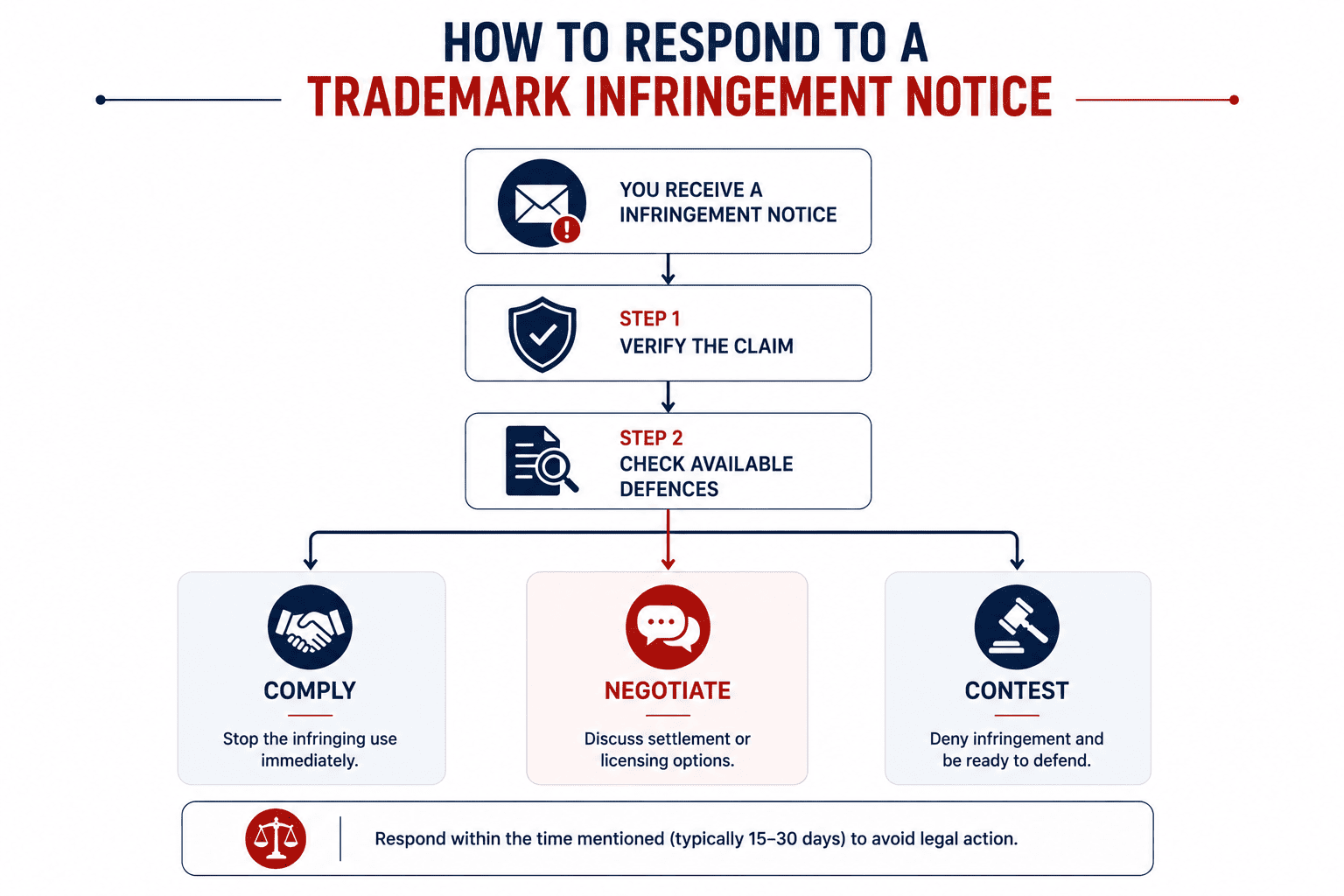
Getting one of these letters is unsettling, but ignoring it is close to the worst option available to you.
-
Do not ignore it. Silence gets read as either an admission or evasion, and it removes your chance to negotiate a cheaper, faster resolution.
-
Verify the claim. Look up the sender's registration number on the IP India portal and confirm the mark is actually registered, not just applied for, and that it covers a class genuinely close to your own use.
-
Check your defences. Section 30 exceptions, such as purely descriptive use or an established prior use of your own, might apply to your situation.
-
Talk to a trademark attorney before you respond. A quick professional read of the notice tells you whether the claim is solid, overstated, or worth contesting outright.
-
Choose your path. You can comply and stop the disputed use, open a negotiation toward coexistence or a licence, or reply formally contesting the claim.
-
Respond within the stated deadline, in writing. Even a short reply asking for more time or clarification is better than saying nothing at all.
Plenty of notices overreach. A brand with a registered mark in one class cannot automatically stop everyone using a similar word in a completely unrelated category, unless their mark genuinely qualifies as a well-known mark under Section 29(4). Reading the actual registration details the sender cites, rather than just their letter, is often the fastest way to tell a legitimate claim from a stretch. LegalBabu's Expert Trademark Review service is built for exactly this kind of second opinion, whether you are checking a notice you received or one you are about to send.
Is Sending a Notice Legally Required Before Filing a Suit?
No. Indian law does not require a trademark owner to send a cease and desist notice before filing an infringement or passing-off suit. It is standard professional practice, not a statutory precondition.
Sending one first often resolves the dispute for a fraction of the cost of litigation, and if it fails, it puts on record that the infringer knew about your rights and chose to continue anyway, which strengthens your position later. In situations where speed matters more than a paper trail, such as counterfeit goods actively moving through a marketplace, going straight to court for an interim injunction is often the better call. A trademark lawyer can help you weigh that trade-off against the facts of your specific case.
How Long Do You Have to Act? What's the Limitation Period for a Trademark Infringement Case?
Three years from the date the infringement occurs, under the Limitation Act, 1963. Where the infringement is a continuing one, meaning the other party keeps using the mark, each fresh act resets the clock, so ongoing use generally stays actionable even years after the first instance you noticed.
That said, delay can still weaken your case for urgent interim relief, even in a suit that is not technically time-barred. Courts assess urgency from the facts on record, and a long, unexplained gap between discovering the infringement and acting on it makes that argument harder to win, even though the Novenco ruling discussed earlier confirms that continuing infringement itself carries built-in urgency in most cases.
How Much Does It Cost to Send a Trademark Infringement Notice?
There is no government fee for sending a notice yourself. Unlike filing an application or replying to an objection, the Trade Marks Act does not charge anything for this step, since it is a private communication rather than a filing with the Registry.
What you do pay for, if you choose it, is professional drafting. Costs vary with how complex the underlying facts are: a straightforward identical-mark case usually costs less to draft than a dispute involving a well-known mark, multiple infringers, or overlapping passing-off arguments. That cost is worth weighing against the risk covered earlier under Section 142. A notice built on solid registration details and real evidence is far cheaper, in the long run, than a hastily drafted one that draws a groundless-threat suit back at you.
If the matter escalates to an actual civil suit, expect court fees on top of your lawyer's fees, and both scale with the value you claim in the suit. Contact LegalBabu for a quote specific to your situation before you commit to either step.
FAQS
Have questions about Trademark Infringement?
We have got you covered.
-
What is a trademark infringement notice?
It is a formal letter a registered trademark owner sends to someone using an identical or deceptively similar mark, demanding they stop, under Section 29 of the Trade Marks Act, 1999.
- What's the difference between trademark infringement and passing off?
- How long do I have to respond to a trademark infringement notice?
- What happens if I ignore a trademark infringement notice?
- Can I send an infringement notice for an unregistered trademark?
- Do I need a lawyer to send a trademark infringement notice?
- What is the penalty for trademark infringement in India?
- Is sending a notice mandatory before filing a court case?
- What's the limitation period for filing a trademark infringement suit?
- What's the difference between a trademark infringement notice and a cease-and-desist letter?


