
A Pradhan Mantri MUDRA Yojana Loan helps eligible micro enterprises obtain formal business credit through authorised banks and other member lending institutions. It can support a new income-generating activity, working capital, equipment purchase or the expansion of an existing unit. However, PMMY is not a grant, automatic subsidy or promise of approval. The lender must still examine the business, borrower, proposed use and repayment capacity.
The current ceiling requires careful explanation. The Department of Financial Services' PMMY guidelines list four categories: Shishu, Kishor, Tarun and Tarun Plus. The maximum reaches ₹20 lakh only in Tarun Plus, which is meant for entrepreneurs who previously availed and successfully repaid a Tarun category loan. Other applicants ordinarily fall within the first three categories, subject to appraisal.
This guide explains Mudra loan eligibility, Mudra loan documents, PMMY loan categories, costs, lender checks and the Mudra loan application process. It also separates official scheme features from conditions that a particular bank, NBFC or MFI may set.
What is a PMMY Loan and How Does it Work?
The Pradhan Mantri Mudra Yojana was launched on 8 April 2015 to widen access to institutional credit for non-corporate, non-farm small and micro enterprises. It covers income-generating activities in manufacturing, trading and services, as well as eligible activities allied to agriculture. The scheme follows the idea of funding an enterprise according to its stage of development.
MUDRA does not normally lend money directly to the entrepreneur. Its borrower application guidance directs applicants to nearby banks, NBFCs and MFIs or an authorised online route. The member lending institution receives the application, assesses it, decides whether to sanction it, sets the applicable terms and disburses the money.
Current participating institution types identified by the government include public and private-sector banks, foreign banks, regional rural banks, small finance banks, NBFCs, MFIs and NBFC-MFIs. Availability can differ by institution, geography, borrower type and loan category. Applicants should therefore verify that the selected lender currently handles the required PMMY product.
The facility may be structured as a term loan, working-capital limit or a combination suited to the activity. A term loan can finance equipment or another identified asset, while a working capital loan for operating needs can help pay for inventory, materials and normal business expenses. A Mudra Card may provide access to sanctioned working capital where the lender offers it; applicants can review the current MUDRA loan products before applying. The lender must be able to connect the amount and facility type to a genuine business requirement.
PMMY Loan Categories
PMMY uses four categories to reflect the enterprise's stage and funding need. These are not four guaranteed entitlements; the lender sanctions only the amount justified by the proposal and its credit policy.
|
Category |
Current loan band |
Broad use case |
Important condition |
|
Shishu loan |
Up to ₹50,000 |
Starting or supporting a very small income-generating activity |
Subject to lender assessment |
|
Kishor loan |
Above ₹50,000 and up to ₹5 lakh |
Establishing or expanding an early-stage micro enterprise |
Business need and repayment must be supported |
|
Tarun loan |
Above ₹5 lakh and up to ₹10 lakh |
Larger equipment, capacity or working-capital requirement |
More detailed appraisal and records may be requested |
|
Tarun Plus loan |
Above ₹10 lakh and up to ₹20 lakh |
Further expansion by a successful PMMY borrower |
Previous Tarun loan must have been availed and successfully repaid |
The ₹20 lakh ceiling became effective on 24 October 2024. The government's Tarun Plus announcement also states that guarantee coverage was extended for the enhanced loans. A first-time applicant who needs ₹15 lakh should not assume that Tarun Plus is available; the prior successful Tarun repayment condition is central.
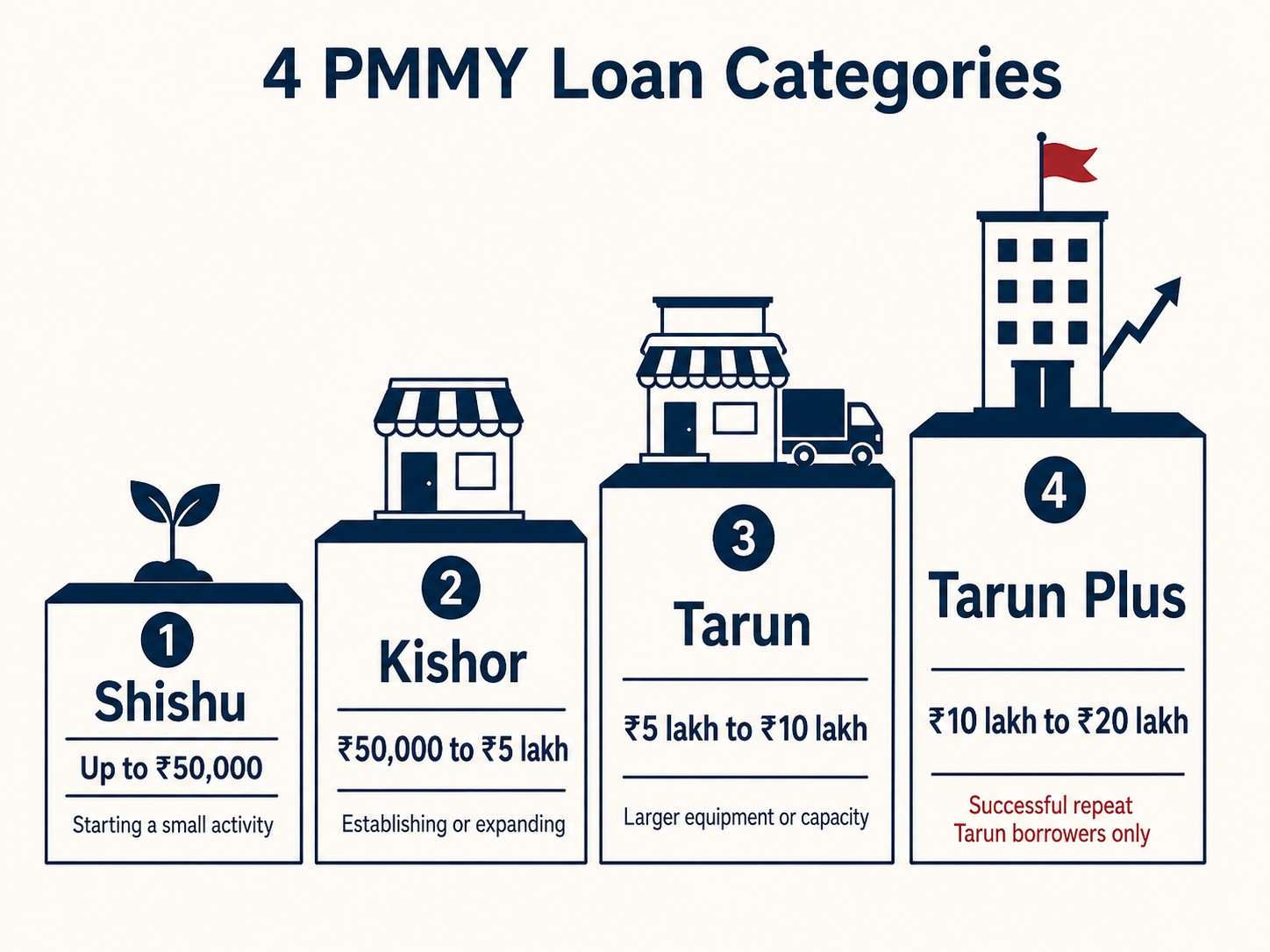
Choose a category after calculating the actual project or cash-flow need. The difference between Shishu Kishor Tarun and Tarun Plus lies mainly in the sanctioned band and the special prior-repayment condition for Tarun Plus. Asking for the category maximum without quotations, costs, turnover support, or a repayment explanation can weaken the proposal. If the requirement involves a longer-life asset, understanding the difference between working capital and a term loan for business assets helps align repayment with the asset's productive life.
Who is Eligible for a PMMY Loan?
The official scheme focuses on eligible individuals and micro business enterprises with a viable plan for an income-generating activity. New and existing units in manufacturing, trading, services and eligible allied agricultural activities may be considered for a micro-enterprise loan. Examples can include small repair units, food processing, tailoring, transport used for business, retail trade, professional services, dairy, poultry, beekeeping and similar activities, subject to the lender's accepted activity list.
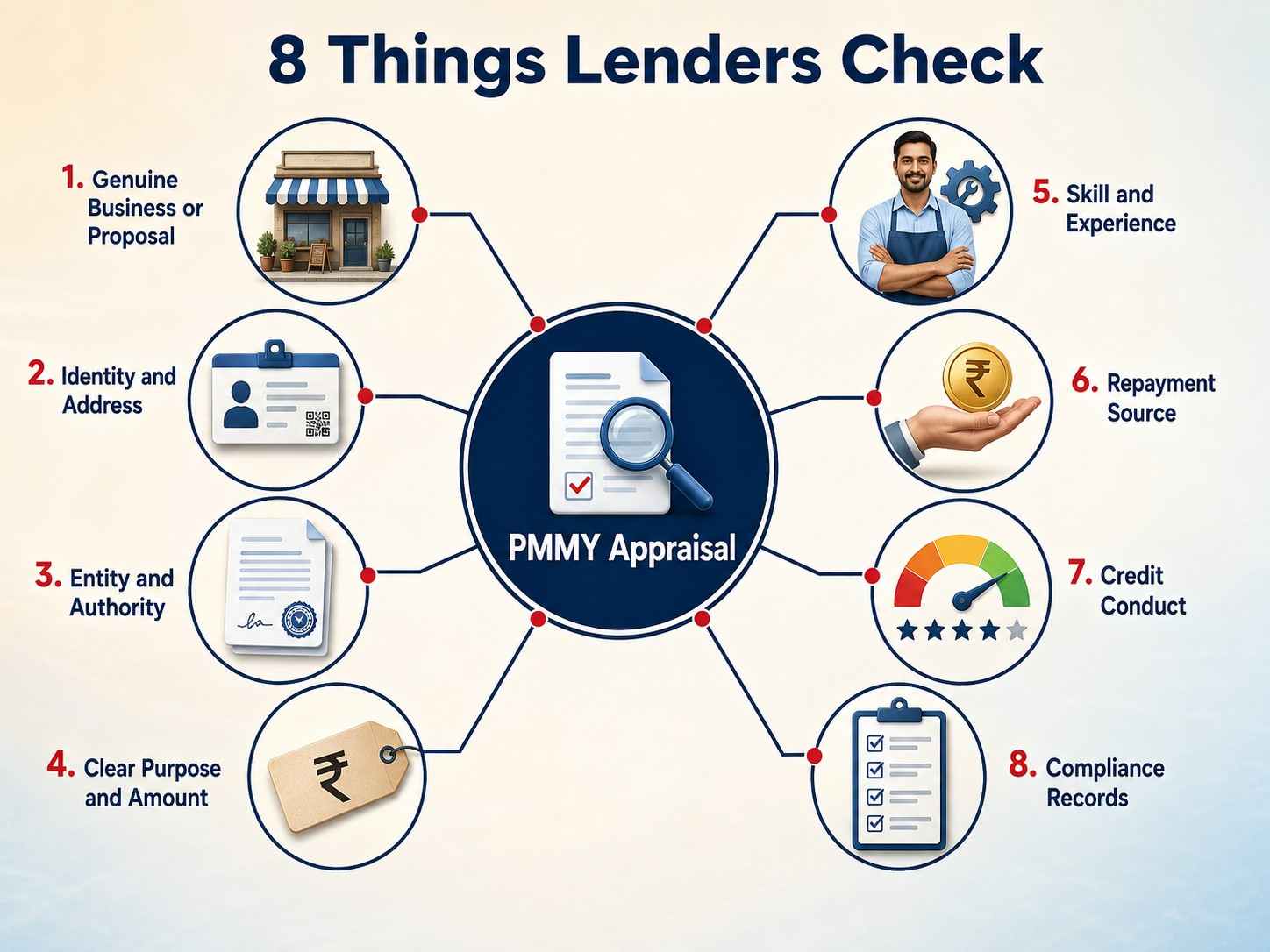
An applicant should normally be able to show:
-
a genuine income-generating business or proposal;
-
identity, address and legal capacity to borrow;
-
the entity form and authority to apply, where relevant;
-
a clear purpose and realistic amount;
-
the skill, experience or operational plan required for the activity;
-
a reasonable source of repayment from business cash flow;
-
acceptable credit conduct and no unresolved wilful default or fraud concern; and
-
compliance records applicable to the business.
PMMY does not publish one universal age limit, minimum credit score, minimum turnover or required number of operating years for every member lender. Those conditions may come from the institution's own product and risk policy. A lender may also ask a new enterprise for stronger promoter background, quotations, licences, contribution or market evidence because historical financial statements are unavailable.
The business need not adopt one fixed legal form for every case. A person starting alone may evaluate sole proprietorship registration, while two or more promoters may compare a registered partnership firm with LLP registration and compliance. A growing enterprise may instead use a private limited company structure. Entity formation does not itself create loan eligibility; the applicant, activity and records must still satisfy the lender.
Are farmers eligible?
PMMY is not a general crop loan for cultivation. It can cover eligible income-generating activities allied to agriculture, such as dairy, poultry, fisheries, food and agro-processing or agricultural services, subject to current scheme and lender rules. An applicant should describe the activity accurately instead of labelling a crop-finance need as a business loan.
Can women, SC, ST or OBC entrepreneurs apply?
Yes, eligible entrepreneurs from these groups can apply. Their inclusion is an important policy objective, but social category alone does not guarantee sanction or establish one nationwide interest concession. Applicants should provide the relevant certificate only where requested and confirm any lender-specific benefit through the lender's official terms.
What Can the Loan Be Used For?
A Mudra loan for business should fund an identifiable income-generating purpose. Depending on appraisal and facility structure, common uses include:
-
plant, tools, machinery or small equipment;
-
commercial vehicles used in the business;
-
shop, workshop or service-unit setup costs;
-
raw materials, stock and other working capital;
-
renovation connected with the enterprise;
-
expansion, modernisation or additional capacity; and
-
eligible allied agricultural business activities.
The loan should not be diverted to personal consumption, speculative investment or an activity different from the sanctioned end use. Land purchase and other uses outside a lender's PMMY policy may be ineligible. Quotations, invoices, account credits and physical verification can be used to confirm how the money was spent.
If the requirement is a general commercial expansion rather than a PMMY-sized micro-enterprise need, compare it with a regular business loan assessment. Where funding depends on a larger project with construction, commissioning and multiple cash flows, the proposal may require a fuller project finance appraisal rather than a small standardised facility.
Documents Required for a PMMY Loan
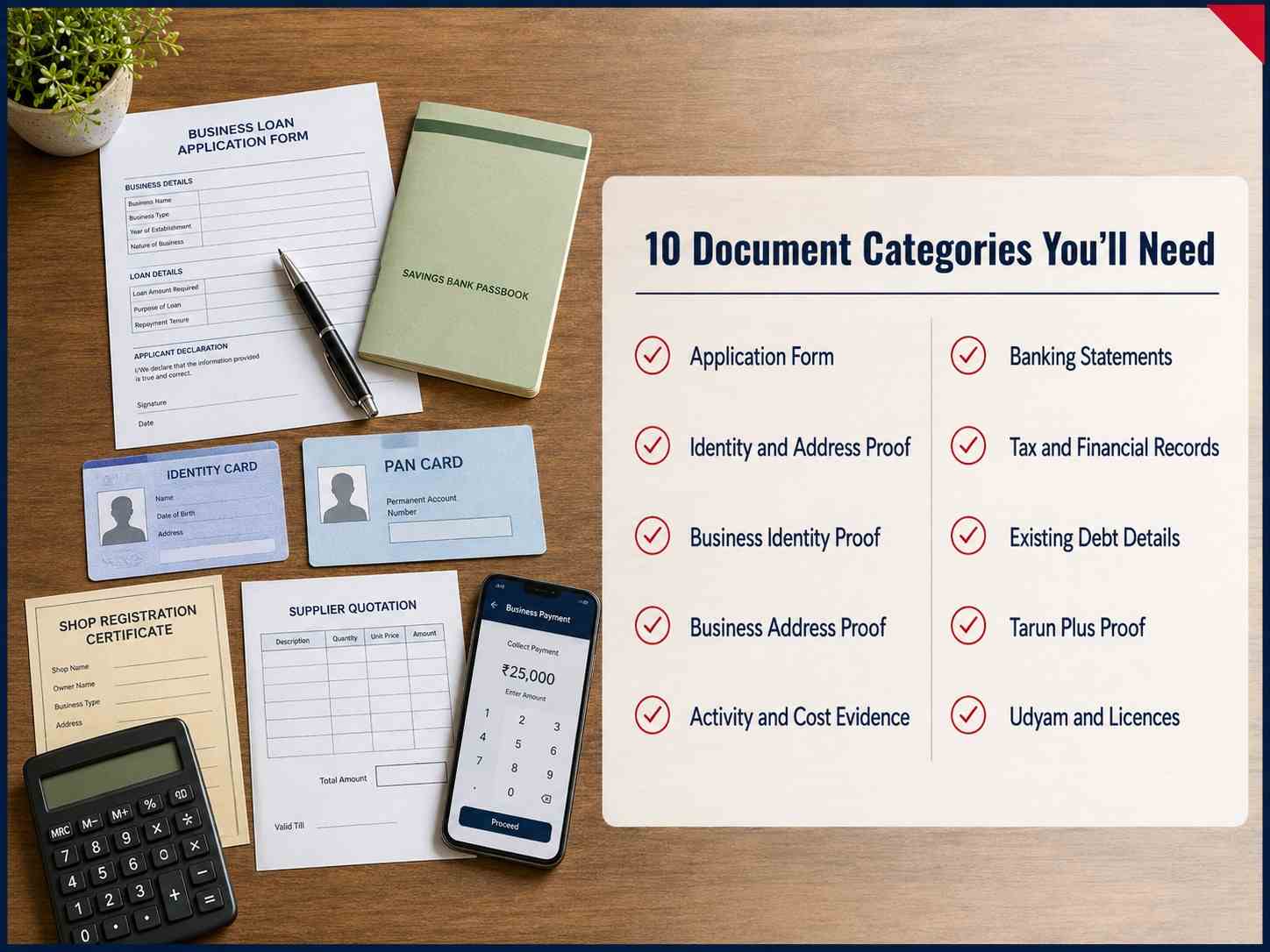
There is no single identical checklist for every borrower. Shishu cases may use a simpler file, while Kishor, Tarun and Tarun Plus applications commonly require more evidence. Check the PMMY application forms and the selected lender's current checklist before submission.
|
Document category |
Common documents |
Why the lender may request them |
|
Application |
Completed form, photographs and declarations |
Captures the amount, purpose and borrower details |
|
Identity and address |
PAN, Aadhaar, voter ID, passport, driving licence or another officially valid document |
KYC and verification |
|
Business identity |
Registration certificate, partnership deed, LLP agreement, incorporation papers, shop licence or other business proof |
Establishes legal existence and authority |
|
Business address |
Utility bill, rent/lease agreement, ownership proof or licence |
Verifies the operating location |
|
Activity and cost |
Project report, quotations, machinery details, supplier estimates, purchase orders |
Supports end use and loan amount |
|
Banking |
Recent business and applicant bank statements |
Shows credits, conduct, obligations and cash movement |
|
Tax and financial |
ITRs, financial statements, GST registration and returns where applicable |
Supports turnover, profitability and compliance |
|
Existing debts |
Sanction letters, loan statements and repayment schedules |
Measures total repayment burden |
|
Category-specific |
Prior Tarun sanction and repayment evidence for Tarun Plus |
Verifies the special repeat-borrower condition |
|
Regulatory |
Udyam certificate and sector licences where applicable |
Supports enterprise classification and lawful operation |
The myScheme PMMY guidance lists identity, address, business and category-related records. These documents required for PMMY loan appraisal are a starting point, and a member lender can ask for additional business loan documents based on the amount, activity and risk.
MSME applicants can complete Udyam registration correctly through the official Udyam portal. Registration is useful for classification and records, but it is not a sanction certificate. Similarly, GST registration requirements depend on the law and business facts; a small borrower should not be described as ineligible merely because GST registration is legally unnecessary.
Existing businesses should reconcile their application with bank credits, GST filings and income-tax records. Support is available for organising small-business accounting records and understanding the income-tax filing process. A large unexplained difference between declared sales and account turnover may lead to questions even when every document has been uploaded.
How Should You Prepare the Business Plan and Loan Amount?
A clear business project report converts an idea into costs, operations and repayment. It does not need exaggerated sales or complex language. It needs evidence and internal consistency.
Include:
-
the promoter's background and relevant experience;
-
the product or service and target customer;
-
location, licences and operating process;
-
project cost split between equipment, setup and working capital;
-
supplier quotations and proposed promoter contribution;
-
capacity, pricing, sales assumptions and direct costs;
-
monthly cash flow, expenses and expected surplus;
-
existing debt and the proposed repayment; and
-
risks such as seasonality, customer concentration and delayed collections.
For example, a tailoring unit should not request ₹5 lakh simply because it falls within Kishor. It should add the cost of machines, deposit, fittings, materials and initial expenses, subtract the owner's contribution, and show how expected orders can service repayment. A food unit should also explain licences, shelf life, input supply and realistic utilisation.
A professionally structured bank-ready project report can help present these figures coherently, but it cannot replace genuine invoices, experience or viable cash flow. Businesses that need continuing budgeting and financing oversight may also consider CFO support for financial planning.
How to Apply for a Pradhan Mantri MUDRA Yojana Loan
Applicants can use an authorised digital route or approach a participating lender. JanSamarth's PMMY eligibility route supports online eligibility checks and applications, while the MUDRA application procedure explains how to approach a participating lender. Anyone asking how to apply for a Mudra loan online should begin with the JanSamarth portal or a verified lender channel.
1. Define the requirement
Write down the business purpose, total project cost, personal contribution and amount requested. Decide whether the need is for equipment, working capital or both. Select Shishu, Kishor, Tarun or Tarun Plus according to the justified amount and eligibility, not simply the largest band.
2. Verify the activity and lender
Confirm that the proposed activity is eligible and that the institution currently offers the required PMMY category. Use only official lender websites, branches or government portals. MUDRA warns that it has not appointed agents or middlemen for arranging loans.
3. Prepare the file
Complete KYC, business proof, quotations, bank statements, tax records, licences and the project report relevant to the case. Cross-check names, addresses, turnover, existing debts and requested costs. Tarun Plus applicants should add clear proof of the earlier Tarun loan and successful repayment.
4. Check eligibility online or visit a branch
For the online route, register through JanSamarth, complete the eligibility questions, sign in and upload the requested records. Alternatively, obtain the current form from a member lender, complete it and submit it to the designated branch or channel. Retain the acknowledgement or application reference.
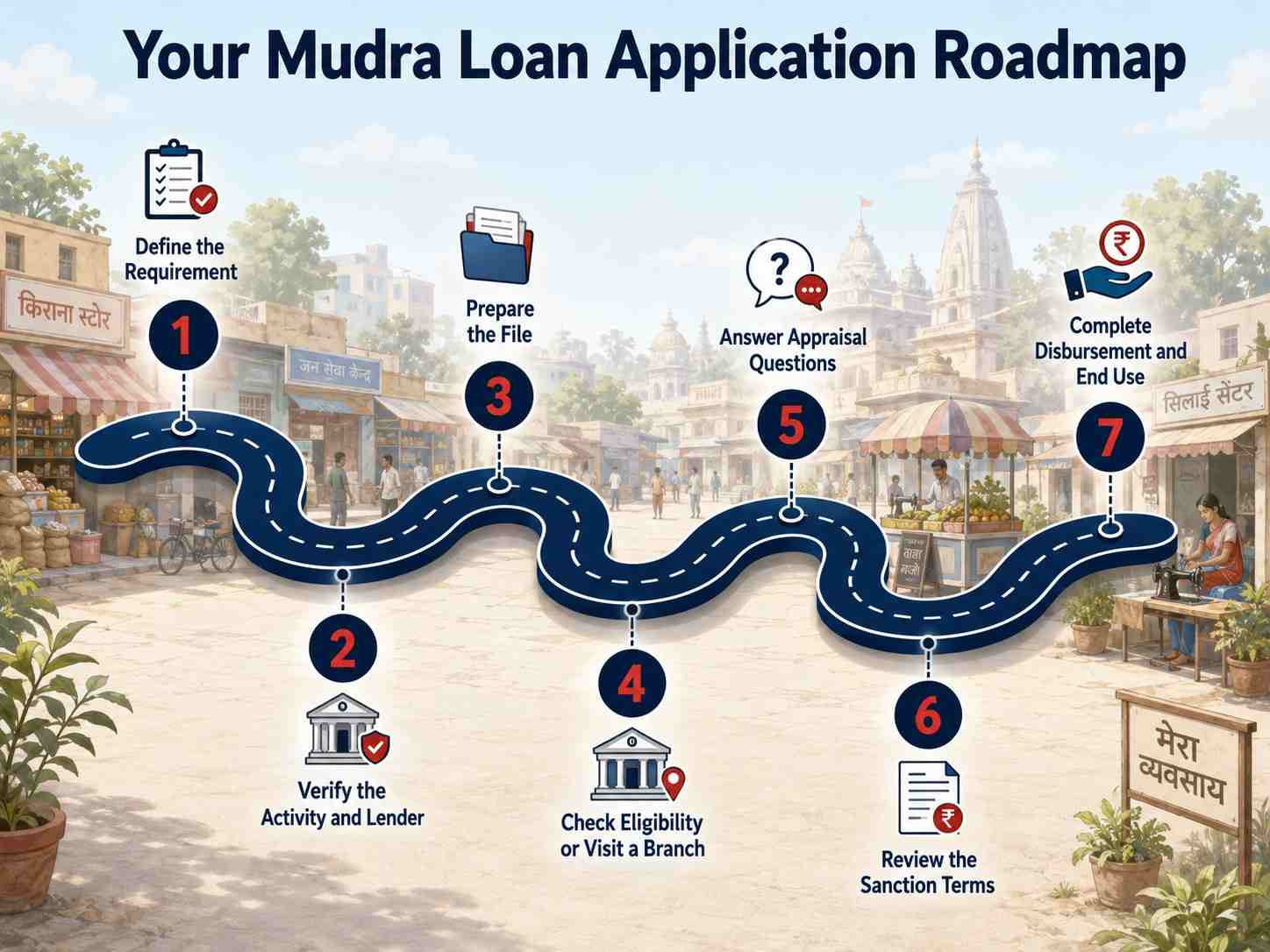
5. Respond to appraisal questions
The lender may check credit reports, banking, residence, premises, suppliers, quotations, licences and business assumptions. It may ask for revised figures or additional proof. Reply accurately and do not conceal an existing liability, overdue account or related business.
6. Review the sanction terms
Sanction can be lower than the amount requested or subject to conditions. Review interest, benchmark and reset terms, margin, repayment, moratorium if any, asset hypothecation, insurance, fees, penal charges, disbursement conditions and reporting duties. Ask for unclear items in writing before acceptance.
7. Complete disbursement and end-use formalities
The lender may pay a supplier directly, credit an approved account or issue a working-capital facility. Keep invoices and use the funds only for the stated business purpose. If the applicant is a company and a charge is legally created over its assets, follow the applicable ROC charge-registration process.
What Does the Lender Check Before Sanction?
The lender's decision can cover five connected areas:
|
Appraisal area |
Typical questions |
|
Borrower |
Is identity verified? Does the promoter have relevant capacity and acceptable credit conduct? |
|
Business |
Is the activity eligible, lawful and commercially workable? |
|
Amount |
Do quotations, working capital and project costs support the request? |
|
Repayment |
Can conservative business cash flow service existing and proposed debt? |
|
Records |
Do bank statements, ITRs, GST data, registrations and declarations agree? |
Credit history matters, but there is no scheme-wide guaranteed approval score. A small past delay with a credible explanation is not the same as a current unpaid default, yet the final treatment belongs to the lender. Applicants should review reports, clear errors through the relevant credit bureau process and disclose material obligations.
Site or telephonic verification may confirm that the enterprise exists, suppliers are genuine, and costs are reasonable. For a new unit, the lender may pay particular attention to promoter experience, contribution, permits, demand and break-even assumptions. An existing unit should explain declining sales, cheque returns, overdue receivables or sudden changes rather than hoping they are unnoticed.
PMMY Loan vs Regular Business Loan vs CGTMSE Route
|
Point |
PMMY loan |
Regular business loan |
CGTMSE-backed eligible credit |
|
Primary target |
Eligible micro business activity |
Wider lender-defined business segment |
Eligible micro and small enterprises under the guarantee scheme |
|
Amount framework |
Shishu to Tarun Plus; Tarun Plus has a prior-Tarun repayment condition |
Set by the lender and product |
Set by the lender within current CGTMSE rules |
|
Collateral position |
Scheme described as collateral-free |
Secured or unsecured |
Eligible collateral-free/partly secured structures may receive guarantee cover |
|
Guarantee institution |
CGFMU through NCGTC |
Usually none unless linked to a guarantee scheme |
CGTMSE guarantee to the eligible member lender |
|
Sanction decision |
Member lender |
Lender |
Member lender |
Do not use “Mudra loan”, “CGFMU” and “CGTMSE” interchangeably. A CGTMSE collateral-free loan route is separate from PMMY even though both can support a collateral-free business loan and both rely on lender appraisal. The suitable route depends on the enterprise, amount, lender and purpose.
Common Reasons an Application Can Be Delayed or Rejected
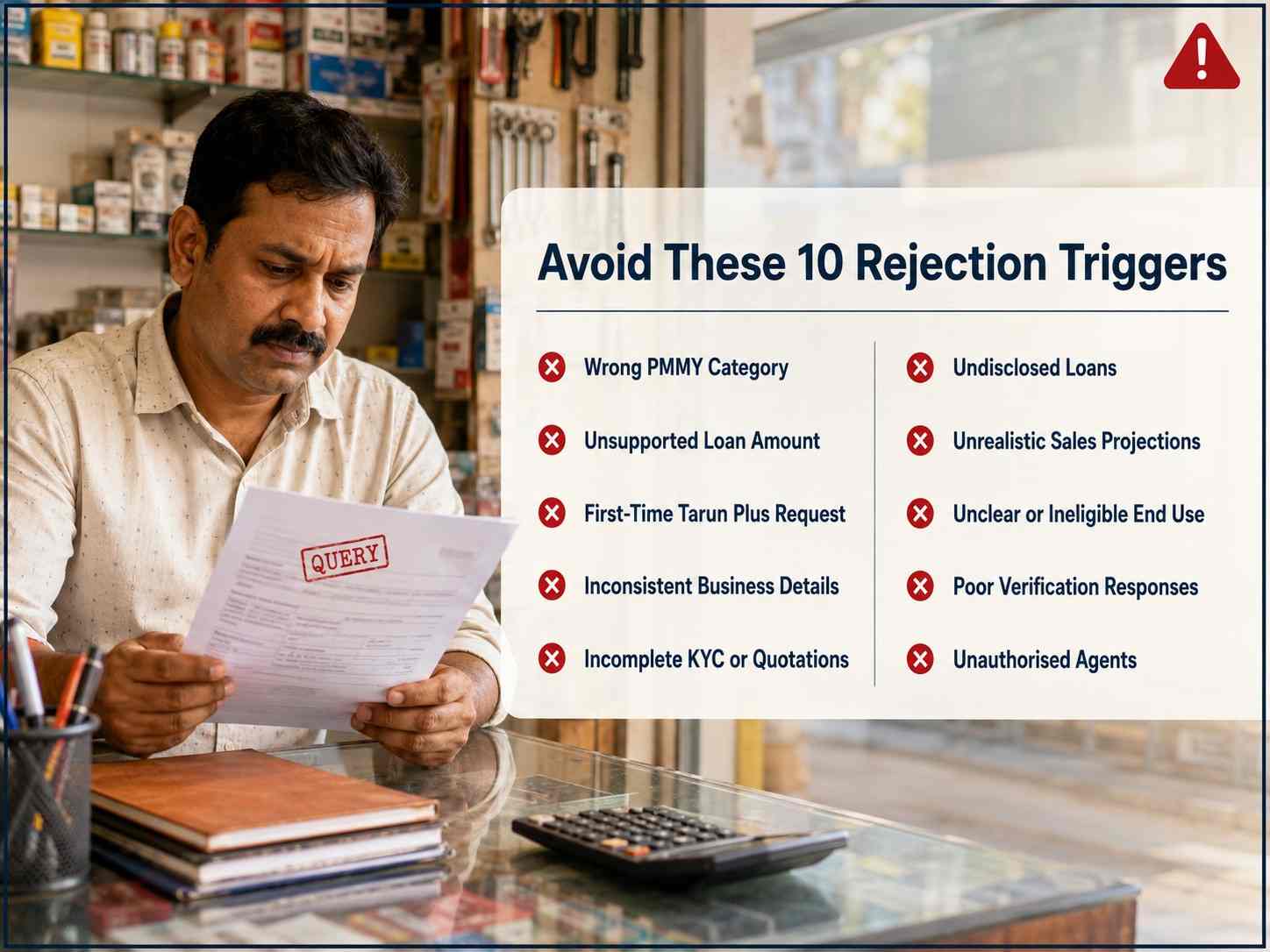
Common weaknesses include:
-
selecting the wrong PMMY category;
-
requesting an amount unsupported by project cost or cash flow;
-
treating Tarun Plus as open to a first-time borrower;
-
inconsistent name, address, turnover or entity information;
-
incomplete KYC, licences, quotations or bank statements;
-
undisclosed loans, overdue accounts or cheque returns;
-
unrealistic sales and profit projections;
-
an ineligible, personal or unclear end use;
-
poor responses during verification; and
-
applying through an unauthorised agent or submitting fabricated records.
A rejection does not prove that the scheme is unavailable, and submitting the same weak file to many institutions may create additional enquiries without solving the problem. Ask the lender for the deficiency or reason where it can be provided, correct factual errors and reassess whether the amount or facility is suitable. Never fabricate invoices, turnover or a business location.
Conclusion
A Pradhan Mantri MUDRA Yojana Loan can fund a viable micro enterprise when the category, amount and repayment plan fit the real business need. Start by choosing the correct band, remembering that Tarun Plus is restricted to eligible borrowers who successfully repaid a prior Tarun loan. Then prepare accurate KYC, business records, quotations and cash-flow projections.
Apply only through an authorised member lender or official portal, compare the total borrowing cost and read every sanction condition. A well-prepared PMMY loan file improves clarity and reduces avoidable questions, but the lender retains the final credit decision, and no adviser can guarantee approval.
FAQS
FAQs About Pradhan Mantri MUDRA Yojana Loan
-
Who can apply for a Pradhan Mantri MUDRA Yojana Loan?
An eligible individual with a viable plan for a micro business in manufacturing, trading, services or an eligible activity allied to agriculture can apply. New and existing units may be considered, subject to the scheme and the selected lender's policy. The lender will assess identity, purpose, business viability, credit conduct and repayment capacity before deciding.
- What is the maximum PMMY loan amount?
- Can a first-time borrower get a Tarun Plus loan?
- Is a Mudra loan a subsidy or free government money?
- Is collateral required for a PMMY loan?
- What documents are required for a PMMY loan?
- How can I apply for Mudra loan online?
- What is the interest rate on a PMMY loan?
- How long does PMMY approval and disbursement take?
- Can a Mudra loan be used for an existing business?


