

A Bank Guarantee helps a business satisfy a tender, payment or performance-security requirement without depositing the entire amount with the beneficiary. The bank promises to pay if the applicant fails to meet the guaranteed obligation. It first appraises the applicant, sets a non-fund-based limit, decides the margin or security and charges commission.
The contract, proposed wording, financial records, borrowing authority and security documents must be consistent. Final sanction, margin, pricing and issuance remain governed by the bank’s policy.
What is a Bank Guarantee and How Does it Work?
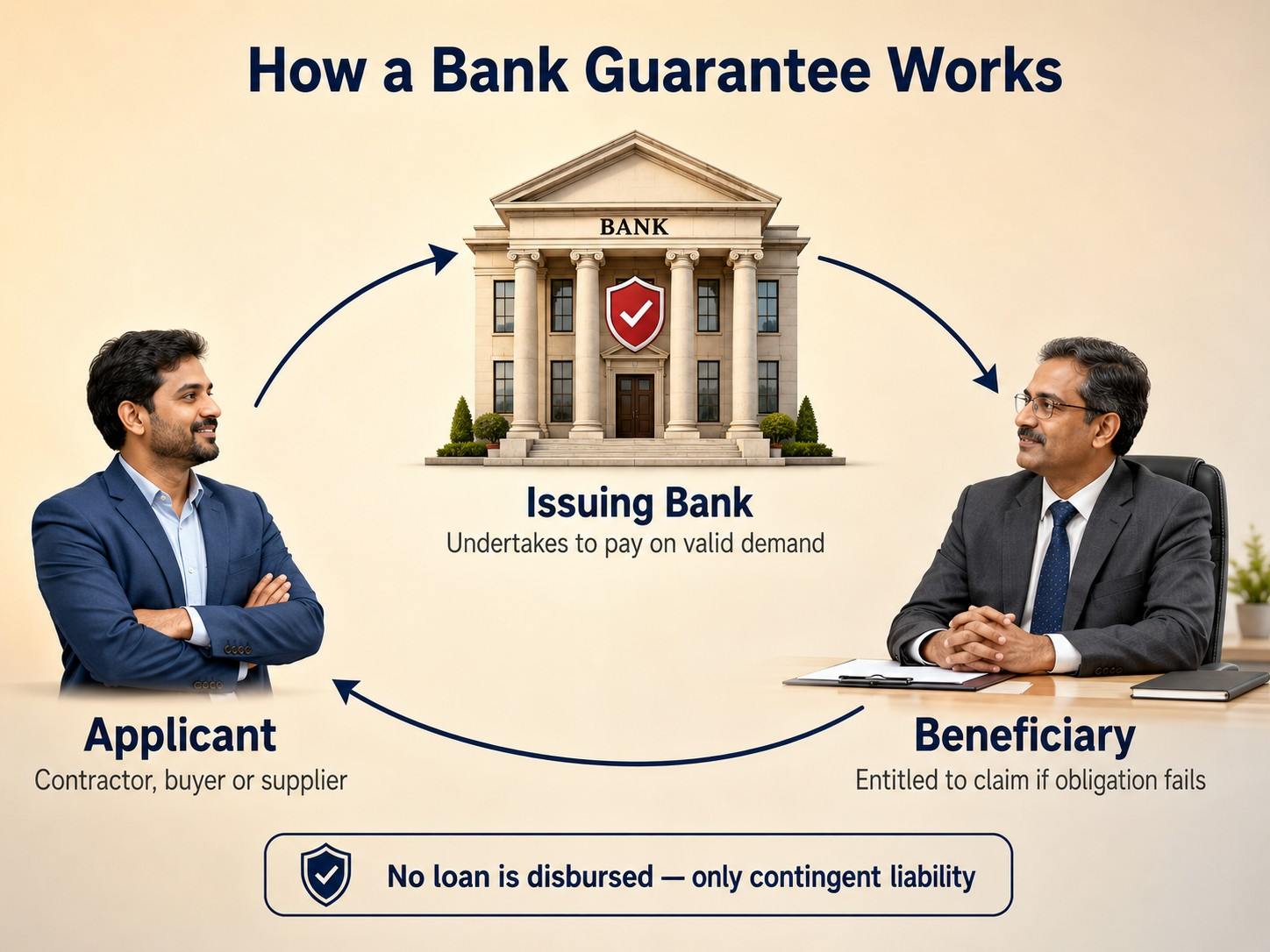
Section 126 of the Indian Contract Act, 1872 defines a contract of guarantee as a contract to perform a promise or discharge another person’s liability if that person defaults. In a banking transaction, the three parties are:
-
Applicant: The contractor, buyer, supplier or other person whose obligation is secured.
-
Issuing bank: The bank that undertakes to pay according to the guarantee’s wording.
-
Beneficiary: The customer, employer, authority or counterparty entitled to make a compliant demand.
This differs from a collateral-free business loan. CGTMSE protects an eligible lender against loss on specified credit facilities; it is not a contractor’s tender guarantee.
Which Type of Bank Guarantee Do You Need?
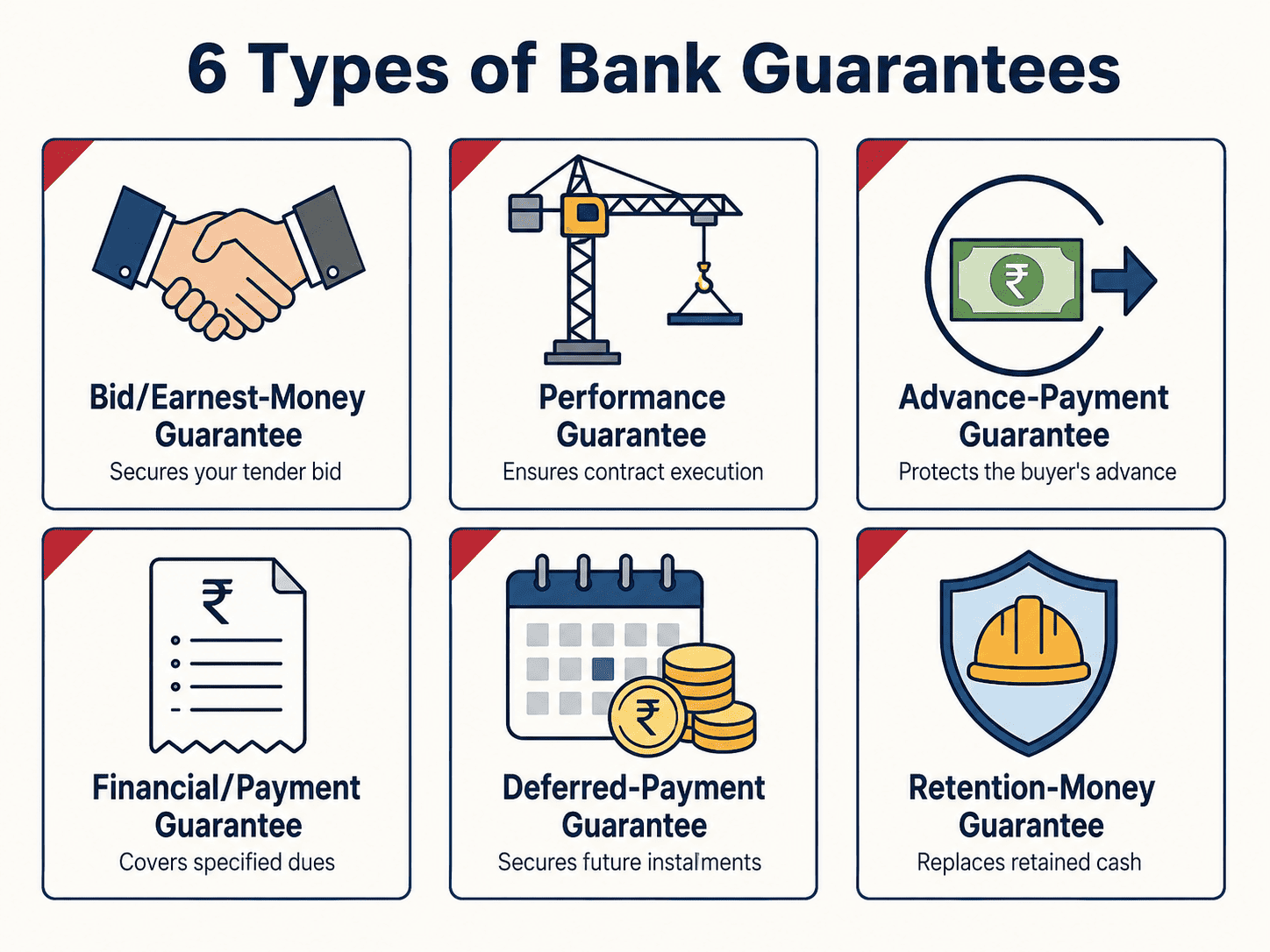
The contract or tender should determine the instrument.
|
Type |
Obligation protected |
Typical use |
Main drafting concern |
|
Bid or earnest-money guarantee |
Bidder will honour the bid and execute the contract if selected |
Government and private tenders |
Bid validity and claim period |
|
Performance guarantee |
Supplier or contractor will perform contractual duties |
Works, supply and service contracts |
Performance trigger and guaranteed amount |
|
Advance-payment guarantee |
Advance will be repaid if agreed work or supply is not delivered |
Mobilisation and purchase advances |
Reduction as the advance is recovered |
|
Financial or payment guarantee |
Applicant will pay specified dues |
Credit purchases, lease or payment obligations |
Amount, due event and demand wording |
|
Deferred-payment guarantee |
Future instalments will be paid |
Machinery or capital-goods purchases |
Instalment dates and maximum liability |
|
Retention-money guarantee |
Replaces cash retained until defects or obligations end |
Construction and engineering contracts |
Release milestones and warranty period |
For obtaining an Overseas Recruitment License, RPSL License, or Non-Seafarers License, you are required to submit a financial bank guarantee as part of the licensing process.
RBI’s directions on guarantees and co-acceptances require banks to examine reimbursement capacity for financial guarantees and the experience, capacity and means needed for performance obligations.
For tender-driven businesses, valid NSIC registration for MSEs may provide procurement benefits, including EMD exemption in eligible cases. Never assume the exemption applies to performance security; follow the particular tender.
What Are the Requirements for a Bank Guarantee in India?
There is no RBI-prescribed universal turnover, credit score, business vintage or cash margin for every BG. Banks apply their credit policies to the applicant and transaction. An existing limit may simplify repeat issuance, but each request must fit its terms.
|
Assessment area |
What the bank commonly checks |
How to prepare |
|
Legal identity and KYC |
Constitution, ownership, authorised signatories and beneficial ownership |
Keep incorporation and KYC records current |
|
Financial capacity |
Audited statements, cash flow, net worth, leverage and contingent liabilities |
Reconcile accounts, ITRs and banking data |
|
Conduct of account |
Repayment record, cheque returns, existing limits and past BG invocations |
Explain anomalies with evidence |
|
Contract capability |
Experience, work orders, capacity, licences and execution record |
Provide comparable completed contracts |
|
Guarantee terms |
Amount, purpose, validity, claim period and invocation conditions |
Obtain beneficiary-approved draft wording |
|
Security cover |
Cash margin, fixed-deposit lien, property or other collateral |
Establish ownership and clear title |
The RBI’s updated KYC Direction requires banks to identify customers and understand their business and financial status. Keep private limited company records and signatory details consistent across MCA, PAN, GST and bank records.
MSMEs should provide an Udyam Registration certificate. Udyam status can support classification or scheme eligibility, but it does not compel a bank to issue a guarantee or waive collateral.
What Documents Are Required for a Bank Guarantee?
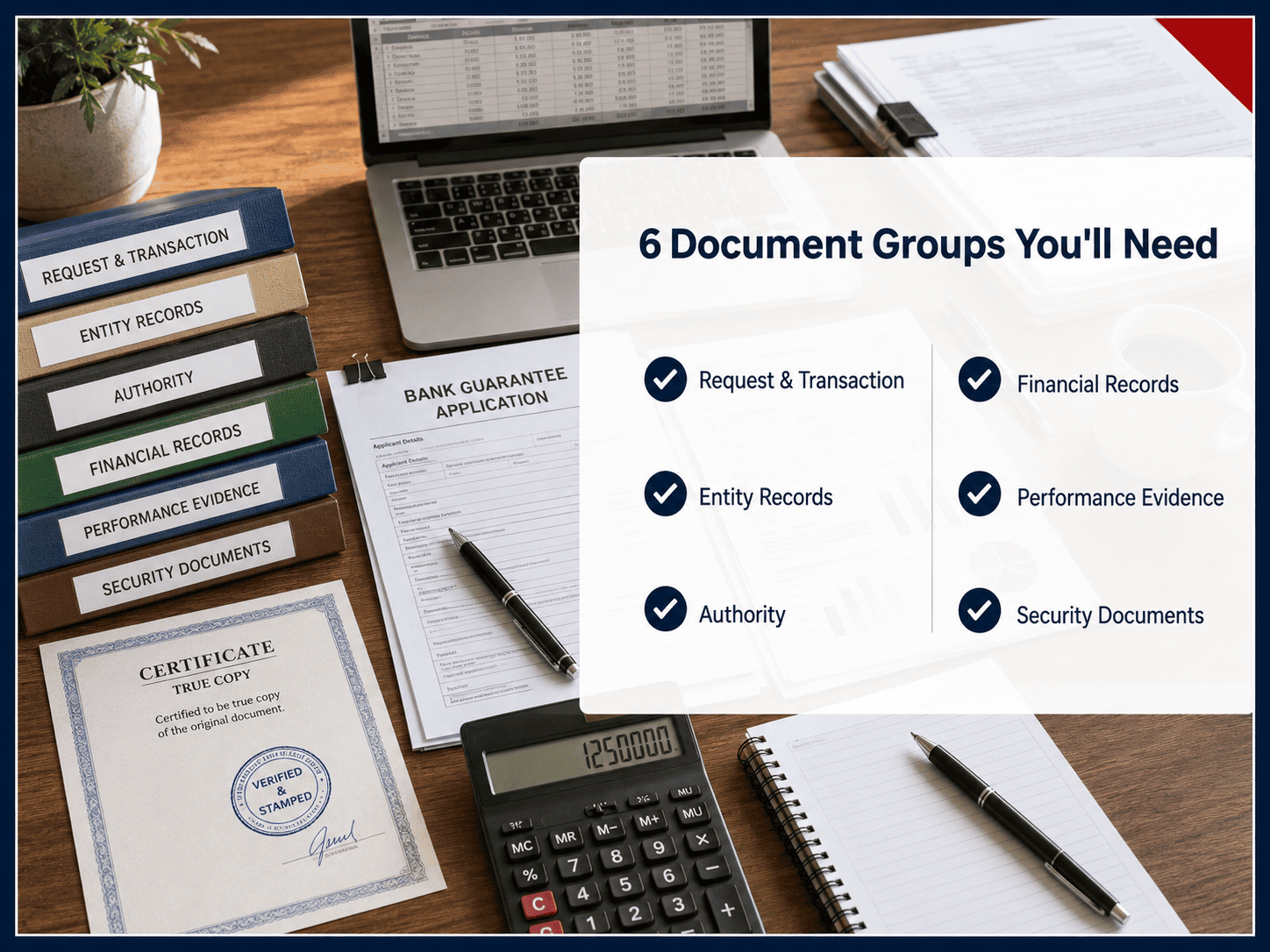
A typical file contains:
|
Document group |
Common documents |
|
Request and transaction |
Bank application, request letter, beneficiary-approved BG format, tender, purchase order, contract or sanction condition |
|
Entity records |
Incorporation certificate, partnership deed or LLP documents, PAN, GSTIN, Udyam certificate, constitutional documents |
|
Authority |
Board or partner resolution, borrowing powers under MOA/AOA, authorised-signatory proof and power of attorney where applicable |
|
Financial records |
Audited financial statements, ITRs, current provisional accounts, bank statements, receivables, existing debt and contingent-liability schedule |
|
Performance evidence |
Past work orders, completion certificates, licences, project schedule and major supplier or customer details |
|
Security documents |
Fixed-deposit receipt, title papers, valuation, insurance, search report and lender-required declarations |
Lenders detect differences between audited revenue, GST returns and bank credits. Regular small-business accounting and bookkeeping supports reconciliation. Resolve inconsistencies in GST registration details, income-tax returns and records, and financial statements in ROC annual filings.
For a project-specific facility, the bank may seek estimates, execution schedules and projections. A realistic project report for bank appraisal should match the contract value, working-capital cycle and proposed BG exposure.
How Much Does a Bank Guarantee Cost?
The applicant pays for contingent exposure even without a claim. Calculate cost for the validity and claim period, not only the contract period.
Remember that a BG can use part of your sanctioned non-fund-based limit and may lock cash margin. Before quoting for a contract, model the commission, margin opportunity cost, expiry extensions and potential invocation. A profitable order can still strain liquidity when several guarantees overlap, especially if customers delay completion certificates or release letters.
|
Cost component |
How it usually works |
What varies |
|
Commission |
Percentage of guaranteed amount for the liability period |
Bank, internal rating, type, tenor and security |
|
Processing or documentation fee |
Charged for appraisal, issuance or a limit |
Bank tariff and facility structure |
|
Cash margin |
Applicant’s funds kept under lien; it is security, not a fee |
Credit profile and sanctioned terms |
|
Stamp duty |
Paid under the applicable state stamp law |
State, instrument and execution method |
|
Amendment or extension charge |
Payable for changes in amount, wording or validity |
Bank tariff and additional exposure period |
|
GST |
Applied to taxable banking charges |
Applicable tax law and invoice treatment |
Rates are not uniform. SBI’s service-charge schedule effective 1 June 2025 varies card rates by BG type, rating, tenor and cash margin. Bank of Baroda’s guarantee tariff also varies by rating, type and tenure. These are examples, not universal pricing.
Financial and related services not specifically listed otherwise attract 18% GST under the CBIC service-rate schedule. Ask the bank for an itemised quote covering commission, processing, amendment, advising, messaging, stamp duty and taxes.
How to Get a Bank Guarantee in India Step by Step
Step 1: Read the underlying requirement
Record the type, amount, beneficiary’s legal name, accepted banks, validity, claim period, format and submission channel. Check whether paper BG, SFMS confirmation, e-BG or insurance surety bond is accepted.
Step 2: Obtain the beneficiary-approved draft
Obtain the prescribed template. Flag unconditional, auto-renewing, open-ended or inconsistent clauses. The bank may change one-sided wording, so early review prevents reissuance.
Step 3: Choose the issuing bank and facility route
Consider a bank that understands the business. Choose between a one-off, fixed-deposit-backed BG and a recurring limit supported by margin or collateral. A financial due-diligence review can identify charges, overdue filings and contingent liabilities before appraisal.
Step 4: Pass internal approvals
Check the MOA, AOA, borrowing powers and existing covenants. Pass the resolution authorising the facility, security, indemnity and signatories. Resolve unclear authority before signing.
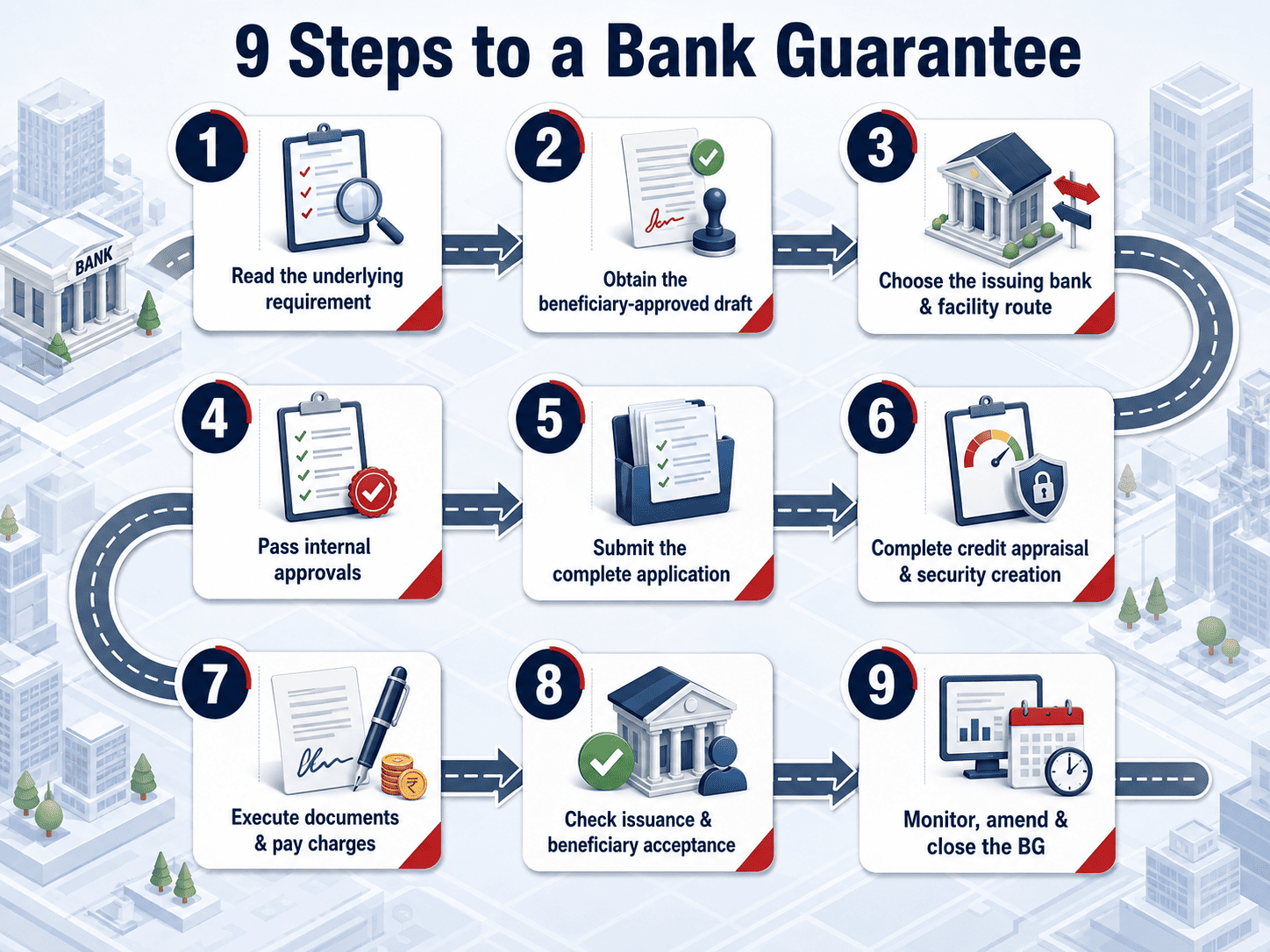
Step 5: Submit the complete application
Submit the application, approved wording, contract, KYC, financials, performance evidence and security documents together. Add an index and transaction note.
Step 6: Complete credit appraisal and security creation
The bank evaluates repayment capacity after invocation, prior performance, account conduct, exposure and security. It sets the amount, margin, commission, collateral, covenants and validity restrictions. No universal turnaround applies.
Where a company creates a charge over assets, Section 77 of the Companies Act, 2013 requires registration of the charge with the Registrar. The company should coordinate the applicable ROC charge-registration process and filing timeline with the lender.
Step 7: Execute documents and pay charges
Sign the counter-indemnity, facility and security documents. Place the required cash margin or create the approved lien or charge. Pay commission, bank fees, stamp duty and GST after verifying the bank’s calculation.
Step 8: Check issuance and beneficiary acceptance
Compare the instrument with the approved draft. Verify names, amount, contract reference, issue date, expiry, claim period, invocation address and amendment terms. The beneficiary should confirm authenticity through the bank or approved digital channel.
Step 9: Monitor, amend and close the BG
Maintain a register with expiry alerts. Request extensions before the deadline. After completion, obtain the discharged original, release letter or accepted electronic cancellation. Security may remain blocked until closure.
How Do Banks Assess a Bank Guarantee Application?
Invocation turns contingent exposure into funded liability. The RBI guarantee directions therefore emphasise reimbursement capacity and performance capability.
The credit team examines profitability, cash accrual, leverage, net worth, working-capital use, receivables, existing guarantees, past invocation, credit history and tax compliance. It also tests whether the contract is achievable. Disproportionate exposure or an aggressive schedule may require more security.
Applicants with several projects need a consolidated exposure schedule. Structured virtual CFO and financial-planning support can help map BG limits, cash margins, renewal dates and the working-capital cost of locked funds.
Why Do Guarantee Wording, Validity and Invocation Matter?
The guarantee is separate from the commercial contract. A conditional BG requires stated conditions; an unconditional, on-demand BG generally requires payment on a compliant demand.
The Supreme Court has held that courts should be slow to restrain an unconditional guarantee; the recognised exceptions include egregious fraud and exceptional irretrievable harm or injustice. The official Supreme Court judgment on unconditional BG invocation shows why applicants should not treat an underlying contract dispute as an automatic defence.
Distinguish the issue date, obligation expiry and last claim date. Avoid open-ended extensions and vague triggers. Review the template, bank changes and main contract together.
What is an Electronic Bank Guarantee?
An e-BG is issued and managed digitally. NeSL supports access, amendment, renewal and closure. For Central Government procurement, the updated General Financial Rules recognise e-BGs and insurance surety bonds among acceptable forms for specified bid and performance security. That does not override a particular tender. Confirm its accepted instrument, platform, issuing institutions and verification method before applying.
Are Any Bank Guarantee Support Schemes Available?
The National SC-ST Hub runs a narrowly targeted Bank Guarantee Charges Reimbursement Scheme for eligible SC/ST-owned MSEs. The current official scheme page states reimbursement of 80% of performance-BG charges or ₹1,00,000, whichever is lower, excluding GST and other taxes. Eligibility, tender category, ownership, Udyam status, documents and claim deadlines should be checked before relying on the benefit.
This is not a general MSME subsidy and does not compel issuance. Where permitted, compare surety bonds, fixed-deposit receipts, online payment or bid-securing declarations by acceptance, collateral use and total cost.
What Causes Delays or Rejection?
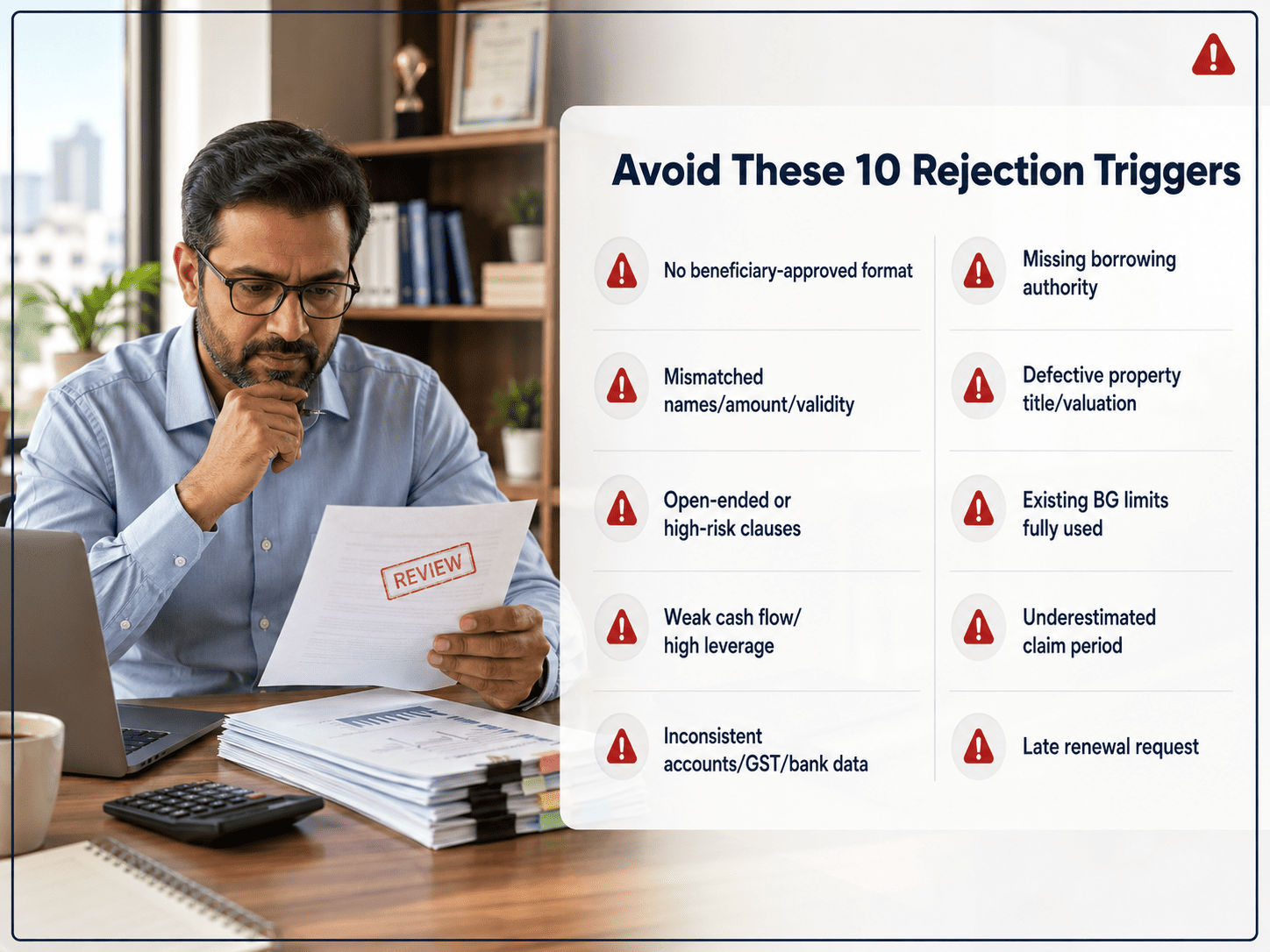
Common problems include:
-
Applying without the beneficiary’s format.
-
Mismatched legal names, contract numbers, amount or validity.
-
Asking for an open-ended or high-risk clause outside bank policy.
-
Weak cash flow, excessive leverage or unexplained banking conduct.
-
Inconsistent audited accounts, GST returns, ITRs and bank credits.
-
Insufficient borrowing authority or missing board approval.
-
Defective property title, valuation or insurance for collateral.
-
Existing BG limits being fully utilised.
-
Underestimating the claim period when calculating commission.
-
Seeking renewal after the contractual deadline.
If property or another asset secures the facility, a current business or asset valuation report may be needed. Do not conceal an existing charge or invocation; a clear explanation is safer than a discrepancy discovered during appraisal.
Conclusion
To obtain a Bank Guarantee in India, begin with the beneficiary’s requirement. Select the correct type, secure authority, reconcile financial records and submit one coherent file. Check every operative clause and date. Budget for commission, margin, stamp duty, taxes and extensions, then monitor the BG until release. Preparation cannot guarantee sanction, but it prevents avoidable failures.
FAQS
FAQs on Bank Guarantee
-
Can a new business get a Bank Guarantee?
Yes, but a limited track record may lead the bank to require a fixed-deposit-backed guarantee, higher cash margin or stronger collateral. The decision depends on the transaction, promoter profile, financial capacity and bank policy.
- Can I get a Bank Guarantee without collateral?
- Is a fixed deposit mandatory for a Bank Guarantee?
- How long does it take to issue a Bank Guarantee in India?
- What is the difference between a Bank Guarantee and a letter of credit?
- What happens when a Bank Guarantee is invoked?
- Can a Bank Guarantee be cancelled before expiry?
- Can the amount or validity be changed after issuance?
- Is an e-BG legally usable for government tenders?


