
GST LUT in India: Who Can File, How to Apply and Key Deadlines
- by kapil
- Updated September 1, 2026
- 13 mins read

A GST LUT, or Letter of Undertaking, is a declaration exporters file in Form RFD-11 on the GST portal, allowing them to export goods or services or supply to SEZs without paying IGST upfront. It is valid for one financial year, must be renewed before the first export invoice of each new year, and filing is completely free.
Most exporters who skip this step do not do it on purpose. They simply do not realise that without a valid LUT, every export invoice raised is technically taxable, whether or not IGST actually gets charged to the buyer.
This guide covers exactly who qualifies for LUT, the deadline that applies right now, the documents worth keeping ready, and the conditions that come attached once the LUT is filed.
What Is a GST LUT, and Why Do Exporters File It?
LUT stands for Letter of Undertaking. It is a self-declaration an exporter files on the GST portal, promising to meet the conditions of a zero-rated export, in exchange for not having to pay IGST at the time of supply.
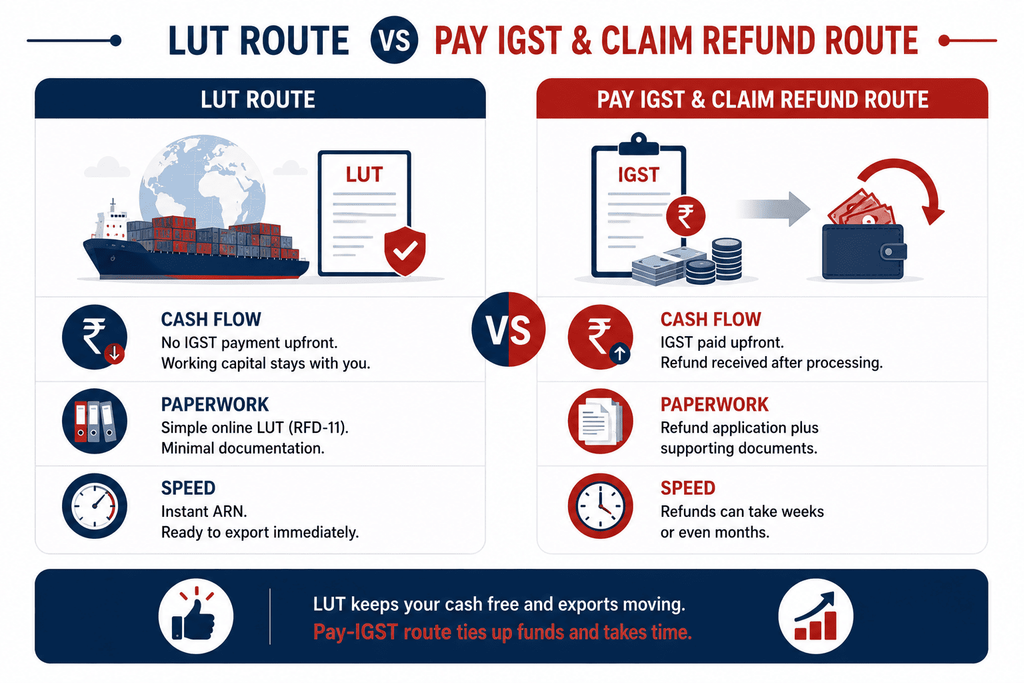
Without an LUT, an exporter has two options. Pay IGST on the export invoice and then apply for a refund later, or file the LUT and skip that payment altogether. Most regular exporters choose the LUT route, since it keeps working capital free instead of tying it up in a refund claim that can take weeks to process.
It is filed in Form GST RFD-11, under Rule 96A of the CGST Rules. Once submitted with a valid digital signature or OTP, the system generates an Application Reference Number immediately. There is no manual approval wait in the vast majority of cases.
Who Is Eligible to File a GST LUT?
Almost every GST-registered business that exports goods or services, or supplies to a Special Economic Zone, can file an LUT. There is exactly one disqualifying condition.
If a business or its owner has been prosecuted for evading tax of Rs 2.5 crore or more under the GST Act or an earlier tax law, LUT is off the table. Everyone else, regardless of turnover, business structure, or how new the export activity is, qualifies.
This threshold catches people off guard because it is about prosecution, not just a large tax demand. A business fighting a genuine, unresolved tax dispute worth crores can still file an LUT, as long as it has not actually been prosecuted for evasion above that figure. It is worth confirming your exact status against your GST registration details if there is any doubt.
What Happens If You’re Not Eligible for LUT?
A business that fails the eligibility test does not lose the ability to export without paying IGST upfront. It just has to use a bond instead of an LUT.
A bond works similarly in principle, but the paperwork is heavier. It has to be executed on non-judicial stamp paper, backed by a bank guarantee, and submitted for manual verification rather than the instant, self-service process an LUT goes through. The bank guarantee is generally capped at 15% of the bond amount, though the jurisdictional GST Commissioner has the discretion to waive this in specific cases.
In practice, very few businesses actually end up on the bond route. It exists mainly for the narrow category of exporters with a serious tax evasion history, not as a routine alternative.
What Documents Do You Need to File the GST LUT Form?
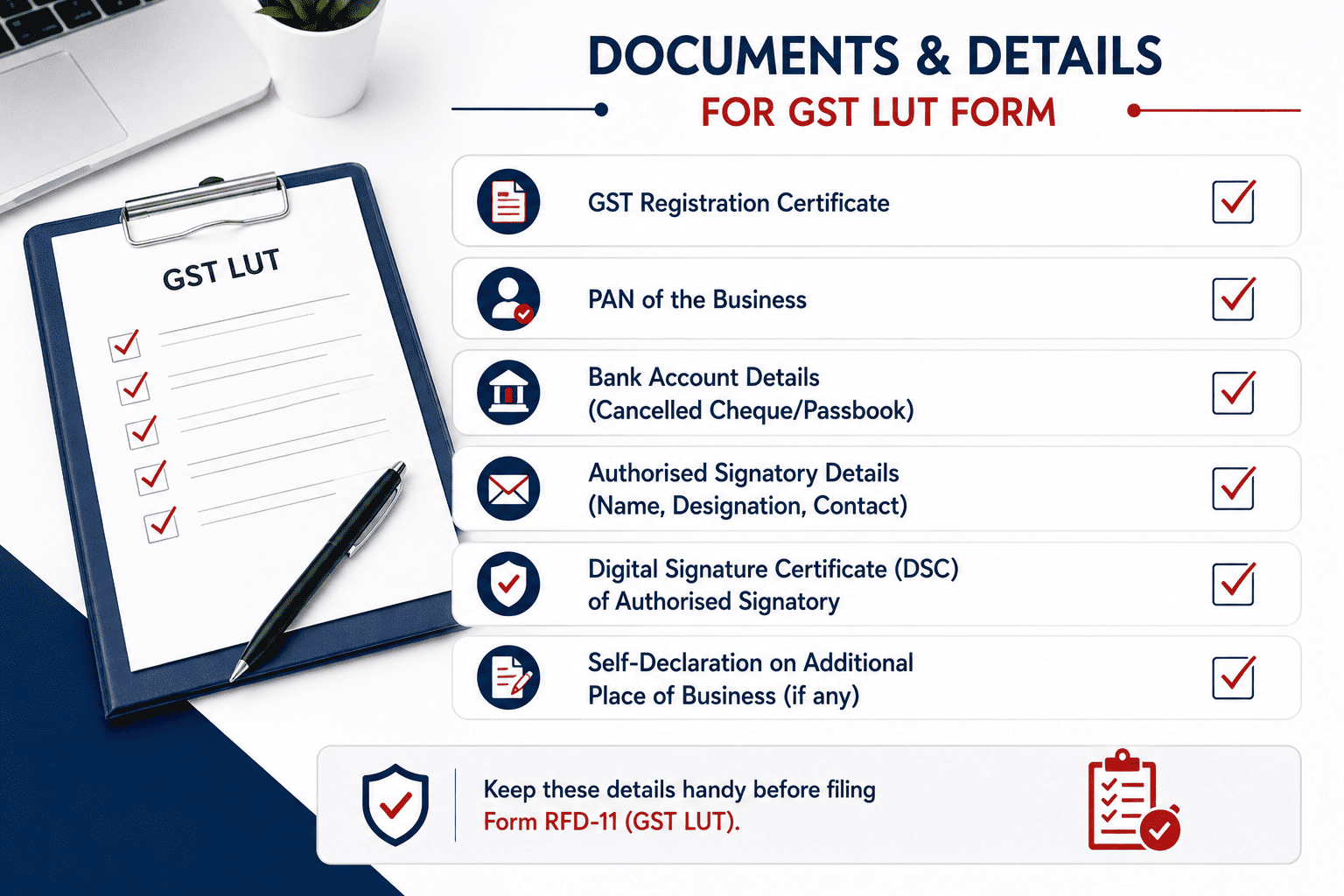
The RFD-11 form itself, filed directly on the portal, is largely a self-declaration. It does not force a document upload for most applicants, just details entered directly into the form, along with a digital signature.
That said, keeping these ready before starting saves time and avoids a mid-filing scramble, especially when a consultant or another authorized signatory is handling the submission:
- Copy of GST registration certificate
- PAN card of the entity
- Import Export Code (IEC), if the business already has one
- Identity and address proof of the authorized signatory
- Name, occupation, and address of two independent witnesses
- A canceled cheque, where a bond or bank guarantee is also involved
- An authorization letter, if someone other than the primary authorized signatory is filing
One detail trips up more filers than it should. The two witnesses have to be different people from the authorized signatory who signs the form. Businesses sometimes list the same director as both a witness and the signatory, which creates a mismatch that a reviewing officer can flag and send back for clarification.
How Do You File Form RFD-11 on the GST Portal?
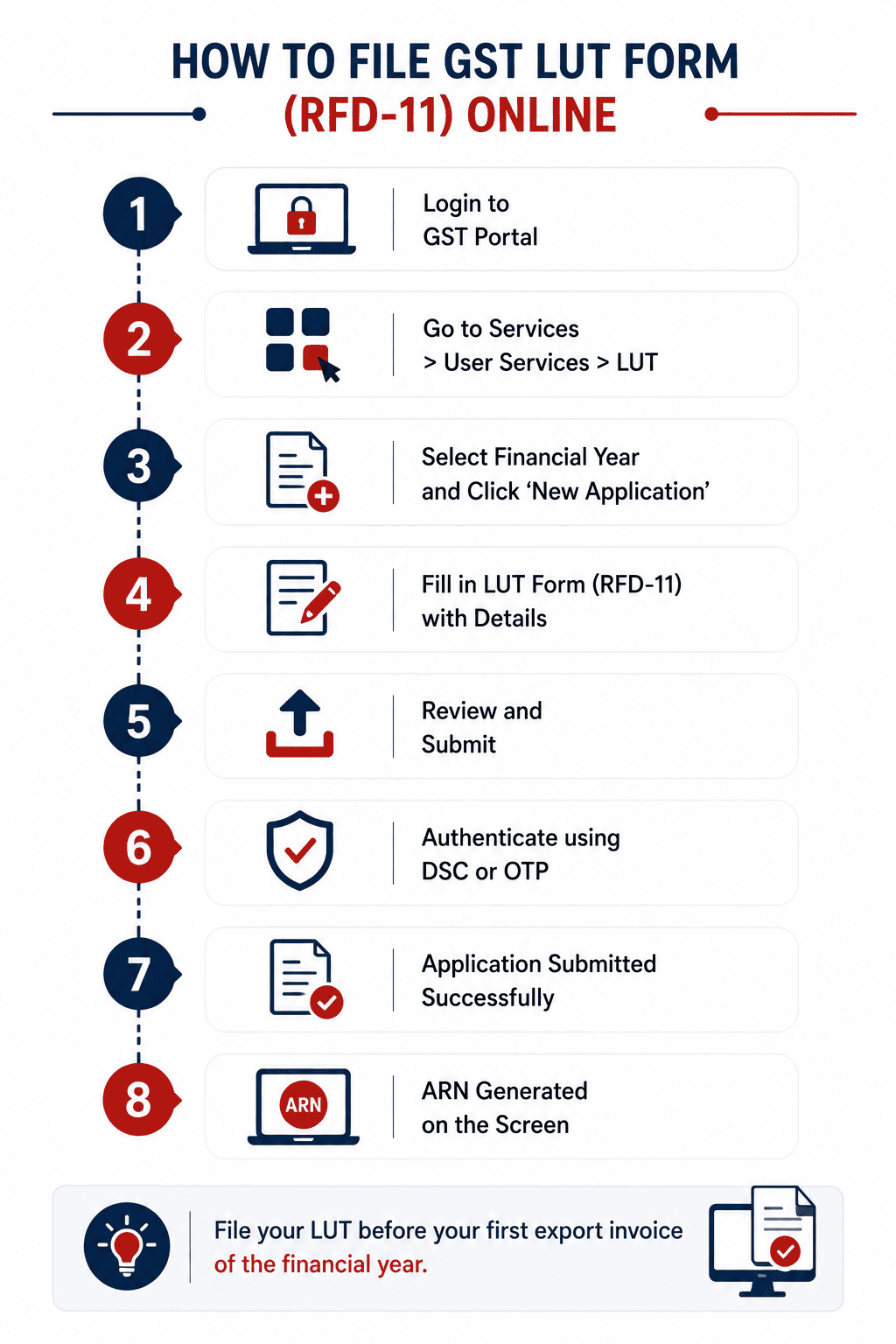
Step 1 – Log In to the GST Portal Go to www.gst.gov.in and log in using your GSTIN credentials.
Step 2 – Navigate to the LUT Service Go to Services, then User Services, then select Furnish Letter of Undertaking (LUT).
Step 3 – Select the Financial Year Pick the correct financial year from the dropdown. Filing under the wrong year is a surprisingly common, entirely avoidable mistake.
Step 4 – Complete the Self-Declaration Tick the three declaration boxes confirming that goods or services will be exported within the prescribed time, that GST law will be followed, and that IGST with interest will be paid if that fails to happen.
Step 5 – Enter Witness Details Provide the name, occupation, and address of two independent witnesses, different from the person signing the form.
Step 6 – Preview Before Signing Click Save, then Preview, and check every field carefully. Once signed, the form cannot be revised.
Step 7 – Sign and File Submit using a Digital Signature Certificate or an Electronic Verification Code sent as an OTP. Companies and LLPs must use DSC specifically; other entity types can use either.
Step 8 – Download the Acknowledgement The portal generates an ARN immediately and sends confirmation by SMS and email. Download the acknowledgement and keep it with the compliance records.
When Is the GST LUT Deadline, and What If You Miss It?
LUT runs on the financial year, not the calendar year. A fresh one is required before the first zero-rated export invoice of each new year, and the government typically opens the filing window on the portal around January or February, a couple of months ahead of time.
Right now, the operative LUT is the one that needed to be filed before 1 April 2026, covering FY 2026-27. If a business has been exporting since April without filing this year’s LUT, that gap needs fixing immediately. Every export made in the meantime does not get the zero-rated treatment it should have. It becomes taxable, with IGST attaching even though nothing was charged to the buyer at the time.
Looking ahead, expect the window for FY 2027-28 to open in a similar pattern, sometime around January or February 2027, effectively due before 1 April 2027.
There is no backdating an LUT. A fresh filing applies from its ARN date forward, never retroactively. If exports happened during a gap, the fix is to pay the IGST on those specific invoices and claim it back through the refund route, not to expect the new LUT to cover them after the fact.
What Conditions Come Attached to an LUT?
Filing an LUT is not a one-time formality. It comes with a running commitment attached to every invoice raised under it.
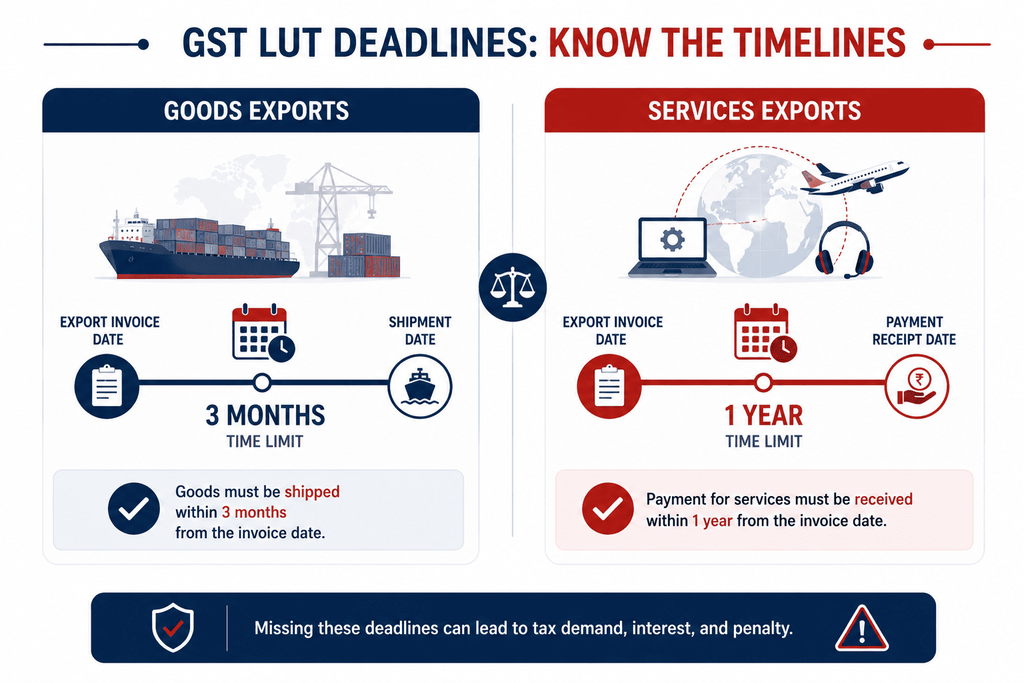
| Supply Type | Deadline to Meet the Condition | If Missed |
| Export of goods | Goods must physically leave India within 3 months of the invoice date | Pay IGST plus 18% annual interest within 15 days of the deadline passing |
| Export of services | Payment must be received in convertible foreign exchange within 1 year of the invoice date | Pay IGST plus 18% annual interest within 15 days of the deadline passing |
A couple of examples make this concrete. Say a garment exporter in Tiruppur raises an export invoice in April under LUT, without charging IGST. If the shipment has not actually left Indian customs within three months of that invoice date, the exporter owes IGST on that invoice, plus interest, due within 15 days after the three-month window closes.
Now take a Pune-based software consultancy that invoices a client in the US in March, again under LUT. That consultancy has roughly a year, until the following March, to actually receive that payment in US dollars through its bank. If the money arrives nine months later, nothing further needs to happen. If it still has not arrived by the one-year mark, the consultancy owes IGST on that invoice, plus interest, within 15 days of that deadline passing.
Both examples end the same way if an extension is genuinely needed. Rule 96A allows the jurisdictional Commissioner to extend either deadline on request, but that request has to happen before the original window closes, not after.
What Happens If You Break the LUT Conditions?
Missing one of these deadlines does not cancel the LUT outright, but it does trigger real consequences on that specific transaction, and repeated breaches put the whole privilege at risk.
- The unpaid IGST becomes due, along with interest at 18% per year, calculated from the invoice date.
- Payment is expected within 15 days of the deadline expiring, not whenever it becomes convenient.
- The LUT privilege can be withdrawn for repeated or serious non-compliance, pushing the exporter onto the bond route instead.
- Recovery proceedings under Section 79 become possible if the dues are not cleared voluntarily.
- Once the tax and interest are paid, the LUT status and export privilege are typically restored.
Getting a departmental query about a specific export invoice is far more common than losing the LUT entirely. If that happens and a formal notice follows, LegalBabu’s notice reply draft services can help put together a response backed by shipping documents, bank realization certificates, and invoice records.
What Mistakes Do Exporters Commonly Make With LUT Filing?
A handful of avoidable errors show up again and again.
- Forgetting to renew before the new financial year starts, and only realising it after raising an export invoice
- Listing the same person as both a witness and the authorized signatory
- Selecting the wrong financial year from the dropdown menu
- Not tracking the three-month or one-year realization deadline on individual invoices, and finding out only when a query arrives
- Assuming LUT is a one-time registration rather than an annual filing
- Treating a large pending tax dispute as automatic disqualification, when the actual bar is specifically a prosecution for evasion above Rs 2.5 crore
None of these mistakes are complicated to avoid. They mostly come down to treating LUT renewal as a calendar reminder rather than an afterthought triggered by the first export of the year.
LUT vs Paying IGST and Claiming Refund: Which Is Better?
| Point of Comparison | Filing an LUT | Paying IGST and Claiming Refund |
| Upfront cash outflow | None | Full IGST paid at the time of export |
| Working capital impact | Minimal | Funds locked until the refund is processed |
| Paperwork per export | Low, covered by one annual LUT | A refund application needed for each cycle |
| Best suited for | Regular, ongoing exporters | Occasional exporters, or those still arranging LUT eligibility |
| Risk if conditions are missed | IGST plus interest becomes payable | Refund simply gets delayed or scrutinized |
For a business exporting every month, the LUT route wins on nearly every count. The one scenario where paying IGST upfront still makes sense is a one-off, irregular export where the hassle of tracking LUT conditions on a single invoice outweighs the benefit.
Should You File the LUT Yourself or Get Expert Help?
A straightforward LUT filing, for a business with clean GST registration and no complicated ownership structure, is genuinely something most exporters can handle themselves in under fifteen minutes.
Where it gets trickier is tracking what happens after filing. Someone still has to monitor the three-month and one-year clocks on every export invoice, follow up on delayed payments from foreign buyers, and step in quickly if a deadline is about to lapse. That ongoing tracking, not the filing itself, is where most exporters actually need support.
If export volumes are growing and manual tracking is starting to feel unreliable, it is worth pairing LUT compliance with proper GST filing support, so return filing and export compliance stay in sync instead of drifting apart.
Frequently Asked Questions
Can I file a GST LUT if I have never exported before?
Yes. There is no prior export history requirement. Any GST-registered business intending to export, even for the first time, can file an LUT before making that first zero-rated supply, as long as it does not fall under the Rs 2.5 crore tax evasion prosecution bar.
Do I need a separate LUT for each GST registration, or does one cover my whole company?
Separately for each GSTIN. If a business holds GST registrations in more than one state, each registration needs its own LUT filed for that financial year, even though the underlying business is the same.
What happens to IGST I already paid on exports made before my LUT was approved this year?
That IGST already paid does not automatically get converted into an LUT-covered supply. It stays taxable, and the amount needs to be claimed back through the standard export refund process. Only invoices raised after the LUT’s ARN date get zero-rated treatment without tax.
Can a proprietorship file an LUT, or is it only for companies?
Any registered person can file, including proprietorships, partnerships, LLPs, and companies. The form just asks who is authorized to sign it: the proprietor for a proprietorship, a partner for a partnership or LLP, or the managing director, company secretary, or another authorized signatory for a company.
Does an LUT cover supplies to SEZ units, or only exports outside India?
Both. LUT covers zero-rated supplies under Section 16 of the IGST Act, which includes exports of goods or services outside India as well as supplies made to SEZ units or SEZ developers.
What if my export payment is genuinely going to be delayed beyond the realization deadline?
Apply to the jurisdictional Commissioner for an extension before the original window closes. Rule 96A allows the Commissioner to extend the three-month or one-year period on request. Waiting until after the deadline has already passed removes that option and triggers the IGST-plus-interest liability.
Is there any government fee for filing the GST LUT form?
No. Filing the LUT on the GST portal costs nothing. There is no government fee, and the process itself takes only a few minutes once the details are ready.
Can I edit my LUT application after I have signed and submitted it?
No. Once an LUT application is signed and submitted with DSC or EVC, it cannot be revised on the portal. This is exactly why the preview step before signing matters. Check every detail, especially the witness information and the financial year selected, before signing.
Can I switch from paying IGST to using an LUT partway through the financial year?
Yes. There is no rule against filing an LUT partway through a financial year if exports have not yet started under LUT. Once the ARN is generated, it applies to export invoices raised from that date forward, not retroactively. IGST already paid on earlier invoices that year still needs to be claimed back separately.
Do I need a CA’s certification or a physical signature for the LUT, or is it entirely digital?
Entirely digital. The form is signed using either a Digital Signature Certificate or an Electronic Verification Code sent as an OTP. Companies and LLPs must use DSC. No physical signature, notarization, or CA certification is required for the LUT itself.
You may also like


What Does Project Logistics Alliance Membership Offer?
Project Logistics Alliance membership offers an Indian project cargo business a