
How to Get Your Valuation Report in India with LegalBabu
Quick Summary
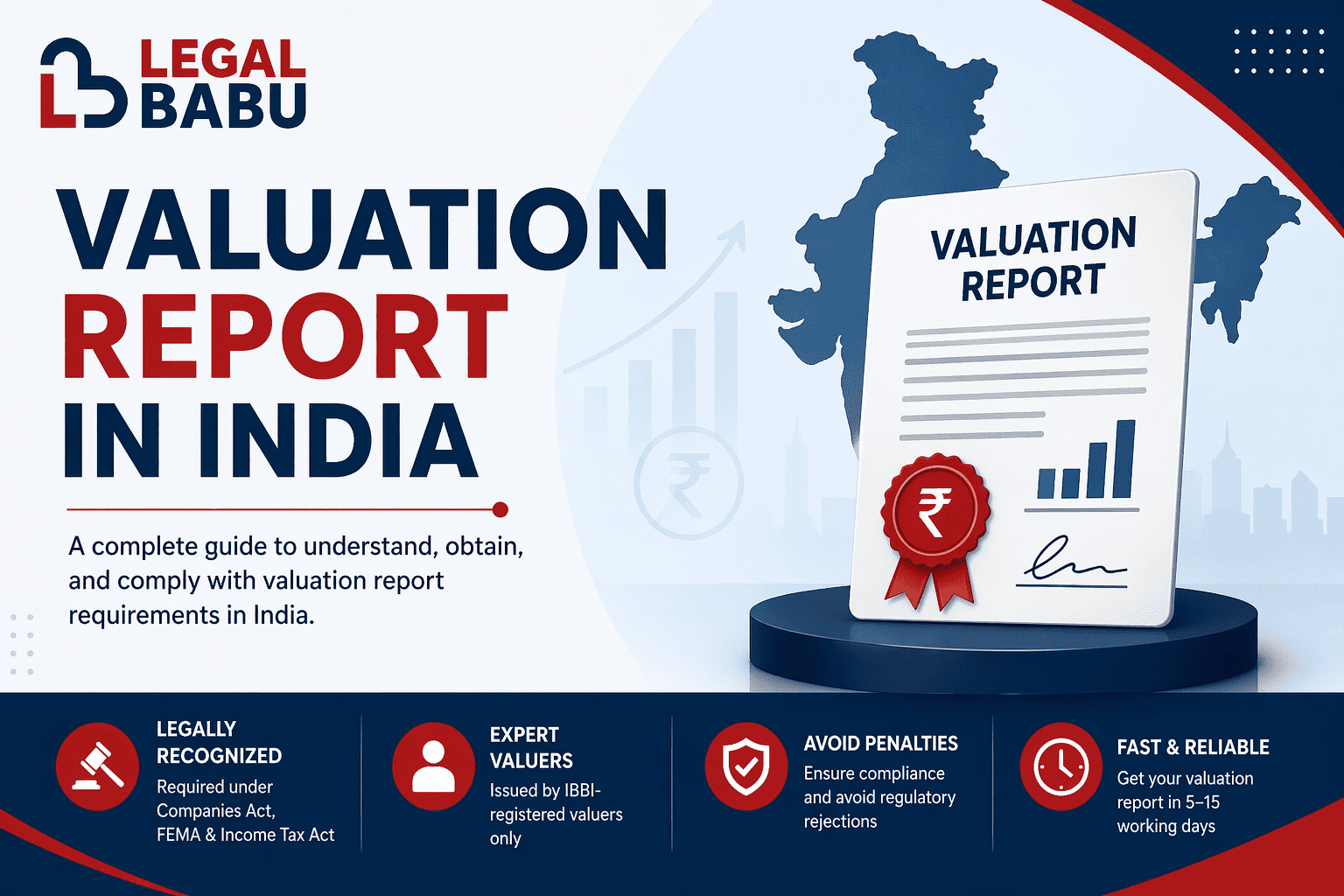
- A valuation report is a legally mandatory document that determines the fair market value of your company’s shares, assets, or net worth.
- Required for fundraising, mergers, FEMA compliance, income tax, and other key transactions.
- Only an IBBI-registered valuer can issue a valuation report under the Companies Act, 2013.
- Typical turnaround time: 5–15 working days, depending on the report type.
- LegalBabu connects you with verified registered valuers for a fast and compliant process.
Raising funds, issuing shares, onboarding a foreign investor, or planning a merger? One critical document can decide whether your transaction goes through smoothly or gets flagged by regulators - the valuation report.
In India, a valuation report is not just a financial formality. It is a legally required document under the Companies Act, FEMA regulations, and the Income Tax Act. Without it, your share issuance can be rejected, your deal can be questioned, and in some cases, penalties may follow.
Yet, many founders and business owners struggle with the basics - who can issue a valuation report, which method should be used, and how to get one done correctly.
This complete guide breaks it down in simple terms - what a valuation report is, when you need it, who can issue it, and the exact step-by-step process to get one in India without compliance risks.
What is a Valuation Report?
A valuation report is a formal document prepared by a qualified and registered professional that determines the fair market value (FMV) of a company's shares, assets, goodwill, intellectual property, or net worth. It is not the same as an audit report or a balance sheet. While an audit report confirms the accuracy of past financial data, a valuation report tells you what the business or asset is actually worth right now, or on a specific valuation date.
The valuation report is used by investors to decide how much equity to receive, by tax authorities to verify that transactions happened at arm's-length pricing, by regulators to ensure that shares were not issued below fair value, and by courts in insolvency proceedings to determine asset liquidation values.
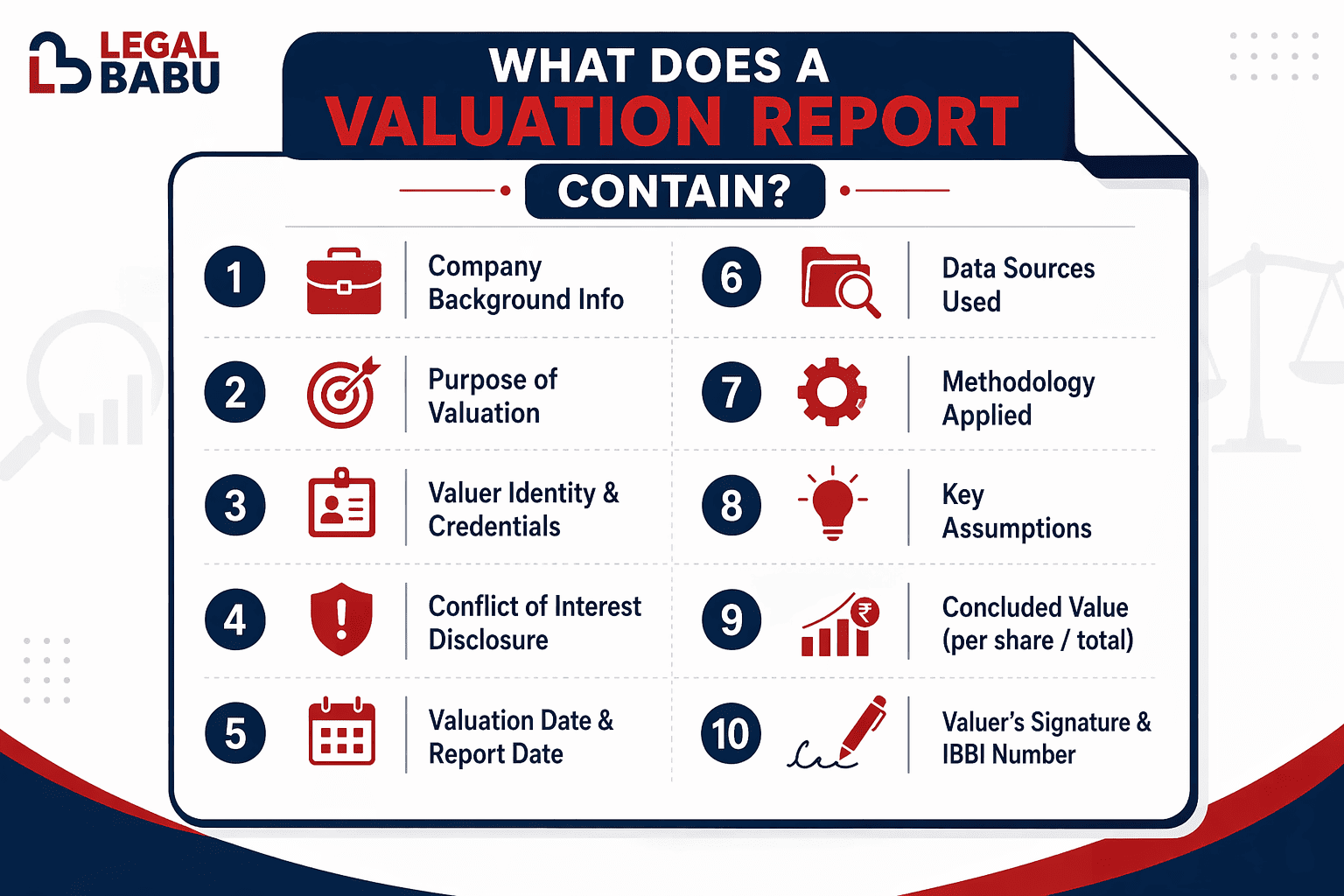
A valuation report typically includes:
-
Background information about the company or asset being valued
-
The purpose of the valuation and the appointing authority
-
Identity and credentials of the registered valuer
-
Disclosure of any conflict of interest
-
The valuation date and report date
-
Data sources and financial information used
-
Valuation methodology applied
-
Key assumptions and limiting conditions
-
Final conclusion - value per share, per unit, or total equity value
-
Registered valuer's signature, IBBI registration number, and seal
When is a Valuation Report Required in India?
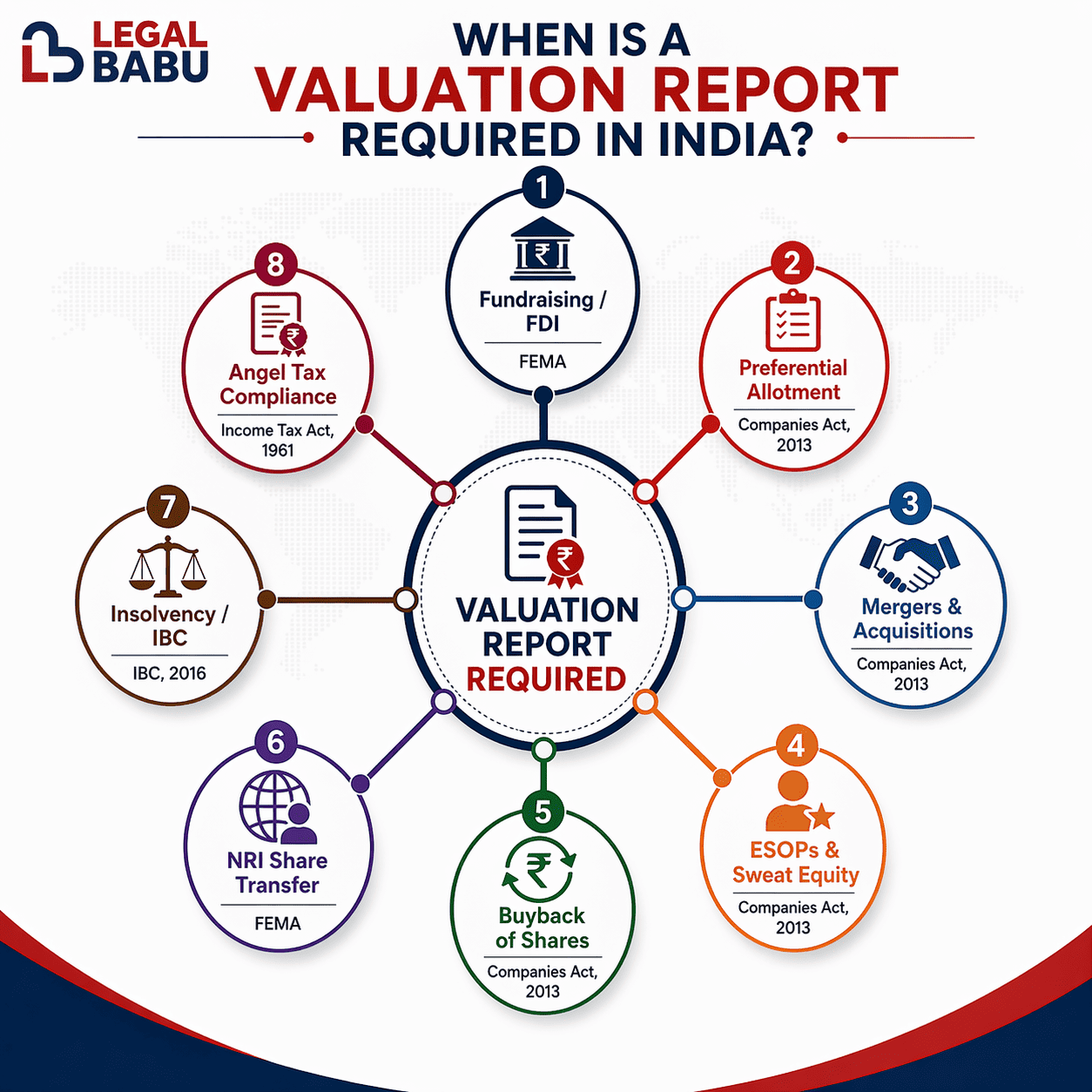
A valuation report is mandated across a wide range of corporate and financial events in India. Below is a clear reference table:
|
Situation |
Applicable Law |
Type of Valuer Required |
|
Preferential allotment of shares |
Companies Act, 2013 (Sec 62) |
IBBI Registered Valuer |
|
Mergers and amalgamations |
Companies Act, 2013 (Sec 230–232) |
IBBI Registered Valuer |
|
Inbound FDI / issue of shares to a foreign investor |
FEMA / FEM (NDI) Rules, 2019 |
IBBI Registered Valuer |
|
Transfer of shares to or from NRI / foreign entity |
FEMA |
IBBI Registered Valuer / Merchant Banker |
|
Angel Tax compliance - Sec 56(2)(viib) |
Income Tax Act, 1961 |
SEBI Cat-I Merchant Banker / CA |
|
ESOPs and Sweat Equity shares |
Companies Act, 2013 |
IBBI Registered Valuer |
|
Buyback of shares |
Companies Act, 2013 |
IBBI Registered Valuer |
|
Insolvency / Liquidation proceedings |
IBC, 2016 |
IBBI Registered Valuer |
|
Startup fundraising (VC / PE rounds) |
Income Tax Act / FEMA |
IBBI Registered Valuer / Merchant Banker |
|
Property or asset transfer |
Stamp Duty / Income Tax |
IBBI Registered Valuer |
Important: Since 1 February 2019, only IBBI-registered valuers are permitted to conduct valuations under the Companies Act, 2013 and the Insolvency and Bankruptcy Code, 2016. Using an unqualified valuer exposes the company to regulatory rejection and penalties.
If you are planning a share transfer or a private limited company registration involving foreign investors, a valuation report is one of the first documents you will need.
Who Can Issue a Valuation Report in India?
Not everyone can legally sign a valuation report in India. The law is specific about who qualifies:
1. IBBI Registered Valuer
The most widely required category. The Insolvency and Bankruptcy Board of India (IBBI) registers and regulates valuers under the Companies (Registered Valuers and Valuation) Rules, 2017, notified under Section 247 of the Companies Act, 2013. Registered valuers are categorised by asset class:
-
Securities and Financial Assets (most common for company/share valuations)
-
Land and Building
-
Plant and Machinery
An IBBI-registered valuer may only sign a valuation report for the asset class in which they are registered.
2. Chartered Accountant (CA)
A CA is permitted to issue a valuation report for income tax-related purposes under Rule 11UA of the Income Tax Rules, 1962 - but only for the Net Asset Value (NAV) method. For the DCF method under income tax law, a SEBI Category I Merchant Banker is required.
3. SEBI Category I Merchant Banker
Required specifically when:
-
The DCF method is used for income tax valuation involving non-resident investors
-
SEBI-regulated transactions, such as preferential issues in listed companies, are involved
Penalty Note: Under Section 247(3) of the Companies Act, 2013, a valuer who contravenes valuation provisions faces a penalty of ₹50,000. The company may also face regulatory scrutiny and transaction invalidation.
What are the Types of Valuation Reports in India?
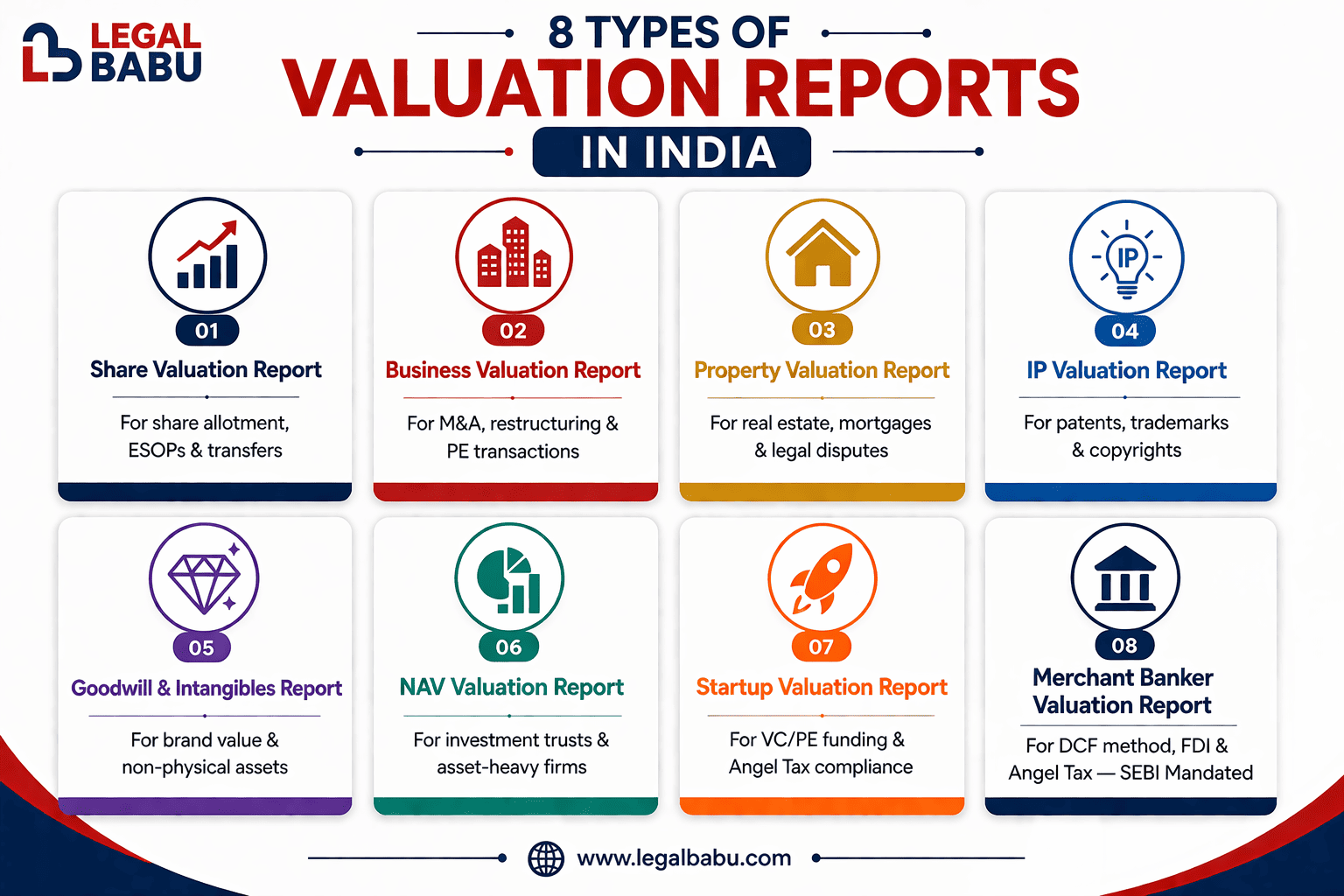
Valuation reports are not one-size-fits-all. Depending on what is being valued and why, there are several distinct types of valuation reports in India:
1. Share Valuation Report
The most commonly required valuation report in India. It establishes the fair market value per equity share of a private limited company. Required for fundraising, share allotment, ESOPs, buybacks, and share transfers.
2. Business Valuation Report
A comprehensive valuation report covering the entire business - including tangible assets, goodwill, brand value, and future earning potential. Used for mergers and acquisitions, business restructuring, or private equity transactions.
For companies undergoing mergers, acquisitions, or private equity transactions, LegalBabu's Transaction Advisory Services can guide you through the entire deal process - including obtaining the right valuation report at each stage.
3. Property / Real Estate Valuation Report
A valuation report that determines the fair market value of land, buildings, or immovable property. Commonly required for mortgage applications, sale transactions, stamp duty calculation, and legal disputes.
4. Goodwill and Intangible Asset Valuation Report
A specialised valuation report focused on non-physical assets such as brand value, customer relationships, non-compete agreements, or proprietary processes. Often required in M&A due diligence.
5. IP Valuation Report (Intellectual Property Valuation)
An increasingly important category of valuation report in India's startup and technology ecosystem. An IP valuation report determines the fair market value of intellectual property assets such as patents, trademarks, copyrights, trade secrets, and proprietary technology.
Given the rapid growth of tech and IP-intensive startups in India, IP valuation reports are now a critical compliance and strategic tool. If you hold registered intellectual property, LegalBabu's IP and trademark registration services can be paired with a professional IP valuation.
LegalBabu's Intellectual Property services - including trademark, patent, and copyright registration - can be seamlessly paired with a professional IP valuation report to give your IP assets both legal protection and a documented market value.
6. Net Asset Value (NAV) Valuation Report
Based on the book value of a company's assets minus its liabilities. Used particularly for investment funds, real estate holding companies, and asset-heavy businesses where income-based valuation may not be appropriate.
7. Startup Valuation Report
A forward-looking valuation report tailored for early-stage startups with limited financial history. Typically relies on DCF projections, market comparables, or Stage Gate methodology. DPIIT-recognised startups registered under DPIIT's Startup India initiative may qualify for an Angel Tax exemption under Section 56(2)(viib) of the Income Tax Act - but only if they obtain a proper valuation report from an eligible registered valuer or SEBI-registered merchant banker to support their share premium.
8. Merchant Banker Valuation Report
A Merchant Banker Valuation Report is issued exclusively by a SEBI Category I registered Merchant Banker and carries specific legal weight under Indian tax and securities law. It is mandatory when the Discounted Cash Flow (DCF) method is used to value shares of unlisted companies for income tax purposes under Rule 11UA of the Income Tax Rules, 1962 — particularly in transactions involving non-resident investors or foreign capital.
This type of valuation report is commonly required for:
- Angel Tax compliance under Section 56(2)(viib) of the Income Tax Act
- Preferential allotments in SEBI-regulated listed company transactions
- Cross-border share issuances involving FDI where the DCF methodology is applied
- Startup fundraising rounds where the share premium needs income tax protection
If you are building a startup, read our guide on Private Limited Company registration to understand the full compliance picture.
Which Valuation Methods are Used in a Valuation Report?
The methodology used in a valuation report directly determines the outcome and its legal acceptability. The choice of method depends on the company type, the purpose of the valuation report, and the applicable law.
Valuation method comparison table:
|
Method |
Best For |
Key Metric |
Who Typically Uses It |
|
Discounted Cash Flow (DCF) |
Startups, high-growth companies |
Future cash flow projections |
Investors, Merchant Bankers |
|
Net Asset Value (NAV) |
Asset-heavy companies |
Assets minus liabilities |
Tax authorities, CAs |
|
Comparable Company Analysis (CCA) |
Market benchmarking |
P/E, EV/EBITDA multiples |
Analysts, Investors |
|
Precedent Transactions |
M&A deals |
Historical deal valuations |
Investment bankers |
|
Revenue / EBITDA Multiple |
SaaS, recurring revenue businesses |
Revenue or profit multiples |
VCs, Private equity firms |
|
Relief from Royalty |
IP and trademark valuation |
Estimated royalty savings |
IP experts, valuers |
How the law determines the method:
-
Under Rule 11UA of the Income Tax Rules, unlisted company shares must be valued using either NAV or DCF. The DCF method requires a SEBI Category I Merchant Banker.
-
Under FEMA / FEM (NDI) Rules, the issue price of shares to a non-resident must be at or above the fair market value determined on an arm's-length basis - typically using DCF or CCA.
-
Under the Companies Act (Sec 230–232) for mergers, the registered valuer may use any recognised methodology and must disclose the rationale in the valuation report.
The Ministry of Corporate Affairs (MCA) and IBBI both publish guidelines that inform the standards registered valuers must follow.
What Documents are Required for a Valuation Report?
Providing complete and accurate documentation is critical. Incomplete data is the single biggest reason valuation reports get delayed or questioned by regulators. Here is the standard checklist:
-
Certificate of Incorporation
-
Audited Financial Statements - Balance Sheet, P&L, and Cash Flow Statement for the last 3–5 years
-
Current and historical shareholding pattern (Cap Table)
-
Details of all share classes - equity, preference, CCDs, CCPs, warrants
-
Board Resolution authorising the valuation exercise
-
Shareholder agreements, investor agreements, and side letters
-
Business plan and financial projections (3–5 years)
-
Provisional financials certified by management (if valuation date falls between financial years)
-
Group entity structure if the company has subsidiaries or associate companies
-
Details of any pending litigation, regulatory notices, or contingent liabilities
If you need help organising and filing company-related documents, LegalBabu's secretarial compliance services can assist you.
How to Get a Valuation Report in India: Step-by-Step Process
Getting a valuation report in India follows a structured process. Here is exactly what you need to do:
Step 1: Identify the Purpose of Your Valuation Report
The regulatory purpose determines the type of valuer, the methodology, and the format of the valuation report required. Are you raising funds? Transferring shares to an NRI? Complying with income tax? Each scenario has a specific set of rules.
The regulatory purpose also depends on your business structure. For example, the valuation requirements for a Private Limited Company differ from those applicable to an LLP registration or a partnership firm. Always confirm the applicable law before engaging a valuer.
Step 2: Determine the Type of Valuer You Need
Based on your purpose:
-
Companies Act event → IBBI Registered Valuer (Securities & Financial Assets class)
-
IBC proceeding → IBBI Registered Valuer
-
Income Tax / Angel Tax (NAV method) → Chartered Accountant or IBBI Valuer
-
Income Tax / Angel Tax (DCF method) → SEBI Category I Merchant Banker
-
FEMA compliance → IBBI Registered Valuer or Merchant Banker
Step 3: Engage a Qualified Registered Valuer
You can search the IBBI database of registered valuers at www.ibbi.gov.in or engage directly through LegalBabu, which connects businesses with verified registered valuers for a smooth, end-to-end valuation report process.
Step 4: Share All Required Company Information
Submit your financial statements, cap table, business projections, and other required documents as listed in the section above. Accuracy of information is your legal responsibility - the registered valuer relies on what you provide.
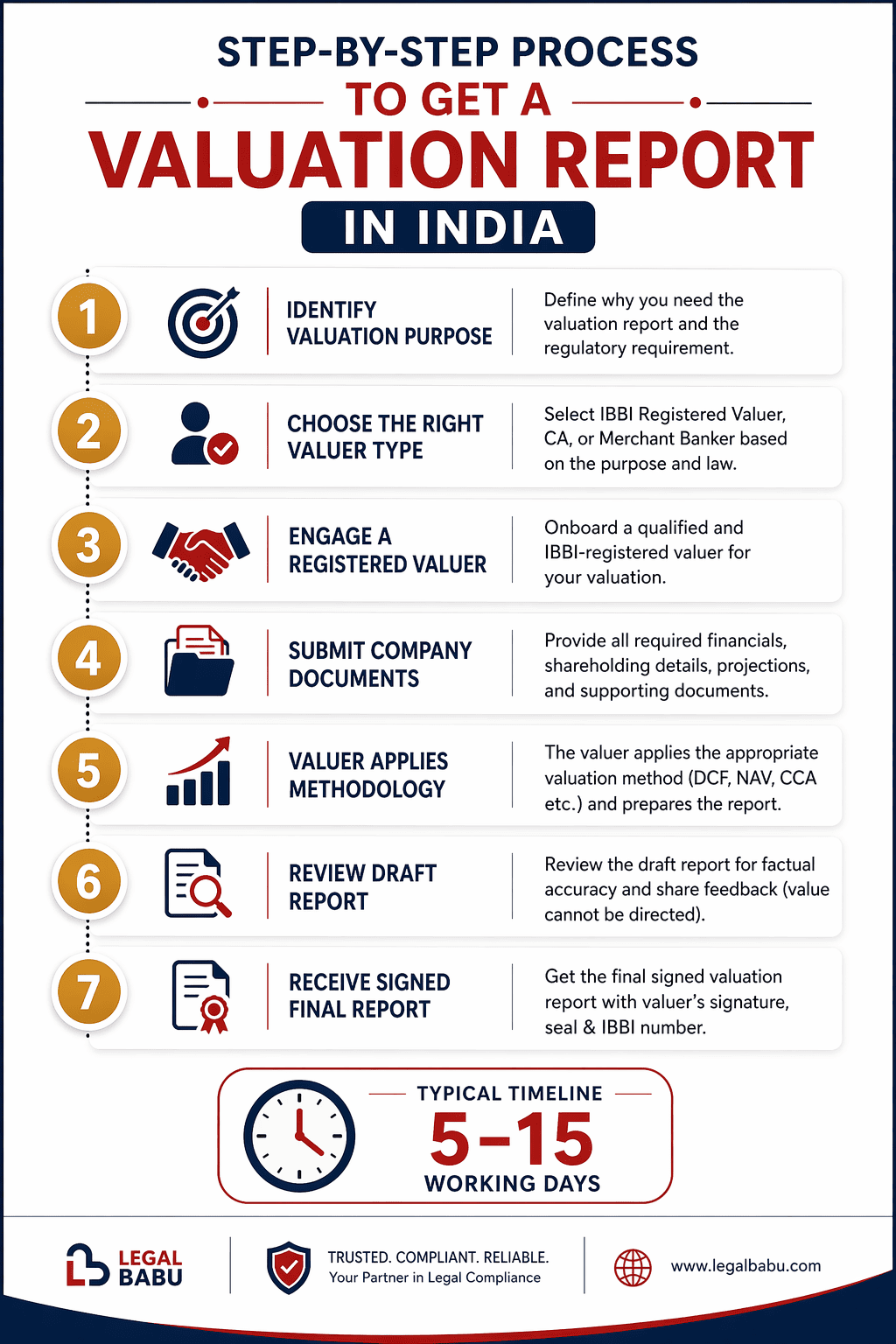
Step 5: Valuer Applies the Appropriate Methodology
The registered valuer selects and applies the right valuation method - DCF, NAV, CCA, or a combination - based on the purpose and the company's profile. They will typically share assumptions and preliminary workings with management.
Step 6: Review the Draft Valuation Report
The registered valuer shares a draft valuation report for management's review of factual accuracy. This is the time to flag any incorrect financial data. Note that you cannot direct the valuer to change the concluded value.
Step 7: Final Signed Valuation Report is Issued
The registered valuer issues the final signed valuation report on their letterhead with their IBBI registration number and seal. This document is a legally valid instrument that can be submitted to income tax authorities, the RBI, NCLT, SEBI, or investors.
Typical Timelines:
-
IBBI Registered Valuer Report → 10 working days
-
SEBI Merchant Banker Report → 7 - 15 working days (Subject to complete documentation being provided upfront)
What is the Cost of Getting a Valuation Report in India
Valuation report costs in India vary based on the company's size, asset complexity, purpose of valuation, and type of valuer engaged. Here is an indicative range:
|
Type of Valuation Report |
Approximate Cost (INR) |
|
Simple startup share valuation (IBBI Valuer) |
₹5,000 – ₹20,000 |
|
Mid-size company business valuation |
₹20,000 – ₹1,00,000 |
|
Property / Real estate valuation report |
₹5,000 – ₹50,000 |
|
IP Valuation Report (patents/trademarks) |
₹15,000 – ₹75,000 |
|
SEBI Merchant Banker Valuation Report |
₹50,000 – ₹2,00,000+ |
Note: The above prices may vary.
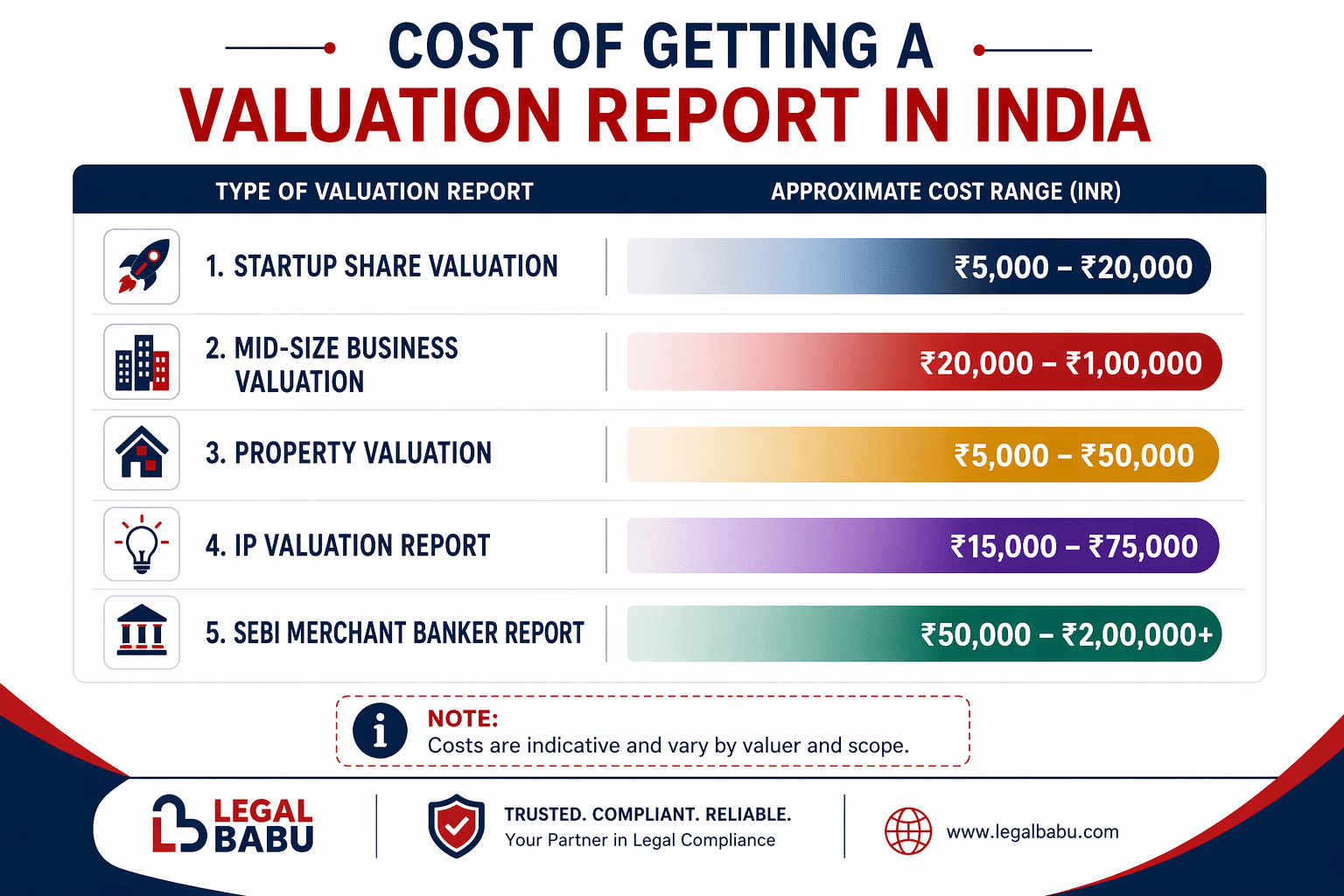
Note: These are indicative figures. Actual fees depend on scope, urgency, and professional engagement terms.
For LegalBabu pricing, connect with our valuation experts.
Why Choose LegalBabu for Your Valuation Report?
LegalBabu makes obtaining a legally compliant valuation report in India simple, fast, and affordable. Here is why thousands of businesses choose LegalBabu:
-
Verified IBBI-registered valuers across asset classes
-
Covers Companies Act, FEMA, and Income Tax compliance requirements
-
End-to-end documentation and filing support
-
Fast turnaround → 5–7 working days for standard share valuation reports
-
Transparent, affordable pricing - no hidden fees
-
Dedicated relationship manager for every client
-
Seamlessly integrates with LegalBabu's company registration, share transfer, trademark registration, and MCA secretarial services
Get Your Valuation Report Today? Contact LegalBabu
Conclusion
A valuation report is not just a compliance checkbox - it is a strategic document that protects your business from tax disputes, regulatory rejection, and legal challenges. Whether you are issuing shares to an investor, complying with FEMA, obtaining an Angel Tax exemption, or preparing for a merger, a correctly prepared valuation report by a qualified IBBI-registered valuer is non-negotiable.
The process is straightforward when you have the right team backing you. LegalBabu offers end-to-end support - from identifying the right type of registered valuer for your specific transaction to ensuring your valuation report meets every regulatory requirement under the Companies Act, Income Tax Act, and FEMA.
Need a Valuation Report? Let LegalBabu handle it for you - fast, accurate, and fully compliant.
FAQS
FAQs about Valuation Report in India
-
What is a valuation report in India?
A valuation report is a formal legal document prepared by a registered valuer that determines the fair market value of a company's shares, assets, intellectual property, or net worth. It is mandatory for various transactions under the Companies Act, FEMA, and the Income Tax Act.
- Who needs a valuation report in India?
- Who can legally issue a valuation report under the Companies Act 2013?
- Is a valuation report mandatory for startups raising funds?
- What is the difference between a valuation report and an audit report?
- Can a Chartered Accountant issue a valuation report?
- What methods are used to prepare a valuation report?
- How long does it take to get a valuation report in India?
- What is the validity period of a valuation report in India?
- What documents are required to get a valuation report?
- What is the penalty for not obtaining a valuation report when required?
- Is a valuation report required for FEMA compliance?
- What is an IP Valuation Report?


