
Table of Content:
- How to Convert Partnership Firm to Private Limited?
- What are the Key Requirements to Convert a Partnership Firm to a Private Limited?
- What are the Advantages of Converting Partnership Firm to Private Limited?
- What is the Procedure to Convert a Partnership Firm to a Private Limited?
- What are the Documents Required to Convert a Partnership Firm to a Private Limited?
- What are the Legal Provisions Governing Converting Partnership Firm to Private Limited?
- What is the Impact of Conversion of Partnership Firm to a Private Limited Firm?
- What are the Common Mistakes to Avoid while Converting a Partnership Firm to a Private Limited?
- Final Thoughts: Take the Next Step Towards Corporate Success
How to Convert a Partnership Firm to a Private Limited Company?

Converting a partnership firm into a private limited company is a significant step for businesses aiming to achieve growth, credibility, and a more structured legal identity. As businesses expand, the traditional partnership model often becomes limited due to unlimited liability, restricted funding options, and lack of separate legal status. This is where a private limited company structure offers clear advantages, including limited liability protection, better access to investment, and enhanced trust among stakeholders.
With proper documentation and regulatory filings through the Ministry of Corporate Affairs (MCA), a partnership firm can be seamlessly transitioned into a private limited company. Understanding the procedure, requirements, and legal implications of this conversion is essential to ensure a smooth transition without compliance issues.
What are the Key Requirements to Convert a Partnership Firm to a Private Limited?
Conversion to a private limited firm requires fulfilling legal, structural, and documentation requirements under company law to ensure a smooth and valid transition process. Here is an overview of the key requirements to convert partnership firm to private limited:
|
Requirement |
Details |
|
Minimum Partners |
The firm must have at least two partners who will become shareholders and directors of the company. |
|
Maximum Members |
A private limited company can have up to 200 members after conversion. |
|
Minimum Directors |
At least two directors are required, and one must be a resident of India. |
|
Consent of Partners |
Written consent from all partners is mandatory for conversion into a company. |
|
Pending Liabilities |
The firm should not have outstanding debts, legal disputes, or tax liabilities. |
|
Continuity of Business |
The business activities should remain the same after conversion to ensure compliance. |
|
Documentation |
All required documents like NOCs, identity proofs, and resolutions must be prepared and submitted. |
|
DIN & DSC |
Directors must obtain Director Identification Number (DIN) and Digital Signature Certificate (DSC). |
|
Name Approval |
A unique company name must be approved by the MCA before incorporation. |
What are the Advantages of Converting Partnership Firm to Private Limited?

Converting a partnership firm into a private limited company offers significant benefits in terms of legal protection, credibility, and growth potential. Some of the key benefits are:
- Limited Liability Protection: Shareholders’ liability is limited to their investment, protecting personal assets from business debts and reducing financial risk significantly.
- Separate Legal Entity: The company has its own legal identity, allowing it to own assets, enter contracts, and operate independently of its owners.
- Better Funding Opportunities: Private limited companies can raise funds through equity, venture capital, and investors, making it easier to expand and grow business operations.
- Perpetual Succession: The company continues to exist regardless of changes in ownership, ensuring stability and uninterrupted business operations over time.
- Enhanced Credibility: A private limited structure builds trust among clients, investors, and financial institutions, improving business reputation and market recognition.
- Ease of Ownership Transfer: Shares can be transferred easily, allowing smooth entry or exit of investors without affecting the company’s existence or operations.
- Tax Benefits and Planning: Companies can access structured tax benefits, deductions, and better planning opportunities compared to partnership firms under applicable tax laws.
What is the Procedure to Convert a Partnership Firm to a Private Limited?
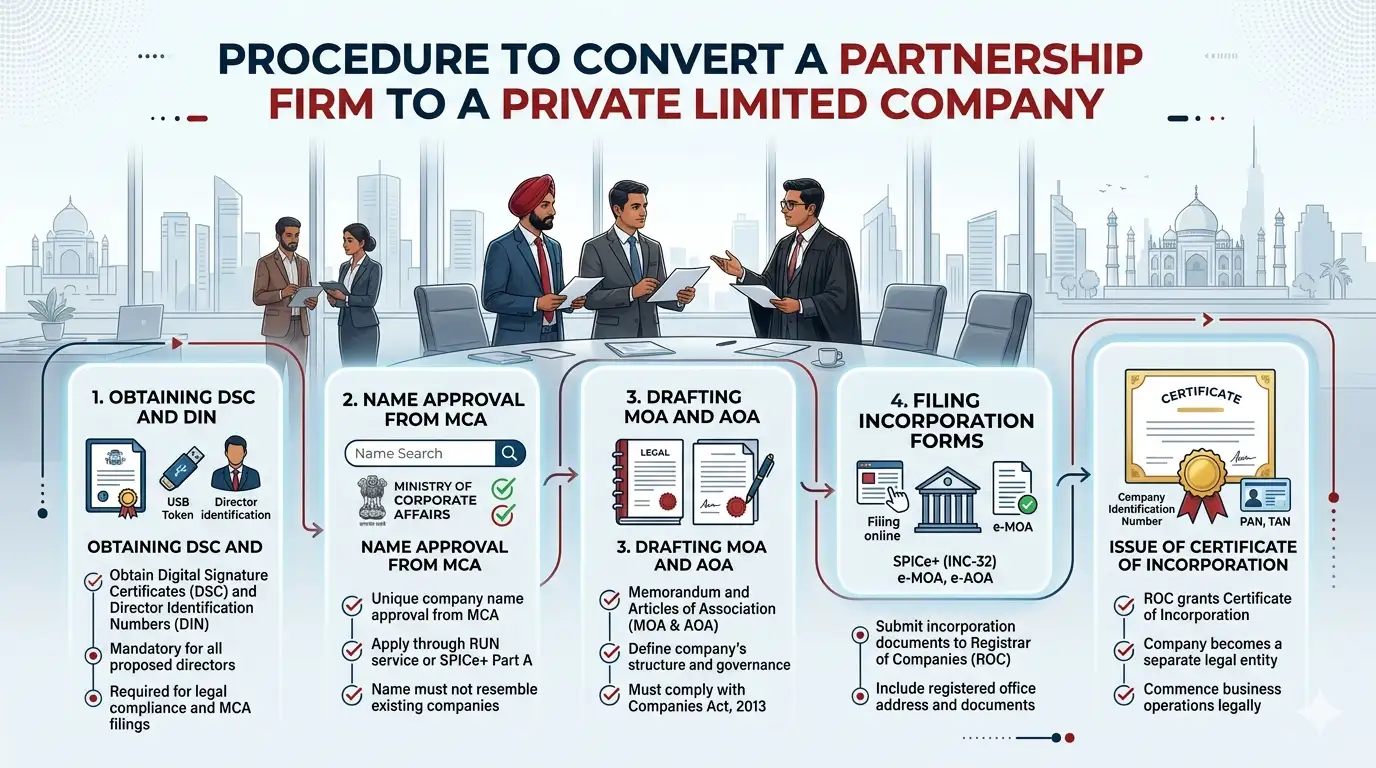
Converting a partnership firm into a private limited company involves a structured legal process including:
1. Obtaining DSC and DIN
All proposed directors must obtain Digital Signature Certificates (DSC) and Director Identification Numbers (DIN) for legal compliance and MCA filings.
- DSC is required for signing all electronic documents filed with MCA
- DIN is mandatory for individuals intending to become company directors
- Apply for DIN through SPICe+ form during incorporation process
- Ensure KYC documents of directors are valid and updated
- Professional certification may be required for DSC issuance
2. Name Approval from MCA
A unique company name must be approved by the Ministry of Corporate Affairs before incorporation.
- Apply through RUN service or SPICe+ Part A form
- Proposed name must be unique and not resemble existing companies
- Name should reflect business activities and comply with naming guidelines
- Maximum two names can be proposed in one application
- Approved name is reserved for 20 days
3. Drafting MOA and AOA
The Memorandum and Articles of Association define the company’s structure and internal governance.
- MOA states the main objectives and scope of company operations
- AOA defines rules for internal management and decision-making
- Must comply with provisions of the Companies Act, 2013
- Subscribers (partners) must sign MOA and AOA digitally
- Ensure clauses align with business conversion requirements
4. Filing Incorporation Forms
Submit incorporation documents with the Registrar of Companies (ROC) for company registration.
- File SPICe+ (INC-32) for company incorporation application
- Attach e-MOA (INC-33) and e-AOA (INC-34) forms
- Submit identity and address proof of directors and subscribers
- Provide registered office address proof and NOC from owner
- Include declaration and certification by a professional
5. Issue of Certificate of Incorporation
Upon verification, the ROC grants the Certificate of Incorporation, completing the conversion process.
- ROC verifies all submitted documents and compliance requirements
- Certificate includes Company Identification Number (CIN)
- Company becomes a separate legal entity from partners
- PAN and TAN are issued along with incorporation certificate
- Enables company to commence business operations legally
What are the Documents Required to Convert a Partnership Firm to a Private Limited?
The following are the key documents required to convert partnership firm to private limited:
- PAN cards of partners/directors
- Aadhaar or passport as identity proof
- Address proof of partners/directors
- Passport-size photographs of partners
- Registered partnership deed copy
- Firm registration certificate (if available)
- Registered office address proof
- Rent agreement and NOC
- Utility bill of business address
- Digital Signature Certificates (DSC)
- Director Identification Number (DIN)
- Affidavit of Dissolution
- Statement of Accounts
- Latest Income Tax Return
- Consent letters from all partners
- Form URC-1 and SPICe+ Forms
- Newspaper Advertisement and Declaration
What are the Legal Provisions Governing Converting Partnership Firm to Private Limited?
|
Provision |
Descriptions |
|
Companies Act, 2013 (Section 366) |
Section 366 deals with the conversion of existing entities, including partnership firms, into companies by registering them under the Companies Act. |
|
Companies (Authorised to Register) Rules, 2014 |
These rules provide detailed procedures, eligibility conditions, and documentation requirements for converting a partnership firm into a company. |
|
Registrar of Companies (ROC) Compliance |
All incorporation forms, declarations, and documents must be filed with the ROC to obtain approval and legal recognition of the company. |
|
Income Tax Act, 1961 |
Relevant provisions govern tax implications during conversion, including conditions for exemption from capital gains tax under specific circumstances. |
|
Other Regulatory Requirements |
Additional registrations such as GST, EPFO, and ESIC may need to be updated or obtained after conversion to ensure continued compliance. |
What is the Impact of Conversion of Partnership Firm to a Private Limited Firm?

Conversion into a private limited company significantly impacts legal structure, operations, and growth potential, offering improved credibility, compliance, and long-term business sustainability in the following ways:
- Separate Legal Entity: The business becomes an independent legal entity, distinct from its owners, enabling it to own assets and enter contracts in its own name.
- Limited Liability Protection: Owners’ liability is limited to their shareholding, safeguarding personal assets from business losses and financial obligations.
- Improved Credibility and Trust: The private limited structure enhances business reputation, increasing trust among customers, investors, banks, and other stakeholders.
- Ease of Raising Funds: Companies can raise capital through equity investment, venture capital, and institutional funding, supporting expansion and business growth.
- Perpetual Succession: The company continues to exist irrespective of changes in ownership, ensuring stability and uninterrupted business operations.
- Higher Compliance Requirements: The company must follow stricter legal and regulatory compliance, including regular filings, audits, and governance standards.
- Tax Structure Changes: Taxation shifts from partnership taxation to a corporate tax regime, offering better planning opportunities but requiring detailed compliance.
- Transfer of Assets and Liabilities: All business assets and liabilities are transferred to the company, ensuring continuity of operations under a new legal structure.
What are the Common Mistakes to Avoid while Converting a Partnership Firm to a Private Limited?
Converting a partnership firm into a private limited company requires careful legal and procedural compliance. Even minor errors can lead to rejection, delays, or legal complications. Here are the key common mistakes you should avoid while converting partnership firm to private limited:
- Choosing a Non-Compliant Company Name: Selecting a name similar to existing companies or violating naming guidelines can lead to rejection by MCA and delay the incorporation process.
- Incomplete or Incorrect Documentation: Submitting inaccurate identity proofs, address details, or missing attachments may result in application rejection or resubmission requirements from authorities.
- Improper Drafting of MOA and AOA: Errors in objectives or internal rules can create legal issues and may not align with business needs or Companies Act provisions.
- Ignoring Stamp Duty and Fees: Failure to pay correct stamp duty and registration fees can lead to delays or invalidation of incorporation documents.
- Non-Compliance with Legal Provisions: Overlooking requirements under the Companies Act, 2013 may result in penalties, rejection, or future compliance issues for the company.
- Failure to Close or Update Partnership Firm Records: Not properly dissolving or updating the partnership firm can create legal conflicts and duplication of business identity.
- Incorrect Details in SPICe+ Forms: Errors in incorporation forms such as director details or registered office address can delay approval or require corrections.
Final Thoughts: Take the Next Step Towards Corporate Success
Converting a partnership firm into a private limited company is a strategic move toward long-term growth, legal security, and enhanced credibility. While the process involves multiple legal steps, proper planning, accurate documentation, and compliance with regulatory requirements can make the transition seamless. This conversion not only protects personal liability but also opens doors to better funding and expansion opportunities. By avoiding common mistakes and understanding the legal framework, businesses can ensure a smooth transformation. Taking this step today can position your business for greater success, sustainability, and competitive advantage in the evolving corporate landscape.
FAQS
Have some questions about Conversion of Partnership Firm to Private Limited?
We have got you covered:
-
Can an unregistered partnership firm be converted into a private limited company?
Yes, an unregistered firm can be converted, but proper documentation and proof of existence are required during incorporation.
- Is it mandatory to dissolve the partnership firm before conversion?
- How long does the conversion process usually take?
- Can all partners become directors in the new company?
- Is there any minimum capital requirement for conversion?
- Can the company name be different from the partnership firm name?
- Are all licenses automatically transferred after conversion?
- Can a foreign national become a director after conversion?
- Can the registered office be changed during conversion?
- Can the converted company issue shares immediately after incorporation?


