
Table of Content
- What is Strike off of Company?
- What are the Conditions for Strike off of Company?
- What is the Difference Between Strike off and Winding up of a Company?
- What are the Different Ways of Striking off of a Company?
- What is Voluntarily Strike off of a Company?
- What is Strike off of a Company by ROC?
- What Documents are Required for Strike off of Company?
- Which Companies are not Eligible for Strike off?
- What is the Step-by-Step Procedure for Strike off of a Company?
- What is the Role of Directors in the Strike off Process?
- What is the Timeline for Completion of Company Strike Off Process?
- What are the Effects of Striking off of a Company?
- Can a Strike off Company be Revived?
- How Legal Babu can Help with the Strike off Process?
What is Strike off of Company?
Strike off of a company refers to the legal process of removing a company's name from the Register of Companies, resulting in the dissolution of the company. The provisions governing strike off are contained in Sections 248 to 252 of the Companies Act, 2013, read with the Companies (Removal of Names of Companies from the Register of Companies) Rules, 2016, covering removal, restrictions, effects of dissolution, penalties for fraudulent applications, and restoration of the company by the Tribunal.
What are the Conditions for Strike off of Company?
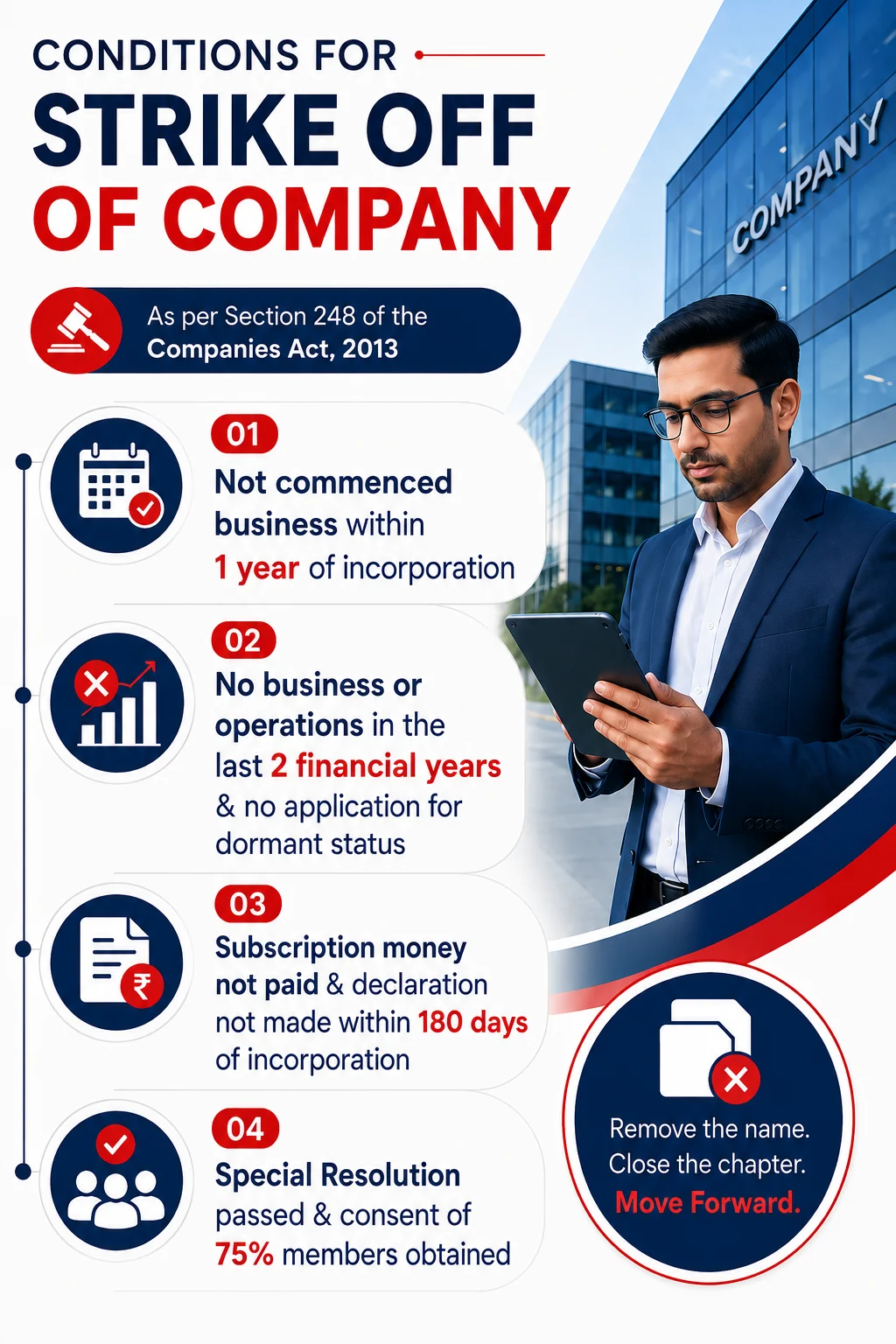
A company can be struck off from the Register of Companies under Section 248 of the Companies Act, 2013, provided it meets certain eligibility criteria. These conditions ensure that only inactive companies with no outstanding liabilities are removed from the records of the Registrar of Companies (ROC). The conditions mentioned in Section 248 include:
- The company has failed to commence business within one year from the date of incorporation.
- The company has not carried out any business or operation for a period of two immediately preceding financial years, and no application for dormant status under Section 455 has been made.
- The Subscription money has not been paid by the subscribers and declaration has not been made within 180 days of incorporation
- The company has obtained approval from its shareholders by passing a special resolution and securing the consent of 75% of members for striking off of company.
Once these conditions are satisfied, the company may proceed with the strike off application and seek removal of its name from the Register of Companies.
What is the Difference Between Strike off and Winding up of a Company?
Although both strike off and winding up result in the closure of a company, they are distinct legal processes under the Companies Act, 2013. Strike off is a simpler and faster method used for inactive companies with no liabilities, whereas winding up is a more comprehensive procedure involving the realisation of assets, settlement of liabilities, and distribution of any remaining funds. Understanding the differences between these two mechanisms helps businesses choose the appropriate method for legally ending their operations. Here are the key differences between the two:
|
Basis of Difference |
Strike Off |
Winding Up |
|
Meaning |
Removal of a company's name from the Register of Companies by the ROC. |
Formal process of closing a company by liquidating its assets and settling its liabilities. |
|
Governing Provisions |
Sections 248 to 252 of the Companies Act, 2013. |
Chapter XX of the Companies Act, 2013, |
|
Purpose |
To close an inactive or non-operational company. |
To completely dissolve a company after settling its affairs. |
|
Liabilities |
Applicable only when all liabilities have been extinguished. |
Liabilities are settled during the winding-up process. |
|
Procedure |
Comparatively simple, quick, and cost-effective. |
More detailed, lengthy, and complex. |
|
Involvement of Liquidator |
No liquidator is appointed. |
A liquidator is generally appointed to administer the process. |
|
Asset Realization |
Assets must be disposed of before applying for a strike-off. |
Assets are realised and distributed during the winding-up process. |
|
Regulatory Authority |
Registrar of Companies (ROC). |
National Company Law Tribunal (NCLT), liquidator, or other competent authority, as applicable. |
What are the Different Ways of Striking off of a Company?
Under the Companies Act, 2013, a company can be strike off through two primary methods:
- by the Registrar of Companies (ROC) or
- by voluntary strike off by the company itself
NOTE:
1. In 2023, the Ministry of Corporate Affairs (MCA) introduced the Centre for Processing Accelerated Corporate Exit (C-PACE) as a centralised authority for processing strike off applications across India.
2. C-PACE has nationwide jurisdiction and functions as the registrar for matters relating to the processing and disposal of applications filed in e-Form STK-2 under Section 248 of the Companies Act, 2013.
3. All strike off applications and related proceedings are handled by C-PACE, making it the designated authority for processing and approving company strike off applications in India.
What is Voluntarily Strike off of a Company?
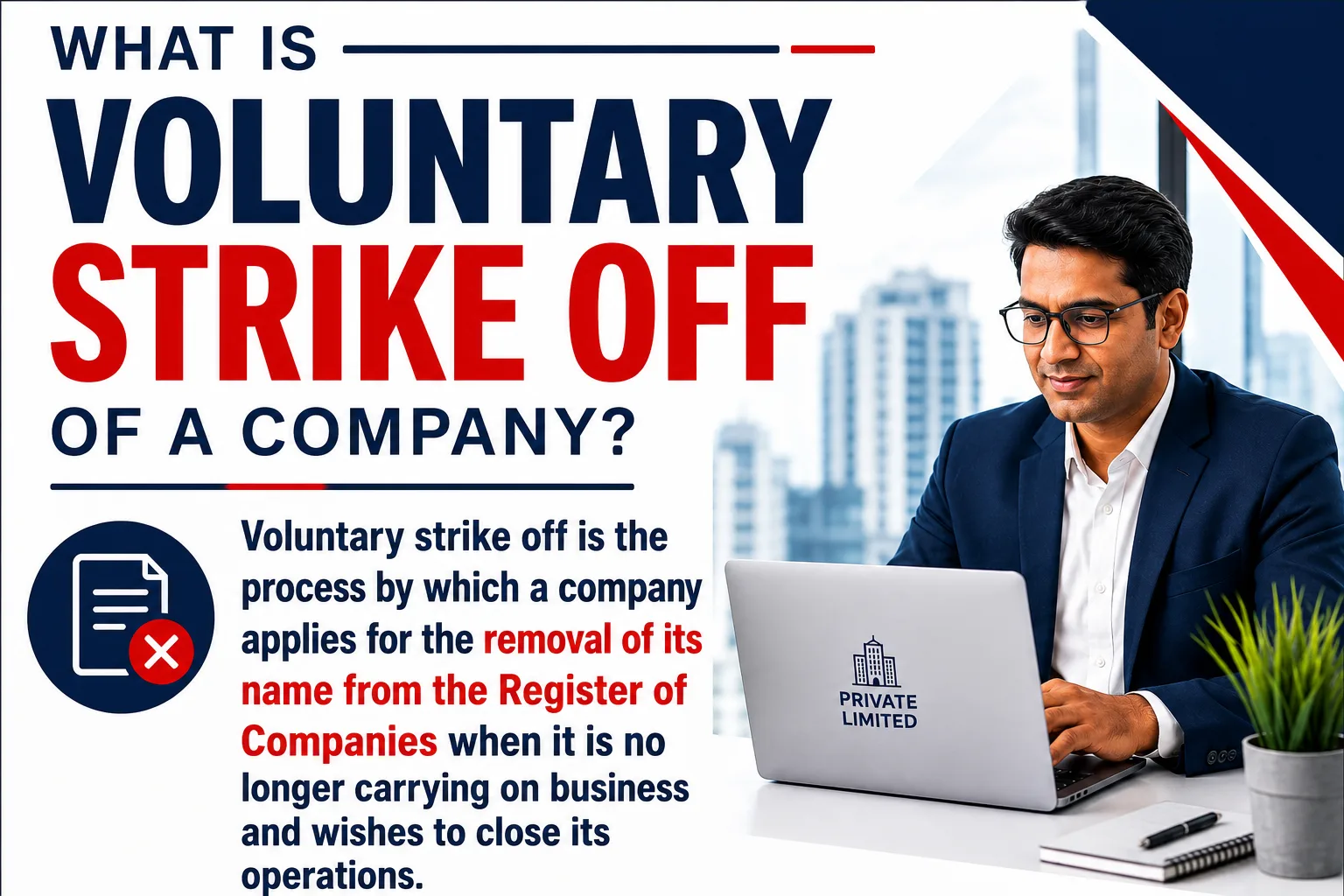
Voluntary strike off of company is the process through which a company applies for the removal of its name from the Register of Companies when it is no longer carrying on business and wishes to close its operations. This process is governed by Section 248(2) of the Companies Act, 2013, and the Companies (Removal of Names of Companies from the Register of Companies) Rules, 2016. Upon approval, the company's name is struck off, and it stands dissolved.
Conditions for Voluntary Strike Off of a Company:
- The company must have extinguished all its liabilities before making the application.
- The company must obtain approval by passing a special resolution or securing the consent of members holding at least 75% of the paid-up share capital.
- The company should not have any ongoing business operations requiring its continued existence.
- The company must not be involved in any ongoing investigation, inspection, or prosecution.
- The company must not fall under any category of companies restricted from applying for strike off under the Companies Act, 2013.
What is Strike off of a Company by ROC?
Strike off by the Registrar of Companies (ROC) is the process through which the registrar removes the company's name on its own initiative, usually when the company fails to comply with certain statutory requirements or remains inactive. This process is governed by Section 248(1) of the Companies Act, 2013, which empowers the ROC to strike off companies that are no longer carrying on business or have defaulted in meeting prescribed legal obligations.
Conditions for Strike Off by ROC:
The ROC may initiate strike off proceedings if:
- The company has failed to commence business within one year of its incorporation.
- The company has not carried on any business or operation for the preceding two financial years and has not applied for dormant status under Section 455.
- The subscribers to the memorandum have not paid the subscription amount, and the declaration under Section 10A has not been filed within the prescribed period.
- The company is found to be inactive or non-operational for a prolonged period.
- The ROC has reasonable cause to believe that the company is not carrying on any business or operations.
- The company has failed to comply with statutory requirements prescribed under the Companies Act, 2013, making it liable for removal from the Register of Companies.
What Documents are Required for Strike off of Company?
The following are the key documents required for strike off of a company:
- Certificate of Incorporation of the company.
- PAN card of the company.
- MOA and AOA of the company
- Board resolution authorising the strike off application.
- Shareholders' Resolution approving the strike off
- Statement of Accounts certified by a Chartered Accountant.
- Affidavit from the directors.
- Indemnity Bond executed by the directors.
- No Objection Certificate (NOC) from creditors
- NOC from regulatory authorities
- Latest income tax return acknowledgement.
- Bank account closure certificate or final bank statement.
- Declaration confirming that all liabilities have been settled.
- Identity and address proof of directors.
- e-Form STK-2 and supporting attachments
These documents help establish that the company has ceased operations, settled all liabilities, obtained the necessary approvals, and is eligible for strike off under the Companies Act, 2013.
Which Companies are not Eligible for Strike off?
Under Section 248 of the Companies Act, 2013 and Rule 3 of the Companies (Removal of Names of Companies from the Register of Companies) Rules, 2016, certain companies are restricted from applying for strike off due to their regulatory status, ongoing obligations, or public interest considerations. These companies must continue complying with statutory requirements and cannot seek removal of their name from the Register of Companies.
|
Category of Company |
Reason for Ineligibility for Strike Off |
|
Listed Companies |
Companies whose securities are listed on any recognised stock exchange cannot apply for strike off due to ongoing public investor interests and regulatory obligations. |
|
Delisted Companies |
Companies delisted by a stock exchange on account of non-compliance with listing regulations are not eligible for strike off until regulatory issues are resolved. |
|
Companies incorporated for charitable, social, educational, or non-profit purposes under Section 8 of the Companies Act, 2013, cannot seek strike off through the normal process. |
|
|
Vanishing Companies |
Companies that have raised funds from investors and subsequently failed to file statutory returns, with their directors or registered office becoming untraceable, are prohibited from obtaining strike off. |
|
Regulated Financial Entities |
Banking companies, insurance companies, housing finance companies, NBFCs, Collective Investment Schemes (CIS), and entities regulated by sectoral regulators such as SEBI, RBI, IRDAI, or NHB cannot be struck off without prior regulatory approval. |
|
Companies Under Inspection, Inquiry, or Investigation |
A company against which an inspection, inquiry, or investigation has been ordered, initiated, or is pending cannot apply for strike off until the proceedings are completed. |
|
Companies Facing Pending Prosecution |
Companies against which prosecution for any offence is pending before a court are not eligible for strike off. |
|
Companies with Pending Compounding Applications |
Where an application for the compounding of offences committed by the company or its officers is pending before a competent authority, a strike off is not permitted. |
|
Companies Under Winding Up or Insolvency Proceedings |
Companies undergoing winding-up proceedings or subject to insolvency resolution proceedings under the Insolvency and Bankruptcy Code, 2016 (IBC), cannot apply for strike off. |
|
Companies with Outstanding Public Deposits |
Companies that have accepted public deposits and have outstanding liabilities or defaults relating to such deposits are not eligible for strike off. |
|
Companies Having Unsatisfied Charges |
Companies with existing secured loans or registered charges that have not been satisfied or released by the charge holder cannot seek strike off. |
|
Companies That Changed Their Name |
A company that has changed its name within three months immediately preceding the strike-off application is disqualified from applying. |
|
Companies That Shifted Registered Office from One State to Another |
Companies that have recently changed the state of their registered office are restricted from seeking strike off during the prescribed period. |
|
Companies That Disposed of Property or Rights Outside Ordinary Business Activities |
If a company has sold or transferred property, assets, or rights for value outside the normal course of business during the previous three months, it cannot apply for strike off. |
|
Companies with Pending Compromise or Arrangement Applications |
Companies that have made an application to the National Company Law Tribunal (NCLT) for a compromise or arrangement with creditors or members, and where such an application is pending, cannot seek strike off. |
NOTE:
A company cannot apply for voluntary strike off if it has overdue financial statements (Form AOC-4) or annual returns (Form MGT-7) up to the end of the financial year in which it ceased operations.
What is the Step-by-Step Procedure for Strike off of a Company?
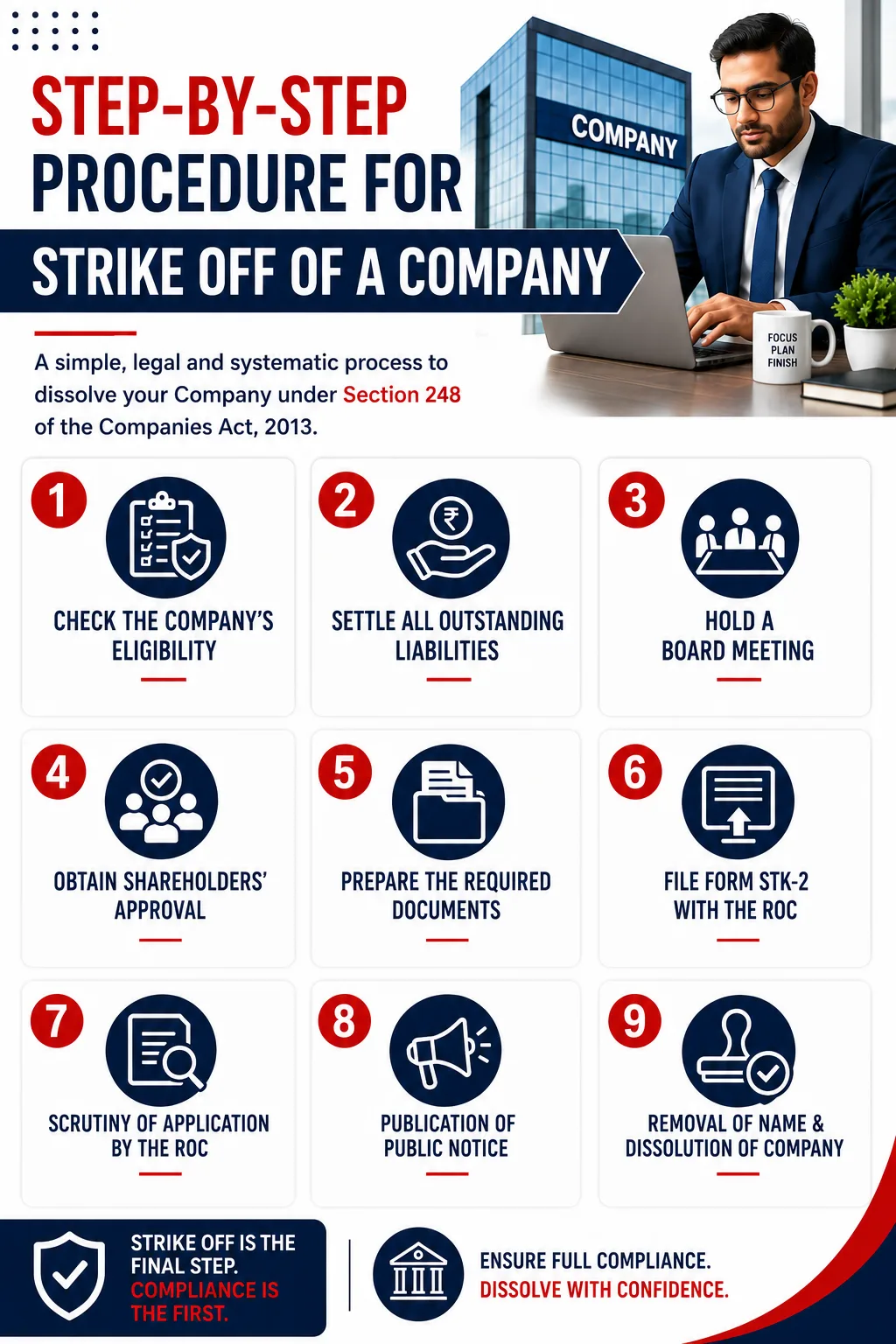
The strike-off process under Section 248 of the Companies Act, 2013, allows a company that has ceased operations and has no outstanding liabilities to apply for removal of its name from the Register of Companies (ROC). The process involves obtaining internal approvals, settling liabilities, filing Form STK-2 with supporting documents, and securing approval from the ROC before the company is formally dissolved. Here is the step-by-step process:
Step 1: Check the Company's Eligibility
Before initiating the strike-off process, the company must verify that it satisfies all conditions prescribed under the Companies Act, 2013 and the Companies (Removal of Names of Companies from the Register of Companies) Rules, 2016. The company should not fall under any category that is prohibited from seeking strike off, such as companies under investigation, companies with outstanding public deposits, or companies involved in insolvency proceedings. It should also ensure that all pending ROC filings have been completed.
Step 2: Settle All Outstanding Liabilities
A company can apply for strike off only after extinguishing all its liabilities. This includes repayment of loans, settlement of creditor dues, payment of statutory liabilities, employee dues, and any other outstanding obligations. The company should also close its bank accounts after clearing all financial transactions. Since directors remain liable for undisclosed liabilities even after being struck off, complete settlement of obligations is crucial.
Step 3: Hold a Board Meeting
The Board of Directors must convene a board meeting to consider and approve the proposal for voluntary strike off. During the meeting, the directors pass a board resolution authorising the strike-off application and appointing a director or other authorised person to complete the necessary filings and procedural requirements before the ROC.
Step 4: Obtain Shareholders' Approval
After receiving board approval, the company must obtain consent from its shareholders. Under Section 248(2), the company is required to pass a Special Resolution or obtain consent from members holding at least 75% of the paid-up share capital. This approval demonstrates that the members agree to discontinue the company's existence and support the strike-off application.
Step 5: Prepare the Required Documents
Before filing the application, the company must prepare all prescribed documents and declarations. These documents confirm that the company has no liabilities and that the directors undertake responsibility for any future claims arising after strike off.
The key documents generally include:
- Indemnity Bond in Form STK-3
- Affidavit by Directors in Form STK-4
- Statement of Accounts certified by a Chartered Accountant
- Special Resolution or shareholders' consent
- Statement regarding pending litigations, if any
- Regulatory approvals, wherever required
Step 6: File Form STK-2 with the ROC
Once all documents have been prepared, the company must file Form STK-2 with the Registrar of Companies. The application should be carefully reviewed before submission to ensure that all declarations, attachments, and supporting documents are complete and accurate. Any discrepancies may result in delays or rejection of the application.
Step 7: Scrutiny of Application by the ROC
After receiving Form STK-2, the ROC examines the application and verifies whether the company has complied with all legal requirements. The registrar may seek additional documents, clarifications, or explanations if necessary. During this stage, the ROC also reviews the company's filing history and verifies whether any legal impediments exist that would prevent the strike off.
Step 8: Publication of Public Notice
If the ROC is satisfied with the application, a public notice is issued inviting objections from stakeholders, creditors, government authorities, and other interested parties. The notice is published in the prescribed manner and provides an opportunity for any affected person to raise objections before the company's name is removed from the register.
Step 9: Removal of Name and Dissolution of Company
If no valid objections are received and the ROC is satisfied that all statutory requirements have been fulfilled, a final notice in Form STK-7 is issued. Upon publication of this notice in the Official Gazette, the company's name is struck off from the Register of Companies, and the company stands dissolved from the specified date.
What is the Role of Directors in the Strike off Process?
Directors play a key role in the strike-off process under Sections 248 and 249 of the Companies Act, 2013. They are responsible for ensuring that the company complies with all legal requirements before applying for removal of its name from the Register of Companies. Their duties continue even after the company is struck off, particularly in relation to any undisclosed liabilities or statutory non-compliances.
The key responsibilities of directors include:
- Ensuring that the company is eligible for strike off under the Companies Act, 2013.
- Verifying that the company has ceased business operations and has no ongoing commercial activities.
- Settling all outstanding liabilities, including taxes, loans, creditor dues, and statutory obligations.
- Convening and approving the strike-off proposal through a board resolution.
- Obtaining the necessary approval from shareholders through a special resolution or requisite consent.
- Executing and signing the Indemnity Bond (Form STK-3) and Affidavit (Form STK-4).
- Certifying that the information and documents submitted to the ROC are true and accurate.
- Authorising the filing of Form STK-2 and other supporting documents with the ROC.
- Cooperating with the ROC and providing additional information or clarifications, if required.
- Remaining liable for any undisclosed liabilities, fraud, or legal violations that existed before the company's dissolution.
What is the Timeline for Completion of Company Strike Off Process?
The timeline for completing a company strike-off process generally ranges from 3 to 6 months, depending on the company's compliance status, accuracy of documents, and the time taken by the Registrar of Companies (ROC) to process the application. Delays may occur if additional clarifications, objections, or document corrections are required during the review process.
Indicative Timeline for Strike Off Process:
|
Stage |
Approximate Timeline |
|
Settlement of liabilities and preparation of documents |
1-3 weeks |
|
Board Meeting and Shareholders' Approval |
1-2 weeks |
|
Preparation and filing of Form STK-2 |
3-7 days |
|
Scrutiny of application by ROC |
30-45 days |
|
Publication of public notice and objection period |
30 days |
|
Issue of final strike-off notice (Form STK-7) |
15-30 days |
The actual time required may vary depending on several factors, including:
- Completeness and accuracy of documents submitted with Form STK-2.
- Whether all pending ROC filings have been completed.
- Existence of outstanding liabilities, charges, or statutory dues.
- Requirement of approvals from regulatory authorities.
- Objections raised by creditors, stakeholders, or government departments.
- Processing time of the concerned ROC office.
What are the Effects of Striking off of a Company?
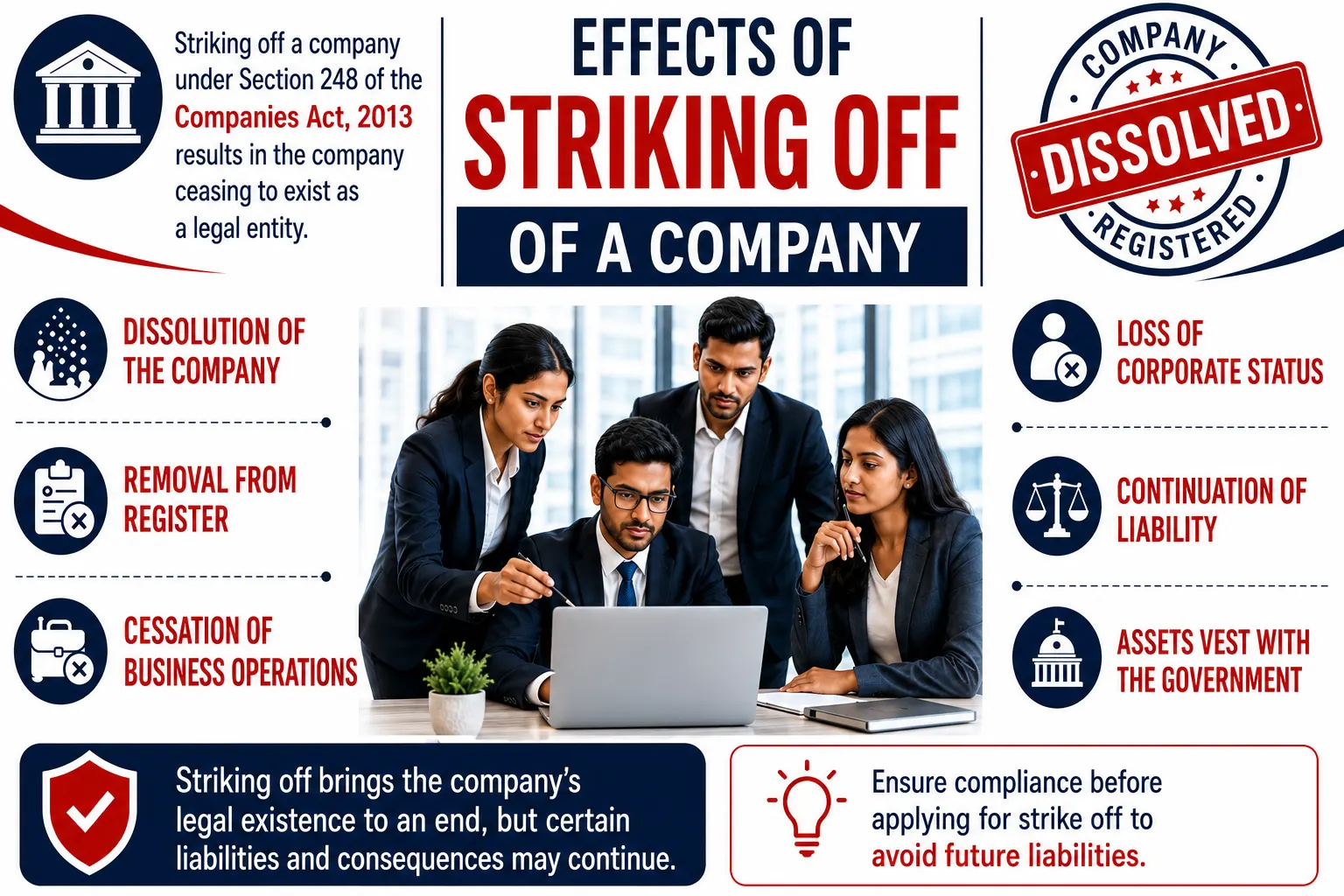
The striking off of a company under Section 248 of the Companies Act, 2013 results in the removal of the company's name from the Register of Companies maintained by the Registrar of Companies (ROC). Once the strike-off process is completed, the company ceases to exist as a legal entity. Here are the key effects of striking off of a company:
1. Dissolution of the Company: Upon publication of the final notice, the company stands dissolved and ceases to exist as a separate legal entity under the Companies Act, 2013.
2. Removal from the Register of Companies: The ROC removes the company's name from the Register of Companies, and the company is no longer recognised as an active registered company.
3. Cessation of Business Operations: After strike off, the company cannot carry on any business activities, enter into contracts, or undertake commercial transactions in its name.
4. Loss of Corporate Status: The company loses all rights and privileges associated with corporate existence, including the ability to sue, be sued, own property, or enter into legal agreements.
5. Continuation of Directors' and Officers' Liability: Strike off does not extinguish the liability of directors, officers, or members for acts, omissions, fraud, or statutory violations committed before dissolution. Any undisclosed or outstanding liabilities existing before strike off may still be enforced against the company, its directors, or other responsible persons in accordance with law.
6. Company's Assets Vest with the Government: Any property or assets of the company that remain undisposed of at the time of dissolution may vest in the Central Government as bona vacantia (vacant goods or ownerless property), subject to applicable legal provisions.
Can a Strike off Company be Revived?
A struck-off company can be revived or restored to the Register of Companies under Section 252 of the Companies Act, 2013. An application for restoration may be filed before the National Company Law Tribunal (NCLT) by the company, its members, creditors, workmen, or any aggrieved person if they can demonstrate that the company was carrying on business or was in operation at the time of strike off, or that restoration is otherwise just and equitable. The Registrar of Companies may also seek restoration if the company was struck off inadvertently or based on incorrect information. Upon satisfaction, the NCLT may order restoration of the company's name, after which the company is deemed to have continued in existence as if its name had never been struck off.
How Legal Babu can Help with the Strike off Process?
Striking off a company is a streamlined legal process for closing inactive or non-operational businesses in accordance with the Companies Act, 2013. However, the procedure involves multiple compliance requirements, document preparation, and coordination with the Registrar of Companies (ROC). At Legal Babu, we simplify the entire process by assisting with eligibility assessment, preparation of resolutions and supporting documents, filing of Form STK-2, and handling ROC-related formalities. Our experienced professionals ensure that all legal requirements are met accurately and efficiently, minimising the risk of delays or rejection.
With our expert support, businesses can achieve a hassle-free and compliant company closure
FAQS
Have some questions about Strike off of Company?
We have got you covered:
-
Is a strike-off certificate issued after the company is removed?
Yes. After approval, the Registrar publishes a final notice in Form STK-7, which serves as evidence of the company's dissolution.
- Can a company with a pending GST registration apply for strike off?
- Can a private limited company be struck off if it has never started business?
- Is the physical submission of documents required for strike off?
- Can foreign directors sign strike-off documents?
- Does strike off affect the DIN of directors?
- Can creditors object to a strike-off application?
- Is a statutory audit required before strike off?
- Can a company own intellectual property at the time of strike off?
- Can a strike-off application be withdrawn after filing?


