
Get a Hasslefree FCRA Registration for Your Organisation

If you are running a society, trust, or Section 8 company in India that intends to receive funds from foreign sources, obtaining FCRA Registration is the most important step towards legally accessing foreign contributions.
FCRA Registration is issued by the Ministry of Home Affairs (MHA) under the Foreign Contribution (Regulation) Act, 2010, as amended by the Foreign Contribution (Regulation) Amendment Act, 2020. It serves as the official authorisation for your organisation to receive and utilise foreign contributions.
FCRA Registration is not merely a government formality but a mandatory legal requirement for any organisation seeking to accept donations, grants, or contributions from foreign individuals, foreign companies, or international agencies. Without a valid FCRA Registration or Prior Permission, organisations are legally barred from receiving foreign contributions, and any such receipt may attract penal action under the Act.
At Legal Babu, we assist NGOs, trusts, and societies in completing the FCRA Registration process accurately and without delays, ensuring full compliance with the latest guidelines issued by the Ministry of Home Affairs.
Who Is Eligible For FCRA Registration?
FCRA Registration is open to any organisation engaged in cultural, economic, educational, religious, or social programmes. This includes:
-
Societies registered under the Societies Registration Act
-
Public Trusts registered under applicable Trust laws
-
Section 8 Companies registered under the Companies Act, 2013
-
Other associations having a definite cultural, economic, educational, religious, or social objective
The eligibility of an organisation is based on its existence, activity track record, and financial spending on its core objectives, as prescribed under the FCRA Rules, 2011 (as amended in 2022). There is no restriction on sector, provided the organisation is engaged in a permissible activity and is not prohibited under the Act.
FCRA Registration Routes
There are two routes through which an organisation may be authorised to receive foreign contributions. Only one route applies at a time, depending on the organisation's maturity and track record.
|
Route |
Applicable To |
Validity |
|
Normal Registration |
Organisations in existence for at least 3 years with a minimum spending of Rs. 15 lakh on core activities in the last 3 years |
5 years |
|
Prior Permission |
Newly formed organisations, or those not meeting the 3-year eligibility, seeking foreign contribution for a specific project from a specific donor |
Limited to the specific amount/project sanctioned |
Validity for FCRA Registration
FCRA Registration is valid for a period of 5 years from the date of grant.
An organisation must apply for renewal at least 6 months before expiry of the certificate. Failure to do so may cause the registration to lapse, barring the organisation from receiving further foreign contributions until renewal is granted.
FCRA vs 12A and 80G Registration
Many NGOs confuse FCRA Registration with 12A and 80G registration, but these serve entirely different purposes. 12A registration exempts an NGO's income from tax, while 80G registration allows donors to claim a tax deduction on donations made to the organisation, both apply to domestic funding and tax treatment. FCRA Registration, on the other hand, is not about taxation at all; it is the legal authorisation required specifically to receive foreign contributions. An NGO can hold 12A and 80G registration without having FCRA Registration, and vice versa, since each addresses a separate compliance requirement.
Eligibility for FCRA Registration
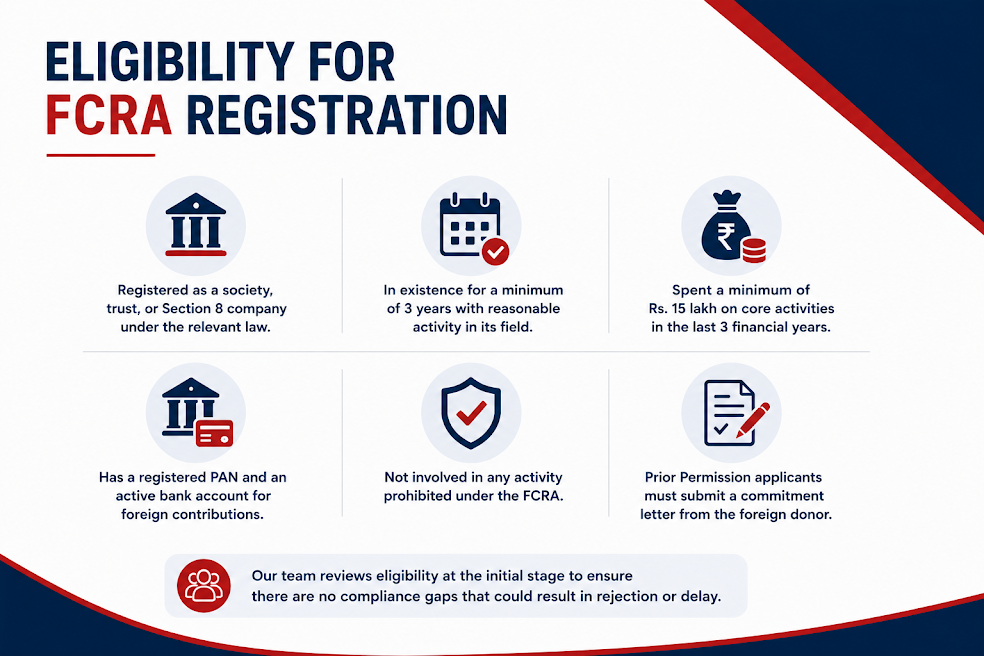
To apply for FCRA Registration, the applicant must fulfil the following basic conditions:
-
The organisation must be registered as a society, trust, or Section 8 company under the relevant law.
-
The organisation must have been in existence for a minimum of 3 years and undertaken reasonable activity in its chosen field.
-
The organisation must have spent a minimum of Rs. 15 lakh on its core activities during the last 3 financial years, excluding administrative expenditure.
-
The organisation must possess a registered PAN and an active bank account exclusively designated for foreign contributions.
-
The organisation, its office bearers, and key functionaries must not be involved in any activity prohibited under the FCRA, including activities affecting national security, sovereignty, or communal harmony.
-
An organisation seeking Prior Permission must furnish a commitment letter from the foreign donor specifying the amount and purpose of the contribution.
Our team reviews eligibility at the initial stage to ensure there are no compliance gaps that could result in rejection or delay.
Documents Required for FCRA Registration
Unlike self-declaration-based registrations, FCRA Registration requires detailed documentation and verification. The following must be readily available for accurate filing:
Organisation & legal documents
-
Registration certificate of the society, trust, or Section 8 company
-
Memorandum of Association / Trust Deed / Articles of Association
-
PAN card of the organisation
Compliance & activity records
-
Darpan ID issued by NITI Aayog (mandatory for application)
-
Audited financial statements and annual reports for the last 3 years
-
Details of activities undertaken and amount spent on core objectives
Banking & authorisation
-
Details of the designated FCRA bank account with State Bank of India, New Delhi Main Branch
-
Digital Signature Certificate (DSC) of the chief functionary
Governance details
-
Identity proof and details of all office bearers, key functionaries, and members of the governing body
At Legal Babu, we verify all documents thoroughly before submission to avoid mismatches that could lead to rejection or scrutiny by the Ministry of Home Affairs.
Fees for FCRA Registration
FCRA Registration involves a government fee of Rs.10,000 for normal or permanent registration payable at the time of filing the application on the FCRA portal, along with charges for the mandatory designated bank account and compliance certifications. The fee is non refundable and the registration is valid for 5 years and then you have to apply for renewal by paying a fee of Rs. 5,000.
Also, in case you want to receive funds from specific foreign sources, apart from you listed while registering, you need to seek prior permission from Govt. of India by paying an additional fee of Rs. 5,000
FCRA Registration Process — How We Help
Filing errors, such as incomplete activity details, mismatched financial figures, incorrect Darpan ID linkage, or inadequate supporting documentation can result in rejection, prolonged scrutiny, or field-level verification delays by the Ministry of Home Affairs.
As professional FCRA Registration consultants, Legal Babu manages the entire process on your behalf:
-
Assessing eligibility and identifying the correct route (Normal Registration or Prior Permission)
-
Assisting with Darpan ID registration, if not already obtained
-
Compiling and reviewing activity reports and audited financial statements
-
Coordinating opening of the designated FCRA bank account with SBI, New Delhi Main Branch
-
Filing Form FC-3A (Registration) or Form FC-3B (Prior Permission) accurately through the FCRA portal
-
Liaising with the Ministry of Home Affairs during scrutiny or field verification, if required
-
Downloading and sharing the final FCRA Registration certificate
Once completed, the FCRA Registration Certificate is issued in digital format, valid for 5 years, subject to timely renewal and continued compliance.
Benefits of FCRA Registration

Access to Foreign Funding
-
Legal Authorisation to Receive Foreign Contributions: Lawfully accept donations, grants, and contributions from foreign individuals, companies, and international agencies.
-
Access to International Donors and Foundations: Enter funding relationships with global foundations, multilateral agencies, and CSR programmes that mandate FCRA compliance.
-
Eligibility for Cross-Border Grants and Projects: Participate in collaborative international projects otherwise inaccessible without valid authorisation.
Legal & Regulatory Standing
-
Recognised Legal Status for Foreign Fund Utilisation: A clear legal framework for receiving, holding, and utilising foreign contributions, reducing regulatory risk.
-
Structured Compliance Framework: A defined reporting and audit structure that strengthens internal financial governance.
-
Protection From Regulatory Action: Organisations that maintain valid registration and file timely returns are shielded from suspension or cancellation proceedings.
Growth & Credibility
-
Enhanced Organisational Credibility: Official recognition of compliance standing, improving credibility with donors, government bodies, and international partners.
-
Stronger Positioning for Partnerships: Better positioned for long-term partnerships with foreign donors, embassies, and international NGOs requiring FCRA compliance as a due-diligence condition.
In short, FCRA-registered organisations are significantly better positioned to access foreign funding, build donor trust, and expand their developmental or charitable footprint internationally.
Post-Registration Compliance
After obtaining FCRA Registration, organisations must:
-
Maintain a separate designated FCRA bank account with SBI, New Delhi Main Branch, and route all foreign contributions exclusively through this account
-
File Annual Returns in Form FC-4 for every financial year, along with audited statements of foreign contribution received and utilised
-
Maintain separate books of accounts for foreign contributions, distinct from domestic funds
-
Report any change in name, address, registration, nature of activities, or key office bearers to the Ministry of Home Affairs
-
Apply for renewal at least 6 months before expiry of the 5-year validity period
-
Utilise foreign contributions strictly for the sanctioned purpose, and refrain from transferring funds to any unregistered person or organisation
Failure to file annual returns, maintain proper accounts, or comply with reporting obligations may result in suspension or cancellation of the FCRA Registration certificate.
FAQS
FAQ's on FCRA Registration in India
-
1. What is FCRA Registration?
FCRA Registration is the official authorisation granted to societies, trusts, and Section 8 companies in India to receive foreign contributions, issued by the Ministry of Home Affairs under the FCRA, 2010. It is mandatory for any organisation intending to lawfully accept funds from foreign sources.
- 2. Is FCRA Registration mandatory for NGOs?
- 3. What is the difference between FCRA Registration and Prior Permission?
- 4. Who can apply for FCRA Registration?
- 5. What documents are required for FCRA Registration?
- 6. Is there a fee for FCRA Registration?
- 7. How long does it take to obtain FCRA Registration?
- 8. Can FCRA Registration be cancelled or suspended?
- 9. What are the benefits of FCRA Registration for NGOs?
- 10. Can an organisation hold both FCRA Registration and Prior Permission?


