
Table of Content
- What is ISO 4437:2014 Plastic Piping System Certification?
- Who Requires ISO 4437:2014 Plastic Piping System Certification?
- What are the Key Principles of Quality Management in ISO 4437:2014 Plastic Piping System Certification?
- What are the Types of Polyethylene (PE) Pipes Covered Under ISO 4437:2014 Certification?
- What are the Key Requirements for ISO 4437:2014 Plastic Piping System Certification?
- Why Choose ISO 4437:2014 Certification?
- What are the Testing Requirements for ISO 4437:2014 Plastic Piping System Certification?
- What is the Process for Obtaining ISO 4437:2014 Plastic Piping System Certification?
- What is the Validity and Renewal Period of ISO 4437:2014 Certification?
- Why Choose Professional Assistance for ISO 4437:2014 Certification?
What is ISO 4437:2014 Plastic Piping System Certification?
ISO 4437:2014 plastic piping system certification is an international benchmark that outlines the requirements for polyethylene (PE) piping systems used for the supply of gaseous fuels. It establishes comprehensive criteria for polyethylene pipes, fittings, valves, and associated components to ensure their safe, reliable, and efficient performance in gas distribution networks.
ISO 4437:2014, effectively integrated with ISO 4427-1:2019 enables manufacturers to produce polyethylene piping systems that comply with international standards for both gas distribution and water supply applications. Compliance with ISO 4437:2014 demonstrates that the piping system meets internationally accepted safety and performance standards for gas transportation applications.
Who Requires ISO 4437:2014 Plastic Piping System Certification?
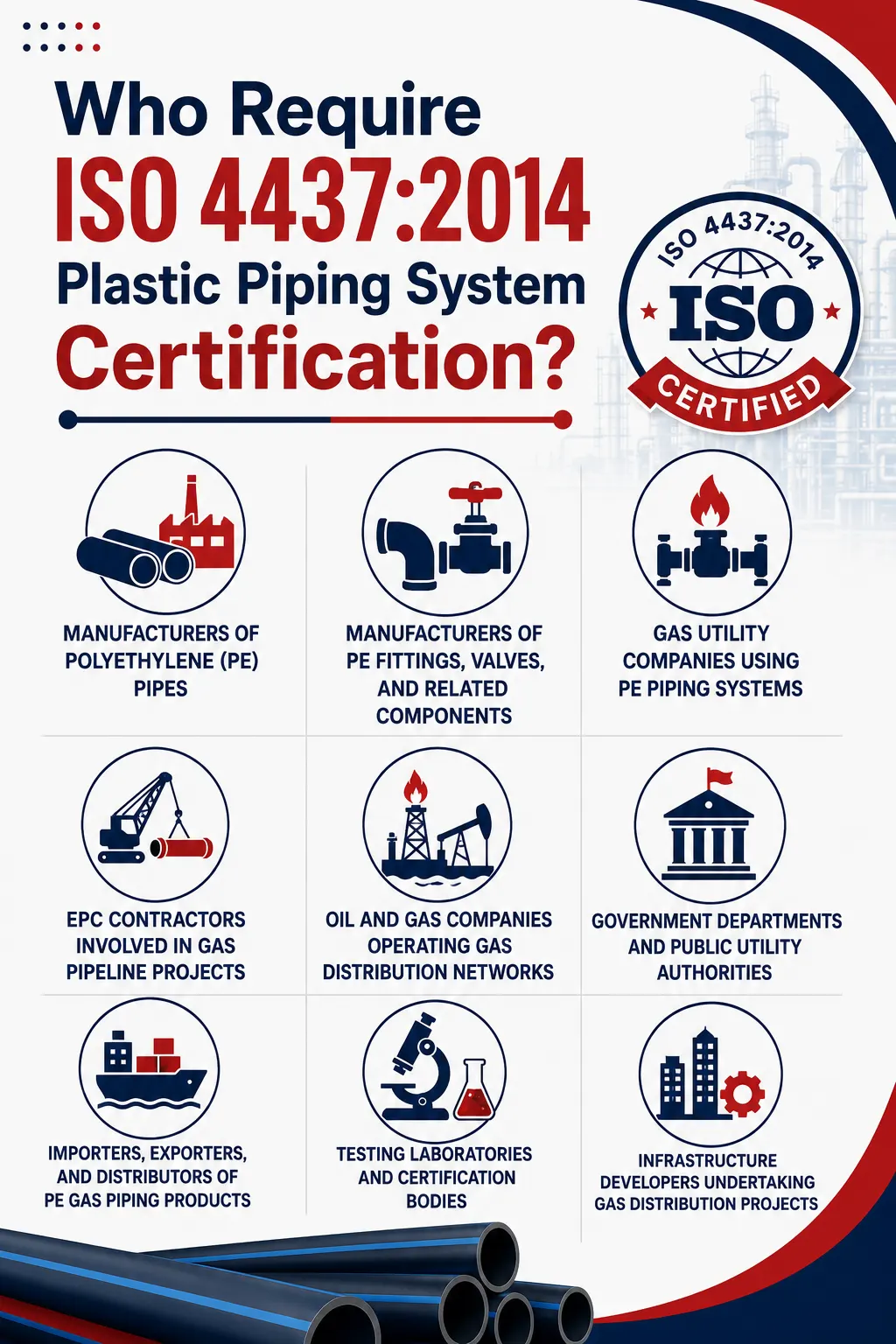
ISO 4437:2014 plastic piping system certification is required by organisations engaged in the manufacture, supply, installation, and procurement of polyethylene (PE) piping systems used for the distribution of gaseous fuels. It is particularly valuable for organisations seeking regulatory compliance, market acceptance, and enhanced customer confidence.
The following organizations typically require ISO 4437:2014 certification:
- Manufacturers of polyethylene (PE) pipes.
- Manufacturers of PE fittings, valves, and related components.
- Gas utility companies using PE piping systems.
- EPC contractors involved in gas pipeline projects.
- Oil and gas companies operating gas distribution networks.
- Government departments and public utility authorities.
- Importers, exporters, and distributors of PE gas piping products.
- Testing laboratories and certification bodies.
- Infrastructure developers undertaking gas distribution projects.
Obtaining ISO 4437:2014 certification helps these organisations demonstrate product quality, strengthen market credibility, satisfy regulatory and contractual requirements, and ensure the safe and reliable distribution of gaseous fuels.
What are the Key Principles of Quality Management in ISO 4437:2014 Plastic Piping System Certification?
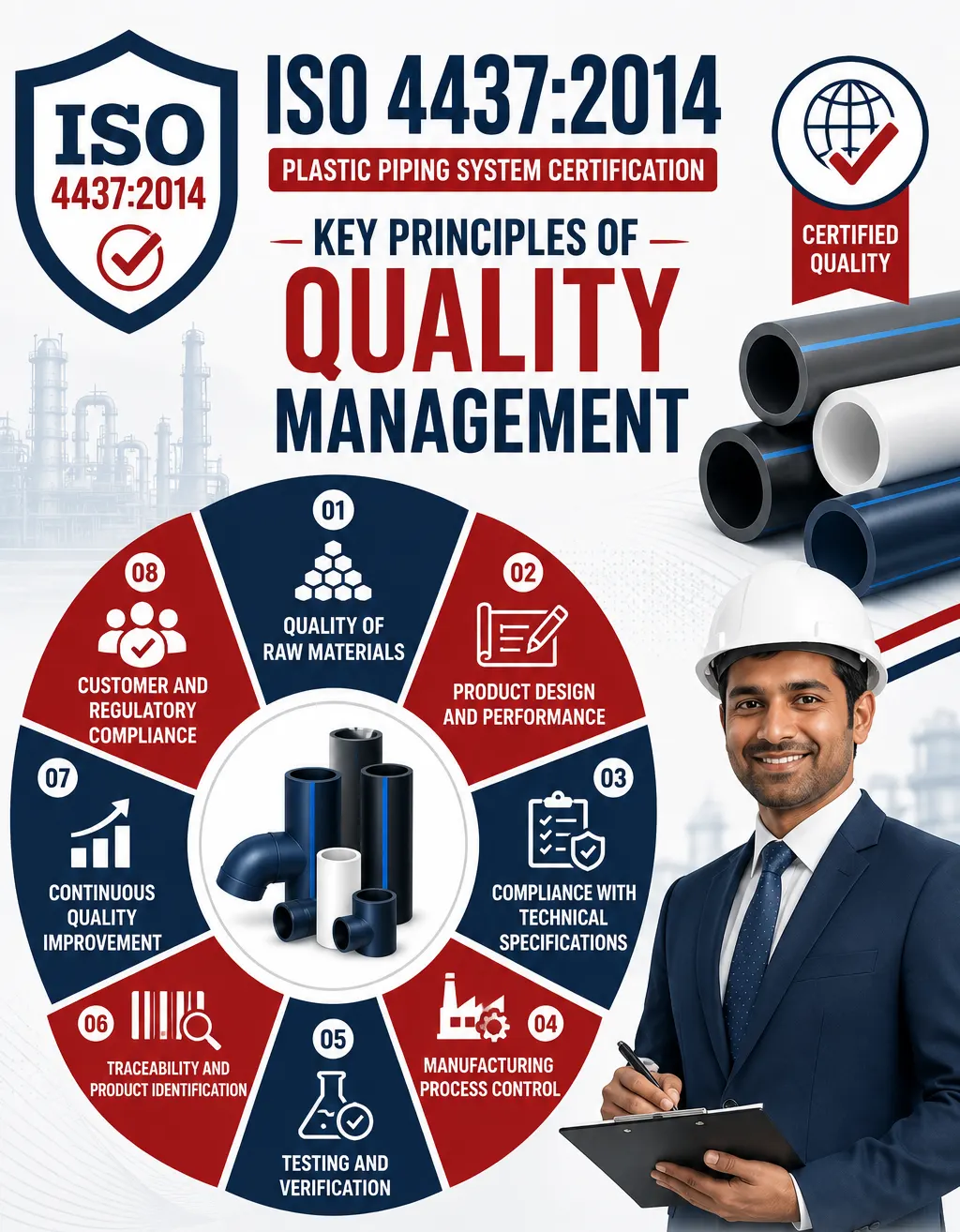
ISO 4437:2014 emphasises quality management principles that ensure polyethylene (PE) piping systems consistently meet safety, performance, and reliability requirements. These principles guide manufacturers in maintaining product conformity, minimizing defects, and delivering piping systems suitable for the safe distribution of gaseous fuels.
The key principles of quality management in Iso 4437:2014 certification are:
- Quality of Raw Materials: High-grade polyethylene materials must be used to ensure the piping system possesses the required strength, durability, and chemical resistance.
- Product Design and Performance: Pipes, fittings, and valves should be designed to withstand internal pressure, environmental stress, and service conditions while maintaining consistent performance throughout their intended lifespan.
- Compliance with Technical Specifications:Every component must conform to the dimensional, mechanical, and physical requirements prescribed by ISO 4437:2014 to ensure compatibility and safe operation.
- Manufacturing Process Control:Standardised manufacturing procedures and continuous process monitoring help maintain product consistency, reduce defects, and ensure compliance with quality requirements.
- Testing and Verification: Products should undergo comprehensive testing, including pressure, dimensional, and performance evaluations, to verify conformity with the standard before market release.
- Traceability and Product Identification: Proper marking and traceability systems enable manufacturers and end users to identify products, monitor quality, and facilitate corrective actions when necessary.
- Continuous Quality Improvement: Manufacturers should regularly evaluate production processes, incorporate technological advancements, and implement corrective measures to improve product quality and operational efficiency.
- Customer and Regulatory Compliance: Adhering to customer specifications and applicable regulatory requirements helps ensure market acceptance, legal compliance, and confidence in the safety of the piping system.
What are the Types of Polyethylene (PE) Pipes Covered Under ISO 4437:2014 Certification?
ISO 4437:2014 classifies polyethylene (PE) pipes based on the grade of polyethylene material used in their manufacture. Each PE grade offers different levels of strength, pressure resistance, and durability, making it suitable for specific gaseous fuel distribution applications. Here are the common types of polyethylene pipes covered under ISO 4437 Certification:
|
PE Pipe Type |
Description |
Application |
|
PE 80 Pipes |
Manufactured from PE 80 resin, these pipes provide good strength, flexibility, and resistance to environmental stress cracking. |
Low- to medium-pressure gas distribution networks and residential gas supply. |
|
PE 100 Pipes |
Made from high-performance PE 100 material with superior pressure resistance, durability, and long-term strength compared to PE 80. |
High-pressure gas distribution systems, industrial pipelines, and municipal gas networks. |
|
PE 100-RC Pipes |
Produced from PE 100 material with enhanced resistance to slow crack growth and point loading, making them suitable for demanding installation conditions. |
Trenchless installations, rocky soils, and areas with high mechanical stress. |
|
Single-Layer PE Pipes |
Pipes manufactured using a single homogeneous layer of polyethylene material that complies with ISO 4437:2014 requirements. |
Standard gas distribution and service pipelines. |
|
Multi-Layer PE Pipes |
Polyethylene pipes consisting of multiple layers designed to enhance mechanical performance, durability, or identification while maintaining compliance with the standard. |
Specialised gas distribution applications requiring improved performance characteristics. |
What are the Key Requirements for ISO 4437:2014 Plastic Piping System Certification?
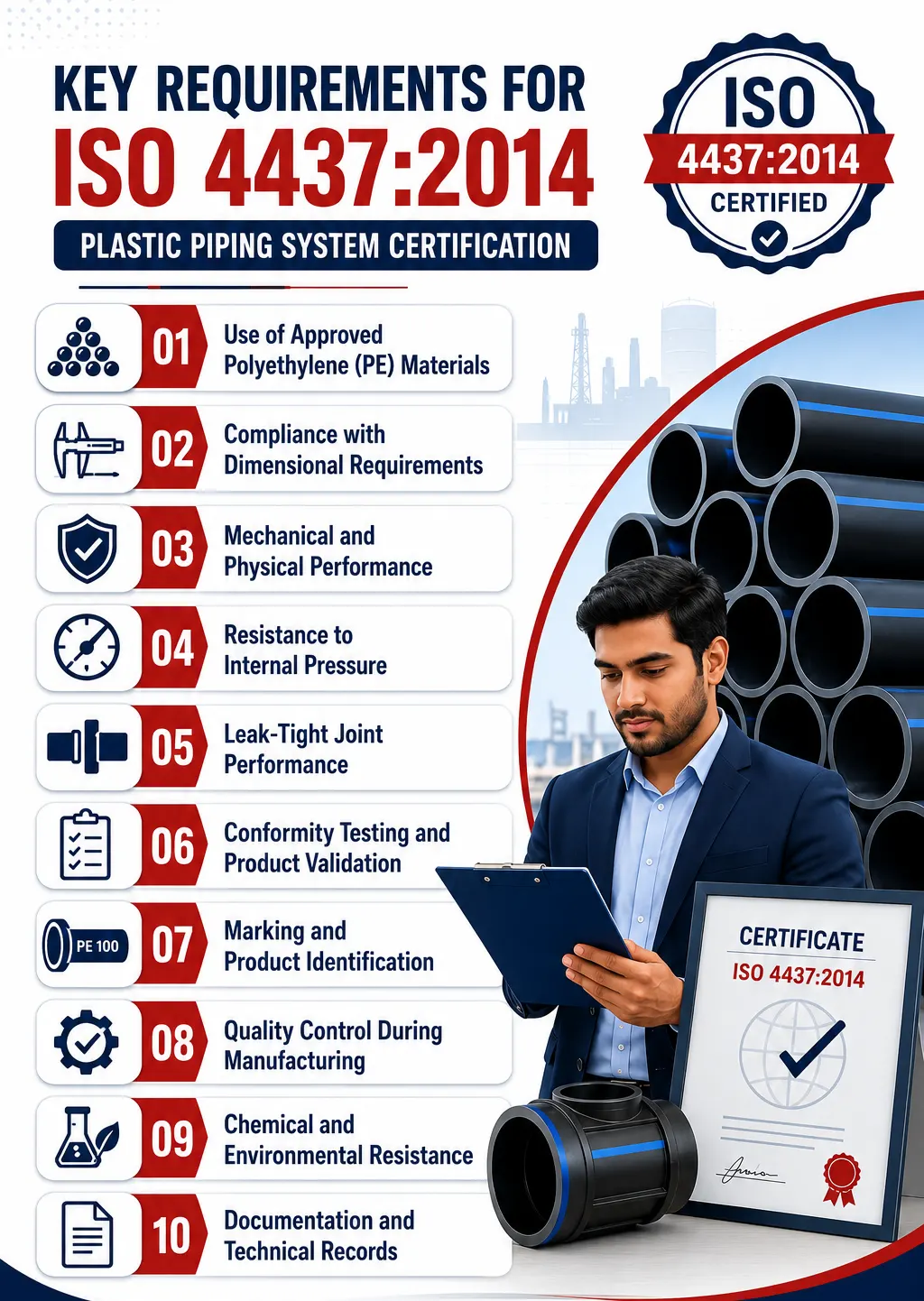
To obtain ISO 4437:2014 plastic piping system certification, manufacturers must ensure that their polyethylene (PE) piping systems comply with the technical, performance, and safety requirements prescribed by the standard. The following are the key requirements for achieving certification:
1. Use of Approved Polyethylene (PE) Materials:The piping system must be manufactured using polyethylene materials that meet the material specifications and performance criteria defined in ISO 4437:2014. The selected material should provide adequate strength, durability, and resistance to environmental and operational stresses.
2. Compliance with Dimensional Requirements: Pipes, fittings, and valves must conform to the specified dimensions, including outside diameter, wall thickness, tolerances, and Standard Dimension Ratio (SDR). Accurate dimensions ensure proper jointing, compatibility, and reliable system performance.
3. Mechanical and Physical Performance:The piping system must demonstrate adequate tensile strength, impact resistance, flexibility, and long-term hydrostatic performance. These properties ensure that the system can withstand internal pressure and external loading throughout its service life.
4. Resistance to Internal Pressure:Certified products must successfully withstand the specified internal pressure tests without leakage, bursting, or permanent deformation. This requirement verifies the pipe's ability to safely transport gaseous fuels under operating conditions.
5. Leak-Tight Joint Performance:Joints, fittings, and connections must provide a secure, leak-proof seal under normal operating conditions and pressure fluctuations. This requirement is essential for maintaining the safety and integrity of gas distribution networks.
6. Conformity Testing and Product Validation:Manufacturers must conduct all mandatory type tests, routine tests, and acceptance tests prescribed by ISO 4437:2014. Testing verifies that every product consistently complies with the standard's technical and performance requirements before being placed on the market.
7. Marking and Product Identification:Each certified pipe and component must be permanently marked with essential information such as the manufacturer's name or trademark, material designation, nominal dimensions, SDR, and production details. Proper marking ensures traceability and product identification.
8. Quality Control During Manufacturing:Manufacturers must implement effective quality control procedures throughout the production process. Regular inspections, process monitoring, equipment calibration, and documented quality records help ensure consistent product quality and compliance with the standard.
9. Chemical and Environmental Resistance:Polyethylene piping systems must be resistant to corrosion, chemical attack, weathering, and environmental stress cracking. This ensures reliable long-term performance, particularly in underground gas distribution installations.
10. Documentation and Technical Records: Manufacturers are required to maintain complete technical documentation, including material specifications, manufacturing records, test reports, inspection results, and quality control records. Proper documentation demonstrates conformity and supports certification audits and regulatory inspections.
Why You Should Choose ISO 4437:2014 Certification?
Choosing ISO 4437:2014 certification demonstrates a commitment to manufacturing polyethylene (PE) piping systems that meet internationally recognised standards for safety, quality, and performance in gaseous fuel distribution. The certification assures customers, regulators, and project stakeholders that the products have been designed, manufactured, and tested in accordance with stringent technical requirements. It enhances product reliability, minimises the risk of failures or gas leakage, and supports the long-term durability of gas distribution networks.
ISO 4437:2014 certification also strengthens a manufacturer's credibility, improves competitiveness in domestic and international markets, and facilitates participation in infrastructure and public procurement projects where compliance with recognised standards is often required. Additionally, it promotes consistent manufacturing practices, effective quality control, and regulatory compliance, enabling organisations to deliver dependable piping solutions while building customer confidence and expanding business opportunities.
What are the Testing Requirements for ISO 4437:2014 Plastic Piping System Certification?
ISO 4437:2014 plastic piping system certification requires polyethylene (PE) piping systems to undergo a series of tests to verify their safety, quality, durability, and performance. These tests ensure that the products comply with the technical requirements of the standard and are suitable for the safe distribution of gaseous fuels. Some of the key tests include:
|
Test |
Purpose |
|
Dimensions Test |
Verifies that the pipe meets the specified dimensions, wall thickness, tolerances, and Standard Dimension Ratio (SDR). |
|
Hydrostatic Pressure Test |
Evaluates the pipe's ability to withstand internal pressure without leakage or failure. |
|
Tensile Strength Test |
Assesses the mechanical strength of the polyethylene material to ensure structural reliability. |
|
Melt Flow Rate (MFR) Test |
Checks the flow characteristics of the polyethylene material to ensure manufacturing consistency. |
|
Density Test |
Confirms that the polyethylene material complies with the specified density requirements. |
|
Resistance to Slow Crack Growth Test |
Determines the pipe's resistance to crack initiation and long-term crack propagation. |
|
Rapid Crack Propagation (RCP) Test |
Assesses the pipe's ability to resist sudden crack propagation under pressurised conditions. |
|
Leak Tightness Test |
Ensures that pipes, fittings, and joints provide leak-free performance during operation. |
|
Fusion Joint Test |
Verifies the strength and integrity of butt-fusion and electrofusion joints. |
|
Oxidation Induction Time (OIT) Test |
Evaluates the material's resistance to thermal oxidation and long-term ageing. |
What is the Process for Obtaining ISO 4437:2014 Plastic Piping System Certification?
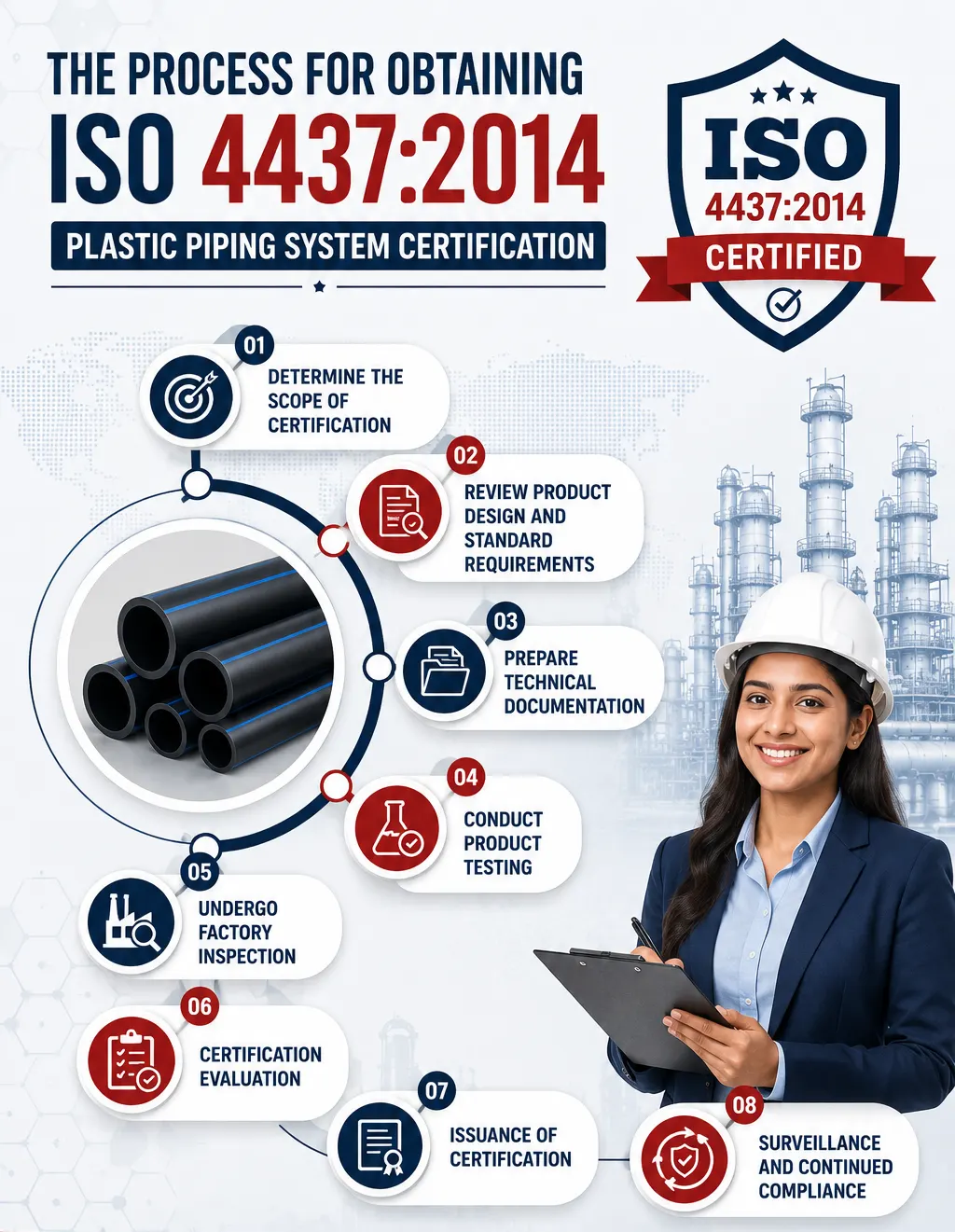
Obtaining ISO 4437:2014 plastic piping system certification involves a structured assessment process to verify that polyethylene (PE) piping systems comply with the standard's technical, safety, and performance requirements. The following steps outline the certification process:
1. Determine the Scope of Certification
The first step is to identify the polyethylene (PE) products that require certification, such as pipes, fittings, valves, or other components used in gaseous fuel distribution. Manufacturers should determine the applicable part of ISO 4437:2014 and define the product specifications, intended application, and operating conditions before initiating the certification process.
2. Review Product Design and Standard Requirements
Manufacturers should evaluate the product design, material specifications, manufacturing processes, and technical documentation against the requirements of ISO 4437:2014. Any non-conformities identified during this review should be addressed to ensure the products satisfy the standard's requirements before testing and certification.
3. Prepare Technical Documentation
Comprehensive technical documentation should be compiled, including product drawings, material specifications, manufacturing procedures, quality control records, inspection reports, and relevant technical data. Well-organised documentation enables the certification body to assess product conformity efficiently and supports traceability throughout the certification process.
4. Conduct Product Testing
Representative product samples are submitted to an accredited testing laboratory for evaluation. The products undergo mandatory tests, such as dimensional verification, hydrostatic pressure testing, mechanical performance, leak tightness, and other assessments specified in ISO 4437:2014 to demonstrate compliance with the standard.
5. Undergo Factory Inspection
The certification body may conduct an on-site inspection of the manufacturing facility to evaluate production processes, quality control systems, testing equipment, and inspection procedures. This assessment ensures that the manufacturer has adequate controls in place to consistently produce products that comply with ISO 4437:2014.
6. Certification Evaluation
After completing the product testing and factory inspection, the certification body reviews all technical documents, laboratory reports, and audit findings. If the products meet all applicable technical and quality requirements, the certification body confirms compliance with ISO 4437:2014 and proceeds with the certification decision.
7. Issuance of Certification
Once the evaluation is successfully completed, the certification body issues the ISO 4437:2014 plastic piping system certification. The certificate confirms that the certified products conform to internationally recognized requirements for quality, safety, and performance in gaseous fuel distribution applications.
8. Surveillance and Continued Compliance
Maintaining certification requires ongoing compliance with ISO 4437:2014. Manufacturers may be subject to periodic surveillance audits, routine product testing, and quality management reviews to ensure that certified products continue to meet the standard's technical and performance requirements throughout the certification period.
What is the Validity and Renewal Period of ISO 4437:2014 Certification?
ISO 4437:2014 certification is generally valid for three years, provided the certified products continue to comply with the requirements of the standard. During this period, manufacturers may be subject to periodic surveillance audits or product assessments to ensure ongoing compliance. Upon the expiry of the certification, manufacturers must apply for renewal by undergoing a reassessment, which typically includes product testing, documentation review, and factory inspection. Successful completion of the renewal process extends the certification for another three-year term.
Why Choose Professional Assistance for ISO 4437:2014 Certification?
Obtaining ISO 4437:2014 certification requires compliance with stringent technical specifications, product testing, quality assessments, and comprehensive documentation. Managing these requirements without expert guidance can be time-consuming and may lead to delays or non-conformities during the certification process. Professional assistance simplifies the entire procedure by ensuring that all technical, regulatory, and documentation requirements are fulfilled accurately and efficiently.
At Legal Babu we offer end-to-end support throughout the certification journey. Our experienced professionals facilitate a seamless certification process, helping manufacturers achieve ISO 4437:2014 certification in a timely manner while ensuring compliance with international quality and safety standards.
FAQS
Have some questions about ISO 4437:2014 Certification?
We have got you covered:
-
Can small manufacturers apply for ISO 4437:2014 certification?
Yes. Manufacturers of all sizes can apply, provided their products meet the technical, testing, and quality requirements of the standard.
- Does ISO 4437:2014 certification apply to both new and existing products?
- Can imported products obtain ISO 4437:2014 certification?
- Does ISO 4437:2014 certification cover accessories used in gas piping systems?
- Is ISO 4437:2014 certification recognised internationally?
- Can ISO 4437:2014 certification improve export opportunities?
- Can customised PE piping products obtain ISO 4437:2014 certification?
- Does ISO 4437:2014 certification require periodic product sampling?
- Can ISO 4437:2014 certification be suspended or withdrawn?
- Is factory production consistency important for ISO 4437:2014 certification?
- Can multiple product models be included under one ISO 4437:2014 certification?
- Does ISO 4437:2014 certification include environmental performance requirements?
- Can ISO 4437:2014 certification be used in government tenders?
- Does ISO 4437:2014 certification require regular calibration of testing equipment?
- Can ISO 4437:2014 certification increase customer confidence?
- What happens if a product fails the ISO 4437:2014 certification assessment?
- Can ISO 4437:2014 certification support long-term business growth?
- Does ISO 4437:2014 plastic piping system certification apply to underground gas distribution networks?
- Can ISO 4437:2014 plastic piping system certification help meet customer procurement requirements?
- Does ISO 4437:2014 certification require ongoing compliance after approval?


