
Get a Hassle-Free Startup India Registration for Your Business

If you have incorporated a new company, LLP, or partnership firm in India with an innovative product or service at its core, obtaining DPIIT Recognition under the Startup India programme is the most important step towards unlocking the full range of government benefits available to your enterprise. DPIIT recognition is a certificate issued by the Department for Promotion of Industry and Internal Trade, under the Ministry of Commerce and Industry, which formally labels your already-registered entity as a "startup" eligible for scheme benefits.
DPIIT recognition unlocks a 3-year income-tax holiday, faster patent and trademark filing, easier access to government tenders, and self-certification under labour and environmental laws. Without a valid DPIIT Recognition Certificate, your enterprise cannot access the funding schemes, tax exemptions, or compliance relaxations that the Startup India Action Plan provides.
At Legal Babu, we assist founders in completing the DPIIT Recognition process accurately and without delays, ensuring full compliance with the latest guidelines issued by the Ministry of Commerce and Industry.
Who Is Eligible for Startup India Registration?
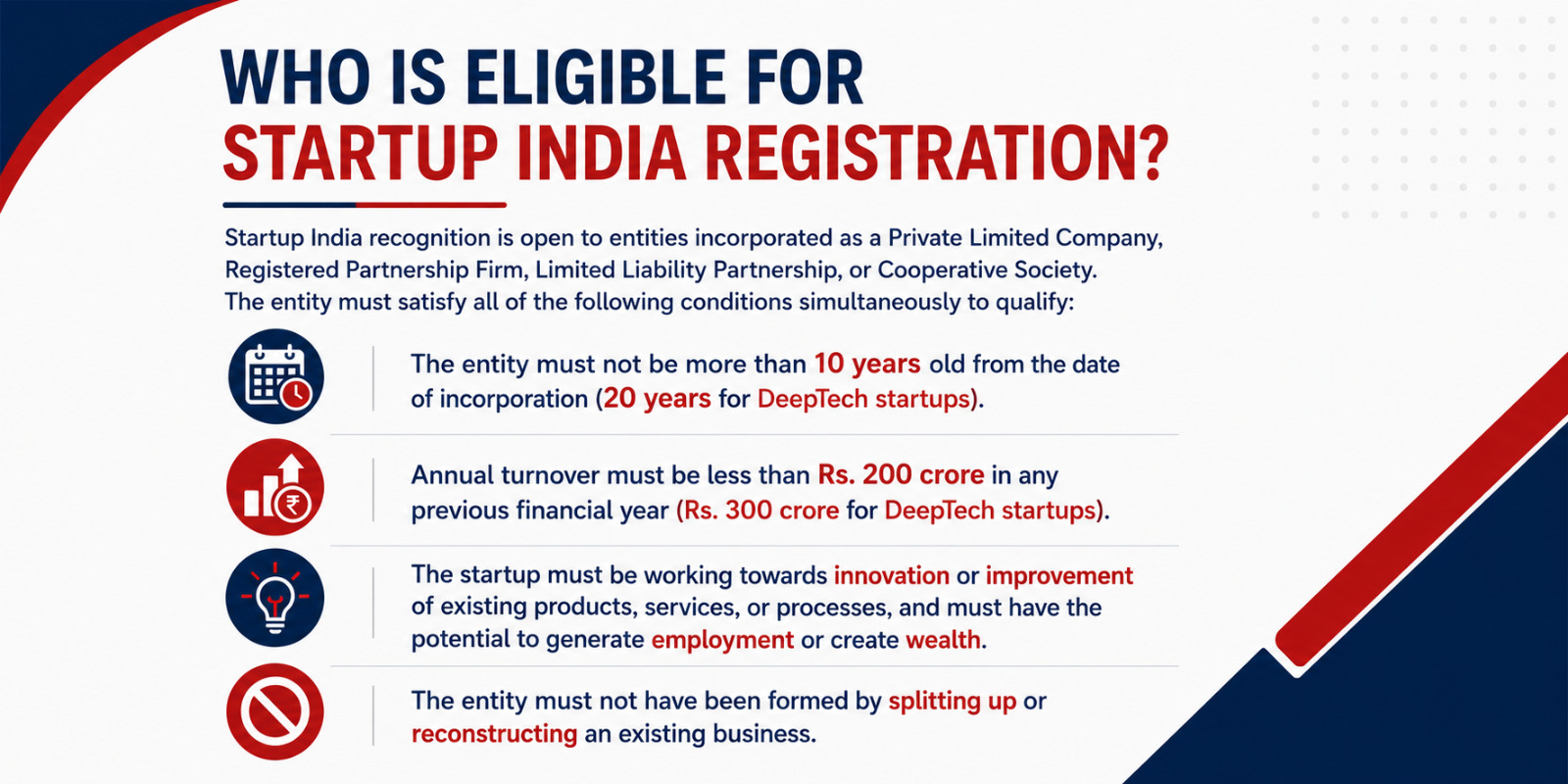
Startup India recognition is open to entities incorporated as a Private Limited Company, Registered Partnership Firm, Limited Liability Partnership, or Cooperative Society. The entity must satisfy all of the following conditions simultaneously to qualify:
- The entity must not be more than 10 years old from the date of incorporation (20 years for DeepTech startups).
- Annual turnover must be less than Rs. 200 crore in any previous financial year (Rs. 300 crore for DeepTech startups).
- The startup must be working towards innovation or improvement of existing products, services, or processes, and must have the potential to generate employment or create wealth.
- The entity must not have been formed by splitting up or reconstructing an existing business.
Startup India Classification and Recognition Criteria
Unlike Udyam Registration, Startup India does not classify enterprises into tiers. Instead, there is a single recognition status, DPIIT Recognition which applies to all qualifying startups regardless of size, sector, or stage. However, certain benefits such as the income tax holiday under Section 80-IAC are restricted to specific entity types.
|
Parameter |
Requirement |
|
Entity type |
Private Limited Company, LLP, Partnership Firm, or Cooperative Society |
|
Age of entity |
Up to 10 years from incorporation (20 years for DeepTech) |
|
Annual turnover |
Below Rs. 200 crore in any financial year |
|
Nature of business |
Innovation-led; scalable business model |
|
Reconstruction |
Must be an original entity, not a restructured existing business |
Validity of DPIIT Recognition
An entity shall be considered a startup for up to 10 years from the date of incorporation (20 years for DeepTech startups). Once the enterprise crosses the prescribed turnover threshold or exceeds the maximum age, it no longer qualifies as a startup under the Startup India programme and the recognition ceases to be valid for fresh benefit claims.
Eligibility Conditions in Detail
To apply for DPIIT Recognition, the applicant must satisfy the following conditions:
- The entity must already be incorporated or registered with the appropriate authority (MCA for companies and LLPs, Registrar of Firms for partnerships).
- The entity must be engaged in innovation-led activity, developing or improving a product, process, or service with a scalable model and potential for employment or wealth generation.
- FDI companies incorporated in India are eligible for Startup India recognition, provided the total shareholding of Indian promoters is 51% or more. Entities incorporated outside India, even with 100% Indian promoters, are not eligible.
- Only Private Limited Companies and LLPs are eligible for the Section 80-IAC income tax holiday. A registered partnership firm may obtain DPIIT recognition and access other benefits but cannot apply for the 80-IAC certificate.
- Each entity can hold only one DPIIT Recognition certificate, irrespective of the number of products, services, or activities it undertakes.
Our team reviews eligibility at the initial stage to ensure your entity type, incorporation date, turnover, and business description align with the DPIIT's requirements before submission.
Documents Required for Startup India Registration
DPIIT recognition is free, fully online, and takes only a few working days once your company is incorporated. The application is submitted through the National Single Window System (NSWS) at nsws.gov.in. The following documents and details must be ready at the time of filing:
- Certificate of Incorporation (for companies and LLPs) or Partnership Registration Certificate (for firms)
- PAN card of the entity and authorised signatory
- Memorandum of Association and Articles of Association (for Private Limited Companies), or LLP Deed (for LLPs)
- Brief description of the startup's innovation, product or service, and business model
- Pitch deck or business plan (recommended, not mandatory but significantly improves approval chances)
- Authority letter authorising the signatory to apply on behalf of the entity
- Website URL or video URL demonstrating the product or service (if available)
- At Legal Babu, we review all documentation and the startup's business description thoroughly before submission, to ensure the application meets DPIIT's innovation and scalability criteria and avoids the most common grounds for rejection.
Fees for Startup India Registration
The Ministry of Commerce and Industry does not charge any fee for the DPIIT Certificate of Recognition or Certificate of Eligibility for startups. There are no government fees applicable for applying, obtaining, or downloading the recognition certificate.
Professional assistance fees may apply when engaging a consultant to review eligibility, prepare the business description, compile documentation, and file the application. At Legal Babu, we offer transparent, fixed-fee professional assistance with no hidden charges, ensuring the process is completed accurately and with the strongest possible application.
Startup India Registration Process – How We Help
Although DPIIT Recognition is an online application process, the most common reason for rejection or delay is a weak or vague business description that does not clearly demonstrate innovation. Generic SaaS platforms, distribution businesses, and reseller models are routinely rejected. The application must demonstrate that the product or process is novel, technology-driven, and has clear employment or wealth-creation potential.
As professional Startup India consultants, Legal Babu manages the entire process on your behalf, which includes:
- Assessing eligibility based on entity type, age, turnover, and nature of business
- Preparing a compelling and DPIIT-compliant description of the startup's innovation and business model
- Compiling and verifying all required documents
- Filing the application through the NSWS portal
- Coordinating with the authorised signatory for OTP and declaration steps
- Downloading and sharing the final DPIIT Recognition Certificate
- Guiding you on the next step, applying for the Section 80-IAC income tax holiday, if applicable
Once submitted and approved, the startup receives a DPIIT Recognition Certificate within 2 to 7 working days.
Benefits of Startup India Registration
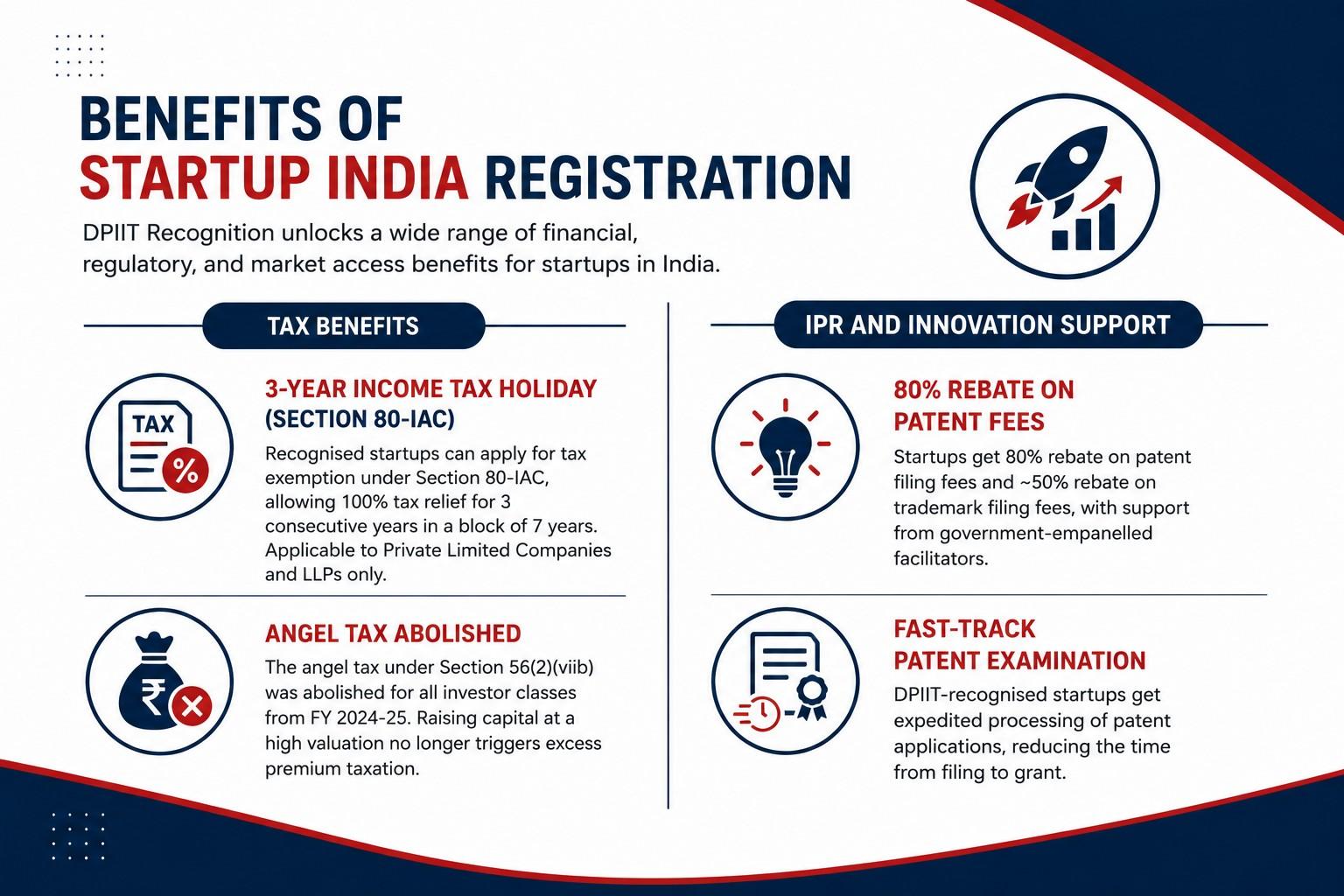
DPIIT Recognition unlocks a wide range of financial, regulatory, and market access benefits for startups in India.
Tax Benefits
3-Year Income Tax Holiday (Section 80-IAC)
Recognised startups can apply for tax exemption under Section 80-IAC, allowing them to claim 100% tax relief for 3 consecutive years in a block of 7 years. This benefit is available to Private Limited Companies and LLPs only.
Angel Tax Abolished
The angel tax provision under Section 56(2)(viib), which previously taxed share premium received above fair market value, was abolished for all investor classes from FY 2024-25 via the Union Budget 2024. This means raising capital at a high valuation no longer triggers excess premium taxation, a major relief for early-stage fundraising.
IPR and Innovation Support
80% Rebate on Patent Fees
Recognised startups receive an 80% rebate on patent filing fees and approximately a 50% rebate on trademark filing fees, with access to a panel of government-empanelled facilitators whose professional charges are borne by the government, the startup pays only the statutory fees.
Fast-Track Patent Examination
DPIIT-recognised startups benefit from expedited processing of patent applications, significantly reducing the time from filing to grant compared to the standard examination queue.
Compliance Relaxations
Self-Certification Under Labour and Environmental Laws
Recognised startups may self-certify compliance under nine different labour laws and three different environmental laws, substantially reducing the regulatory burden during the critical early years of operations.
No Tax Scrutiny for 3 Years
During the period of income tax exemption under Section 80-IAC, recognised startups are not subject to routine tax scrutiny assessments under the Income Tax Act, allowing founders to focus on growth without compliance distractions.
Funding Access
Credit Guarantee Scheme for Startups (CGSS)
With DPIIT recognition, startups can access the Credit Guarantee Scheme for Startups, which provides credit guarantees of up to Rs. 10 crore to SEBI-registered Alternative Investment Funds and lending institutions.
Fund of Funds (SIDBI)
SIDBI's Fund of Funds 2.0 is a Rs. 10,000 crore corpus fund that invests equity into Alternative Investment Funds, which in turn invest into startups. DPIIT recognition is a prerequisite for eligibility under this scheme.
Market Access and Procurement
Preference in Government Tenders
DPIIT-recognised startups are eligible for exemption from earnest money deposits while bidding on government tenders, reducing the upfront capital requirement for competing in public procurement.
GeM Portal Access
Recognised startups gain access to the Government e-Marketplace (GeM), providing a direct channel to sell products and services to government departments and public sector undertakings.
Enhanced Business Credibility
A valid DPIIT Recognition Certificate serves as official government acknowledgement of the startup's innovative status, improving its credibility with investors, large buyers, banks, and incubators.
Post-Registration Compliance
After obtaining DPIIT Recognition, enterprises must:
- Apply separately for the Section 80-IAC income tax exemption if eligible, recognition alone does not automatically confer the tax holiday
- Ensure the entity continues to meet the prescribed age and turnover thresholds throughout the recognition period
- Update the Startup India portal if there are changes to the entity's name, registered address, or authorised signatory
- Maintain accurate records of turnover, investments, and business activities for any future Inter-Ministerial Board evaluation
- File income tax returns and maintain GST compliance as required under the applicable tax laws
Failure to maintain accurate information on the portal or providing false details in the original application may result in cancellation of the DPIIT Recognition Certificate.
FAQS
Frequently Asked Questions on Startup India Registration
-
1. What is Startup India Registration?
Startup India Registration refers to obtaining DPIIT Recognition, a certificate issued by the Department for Promotion of Industry and Internal Trade under the Ministry of Commerce and Industry which officially recognises your incorporated entity as a "startup" under the Startup India programme. It is a free, online process submitted through the NSWS portal and is separate from and additional to the entity's incorporation or company registration.
- 2. Is Startup India Registration mandatory?
- 3. What is the difference between Startup India Registration and company registration?
- 4. Who can apply for Startup India Registration?
- 5. What documents are required for Startup India Registration?
- 6. Is Startup India Registration free of cost?
- 7. How long does it take to obtain DPIIT Recognition?
- 8. Can DPIIT Recognition be cancelled or rejected?
- 9. What are the tax benefits of Startup India Registration?
- 10. Can a startup hold more than one DPIIT Recognition?


