
 Every business in India operates within a web of vendors, contractors, and third-party suppliers. Whether you are a manufacturing company in Pune, a logistics firm in Delhi, or a technology startup in Bengaluru, the reliability and legal standing of your vendors directly determine your operational health and regulatory exposure. Yet, a surprising number of Indian businesses onboard vendors without conducting any structured evaluation - only to face GST input tax credit losses, labour law penalties, or supply chain disruptions down the line.
This is where supplier and vendor assessment services become not just useful, but essential. Supplier and vendor assessment services are structured processes that evaluate third-party partners across legal, financial, operational, and compliance parameters before you commit to a business relationship - and throughout the duration of it. They protect your business from the risks you cannot see until they become expensive problems.
At LegalBabu, we offer end-to-end supplier and vendor assessment services tailored specifically for the Indian regulatory environment. This guide explains what vendor assessment involves, why it matters under Indian law, how the process works, and what your business should be checking before it signs a single vendor contract.
What Are Supplier and Vendor Assessment Services?
Supplier and vendor assessment services refer to the systematic evaluation of third-party entities - suppliers, contractors, subcontractors, and service providers - to verify their legal compliance, financial stability, operational capacity, and alignment with contractual obligations.
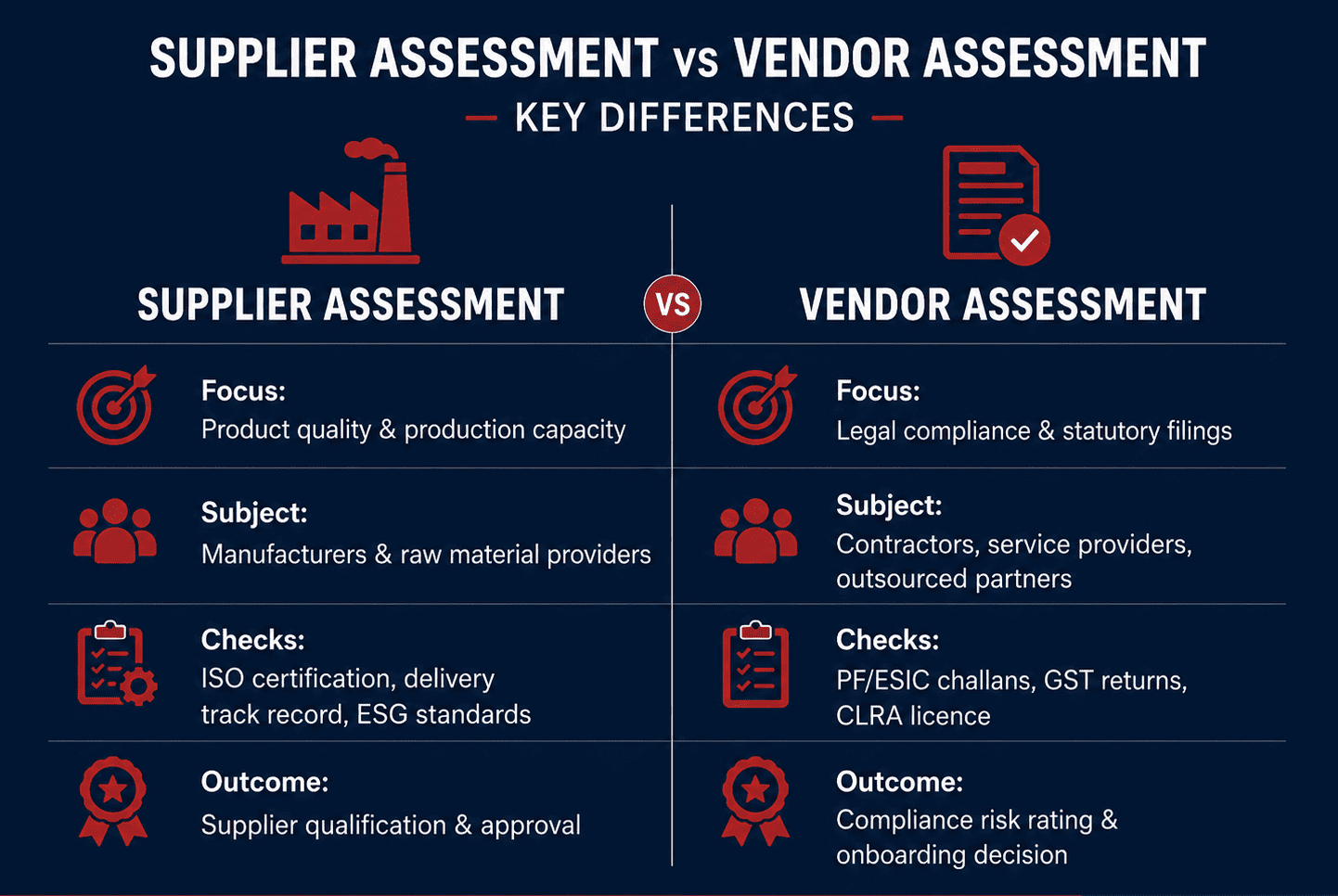
While the terms are often used interchangeably, there is a useful distinction:
|
Supplier Assessment |
Vendor Assessment |
|
|
Primary Focus |
Quality, production capacity, and delivery capability |
Legal compliance, statutory filings, contractual fit |
|
Typical Subjects |
Manufacturers, raw material providers |
Contractors, service providers, outsourced partners |
|
Key Parameters |
ISO certifications, quality systems, ESG |
PF/ESIC filings, GST returns, CLRA licence |
|
Outcome |
Supplier qualification and approval |
Compliance rating, risk classification |
Vendor assessment is typically conducted before entering into a formal business relationship - before awarding a contract, renewing a vendor agreement, or making a significant procurement commitment. Its core purpose is to help businesses make informed decisions about selecting vendors who can genuinely meet their operational requirements while minimising the legal, financial, and reputational risks that come with third-party dependency. In India's statutory environment, this pre-engagement evaluation is not a formality - it is a risk management imperative.
In practice, most professional supplier and vendor assessment services cover both dimensions together, producing a holistic picture of a third party's suitability. The depth of assessment depends on the vendor's risk tier - a critical infrastructure contractor warrants deeper scrutiny than a stationery supplier.
These services are relevant across company sizes. MSMEs, growing startups, mid-size manufacturers, and large enterprises all face statutory exposure from non-compliant vendors. The legal framework in India does not exempt small businesses from principal employer liability - a point many business owners discover only after receiving a government notice.
Why Supplier and Vendor Assessment Services Are Critical in India
India's legal environment places significant responsibility on the businesses that engage third parties. Understanding these obligations is fundamental to understanding why vendor assessment services in India have become a compliance priority - not merely a procurement best practice.
1. Principal Employer Liability Under the Contract Labour Act
Under the Contract Labour (Regulation and Abolition) Act, 1970, a principal employer - meaning the company that engages contractors - is directly and jointly liable if the contractor fails to pay wages, provide statutory benefits, or maintain required registers. If a vendor deploying contract workers at your facility defaults on minimum wage payments, the legal consequence falls on you. The contract does not protect you from this liability. Only prior vendor compliance audit work that confirms the vendor's track record can help you manage this exposure.
2. PF and ESIC Joint Liability
Under Section 8A of the Employees' Provident Funds and Miscellaneous Provisions Act, 1952, principal employers are responsible for ensuring that contractors contribute provident fund on behalf of their workers. If the contractor defaults, EPFO can recover dues from the principal employer. The same logic applies under the Employees' State Insurance Act, 1948, making ESIC registration verification of your contractors a business necessity, not optional diligence.
3. GST Input Tax Credit Exposure
Under the CGST Act, 2017, businesses can claim Input Tax Credit only when their vendor has filed accurate GSTR-1 and GSTR-3B returns and the corresponding ITC appears in their GSTR-2B. If a vendor fails to file returns or underreports supplies, your ITC claim becomes invalid - resulting in direct tax outgo with no recourse.
Vendor compliance audits in India now routinely include GST filing verification for this reason. GST registration and filing status checks form a core part of modern supplier assessment services in India.
4. Evolving Regulatory Environment
India's compliance landscape is changing rapidly. The four Labour Codes, which came into effect in November 2025, have revised wage definitions, social security contributions, and contractor obligations across all industries. The Digital Personal Data Protection Act, 2023, has brought data security obligations into vendor contracts involving IT and data service providers.
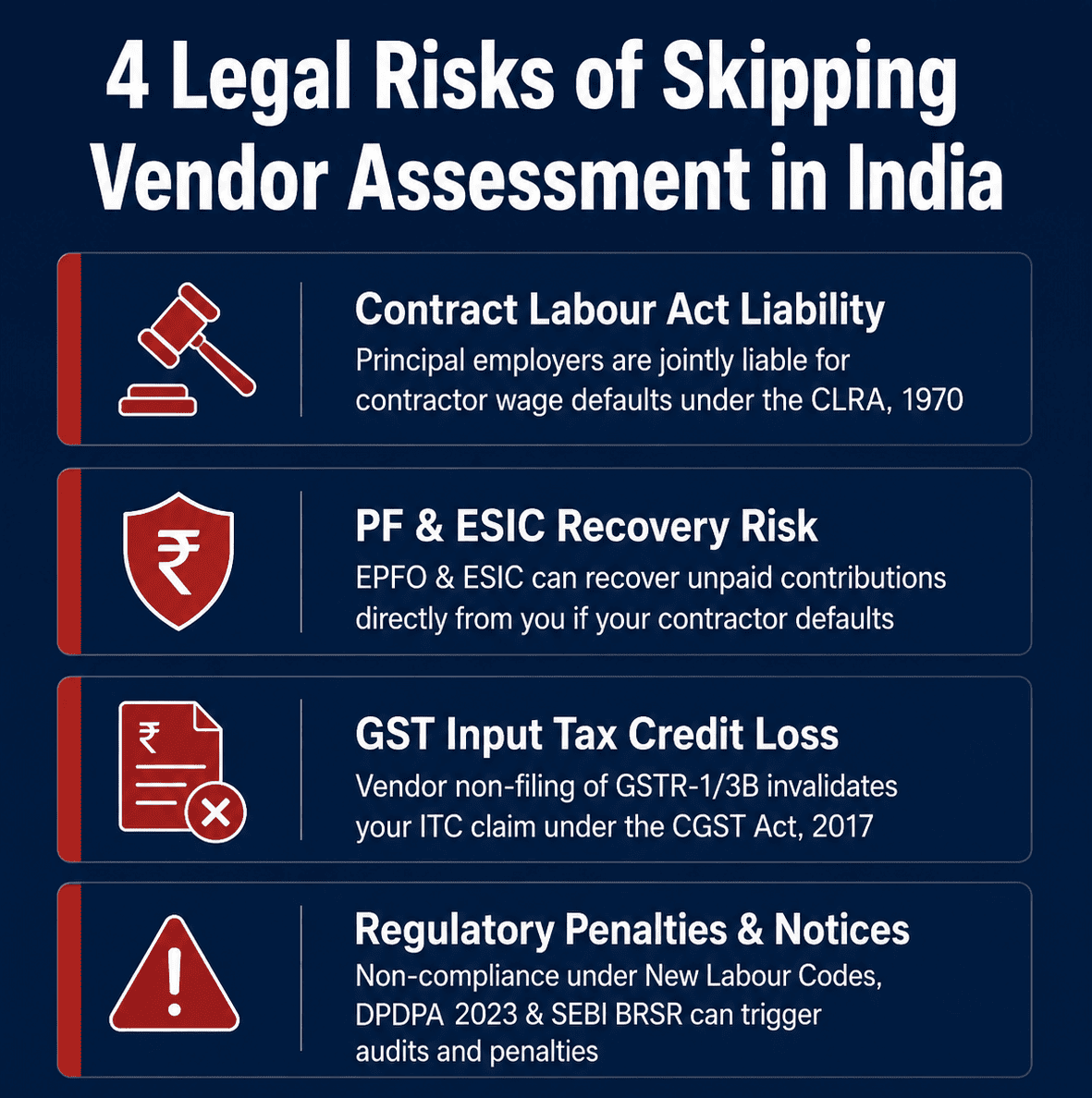
SEBI's Business Responsibility and Sustainability Reporting (BRSR) framework is increasingly requiring large listed companies to extend compliance disclosures down their supply chains. Businesses that do not conduct third-party vendor assessment regularly are operating with blind spots in a regulatory environment that is tightening, not loosening.
Key Parameters of Supplier and Vendor Assessment Services
Professional supplier and vendor assessment services evaluate vendors across multiple dimensions. The specific parameters applied depend on the vendor's industry, the nature of their engagement, and the risk tier assigned to them.
|
Assessment Parameter |
What Is Verified |
Governing Law / Standard |
|
GST Registration & Filing Status |
Valid GSTIN, GSTR-1, GSTR-3B filings, ITC reconciliation |
CGST Act, 2017 |
|
PF Compliance |
Registration, monthly ECR filings, paid challans |
EPF & MP Act, 1952 |
|
ESIC Compliance |
Registration, contribution receipts, and IP generation |
ESI Act, 1948 |
|
Contract Labour Licence (CLRA) |
Valid CLRA registration if engaging contract workers |
Contract Labour Act, 1970 |
|
Labour Law Registrations |
Shops & Establishments Act, Minimum Wages Act, wage registers |
State Labour Acts |
|
Corporate Legal Standing |
GST certificate, PAN, incorporation documents, trade licence |
Companies Act, 2013 |
|
Financial Stability |
Audited financials, credit history, and payment track record with other clients |
- |
|
Operational Capability |
Production capacity, delivery performance, and ISO certifications |
ISO 9001 standards |
|
Contractual Compliance |
SLA adherence, scope delivery, and pricing alignment |
Indian Contract Act, 1872 |
|
Data Security (IT Vendors) |
DPDPA compliance, cybersecurity policies, and data handling protocols |
|
|
ESG and Ethical Standards |
Labour practices, environmental compliance, and POSH policy |
SEBI BRSR; Factories Act, 1948 |
The depth at which each parameter is evaluated scales with the vendor's risk classification. A vendor with access to sensitive employee data, or one deploying large workforces at your site, warrants a significantly more thorough vendor risk assessment than a low-contact supply partner.
How Supplier and Vendor Assessment Services Work
Rather than a checklist exercise, effective supplier and vendor assessment services follow a structured, phased methodology. Here is how the process typically unfolds.
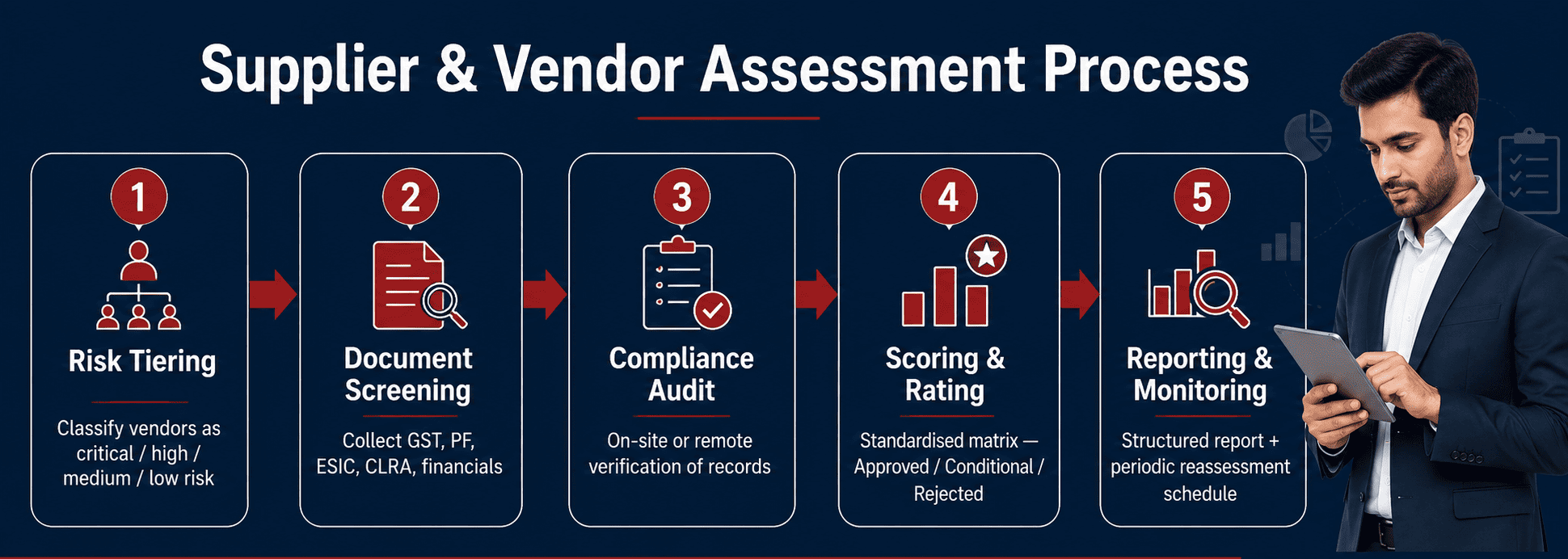
Phase 1 - Vendor Identification and Risk Tiering
The first step is to map your entire third-party ecosystem and classify each vendor by risk. A vendor providing critical components to your assembly line, a contractor deploying 200 workers at your facility, and a software provider with access to your HR data are all high-risk. A vendor supplying printed stationery is not. Risk tiering determines how deep the assessment goes and how frequently it is repeated.
Phase 2 - Document Collection and Initial Screening
This phase involves collecting statutory documents: GST registration certificate, PF registration and recent challans, ESIC registration and contribution receipts, CLRA licence (where applicable), labour licences, wage and attendance registers, incorporation documents, and audited financials. Initial screening flags obvious red flags, unregistered entities, lapsed licences, GST cancellation notices, or non-compliance defaults.
Phase 3 - On-Site or Remote Compliance Audit
For higher-risk vendors, an on-site or remote audit is conducted. Auditors verify headcount against wage registers, confirm that PF and ESIC are being paid for actual deployed workers, inspect working conditions under applicable factory or establishment laws, and cross-check financial documents against publicly available records where possible.
Phase 4 - Scoring, Evaluation, and Risk Rating
Vendors are scored on a standardised matrix across all assessed parameters. The output categorises vendors as approved, conditionally approved (with a remediation plan and timeline), or rejected. This scoring forms the basis of your vendor risk register.
Phase 5 - Reporting and Periodic Reassessment
A structured assessment report is delivered with risk ratings, specific findings, and recommended corrective actions. High-risk vendors are typically reassessed quarterly. Lower-risk vendors are reviewed annually or triggered by events such as a change in ownership, a significant contract extension, or an adverse compliance notice.
Scope of Vendor Audit Services
The scope of a vendor audit is not one-size-fits-all. At LegalBabu, our vendor audit services are tailored to the specific requirements of each engagement — the vendor's industry, the nature of their relationship with your business, and the risk tier they fall into. Depending on the assessment mandate, our audits may cover the following evaluations:
|
Audit Area |
What Is Evaluated |
|
Company Infrastructure Review |
Factory layout, equipment list, production lines, and storage conditions |
|
Manpower & Technical Capability |
Workforce skills, engineering team strength, supervision structure, and key personnel |
|
Quality Management System |
ISO certification status, QC procedures, calibration records, and inspection protocols |
|
Process Control & Manufacturing Capability |
Raw material handling procedures, in-process quality checks, and production traceability |
|
Past Performance & Client References |
Previously executed projects, client list, delivery history, and dispute track record |
|
Health, Safety & Environment (HSE) |
On-site safety practices, PPE usage compliance, incident records, and waste management |
|
Document Verification |
Statutory licences, certifications, financial documents, and test/inspection records |
The breadth of audit coverage is determined at the scoping stage, where vendor risk tier and business criticality drive the depth of each evaluation area. A manufacturing vendor supplying critical components will undergo a full infrastructure and process control audit, while a low-risk service vendor may require only document verification and financial screening.
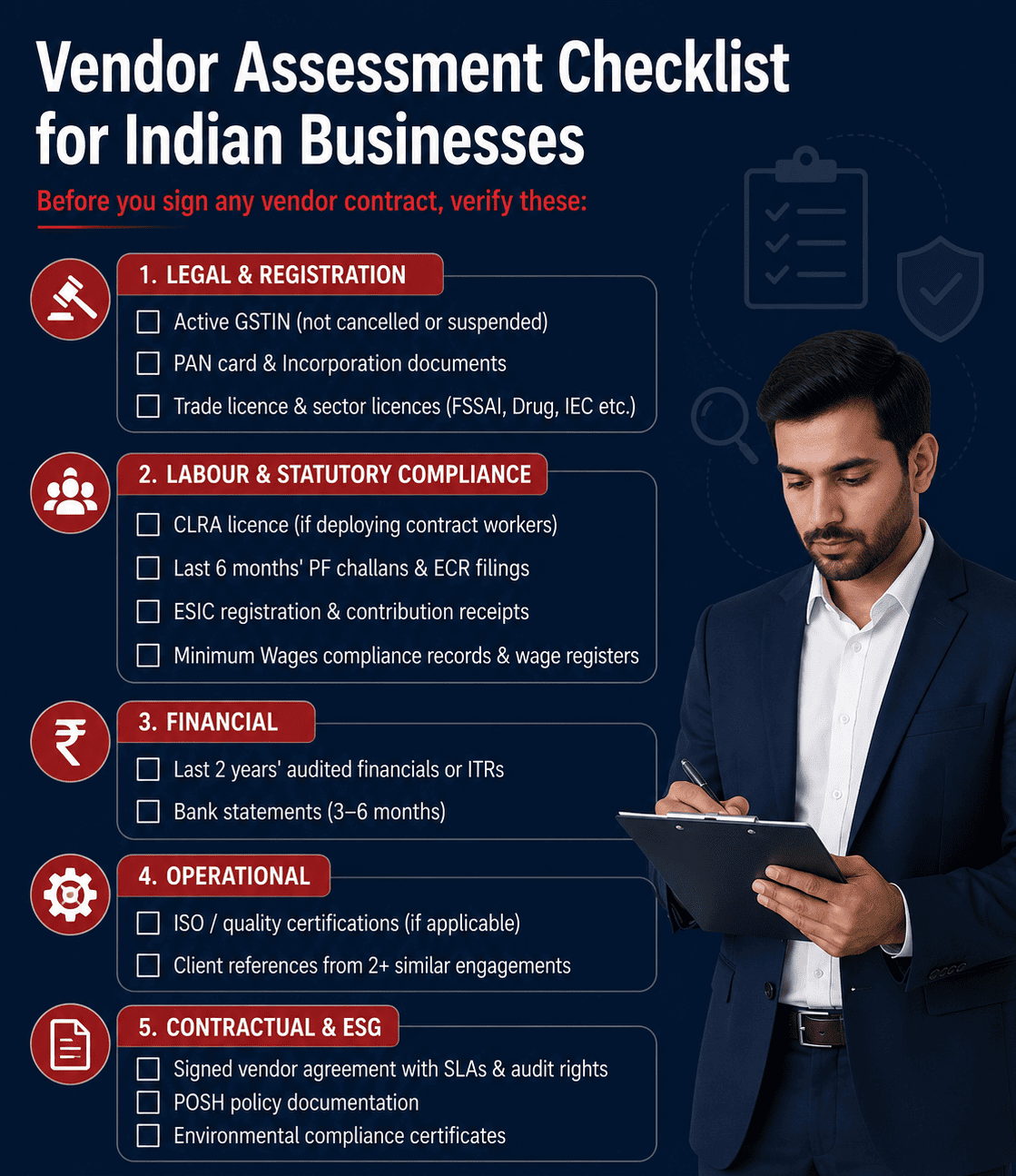
Supplier and Vendor Assessment Checklist for Indian Businesses
Use this checklist as a starting point for your vendor compliance audit framework. Document evidence should be collected for each item before any vendor is onboarded or a contract renewed.
Legal and Registration Documents
-
GST registration certificate (active, not cancelled or suspended)
-
PAN card and Certificate of Incorporation or registration
-
Trade licence and applicable sector licences (e.g., FSSAI licence, Drug Licence, IEC Code for importers/exporters)
Labour and Statutory Compliance Documents
-
Contract Labour (Regulation and Abolition) Act registration/licence - mandatory if the vendor deploys contract workers
-
Last six months' PF challans and ECR filings, verified against deployed headcount.
-
ESIC registration certificate and contribution receipts
-
Minimum Wages Act compliance records and wage registers
-
Attendance registers and overtime records
Financial Documents
-
Last two years' audited financial statements or Income Tax Returns
-
Bank statements for three to six months
-
Credit references or payment history from existing clients
Operational and Quality Documents
-
Quality certifications (ISO 9001, ISO 14001, or sector-specific standards where applicable)
-
Client references from at least two existing engagements of similar scope
Contractual and ESG Documents
-
Signed vendor agreement incorporating SLAs, compliance obligations, and audit rights
-
POSH policy documentation
-
Environmental compliance certificates under the Factories Act or applicable environmental regulations
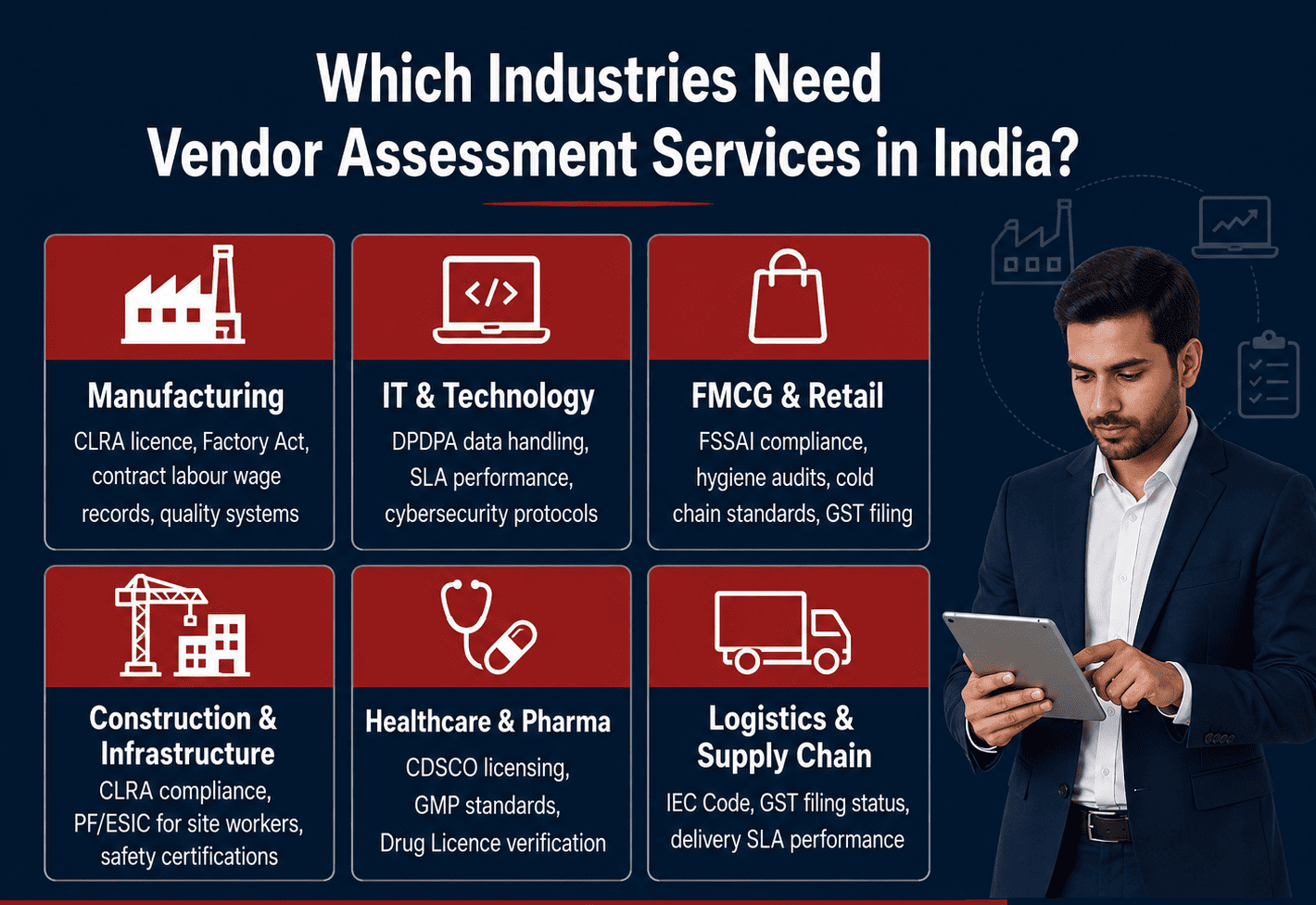
Industries That Benefit Most from Vendor Assessment Services in India
Supplier and vendor assessment services are particularly high-value for businesses operating in sectors where third-party dependency is high and regulatory exposure is significant.
|
Industry |
Primary Assessment Focus |
|
Manufacturing |
Factory Act compliance, CLRA licences, contract labour wage records, quality systems |
|
IT and Technology |
DPDPA data handling, cybersecurity protocols, SLA performance, subcontractor visibility |
|
FMCG and Retail |
FSSAI compliance, hygiene audits, cold chain standards, and GST filing verification |
|
Construction and Infrastructure |
CLRA compliance, EPF/ESIC for site workers, safety certifications |
|
Healthcare and Pharmaceuticals |
CDSCO licensing, GMP standards, drug licence verification, cold chain compliance |
|
Logistics and Supply Chain |
IEC Code Registration, GST filing status, delivery SLA performance, vehicle compliance |
The supplier evaluation process in India varies by sector, but the legal obligations - particularly those under PF, ESIC, CLRA, and GST - apply uniformly across all industries. Every company that engages third parties faces statutory exposure.
Supplier and Vendor Assessment Services at LegalBabu
LegalBabu's supplier and vendor assessment services are built for the Indian compliance framework. We do not apply generic global frameworks - our assessments are calibrated against Indian labour law, tax law, and sector-specific licensing requirements.
Our vendor audit services cover:
-
Document verification and statutory compliance screening (PF, ESIC, GST, CLRA)
-
Financial background checks and creditworthiness review
-
On-site and remote compliance audits
-
Risk-tiered scoring and structured vendor risk reports
-
Corrective action tracking and remediation support
-
Periodic reassessment and ongoing vendor monitoring
We work alongside LegalBabu's broader consulting practice, which includes due diligence services, labour law compliance, and M&A advisory, to give clients an integrated view of third-party risk alongside their wider business compliance picture. Whether you are onboarding a new contractor fleet, preparing for a significant procurement decision, or building a vendor compliance programme from scratch, our team delivers structured, actionable assessments.
Protect your business from third-party risk. Talk to LegalBabu's expert consultants today. Contact LegalBabu
Conclusion
Your supply chain is only as strong as the vendors within it. In India's regulatory environment - where principal employer liability, GST ITC exposure, and evolving labour codes create real financial and legal consequences - conducting structured supplier and vendor assessment services is no longer a sophisticated enterprise activity. It is a foundational business requirement for any company that relies on third parties.
Effective vendor assessment services in India protect you from statutory penalties, preserve your input tax credit, shield your brand from reputational damage linked to non-compliant contractors, and give your procurement decisions a defensible, documented basis. The cost of a structured vendor compliance audit is a fraction of the liability it prevents.
LegalBabu's supplier and vendor assessment services are built around India's actual legal framework - not generic checklists. From first-time vendor onboarding to periodic reassessment of your entire contractor network, our team delivers the compliance assurance your business needs to grow confidently.
Ready to secure your vendor relationships?
Contact LegalBabu to speak with our expert team today.
FAQS
FAQs About Supplier and Vendor Assessment Services
-
What is the difference between supplier assessment and vendor assessment services?
Supplier assessment focuses primarily on a third party's operational and quality capabilities - their ability to deliver the right product at the right quality and time. Vendor assessment focuses on legal and statutory compliance - whether the third party meets its obligations under PF, ESIC, GST, labour laws, and the contract terms. Professional supplier and vendor assessment services combine both into a single evaluation framework, giving businesses a complete picture before and during the engagement.
- Why are supplier and vendor assessment services important for Indian businesses?
- What documents are typically checked during a vendor compliance audit in India?
- Is a principal employer legally liable if a contractor defaults on PF or ESIC contributions?
- How often should a vendor compliance audit be conducted?
- What happens if a vendor fails the supplier and vendor assessment?
- Does vendor assessment include GST compliance verification?
- Are MSMEs and startups also required to conduct vendor assessments?
- What is the role of the Contract Labour Act in vendor compliance in India?
- How can LegalBabu help with supplier and vendor assessment services?


