
Professional Tax filing is a state-level compliance process, not a single central return. An employer may have to deduct tax from salary, deposit it and file a return, while a self-employed person or business may need separate enrolment and an annual payment.
The rules depend on the place of work, business presence, taxpayer category and state law. Businesses should therefore maintain professional tax alongside small-business accounting records rather than copy one state's calendar across every location.
What is Professional Tax Filing in India?
Professional tax is imposed by a state or authorised local body on professions, trades, callings and employment. Article 276 of the Constitution permits this levy and limits the total amount payable for one person to ₹2,500 a year.
Professional Tax filing can involve four separate actions: registration or enrolment, salary deduction, payment through a challan, and submission of a return. Not every taxpayer performs all four. It is also different from income tax return filing, which is governed centrally.
Because professional tax in India is decentralised, the responsible authority, certificate, slab and filing cycle must be checked for each location.
Who Must Register for Professional Tax?
Check liability when you employ people, start a profession or trade, open an office, or add staff in another state. The applicable law may cover companies, LLPs, firms, proprietors, professionals, contractors and other listed persons once the relevant threshold or category is met.
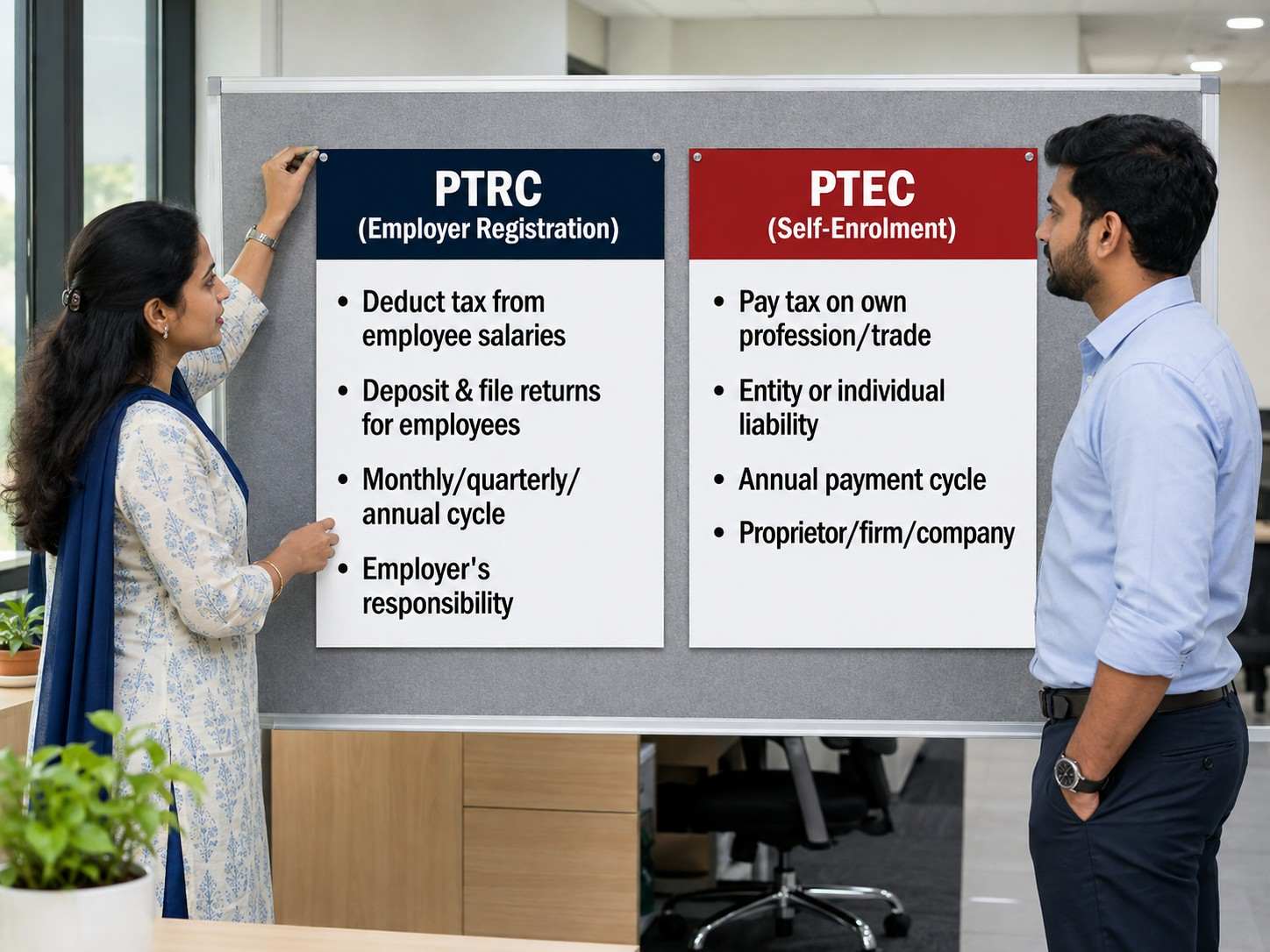
PTRC and PTEC Difference in India
|
Registration type |
Main purpose |
Usual responsibility |
|
Employer registration, often called PTRC |
Deduct, deposit and report tax for liable employees |
Employer |
|
Enrolment, often called PTEC |
Pay tax on one's own profession, trade or entity status |
Enrolled person or entity |
PTRC registration and PTEC registration are widely used terms, especially in Maharashtra, but other states may use different certificate names. A liable entity can require both. The MAHAGST PT registration facility, for example, provides separate and combined routes.
First confirm the entity type. A sole proprietorship, partnership firm, limited liability partnership, One Person Company and private limited company have different constitutional records, even where their PT obligations are similar. LegalBabu's guide to types of business entities can help identify the correct record set.
State-Wise Professional Tax Registration, Return and Payment Rules
The following table gives the broad FY 2026–27 position. It is a compliance map, not a substitute for the latest state schedule, municipal notification or certificate-specific due date.
|
State or UT |
Professional tax payable |
Broad filing and payment model |
|
Andhra Pradesh |
Salary up to ₹15,000: Nil; ₹15,001 to above ₹20,000: ₹150–₹200 per month |
Employer compliance is generally monthly; enrolled persons follow the notified annual cycle |
|
Assam |
Salary up to ₹15,000: Nil; ₹15,001 to ₹25,000 and above: ₹180–₹208 per month |
Employer deduction, remittance and state-prescribed return cycle |
|
Bihar |
Annual income up to ₹3 lakh: Nil; above ₹3 lakh to above ₹10 lakh: ₹1,000–₹2,500 per year |
Mainly annual assessment and payment |
|
Chhattisgarh |
Nil from 1 April 2011 |
No current employee deduction, return or payment requirement |
|
Gujarat |
Salary up to ₹12,000: Nil; above ₹12,000: ₹200 per month |
Administered through designated municipal or local authorities |
|
Jharkhand |
Annual salary up to ₹3 lakh: Nil; above ₹3 lakh to above ₹10 lakh: ₹1,200–₹2,500 per year |
State registration with notified periodic returns and payments |
|
Karnataka |
Salary below ₹25,000: Nil; ₹25,000 and above: ₹200 per month and ₹300 in February |
Employer compliance is periodic; enrolled persons generally pay annually |
|
Kerala |
Half-yearly income below ₹12,000: Nil; ₹12,000 to ₹1.25 lakh and above: up to ₹120–₹1,250 per half-year |
Local-body administration, generally half-yearly |
|
Madhya Pradesh |
Annual salary up to ₹2.25 lakh: Nil; above ₹2.25 lakh to above ₹4 lakh: ₹1,500–₹2,500 per year |
Employer deduction and state-prescribed periodic compliance |
|
Maharashtra |
Men: Up to ₹7,500 Nil; above ₹7,500: ₹175–₹200 per month, with ₹300 in February for the highest slab. Women: Up to ₹25,000 Nil; above ₹25,000: ₹200 per month and ₹300 in February |
PTRC applies to employer returns and payment; PTEC enrolment is separate |
|
Manipur |
Annual salary up to ₹50,000: Nil; above ₹50,000 to above ₹1.25 lakh: ₹1,200–₹2,500 per year |
State-notified registration and annual payment cycle |
|
Meghalaya |
Annual income up to ₹50,000: Nil; above ₹50,000 to above ₹5 lakh: ₹200–₹2,500 per year |
Annual income-based liability with prescribed employer compliance |
|
Mizoram |
Salary up to ₹5,000: Nil; above ₹5,000 to above ₹20,000: ₹75–₹208 per month |
Monthly payment or the permitted annual lump-sum option |
|
Nagaland |
Salary up to ₹4,000: Nil; above ₹4,000 to ₹12,000 and above: ₹35–₹208 per month |
State-notified registration, return and payment cycle |
|
Punjab |
₹200 per month for persons covered by the Punjab State Development Tax Act |
Separate employer and self-liability compliance under the 2018 law |
|
Puducherry |
Half-yearly income below ₹1 lakh: Nil; ₹1 lakh to above ₹5 lakh: ₹250–₹1,250 per half-year |
Local-authority administration, generally half-yearly |
|
Sikkim |
Salary up to ₹20,000: Nil; above ₹20,000 to above ₹40,000: ₹125–₹200 per month |
Employer deduction with periodic remittance |
|
Tamil Nadu |
Greater Chennai: Half-yearly income up to ₹21,000: Nil; above ₹21,000 to above ₹75,000: ₹180–₹1,250 per half-year |
Local-body rules apply; rates can differ between corporations, municipalities and panchayats |
|
Telangana |
Salary up to ₹15,000: Nil; ₹15,001 to above ₹20,000: ₹150–₹200 per month |
Employer return and remittance are generally monthly |
|
Tripura |
Salary up to ₹7,500: Nil; above ₹7,500 to above ₹15,000: ₹150–₹208 per month |
State-prescribed periodic deduction, return and payment |
|
West Bengal |
Salary up to ₹10,000: Nil; above ₹10,000 to above ₹40,000: ₹110–₹200 per month |
Periodic employer compliance with separate annual enrolment payment |
|
Odisha |
Nil from 1 April 2026 |
No new liability; earlier returns, assessments, notices and arrears remain preserved |
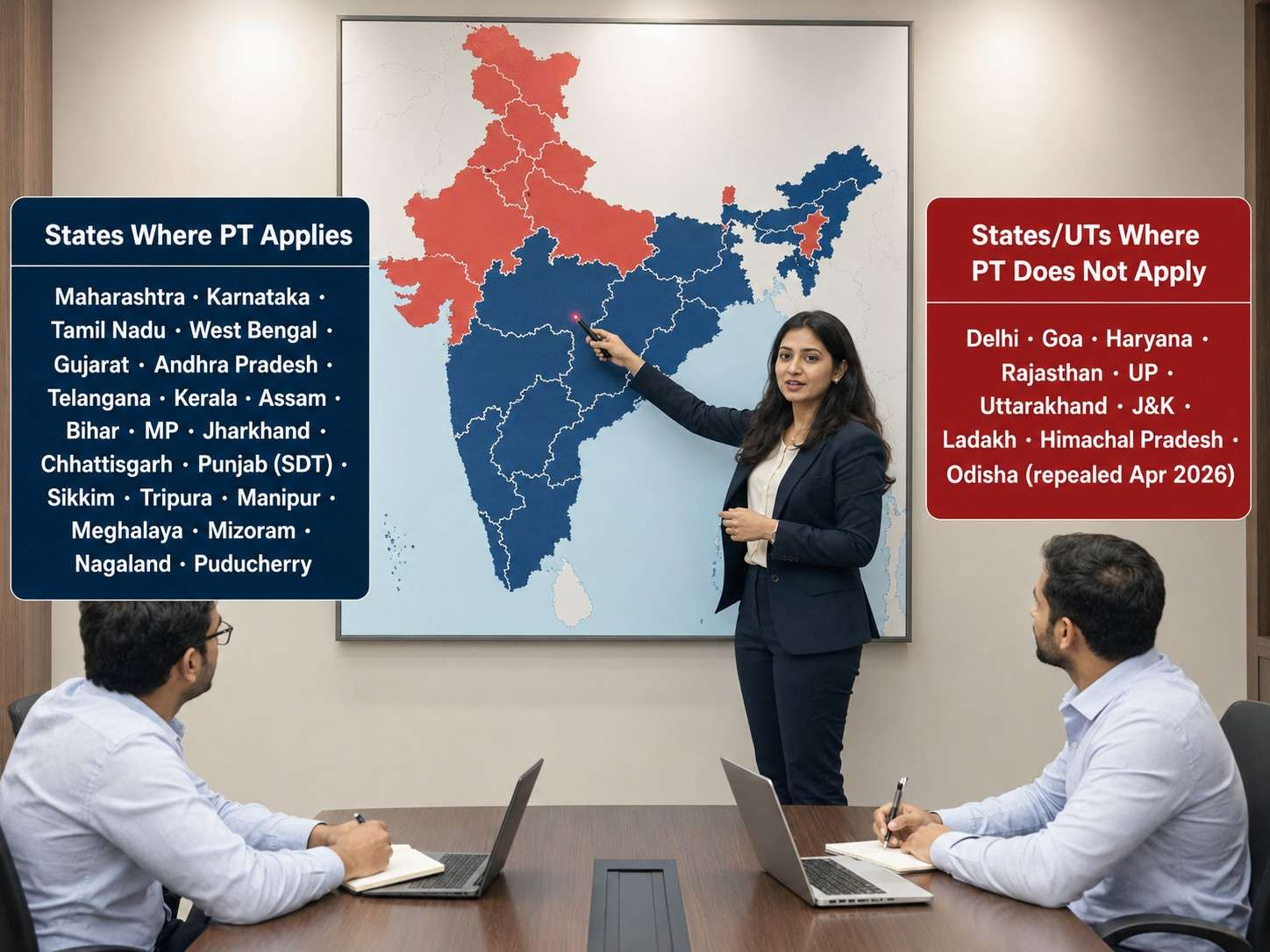
No general professional-tax levy currently applies in Delhi, Goa, Haryana, Himachal Pradesh, Rajasthan, Uttar Pradesh, Uttarakhand, Arunachal Pradesh, Jammu and Kashmir, Ladakh and most other Union Territories. Recheck this position before onboarding staff because state and local rules can change.
What Documents Are Required?
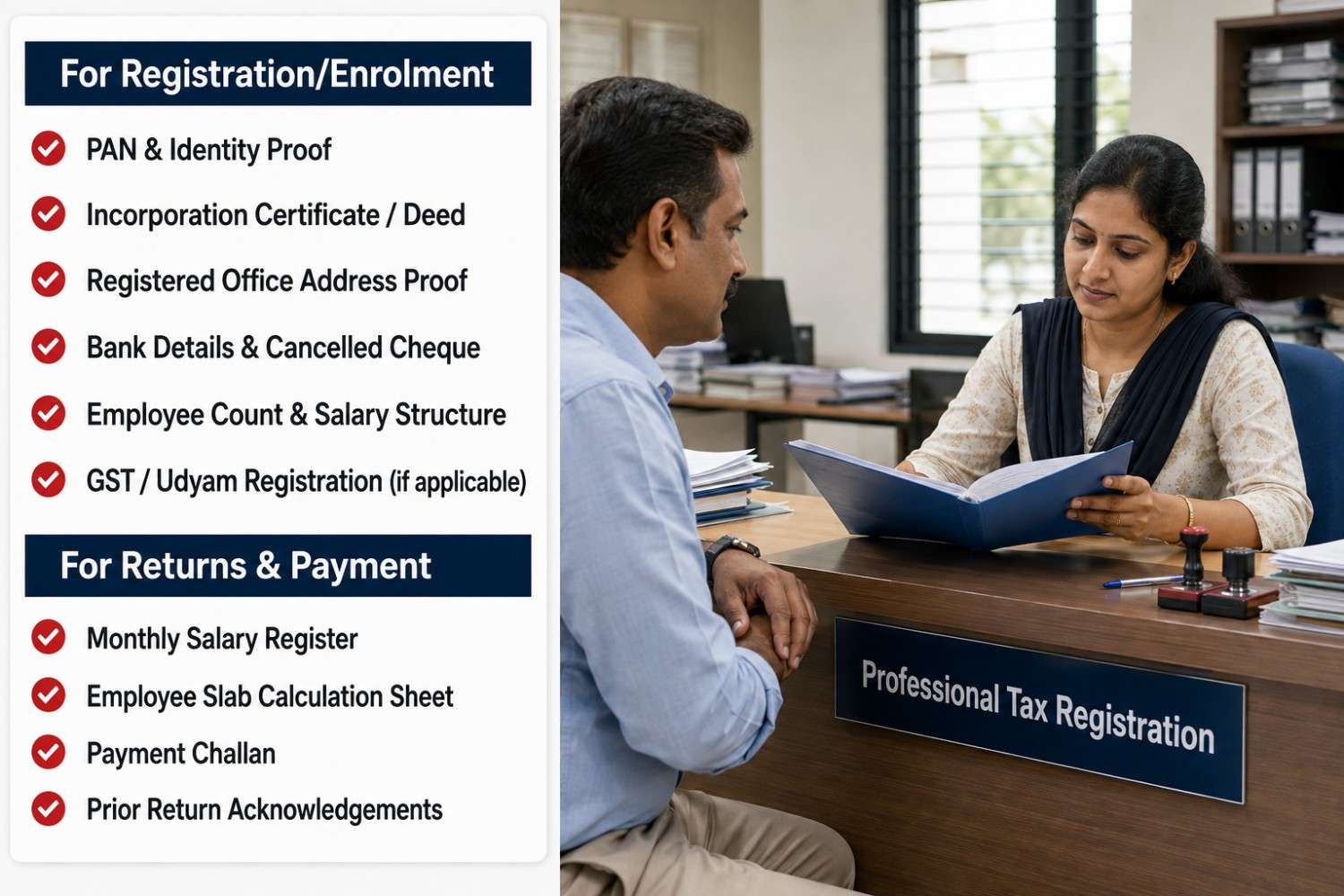
For registration or enrolment
-
PAN, identity proof and authorised-signatory details
-
Incorporation certificate, LLP agreement, partnership deed or proprietorship proof
-
Registered-office and workplace address proof
-
Bank details, cancelled cheque and contact information
-
Employee count, salary structure and commencement date
-
Existing GST, shop, Udyam or other registration details, where requested
Ensure the application matches your GST registration records and Udyam registration details where those numbers are quoted.
For returns and payment
Keep the employee master, monthly salary register, slab calculation, deduction sheet, challan, prior return acknowledgement and adjustment details. These should reconcile with PF filing records, ESI return data, ESIC registration records and TDS filing data.
Keep these professional tax documents period-wise so a challan can be traced to the employee calculation and submitted return.
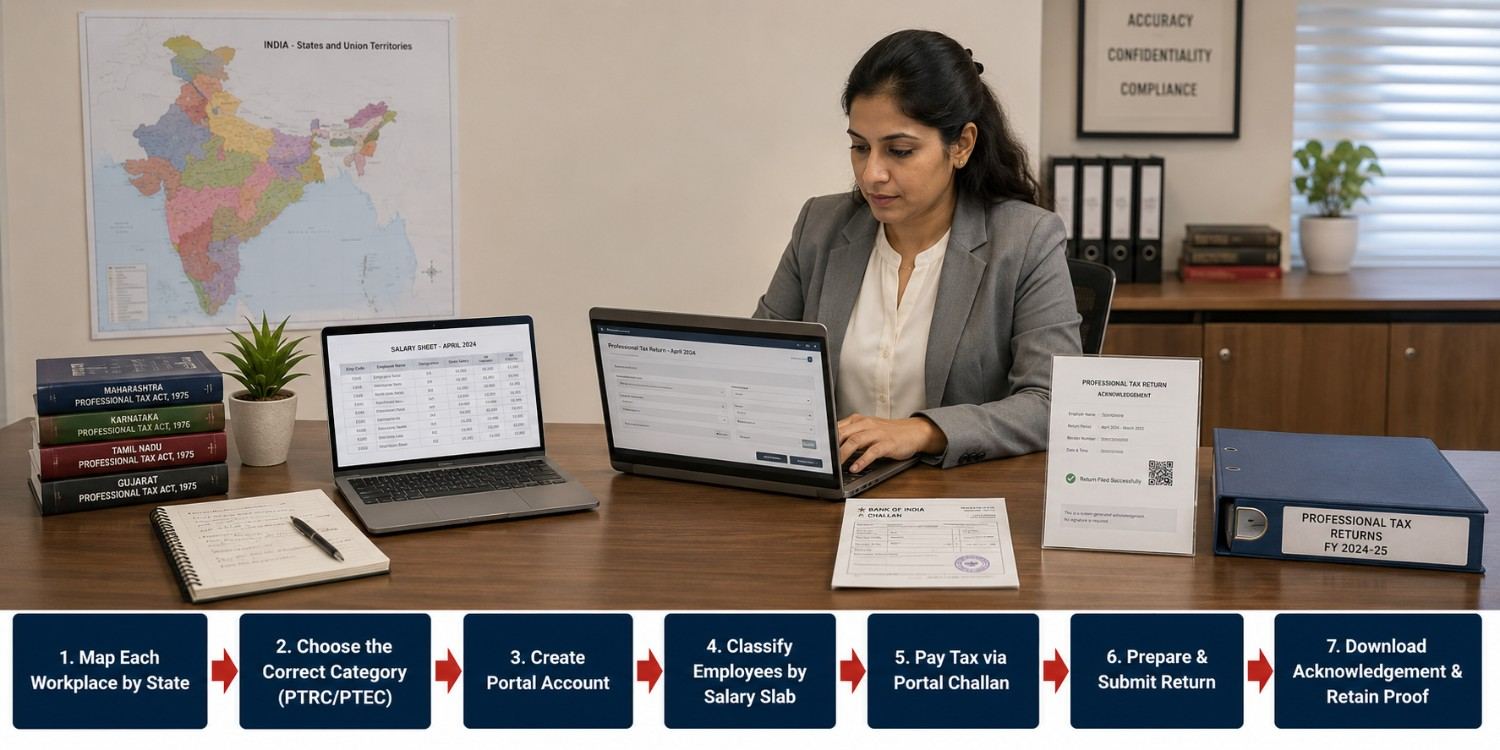
How to Complete Professional Tax Filing Online
If you are checking how to pay professional tax online, start with the correct state or local-body portal. Each professional tax online facility has its own account, form and payment workflow.
-
Map each workplace: Identify every state and local-body jurisdiction where staff work or the business carries on a taxable activity.
-
Choose the correct category: Apply for employer registration, enrolment or both under that jurisdiction's terminology.
-
Create the portal account: Enter PAN, entity, workplace, bank and authorised-person details; upload the requested proofs.
-
Classify employees: Apply the current salary slab and exemption rules for the relevant state and period.
-
Pay the tax: Generate the portal challan, complete payment and verify that it is credited against the correct registration and period.
-
Prepare the return: Report salary, employee count, tax deducted, payment reference and adjustments in the prescribed form.
-
Submit and retain proof: Download the return acknowledgement, challan and computation sheet.
Portal approval time and document demands vary. Do not promise a fixed registration period. Where a business has several establishments, a labour-law compliance review can help map workplace-based obligations.
What Does Registration Cost and How Long Does It Take?
The tax payable follows the state schedule; it is not a professional-assistance fee. Application or portal charges, if any, vary by authority, while service fees depend on locations, employee records and filing history. Registration timing depends on document accuracy, departmental verification and queries, so no national completion period applies.
How Should Employers Manage Returns and Due Dates?
Create a state-wise calendar that records registration number, period, slab source, payment date, return date, portal owner and reviewer. Payment and return filing may have separate deadlines, and an extension for one period should not be treated as a permanent rule.
A nil return may still be required where an employer registration remains active, but no tax is payable. Check the state form and portal instead of assuming that zero deduction means no filing. Keep PT controls aligned with ROC annual return compliance but do not combine the two obligations.
For multi-state payroll, review the employee's actual work location, establishment mapping and local law. Centralising payroll does not automatically centralise the tax. Periodic review through CFO-level compliance controls can reduce missed state registrations.
Penalties, Exemptions and Records
Late registration, deduction, payment or return filing may attract interest, fixed or daily late fees, percentage-based penalties, assessment and recovery action. The amount and procedure come from the applicable state law; there is no single national professional tax penalty.
Exemptions also differ. A state may exempt income below a slab, certain senior citizens, persons with specified disabilities, members of armed forces, parents or guardians in notified cases, or particular occupations. Record the legal basis and supporting proof before stopping a deduction.
Maintain certificates, employee declarations, salary registers, challans, acknowledgements, notices and correction workings for the state-prescribed period. These records may also be reviewed during a vendor compliance assessment.
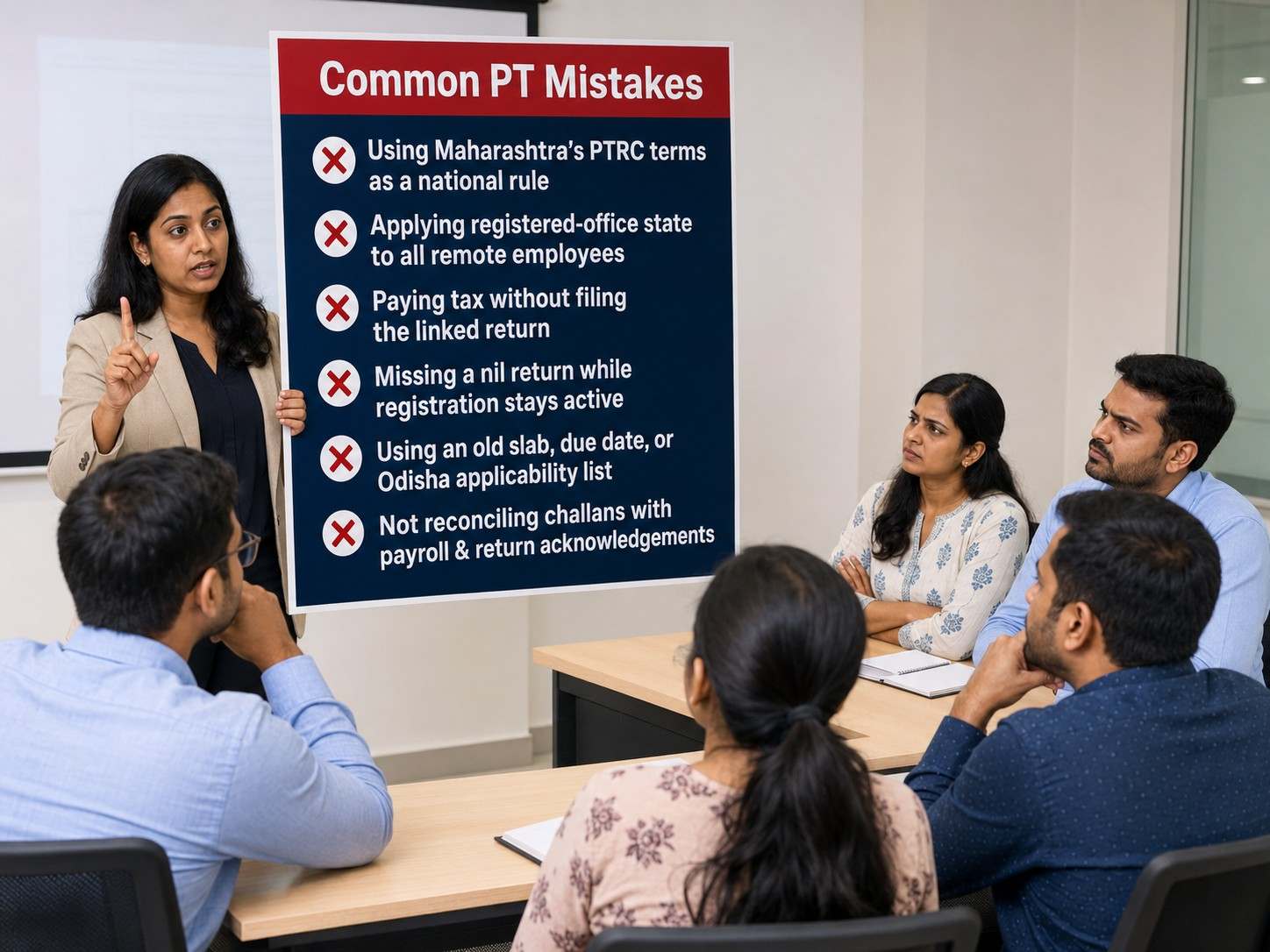
Common mistakes to avoid
-
Using Maharashtra's PTRC/PTEC terminology as a national rule
-
Applying the registered-office state to every remote employee
-
Paying tax without filing the linked return
-
Missing a nil return or inactive-registration closure
-
Using an old slab, due date or Odisha applicability list
-
Failing to reconcile challans with payroll and return acknowledgements
Conclusion
Professional Tax filing works correctly only when registration, payroll deduction, payment and returns are mapped state by state. Confirm the current law, certificate type, employee location, slab, exemption and due date before every filing period.
A clean calendar and reconciled records make professional tax compliance easier to defend during an assessment. Businesses should also coordinate it with accounting, payroll and wider statutory compliance rather than treating it as an isolated annual task.
FAQS
FAQs About Professional Tax filing
-
Is Professional Tax filing mandatory in every Indian state?
No, Professional Tax filing is required only where a state or authorised local body has enacted and applies the levy. Several states and Union Territories do not impose a general professional tax. Always check the employee's workplace and the current local rule before deducting salary.
- What is the difference between PTRC and PTEC?
- Does a freelancer need professional tax registration?
- Does a company with no employees need PTEC or PTRC?
- Can Professional Tax filing be completed online?
- What is the professional tax payment due date?
- Is a nil professional tax return compulsory?
- What should a multi-state employer do?
- Can a professional tax return be corrected?
- What happens when professional tax is filed or paid late?


