
A profitable business may still struggle with immediate bills because sales and collections occur at different times. A manufacturer has money tied up in materials and finished goods; a trader stocks products before a busy season; a service company waits for customers to clear invoices. Meanwhile, salaries, rent, taxes and suppliers remain due.
A working capital loan bridges this timing difference. Obtaining the right facility requires the business to calculate its need, prepare consistent records, select suitable finance and show how it will be repaid.
This guide covers the facilities, eligibility, documents, costs, appraisal and application process in India.
What Is a Working Capital Loan and Why Do Businesses Need It?
A working capital loan funds short-term needs such as stock, materials, wages, rent, utilities, transport and confirmed orders where production costs arise before customer payment.
Working capital is calculated as:
Working capital = Current assets − Current liabilities
Current assets include cash, inventory and receivables. Current liabilities include supplier dues, taxes, short-term debt and near-term expenses. If current assets are ₹48 lakh and current liabilities are ₹34 lakh, net working capital is ₹14 lakh. The lender will still examine stock movement, receivable age and supplier credit.
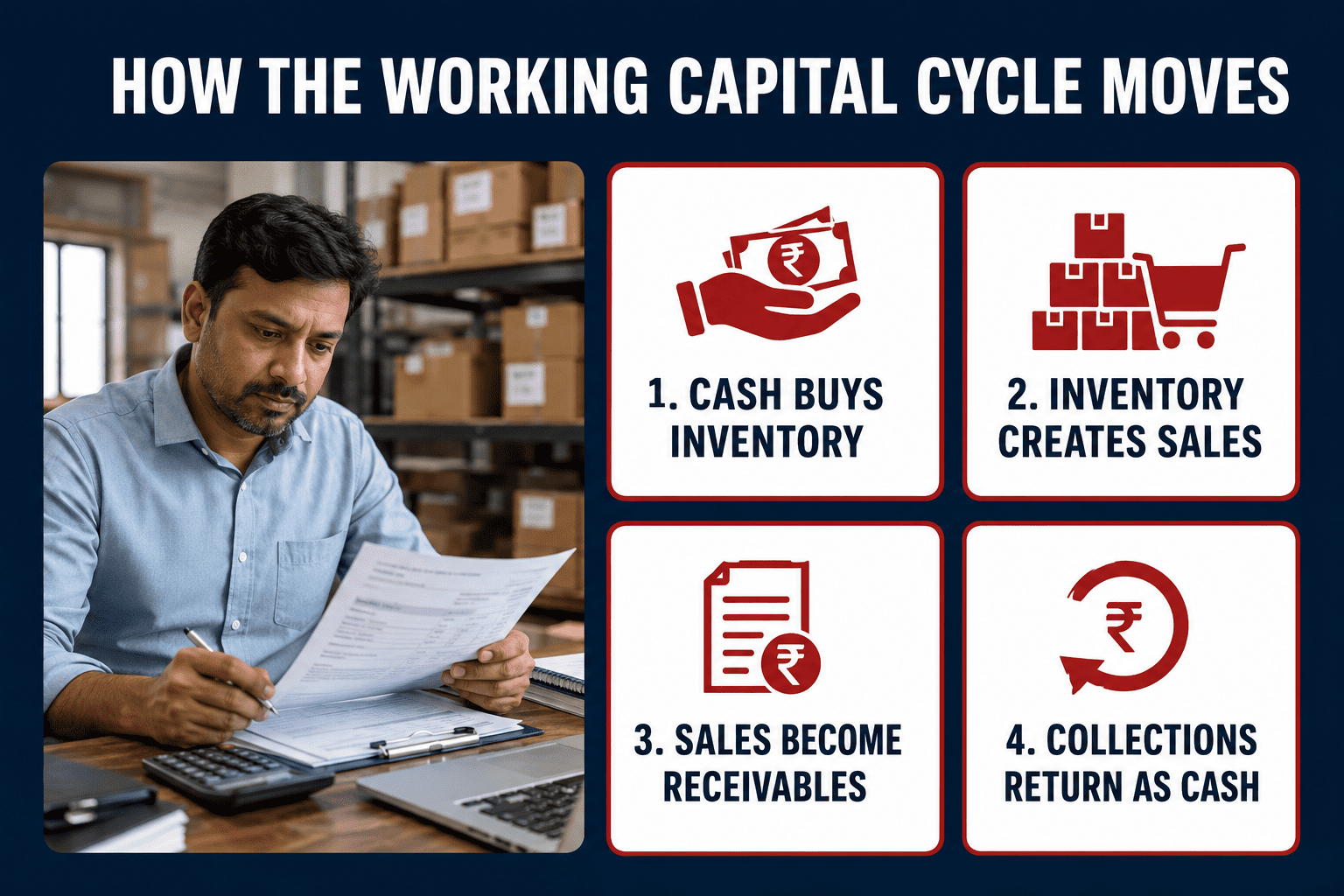
This movement is the working capital cycle: cash purchases inventory, sales create receivables, and collections return as cash. A longer cycle usually needs more finance. Borrowing can bridge a healthy cycle but cannot permanently fix weak margins, excess stock or doubtful debts.
Before borrowing, separate a temporary shortage caused by stock or confirmed orders from a recurring loss that requires operational correction.
When Does a Working Capital Loan Make Business Sense?
The facility makes sense when the requirement is short-term, measurable and connected to an operating activity that will generate cash. A wholesaler may need to purchase stock before its busiest quarter. A manufacturer may receive a large order but need materials and labour before collecting the invoice. A contractor may have completed work and raised a bill but still need to pay employees while certification and payment are pending. In each case, the business can identify both the reason for borrowing and the expected source of repayment.
It may also help a business protect supplier relationships. Paying a regular supplier on time can preserve credit terms, ensure uninterrupted supply and sometimes secure a purchase discount. The saving should nevertheless be compared with the borrowing cost. Taking an expensive loan solely to obtain a small discount may not produce a real benefit.
A working capital loan becomes risky when it finances continuing losses, personal expenditure or a long-term asset. If every month ends with a shortage even after customers have paid, the problem may lie in pricing, margins or overheads. Additional debt can postpone the issue but will add interest and repayment pressure. Likewise, land, buildings and major machinery usually require longer-term funding because they generate returns over several years rather than one operating cycle.
How Is the Working Capital Requirement Calculated?
No single calculation suits every business. Lenders examine the activity, sales pattern, operating cycle, financials and requested facility. The Reserve Bank of India’s MSME guidance says banks should consider genuine short-term needs and the business cycle. The Ministry of MSME also explains this assessment.
The operating-cycle method measures how long money remains in materials, work in progress, finished goods and receivables after supplier credit. A four-month production and collection cycle normally needs more support than a two-week retail cycle.
Projected turnover may also guide appraisal. Historical sales, expected growth and borrower contribution affect the limit; no percentage is automatically sanctioned. GST returns, bank credits or purchase orders should support projections.
For seasonal businesses, a monthly cash budget identifies the peak shortage. Cash-credit drawing power may be linked to eligible stock and receivables after margins, excluding old debts, disputed invoices or obsolete stock.
A sound calculation includes inventory days, customer and supplier credit, monthly expenses and existing repayments.
Read more: LegalBabu’s accounting services and project report preparation for submitting documents.
Types of Working Capital Finance Available in India
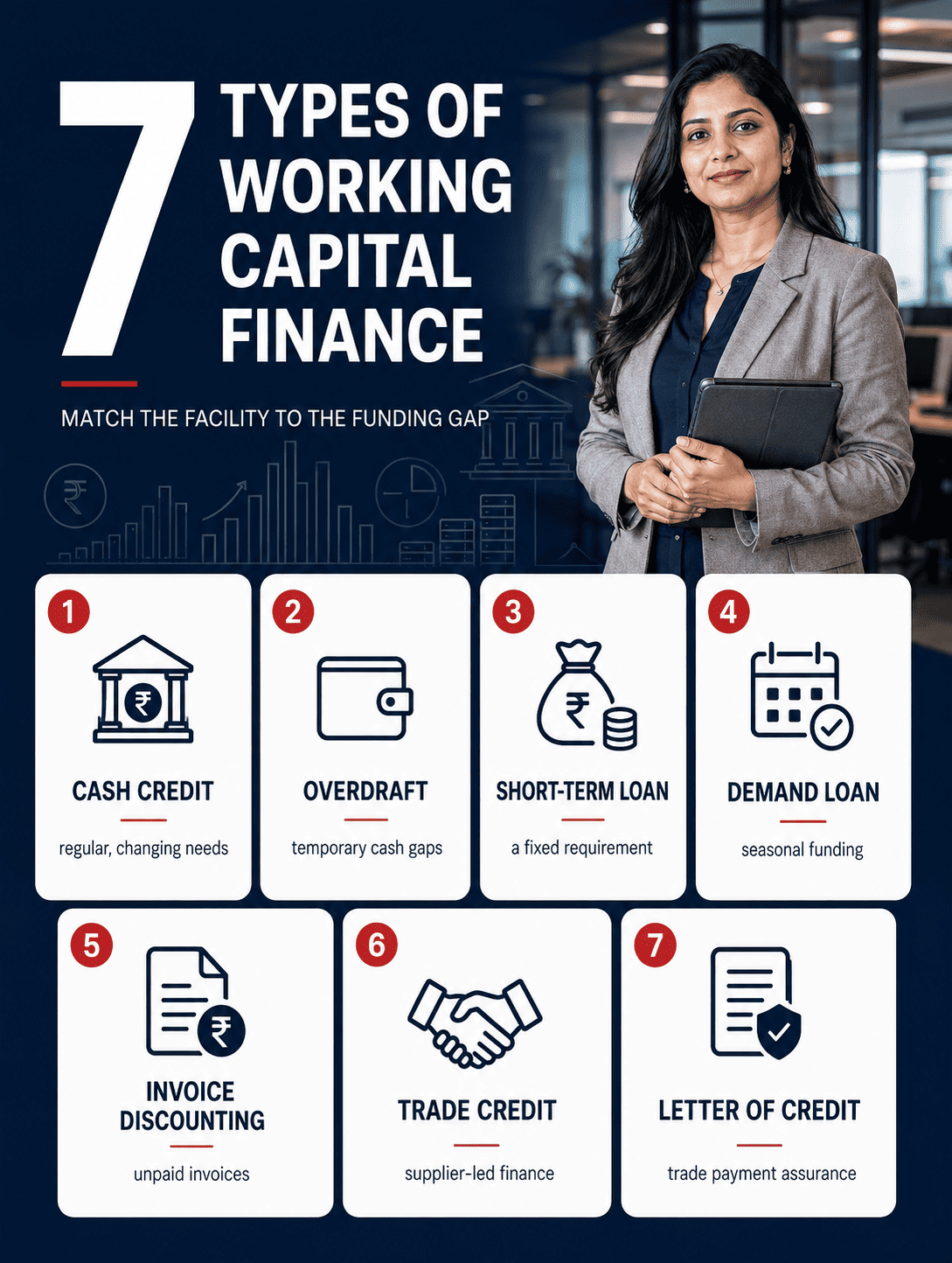
Working capital finance includes several products. The best choice depends on whether the gap is recurring, occasional or tied to an invoice.
|
Facility |
How it works |
Suitable situation |
|
Cash credit |
A revolving limit is commonly secured against stock and receivables. Interest generally applies to the amount used. |
Regular and fluctuating operating needs |
|
Overdraft |
The account holder can withdraw beyond the available balance up to the approved limit. |
Short and occasional cash mismatches |
|
Short-term loan |
A fixed sum is disbursed and repaid according to an agreed schedule. |
A clearly defined short-term expense |
|
Working capital demand loan |
A specified amount is provided for a particular period or seasonal requirement. |
Temporary peak demand |
|
Invoice discounting |
Eligible invoices are financed before the customer’s payment date. |
Businesses with reliable unpaid invoices |
|
Trade credit |
A supplier allows the business to pay after an agreed period. |
Purchases from regular suppliers |
|
Letter of credit |
A bank assures payment when stated terms and documents are met. |
Domestic and international trade transactions |
Cash credit suits changing requirements because funds can be drawn and repaid within the approved structure. A fixed loan suits a known amount and repayment date. Invoice discounting applies after a sale when payment remains pending.
For registered MSMEs, TReDS enables receivable financing through multiple financiers, including for accepted invoices from corporate and government buyers.
Who Is Eligible and What Do Lenders Examine?
Proprietorships, partnerships, LLPs, companies and other eligible entities may apply under lender-specific rules. Businesses still formalising their structure can review private limited company registration or LLP registration through LegalBabu.
Operating history provides evidence of turnover, margins and repayment. A startup may face closer scrutiny, making confirmed orders, promoter experience, projections, security or a guarantee more important.
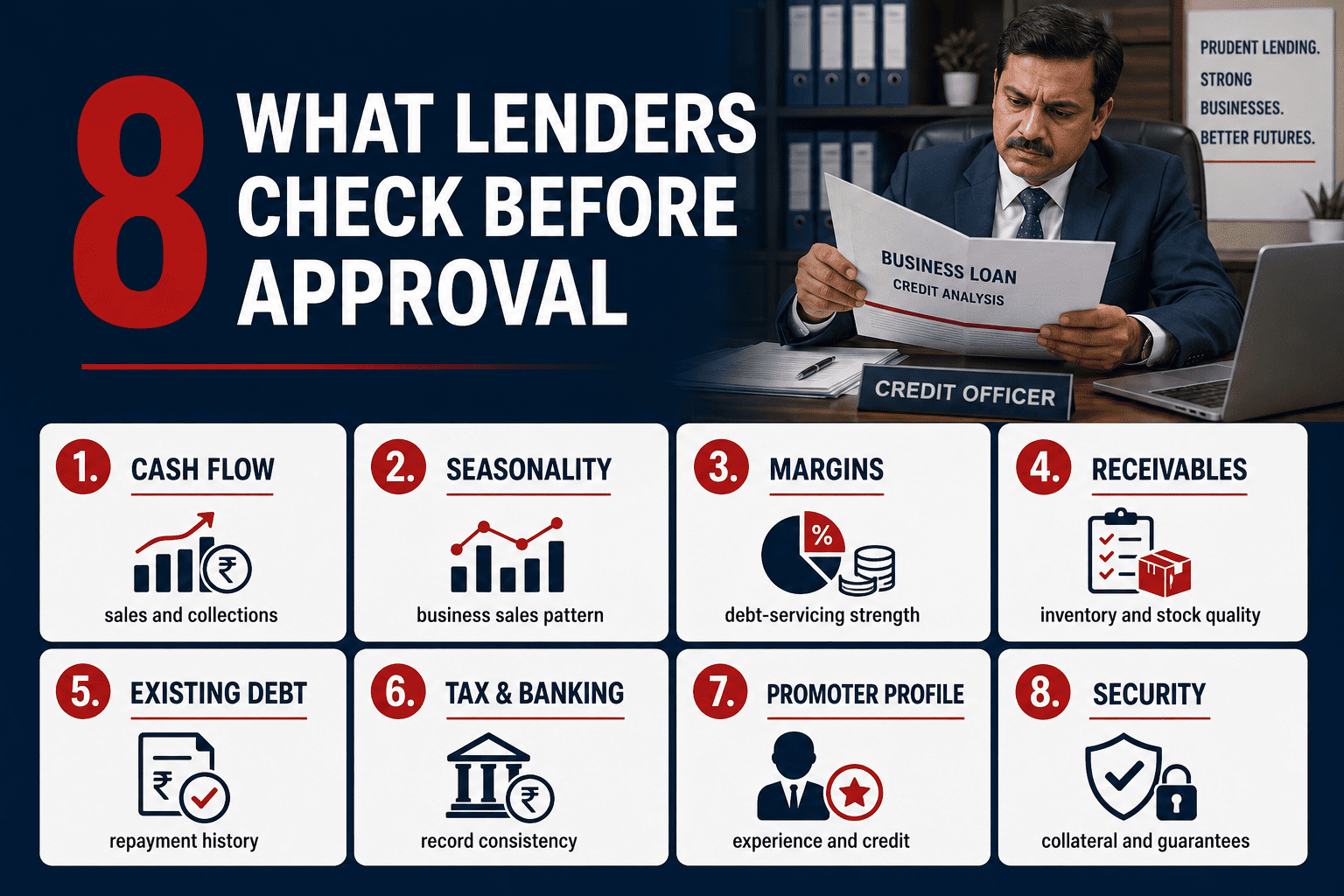
Assessment goes beyond CIBIL. Lenders review business and promoter scores, debt, overdue instalments, cheque returns and defaults. There is no universal score, and clean credit cannot replace weak cash flow.
Sales in financial statements should reconcile with GST returns and bank credits. Genuine differences can be explained; unexplained mismatches weaken confidence. Lenders also study customer concentration, receivable ageing, inventory, profitability and end use. Rising turnover is unhelpful when invoices remain uncollected.
Read more: LegalBabu’s GST registration service can support businesses that need to regularise registration.
How Can a Business Strengthen Its Loan Application?
A strong application allows the credit team to follow the movement of money without guessing. The amount requested should connect with stock purchases, production time, customer credit and expected collections. If the business seeks ₹30 lakh, its calculation should show why ₹30 lakh is required rather than a convenient rounded figure. Purchase orders, historical sales and receivable schedules can support this explanation.
Good financial housekeeping also matters. Business and personal transactions should remain separate. Books should be reconciled with bank statements, and GST and income-tax filings should be current. Old receivables need to be reviewed honestly because a large debtor balance is not useful when much of it is disputed or unlikely to be collected. Existing loans, guarantees and contingent liabilities should be fully disclosed.
Projections should remain realistic. Immediate sales at full capacity, no seasonal slowdown and perfect customer collections will usually look less credible than conservative assumptions supported by evidence. If performance changed sharply, the proposal should explain the reason. A new distributor, additional capacity or confirmed order is more meaningful than a general statement that demand will increase.
Finally, avoid making several unplanned applications within a short period. Compare suitable facilities first and submit a complete proposal to institutions whose product and eligibility conditions match the business. Prompt, accurate responses during verification can prevent avoidable delays, although no preparation can guarantee sanction.
Documents Required for a Working Capital Loan
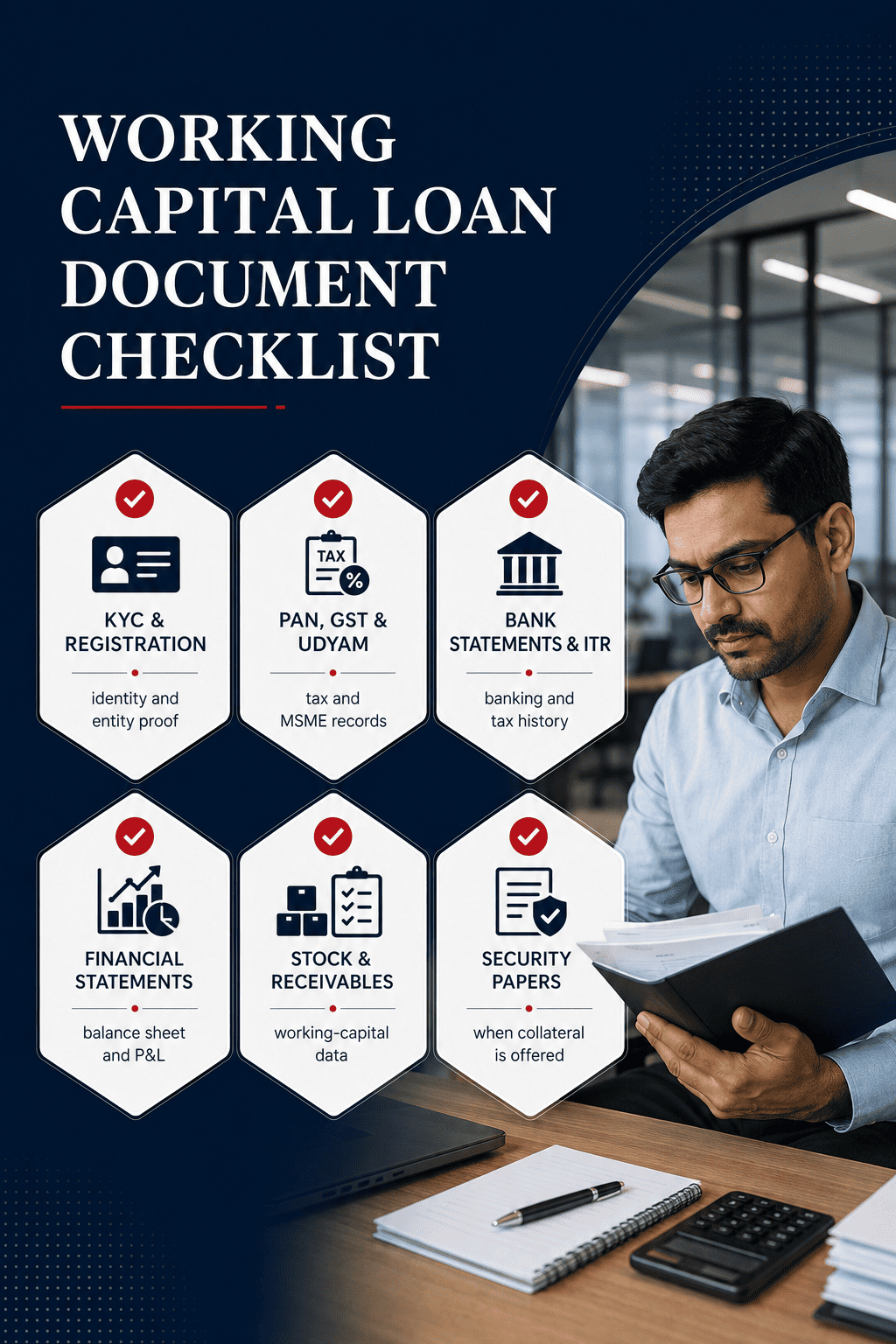
The document list varies with the lender, facility, entity and security. Applications usually begin with promoter or signatory KYC and proof that the business legally exists at the declared address.
Financials, tax returns, banking and existing debt form the proposal’s core. Stock statements, ageing reports, orders and projections explain the requirement and repayment path.
|
Document category |
Common records requested |
|
Applicant KYC |
PAN, Aadhaar or another accepted identity and address proof |
|
Entity records |
Incorporation certificate, partnership deed, LLP agreement or applicable business registration |
|
Tax records |
Business PAN, GST registration and returns, income-tax returns |
|
Financial records |
Balance sheet, profit and loss account, audit report and cash-flow statements |
|
Banking records |
Current-account statements and existing loan statements |
|
Working capital records |
Stock statements, receivables ageing, payables, monthly sales and projections |
|
Security records |
Ownership, valuation, insurance and title papers where collateral is offered |
MSMEs should keep registration details current. LegalBabu’s Udyam guide explains the process; applications belong on the official Udyam portal. Registration supports classification but does not guarantee finance.
Interest Rate, Security and Total Borrowing Cost
There is no single working capital loan interest rate in India. Pricing depends on the benchmark, risk, facility, security, credit and repayment capacity. Advertised rates may apply only to selected profiles. Check processing, renewal and commitment charges, legal and valuation costs, insurance, penal charges and prepayment terms. For revolving finance, calculate cost against expected utilisation.
Repayment structure deserves equal attention. A fixed loan may require instalments during slow months, while cash credit or overdraft offers flexibility within its terms. Model the payment schedule against conservative collections before accepting the facility.
Also distinguish fixed from floating interest. If the rate can change, understand the benchmark, spread, reset date and method of communication. Penalty charges for delay or covenant breaches should be clearly stated before signing. Security may include stock, receivables, deposits or property, and personal guarantees may apply. Where a company charges its assets, see LegalBabu’s guide to registration of charges with the ROC.
Review the sanction amount, margin, drawing power, repayments, reporting, renewal and default terms. A low rate cannot compensate for unsuitable charges or restrictions.
How to Apply for a Working Capital Loan
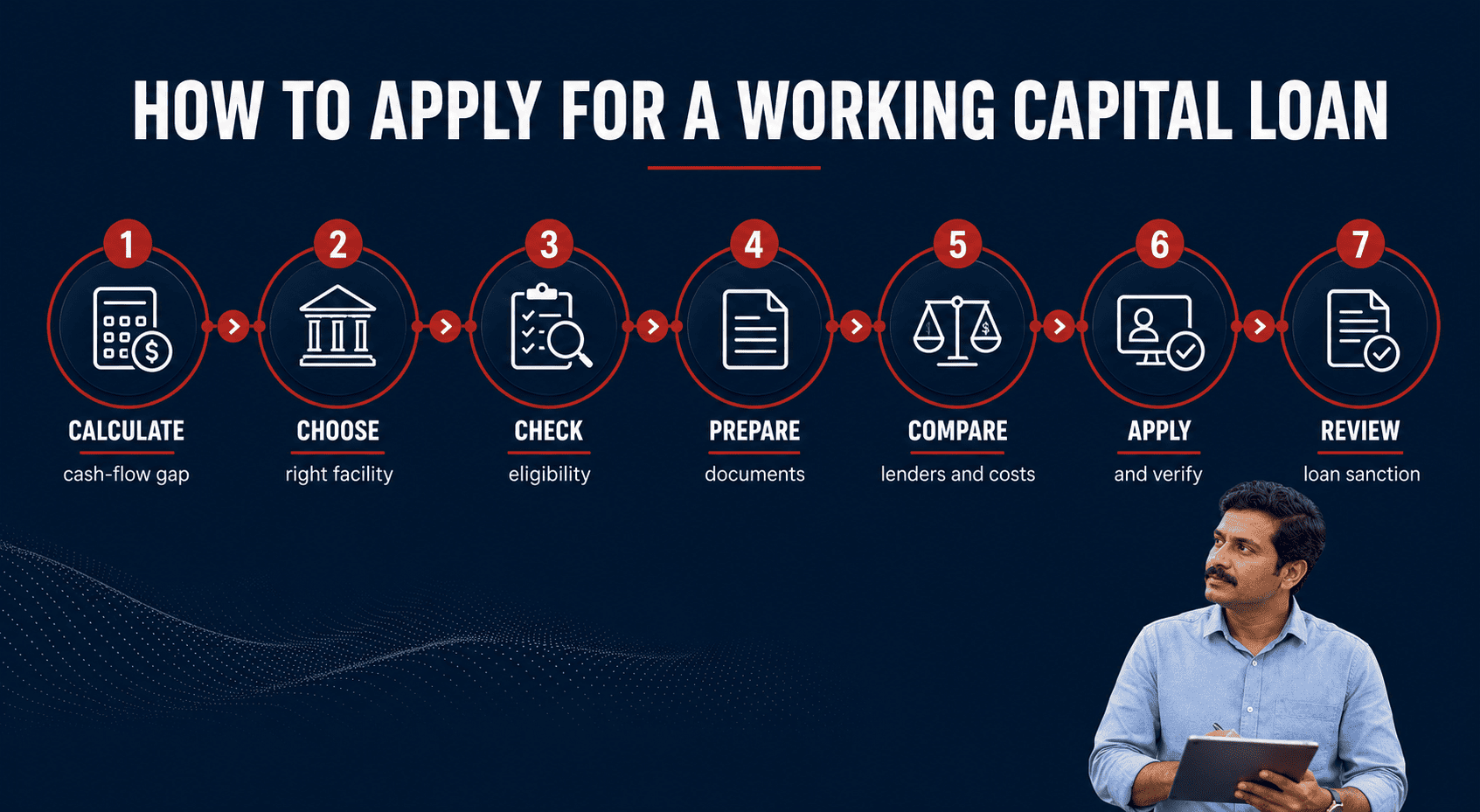
Below are the steps to apply for a working capital loan:
1. Assess the Actual Cash-Flow Gap
Prepare a monthly cash-flow estimate covering sales, collections, stock purchases, salaries, taxes, rent and existing repayments. Identify when the shortfall begins and when customer payments are expected. This helps determine the amount required without disrupting regular operations.
2. Choose the Suitable Finance Facility
Match the facility to the business need. Cash credit may suit recurring operational cycles, while a short-term loan may be more suitable for a defined order or expense. Invoice discounting can work when eligible customer invoices are pending for payment.
3. Review Eligibility and Financial Records
Check credit reports, existing overdues, bank statements, GST returns and income-tax filings before applying. Reconcile sales shown in financial statements, GST records and bank credits. Any genuine difference should be clearly explained to the lender.
4. Compare Lenders and Total Borrowing Cost
Do not compare only the interest rate. Review processing fees, renewal charges, collateral requirements, repayment terms, commitment charges and penal charges. Choose a facility that fits the expected collection cycle and repayment capacity.
5. Submit the Application With Complete Documents
Apply through the lender’s official channel with KYC, business registrations, financial statements, bank records, stock details, receivables ageing and projections, where required. An incomplete or inconsistent file can delay appraisal.
6. Complete Lender Verification
The lender may request updated statements, transaction proof or clarification on sales and receivables. Verification can include premises, banking, GST compliance, stock, collateral, customer payments and the stated end use of funds.
7. Review the Sanction Letter Before Using Funds
Read the sanction letter carefully before accepting the facility. Check the approved limit, drawing power, margin, interest rate, repayment schedule, reporting conditions, security, renewal requirements and default charges. Use the funds only for the approved business purpose.
Government-Backed and Receivables-Based Options for MSMEs
Eligible micro and small enterprises may explore CGTMSE. It provides guarantee cover to eligible member lenders but does not lend directly. The lender still appraises the application. LegalBabu’s CGTMSE collateral-free loan guide explains the route and documents.
Businesses can also review SIDBI’s working capital assistance. Check current eligibility and terms on the official portal.
Where invoices are delayed, TReDS may release cash before the normal payment date. If recovery is required, LegalBabu’s MSME payment recovery service explains the formal route. Finance bridges timing; recovery addresses an overdue claim.
Working Capital Loan vs Term Loan
|
Basis |
Working capital loan |
Term loan |
|
Purpose |
Daily operations and short-term gaps |
Machinery, property, expansion or another long-term purpose |
|
Structure |
Revolving limit or short-term borrowing |
Fixed disbursement with scheduled repayment |
|
Appraisal focus |
Stock, receivables, cash cycle and turnover |
Asset cost, project viability and long-term cash flow |
|
Tenure |
Linked to short-term need or periodic renewal |
Normally matched to the useful life of the asset |
|
Use of funds |
Operational expenditure |
Capital expenditure or long-term investment |
Financing machinery through short-term credit can create pressure before the asset generates revenue. The funding period should match the time required to produce cash.
Mistakes That Can Weaken an Application
Applications weaken when records conflict. Turnover may differ from GST filings, projections may lack orders or capacity, or existing loans may be omitted despite appearing in bank statements and credit reports.
Avoid requesting a round amount without an operating-cycle calculation, applying everywhere at once, using funds personally or treating the limit as income. After disbursement, monitor stock statements, repayments, renewals, receivable ageing, inventory days and interest. Delayed reporting can restrict drawing power.
Review use against the purpose stated in the application. When collections arrive, reducing the outstanding balance can lower interest and restore the available limit. Continuous full utilisation may indicate that the assessed amount is inadequate or operating cash is not returning as expected; find the cause before seeking an enhancement.
Conclusion
A working capital loan works best when it supports a healthy cycle with a clear collection path. Calculate the shortage, select the right facility and submit reliable records. Review interest, fees, security and reporting duties before acceptance.
FAQS
FAQs about Working Capital Loan
-
Who can apply for a working capital loan in India?
Proprietorships, partnerships, LLPs, companies and eligible MSMEs can apply, subject to the lender’s policy. The lender examines operating history, turnover, cash flow, credit conduct and repayment capacity.
- What can a working capital loan be used for?
- What documents are required for a working capital loan?
- Is collateral compulsory?
- What CIBIL score is required?
- How is the loan limit calculated?
- What is the interest rate on a working capital loan?
- How long does approval take?
- Is cash credit the same as a working capital loan?
- Can a startup obtain a working capital loan?


