
A Shop Act License, more accurately called Shop and Establishment Registration, is the certificate every shop, office, restaurant or commercial establishment needs from its state labour department before it starts operating. It confirms your business exists legally at a specific address and follows basic rules on working hours, wages and employee welfare. Most states charge a small fee and expect you to apply within 30 days of opening.
Most first-time business owners assume this is a formality they can skip if they already have GST registration or a company incorporation certificate. It isn't, and skipping it tends to surface at the worst possible moment, usually when a bank asks for it before opening a current account. Here's how the whole system actually works.
What Is a Shop Act License, and Why Does India Require One?
A Shop Act License is the registration certificate issued under your state's Shops and Establishments Act. It isn't a business registration in the way company incorporation is, and it isn't a tax registration either. It's a labour compliance record, confirming that your shop or commercial establishment exists at a known address and follows your state's rules on working hours, weekly holidays, wages, leave and employee treatment.
There's no single national Shops and Establishments Act. Each state and union territory has its own version, administered by its own Labour Department. The first one was the Bombay Shops and Establishments Act, 1948, and most states modelled their own laws on it afterward. That's why the process in Maharashtra looks different from the process in Karnataka or West Bengal, even though the underlying purpose stays the same everywhere.
You'll hear this license called by different names depending on where you're registering. In Maharashtra, people call it a Gumasta license. Elsewhere it's simply "Shop Act Registration" or "Shops and Establishment Certificate." All of them point to the same underlying legal requirement.
The central government's four labour codes, the Code on Wages, the Industrial Relations Code, the Social Security Code and the Occupational Safety, Health and Working Conditions Code, are meant to eventually standardise a lot of what individual state Shops and Establishments Acts currently cover. As of now, most states haven't fully notified these codes for shops and establishments, so the existing state-specific Acts remain the law you need to follow. Keep an eye on your state labour department's notifications rather than assuming the codes have already replaced your state Act.
Who Needs a Shop Act License in India?

Almost any commercial establishment operating from a fixed address needs to register, including:
- Retail shops, showrooms and general stores
- Restaurants, cafes, sweet shops and catering businesses
- Offices of consultants, agencies, IT firms and professional service providers
- Salons, gyms, spas and coaching or tutoring centres
- Clinics, diagnostic labs and pharmacies
- Hotels, lodges and guest houses
- Warehouses and godowns used for storage or distribution
- Cinemas, theatres and other places of public entertainment
The test isn't your turnover or how your business is structured. A single-person consultancy working out of a rented office and a 500-employee company follow the same basic rule: if you're carrying on trade, business or a service from a physical address, that address needs Shop Act registration. Even a proprietorship with no employees at all is usually expected to register in most states, since the requirement is tied to the establishment, not the headcount. Our guide to sole proprietorship registration covers this exact point, since Shop Act License is one of the first registrations most new proprietors need right after choosing their business name.
Home-based and online businesses sit in a genuine grey area. A freelance writer or consultant working alone from home with no client footfall often falls outside most states' definition of an "establishment." The moment you hire even one employee, or clients start visiting regularly, that exemption tends to disappear fast. Many labour inspectors now treat a home office receiving regular visitors as commercial premises. If you're unsure, registering anyway is usually the safer call. It costs little, and most banks and GST officers accept it as valid proof of your business address regardless of whether you were strictly required to get one.
What Documents Do You Need for Shop Act License Registration?
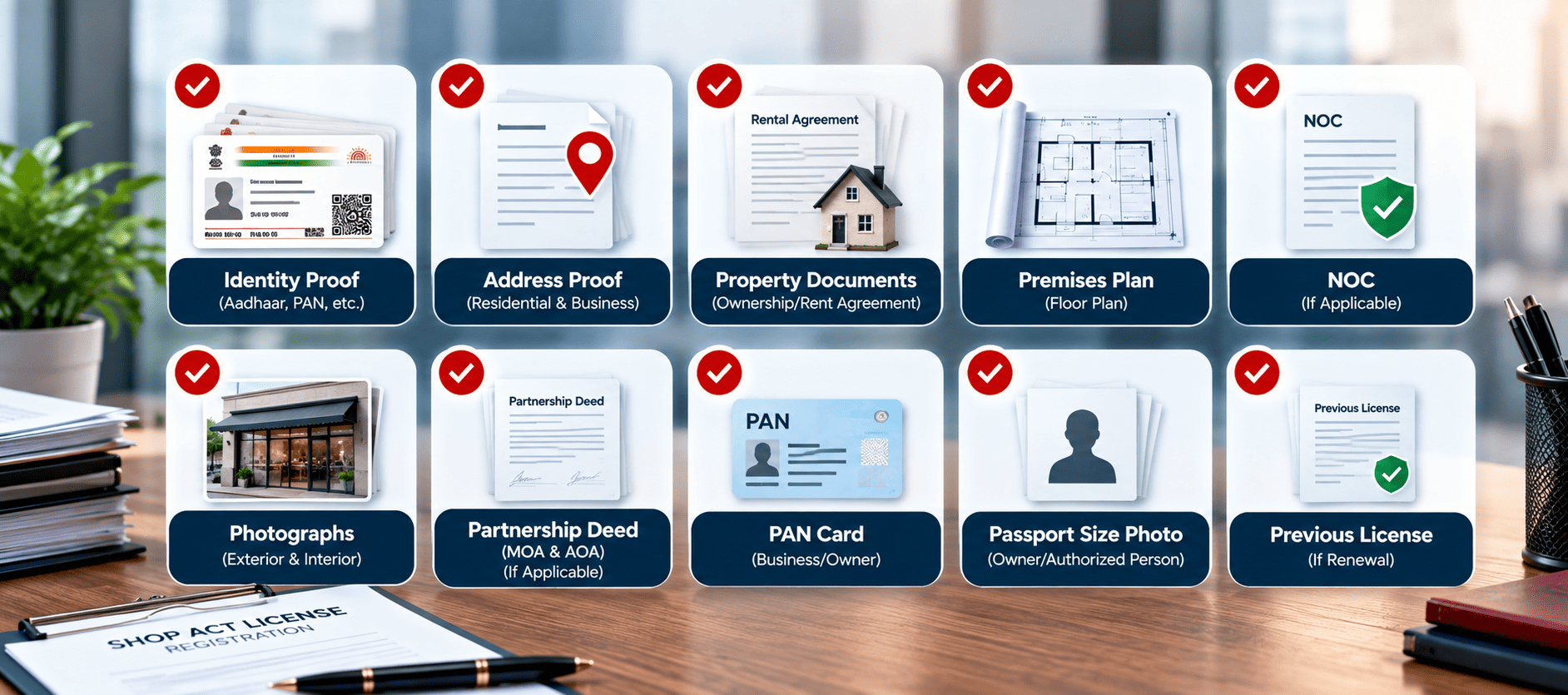
Keep these ready before you start the application. Missing paperwork is the single biggest reason applications sit unresolved for weeks.
- PAN card of the proprietor, partners or the company, along with identity proof (Aadhaar, passport or voter ID)
- Passport-size photographs of the applicant or authorised signatory
- Address proof of the business premises, such as a property tax receipt, sale deed, or a rent or lease agreement along with a No Objection Certificate from the landlord
- Proof of business constitution, meaning a Certificate of Incorporation for a company, an LLP agreement, a partnership deed, or a simple declaration for a proprietorship
- Details of employees, including total headcount, names and a rough breakdown of working hours, where the state form asks for it
- A recent utility bill, such as an electricity or water bill, for the business premises
- Bank account details of the business, where the state portal requests them at the registration stage
- Passport or visa copy, for any foreign national employed at the establishment, in states that ask for this
Keep your rent agreement, layout details and the address on your application consistent with each other. A mismatch between what's on paper and what an inspector sees during a site visit is one of the most common reasons a Shop Act License application gets delayed.
How Do You Apply for a Shop Act License in India?
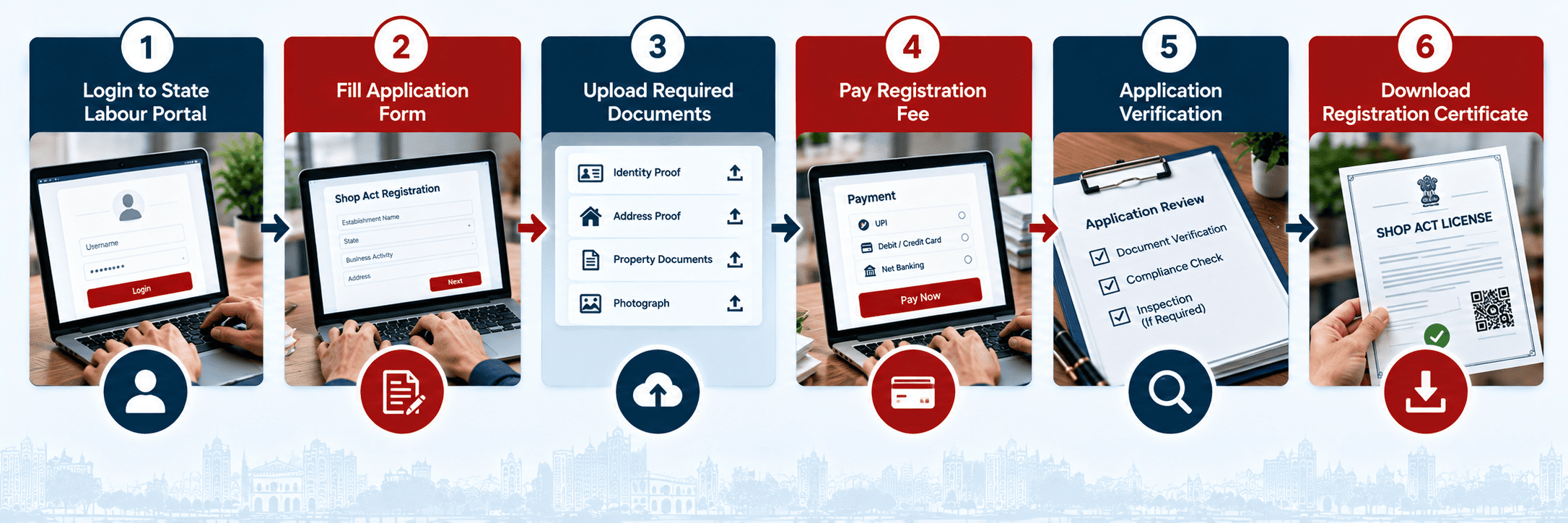
Applying online
- Go to your state labour department's official portal, or the specific Shops and Establishment module for your state, such as Maharashtra's Labour Management System or Telangana's Mee Seva.
- Register as a new user with your mobile number and email address.
- Fill in your business details, including trade name, nature of business, date of commencement and number of employees.
- Enter your premises address and upload the supporting documents, scanned clearly and matching the checklist above.
- Pay the government fee online through the portal's payment gateway. Fees are small and vary by state, which the table below covers in detail.
- Submit the application and note your reference number so you can track the status.
- Some states verify the application automatically and issue the certificate within a few working days. Others may schedule a site inspection first.
- Download your Shop Act License once approved, and keep a copy displayed at your premises, since several states legally require this.
Applying offline
You can still visit your local labour department office, collect a physical application form, attach the same set of documents and submit it over the counter. This route usually takes longer, and you'll need to follow up in person rather than tracking status online.
Some states also let you check overall business approval requirements through the National Single Window System, which won't issue your Shop Act License directly but tells you which other state and central approvals your specific business needs.
How Much Does a Shop Act License Cost? State-Wise Government Fee
There's no single national fee for Shop Act License registration. Each state sets its own fee schedule, and the amount can also depend on your number of employees or your establishment category in some states. The table below lists the government fee reported for each state and union territory.
Treat these figures as indicative starting points rather than the final word. Fees change with state budget notifications, and a few states link the charge to employee count or premises size. Always confirm the current fee on your state labour department's portal before you pay.
| S. No. | State / UT | Govt. Fee (₹) |
|---|---|---|
| 1 | Andaman & Nicobar Islands | ₹0 |
| 2 | Andhra Pradesh | ₹640 |
| 3 | Arunachal Pradesh | Not specified; check with local labour department |
| 4 | Assam | ₹2,000 |
| 5 | Bihar | ₹20 |
| 6 | Chhattisgarh | ₹0 |
| 7 | Chandigarh | ₹0 |
| 8 | Daman and Diu | ₹1,000 |
| 9 | Dadra and Nagar Haveli | ₹1,000 |
| 10 | Delhi | ₹0 |
| 11 | Goa | ₹1,000 |
| 12 | Gujarat | ₹50 |
| 13 | Himachal Pradesh | ₹300 |
| 14 | Haryana | ₹900 |
| 15 | Jammu and Kashmir | ₹300 |
| 16 | Jharkhand | ₹420 |
| 17 | Kerala | ₹50 |
| 18 | Karnataka | ₹600 |
| 19 | Lakshadweep | ₹0 |
| 20 | Maharashtra | ₹100 |
| 21 | Meghalaya | ₹350 |
| 22 | Manipur | ₹3,000 |
| 23 | Madhya Pradesh | ₹150 |
| 24 | Mizoram | ₹300 |
| 25 | Nagaland | ₹500 |
| 26 | Odisha | ₹300 |
| 27 | Puducherry | ₹200 |
| 28 | Punjab | ₹0 |
| 29 | Rajasthan | ₹5,000 |
| 30 | Tamil Nadu | NA (varies by local body) |
| 31 | Tripura | ₹300 |
| 32 | Telangana | ₹1,000 |
| 33 | Uttarakhand | Not specified; check with local labour department |
| 34 | Uttar Pradesh | ₹2,500 |
| 35 | West Bengal | ₹50 |
Maharashtra deserves a quick separate mention here, since it's one of the states businesses ask about most. The government fee itself is low, but Maharashtra now lets you pick a validity period of one to ten years at the time of registration, and the total amount you pay depends on which validity slab you choose. Paying for a longer validity upfront usually works out cheaper than renewing every single year.
How Long Is a Shop Act License Valid, and How Do You Renew It?
Validity rules differ more here than almost anywhere else in the process. Some states issue a certificate valid for one year only. Others, including Maharashtra, let you choose a validity period of up to ten years when you first register. A handful of states have moved toward longer or one-time registration for smaller establishments as part of ease-of-doing-business reforms, though this varies enough that you should confirm your specific state's current rule rather than assume.
Where renewal applies, file it before your certificate expires, generally at least 30 days ahead. You'll usually submit the same category of documents as your original application, along with the renewal fee. Miss the deadline and most states still let you renew, but with a late fee added on top. Let the gap stretch too long, and some labour departments start treating the establishment as unregistered, which brings back the full penalty structure.
One practical habit worth building early: note your renewal date the moment you receive your certificate, not the month before it expires. A lapsed Shop Act License has a way of surfacing during a bank audit or a GST verification at the worst possible time.
What Happens If You Operate Without a Valid Shop Act License?
Running your establishment without registering, or letting your registration lapse for too long, is a violation of your state's Shops and Establishments Act, not a paperwork technicality that gets quietly ignored. Depending on your state, you're looking at:
- A monetary fine, which can range from a few thousand rupees for a first-time default to considerably more for repeat or larger establishments
- A daily penalty added for every day the establishment continues operating without a valid registration
- Difficulty opening or maintaining a business current account, since most banks ask for this certificate as address proof
- Rejected or delayed GST registration applications, since GST officers commonly ask for a Shop Act License to verify your place of business
- Legal proceedings under the state Act in serious or repeat cases
Beyond the direct penalty, an unregistered establishment tends to run into friction in places business owners don't expect. Government tenders, several MSME schemes and even some corporate vendor onboarding processes ask for this certificate before they'll deal with you. Labour departments across most states have also tightened enforcement in recent years, so treating this as low-priority paperwork rarely pays off.
How Is a Shop Act License Different From Trade License, GST Registration and Professional Tax?
This is where a lot of new business owners get confused, and understandably so. All of these sound like generic "business registration," and it's easy to assume having one covers the others. They don't. Each answers a completely different question.
| Feature | Shop Act License | Trade License | GST Registration |
|---|---|---|---|
| Issued by | State Labour Department | Municipal corporation, municipality or panchayat | GST department (central and state) |
| Governs | Employment conditions, working hours, leave and wages | Permission to run a specific trade at a specific address | Indirect tax on goods and services |
| Mandatory when | You run a shop or commercial establishment in most states regardless of employee count. | You have physical business premises within municipal limits. | Turnover crosses the applicable threshold, or you want to bill corporate clients. |
| Governing law | State Shops and Establishments Act | State Municipal Corporation or Municipalities Act | CGST and SGST Acts |
| Typical validity | One year to ten years, depending on the state | One year, renewed annually | Ongoing, no fixed expiry |
Professional Tax works alongside these but answers yet another question. It's a state-level tax on employment and professions, separate from your Shop Act License, and it involves its own registration, deduction and filing cycle. Our detailed guide to Professional Tax filing breaks down the state-wise slabs and PTRC or PTEC registration types in full.
Most established businesses end up holding all of these together: Shop Act License, a trade license from the municipal corporation, GST registration once turnover crosses the threshold, and Professional Tax registration once they employ staff. None of them substitutes for the other, and a clean GST filing history won't protect you if your labour department flags an unregistered establishment during an inspection.
Do You Need Other Registrations Alongside Your Shop Act License?
Shop Act License covers your labour compliance at a specific address. It doesn't replace everything else your business needs to operate legally.
- Proprietorship, partnership, LLP or private limited company registration, depending on how you've structured your business, since this decides which constitution proof you'll submit with your Shop Act application
- GST registration, once your turnover crosses the applicable threshold, or earlier if you want to bill corporate clients and claim input tax credit
- A trade license from your municipal corporation, which most physical shops and offices need in addition to their Shop Act License
- Udyam registration for MSME benefits, easier loans and access to government tenders
- Professional Tax filing, once you start employing staff in a state that levies this tax
- An FSSAI license if your business handles food in any commercial capacity, alongside your Shop Act registration
If your business structure changes later, say you started as a proprietorship and want to move to a private limited company, your Shop Act License will need updating too, since it's tied to your business constitution as much as your address.
What Mistakes Should You Avoid When Applying for a Shop Act License?
- Assuming your GST registration or company incorporation already covers this requirement
- Applying under the wrong state, particularly for businesses with staff or offices across more than one location
- Using an address on your application that doesn't match your rent agreement or utility bill
- Registering only your head office and forgetting that branch locations usually need separate registration
- Missing your renewal date because the business has been running smoothly with no complaints so far
- Choosing the shortest validity option to save money upfront, then paying renewal charges and filing effort repeatedly instead of a longer validity slab where your state offers one
- Ignoring an employee count change, since some states recalculate your fee or category once you cross a certain headcount
Getting the state, the category and the paperwork aligned on the first attempt is most of what separates a smooth Shop Act License approval from weeks of back-and-forth. This is where Legal Babu's team comes in. We help you confirm which state Act applies to your establishment, prepare and verify your documents against the current checklist, file your application on the correct labour department portal, and track it through to approval. We also flag your renewal date well in advance, so a lapsed registration never catches your business off guard during a bank audit or a GST verification.
FAQS
FAQs About Shop Act License
-
Do freelancers or work-from-home consultants need a Shop Act License?
Usually not if you're working alone with no employees and no clients visiting your home. The moment you hire someone or start receiving clients regularly at the premises, most states expect registration. Since the cost is low, many freelancers register anyway to make bank and GST paperwork easier later.
- Can I get a Shop Act License if I don't own the shop and I'm on rented premises?
- Is a Shop Act License mandatory for an online-only business with no physical shop?
- Can I run two different businesses from the same shop under one Shop Act License?
- What happens if I accidentally registered in the wrong state or the wrong local body?
- Can I use my Shop Act License to open a current bank account before I get GST registration?
- Is a Shop Act License mandatory even if I have zero employees and it's just me?
- My shop changed address. Do I need a fresh Shop Act License, or can I amend the existing one?
- Can a private limited company or LLP skip Shop Act License since it already has an incorporation certificate?
- How is a Shop Act License different from Udyam or MSME registration?


