

A factory expansion, solar plant, warehouse, hospital or infrastructure asset may require far more than an ordinary business loan. Project Finance is designed for such capital-intensive ventures, where repayment is expected mainly from the cash flows created by the project itself. Getting it requires a credible promoter, a viable project, committed equity, enforceable contracts, approvals and a financial model that survives lender scrutiny.
There is no universal interest rate, credit-score cut-off, promoter contribution or approval period. Each lender applies its credit policy and assesses the sector, project stage, security and sponsor strength. The practical task is therefore to make the proposal bankable, not merely to complete an application form.
What is Project Finance?
The RBI defines project finance as funding in which project revenues serve as the primary security and repayment source. Under its current framework, at least 51% of the repayment envisaged at financial closure must arise from the financed project’s cash flows, and all lenders must have a common agreement with the borrower.
This is different from a regular corporate term loan assessed mainly on the borrower’s existing balance sheet. A project-finance structure commonly uses a special-purpose vehicle (SPV), although the precise structure depends on the transaction. Sponsors planning a separate entity should settle the private limited company registration, ownership and project-object clauses before approaching lenders.
|
Point |
Project finance |
Conventional corporate term loan |
|
Main repayment source |
Future project cash flows |
Borrower’s overall business cash flows |
|
Typical purpose |
New asset, expansion or major modernisation |
General capital expenditure or business requirement |
|
Structure |
Often ring-fenced through an SPV |
Usually borrowed by the operating entity |
|
Appraisal focus |
Project viability, contracts, risks and sponsor support |
Business history, financial position and security |
|
Disbursement |
Linked to milestones and equity infusion |
As specified in the sanction terms |
|
Recourse |
May be limited, structured or supported by sponsors |
Commonly recourse to the borrower |
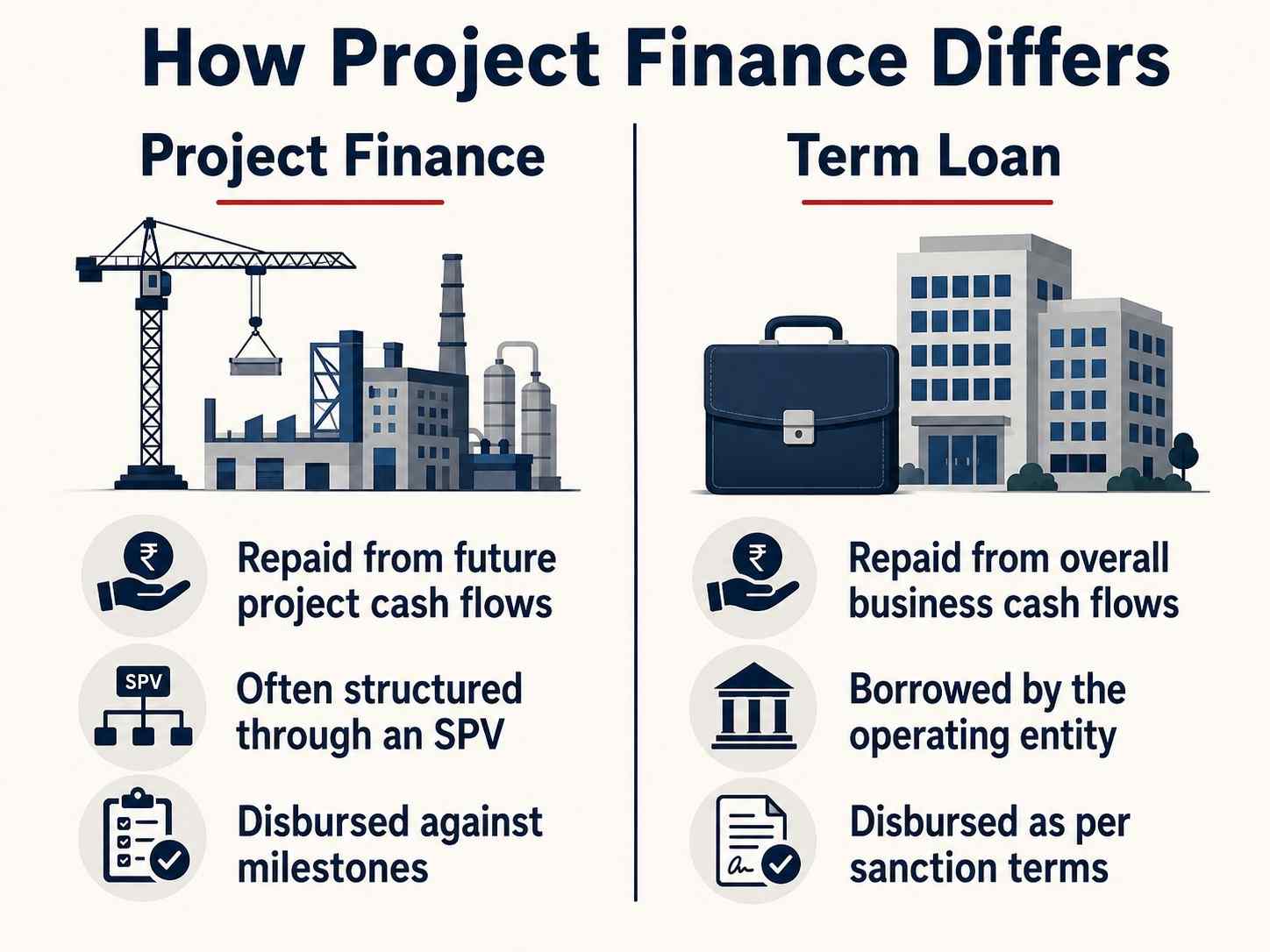
“Project finance” does not automatically mean non-recourse funding. Indian lenders may require promoter guarantees, cost-overrun support, collateral or other credit enhancement. The final structure is transaction-specific.
How Does Project Finance Work in India?
The project company first estimates the total cost and identifies the means of finance: promoter equity, subordinated funding, grants where applicable and lender debt. A well-prepared project report for bank finance connects technical capacity, implementation schedule, market demand, project cost, revenue assumptions and debt servicing.
The project then moves through three broad phases: design, construction and operation. Financial closure occurs when the capital structure-including debt, equity and any grant-covering at least 90% of project cost becomes legally binding. Before disbursement, the lender must document financial closure, the original Date of Commencement of Commercial Operations (DCCO), a stage-linked disbursement schedule and realistic post-DCCO repayment.
Funds are normally released in tranches after evidence of promoter contribution, invoices, approvals and physical progress. RBI requires lenders to align disbursement with project completion and equity infusion; the lender’s independent engineer or architect certifies progress. This is why sanction and disbursement are separate milestones.
What Types of Project Finance Are Available?
|
Option |
Suitable use |
Key consideration |
|
Greenfield finance |
Building a new facility or asset |
Higher construction, approval and demand risk |
|
Brownfield finance |
Expansion, upgrade or capacity addition |
Existing operations provide performance evidence |
|
Infrastructure or PPP finance |
Roads, power, transport and public assets |
Concession, appointed date and right-of-way are critical |
|
Industrial project loan |
Plant, machinery, buildings and utilities |
Technical feasibility and product demand drive appraisal |
|
Consortium or syndicated finance |
Large debt requirement shared by lenders |
Common terms, security sharing and aligned DCCO are needed |
|
Scheme-linked micro-project finance |
Eligible new or expanding micro units |
Scheme conditions and lender appraisal both apply |
Debt may be combined with working-capital limits, bank guarantees or letters of credit. SBI, for example, describes project finance as including term loans, foreign-currency facilities and non-fund-based facilities for infrastructure and non-infrastructure ventures in its official project-finance FAQ. The right mix depends on construction purchases, import content, operating cycles and contractual obligations.
If a company’s memorandum does not cover the proposed activity, it may need to change its main object clause before borrowing. Where equity commitments exceed the present capital headroom, promoters should also examine an increase i nauthorised share capital early rather than after sanction.
Who Is Eligible for Project Finance in India?
There is no single statutory eligibility checklist for every project-finance product. Banks, NBFCs and financial institutions set sector, exposure, sponsor and security criteria through their credit policies. Broadly, an applicant must demonstrate the following:
|
Assessment area |
What the lender generally expects |
|
Applicant |
Legally constituted entity with authority to undertake and finance the project |
|
Promoters |
Relevant experience, acceptable conduct, financial capacity and committed contribution |
|
Project |
Technically feasible, commercially viable and permitted at the proposed location |
|
Cash flow |
Defensible revenue, operating-cost and debt-service assumptions with downside capacity |
|
Equity |
Identified source and a credible infusion schedule; amount follows lender policy |
|
Land and approvals |
Clear title or valid rights, with applicable permissions available at the required stage |
|
Contracts |
Bankable EPC, supply, offtake, concession and O&M arrangements where relevant |
|
Credit conduct |
Satisfactory repayment and banking history, without undisclosed defaults |
|
Security |
Acceptable project assets, receivables, collateral or guarantees as stipulated |
Lenders review both the SPV and its sponsors because a new project company may have no operating history. A clean financial and legal due-diligence review can expose title defects, contingent liabilities, related-party issues and expired licences before the lender finds them.
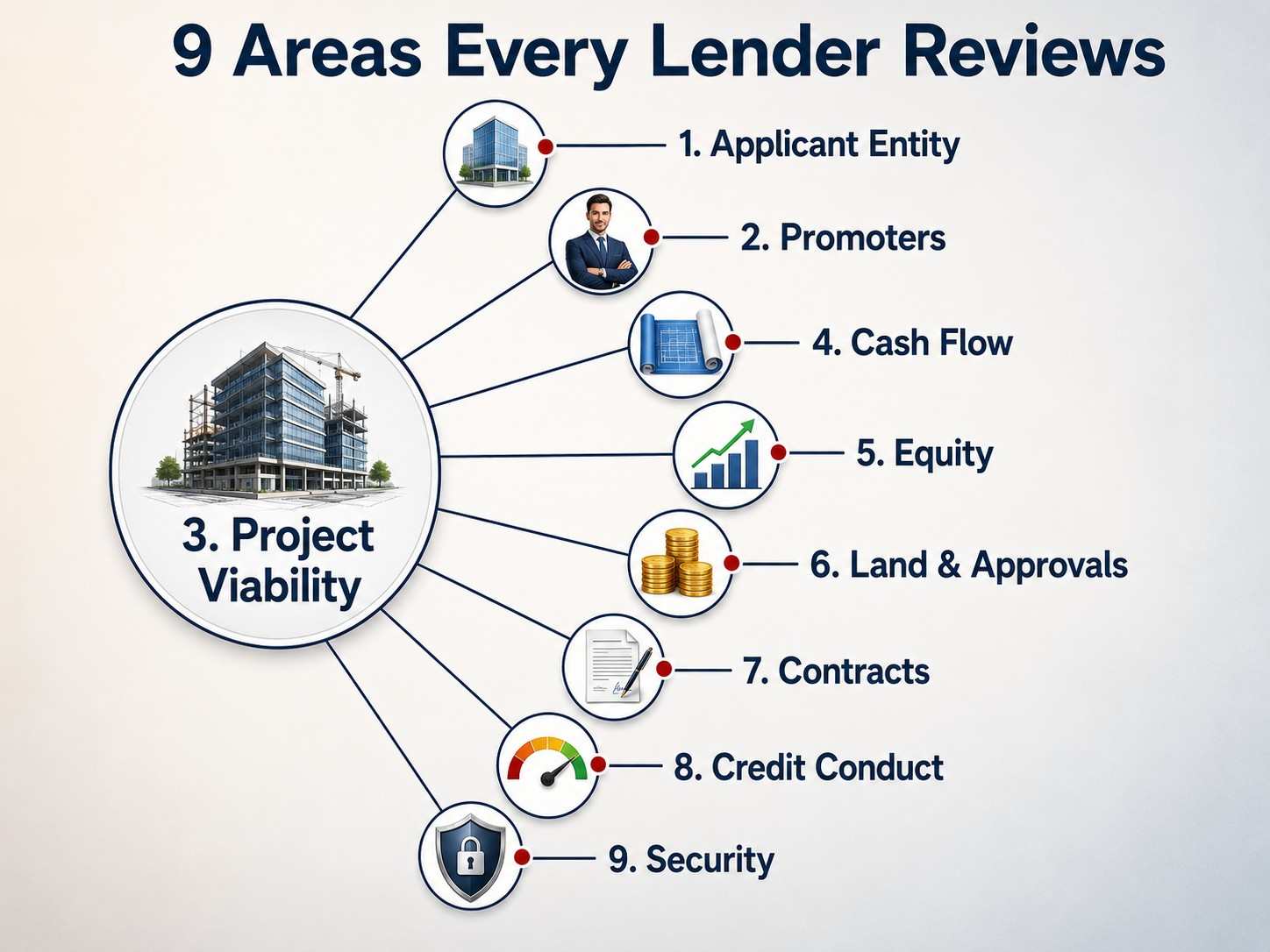
Do not treat a quoted credit score, business vintage or debt-equity ratio on a comparison website as a nationwide rule. These parameters vary by lender, product, sector and project risk. Even a strong sponsor cannot compensate for an unviable project or missing permission.
What Documents are Required for Project Finance?
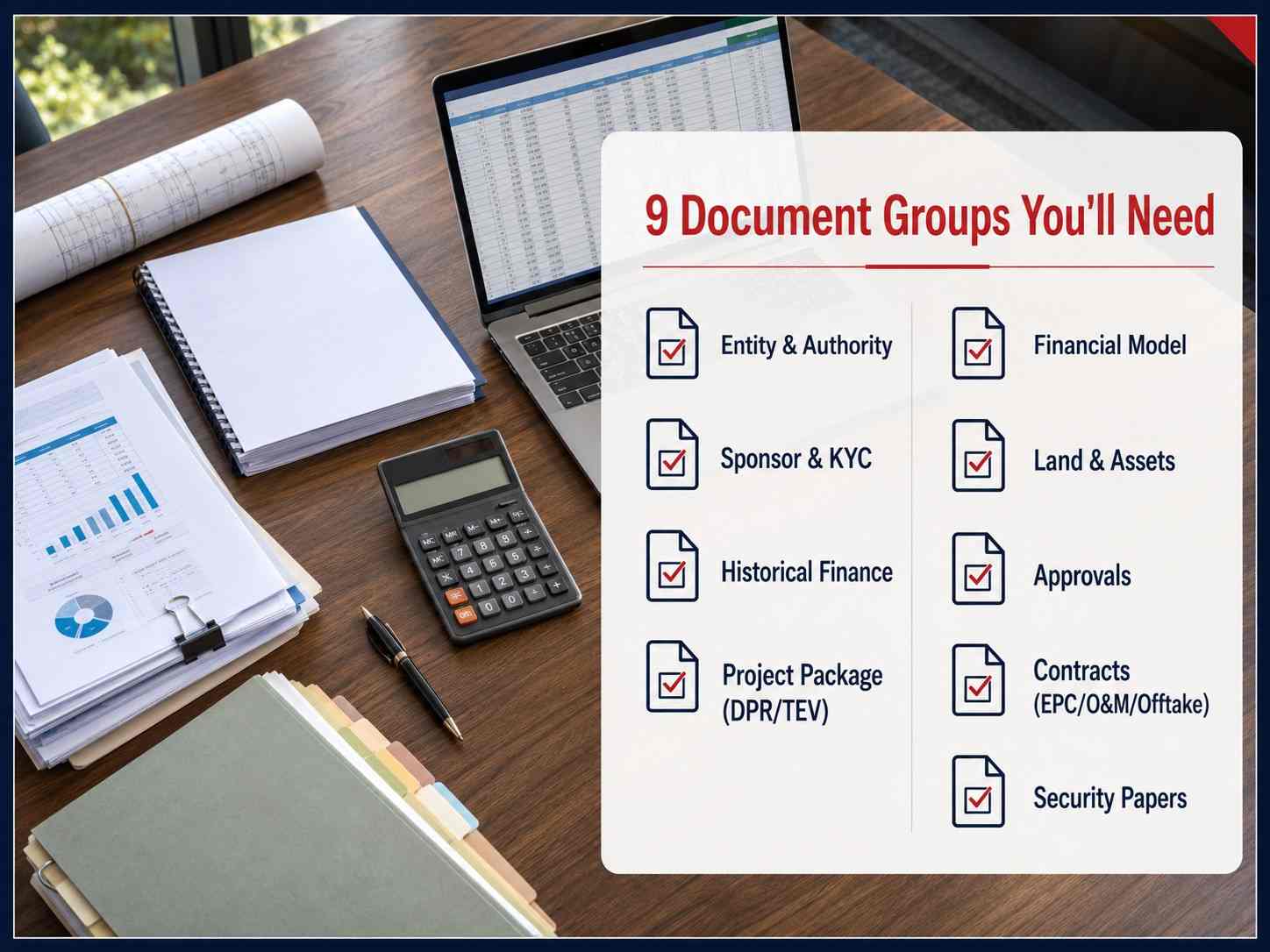
The lender issues its own checklist. SBI’s commercial-loan documentation guidance includes entity documents, promoter assets and liabilities, financial statements, projections, title deeds and statutory approvals. NEDFi similarly lists KYC and business proofs while reserving the right to request additional material on its project-finance product page.
|
Document group |
Typical records |
|
Entity and authority |
Incorporation certificate, constitutional documents, PAN, shareholding, board resolution and borrowing powers |
|
Sponsor and KYC |
Identity and address proofs, profiles, net-worth statements and source of equity |
|
Historical finance |
Audited statements, bank statements, debt schedule, tax returns and GST records |
|
Project package |
DPR, TEV or feasibility study, project cost, means of finance, implementation schedule and quotations |
|
Financial model |
Profit and loss, balance sheet, cash flow, debt schedule, sensitivities, DSCR and break-even analysis |
|
Land and assets |
Title or lease, encumbrance search, valuation, site plan and insurance proposal |
|
Approvals |
Environmental, pollution, building, utility, sector and local permissions, as applicable |
|
Contracts |
EPC, O&M, supply, offtake, concession, licence, shareholder and key customer agreements |
|
Security papers |
Mortgage, hypothecation, pledge, escrow, guarantees and intercreditor documents |
Reconcile the model with source records. Reliable small-business accounting records, completed income-tax return filings, consistent GST registration details and current ROC annual return filings reduce avoidable queries. Forecasts should be assumptions-led, not reverse-engineered to reach a preferred loan amount.
What Costs and Terms Should You Compare?
Project finance cost is wider than the headline interest rate. Pricing depends on the lender’s cost of funds, project and sponsor risk, security, tenor, rating and structure; RBI does not prescribe one universal project-finance rate.
|
Cost or term |
What to verify |
|
Interest |
Fixed or floating basis, benchmark, spread and reset frequency |
|
Upfront charges |
Processing, appraisal, syndication or commitment fees and applicable taxes |
|
Third-party expenses |
TEV, legal review, engineer, valuation, insurance and security perfection |
|
Undrawn commitment |
Charge, if any, on sanctioned but unused limits |
|
Prepayment |
Lock-in, notice and prepayment or foreclosure charge |
|
Default consequences |
Penal charges, covenant breach and event-of-default provisions |
|
Repayment |
Moratorium, instalment pattern, cash sweep and final maturity |
Applicability should be checked where the borrowing entity or facility falls outside those categories.
RBI also requires a breach-related penalty to be treated as a penal charge rather than additional penal interest, with no further interest capitalised on that charge. The amount and reason must be disclosed under the penal-charges directions. Borrowers should nevertheless negotiate the complete facility agreement, not rely only on a summary.
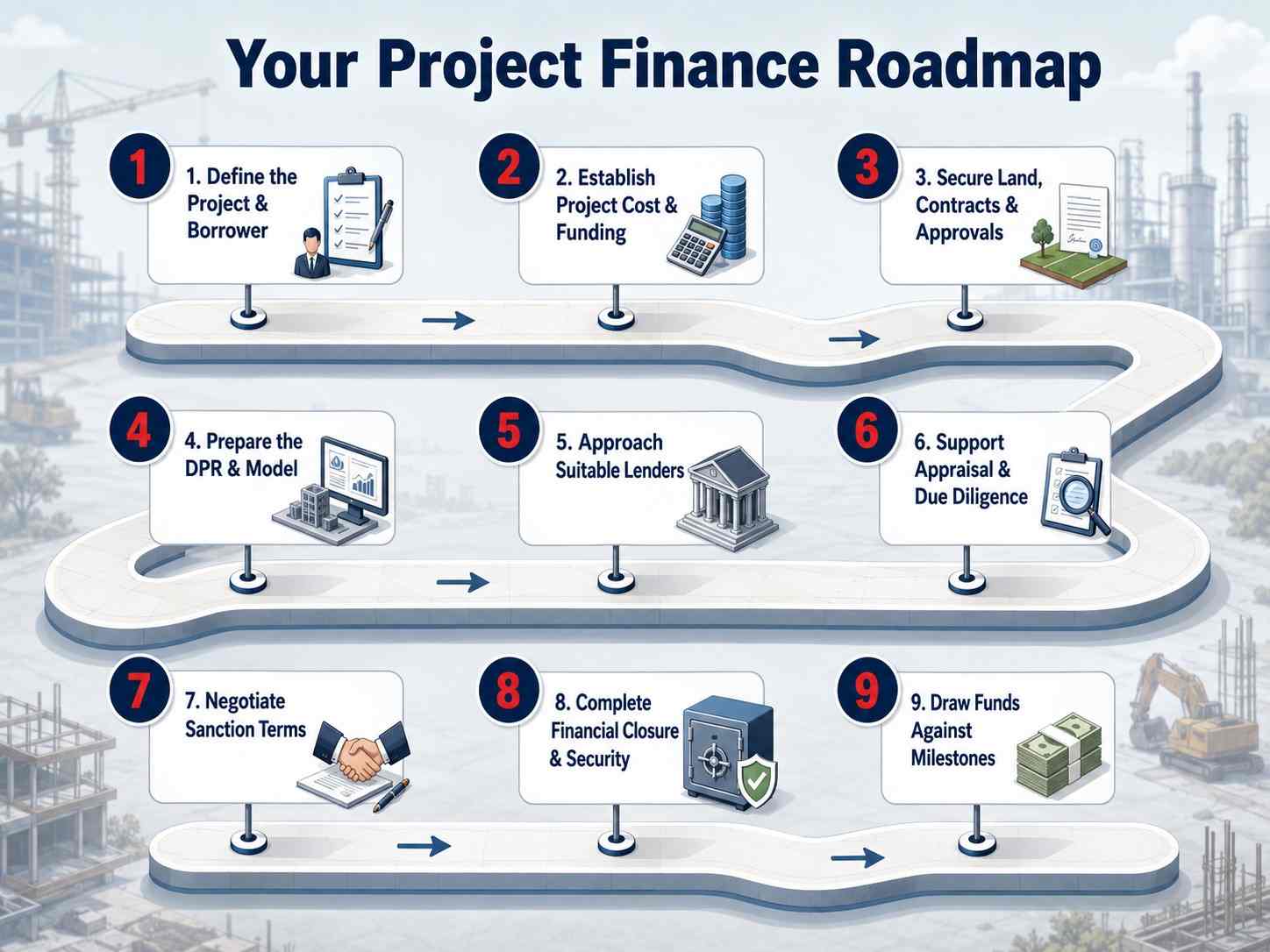
How to Apply for Project Finance: Step-by-Step Process
Below is the process for applying:
Define the project and borrower
Confirm project scope, location, capacity, implementation route and SPV ownership. Complete applicable Udyam registration or Industrial Entrepreneur Memorandum filing where relevant.
Establish project cost and funding
Obtain defensible land, civil-work, machinery, pre-operative and interest-during-construction estimates. Identify promoter equity and contingency funding.
Secure land, contracts and approvals
Resolve title and access, select contractors, and map every permission to its required date. An environment, health and safety compliance review may reveal gaps affecting construction or operations.
Prepare the DPR and model
Align capacity, selling prices, ramp-up, operating expenses, tax, working capital and repayment. Run delay, cost-overrun and lower-revenue sensitivities.
Approach suitable lenders
Match sector appetite, ticket size, geography and structure. Submit a complete proposal and record assumptions consistently across forms, presentations and the model.
Support appraisal and due diligence
Answer technical, financial, legal and environmental questions; facilitate site visits and provide requested clarifications. A lender may appoint independent advisers at the borrower’s cost.
Negotiate sanction terms
Review pricing, promoter contribution, security, covenants, conditions precedent, DCCO, repayment, reporting and cost-overrun support.
Complete financial closure and security
Execute financing and project documents, bring required equity, perfect mortgages or charges and satisfy conditions precedent.
Draw funds against milestones
Submit utilisation evidence and progress certificates. Keep the lender informed of delay, scope change or budget variance instead of waiting for a covenant breach.
There is no fixed statutory approval time. Complexity, consortium formation, approvals, documentation quality, valuation and lender workload can materially change the timeline.
How Do Lenders Assess a Project Finance Application?
Lenders test whether the project can be built on budget, start on time and generate sufficient cash after operating expenses. The model’s DSCR, internal rate of return, break-even level and sensitivity cases matter, but so do contract quality and execution capability. They examine contractor strength, raw-material availability, customer concentration, tariff or price risk, insurance and termination payments.
The RBI framework effective 1 October 2025 adds specific prudential conditions. All applicable approvals must be obtained before financial closure. Before disbursement, lenders must ensure at least 50% land or right-of-way availability for PPP infrastructure projects and 75% for other projects; transmission lines follow lender assessment. A TEV study is required for the specified reassessment under the Directions where aggregate lender exposure is ₹100 crore or more.
Repayment, including any moratorium, cannot exceed 85% of the project’s economic life under the Directions. These are lender-facing prudential rules, not a promise that a proposal meeting them will be sanctioned. A project asset valuation report may support security assessment, but collateral value does not replace cash-flow viability.
Which Government Schemes May Support Smaller Projects?
Government support is not a substitute for lender appraisal. It applies only when the borrower, activity, lender and facility meet the scheme rules.
CGTMSE can cover eligible fund and non-fund-based credit facilities to micro and small enterprises up to ₹10 crore per eligible borrower, subject to scheme conditions and lender participation. Its current credit-facility parameters also permit hybrid security, where the unsecured portion may receive cover. The guarantee protects the lender; it does not guarantee sanction to the borrower. A detailed CGTMSE collateral-free loan guide can help applicants distinguish guarantee cover from a direct government loan.
PMEGP supports eligible new micro-enterprises. The official PMEGP eligibility states maximum project costs of ₹50 lakh for manufacturing and ₹20 lakh for service projects for the relevant assistance, with scheme-specific contribution, education and activity conditions. Larger commercial projects should consider ordinary institutional finance or sector-specific facilities instead of forcing a scheme fit.
MSME status itself changed from 1 April 2025. The current thresholds are: micro-investment up to ₹2.5 crore and turnover up to ₹10 crore; small-₹25 crore and ₹100 crore; medium-₹125 crore and ₹500 crore. The Ministry of MSME year-end review confirms the effective date and revised limits.
What Happens After Sanction?
A sanction letter records the approved amount and conditions, but it is not the same as receiving money. The borrower must accept the terms, execute facility and security documents, contribute the equity, provide insurance and satisfy all conditions precedent. If several lenders participate, documentation and security-sharing arrangements may be required.
Before each drawdown, the lender can ask for invoices, certificates, engineer reports, proof of utilisation and confirmation that no default has occurred. Disbursement may be paid to equipment suppliers or contractors rather than into a usable account.
Management should maintain a compliance calendar covering construction milestones, lender reports, financial covenants, insurance renewals and approval validity. Any material delay, cost increase or scope change should be reported because it may require approval, equity or financing terms.
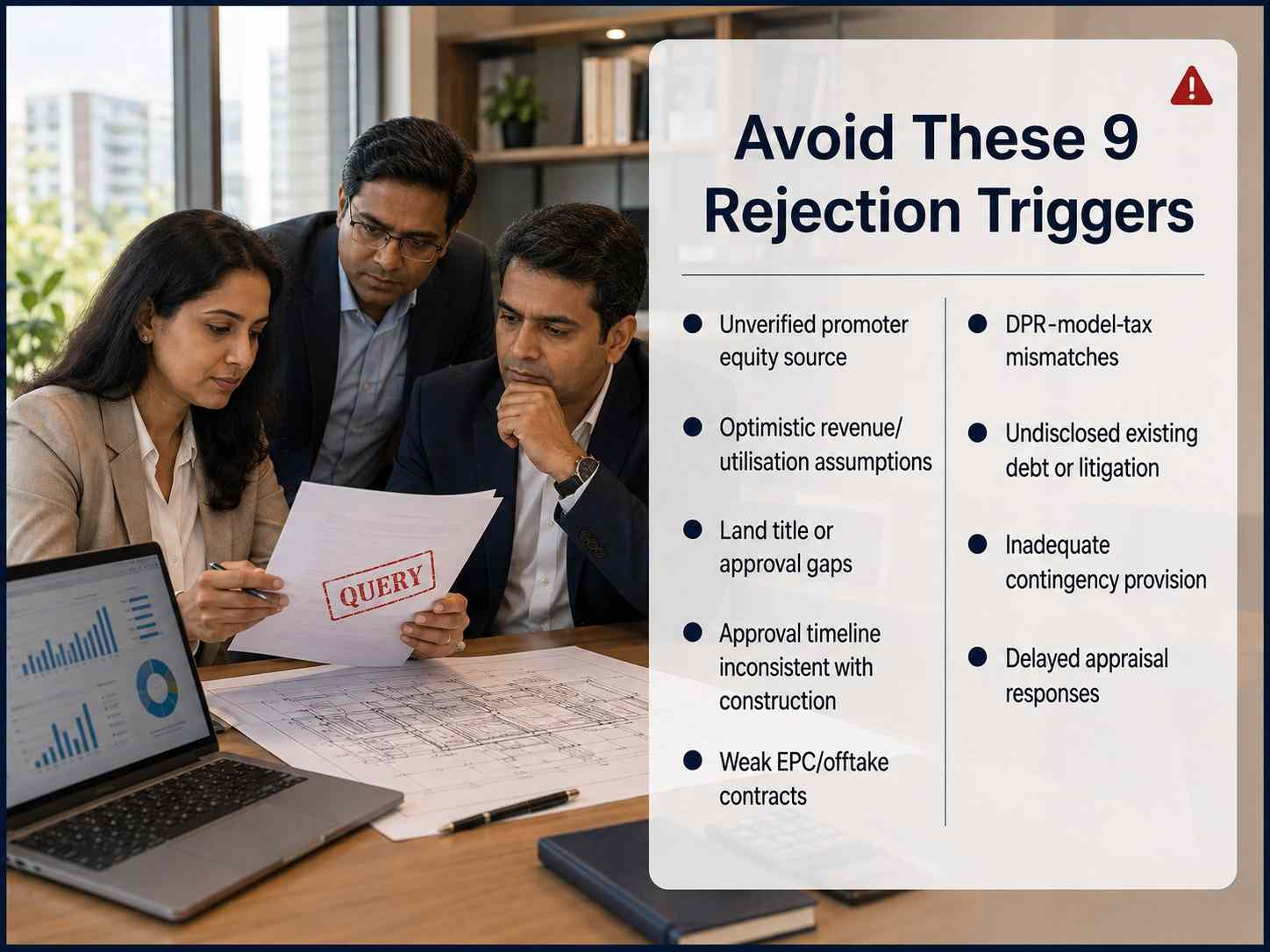
Why are Project Finance Applications Delayed or Rejected?
Common problems include:
-
promoter equity shown on paper but not supported by a verifiable source;
-
optimistic capacity utilisation, selling price or commissioning assumptions;
-
land title, access, conversion or environmental issues;
-
incomplete permits or an approval timeline inconsistent with construction;
-
weak EPC, supply or offtake contracts and excessive counterparty concentration;
-
mismatches among the DPR, financial model, tax records and application;
-
existing debt, litigation or related-party transactions not disclosed upfront;
-
inadequate working capital, contingency or interest-during-construction provision; and
-
delayed responses during appraisal or conditions-precedent completion.
For a company borrower, security creation may also trigger ROC compliance. Section 77 of the Companies Act requires particulars of a charge to be filed within 30 days of creation, subject to the statutory extension mechanism and fees described in the Companies Act, 2013. Timely registration of the lender’s charge should be included in the closing checklist.
Conclusion
To obtain Project Finance in India, begin with a viable project and evidence-not a desired loan amount. Settle the entity and promoter contribution, secure land and approvals, prepare a defensible DPR, align contracts with the model, compare the full borrowing cost and complete security documentation on time.
The strongest file lets a lender trace every major assumption to a contract, quotation, approval or historical record. It also acknowledges downside risk and provides practical mitigation. That discipline cannot assure approval, but it gives the proposal a credible basis for appraisal, negotiation and financial closure.
FAQS
FAQs About Project Finance
-
Is project finance the same as a term loan?
Not exactly. Project finance may include a term loan, but repayment is structured primarily around the financed project’s future cash flows. A conventional term loan may instead be assessed mainly against the borrower’s existing operations and financial position.
- Can a newly incorporated company obtain Project Finance?
- Does project finance always require collateral?
- What is promoter contribution in a project loan?
- Is there a minimum CIBIL score for project finance?
- What is a DPR in project finance?
- What does DCCO mean?
- How long does project finance approval take?
- Can a project loan include working capital?
- What happens if a financed project is delayed?


