
How to Claim Startup Tax Exemption Under Section 80 IAC
- by kapil
- Updated September 23, 2026
- 38 mins read
You have built a DPIIT-recognised startup, it has finally turned profitable, and now the tax bill has arrived. The startup tax exemption under Section 80-IAC is the provision that can reduce that bill to zero for three consecutive years, provided you meet a condition that DPIIT recognition alone does not satisfy. Founders often learn about it only after their first profit year has ended, which is when most of the value has already been quietly lost.
This guide explains who qualifies, the documents the Inter-Ministerial Board expects, the step-by-step application process, the exact fees, and the mistakes that delay approvals. It also covers what the holiday does not cover, including minimum alternate tax and the profit-attribution rules.
One distinction matters from the start: Section 80-IAC is now Section 140 of the Income-tax Act, 2025, and it rewards planning done years before your first profitable return, not paperwork filed after it.
What Is the Startup Tax Exemption Under Section 80-IAC?
Section 80-IAC of the Income-tax Act, 1961 allowed an eligible startup a deduction equal to 100% of the profits and gains derived from its eligible business, and this is the provision every founder now searches for as the Startup India tax exemption. From 1 April 2026 that same startup tax exemption is carried out in Section 140 of the Income-tax Act, 2025. The substance of the benefit has not changed, and founders continue to refer to the startup tax exemption by its old section number.
The word “exemption” is used loosely. Technically this is a deduction. Your business income is computed normally, and then the eligible amount is subtracted while arriving at total income. That difference matters when the assessing officer examines which portion of your profit came from the eligible business and which did not, because the startup tax exemption protects only the eligible slice.
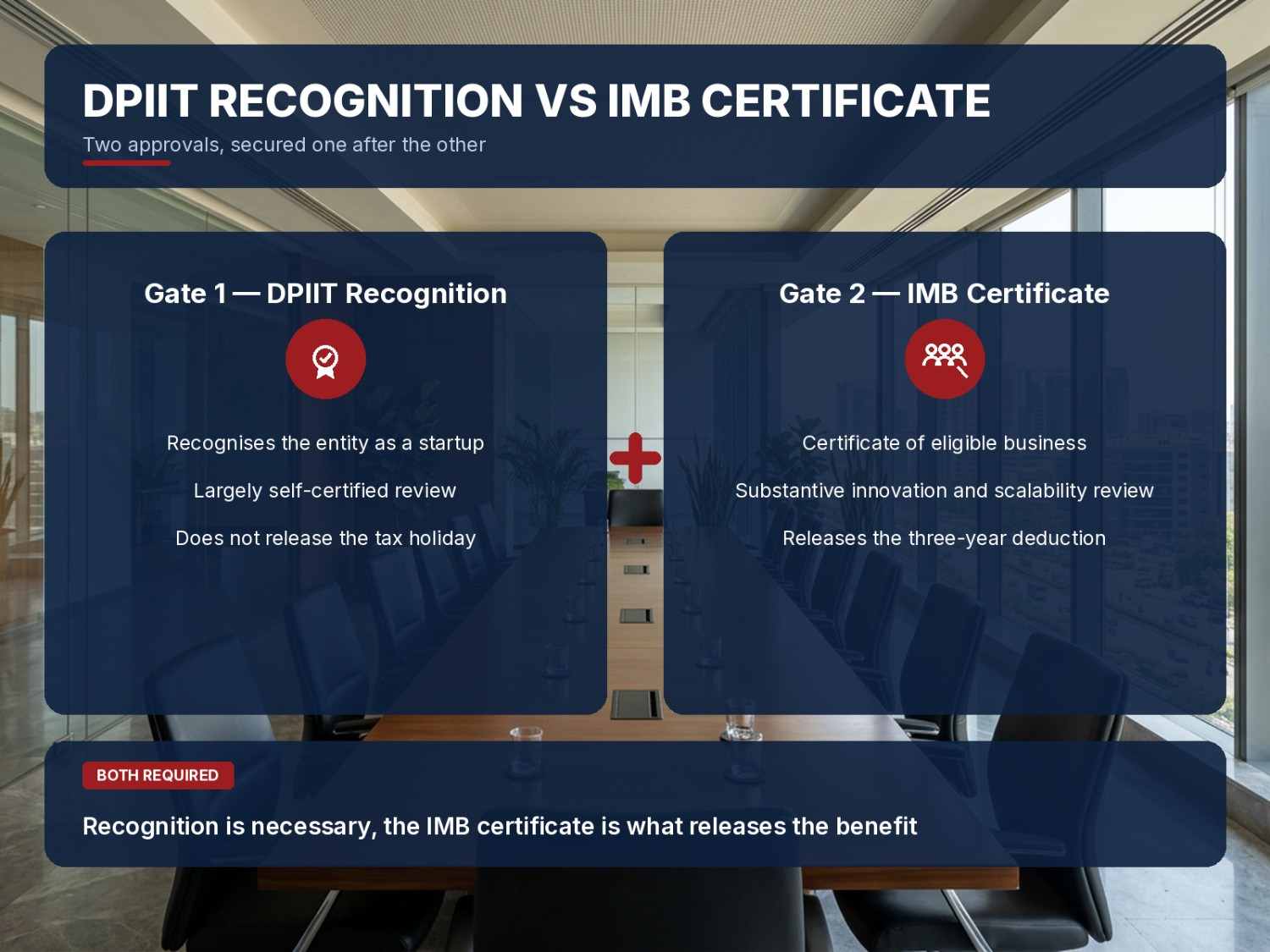
Two separate approvals stand between a startup and the Section 80-IAC tax exemption. The first is DPIIT recognition. The second is a certificate of eligible business from the Inter-Ministerial Board of Certification. Holding the first does not give you the second, and this is where most applications stall.
| Feature | Position Under the Law |
| Nature of benefit | A deduction against eligible business profit, not a blanket startup tax exemption from filing or assessment |
| Quantum | 100% of profits and gains of the eligible business |
| Number of years | Three consecutive tax years |
| Choice of years | Any three consecutive years within ten years from incorporation |
| Turnover limit | Must not exceed ₹100 crore in the relevant year |
| Entity types allowed | A company or a limited liability partnership only, whichever structure you have registered |
| Incorporation window | On or after 1 April 2016 and before 1 April 2030 |
| Approvals required | DPIIT recognition plus IMB certificate of eligible business |
| Government fee | No fee prescribed for either approval |
How the 100% Deduction Actually Works
Assume your company earns ₹1 crore of profit from its eligible business in a claim year and holds a valid IMB certificate for the Section 80-IAC tax exemption. The startup tax exemption reduces that ₹1 crore to nil for the purpose of computing total income, so no tax is payable on the operating profit at the normal corporate rate.
The deduction is not automatic for every rupee on your profit and loss statement. Interest on fixed deposits, rental income, dividend income and capital gains sit outside the eligible business, and none of them can be shielded by this DPIIT startup tax exemption. If your books pool all income into one figure without segment-level attribution, the claim becomes difficult to defend during assessment.
A second limitation applies to companies. Minimum alternate tax is computed on book profit, not on the income left after Chapter VI-A deductions. A company can therefore claim the full Section 80-IAC tax exemption and still pay tax on book profits in the same year. The amount paid becomes a credit that can be carried forward for up to 15 assessment years and set off once your normal tax liability exceeds the alternate minimum tax again.
Two traps sit inside this credit. It earns no interest, so its real value erodes over a long gap, and it is forfeited entirely if the company later switches to the concessional corporate regime. This limitation is the one most often missed by founders reading about the 3-year tax holiday for startups for the first time.
Section 80-IAC and Section 140 of the Income-tax Act, 2025
The Income-tax Act, 2025 replaced the Income-tax Act, 1961 with effect from 1 April 2026. The eligible startup deduction was re-coded, not removed. Confusion on this point causes founders to delay applications, because older guides still describe the Startup India tax exemption as though it sits only in the 1961 Act.
| Parameter | Section 80-IAC (Income-tax Act, 1961) | Section 140 (Income-tax Act, 2025) |
| Deduction | 100% of eligible business profits | The same startup tax exemption, 100% of eligible business profits |
| Period | Three consecutive assessment years | Three consecutive tax years |
| Selection window | Ten years from incorporation | Ten years from incorporation |
| Incorporation window | 1 April 2016 to 31 March 2030 | On or after 1 April 2016, before 1 April 2030 |
| Turnover cap | ₹100 crore | ₹100 crore |
| IMB certificate | Required | Required |
| Audit of eligible business accounts | Required before the specified date | Required before the specified date |
Who Qualifies for Section 80-IAC Tax Exemption?
Eligibility for the Startup India tax exemption is decided by the statute, not by the startup’s own assessment of how innovative it believes it is. Every condition below must hold in each year for which the deduction is claimed, because the test is applied afresh annually. A startup that qualified for the DPIIT startup tax exemption in the first claim year is not automatically qualified in the second.
| Eligibility Condition | What It Requires |
| Entity type | A company or a limited liability partnership |
| Incorporation date | On or after 1 April 2016 and before 1 April 2030 |
| Age at the time of claim | Still within ten years from the year of incorporation |
| DPIIT recognition | A valid Certificate of Recognition in force |
| IMB certificate | A certificate of eligible business from the Inter-Ministerial Board |
| Turnover | Not more than ₹100 crore in the tax year of the claim |
| Nature of business | Innovation, development or improvement of products, processes or services, or a scalable model with high potential for employment generation or wealth creation |
| Formation | Not formed by splitting up or reconstructing an existing business |
| Plant and machinery | Not formed by transferring previously used plant or machinery beyond the permitted limit |

DPIIT Recognition Limits Are Not the Same as Section 80-IAC Limits
Founders routinely assume that a DPIIT recognition threshold carries across to the tax exemption. It does not. The recognition framework and the deduction use different numbers, and confusing them is a common reason a startup discovers late that it does not qualify.
| Limit | DPIIT Recognition | Section 80-IAC Tax Exemption |
| Age of the entity | Up to 10 years from incorporation, and 20 years for a Deep Tech startup | Must still be within 10 years from the year of incorporation |
| Annual turnover | Up to ₹200 crore, and ₹300 crore for a Deep Tech startup | Not more than ₹100 crore in the tax year of the claim |
| Entity types allowed | Private limited company, LLP, registered partnership firm, cooperative society | Private limited company or LLP only |
| Innovation test | Required for recognition | Required, and tested again by the Inter-Ministerial Board |
The turnover gap matters most. A startup comfortable at ₹200 crore for recognition purposes is already outside the Section 80-IAC tax exemption once it crosses ₹100 crore. The Deep Tech relaxation extends the age and turnover limits for recognition, but the deduction itself still uses the 10-year and ₹100 crore figures. Plan against the tighter number.
A private limited company is the structure most applicants use, and the incorporation route for it is straightforward through private limited company registration. Registration under the Companies Act, 2013 gives you the separate legal identity, the shareholding register and the audited accounts that the Inter-Ministerial Board later examines in detail before granting the startup tax exemption.
An LLP is equally eligible for this DPIIT startup tax exemption, and it carries one practical advantage that many founders discover late. Where a company still faces minimum alternate tax on book profits during the holiday years, an LLP is placed differently under the alternate minimum tax provisions. LLP registration is worth evaluating at the structuring stage, because converting an entity later is far more expensive than choosing correctly at the start.
Entity Types That Cannot Claim the Holiday
A registered partnership firm, a sole proprietorship, a one person company and a public company fall outside this specific deduction. This surprises founders, because DPIIT recognition is open to a wider set of entity types than the tax deduction is.
A registered partnership firm can hold DPIIT recognition and use the other Startup India benefits, including the patent fee rebate and the self-certification routes. It simply cannot apply for the certificate of eligible business that unlocks the tax holiday. If the tax holiday is central to your plan, the entity decision has to be made before incorporation, not after it.
The Eligible Business Test
“Eligible business” means a business engaged in innovation, development or improvement of products, processes or services, or a scalable business model with a high potential of employment generation or wealth creation. This single condition decides the fate of most applications for the DPIIT startup tax exemption, and it is the condition candidates most often underestimate.
A business that is merely digital, or merely new, does not automatically satisfy the test. A generic reseller, a staffing business billing out consultant hours, or a franchise operation describing itself as technology-enabled is unlikely to clear the evaluation. The innovation thread has to be specific, documented and tied to something you actually built. If the business cannot be described in those terms on paper, the Section 80-IAC tax exemption is unlikely to follow, however strong the revenue numbers look.
DPIIT Startup Tax Exemption vs IMB Certification: Why Both Matter
The DPIIT startup tax exemption is the phrase founders search for, but the approval that releases the money is issued by the Inter-Ministerial Board. Treating these as one step is the single most expensive misunderstanding in this area of startup taxation, because the approval is released by the board, not by the recognition certificate.
| Basis | DPIIT Recognition | IMB Certificate of Eligible Business |
| What it certifies | That the entity is a recognised startup | That the business is eligible for the Section 80-IAC tax exemption |
| Who reviews it | Department for Promotion of Industry and Internal Trade | Inter-Ministerial Board of Certification |
| Typical filing route | Startup India portal and the National Single Window System | Startup India portal, through the 80-IAC application |
| Assessment depth | Documentary and largely self-certified | Substantive evaluation of innovation, scalability, employment potential and financials |
| Indicator of outcome | Generally issued within days for complete applications | Complete applications are reviewed within a stated 120-day framework, though practice can take longer |
| Effect of holding it | Opens the Startup India benefit basket | Releases the three-year deduction on eligible profits |
| Practical takeaway | Necessary, but never sufficient on its own | The approval that actually releases the startup tax exemption |
The government has stated that complete applications under the revised evaluation framework are reviewed within 120 days, and that cumulative approvals since the scheme began have crossed 3,700 startups. The eligibility window was also extended, so startups incorporated before 1 April 2030 can apply.
Those figures explain both sides of the reality: the process for the Section 80-IAC tax exemption is now structured, but the number of approvals remains small relative to the number of recognised startups. The official statement on the revised framework sets out the review position and the extended window.
Documents Required for Section 80-IAC Tax Exemption
The 80-IAC application is not a short form. It is a five-step filing with a document set that mixes corporate records, financial evidence and proof of innovation. Preparing the set before you begin the form is faster than hunting for documents between steps, and documents are the only evidence the board ever sees.
The official 80-IAC application page lists the document requirements and the prescribed formats, and it is the version to work from rather than any downloaded checklist.
| Document | Purpose in the Application |
| Memorandum of Association or LLP Deed | Establishes the objects and the entity structure |
| Board resolution | Authorises the application and the claim |
| Shareholding pattern as per the MoA and current shareholding | Shows ownership, including director or partner interests in other entities |
| Acknowledgement receipts of income tax returns | Supports the revenue and profit figures declared |
| Audited balance sheet and profit and loss statement | Provides the financial base for the three-year figures |
| Chartered Accountant certification on formation | Confirms the startup was not formed by splitting up or reconstructing an existing business |
| Declaration of scalability | Records revenue growth against the prescribed thresholds |
| Proof of credit rating, if any | Optional supporting evidence from an accredited agency |
| Intellectual property filings and grants | Evidence that the innovation is real and protected |
| Awards and recognitions | District, state or national level recognition, where available |
| Pitch deck | Explains the business, product or service in presentation form |
| Employment records and HR declaration | Direct employment, employees in non-metro locations, and inclusion data |
| Proof of investment received | Funding declarations, investor details, term sheets or agreements |
| Video pitch link | Allows the board to hear the founding team explain the innovation it is being asked to certify |
For the Section 80-IAC tax exemption, intellectual property carries unusual weight because it converts a claim of innovation into a dated record. Filings and grants are objective, and the Inter-Ministerial Board can verify them.
Where a startup has protectable technology, patent registration creates exactly the kind of evidence the evaluation looks for, because the documents carry application numbers and dates that stand independently of anything the founder writes.

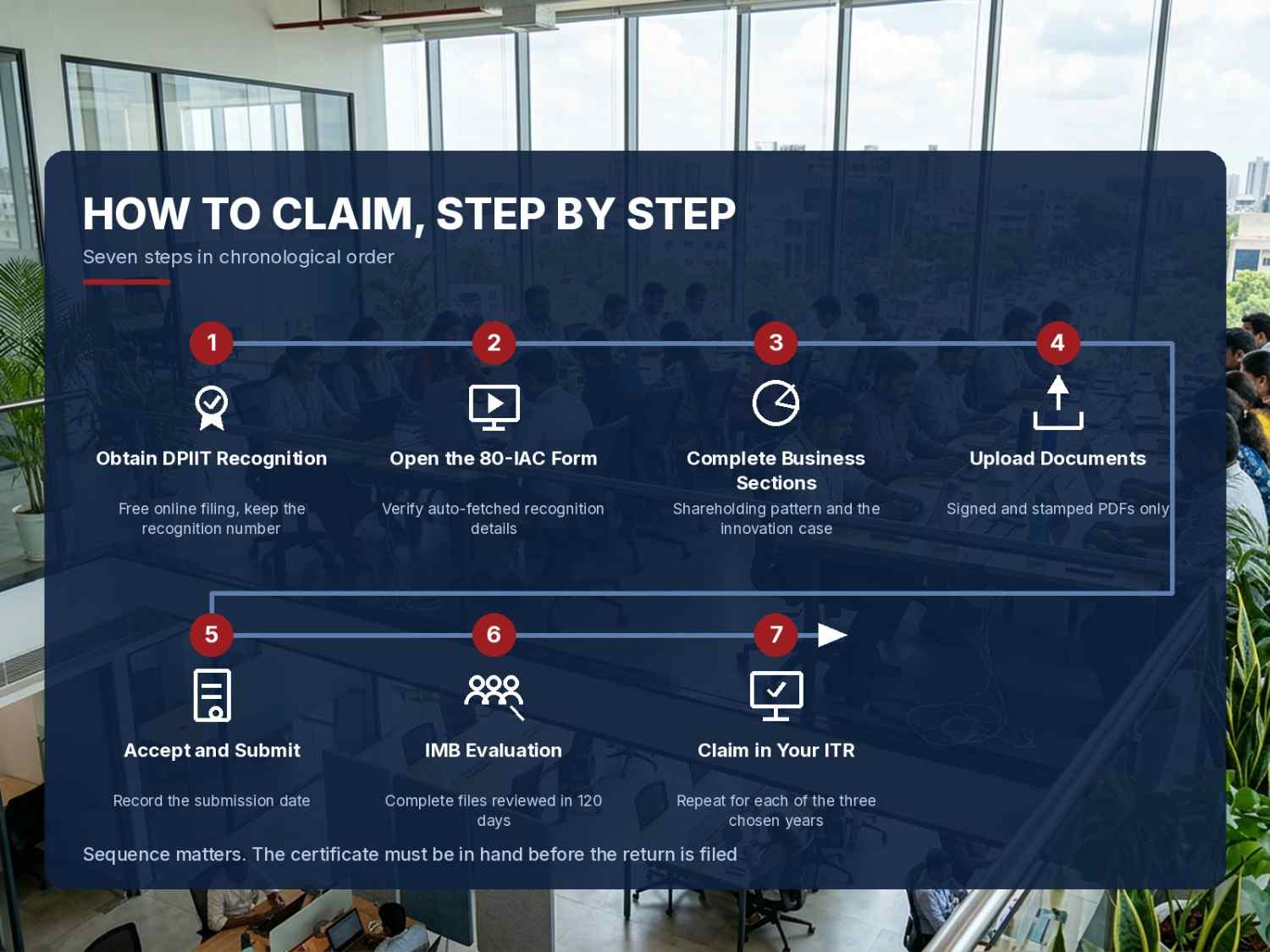
How to Claim Startup Tax Exemption: Step-by-Step Process
The sequence below follows the order in which the portal actually works when a startup tax exemption is claimed for the first time. Skipping ahead, or filing the deduction before the certificate is in hand, is the most common source of avoidable delay.
Step 1: Obtain DPIIT Recognition
Recognition is the entry condition for the startup tax exemption under this section, and the entire process is free of government fee. Applications are filed online, and complete submissions are generally decided within days rather than months. Keep the certificate and the recognition number handy, because the 80-IAC form pulls your recognition details across automatically and asks you to confirm them before proceeding.
If you have not yet obtained it, the full eligibility and drafting process is set out in this guide to Startup India registration. The innovation description in that application is the same narrative the Inter-Ministerial Board later tests, so write it with the eventual tax filing in mind rather than as a formality.
Step 2: Start the 80-IAC Application and Confirm Recognition Details
Log in to the Startup India portal and open the 80-IAC application that carries your startup tax exemption request. The first screen displays the details fetched from your recognition form, including the entity name, date of incorporation, registration number, address, nature of business, DIPP number, PAN and sector.
Read this screen carefully before confirming. Any mismatch between the recognition record and your current corporate record becomes a query later. If the details are outdated, correct the recognition form first and let the updated information flow through to the tax exemption application.
Step 3: Complete the 80-IAC Details and Business Sections
The application then asks for the existing or proposed activities, the board resolution, and the shareholding pattern both as per the Memorandum of Association and as it stands today. Where the two patterns are identical, a single confirmation can be recorded on the form.
This is also the screen where the innovation case for the 3-year tax holiday for startups is made in text. Describe what you built, what makes it difficult to replicate, and why the model scales. Applications that describe the business only as technology-based or platform-driven tend to come back with queries rather than approvals.
Step 4: Upload Documents and Evidence
Upload the audited financial statements, income tax return acknowledgements, Chartered Accountant certifications, intellectual property proof, award records, employment data, investment proof and the pitch deck. Files are accepted in PDF and should be signed and stamped wherever a format is prescribed.
Two details cause repeated rejections. A SPICe Memorandum of Association must be printed and scanned rather than uploaded in its raw form, and financial statements must carry the auditor’s signature, stamp and membership number. Treat every upload as evidence that will later be read adversarially by an assessing officer.
Step 5: Accept the Declaration and Submit
The final step carries a declaration covering the accuracy of the information and the conditions on formation and machinery. Read it fully before accepting, because it is the same declaration the department relies on if it later examines whether the approval should be withdrawn.
Submission is complete only after the terms are accepted and the application is lodged. Record the submission date. The review framework operates on complete applications, and an incomplete set restarts the clock rather than pausing it.
Step 6: Await the Inter-Ministerial Board Evaluation
The board evaluates innovation, scalability, market potential and contribution to employment before it issues any startup tax exemption certificate. It may seek clarifications, and the speed of your reply matters considerably. Once approved, the certificate of eligible business is issued and can be downloaded from the portal.
Plan the timing of this step around profit, not around incorporation. If you know your first profitable year is two years away, the application should still be filed well before that year begins, so that the certificate is in hand when the claim is first made.
Step 7: Claim the Deduction in Your Income Tax Return
The deduction is claimed in the income tax return for each of the three chosen years, supported by the IMB certificate. The accounts of the eligible business must be audited before the specified date, and the audit report is furnished within that date. This is the step where the startup tax exemption is actually claimed on the return, and it repeats in each of the three chosen years.
One obligation does not pause during the holiday. The company or LLP must still file its income tax return every year, and the accounts of the eligible business must be audited, because the deduction is claimed on that return. A company files ITR-6 and an LLP files ITR-5, and the company form carries a dedicated schedule for this deduction where the startup recognition number and the Inter-Ministerial Board certificate details are reported.
Filing quality decides whether the claim survives scrutiny. The return, the audit-linked deadlines and the schedules that carry the claim are all part of a wider annual cycle, and the filing expectations for businesses are set out in this overview of income tax filing.
What Does the Startup Tax Exemption Really Cost?
The straight answer to the fee question is simple, and it is also the strongest fact in this article. The startup tax exemption itself has no government price. DPIIT recognition is free, the 80-IAC application is free, the certificate carries no issuance charge, and there is no renewal fee because nothing is renewed. On the official application form, the applicant confirms turnover and formation conditions, but no fee is demanded anywhere in the process.
Where founders lose money is everywhere around the exemption. The following tables separate the published statutory amounts from the costs that no regulator fixes.
What the Exemption Itself Costs
| Item | Official Position | Verified Amount |
| DPIIT recognition application | No government fee, online filing | ₹0 |
| 80-IAC application through the Startup India portal | No government fee | ₹0 |
| Issue and download of the certificate of eligible business | No charge | ₹0 |
| Retention of the certificate | No renewal cycle exists | Not applicable |
| Procedure at the evaluation stage | No filing or hearing fee published | ₹0 |
What It Costs to Prepare the Entity
These are the statutory amounts published in the MCA schedules. They are payable whether or not you ever claim the exemption, so they are the true cost of getting the structure in place.
Two things stand out here. Incorporation of a company at a modest authorised capital costs nothing in MCA filing fee, which surprises most founders, and an LLP is the cheaper route to a FiLLiP filing. The variable that catches people out is stamp duty, which is a state subject and can range from a few thousand rupees in one state to considerably more in another for the same capital. The portal computes it at the time of filing.
Statutory Fee Concessions the Recognition Unlocks
These are the rebates that DPIIT recognition itself creates, and they are worth more than most founders realise. All figures are for electronic filing.
| Filing | Rate for a DPIIT-Recognised Startup | Rate for Other Applicants | Saving |
| Patent application, Form 1, up to 30 pages and 10 claims | ₹1,600 | ₹8,000 | ₹6,400 |
| Patent examination request, Form 18 | ₹4,000 | ₹20,000 | ₹16,000 |
| Patent early publication, Form 9 | ₹2,500 | ₹12,500 | ₹10,000 |
| Patent expedited examination | ₹8,000 | ₹60,000 | ₹52,000 |
| Trademark application, Form TM-A, per class per mark | ₹4,500 | ₹9,000 | ₹4,500 |
| Patent claims beyond 10, each | ₹320 | ₹1,600 | ₹1,280 |
| Patent pages beyond 30, each | ₹160 | ₹800 | ₹640 |
The patent concession is claimed by filing Form 28 with proof of status, and the trademark concession by selecting the startup or small enterprise category in the form with the DPIIT certificate attached. A large company named as a joint applicant takes the whole filing back to the higher rate, so applicant structure should be decided before filing rather than after.
Recurring Costs and Professional Charges
No regulator fixes what a chartered accountant or consultant charges, and no official fee schedule exists for audit or return preparation. Anyone quoting you a definite figure for these is quoting a market rate, not a statutory one.
| Item | Position |
| Statutory audit, audit report and certifications for the claim years | Professional fees. Not fixed by any regulator and not publicly disclosed by the government |
| Income tax return preparation and filing | Professional fees, payable every year whether or not the deduction is claimed |
| LLP annual filings, Form 11 and Form 8 | ₹50 to ₹100 each by contribution slab, with a late fee of ₹100 per day and no upper cap |
| Company annual filings with the Registrar | Slab-based statutory fees, separate from the exemption |
| GST on professional fees | Professional invoices generally attract GST, which is charged over and above the fee |
Three practical warnings follow. First, do not pay any intermediary a government fee for DPIIT recognition or for the 80-IAC application, because none is prescribed. Second, budget for the audit and return costs across all three claim years, because they fall due regardless of how the claim turns out. Third, ask any consultant for a written quotation that separates government fees from professional fees, so that you can see which part is statutory and which part is negotiable.
Choosing the Three Profit Years for Your 3-Year Tax Holiday for Startups
The law permits any three consecutive tax years within ten years from the year of incorporation. It does not require you to begin in the first year you become eligible, and it does not require you to begin in the first profitable year. That flexibility is the main planning lever available to a founder, and it decides the real value of the startup tax exemption.
A startup that uses its 3-year tax holiday for startups on three low-profit years spends the benefit at a fraction of its value, which is why year selection is treated as a planning decision rather than an accounting one. A startup that waits and claims in its three strongest consecutive years captures the full amount, provided it still satisfies every condition in those years.
| Scenario | Choice of Years | Practical Outcome |
| Break-even years followed by fast growth | Delay the claim to the high-profit years | Deduction absorbs the largest possible profit |
| Steady moderate profits from year two | Claim early and consecutive | Benefit is certain and cash flow improves immediately |
| Profit expected only after year five | Delay, but secure the certificate early | Certificate is in hand before the claim year begins |
| Sharp one-year spike then a fall | Ensure the spike sits inside the three consecutive years | The deduction is not wasted on thin years |
Two constraints limit the flexibility. The years must be consecutive once you begin, and you must satisfy the eligibility conditions in each of those years. Because conditions are tested annually, a turnover breach or a lapse in recognition in one claim year affects that year directly and cannot be repaired afterwards. This is the operational discipline that a 3-year tax holiday for startups demands from a growing business.

5 Best Ways to Save Tax Under Section 80-IAC
Each of these five decisions is within the founder’s control, each one has a deadline attached to it, and together they decide how much of the Section 80-IAC tax exemption you actually keep.
Way 1: File the 80-IAC Application Before Your First Profitable Year
The certificate takes time, and profit does not wait. The single most common regret among founders is delaying the startup tax exemption application until the year in which tax is actually due. Founders who apply in the same year they first owe tax often end up paying tax on that year and losing it permanently, because the deduction cannot be carried forward, and a startup tax exemption not claimed in the chosen year is simply lost.
Work backwards from your projected profit. If your financial model shows the first strong profit in the third financial year, the application should be filed at least a few months before that year ends. The board reviews applications periodically, and complete applications move faster than those that arrive mid-cycle with queries attached.
Way 2: Wait for Your Strongest Three Consecutive Years
Because the claim can be made for any three consecutive years inside the ten-year window, the 3-year tax holiday for startups should be spent on the highest profits available in that window. This is the difference between saving a few lakhs and saving a significant share of your cumulative tax outgo.
The counter-argument is certainty. A startup that waits is betting that it will still qualify in the later years, which depends on staying within the turnover limit, retaining recognition and remaining an eligible business. If your model shows a realistic risk of breaching the turnover ceiling, claiming earlier is the safer trade.
Way 3: Separate Eligible Business Profit From Other Income
The Section 80-IAC tax exemption applies to profits of the eligible business only. Interest income, rental income, dividend income and capital gains are outside it, and mixing them into a single line in your profit and loss statement invites a query that is difficult to answer retrospectively.
Maintain segment-level reporting from the first year, not from the first claim year, because the startup tax exemption is assessed against eligible business profit alone. Your chartered accountant should be able to produce a working that shows eligible business revenue, eligible business expenses and eligible business profit separately, with the basis for each allocation documented in the file.
Way 4: Compare the Deduction Against the Concessional Tax Regime Before You Elect
A company that opts for the concessional corporate regime gives up Chapter VI-A deductions, which is where the startup tax exemption sits. That election is effectively irrevocable once made for a year, so it should be taken with the holiday in view rather than as a default choice.
Run the arithmetic both ways for your projected profits. A startup with three years of high profit inside the window may find that the deduction is worth more than a permanently lower rate. A startup with modest profits may prefer the certainty of the lower rate and the absence of minimum alternate tax. Neither answer is universal, and the comparison belongs in your financial model rather than in a general rule.
Way 5: Reduce Book Profit So Minimum Alternate Tax Does Not Eat the Saving
Minimum alternate tax is computed on book profit, and book profit does not fall just because you claimed the deduction. A company can therefore reduce its regular tax to nil and still pay tax in the same year. This is the single most misunderstood feature of the startup tax exemption, and it is the usual reason a founder concludes that the holiday did not work.
The legitimate levers sit in how book profit is computed, including the treatment of eligible additions and reductions in the schedule. Work through the computation with your auditor before the year closes, because several adjustments are easier to plan for than to reverse. Where the tax is paid, track the credit carefully, since it can be set off in later years.

Common Reasons Applications Are Delayed or Rejected
Rejections are rarely about the idea being poor. They are usually about the application failing to demonstrate what the board needs to see before it grants a startup tax exemption certificate.
| Problem | Why It Causes Delay or Rejection | How to Avoid It |
| Generic innovation description | The narrative does not distinguish the business from an ordinary service provider | Describe the specific product, process or technology and what makes it difficult to copy |
| Unsigned or unstamped financials | The auditor’s signature, stamp or membership number is missing | Get the audit report signed and stamped before uploading |
| Recognition details not updated | The application auto-fetches outdated data from the recognition form | Correct the recognition record before starting the 80-IAC form |
| Investment proof missing | Revenue and growth claims are not substantiated | Attach term sheets, agreements, bank statements and investor details |
| Turnover breach in a claim year | The ₹100 crore condition fails for that year | Monitor turnover monthly and model the ceiling before the year closes |
| Reconstruction or machinery issues | The entity appears to be a restructured business | Keep the formation certificate and the machinery position documented, including the 20% test below |
| Deduction claimed without the certificate | The return is filed before the IMB certificate is issued | Wait for the certificate, or plan the filing around the expected issue date |
What the Portal Declaration Actually Makes You Confirm
The acknowledgement on the official application form is worth reading closely, because it is wider than the statutory test in one respect. The applicant confirms that the startup is recognised by DPIIT, that the turnover has not exceeded ₹100 crore in any financial year since incorporation, and that the business was not formed by splitting up or reconstructing an existing entity.
The turnover confirmation on the form is framed across every year since incorporation, not only the year of the claim. A founder who crossed the ceiling at some earlier point and came back below it should not treat the position as settled. Take the wording to your chartered accountant before you accept the declaration, because it is the applicant’s certification and not the department’s.
The 20% Plant and Machinery Test
The formation condition has a numerical floor that is rarely explained. A startup is not treated as formed through the transfer of previously used plant or machinery if the total value of such transferred plant or machinery does not exceed 20% of the total value of the plant and machinery used in the business. Below that line, the condition is treated as satisfied.
A separate and narrow exception applies to a business that has to be re-established or revived after extensive damage from a flood, typhoon, hurricane, cyclone, earthquake or similar event. That exception comes with its own conditions, so a founder relying on it should have the position documented by the auditor rather than assumed.
Two process warnings are worth repeating. An incomplete application is not queued behind a complete one, and the eligibility conditions for the startup tax exemption are re-tested in each claim year. Neither can be fixed retrospectively once the year has closed.
Validity, Cancellation and Renewal of the IMB Certificate
The certificate of eligible business does not carry a renewal cycle. It is not renewed annually, and there is no published renewal fee. What it does carry is a continuing obligation, because the underlying conditions must remain true throughout the claim period.
Recognition and certification can be revoked where they were obtained based on false or misleading information. Where that happens, the approval is treated as though it had never been granted, which affects the returns already filed on the strength of it. Accuracy in the application is therefore not a formality.
| Question | Position |
| Is there a renewal process | No renewal cycle is prescribed for the certificate |
| Is a renewal fee payable | No renewal fee is published |
| Does the Section 80-IAC tax exemption continue automatically | No. The conditions must be satisfied in each year the deduction is claimed |
| Can the approval be withdrawn | Yes, where it was obtained on false or misleading information |
| What ends the benefit | Completion of the ten-year window, a turnover breach in a claim year, or loss of eligibility |
Where a condition lapses, the startup tax exemption stops for that year even though the certificate stays on file. The practical implication is that the three-year holiday is a rolling compliance exercise rather than a one-time unlock. Monitoring turnover, preserving recognition and maintaining segment-level accounts are the three habits that keep it intact.
Other Startup Tax Exemption Benefits to Claim Alongside Section 80-IAC
The three-year deduction is the headline benefit, but it is not the only reason to hold an IMB certificate. Three further reliefs become available once the certificate is in hand, and one of them depends on it directly.
ESOP Perquisite Tax Deferral
Employees of an eligible startup do not pay tax on the perquisite arising from employee stock options at the point of exercise. The liability and the employer’s withholding obligation are deferred to the earliest of a set number of months from exercise, the employee’s cessation of employment, or the sale of the securities. This relief is available only where the employer is an eligible startup and holds the certificate of eligible business.
The practical importance is large. Without the deferral, an employee must find cash to pay tax on a benefit that has not been converted into money. With it, the tax follows the liquidity. Because the deferral is tied to the same certificate that carries the profit deduction, an employer that never applied for the certificate cannot offer this benefit to its team, however well the payroll is structured.
Loss Carry-Forward Through Funding Rounds
A company that raises capital normally risks losing its accumulated business losses where the ownership of its shares changes substantially. Eligible startups have been given relief from that restriction, so losses continue to be available for set-off even after funding rounds dilute the founders.
This matters because early-stage businesses commonly accumulate losses for several years before turning profitable. Those losses are a real asset against future income. The relief applies to eligible startups, so preserving the conditions that make the entity eligible also protects the losses.
Angel Tax Abolition
The tax on share premium received above fair market value, long a source of anxiety during funding rounds, was removed with effect from 1 April 2025 and is not carried into the current Act. Raising capital at a valuation above the fair market value of the shares no longer triggers that charge for the issuer.
This changes the sequencing advice that circulated for years. Founders no longer need recognition primarily to protect a funding round, so the argument for obtaining DPIIT recognition early now rests on the deductions, the carry-forward relief and the compliance concessions instead.
Advance Tax Position During the Holiday Years
Where the deduction reduces the total income to nil, there is nothing on which advance tax can be computed for the eligible business profit. Founders often continue making quarterly advance tax payments out of habit during the holiday years, which ties up working capital that the deduction was meant to release.
Confirm the computed position with your auditor before each instalment falls due, and remember that minimum alternate tax remains payable by a company even in a holiday year, so the instalment position is not identical for every entity type.
| Benefit | What It Does | Does It Depend on the IMB Certificate |
| Three-year profit deduction | Removes income tax on eligible business profit for three consecutive years | Yes |
| ESOP perquisite deferral | Postpones tax and withholding on stock option perquisites for employees | Yes |
| Loss carry-forward relief | Preserves accumulated losses through funding rounds | No, this follows eligible startup status |
| Angel tax abolition | Removes tax on share premium above fair market value | No, this applies generally from 1 April 2025 |
| Advance tax relief | Avoids quarterly payments where the computed liability is nil | Follows from the deduction |
Logistics, Freight and Shipping Startups: What 80-IAC Does Not Cover
A startup tax exemption changes what you owe the tax department. It does not change the licensing, accreditation or insurance obligations that attach to a regulated transport activity. Founders in freight and shipping sometimes conflate the two, and the gap surfaces at the worst possible time.
Multimodal Transport Registration
If your startup issues multimodal transport documents or takes responsibility for cargo moving under more than one mode, registration as a multimodal transport operator applies independently of any tax benefit.
The two approvals sit under different authorities and serve entirely different purposes, and a startup tax exemption grants no licensing advantage of any kind. The process and current requirements are set out in this guide to MTO registration, and it should be planned alongside your tax filing rather than after it.
Air Cargo Agency Accreditation
Air cargo agency work is governed by accreditation requirements that a tax certificate does not satisfy. A recognised startup cannot act as an accredited cargo agent merely because it holds DPIIT recognition or an IMB certificate.
Where air freight is part of the model, IATA registration addresses the accreditation side of the business, and both processes should be tracked separately on the same compliance calendar.
Insurance for Multimodal Operators
Operators carrying cargo under multimodal arrangements face insurance obligations that scale with the liabilities they assume. These are operational costs with their own documentation requirements, and they sit outside the tax regime entirely.
The cover position and its documentation expectations are explained in this note on MTO insurance essentials, which is a useful checklist to run before signing a transport contract.
Verifying Operators You Work With
Startups that outsource movement to third parties inherit risk from the counterparty’s registration status. Checking whether an operator is properly registered before awarding work is a basic control, and the IndoSearch MTO directory can be used to identify and shortlist registered multimodal transport operators. Keep the verification record with the contract file, because it is easier to produce during a dispute than to reconstruct afterwards.
Conclusion
The startup tax exemption under Section 80-IAC is one of the most valuable benefits available to an Indian startup, and it is also one of the most misread. Used well, it also carries employee stock option relief, loss protection and a cleaner funding story alongside the profit deduction. The money does not follow automatically from DPIIT recognition. It follows from a separate certificate of eligible business, issued after an evaluation of whether your business is genuinely innovative or genuinely scalable.
The sequence that works is consistent. Get recognition early and keep the record accurate. File the 80-IAC application well before your first strong profit year, not after it. Choose your three consecutive years deliberately, separating eligible business profit from everything else. Keep the accounts audit-ready and the turnover under the ceiling in every claim year. Plan for minimum alternate tax if you are a company.
FAQs About Startup Tax Exemption
Can a startup claim the tax holiday if it has already completed ten years from incorporation?
No. The deduction can only be claimed within the ten-year window that begins from the year of incorporation. Once that window closes, the option lapses and there is no provision to carry the benefit forward to a later year. This is why timing matters more than most founders expect, and it is also why applying for the Section 80-IAC tax exemption late in the window rarely delivers the full value of the benefit.
My startup is DPIIT-recognised but was still turned down under 80-IAC. What usually goes wrong?
The most frequent cause is a weak innovation narrative. Applications that describe the business in general terms, without identifying a specific product, process or technology that is difficult to replicate, struggle to clear the evaluation. Missing or unsigned financial certifications, unsubstantiated revenue claims, and recognition details that no longer match the corporate record are the next most common reasons. Reviewing the narrative against the eligible business definition before filing is far more effective than revising it after a query arrives.
Do I have to file Form 10CCB along with my income tax return to claim this deduction?
This point has been actively litigated, and the position is more nuanced than most checklists suggest. The statutory requirement is that the accounts of the eligible business are audited before the specified date and that the audit report in the prescribed form is furnished within that date. Taxpayers have argued that the notified form contains no field that permits a chartered accountant to certify a claim under this particular section, and tribunals have treated the omission as a procedural lapse rather than a substantive failure. The safe course is to file the return on time, furnish the audit report to the extent the form permits, and keep the auditor’s separate certification of eligibility on record.
Can an LLP claim the startup tax exemption, and does minimum alternate tax apply in the same way?
A limited liability partnership is expressly covered, and it must satisfy the same conditions as a company: incorporation within the window, DPIIT recognition, an IMB certificate, turnover within the ceiling, and a genuine eligible business. The practical difference lies in the alternate minimum tax position. A company remains exposed to minimum alternate tax computed on book profit even in a year when the deduction reduces its regular tax to nil. This is a genuine structuring consideration, but it has to be weighed against the funding and employee stock option flexibility that a company structure offers.
What happens if my turnover crosses the ceiling during the three-year holiday?
The turnover condition is tested in the year for which the deduction is claimed, so a breach affects the claim for that year. If the ceiling is crossed in a year in which you intended to claim, you lose the deduction for that year, and the three-year block is disrupted because the years must be consecutive. Monitoring turnover monthly rather than annually is the only reliable way to plan around the ceiling, and it belongs in the founder’s review rhythm rather than only in the accountant’s.
Is interest income, rental income or capital gains covered by the deduction?
No. The deduction applies to profits and gains derived from the eligible business. Interest earned on surplus funds, rental income from property, dividend income and capital gains on investments fall outside it, even where they appear in the same profit and loss statement. The complication arises when accounts are maintained without segment-level attribution, because the assessing officer then has to determine what portion of the reported profit genuinely belongs to the eligible business. Maintaining separate workings from the first year of operations avoids that argument entirely.
Can I claim the deduction in a year when the startup made a loss?
The deduction reduces profits. If there is no profit from the eligible business in a given year, there is nothing for the deduction to absorb, and the benefit for that year is effectively wasted because it cannot be carried forward as a separate entitlement. This is the strongest practical argument for choosing your three consecutive years carefully rather than claiming from the first year of eligibility out of habit. A loss year inside the block is a claim year spent for no return.
Does the deduction survive if founders’ shareholding falls after a funding round?
A change in shareholding does not by itself disqualify the startup from the deduction, but it interacts with the separate rules on carrying forward business losses. Historically, a substantial change in the ownership of shares was a reason why accumulated losses could not be carried forward. Eligible startups have been given relief on that front, which is why loss carry-forward is treated as a distinct benefit from the tax holiday. Dilution through funding rounds should still be modelled in advance, because the change in shareholding pattern is one of the details the application form asks about directly.
Is there any application fee, renewal fee or refund involved?
Neither DPIIT recognition nor the 80-IAC application attracts a government fee, and the department has stated that no agency has been appointed to collect fees on its behalf. There is also no renewal fee, because the certificate does not follow a renewal cycle. Because no government fee is payable, there is no government refund to claim either. Where money has been paid, it has generally gone to an intermediary, and the appropriate response is to seek the official receipt that corresponds to the payment.
Can the certificate of eligible business be cancelled after it has been granted?
Yes. Where recognition or certification is obtained on the basis of false or misleading information, the approval can be revoked, and the position is then treated as though the approval had never been granted. That has consequences for returns already filed using the certificate. The exposure is entirely avoidable, because the grounds for revocation relate to the accuracy of the application rather than to commercial performance after it. Documents that are complete and truthful at the time of filing remove almost all of the risk.
You may also like

Top 20+ Registrations Required for a Logistics Business in India
Registrations for a logistics business can feel endless because the list grows