
Planning a Merger or Acquisition? LegalBabu Protects Your Interests at Every Step

India is in the middle of a business revolution - and mergers and acquisition is at the heart of it.
Think about it. A decade ago, the idea of an Indian startup being acquired for hundreds of crores felt like a rare headline. Deals are being signed every single week across sectors - technology, healthcare, manufacturing, fintech, retail, and renewable energy. Indian promoters are buying foreign brands. Foreign investors are acquiring Indian businesses. And homegrown companies are merging to build something neither could achieve alone.
This is what merger and acquisition in India looks like in 2026: fast-moving, high-stakes, and full of opportunity for those who are prepared.
But here is what nobody tells you upfront: the business logic of a deal is usually the easy part. Two owners shake hands, agree on a number, and believe the hard work is done. What follows - the due diligence, the regulatory filings, the documentation, the tax structuring, the post-deal compliance - is where deals either get closed cleanly or unravel completely. Whether you are at the idea stage or already in negotiations, this is the only guide you will need.
What are mergers and Acquisitions?
Every single day in India, business owners are either quietly looking to buy a company, merge with a competitor, or plan a profitable exit from the business they have spent years building. This is the world of mergers and acquisitions - one of the most powerful strategies for business growth, consolidation, and wealth creation in the Indian market.
Merger and acquisition in India crossed ₹6.5 lakh crore in total deal value during FY 2025–26, making it one of the most active M&A markets in Asia. Whether you are a startup founder planning an exit, a business owner looking to expand, or an investor searching for the right target, understanding how mergers and acquisition works is the first step toward making the right decision.
Simply put, a merger happens when two or more companies combine to form a single new entity. Both companies cease to exist independently and are replaced by a unified legal entity. An acquisition, on the other hand, is when one company purchases another - the acquiring company absorbs the target, which may either be dissolved or continue to operate as a subsidiary.
The terms merger and acquisition are often used interchangeably, but they carry distinct legal meanings under Indian law, particularly under the Companies Act, 2013, administered by the Ministry of Corporate Affairs (MCA).
If you are planning to buy or sell a business in India, read our detailed guide on Business for Sale in India before proceeding.
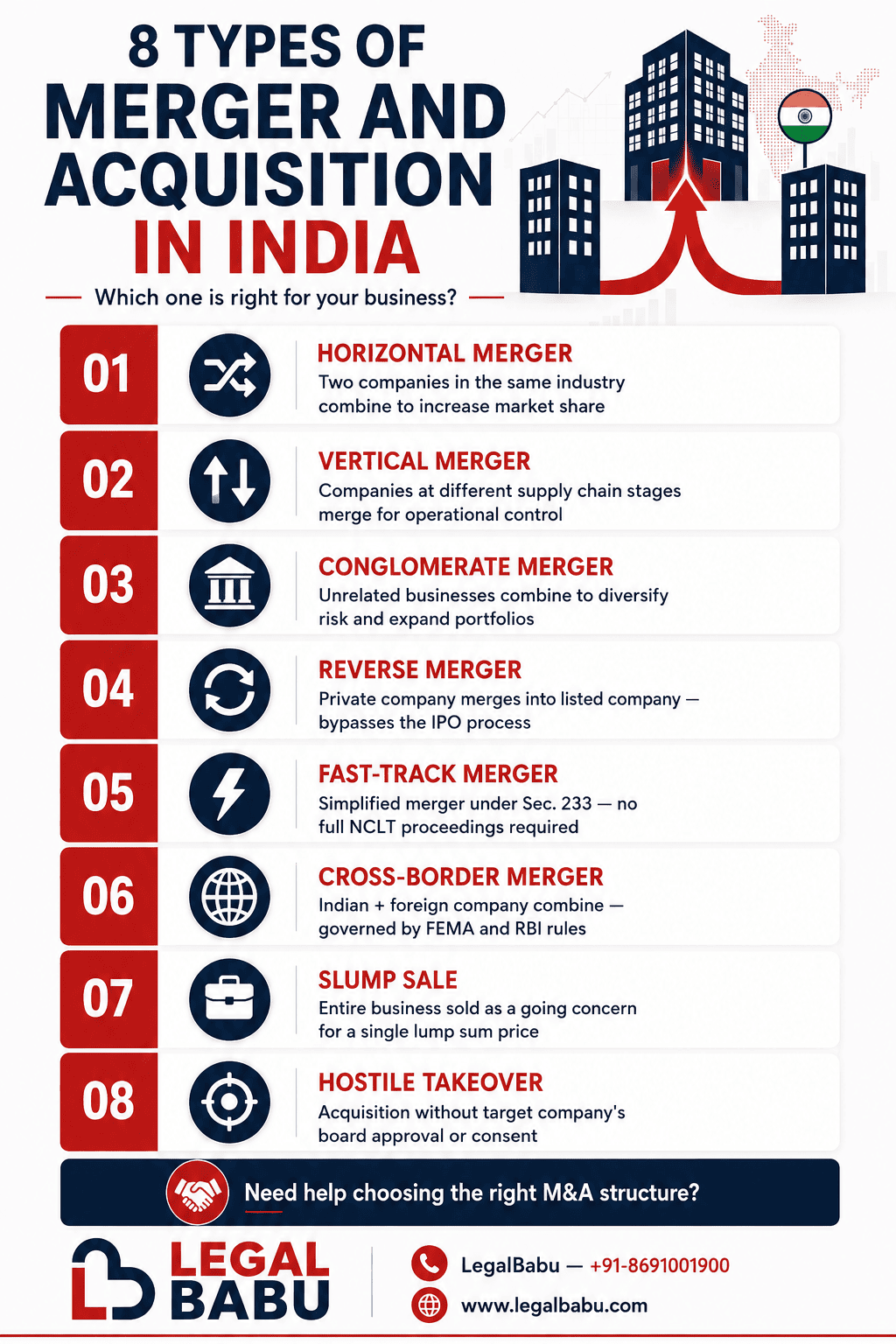
Types of Mergers and Acquisitions in India
Understanding the type of merger and acquisition relevant to your situation is critical. Each structure carries different legal, tax, and regulatory implications.
|
Type |
Description |
Example |
|
Horizontal Merger |
Two companies in the same industry and at the same stage of production combine |
Vodafone India + Idea Cellular |
|
Vertical Merger |
Companies at different stages of the same supply chain merge |
Car manufacturer + tyre manufacturer |
|
Conglomerate Merger |
Companies from completely unrelated industries merge |
Tata Group's diversified acquisitions |
|
Reverse Merger |
A private company merges with a listed public company to gain a stock exchange listing |
Multiple tech startup deals |
|
Fast-Track Merger |
Simplified merger under Section 233, Companies Act 2013, without full NCLT proceedings |
Small companies, wholly owned subsidiaries |
|
Cross-Border Merger |
Merger between an Indian and a foreign company |
Reliance–Disney JV merger |
|
Slump Sale |
An entire business undertaking is sold as a going concern for a lump sum |
Asset deal, manufacturing unit transfer |
|
Hostile Takeover |
Acquisition without the consent or approval of the target company's board |
L&T's attempted acquisition of Mindtree |
Each type of merger and acquisition demands a unique approach to structuring, compliance, valuation, and documentation. LegalBabu's expert team helps you identify the most suitable structure for your specific business situation and execute it with full legal compliance.
Legal Framework Governing Mergers and Acquisitions in India
One of the most crucial aspects of any merger and acquisition in India is navigating the complex and multi-layered regulatory environment. No single law or regulator governs the entire M&A process, it involves a coordinated framework across multiple statutes and bodies.
|
Law / Regulator |
Role in Merger and Acquisition |
|
Companies Act, 2013 (Sec. 230–234) |
Governs mergers, amalgamations, demergers, NCLT approval process |
|
Competition Act, 2002 - CCI |
Merger control approves combinations above financial or deal value thresholds |
|
SEBI Takeover Code, 2011 - SEBI |
Regulates the acquisition of listed companies; mandates open offers |
|
FEMA, 1999 - RBI |
Governs cross-border mergers and acquisitions; FDI compliance |
|
Income Tax Act, 1961 |
Tax treatment on capital gains, amalgamation benefits, and slump sale |
|
Insolvency & Bankruptcy Code, 2016 |
Enables distressed asset acquisition through the CIRP process |
|
Competition (Amendment) Act, 2023 |
Introduced a new Deal Value Threshold (DVT) of ₹2,000 crore for CCI review |
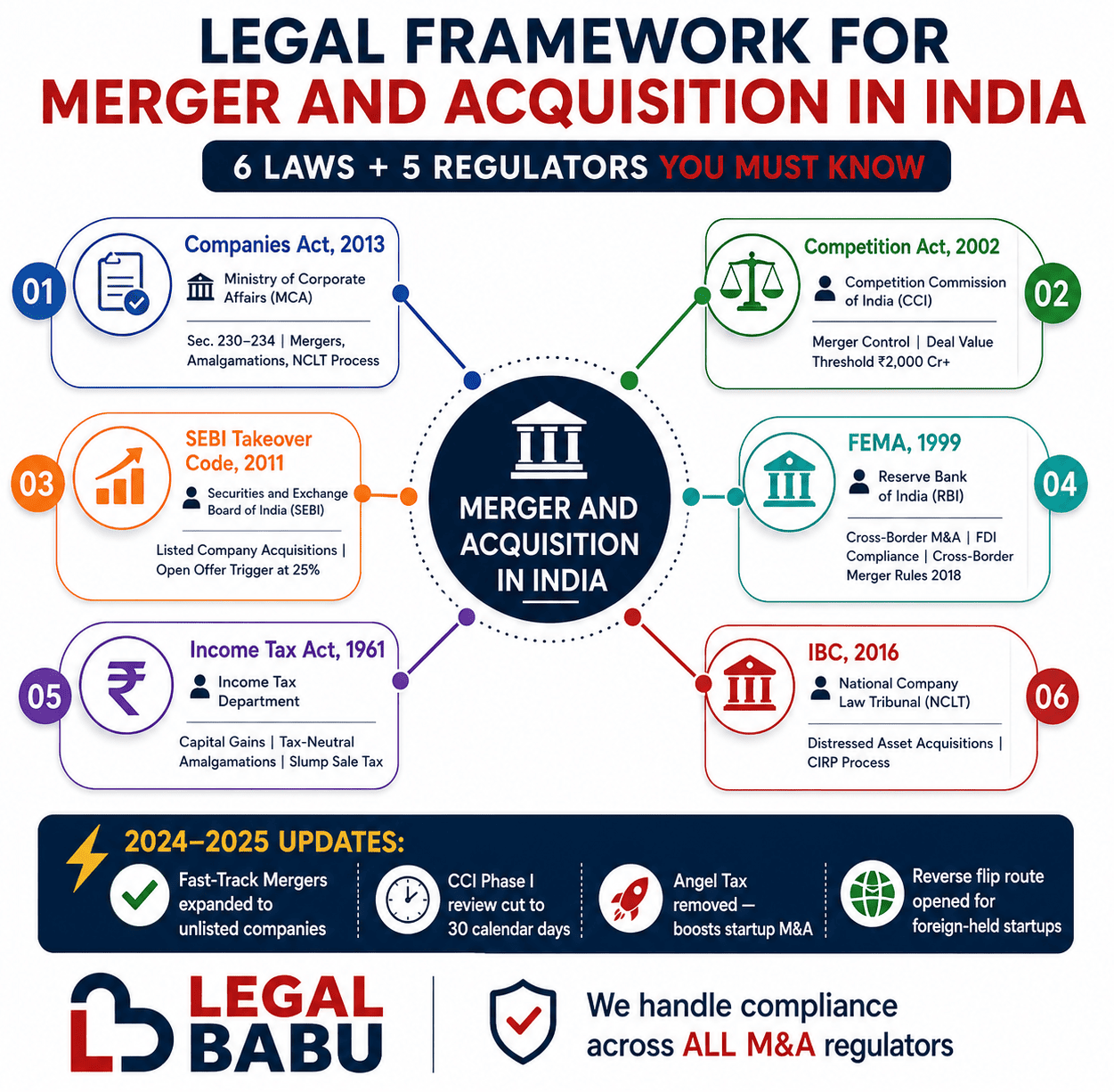
Key 2024–2025 regulatory updates that directly affect mergers and acquisitions in India:
-
Fast-track mergers now extended to unlisted companies with outstanding loans under ₹200 crore (effective September 2025)
-
Foreign parent companies can now merge into their wholly owned Indian subsidiaries - enabling the popular "reverse flip" for startups
-
The CCI Phase I review has been reduced from 30 working days to 30 calendar days, speeding up approvals
-
Angel tax removal under the Finance Act 2025 has made startup acquisitions significantly more attractive
For post-merger changes like company name changes, updating MOA objects, or director changes, LegalBabu handles all MCA compliance on your behalf. Explore all MCA secretarial services here.
Step-by-Step M&A Process in India
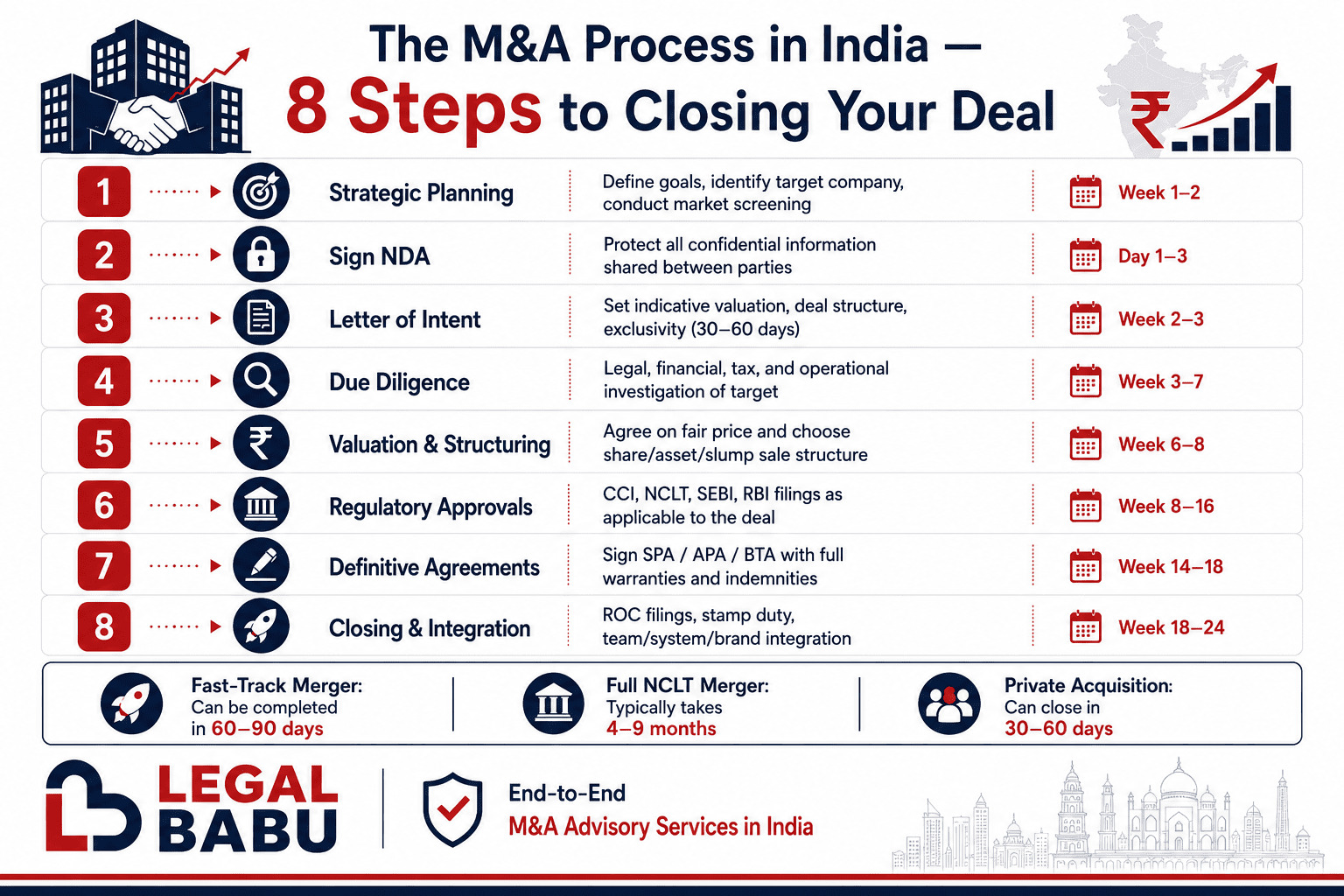
The M&A process in India involves several carefully sequenced stages. Skipping or rushing any step can lead to costly post-deal disputes, regulatory penalties, or failed integrations. Here is the complete step-by-step M&A process in India:
Step 1 - Strategic Planning and Target Identification
Before any merger and acquisition begins, the acquiring party must define clear goals - market expansion, technology access, talent acquisition, or competitor elimination. A target company is then identified and screened against strategic, financial, and cultural criteria.
Step 2 - Signing a Non-Disclosure Agreement (NDA)
An NDA is the first binding document in any merger and acquisition transaction. It protects all confidential information exchanged between the parties during negotiations and due diligence. NDAs in India typically carry a validity of two to three years and include a non-solicitation clause preventing the parties from poaching each other's employees.
Step 3 - Letter of Intent (LOI) / Term Sheet
The LOI is a non-binding document that outlines the key terms of the proposed merger and acquisition - indicative valuation, deal structure, exclusivity period (typically 30–60 days), and proposed timelines. This sets the foundation for formal due diligence to begin.
Step 4 - Due Diligence
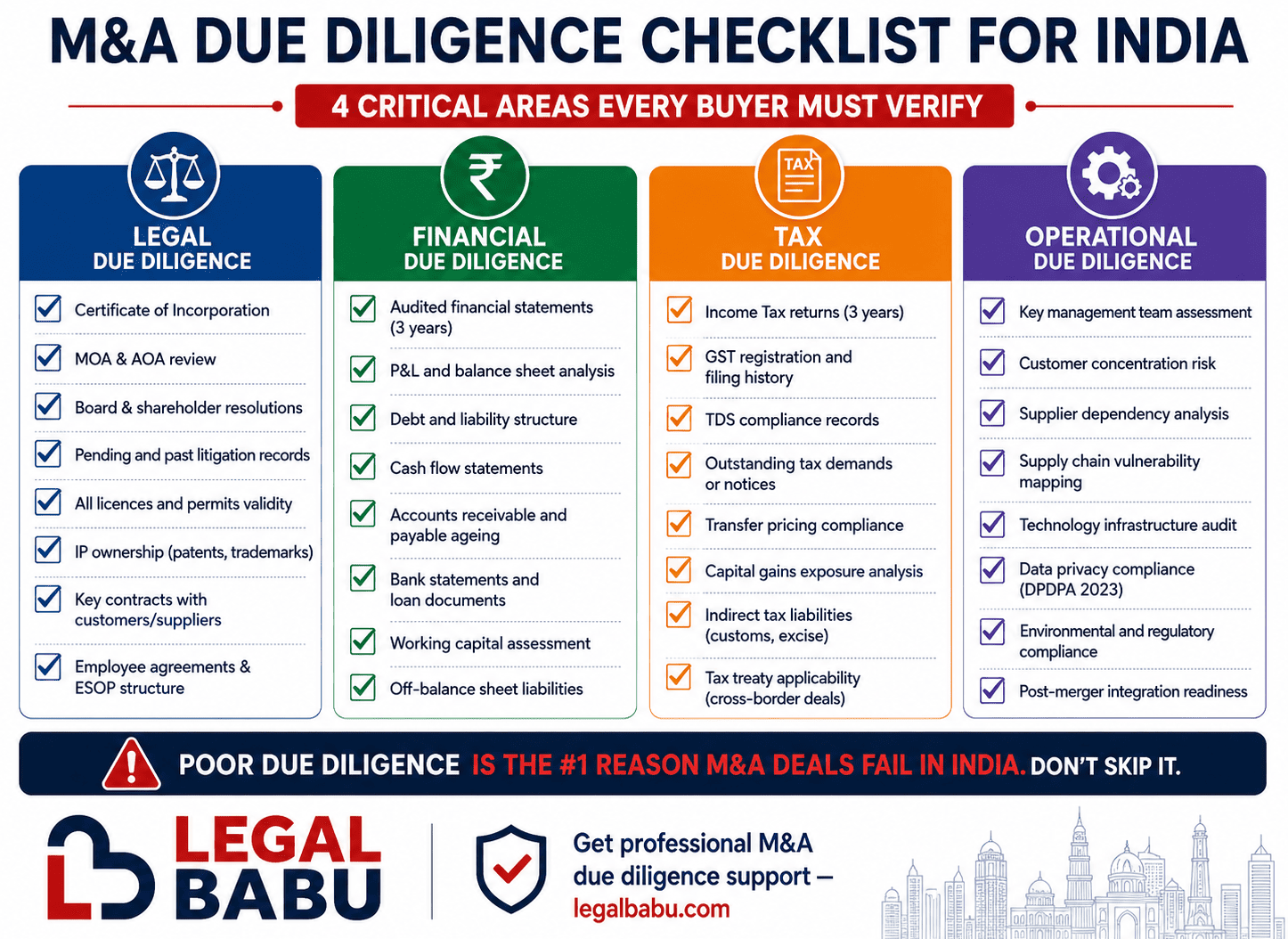
Due diligence is the backbone of every successful merger and acquisition in India. It involves a thorough investigation of the target company across four key dimensions:
|
Due Diligence Area |
What is Reviewed |
|
Legal DD |
Corporate documents, MOA/AOA, litigation history, IP ownership, licenses, contracts |
|
Financial DD |
Balance sheets, P&L statements, debt structure, cash flows, receivables |
|
Tax DD |
Income tax filings, GST compliance, outstanding liabilities, transfer pricing |
|
Operational DD |
Supply chain health, key customer dependencies, employee agreements, and operational risks |
Poor due diligence is the single biggest reason merger and acquisition deals fail or lead to post-closing disputes in India. LegalBabu provides structured due diligence support for both buyers and sellers.
Step 5 - Business Valuation and Deal Structuring
Once due diligence is complete, both parties agree on a fair valuation using recognised methods - Discounted Cash Flow (DCF), EBITDA multiples, or Net Asset Value. You can learn more about the valuation report process in India on our platform. The deal structure - share purchase, asset purchase, slump sale, or formal merger - is then finalised based on tax efficiency and regulatory requirements.
Step 6 - Regulatory Approvals
Depending on the deal structure and size, merger and acquisition transactions in India may require approvals from:
-
CCI - if deal value exceeds ₹2,000 crore or asset/turnover thresholds are met
-
NCLT - for formal merger/amalgamation schemes
-
SEBI - for acquisitions involving listed entities
-
RBI - for cross-border mergers involving foreign investment under FEMA
Step 7 - Definitive Agreements
This is where the merger and acquisition deal is formalised in legally binding documents:
-
Share Purchase Agreement (SPA) - for share-based acquisitions
-
Asset Purchase Agreement (APA) - for specific asset acquisitions
-
Business Transfer Agreement (BTA) - for slump sale transactions
-
Representations, Warranties, and Indemnities - covering post-deal risk allocation
If shares are being transferred as part of the transaction, refer to our guide on share transfer in a Private Limited Company for detailed compliance steps.
Step 8 - Closing and Post-Merger Integration
The final stage of the M&A process in India involves filing all regulatory documents with the Registrar of Companies (ROC), paying applicable stamp duty, and completing post-merger integration - aligning teams, systems, brand identities, and operational processes. For businesses undergoing a structural change, converting from Private Limited to Public Limited may also be a required step post-merger.
Key Documents Required in Merger and Acquisition
Every merger and acquisition transaction in India requires a specific set of legal and financial documents. Missing any one of these can delay your deal or create compliance gaps.
|
Document |
Purpose |
|
Non-Disclosure Agreement (NDA) |
Protects confidential information during negotiations |
|
Letter of Intent (LOI) |
Sets out indicative terms and exclusivity |
|
Due Diligence Report |
Comprehensive risk and compliance assessment |
|
Valuation Report |
Establishes the fair market value of the business |
|
Share / Asset Purchase Agreement |
Defines the final terms of the acquisition |
|
Board and Shareholder Resolutions |
Corporate approvals for the transaction |
|
NCLT / CCI Filing Documents |
Regulatory approval applications |
|
Stamp Duty Payment Receipts |
State-specific conveyance compliance |
|
ROC Filing Acknowledgements |
Post-merger statutory filings with MCA |
Benefits of Mergers and Acquisitions for Indian Businesses
Merger and acquisition activity in India is not just for large corporations. SMEs, family businesses, and startups are increasingly using M&A as a strategic tool. Here is why:
-
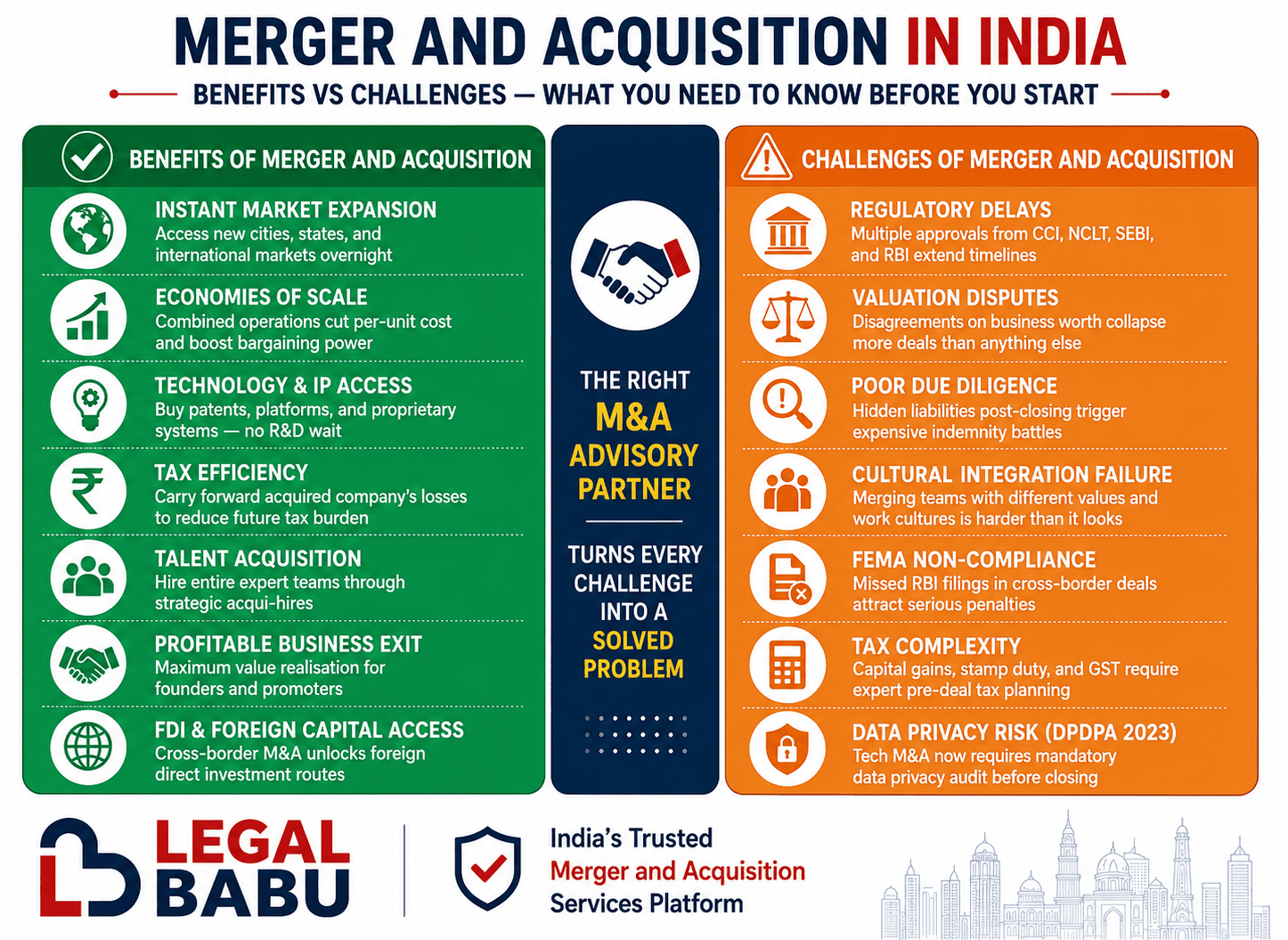
Market Expansion: Mergers and acquisition gives immediate access to new geographies, customer bases, and distribution networks - far faster than organic growth.
-
Economies of Scale: Combined operations reduce per-unit costs, improve bargaining power with suppliers, and eliminate redundant overheads.
-
Technology and IP Access: Acquiring a company with patents, platforms, or proprietary technology accelerates innovation without years of R&D investment.
-
Tax Benefits: Carry-forward of accumulated losses of the acquired company can be set off against future profits of the acquiring entity, reducing overall tax burden.
-
Talent Acquisition: Acqui-hires allow businesses to buy an entire team of skilled professionals, common in the Indian tech sector.
-
Business Exit Strategy: For founders and promoters, mergers and acquisition offers a structured, legally sound exit route with maximum value realisation.
-
FDI Access: Cross-border mergers and acquisition opens FDI routes, enabling foreign capital injection into Indian businesses.
Common Challenges in Merger and Acquisition
Despite its many benefits, executing a merger and acquisition in India comes with real challenges:
|
Challenge |
Why It Matters |
|
Regulatory Delays |
Multiple approvals from CCI, NCLT, SEBI, and RBI can extend timelines significantly |
|
Valuation Disputes |
Disagreements over business worth are the most common reason deals break down |
|
Poor Due Diligence |
Hidden liabilities discovered post-closing can trigger expensive indemnity claims |
|
Cultural Integration |
Merging teams with different work cultures, hierarchies, and processes is complex |
|
FEMA Non-Compliance |
Cross-border mergers without proper RBI filings attract heavy penalties |
|
Tax Complexity |
Capital gains, stamp duty, and GST on transfers require careful pre-deal tax planning |
|
Data Privacy (DPDPA 2023) |
For tech M&A, a data privacy audit is now mandatory under India's new data protection law |
Working with experienced M&A advisory services in India - like LegalBabu - dramatically reduces these risks by providing end-to-end support across every stage of the deal.
Merger and Acquisition Trends in India 2025–2026
The merger and acquisition landscape in India is undergoing rapid transformation. Here are the key trends shaping deals right now:
-
Record Deal Volumes: India's M&A deal value reached approximately USD 50 billion in H1 2025, with 10 transactions individually exceeding USD 1 billion.
-
Power and Renewable Energy Dominance: The energy sector led M&A deal value at USD 8.5 billion in H1 2025, driven by India's green energy push toward 500 GW renewable capacity by 2030.
-
Technology and AI Acquisitions: With the Indian government allocating USD 1.25 billion toward AI development, the tech sector merger and acquisition is accelerating sharply.
-
Reverse Flipping of Startups: Hundreds of Indian startups originally incorporated in Singapore, Delaware, or the Cayman Islands are now merging back into Indian entities, leveraging the expanded fast-track merger route.
-
GIFT City as an M&A Hub: GIFT IFSC in Gujarat is emerging as the preferred jurisdiction for structuring cross-border merger and acquisition transactions.
-
ESG-Driven Valuations: SEBI's BRSR sustainability reporting mandate now directly influences how merger and acquisition targets are valued, with ESG-compliant businesses commanding premium pricing.
-
IBC-Driven Acquisitions: Distressed asset deals through the Insolvency and Bankruptcy Code continue to create significant merger and acquisition opportunities in steel, real estate, and aviation.
-
Private Equity Activity: PE-backed mergers and acquisitions surged 227% in Q1 2025, reflecting strong institutional appetite for Indian assets.
How LegalBabu Helps with Merger and Acquisition Services in India
LegalBabu is a trusted provider of merger and acquisition services in India, offering complete end-to-end support for businesses planning to merge, acquire, sell, or restructure. Whether you are a buyer, seller, or investor, our team of experts handles every aspect of the merger and acquisition process so you can focus on running your business.
Our M&A advisory services in India include:
-
Due Diligence Support - Legal, financial, tax, and operational assessment of target companies
-
Business Valuation Reports - FEMA and Companies Act compliant valuations by registered valuers
-
Deal Structuring Advisory - Share purchase, slump sale, asset acquisition, fast-track merger
-
Regulatory Compliance - CCI, NCLT, SEBI, RBI filing and approval management
-
Document Drafting - NDA, LOI, SPA, APA, BTA, shareholder resolutions
-
Business for Sale Services - Connect buyers and sellers across India
-
Post-Merger MCA Filings - Company name change, MOA amendments, director changes, share transfers
-
Accounting and Financial Advisory - Read about our accounting services for small businesses in India
Trusted by 1,000+ entrepreneurs across India | Call: +91-8691001900 | Get a Free Consultation
Conclusion
Mergers and acquisitions are no longer limited to India's largest conglomerates. Today, SMEs, family businesses, and early-stage startups are all using mergers and acquisitions as a strategic lever to grow faster, access new markets, gain technology, or exit profitably. With India's M&A market setting record deal values year after year and significant regulatory reforms making the M&A process in India more streamlined than ever, there has never been a better time to explore your options.
The key to a successful merger and acquisition transaction is thorough preparation - from the right deal structure and accurate valuation to airtight documentation and regulatory compliance. That is exactly where LegalBabu's merger and acquisition services make all the difference.
Ready to take the next step? Get a Free M&A Consultation with LegalBabu today.
FAQS
FAQs on Mergers and Acquisitions in India
-
What is the difference between a merger and an acquisition in India?
A merger is when two companies combine to form a new, single legal entity - both original companies cease to exist. An acquisition is when one company purchases another; the acquiring company absorbs the target, which may continue as a subsidiary or be dissolved. Both fall under the broader umbrella of merger and acquisition activity.
- Which law governs mergers and acquisitions in India?
- What is a fast-track merger in India?
- Is CCI approval mandatory for all mergers and acquisitions?
- How long does the M&A process in India take?
- What documents are required for a merger and acquisition in India?
- What are the tax implications of mergers and acquisitions in India?
- Can a foreign company acquire an Indian company?
- What is due diligence in mergers and acquisitions?
- What is a slump sale in mergers and acquisitions?
- What is a reverse merger in India?
- What happens to employees during a merger and acquisition?


