
How to Start a Chemical Business in India: Types & Licences
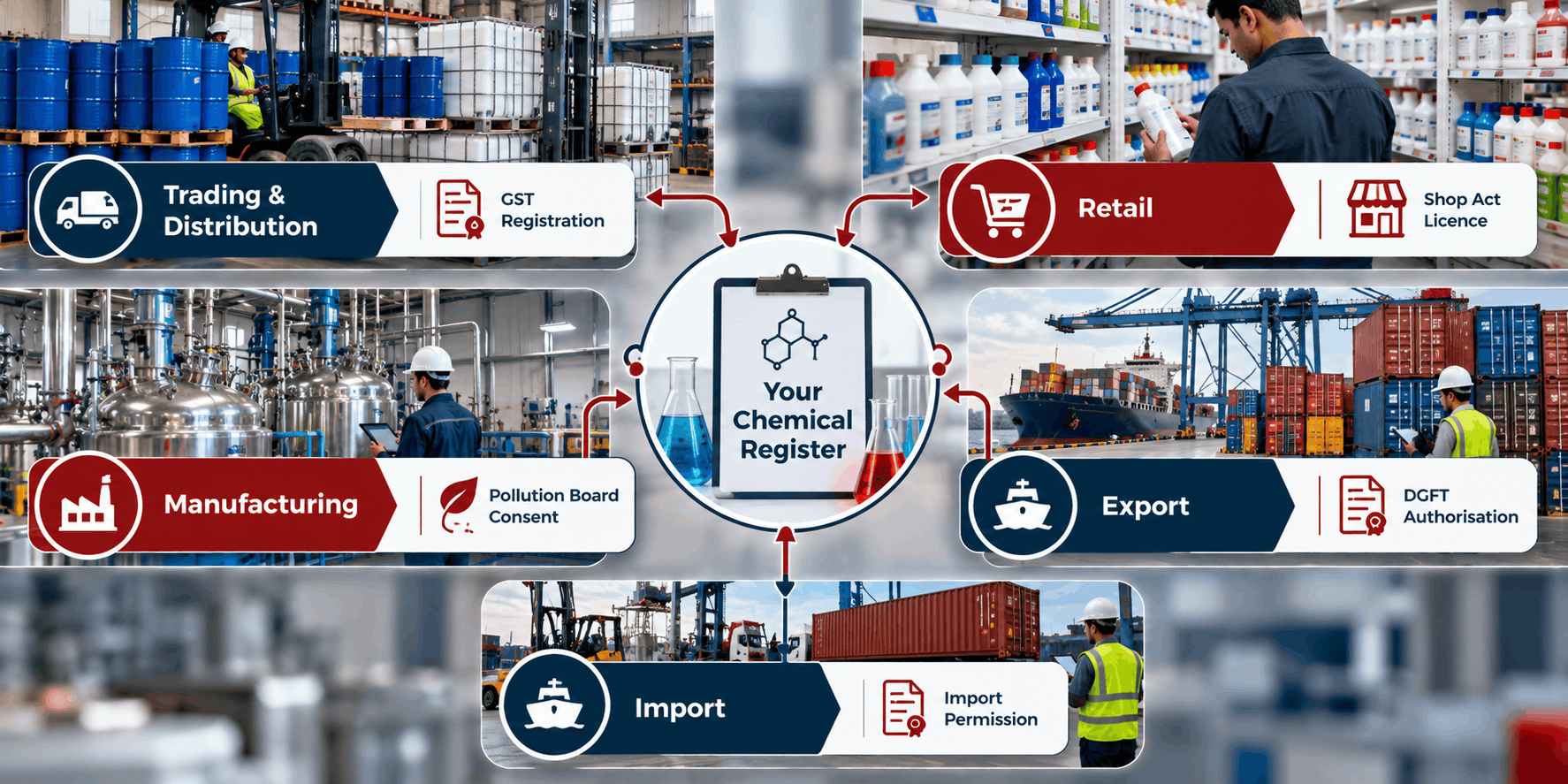
Here is how to start a chemical business in India. Pick your model first: trading, retail, manufacturing, import or export. Register the business, get GST and an IEC if you trade across borders, then check hazard rules for each chemical you handle. Storage, pollution, safety and, for some chemicals, import or export permissions decide your licence list.
India has no single licence for a chemical business. The rules attach to the chemical, the quantity you store and the activity you run. A dealer in a mild salt and a dealer in chlorine face very different checklists, even from the same godown.
Four bodies come up again and again: the State Pollution Control Board, the Petroleum and Explosives Safety Organisation (PESO), the Directorate General of Foreign Trade (DGFT) and your state’s labour and industry offices. The Manufacture, Storage and Import of Hazardous Chemical Rules, 1989 (MSIHC Rules) sit underneath much of it. Read this guide before you sign a lease or place a first order.
What Counts as a Chemical Business in India?
The label covers a wide field: bulk industrial chemicals such as acids, alkalis and solvents, specialty and process chemicals, laboratory chemicals, agrochemicals, and ingredients that go into food, drugs and cosmetics. Two products on the same shelf can fall under different laws.
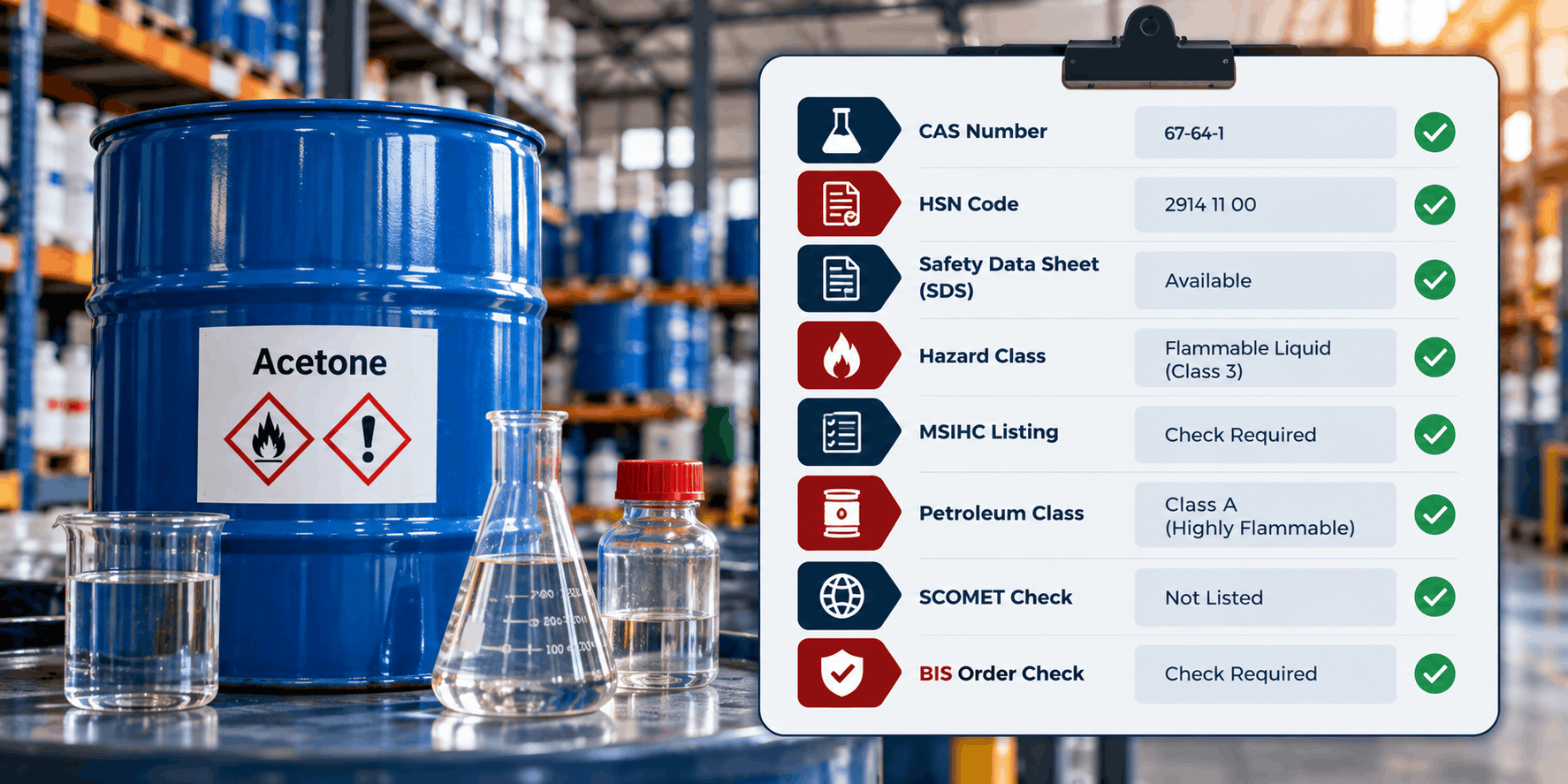
Start a simple product register before anything else. For each chemical, record the CAS number, HSN code, safety data sheet (SDS), hazard class and any law that flags it. Every licence decision in this guide flows from that sheet.
Which Types of Chemical Businesses Can You Start in India?
Pick the lightest model that fits your plan. Moving up later is easier than unwinding a heavy licence you did not need.
|
Type |
What you do |
Core registrations |
Approvals it commonly triggers |
Capital and risk |
|
Trading and distribution |
Buy from makers or importers, store, sell to businesses |
Entity, GST, Udyam, trade licence or Shop Act |
PESO or district licence for flammable solvents, MSIHC rules at bulk quantities, fire and pollution checks on the godown |
Medium: stock, credit and storage risk |
|
Retail |
Sell small packs to consumers and small users |
Entity, GST where applicable, Shop Act, trade licence |
Acid and poison sale rules, pesticide licence, Legal Metrology |
Lower: small stock, strict counter rules |
|
Repacking and blending |
Buy in bulk, repack or mix under your brand |
As above, plus trademark |
Can count as manufacturing for pollution and factory rules |
Medium |
|
Manufacturing |
Formulate or synthesise chemicals |
Entity, Udyam or IEM, factory registration |
Consent to Establish and Operate, environmental clearance for some plants, MSIHC approvals, hazardous waste authorisation |
High: land, plant, safety, long approvals |
|
Importing |
Bring in chemicals for sale or use |
IEC, GST |
MSIHC import notice, BIS orders, import restrictions, customs |
Medium to high |
|
Exporting |
Ship chemicals abroad |
IEC, GST, LUT |
SCOMET authorisation, destination country rules, dangerous goods shipping |
Medium |
|
Brokerage or commission agency |
Connect chemical buyers and suppliers and earn a commission |
Business registration and applicable tax registrations |
Depends on whether you only act as an intermediary or also buy, store, transport or sell chemicals |
Low to medium: less inventory investment, but customer acquisition and payment risks |
|
Online chemical sales |
Sell chemical products through your own website or an online marketplace |
Business entity, GST where applicable, and applicable trade registrations |
Product-specific sale restrictions, packaging and labelling, storage, fire safety and transport requirements, where applicable |
Low to high: depends on the products, stock, storage and delivery model |
What Is the Difference Between Chemical Wholesale Trading and Retail?
Chemical wholesale trading and retail differ mainly in the type of buyer, order size and way products are supplied.
-
Wholesale trading: You buy chemicals in bulk from manufacturers, authorised suppliers or importers and sell them to factories, laboratories, workshops, distributors or other businesses. Orders may involve drums, bags, containers or bulk deliveries.
-
Distribution: You act as a supply channel for one or more manufacturers or brands. Depending on your agreement, you may maintain stock, manage local delivery, develop business customers or work within an assigned territory.
-
Retail: You sell smaller quantities or packaged products to individual consumers, small businesses, laboratories or other end users. Depending on the product, retail sales may involve additional rules for packaging, labelling, buyer verification and sale records.
-
Commission-based trading: You connect a buyer with a supplier and earn a commission without necessarily purchasing or storing the chemical yourself. Your contractual role and actual activities still matter when determining the applicable legal obligations.
For example, a business selling bulk industrial solvents to factories operates differently from a shop selling small packs of laboratory reagents. Both may be described as chemical trading, but their storage, transport, customer-verification and product-specific requirements can differ.
Before choosing a model, decide who your customers will be, what quantities you will sell, whether you will hold stock and who will arrange delivery. Then check the rules for the exact chemicals you intend to handle.
Can You Start a Chemical Brokerage or Commission Agency Business?
Yes. One option is to connect chemical manufacturers, suppliers, importers and industrial buyers and earn a commission for completed transactions. This model may require less capital than a business that purchases and stores chemical inventory, although the actual investment depends on your services and contractual responsibilities.
A chemical broker or commission agent may:
-
Find buyers for manufacturers and authorised suppliers.
-
Help industrial customers source specific chemicals.
-
Coordinate quotations, purchase orders and delivery arrangements.
-
Earn a commission or agreed service fee under a written contract.
-
Support communication between buyers and suppliers without necessarily taking ownership of the goods.
Does a broker need the same approvals as a chemical trader? Not automatically. The answer depends on the chemical and what the broker actually does. A business that only introduces a buyer and supplier may have a different compliance position from one that buys and resells chemicals, stores inventory, repacks products, transports hazardous goods or imports chemicals in its own name.
Define your role in writing, confirm who is responsible for product documentation and transport, and check whether your activities trigger any product-specific requirements. Do not assume that avoiding physical storage removes every legal obligation.
Which Registrations Does Every Chemical Business Need?
Every model starts with the same base. Then the chemical decides what you add.
-
Business entity. Choose a sole proprietorship, partnership firm, LLP, One Person Company or private limited company. Chemical businesses carry liability for accidents and unpaid dues, so many founders prefer a company or LLP. Our guides on types of company and comparing types of business help you choose.
-
GST registration. Rates follow the HSN code of each chemical. For example, sulphuric acid, nitric acid and ammonia moved from 18% to 5% from 22 September 2025. Other chemicals can sit in other slabs, so confirm each code. Our GSTIN guide, GST calculator and GST filing service help you stay accurate.
-
Udyam registration for MSME recognition and NSIC registration if you plan to bid for government tenders.
-
Shop Act licence and trade licence for your office, shop or godown.
-
Staff registrations. Once you hire, look at PF registration, ESIC registration, professional tax filing and TDS filing.
-
Brand and formulation protection. Trademark registration protects your brand name. A genuinely new process or formulation may qualify for a patent application.
Finance planning matters too. A lender will want a project report, and you can compare a term loan, working capital loan and project finance.
How Do You Check Whether Your Chemical Is Regulated?
Check the product, not the business. The MSIHC Rules list 684 hazardous and toxic chemicals in Part II of Schedule 1, and they classify others by toxicity, flammability and explosive properties. Isolated storage becomes a “major accident hazard” activity when you hold a listed chemical at or above its threshold. Schedule 2 sets 10 tonnes for chlorine and 60 tonnes for ammonia, for example.
Use this screening table for each product on your register.
|
Question to ask |
Law |
Authority |
What it may require |
|
Is it listed under the MSIHC Rules, and in what quantity? |
MSIHC Rules, 1989 |
State Pollution Control Board for isolated storage and import; Chief Inspector of Factories for factories |
Site notification, safety report, emergency plan, container labels, import notice |
|
Is it a flammable liquid that counts as petroleum? |
Petroleum Act, 1934 and Petroleum Rules, 2002 |
District authority for small quantities; PESO above that |
Storage licence and NOC |
|
Is it an acid or poison sold over the counter? |
Poisons Act, 1919, state rules and Supreme Court orders |
State and local magistrates |
Sales register, buyer ID, stock declaration |
|
Is it a SCOMET item or a Chemical Weapons Convention chemical? |
Foreign trade policy |
DGFT |
Export authorisation or notification |
|
Will your process create hazardous waste? |
Hazardous and Other Wastes Rules, 2016 |
State Pollution Control Board |
Authorisation, valid for five years |
|
Is it a pesticide, drug, cosmetic or food ingredient? |
Insecticides Act, Drugs and Cosmetics Act, food law |
State agriculture office, CDSCO, FSSAI |
Separate licences |
|
Does a BIS Quality Control Order cover it? |
BIS Act, 2016 |
BIS and the Department of Chemicals and Petrochemicals |
BIS licence and Standard Mark |
How Does a Chemical Trading Business Work in India?
A trader buys from manufacturers or importers, stores the goods and sells to factories, labs and distributors. Your margin comes from sourcing, credit terms and reliable delivery.
The paperwork starts with the base registrations above, then branches by product.
-
Flammable solvents. PESO’s guidelines say acetone, ethyl alcohol, methyl alcohol and wood naphtha are classified as petroleum. Storage then needs a licence above small exempt quantities. The PESO guidelines set out the forms and limits.
-
Bulk hazardous stock. Check your holding against the MSIHC thresholds. Environmental clearance is not needed for isolated storage: a June 2019 notification removed isolated storage and handling of hazardous chemicals from the EIA Notification, but the MSIHC thresholds still apply.
-
Godown approvals. Fire safety and pollution board requirements vary by state and by category. CPCB revised its Red, Orange, Green, White and Blue categories in February 2025, and state boards adopt and adjust them. Ask your board where your exact activity falls.
-
BIS orders. Some chemicals still need BIS-licensed supply. The government revoked a large batch of chemical Quality Control Orders in November 2025, so check the current status of each product. Our BIS certification page explains the licence.
-
Packed goods. Chemicals sold in retail packs need Legal Metrology declarations. Rules for industrial packs differ, and our LMPC certificate guide covers the basics.
Most trading trouble starts at the godown. Vet each supplier before your first purchase, and ask for their licences and SDS. Our vendor assessment service can do this for you. If a buyer delays payment later, payment recovery under MSME may help.
How Do You Start a Chemical Retail Business in India?
Retail means smaller packs, walk-in buyers and tighter counter rules.
Acids and corrosives. The Supreme Court’s 2013 orders in the Laxmi case set interim rules for states without their own. Over-the-counter acid sales need a register with the buyer’s details and purpose, a government photo ID with address, and no sale to minors. Under the Centre’s model rules, sellers also declare stock to the Sub-Divisional Magistrate within 15 days, as one summary of the rules explains. The Ministry of Home Affairs again asked states to enforce the Poison Rules in August 2021. Some states, including Rajasthan, Karnataka, Tripura and Himachal Pradesh, have their own acid-sale rules, and shopkeepers must display them. Check your state before you stock any acid.
Pesticides and related chemicals. Pesticides need a separate licence under the Insecticides Act, 1968, issued through your state. Our pest control licence page covers the service side of that law.
Everything else. You need a Shop Act licence, a trade licence, GST where it applies, and label and pack declarations as above.
Can You Sell Chemicals Online in India?
Yes, subject to the rules that apply to the products and the way you operate. You can use a business website, online marketplace or business-to-business ordering platform to receive enquiries and orders. However, an online storefront does not replace any licence, registration or safety requirement that applies to the chemical itself.
Before launching an online chemical store:
-
Define your product range: Identify each chemical by its product name, CAS number, grade, intended use and hazard classification.
-
Check sale restrictions: Some products, including certain acids, pesticides, poisons and other regulated chemicals, may be subject to special sale conditions or licensing requirements.
-
Prepare accurate product information: Provide the appropriate safety information, handling precautions, packaging details and legally required labels.
-
Plan storage and delivery: Confirm that the premises, packaging and transport arrangements are suitable for the chemicals you intend to supply.
-
Verify customer requirements: Where the law restricts a sale or requires buyer identification, records or proof of authorisation, build those checks into the ordering process.
-
Check marketplace conditions: Review the platform's restricted-product policies and documentation requirements before listing regulated chemicals.
The exact obligations depend on the product and the seller's role. Check the applicable central and state rules before listing chemicals online, particularly where the products are hazardous or restricted.
A practical tip: keep the acid register at the counter, and train every employee to ask for ID. A single careless sale can cost you the licence and more.
What Does a Chemical Manufacturing Business Need in India?
Manufacturing carries the longest approval chain. Two flavours exist. A formulation or blending unit mixes chemicals into products. A synthesis plant runs reactions. Both can fall under pollution and factory rules, and a blending unit can count as manufacturing for those purposes, so ask your state board.
What Is the Difference Between Chemical Repacking, Blending and Manufacturing?
These activities are not always treated the same way, so identify your actual process before selecting premises or applying for approvals.
-
Repacking: You purchase a chemical in bulk and transfer it into smaller containers for sale. You may not chemically alter the product, but packaging, labelling, storage and other applicable requirements still need to be checked.
-
Blending or formulation: You combine two or more ingredients to produce a mixture with a defined specification or intended use. Depending on the process and product, this may trigger manufacturing-related pollution, factory, safety or product-specific requirements.
-
Chemical synthesis: You use a chemical reaction to produce a substance or intermediate. This can involve more complex process-safety, emissions, waste-management and hazardous-chemical requirements.
For example, transferring a purchased solvent into smaller packs is different from mixing solvents into a formulated cleaning product, which is different again from producing a solvent through a chemical reaction.
Do not decide your licence requirements from the business name alone. Document the ingredients, quantities, process steps, storage conditions, emissions and waste streams, then ask the relevant pollution control board and other authorities to confirm which approvals apply before you set up the facility.
Approvals checklist:
|
Approval |
Authority |
When it applies |
Note |
|
Consent to Establish (CTE) |
State Pollution Control Board |
Red, Orange and Green category units, before building |
White category units are exempt, and an intimation suffices |
|
Environmental clearance, item 5(f) |
MoEFCC or the State Environment Impact Assessment Authority |
Synthetic organic chemical plants |
Category depends on location and scale, and a project near protected areas can move up a category |
|
MSIHC approval, site notification, safety report, on-site emergency plan |
Authority named in Schedule 5 |
Activity at or above scheduled thresholds |
Site report 3 months before starting, safety report 90 days before |
|
Industrial licence |
DPIIT |
Hydrocyanic acid, phosgene and their derivatives, certain isocyanates |
Narrow list, but compulsory |
|
IEM filing |
DPIIT |
Large undertakings in de-licensed sectors |
See our IEM registration page |
|
Factory registration |
State labour department |
20 or more workers with power, 40 or more without |
OSH Code, 2020, in force since 21 November 2025 |
|
PESO licences and approved electricals |
PESO and district authority |
Flammable liquids and gases |
Safety distances apply |
|
Consent to Operate (CTO) |
State Pollution Control Board |
Before production starts |
Validity differs by category and state |
|
Hazardous waste authorisation |
State Pollution Control Board |
If the process generates hazardous waste |
Form 1 application, Form 2 grant, valid five years |
Some details deserve a closer look.
-
Environmental clearance. Synthetic organic chemicals fall under item 5(f) of the EIA Notification, 2006. The general condition can push a category B project to category A when it sits within 5 km of a protected area or similar sensitive site. EIA reports come from consultants accredited by QCI-NABET. Synthetic organic chemical industries sit in the red pollution category, as one state authority notes.
-
MSIHC timelines. The Rules ask for approval and site notification at least three months before you start. The authority decides within 60 days of receiving your report. You submit a safety report 90 days before you begin, commission an independent safety audit, update it each year, run a mock drill every six months, and report a major accident within 48 hours. The authority inspects at least once a calendar year.
-
Industrial licences. Only a short list needs one, and the Department of Chemicals and Petrochemicals names hydrocyanic acid and phosgene derivatives. The DPIIT list adds isocyanates and di-isocyanates of hydrocarbon, such as methyl isocyanate.
-
Factory rules. The OSH Code replaced the Factories Act. Central rules came into effect on 8 May 2026, and state rules and portals may differ.
-
Hazardous waste. Apply in Form 1 with your consents, as the MPCB procedure shows.
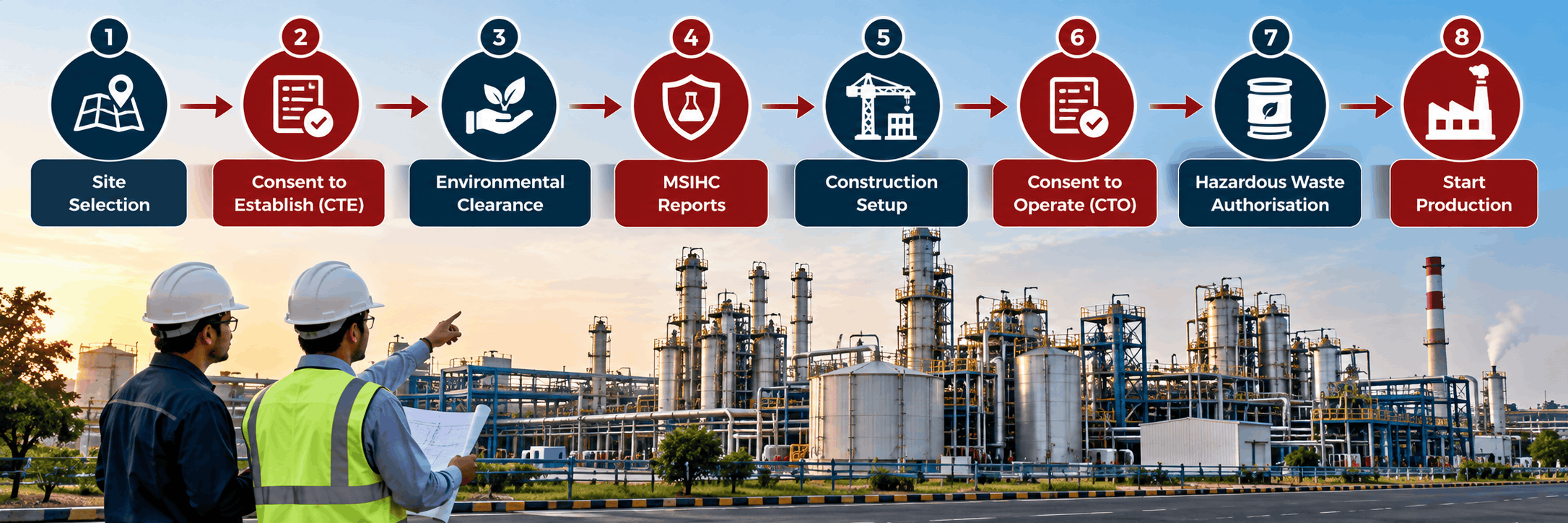
Steps to follow:
-
List your products with CAS numbers, quantities and hazards.
-
Choose a site. Check zoning, protected areas and the distance to neighbours.
-
Confirm your pollution category and whether item 5(f) applies.
-
Register your entity, then your Udyam or IEM filing.
-
Apply for CTE, environmental clearance if needed, MSIHC approvals and PESO plan approval.
-
Build with approved equipment and an effluent treatment plan.
-
Apply for CTO, hazardous waste authorisation, factory registration and PESO licences.
-
Start production, keep records and run your drills.
Optional certificates help with larger buyers. RC 14001, ISO 9001, ISO 14001 and ISO 45001 are voluntary, and a periodic EHS audit keeps your files ready. Our labour law compliance service covers workers, and registration of charges applies if a company borrows against its plant.
How Do You Start a Chemical Import Business in India?
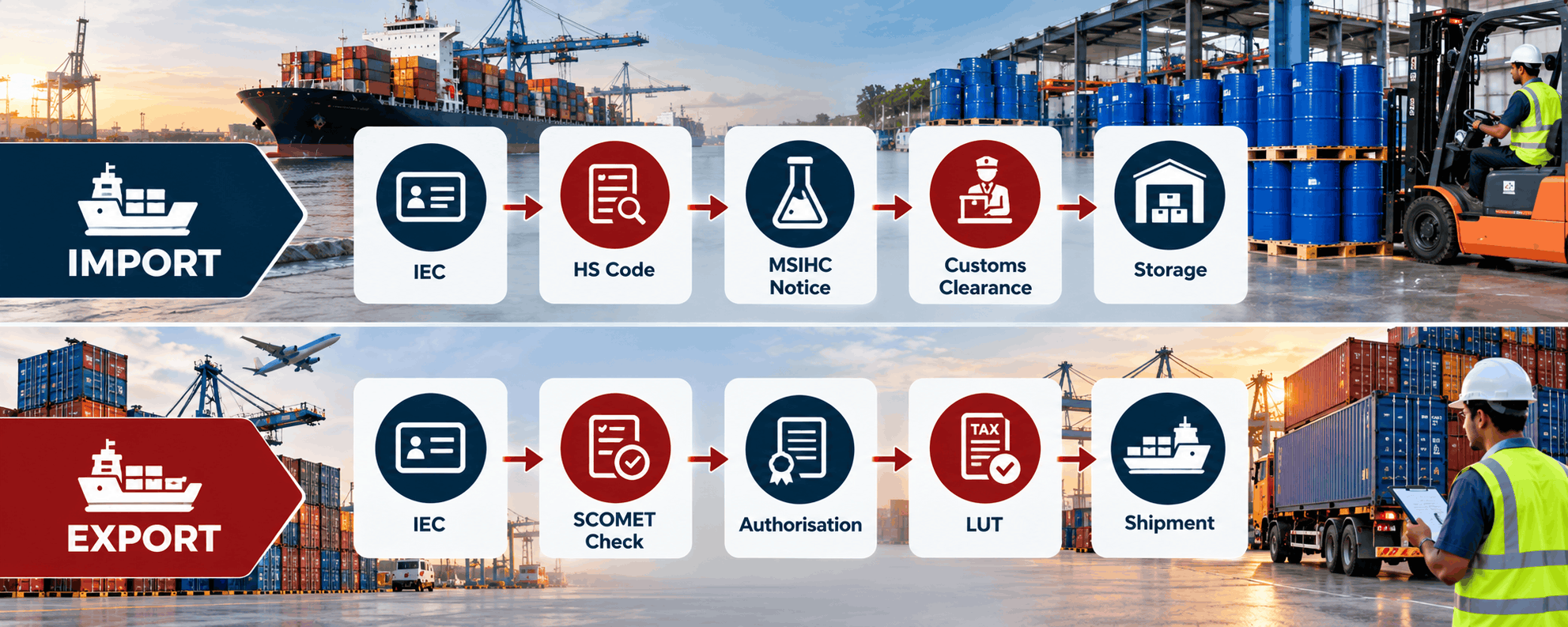
Importing needs an Importer-Exporter Code (IEC) from DGFT. Our IEC code registration page covers the process, and the code needs an annual update between April and June. India’s trade policy treats imports as free unless a product is restricted or prohibited, so check the policy entry for your HS code first.
What Types of Chemical Import Businesses Can You Start?
Chemical imports can support different business models:
-
Import for resale: You import chemicals and sell them to Indian manufacturers, distributors, laboratories or other buyers.
-
Import for own use: You import raw materials, solvents, additives or other chemicals for use in your own manufacturing or processing operations.
-
Import and distribution: You import products and supply them through a domestic dealer or distributor network.
-
Import under a customer order: You source a specified chemical for an Indian customer and coordinate the import under the agreed commercial arrangement.
Your responsibilities depend on who is named as the importer, who owns the goods, the chemical's classification and the intended use. An importer should check the applicable import policy, customs classification, any relevant BIS Quality Control Order, hazardous-chemical requirements and storage or transport obligations before placing an order.
If you import chemicals for your own factory, you must also check the approvals applicable to the manufacturing facility. An import-related registration does not replace those separate requirements.
For hazardous chemicals, MSIHC Rule 18 adds a duty. You give the State Pollution Control Board, 30 days before import or as early as reasonably possible and no later than the import date, the consignee’s name and address, port of entry, mode of transport, quantity and complete product safety information. The authority can then direct safety measures or stop the import. You also keep import records in the Schedule 10 format, and road transport from the port must follow the Central Motor Vehicles Rules, 1989.
Other checks:
-
BIS orders. Importers of covered chemicals need compliance. Check the current list, since several orders were revoked in late 2025.
-
Precursor and scheduled chemicals. Some chemicals, such as acetic anhydride, are also drug precursors. Ask the relevant authority which clearance applies before you book.
-
Customs. Most importers work with a licensed customs broker. Our customs broker licence page explains the role.
-
Tax. You pay IGST at the port and claim input tax credit in your returns.
-
Storage. Arrange a licensed or compliant godown before the ship arrives.
Collect the SDS before you book the order. Rule 18 expects “complete product safety information”, and a supplier who cannot provide it is a warning sign.
How Do You Start a Chemical Export Business in India?
Exporters need an IEC and GST registration. File a Letter of Undertaking each financial year so you can export without paying IGST upfront, as our GST LUT guide explains.
What Types of Chemical Export Businesses Can You Start?
You do not necessarily need to manufacture chemicals to enter the export business. Common models include:
-
Manufacturer-exporter: You manufacture or formulate chemicals in India and sell them to overseas customers.
-
Merchant exporter: You source chemicals from Indian manufacturers or suppliers and export them under your own commercial arrangements, without necessarily manufacturing them yourself.
-
Export distributor: You supply products from one or more Indian manufacturers to overseas distributors, industrial buyers or laboratories.
-
Export sourcing agent: You connect overseas buyers with Indian suppliers and earn a commission or service fee. Your obligations depend on your actual role in the transaction.
Each model has different commercial responsibilities. A manufacturer-exporter must address the requirements of its production facility as well as export rules. A merchant exporter must verify the supplier, product classification, documentation, packaging and shipment requirements. A sourcing agent should define its responsibilities in the contract and confirm whether it acts only as an intermediary or participates directly in the sale.
Before accepting an export order, check the product's HS classification, the current DGFT export policy, SCOMET controls where applicable, dangerous-goods transport requirements and the destination country's chemical regulations. Do not assume that a product is unrestricted simply because it can be purchased freely in India.
The biggest trap is SCOMET, India’s list of Special Chemicals, Organisms, Materials, Equipment and Technologies. Category 1 covers toxic chemical agents and other chemicals, and exports of listed items need DGFT authorisation, unless a general authorisation such as GAEC applies. A mixed product can trip the rule too. A 2025 Mumbai Customs show-cause notice dealt with a chemical product carrying a SCOMET-listed constituent, and it warned that goods moving without authorisation risk confiscation under section 113 of the Customs Act. Check the current list at DGFT before you accept an order.
Export checklist:
-
Get an IEC and register your bank’s AD code with customs.
-
Classify each product by HS code and check it against SCOMET, including every constituent of a mixture.
-
Apply for SCOMET authorisation where it applies.
-
File your LUT before your first export invoice of the year.
-
Pack and label to dangerous goods rules for your transport mode.
-
Check the buyer country’s chemical rules. EU buyers often ask for REACH compliance, and our REACH certification page explains it.
BIS Quality Control Orders do not apply to chemicals made solely for export, according to a summary of the rescissions. Keep production records that show the export-only intent.
What Compliance Do You Keep Up After You Open?
Licences are a start. Your compliance calendar keeps them alive.
-
Every month or quarter: GST returns, TDS, PF and ESIC contributions where they apply
-
Every year: LUT renewal for exporters, IEC update from April to June, MSIHC safety audit update and fresh insurance and fire checks where your state asks
-
Every six months: mock drill of the on-site emergency plan for MSIHC sites
-
Every five years: hazardous waste authorisation renewal
-
On every change: a new product, a higher stock quantity or a new godown can trigger fresh approvals
Name one person to own the calendar. Our accounting services for small businesses can keep the financial side clean.
What Will Legal Babu Do for Your Chemical Business?
Legal Babu helps you map, prepare and file. We do not issue licences, and the authorities decide every approval. Our team will:
-
Review your products and recommend the right model: trading, retail, manufacturing, import or export
-
Register your company, LLP or proprietorship, then arrange GST, Udyam, IEC and trade licence registrations
-
Build your chemical register and screen each product against MSIHC, PESO, SCOMET and BIS triggers
-
Prepare and file your applications, including MPCB licence work in Maharashtra, and follow up with the authority
-
Tell you which studies need accredited experts, and coordinate your EHS audit
-
Vet suppliers through vendor assessment and check premises through due diligence
-
Prepare your project report and guide you on a business loan
-
Handle bookkeeping, GST filing and ongoing returns
Browse our registration services or consulting services, or book a free consultation.
FAQS
FAQs About Chemical Business in India
-
Do I need a chemistry degree to run a chemical business?
We found no general degree requirement for trading or retail in the rules reviewed for this guide. Manufacturing is different. Safety audits, emergency plans and hazard assessments call for competent technical people, and pesticide and drug-linked chemicals carry their own qualification rules. Hire a qualified chemist or process engineer before you go beyond trading.
- Do I need a licence to stock 200 litres of acetone, methanol or ethanol?
- Is a safety data sheet legally required for every chemical I sell?
- What rules apply when I move hazardous chemicals by road?
- Can I run a chemical business from a rented godown or a shop in a residential area?
- Which extra laws apply if my chemical goes into food, drugs, cosmetics or pesticides?
- Can a foreign national or NRI start a chemical business in India?
- Can I supply chemicals to government departments?
- Is Responsible Care or ISO certification mandatory?
- What is the difference between Consent to Establish and Consent to Operate?


