
An MPCB license is really two approvals: Consent to Establish and Consent to Operate. Both come from the Maharashtra Pollution Control Board. You need one or both before you build or run a unit that pollutes, or could pollute, in Maharashtra. You apply online through MPCB's portal. Your fees, documents, and timeline all depend on one thing: which pollution category your industry falls into.
That single fact trips up more entrepreneurs than anything else. People search for "MPCB license" and expect one certificate, one fee, one timeline. What they actually get is a system that treats a bakery, a dyeing unit, and a pharma plant very differently. Sometimes the gap between approvals is 15 days. Sometimes it's 40. Here's how the whole system actually works.
What Is an MPCB License, and Why Does Maharashtra Require It?
The Maharashtra Pollution Control Board enforces two central laws in the state: the Water (Prevention and Control of Pollution) Act, 1974, and the Air (Prevention and Control of Pollution) Act, 1981. It also enforces rules under the Environment (Protection) Act, 1986, including the Hazardous and Other Wastes Rules. Any industry that discharges sewage or effluent needs the Board's consent first. So does any unit that emits air pollutants.
People call this consent an "MPCB license" in everyday talk. MPCB itself doesn't issue one document with that exact name. It issues Consent to Establish, Consent to Operate, and, where hazardous waste is involved, a separate authorization. These often come bundled as one Combined Consent. The name changes. The requirement doesn't.
Think of it this way. Say your registered company plans to manufacture anything. Or process food. Or run machinery with a large diesel generator. Or handle chemicals. MPCB consent sits between you and legally switching on your plant. You can't fix this gap later with paperwork. Skipping it is an operational risk. It can shut your unit down mid-production.
What Is the Difference Between Consent to Establish and Consent to Operate?
This is the most common point of confusion. Let's get it straight early.
Consent to Establish (CTE) is permission to build. You apply for it before you pour a single foundation. MPCB reviews your project on paper: your site plan, your pollution control design, your effluent treatment system. It either grants CTE with conditions, or asks you to make changes first.
Consent to Operate (CTO) is permission to run. You apply for it only after construction is done. Your pollution control equipment must already be installed. MPCB usually inspects the site before granting CTO. Field officers check whether what got built actually matches what CTE promised on paper.
|
Feature |
Consent to Establish (CTE) |
Consent to Operate (CTO) |
|
When you apply |
Before construction or installation begins |
After construction is done, before trial production |
|
What MPCB checks |
Project design, site plan, proposed pollution controls |
Pollution control systems actually installed and working |
|
Site inspection |
Usually a desk review, sometimes a site visit |
A field visit is standard for a first-time grant |
|
Typical validity |
Life of the project, or a fixed construction window |
A fixed term, often 1 to 10 years, renewable |
|
What happens if skipped |
Construction itself is an offence under the Water and Air Acts |
Running the unit without it is unauthorised operation |
Here's a nuance worth knowing. CTE conditions become the checklist for your CTO approval. Say you quietly changed your effluent treatment design after CTE, because it was cheaper. That mismatch is exactly what field officers look for. It's a common reason CTO applications get delayed.
How Does MPCB Classify Industries Into Red, Orange, Green, White and Blue Categories?
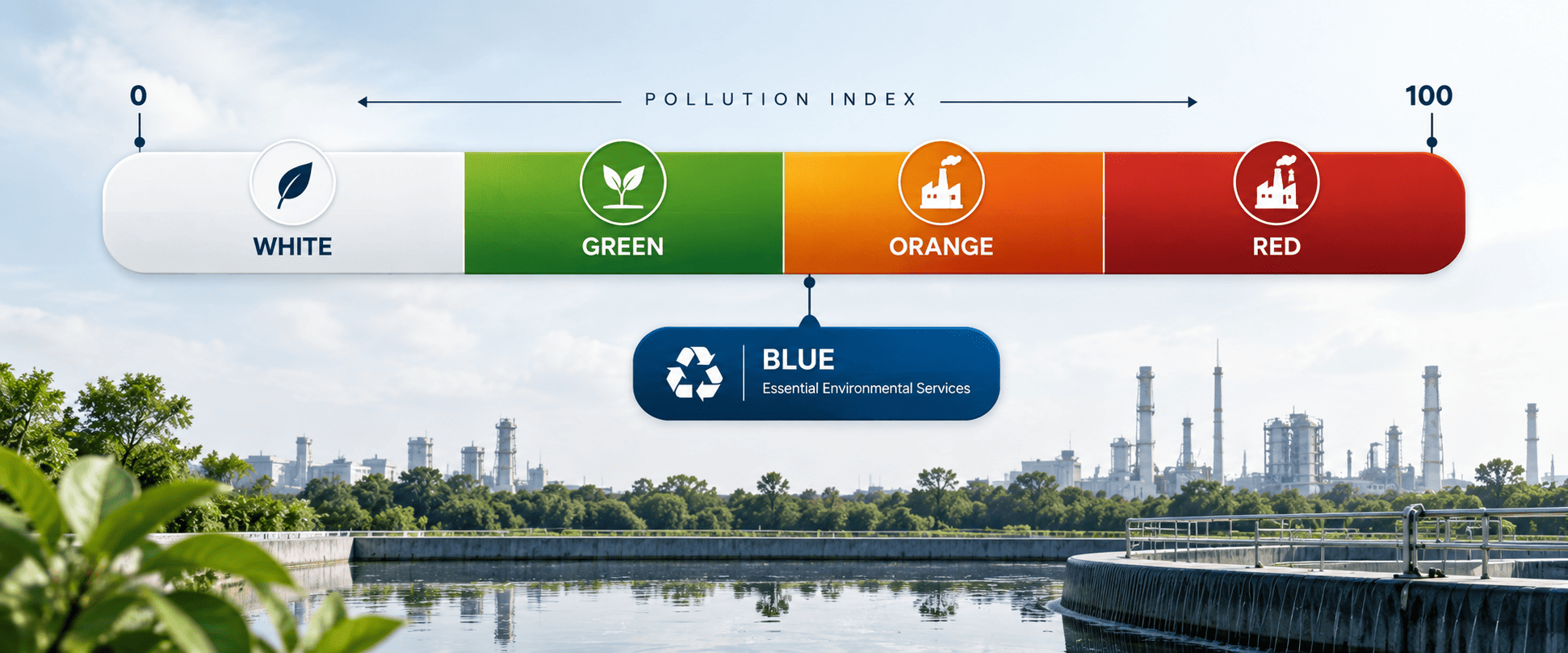
MPCB doesn't treat every industry the same way. This is where most confusion about fees, documents, and timelines starts. Every sector gets a Pollution Index (PI) score from 0 to 100. The score covers air emissions, water pollution, hazardous waste, and resource use. That score decides your category.
|
Pollution Index (PI) |
Category |
What It Generally Means |
|
60 and above |
Red |
High pollution potential. Strictest checks, most paperwork, closest monitoring |
|
41 to 59 |
Orange |
Moderate pollution potential. Full consent needed, moderate monitoring |
|
21 to 40 |
Green |
Lower pollution potential. Consent needed, but a lighter compliance load |
|
20 and below |
White |
Near-zero pollution. No Consent to Operate needed, just self-declaration |
|
Essential services |
Blue |
Added in 2025 for units like effluent treatment plants and sewage plants. Gets extended validity |
CPCB revised this system in 2025. MPCB adopted the new list through a circular dated 23 June 2025. It covers close to 420 industrial sub-sectors across all five categories. If you last checked your category a few years back, check again. Sectors have moved between categories. MPCB has also widened the White category to around 850 low-impact activities. It added nine more sectors to Blue, taking that list to 17 sectors.
Here's something that catches first-time applicants off guard. Your category depends on your manufacturing process, not your business size. A small unit running a hazardous chemical reaction can land in Red category. A much bigger unit doing simple mechanical assembly can sit comfortably in Green. Never guess your category from headcount or factory size. Confirm it against MPCB's actual sector list, or ask an environmental consultant, before you plan your timeline or budget.
Which Businesses in Maharashtra Actually Need an MPCB License?
The honest answer is broader than most people expect. Say your business creates trade effluent, stack emissions, or hazardous waste, in any amount. MPCB consent almost certainly applies. It doesn't matter how small the operation feels.
Common categories that need CTE and CTO include:
-
Manufacturing units of every kind: textiles, pharmaceuticals, plastics, metal fabrication
-
Food processing and beverage units, including dairies and bottling plants
-
Chemical, dye, and pesticide manufacturing, almost always Red or Orange category
-
Hospitals and diagnostic labs, which need a separate bio-medical waste authorization too
-
Hotels, malls, and large complexes above a certain built-up area, mainly for sewage and waste handling
-
Construction and infrastructure projects that generate real dust, effluent, or debris
Maharashtra's coastline adds a layer most guides skip entirely. Ports and ship-repair yards near Mumbai and Jawaharlal Nehru Port handle tank cleaning, hull blasting, painting, and bilge water disposal. All of this falls under MPCB's Water Act and Hazardous Waste rules. Say your business also runs vessels calling at these ports. You're likely running two compliance tracks at once. One is MPCB consent for the shore facility. The other is maritime paperwork: a Document of Compliance or DDOC certification for the vessel's safety system, MLC 2006 certification for seafarer welfare, and SIRE inspection readiness for tankers. Neither track replaces the other. If you're also bringing a vessel under the Indian flag to a Maharashtra port, handle converting the vessel to Indian registration on its own separate timeline.
Pharma and cosmetic manufacturers face a similar overlap closer to shore. Alongside MPCB consent for effluent and hazardous waste, they usually also need a drug manufacturing license, CDSCO registration where it applies, and sometimes a cosmetics license. These run in parallel, not one after the other. Food manufacturers layer FSSAI licensing on top of MPCB consent the same way.
One real exemption is worth knowing. A business with no trade effluent, no air emissions, and no hazardous waste usually sits outside MPCB's consent rule entirely. Think of a software office, a co-working space, or a pure trading business with no manufacturing. Not sure which side of that line you're on? Confirm it before you sign a lease, not after.

What Documents Do You Need to Apply for MPCB Consent?
Missing or inconsistent paperwork is the biggest reason applications get stuck in queries. Get these ready before you start the online application:
-
Site plan or index, and a topographical map where relevant
-
A detailed layout of every process, effluent point, emission source, and stack, plus DG set capacity in KVA
-
A process flow sheet showing raw materials, steps, and outputs
-
Details of your proposed water and air pollution control systems
-
An Ambient Air Quality Report, if one already exists
-
NOC or SSI registration from the Directorate of Industries, Government of Maharashtra, where it applies
-
Chemical reaction details with a mass balance, for process industries
-
NOC from your local body: municipal corporation, municipal council, or gram panchayat
-
Proof of land ownership, or a valid lease agreement
-
An undertaking on stamp paper, or a CA certificate, stating your proposed capital investment
-
Certificate of Incorporation and PAN details of the applicant company
For Consent to Operate, you'll also need proof that your CTE-approved pollution controls got installed. Add recent effluent or emission test reports, plus a copy of your CTE. Renewal asks for the same base documents, plus your compliance record and any monitoring data MPCB has asked for.
Here's a tip that saves real time. Align your capital investment figure with your finance team before you submit anything. That number decides your fee slab. A mismatch between what you declare and what your balance sheet later shows is one of the fastest ways to trigger a query.
How Does the Online MPCB Consent Application Process Work?
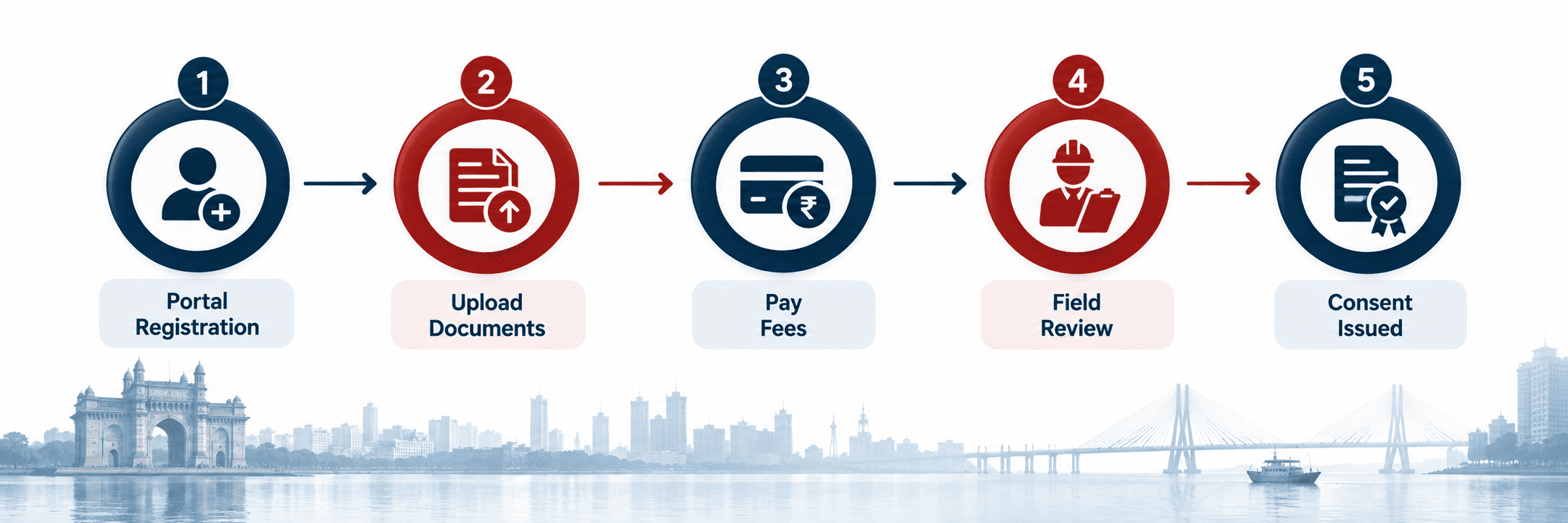
MPCB runs its consent system through the Ec-MPCB Web Portal at ecmpcb.in. This has mostly replaced the older paper-based process. Here's how an application actually moves:
-
Register on ecmpcb.in. Create your industry profile with basic company and unit details.
-
Fill the consent form. Enter production details, raw materials, water sources, and pollution sources for your unit.
-
Upload the required documents. At least four compulsory documents move your status from "Document Pending" to "Payment Pending."
-
Pay the fee online. Since September 2016, MPCB has required all fee payments through its e-payment gateway, not physical demand drafts.
-
Field officer review. Once payment clears, a Sub-Regional Officer assigns your file to a field officer. They review it through MPCB's internal system. For establishment or first-operate cases, they also visit the site.
-
Respond to any queries. If there's a gap or a discrepancy, MPCB emails and texts your registered contact. You upload your reply straight to the portal.
-
Get your consent copy. Once the field officer's review clears, your status changes to "Approved." A signed consent copy becomes available to download from your dashboard.
Feels unfamiliar? Working with an EHS audit partner before you file can catch gaps before MPCB does. That's a lot less stressful than fixing them mid-review.
How Much Does an MPCB License Cost?
MPCB calculates fees as a percentage of your project's capital investment, not a flat charge. That's exactly why two businesses in the same city can pay very different amounts. Across CTE and CTO, the fee usually falls between 0.02% and 0.05% of capital investment. Your exact slab depends on your investment size and your pollution category.
White category units are the clear exception. They only submit a self-declaration, not a full application. No consent fee applies to them at all. Mining projects work a bit differently. They pay a per-tonne rate on mineral output, on top of the standard fee.
Budget for more than the consent fee alone. You'll also need a Detailed Project Report, consultant fees for documentation, and, for Red and Orange units, the ongoing cost of running your pollution control equipment. That last cost usually dwarfs the consent fee over the life of the unit. It's the one first-time applicants underestimate most.
How Long Does MPCB Approval Take, and How Long Is Consent Valid?
Things changed here, and recently. It matters if you're planning a timeline right now. In February 2026, under the state's Ease of Doing Business push, MPCB cut its approval and renewal timelines by more than half.
|
Category |
Consent Type |
Earlier Timeline |
Current Timeline (from Feb 2026) |
|
Green |
CTE, CTO, and renewal |
30 days |
15 days |
|
Orange |
Consent to Establish |
45 days |
24 days |
|
Orange |
CTO or renewal |
60 days |
24 days |
|
Red |
Consent to Establish |
60 days |
40 days |
|
Red |
Consent to Operate |
90 days |
40 days |
|
Red |
Renewal |
120 days |
40 days |
That's a real shift. Most articles online still quote the old figures. Plan around a 90-day or 120-day wait for a Red category unit, and you'll overestimate your timeline by weeks.
Validity works differently from processing time. CTE usually lasts for the life of the project, or a fixed construction window, depending on your category. CTO validity varies more. Green category units often get 5 to 10 years before renewal. Orange sits closer to 5 years. Red renewals tend to run shorter, given the closer monitoring those units need. Always check the exact date on your own consent copy. Don't assume a category-wide default. MPCB can set a shorter term based on your specific compliance record.
Apply for renewal early. Most consultants suggest starting at least 60 days before expiry. MPCB needs that time to review your record and schedule any inspection before your old consent runs out.
Is MPCB Consent the Same as Environmental Clearance (EC)?
No. Mixing these two up is a common, and costly, mistake. Environmental Clearance comes under the EIA Notification, 2006. It's granted by the State Environment Impact Assessment Authority or the central Ministry. It applies only to specific large or sensitive projects on that list: big industrial estates, large mining projects, major infrastructure works.
MPCB consent applies far more broadly. It covers almost any unit that discharges effluent, emits pollutants, or handles hazardous waste, no matter its size. A project needing Environmental Clearance will almost always also need MPCB's CTE and CTO afterward. EC covers the project's overall environmental impact. MPCB consent covers day-to-day operating compliance. A project that doesn't need EC, which describes most small and mid-sized units, may still need MPCB consent. Treat these as two separate approvals from two separate authorities. They are not alternatives to each other.
Can You Get an MPCB Consent Renewed Automatically?
For units with a clean record, yes, to an extent. MPCB runs a simplified auto-renewal scheme based on self-declaration. It's built for established units that haven't changed much since their last consent. Eligible units declare that their production, capital investment, and pollution controls stay within the limits set last time. That skips a full fresh review.
This isn't for everyone, though. Say your capital investment grew a lot. Or your process changed. Or your record shows unresolved violations. MPCB will likely push your renewal into the standard review track instead. Keep your compliance records current all year, not just at renewal time. Consultants call the last-minute scramble "renewal panic." It's one of the most common, and most avoidable, sources of stress in this whole process.
What Happens If You Operate Without a Valid MPCB License?
Running a unit without CTE, CTO, or the right hazardous waste authorization isn't a minor lapse MPCB overlooks. Under Section 33A of the Water Act, and a matching rule in the Air Act, MPCB can order a unit closed. It can also stop or regulate the unit's water and electricity supply. It doesn't need a lengthy court process first. Violations can also lead to prosecution under the Environment (Protection) Act, 1986. That law carries fines, and for serious or repeat violations, possible imprisonment.
There's a cost beyond the legal risk too. An unauthorised unit usually can't get bank finance, government tenders, or export paperwork that needs proof of environmental compliance. Insurers often ask for a valid consent copy as well, especially for fire and liability cover on industrial premises. The real cost of skipping consent almost always beats the cost of the consent fee itself, by a wide margin.
Do You Need Other Certifications Alongside Your MPCB License?
MPCB consent tells you what pollution controls the law requires. It doesn't show that you're managing environment, health, and safety as one connected system. That's increasingly what bigger clients, export buyers, and insurers want to see.
That's where ISO 14001 for environmental management and ISO 45001 for workplace health and safety come in. Many manufacturers pursue both together through an Integrated Management System (IMS) certification. This bundles quality, environment, and safety into one audited framework instead of three separate ones. None of these replace MPCB consent. MPCB doesn't check for them. But tender documents and larger buyers increasingly do.
Managing a workforce across shifts and shop floors? Pairing your MPCB compliance with proper labour law compliance closes a gap that other inspectors look at, often during the same site visit.
What Mistakes Should You Avoid While Applying for MPCB Consent?
A few patterns show up again and again in rejected or delayed applications. Most are avoidable with a bit of upfront planning.
-
Guessing category from business size. A small unit running a hazardous chemical process can still land in Red category. Confirm your real sector classification. Don't guess from headcount or floor area.
-
Starting construction before CTE is granted. This is one of the most common, and most avoidable, violations. It's a direct offence under the Water and Air Acts, not a minor slip.
-
Changing your pollution control design between CTE and CTO without telling MPCB. Field officers compare what you proposed against what got built. Unexplained gaps trigger queries.
-
Waiting until the final weeks before consent expiry to start renewal. Renewal isn't instant. A lapsed consent means your unit legally can't operate in the gap.
-
Treating a consultant's submission as fire-and-forget. Even when a consultant files for you, someone in-house should review the data first. Your company, not the consultant, carries legal responsibility for what's declared.
FAQS
Have questions about MPCB License?
We have you covered:
-
Can a small startup or home-based business skip MPCB consent entirely?
Only if the business truly creates no trade effluent, no air emissions, and no hazardous waste. A home-based food business using a shared kitchen may still need to check, depending on scale. A purely service-based or trading business with no manufacturing usually sits outside the rule.
- Do IT companies, offices, or co-working spaces need an MPCB license?
- What happens if my industry category changes after I already have a CTO?
- Can I start construction while my CTE application is still pending?
- Does MPCB consent cover noise pollution too, or is that separate?
- Is MPCB consent required for a warehouse or godown that doesn't manufacture anything?
- Can a consultant or Chartered Accountant apply for MPCB consent on my behalf?
- What if MPCB rejects my application? Can I reapply immediately?
- Do I need a separate MPCB license for each branch or unit, or does one consent cover everything?
- Is MPCB consent transferable if I sell my business or change ownership?


