
Getting a Customs Broker License in India requires more than passing an examination. Applicants must meet the Customs Brokers Licensing Regulations, 2018, submit the F-Category application through CBLMS, clear the written and oral examinations, pay the licence fee and furnish a bond and security.
NACIN conducts the Regulation 6 examination, but it does not replace the licensing authority. Since the 2021 amendment, a Customs Broker licence remains valid unless revoked, although one year of inactivity can make it invalid and require renewal through Form I.
This guide explains Customs Broker eligibility, documents, CBLR exam requirements, application steps, fees, security, validity, all-India operations, compliance duties and cancellation risks. It explains why a CHA licence, F card, G card, IEC and MTO registration are not interchangeable.
What Is a Customs Broker License in India?
A Customs Broker is licensed under the Customs Brokers Licensing Regulations, 2018 to act for an importer or exporter. The work covers conveyances, imported or exported goods and related customs business at a customs station, including audit.
The licence is required for customs-broking business conducted for others. An importer or exporter may transact solely on its own account. Limited exceptions also cover approved employees acting for an employer and vessel or aircraft agents performing incidental agency work.
This approval is not interchangeable with other trade credentials. An IEC identifies an eligible importer or exporter, while IATA cargo registration concerns airline cargo accreditation. Neither one authorises customs-broking business for clients.
Who Issues a Customs Broker License in India?
The jurisdictional Principal Commissioner of Customs or Commissioner of Customs issues a Customs Broker License under Regulation 7 of the Customs Brokers Licensing Regulations, 2018.
The Central Board of Indirect Taxes and Customs frames and administers the regulatory framework. However, CBIC does not directly process every individual application. The applicant selects the relevant Customs Policy Section according to the area where the customs-broking business will initially operate.
NACIN conducts the written and oral examinations under Regulation 6. The Customs Broker License Management System, or CBLMS, is the online platform used for application and licensing activities.
|
Authority or platform |
Principal function |
|
CBIC |
Frames and administers the licensing regulations |
|
NACIN |
Conducts the Regulation 6 examination |
|
CBLMS |
Handles online applications and licence-related processes |
|
Jurisdictional Customs Commissioner |
Scrutinises eligibility and grants the licence |
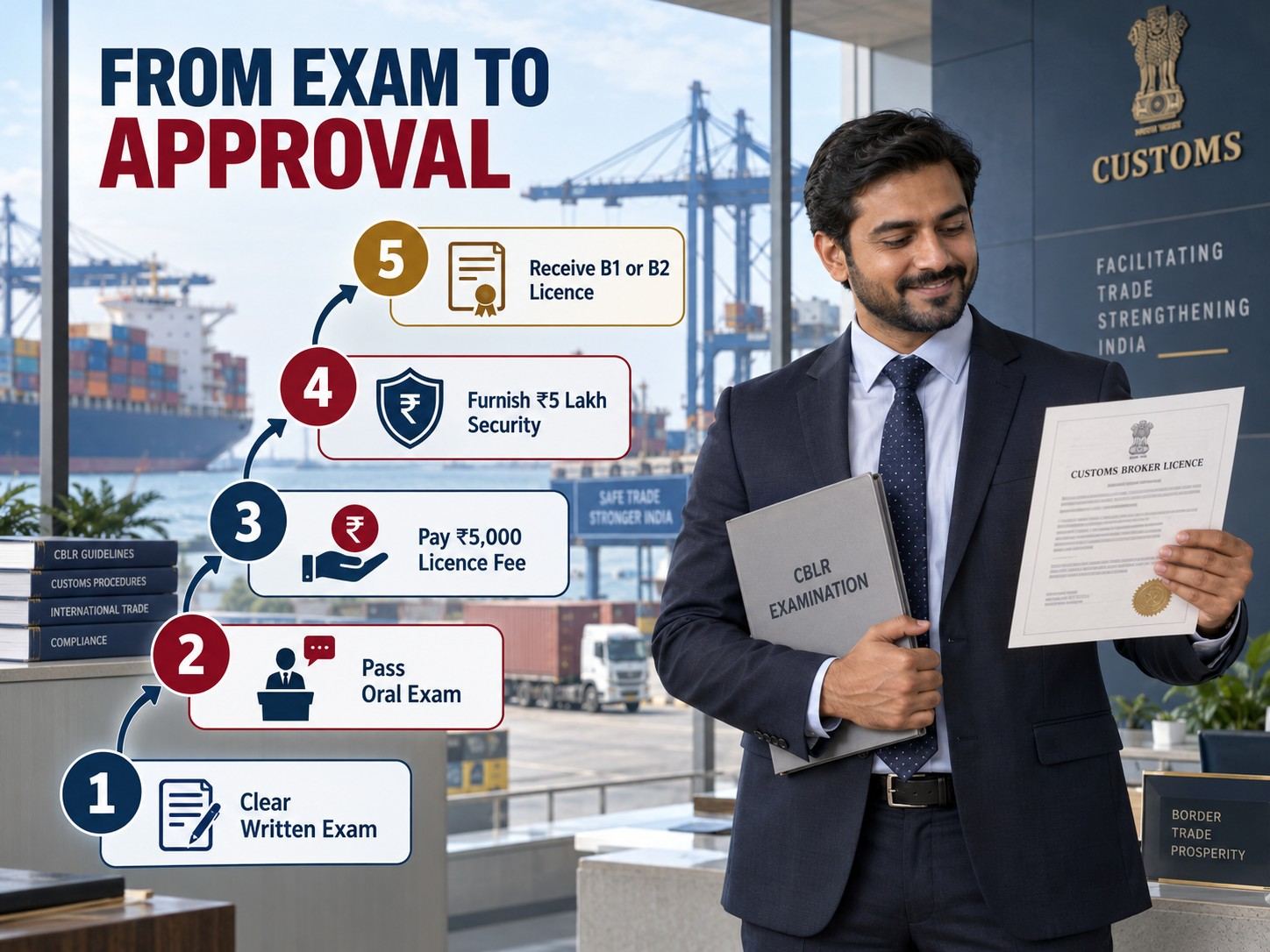
After the applicant passes both examinations, pays the ₹5,000 licence fee within the prescribed two-month period and completes the bond and security requirements, the competent Customs authority may issue Form B1 or Form B2.
Custom House Agent License vs Customs Broker License
A Custom House Agent License and a Customs Broker License are not two separate present-day licences. “Custom House Agent” or “CHA” is the older terminology used under earlier licensing regulations. The current statutory designation under CBLR 2018 is “Customs Broker”.
Searches for a CHA licence, custom house agent licence or customs clearance licence generally refer to the Customs Broker licensing route. However, an F card, G card or H card is an identity or authority card and should not be described as the business licence.
An individual who passes the Regulation 6 examination may receive a licence in Form B1. A qualifying firm, company or association receives Form B2 when at least one director, partner or authorised employee satisfies the examination requirement.
Who are Eligible for Customs Broker License in India?
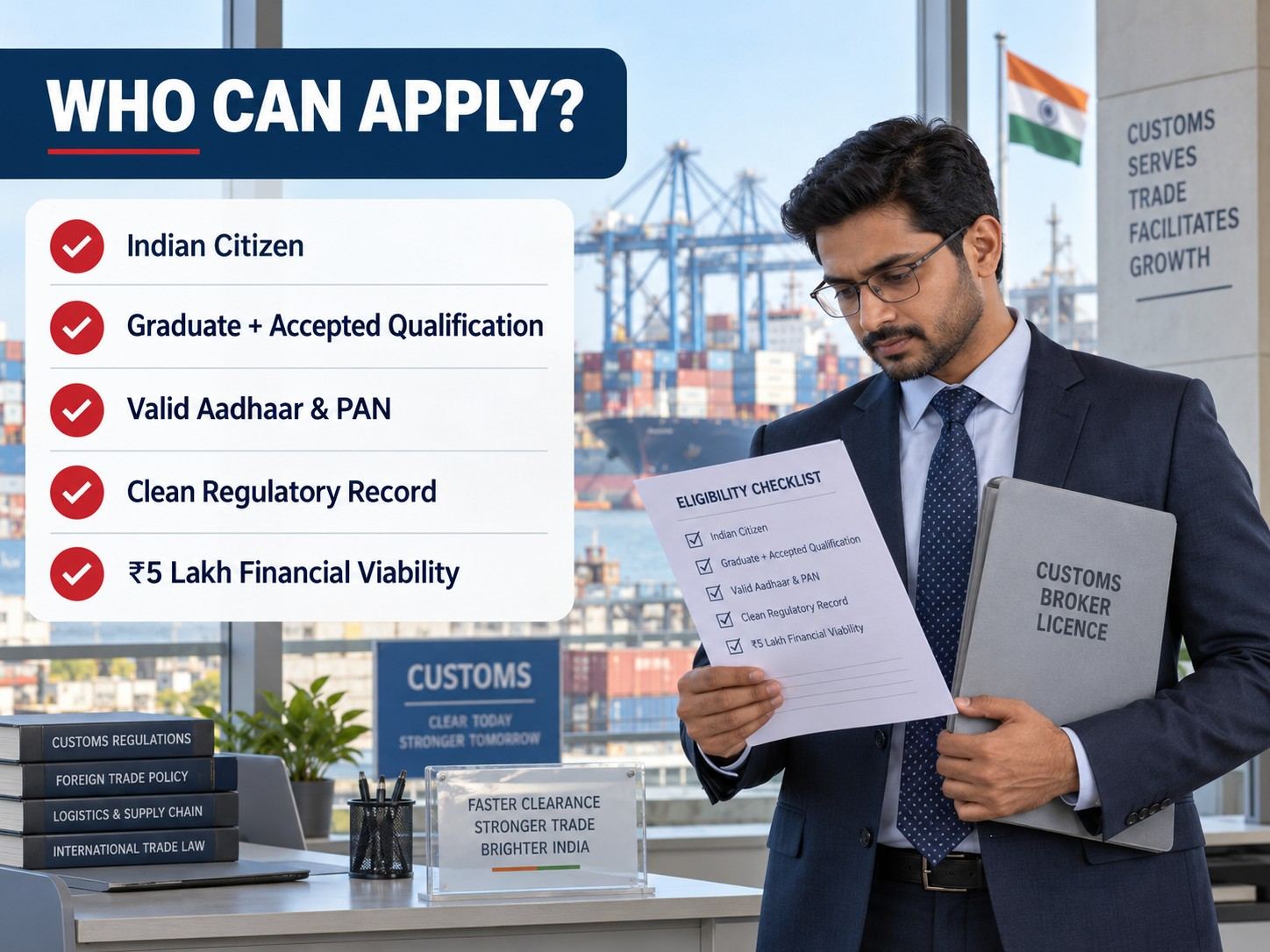
Regulation 5 sets personal and professional conditions. For an entity, the partner, director or authorised employee handling customs work must meet the qualification route.
|
Eligibility point |
Official requirement |
|
Citizenship |
The applicant must be an Indian citizen |
|
Legal capacity |
The applicant must be of sound mind and must not have been adjudicated insolvent |
|
Identity |
Aadhaar and a valid PAN are required |
|
Regulatory record |
The applicant must not have been penalised under the specified customs, excise, service tax, CGST or IGST laws |
|
Criminal record |
The applicant must not have been convicted, and no criminal proceeding may be pending in a court |
|
Basic education |
The individual or qualifying person must be a graduate from a recognised university |
|
Additional qualification |
The graduate must also hold an accepted professional qualification or recognised customs-clearance diploma, or have at least two years' Customs Broker work experience as a G-card holder |
|
Financial viability |
A scheduled-bank certificate or other acceptable proof must show assets worth at least ₹5 lakh |
Listed professional qualifications include a master's or equivalent degree in Accounting, Finance or Management, CA, CS, MBA, LLM, ACMA and FCMA. A government-recognised Diploma in Customs Clearance work is also accepted.
A bachelor's degree alone does not satisfy the ordinary route. The applicant must be a graduate and also meet the professional qualification, diploma or two-year G-card experience condition.
A retired Group A Indian Revenue Service officer from Customs and Central Excise may apply after at least five years in a Group A post. The other stated personal and financial conditions still apply. CBLR specifies no upper age limit.
An entity planning to carry goods under one multimodal transport contract should separately review MTO registration requirements. Holding MTO registration does not make the entity a licensed Customs Broker.
Difference Between B1, B2, F, G and H Cards
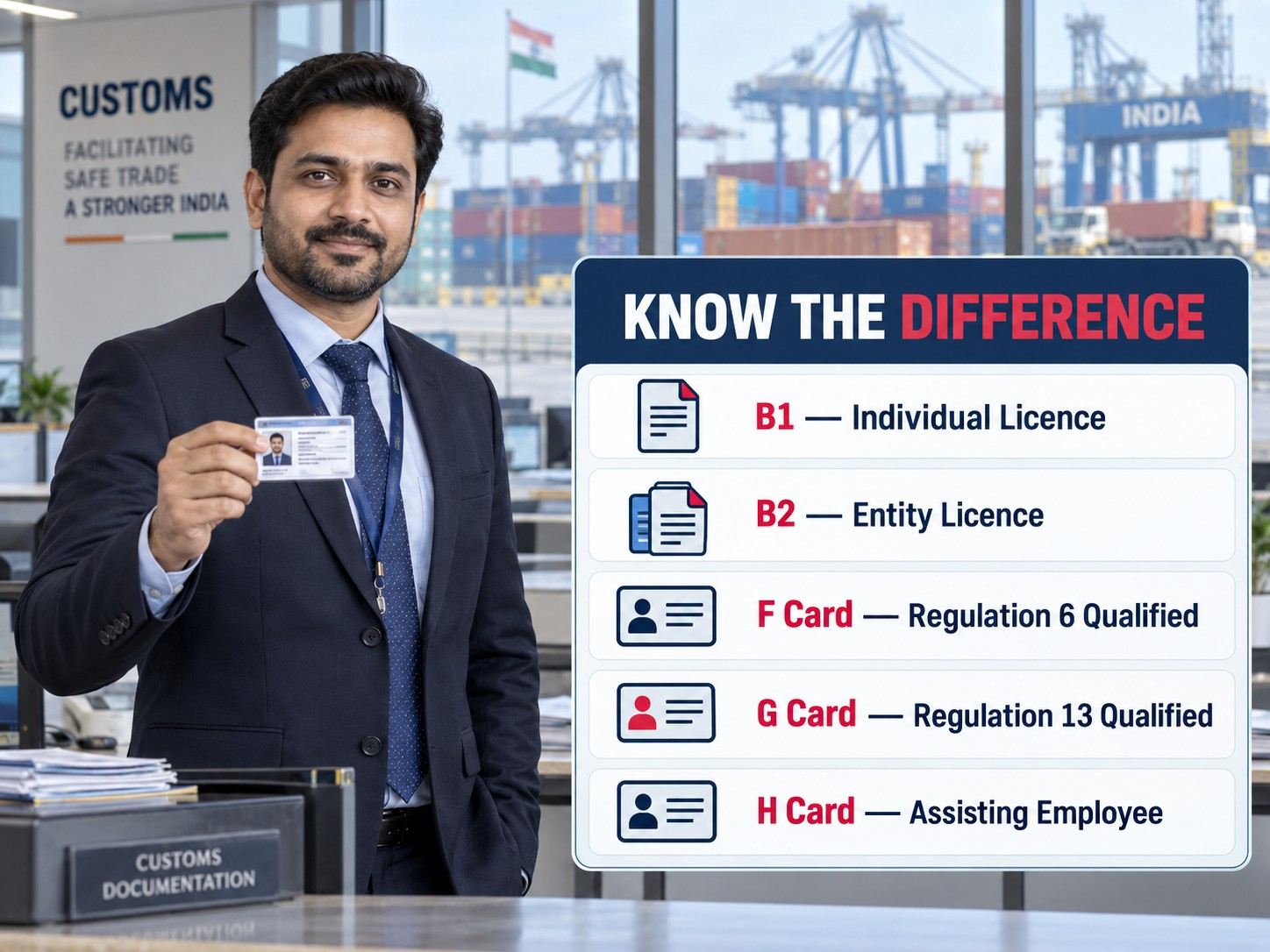
These connected terms are not identical. An identity card should never be presented as the entity's licence.
|
Term |
What it represents |
|
Form B1 licence |
Customs Broker licence granted to a qualified individual |
|
Form B2 licence |
Licence granted to a company, firm or association with at least one qualified director, partner or authorised employee |
|
F card |
Photo identity card for a person who passed the Regulation 6 examination |
|
G card |
Photo identity card for an approved employee who passed the Regulation 13 examination |
|
H card |
Photo identity card for an approved assisting employee who has not passed the Regulation 13 examination |
The exam-qualified person supporting Form B2 may act for only one licensed firm or company at a time. The entity still needs its own Form B2 licence.
Documents to Prepare for Customs Broker Registration
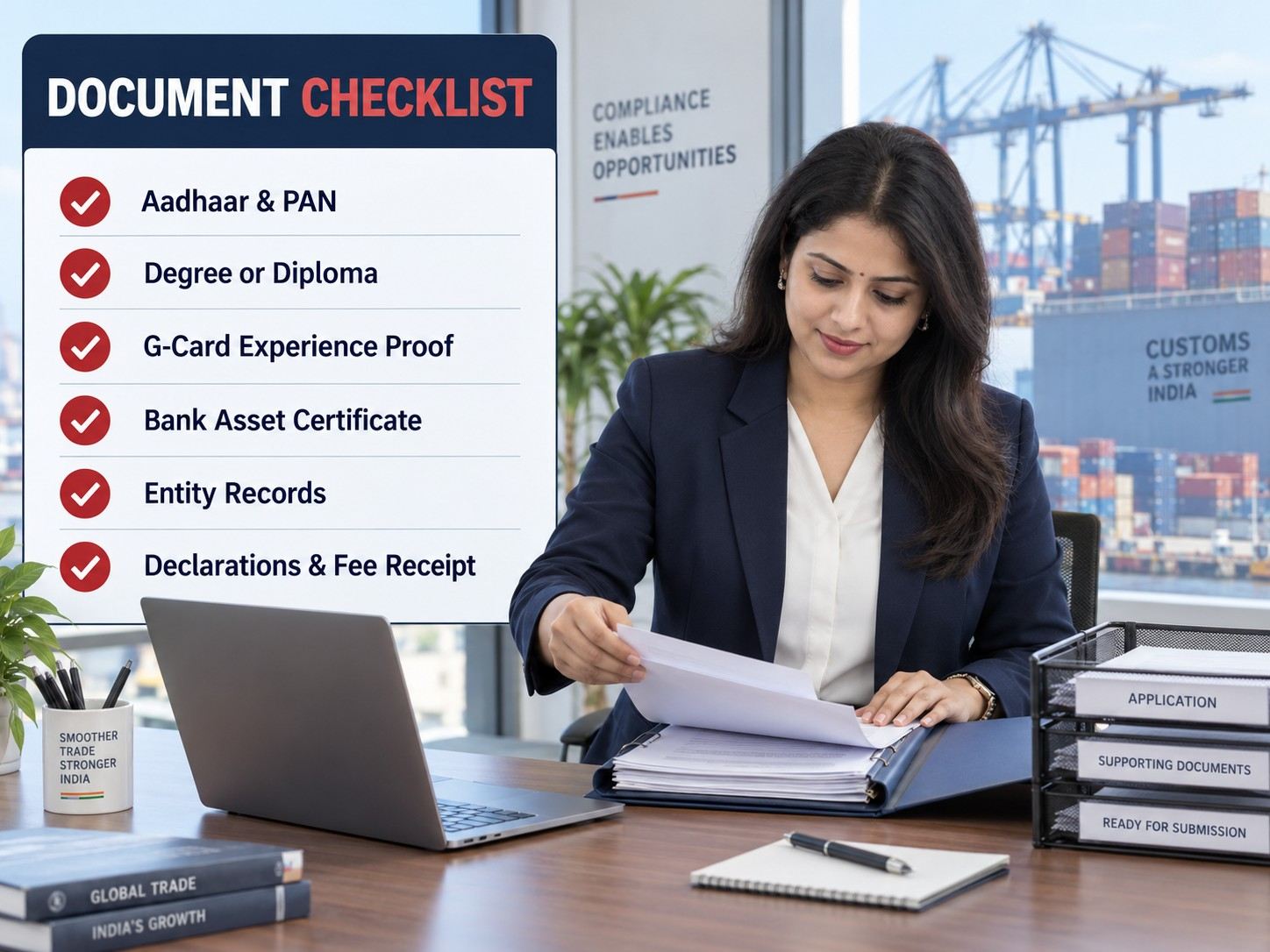
Check exact upload fields against the current CBLMS manual and notice. The file must prove every applicable Regulation 5 condition and match the online entries.
|
Document or record |
Why it is needed |
|
Aadhaar and PAN |
Establish identity and mandatory registration details |
|
Citizenship proof |
Supports Indian citizenship declaration |
|
Graduation certificate |
Proves the recognised university degree |
|
Professional degree or diploma |
Supports the chosen academic qualification route |
|
G card and experience evidence |
Required when relying on two years of G-card Customs Broker experience |
|
Scheduled-bank certificate or asset proof |
Establishes financial viability of at least ₹5 lakh |
|
Firm or company records |
Identify the entity, partners, directors and proposed qualified person |
|
Prescribed declarations |
Disclose prior applications, licences, penalties, convictions and prosecutions |
|
Fee receipt or paid challan |
Proves payment of the ₹500 application fee |
Names, PAN details and entity records should agree throughout. For the applicant's own import-export transactions, IEC code registration remains separate and does not prove CBLR eligibility.
Customs Broker License Exam 2027: Important Dates
NACIN issued the current advertisement on 27 August 2026. Use the NACIN examination notice page for later guidelines, admit cards and results.
|
2027 examination stage |
Announced position |
|
Online application window |
14 October to 13 November 2026, up to 24:00 hours |
|
Application mode |
Online through CBLMS only |
|
Application fee |
₹500 |
|
Eligible applicant list |
To be displayed by the respective Commissionerate by 8 December 2026 |
|
Admit card |
Website access and email to eligible applicants 12 days before the examination |
|
Written examination |
March 2027 |
|
Answer language |
Hindi or English |
|
Oral examination |
Separate communication for written-exam qualifiers |
These are notice-specific dates. They should not be copied into a later examination cycle without checking the next official advertisement.
How to Apply for a Customs Broker License Online
The 2027 process uses an “F Category Exam & License” application. Follow the sequence carefully because it can be submitted only once.
Step 1: Confirm the Correct Eligibility Route
Match your degree, professional qualification, diploma or G-card experience against Regulation 5. An entity must identify the person who will handle customs work and sit the examination.
Step 2: Select the Correct Policy Section
Choose the Policy Section for the intended business area. The notice asks applicants to select carefully because this section handles scrutiny and communication.
Step 3: Register on CBLMS
Create an account on the official CBLMS portal using the applicant's own PAN. Keep the registered email and mobile number active for official communication.
Step 4: Complete the F-Category Application
Complete every field consistently. Upload legible identity, qualification, experience, financial and declaration records requested for the selected route.
Step 5: Pay the ₹500 Application Fee
Pay online or by permitted manual challan. If online payment succeeds without automatic submission, download the BharatKosh receipt, upload it in the designated field and submit the form.
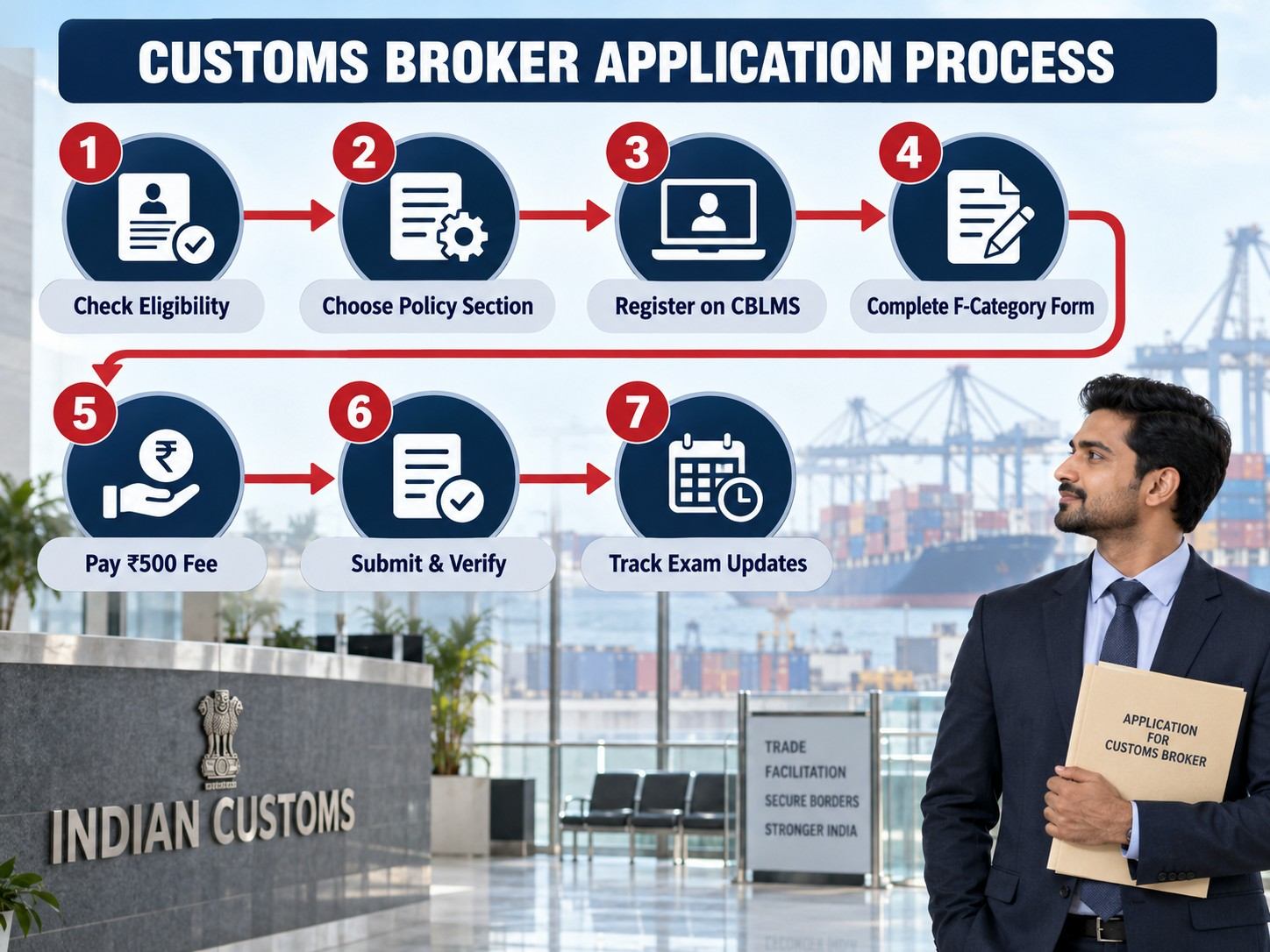
Step 6: Verify Final Submission
Payment or receipt upload alone is insufficient. Confirm final submission and retain the acknowledgement, receipt and application copy.
Step 7: Track Scrutiny and Examination Updates
Check the Commissionerate's website or notice board for the eligible list. Download the admit card and read the current exam-day guidelines before attending.
CBLR Exam Pattern, Syllabus, Passing Marks and Attempts
The CBLR exam has two stages: an online written examination followed by an oral examination. Applicants must clear both stages before becoming eligible for the grant of a Customs Broker License.
A maximum of six attempts is allowed under Regulation 6. An appearance in the written examination counts as an attempt even when the candidate is subsequently disqualified or the application is cancelled.
The 2027 notice confirms that the written examination will be conducted in March 2027 and may be answered in Hindi or English. However, the notice does not currently specify the final question count, examination duration, marking system or written-examination passing marks.
Applicants should not assume that the pattern followed in 2026 will automatically apply in 2027. The exact CBLR exam pattern and passing marks should be updated only after NACIN publishes the examination guidelines for the 2027 cycle.
The syllabus can cover:
-
Bills of entry, bills of export, shipping bills and clearance documents
-
Arrival entry and clearance of vessels
-
Tariff classification, duty rates and customs valuation
-
Currency conversion, assessment, payment and duty refunds
-
Examination of goods, bonded clearance and re-importation
-
Import and export prohibitions
-
Drawback, export-promotion and SEZ procedures
-
Customs offences, appeals and revision applications
-
Allied laws affecting EXIM clearance
-
ICEGATE and ICES electronic filing
-
Current rules, regulations and notifications under customs and allied laws
The 2027 notice confirms an online written examination in Hindi or English. Wait for the 2027 guidelines before relying on an earlier cycle's duration, marking pattern or objection process.
Customs Broker License Fees, Bond and Security Deposit
The ₹500 application fee, ₹5,000 licence fee and ₹5 lakh security serve different purposes. The application fee, licence fee and security deposit are separate regulatory requirements and become payable at different stages of the Customs Broker registration process.
|
Payment or security |
When payable |
Verified official position |
|
Application fee |
With the F-category exam and licence application |
₹500 |
|
Licence fee |
After passing both written and oral examinations |
₹5,000, payable within two months of the oral result |
|
Security |
Before grant of licence |
₹5 lakh through an accepted security instrument |
|
Renewal after inactivity |
After the licence becomes invalid because of one year of inactivity |
₹15,000 with Form I, subject to approval |
The ₹5 lakh amount is security, not a fee. Accepted instruments include a bank guarantee, postal security, National Savings Certificate or fixed-deposit receipt from a nationalised bank. Form D and, where specified, Form E bonds also apply.
CBLR prescribes no all-inclusive setup price. Association charges, assistance and operating systems remain separate, so a quotation should distinguish them from government payments.
Customs Broker License Approval Process After the Exam
Clearing the oral examination begins, but does not complete, approval.
Pay the Licence Fee Within Two Months
Pay ₹5,000 within two months after the oral result and inform the relevant authority. Missing the period forfeits the right to receive the licence under that result.
Execute the Bond and Furnish Security
Execute Form D, any specified Form E surety bond and the ₹5 lakh security before grant.
Receive Form B1 or Form B2
An exam-qualified individual receives Form B1. An eligible entity receives Form B2 when at least one director, partner or authorised employee has passed Regulation 6.
Complete Card and Operational Formalities
The qualified person receives the Form F photo identity card. Client work must be performed personally or through approved employees under the required authority.
Intimate Other Customs Stations in Form C
A licensee may extend operations through Form C. A new licence generally faces a two-year wait at another station, with exceptions for the issuing station and specified legacy cases.
The authority should grant the licence within one month after verifying the ₹5,000 payment. This is not the total application-to-approval time.
Customs Broker License Validity and Renewal Rules
A Customs Broker License is no longer subject to routine renewal after every ten years. Following the Customs Brokers Licensing (Amendment) Regulations, 2021, the licence remains valid unless it is revoked under the applicable provisions.
This is commonly described as lifetime validity. However, lifetime validity does not protect a dormant licence or prevent regulatory action against a Customs Broker who violates CBLR requirements.
Invalidation Due to Inactivity
A Customs Broker License is deemed invalid when the licensee does not transact any customs-broking business for one year. A period during which the licence remains officially suspended is not included when calculating this one-year inactivity period.
Renewal After One Year of Inactivity
A licensee whose licence becomes invalid due to inactivity may apply for renewal using Form I. The Principal Commissioner of Customs or Commissioner of Customs may approve the application after confirming that the applicant continues to satisfy the relevant licensing requirements.
The prescribed renewal fee is ₹15,000. This payment applies to the restoration of a licence invalidated because of inactivity. It is not a regular renewal fee payable by every active Customs Broker.
Voluntary Surrender of the Licence
A Customs Broker may submit a written request to surrender the licence to the authority that issued it. The request may be accepted when all dues payable to the Central Government have been cleared, and no proceeding is pending against the licensee.
Duties That Continue After Licence Approval
A Customs Broker must:
-
Obtain authorisation from every client and produce it when required
-
Advise clients to comply with customs and allied laws
-
Exercise due diligence before sharing clearance information
-
Verify the client's IEC, GSTIN, identity and operation at the declared address
-
Pay government sums received from clients promptly and account for all client funds
-
Maintain orderly transaction and financial records for at least five years
-
Report changes in postal address, telephone number or email within two days
-
Supervise employees and remain responsible for their acts and omissions
-
Cooperate with customs investigations
-
Avoid improper access to government records or influence over officials
Where a registered, recognised association exists, the broker must enrol in each operating jurisdiction but cannot join two associations simultaneously in one jurisdiction.
The licence does not replace multimodal registration or MTO insurance requirements. For an outside provider, use a registered MTO operator directory only as a starting point, then verify registration and capability.
Is a Customs Broker License Valid Across India?
A Customs Broker License issued in Form B1 or Form B2 allows the licensee to operate at Customs Stations across India, subject to the conditions prescribed under Regulation 7.
Before starting operations at another Customs Station, the broker must submit an intimation in Form C to the Principal Commissioner of Customs or Commissioner of Customs having jurisdiction over that station. A copy of the intimation must also be sent to the authority that issued the original licence.
A newly licensed Customs Broker generally has to wait two years before transacting business at an additional Customs Station requiring Form C. The restriction does not apply to the original jurisdiction selected during the licence application and is waived for specified licences issued under earlier regulations.
Therefore, all-India validity does not allow a broker to start working immediately at every port or Customs Station without completing the required intimation.
Common Reasons for Rejection or Delay
Below are some of the common reasons for rejection or delay:
|
Problem |
Practical consequence |
|
Bachelor's degree submitted without the second qualifying condition |
Regulation 5 eligibility may remain unproved |
|
Wrong Policy Section selected |
Scrutiny and jurisdictional handling may be affected |
|
Payment made but application not finally submitted |
No valid application reaches scrutiny |
|
Blurred, incomplete or inconsistent uploads |
The application may be treated as incomplete |
|
PAN, name or entity details do not match |
The authority may seek verification or reject incorrect information |
|
Financial proof does not establish assets of at least ₹5 lakh |
Financial viability remains unproved |
|
Penalty, prosecution or criminal proceeding declaration is inaccurate |
Application rejection or later licence cancellation may follow |
|
₹5,000 licence fee is not paid within two months |
The right to grant of the licence is forfeited |
|
Bond or security is not completed |
The licence cannot be granted |
The 2027 notice says incomplete applications will be summarily rejected. Incorrect information may cause rejection or later cancellation, so review the form before its single submission.
Conclusion
A Customs Broker License in India requires more than the CBLR exam. The applicant must prove eligibility, submit correctly, clear both examinations, pay ₹5,000 on time and complete the bond and ₹5 lakh security.
After approval, the broker must protect authorisations, verify clients, keep records, supervise employees and remain active. The CHA licence, F card, IEC, IATA and MTO registration are not interchangeable. A sound application proves every condition with consistent records.
FAQS
FAQs About Customs Broker License
-
Does a written-exam appearance count if the application is later cancelled?
Yes. A written exam appearance remains an attempt after a later disqualification or cancellation. Check eligibility and declarations before using one of the six permitted attempts.
- Must someone who passed an older CHA examination take the CBLR exam again?
- Can an F-card-qualified person represent two licensed companies at once?
- What happens if a licensed firm's or company's PAN changes?
- What if the exam-qualified partner, director or employee retires or dies?
- Can a Customs Broker surrender the licence while proceedings are pending?
- Can a Customs Broker join two associations in the same jurisdiction?
- Can a CBLR time limit be extended for circumstances beyond the applicant's control?
- What should an applicant do if the name is missing from the eligible list?
- Can someone start clearing client cargo immediately after passing the exam?


