

A pest control license lets you legally run a commercial pest control business in India. The Insecticides Act, 1968 makes it mandatory. You need a qualifying degree. You need a 15-day training certificate. And you need approval from your state's licensing officer. Only then can you spray, fog, or fumigate someone else's premises for money.
Most first-time applicants expect this to work like a shop license. One form, one fee, done in a week. It doesn't work that way. Your qualification decides which form you file. So does your training certificate. So does whether you plan to fumigate with restricted chemicals. Here's how the whole system fits together.
What Is a Pest Control License, and Why Does India Require One?
A pest control license is your state government's permission to use insecticides commercially. It covers work on someone else's property, done for a fee. The Insecticides Act, 1968 and the Insecticides Rules, 1971 created this requirement. The Ministry of Agriculture and Farmers' Welfare administers the law nationally. Your state's Agriculture Department actually grants the license, through an officer called the Licensing Officer.
The Act calls this activity "commercial pest control operations." That covers spraying, fogging, or fumigating insecticide anywhere. Homes, offices, public spaces, even fields. It includes aerial spraying too. But it excludes private use. Spraying pesticide in your own kitchen doesn't need a license. Spraying it in a client's kitchen for payment does.
Two authorities work together here, and mixing them up causes real confusion. The Central Insecticides Board and Registration Committee, or CIBRC, registers insecticide products at the national level. Your state's Licensing Officer grants a separate license. That license lets you use those registered products for commercial pest control. One body approves the chemical. The other approves your business.
Who Actually Needs a Pest Control License?
Anyone who offers pest control as a paid service needs this license. Business size doesn't matter. That includes:
-
Urban pest control companies handling cockroaches, rodents, bed bugs, mosquitoes, and general household pests
-
Termite control and pre-construction or post-construction anti-termite treatment providers
-
Fumigation operators servicing warehouses, grain storage units, shipping containers, and export cargo
-
Facility management companies that bundle pest control into their service contracts
-
Independent pest control technicians and franchise operators working under their own name
Here's a simple line to draw. If you only treat property you own, you're exempt. The moment you charge someone else, that exemption disappears. A hotel using its own handyman to spray its own lobby sits in a grey zone. Many states still expect this to be licensed once it turns into a routine paid arrangement. Check with your local Agriculture Department instead of assuming.
Food processing units, hospitals, hotels, and IT parks don't need this license themselves. They need it from whoever they hire. Many now ask vendors for proof of a valid license. They also ask for training records. This matters most for businesses working under FSSAI licensing, or ISO 22000 and HACCP certification.
What Is the Difference Between a Pesticide Dealer License and a Pest Control License?
This is where a lot of new entrants get confused. Selling insecticide and applying insecticide are two different activities. The same Act regulates both, but each needs its own license.
|
Feature |
Pesticide Dealer License |
Pest Control License |
|
What it allows |
Selling, stocking or distributing insecticide products from a shop or godown |
Applying insecticide commercially on a client's premises |
|
Governed under |
Insecticides Rules, 1971 (Forms II, VI, VIII) |
Insecticides Rules, 1971, Rule 9 (Form VI-A or VI-C) |
|
Typical holder |
Agri-input shops, pesticide wholesalers, retail dealers |
Pest control companies, PCOs, fumigation operators |
|
Qualification |
Varies by state; often a DAESI diploma or trade experience |
Graduate in Agriculture or Science with Chemistry, plus 15-day training |
|
Site requirement |
Licensed retail or storage premises |
Licensed for each operating location |
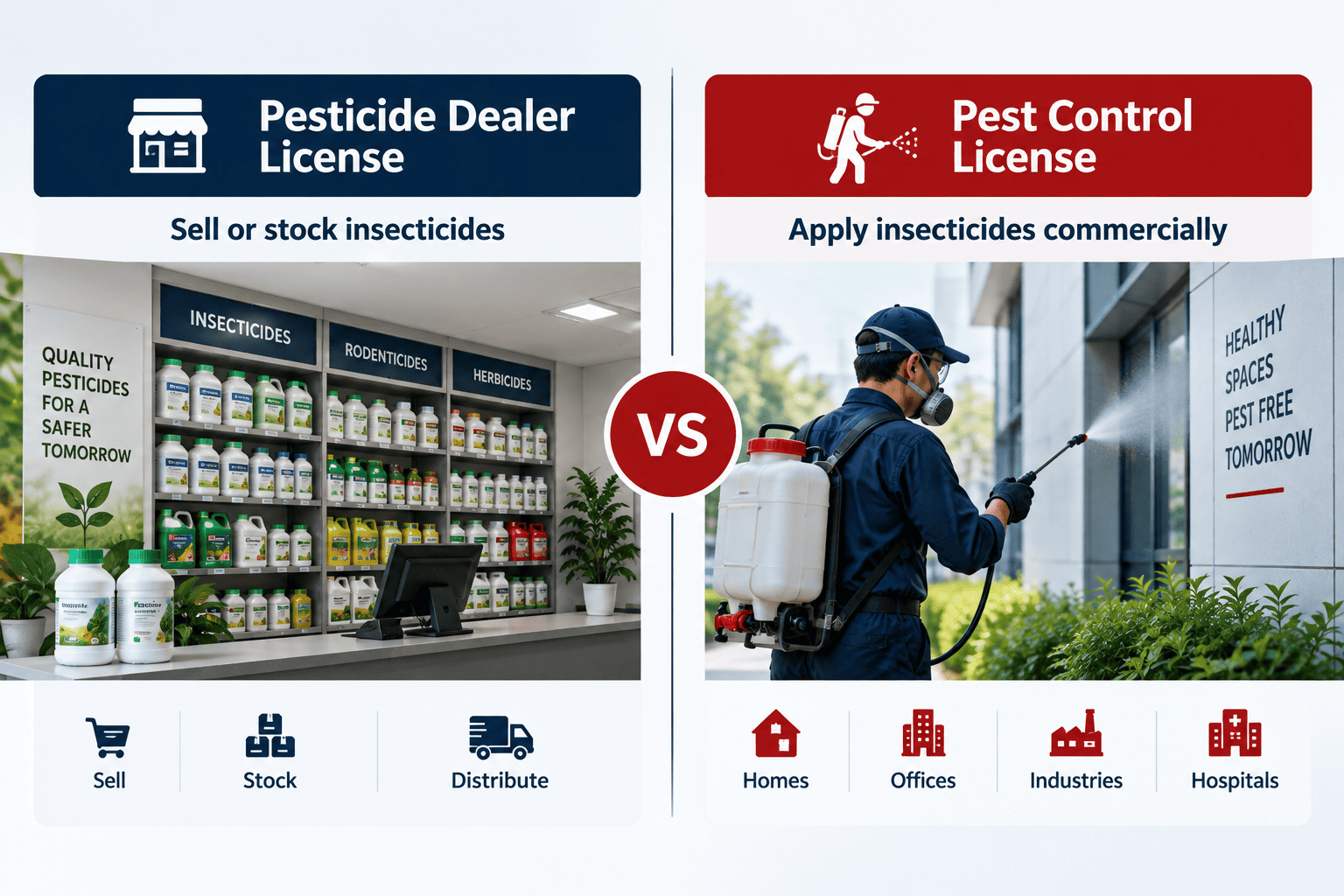
Some states issue one combined certificate naming both approvals, if you apply for both together. Karnataka does this in practice. That doesn't merge the two into one rule. If you only hold the dealer license, you still can't send a technician to spray a client's office.
What Are the Eligibility Requirements for a Pest Control License?
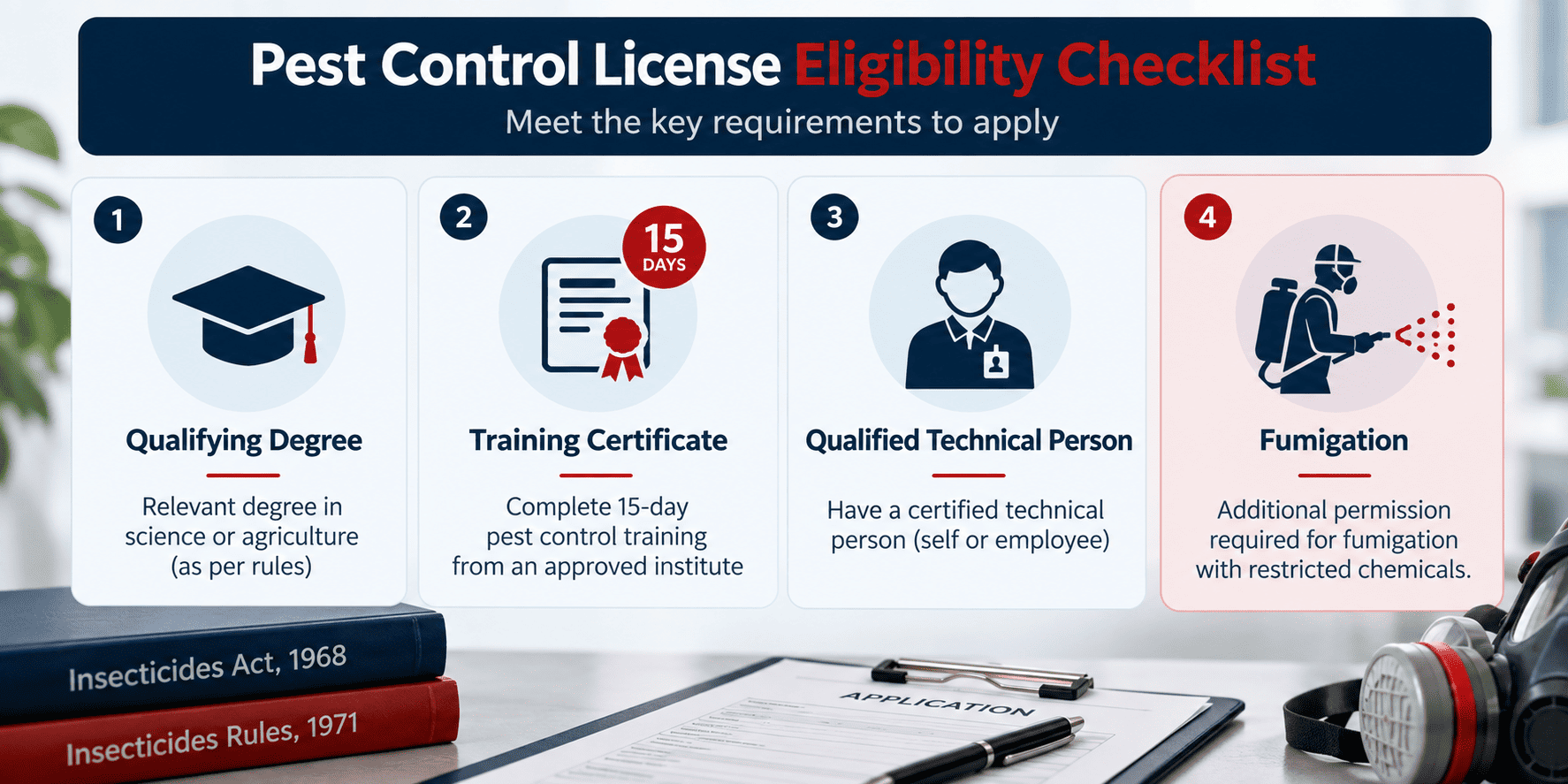
The Insecticides Rules set a specific bar. This bar applies to one person: the one whose name and qualification the license rests on. That person doesn't have to be every technician on your team. It's usually the owner, a partner, or one named staff member.
-
A graduate degree in Agriculture, or in Science with Chemistry as a subject
-
A certificate from a minimum 15-day training programme in pest management, from a recognised institution
-
Several states also accept a Diploma in Agricultural Extension Services for Input Dealers (DAESI) instead of a full degree
-
Some states also ask for a year of hands-on pesticide experience, as an owner or an employee. This isn't uniform nationally
-
For fumigation work, separate written permission from the Plant Protection Adviser to the Government of India, on top of the state license
Don't have the degree yourself? You can still own and run the business. Hire or partner with someone who meets the qualification. Put that person's name on the license as the technical authority. This is standard practice. Most licensing officers expect it for company and partnership applicants. Nobody assumes every owner personally holds a Chemistry degree.
The 15-day training itself isn't a formality you can skip. NIPHM, in Hyderabad, runs a Certificate Course on Urban Pest Management. This course meets the training rule. A couple of other institutes are recognised too. Seats fill up fast. The course also runs on a fixed calendar. Build this into your timeline early. Don't leave it for the last stage.
What Documents Do You Need to Apply?
Keep these ready before you start filing. Missing paperwork is the most common reason applications sit in queries for weeks.
-
Completed application form (Form VI-C for general pest control, Form VI-A for fumigation)
-
Proof of educational qualification or DAESI diploma of the technical person
-
15-day training certificate in pest management
-
Identity and address proof of the applicant or authorised signatory
-
Business registration proof: Certificate of Incorporation, partnership deed, or proprietorship registration, along with PAN
-
Ownership or lease document for the business premises and any storage site
-
List of insecticides you intend to use, with their registration numbers under the Insecticides Act
-
Layout or storage plan for the premises where insecticide will be stocked
-
GST registration certificate
-
Fee payment receipt
-
For fumigation applicants, the separate application for special permission from the Plant Protection Adviser
Align the insecticide list on your application with what you'll actually stock. Licensing officers check this against your storage premises during inspection. A mismatch here is an easy way to get your file sent back.
How to Apply for a Pest Control License in India?
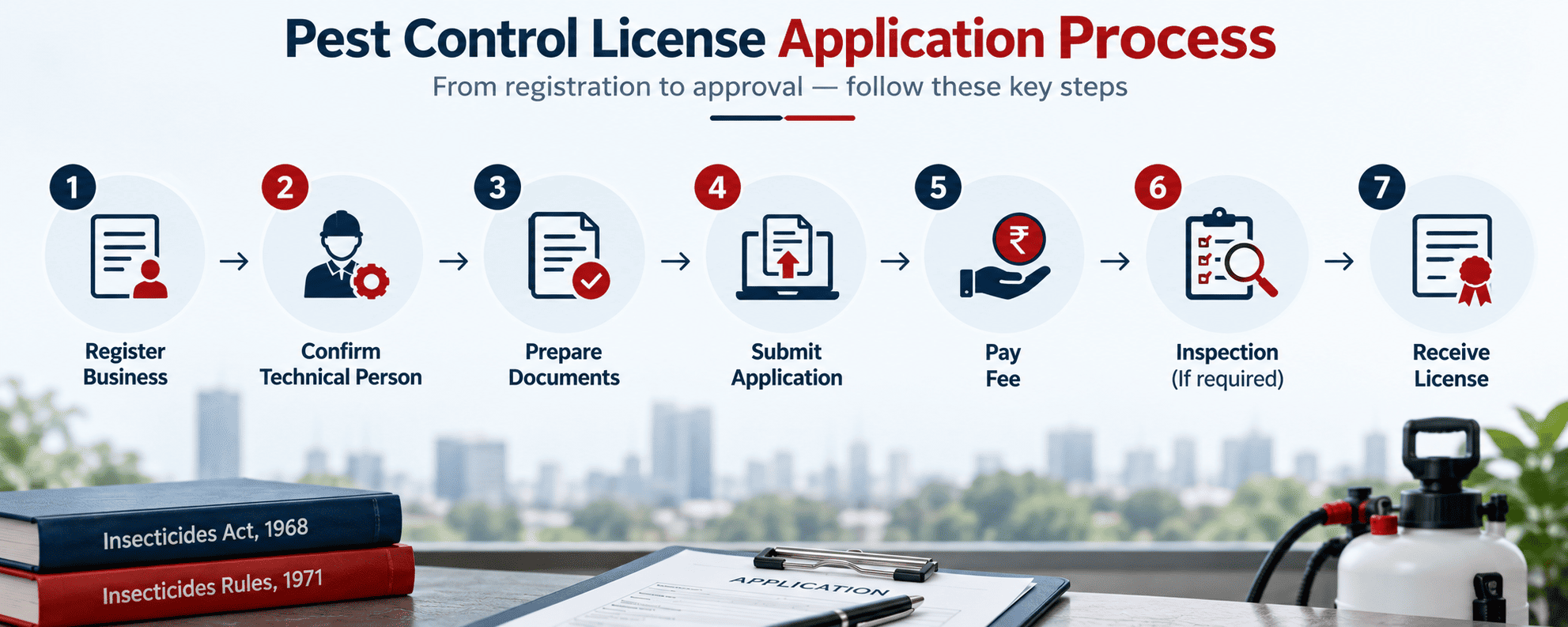
The procedure for obtaining a pest control license depends on the state in which you plan to operate. Applicants generally need to submit the prescribed application, provide the required qualification and training documents, pay the applicable fee, and complete verification or inspection by the concerned licensing authority.
Procedure for Obtaining a Pest Control License Online
1. Visit the relevant government portal
Start by identifying the state authority responsible for issuing the pest control licence. Depending on the state, the application may be available through a state Agriculture Department portal or through the National Single Window System (NSWS).

2. Select the pest control approval
Choose the applicable approval for commercial pest control operations and review the eligibility, documents, fees and other requirements specified by the authority.
3. Register as a new applicant
Create an account on the applicable portal using the required applicant or business details.
4. Complete the application form
Enter the required business, applicant, technical person and premises details accurately.
5. Upload the required documents
Submit the qualification certificate, pest management training certificate, identity and address proof, business documents, premises-related documents and other documents required by the state authority.
6. Pay the prescribed government fee
Pay the applicable application or license fee through the available online payment facility.
7. Submit the application
Review the information and documents before submitting the application to the concerned licensing authority.
8. Document verification and inspection
The authority may verify the submitted documents and inspect the relevant premises before deciding on the application.
9. Receive the license
If the application satisfies the applicable requirements, the licensing authority issues the pest control license.
Pest Control License Application Through NSWS
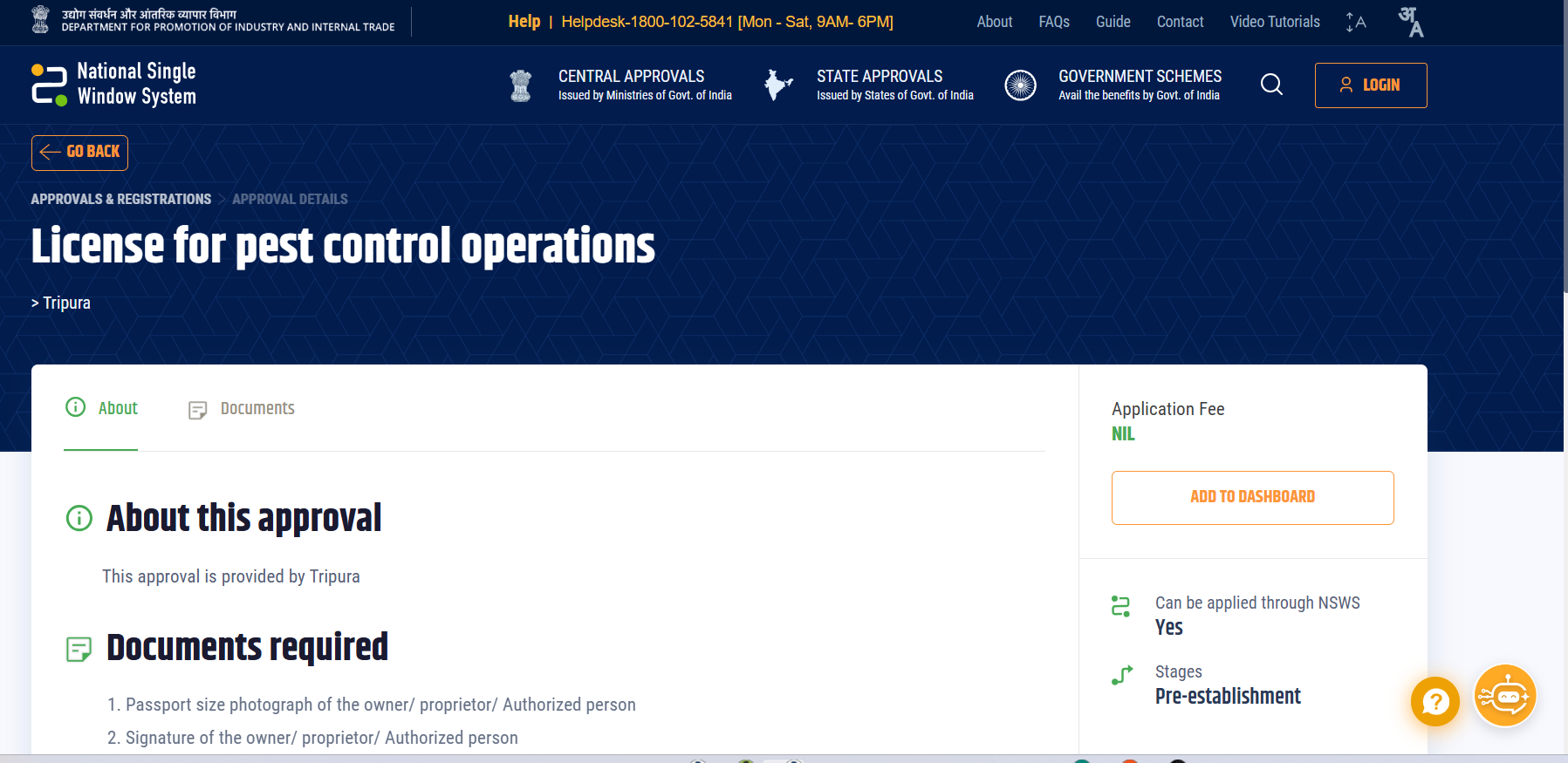
The National Single Window System (NSWS) can be used to identify applicable Central and State approvals. The exact application route, documents, fees and processing requirements can differ between states.
For example, NSWS provides a dedicated approval entry for a licence for pest control operations under the Department of Agriculture and Farmers Welfare, Tripura.
Official approval details:
License for Pest Control Operations – Tripura on NSWS
Applicants should check the applicable state authority because there is no single identical online procedure for every state in India.
Is Fumigation Covered Under the Same License?
No. And this trips up more applicants than any other part of the process. Fumigation with certain restricted chemicals needs its own separate approval, on top of your general pest control license.
|
Feature |
General Pest Control (Form VI-C) |
Fumigation (Form VI-A) |
|
What it covers |
Spraying, gel baiting, dusting, and liquid termite treatment for routine urban pest control |
Fumigation using Aluminium Phosphide, Methyl Bromide, Ethylene Dibromide, or other notified fumigants |
|
Extra approval needed |
No |
Yes, special permission from the Plant Protection Adviser to the Government of India |
|
Typical setting |
Homes, offices, restaurants, hotels, retail stores |
Warehouses, grain silos, shipping containers, export cargo |
|
Application fee |
Set by the state licensing officer |
Rs. 1,000 per place of operation |
|
Validity |
Set by the state licensing officer |
5 years, renewable through Form VI-B |
If your business only handles cockroaches, rodents, and general household pests, Form VI-C usually covers you. The moment you take on warehouse fumigation or export cargo work, that changes. This work almost always uses Aluminium Phosphide tablets. You now need Form VI-A, plus that extra central permission, before you touch the job.
How Much Does a Pest Control License Cost?
The central Insecticides Rules fix the fumigation license fee at Rs. 1,000 per place of operation, under Form VI-A. General pest control fees under Form VI-C work differently. Each state sets its own fee through a state notification. So these fees vary. Some states also charge extra for late renewal, duplicate certificates, or adding a new site.
Budget for costs beyond the government fee. The 15-day training programme itself carries a course fee, often running into thousands of rupees. Add any consultant charges for paperwork and filing. First-time applicants often treat training cost as an afterthought. In reality, it's usually your biggest expense, bigger than the license fee itself.
How Long Is a Pest Control License Valid, and How Do You Renew It?
A fumigation license under Form VI-A is valid for five years. Renewal happens through Form VI-B, for another five-year term. The licensing officer verifies your record first. General pest control licenses under Form VI-C work differently. Each state sets its own validity period. Most run on a similar multi-year cycle. Always confirm the exact term printed on your own certificate. Don't assume a default.
Apply for renewal well before expiry. A lapsed license means you legally cannot take new pest control work in that gap. It doesn't matter how many years you've operated without incident. Keep your training certificate and business documents current. A renewal review can ask for the same paperwork you submitted the first time.
What Happens If You Operate Without a Valid License?
This isn't a paperwork technicality that regulators quietly overlook. Section 29 of the Insecticides Act treats unlicensed commercial pest control as a criminal offence. It's not just a compliance lapse.
For a first offence, the Act allows imprisonment up to two years. It also allows a fine between Rs. 10,000 and Rs. 50,000, or both together. A second or later offence raises this further. Imprisonment can go up to three years. The fine rises to between Rs. 15,000 and Rs. 75,000. Courts can also confiscate your insecticide stock. Repeat offenders can even have their name and offence published in newspapers.
Beyond the legal risk, an unlicensed business usually can't win big contracts. Hotels, hospitals, and food manufacturers increasingly ask for your license number before they'll even shortlist you. It protects their own compliance record, especially under FSSAI or export audits.
Do You Need Other Registrations Alongside Your Pest Control License?
The pest control license covers your insecticide use. Running the business itself needs a few other pieces too. Most of these apply to any small service business in India.
-
Company, LLP, or partnership registration, depending on how you structure the business
-
GST registration, once you cross the applicable turnover threshold or want to bill corporate clients
-
Udyam registration for MSME benefits and easier access to government and corporate tenders
-
Shops and Establishment or trade license from your local municipal body, which most states require for any commercial premises
-
ISO 45001 certification to formalise worker safety around chemical handling, something larger clients increasingly expect from vendors
-
Labour law compliance support once you're hiring field technicians across shifts
Say you expand into industrial-site pest control, working with effluent-heavy clients. You may cross paths with pollution board approvals too, like an MPCB license for clients in Maharashtra. That's the client's requirement, not yours. But it helps to understand it when you're pitching industrial accounts.
What Mistakes Should You Avoid While Applying?
A handful of avoidable errors show up again and again in delayed or rejected applications.
-
Filing Form VI-C when your work actually involves Aluminium Phosphide fumigation. Inspectors catch this. You'll end up filing fresh under Form VI-A.
-
Letting your technical person's training certificate lapse or go undocumented before renewal.
-
Declaring a different insecticide list than what's actually stocked at your premises.
-
Starting operations before the license is signed. Approval is never just a formality.
-
Assuming the 15-day training is optional for the owner, just because a hired technician has it. Licensing officers check whose name the license actually rests on.
-
Ignoring state-specific fee and form variations by copying a process description written for a different state.
FAQS
Have questions about Pest Control License?
We have you covered:
-
Do I need a pest control license just to spray pesticides in my own home?
No. The Insecticides Act specifically excludes private use from the definition of commercial pest control operations. The license requirement kicks in only when you're applying insecticide on someone else's property for payment.
- Can I run a pest control business if I don't personally have an Agriculture or Science degree?
- Does a pest control license from one state work if I want to serve clients in another state?
- My company only handles rodents and cockroaches, not fumigation. Do I still need special permission?
- Can a pest control license be issued in a company's name, or does it have to be an individual?
- What happens to my license if I add a new branch office in a different city?
- Do hotels, restaurants, or hospitals actually check my pest control license before signing a contract?
- Can my pest control license get cancelled, and for what reasons?
- Is police verification part of the pest control license process?
- Can I apply for a pest control license while my company registration is still in process?


