
What Should You Know Before Haj Tour Operator Registration?
- by kapil
- Updated October 23, 2026
- 13 mins read
Haj tour operator registration in India is handled through the Ministry of Minority Affairs’ annual Haj Group Organiser framework, rather than a permanent licence based on the MEA notice. The Ministry issued its Haj 2027 operator policy on 3 July 2026, followed by clarification and selection notices. By 1 October 2026, it had published the final composition and quota of 26 Combined Haj Group Organisers. This guide explains who can qualify, which documents establish experience and turnover, what application fees and security deposits apply, and how individual operators join approved groups.
It also covers pilgrim agreements, payment restrictions, rejection risks and the difference between operator approval and a pilgrim’s visa. The 2006 reference remains historical material, not a current application checklist. If you are preparing to enter this business, check the relevant Haj year before spending on documentation or accepting bookings. Registration alone does not guarantee a visa or quota.
What is Haj Tour Operator Registration in India?
Haj tour operator registration is the Ministry’s selection and registration process for private businesses organising Haj under India’s private channel. These businesses are called Haj Group Organisers, or HGOs. Older notices call them Private Tour Operators, or PTOs.
The term Haj tour operator licence is commonly used, but the current government framework is annual HGO selection, group formation and quota allocation. It is separate from an individual pilgrim’s application through the Haj Committee of India.
Under the official HGO Policy for Haj 2027, individual operators must participate through Combined Haj Group Organisers, or CHGOs. These groups address Saudi Arabia’s requirement for entities handling at least 2,000 pilgrims, subject to the Ministry’s balancing arrangements.
IATA travel agency accreditation serves a different purpose and cannot replace Haj approval. Similarly, ordinary business registration does not establish eligibility for Haj quota.
Who is Eligible for HGO Registration for Haj 2027?
Eligibility depends on the category claimed, documented pilgrimage experience, financial capacity and compliance history. A newly incorporated travel business does not qualify merely because it has an office and customers.
| HGO category | Experience and turnover requirements |
| Category 1* Lead | At least 12 Haj operations and ₹8 crore annual Haj/Umrah turnover in either preceding financial year, plus the additional conditions below |
| Category 1* Non-Lead | At least 12 Haj operations and ₹8 crore annual Haj/Umrah turnover in either preceding financial year |
| Category 1 Experienced | At least seven Haj operations and ₹5 crore annual Haj/Umrah turnover in either preceding financial year |
| Category 2 Experienced | At least one Haj operation and ₹1.50 crore annual Haj/Umrah turnover in either preceding financial year |
| Category 2 New | At least two qualifying Umrah operations in the preceding five financial years and ₹1.50 crore annual Umrah turnover in either preceding financial year |
For the new category, a qualifying Umrah operation means a batch of at least 50 pilgrims facilitated in a financial year. A current agreement with a licensed Saudi Umrah operator is also required.
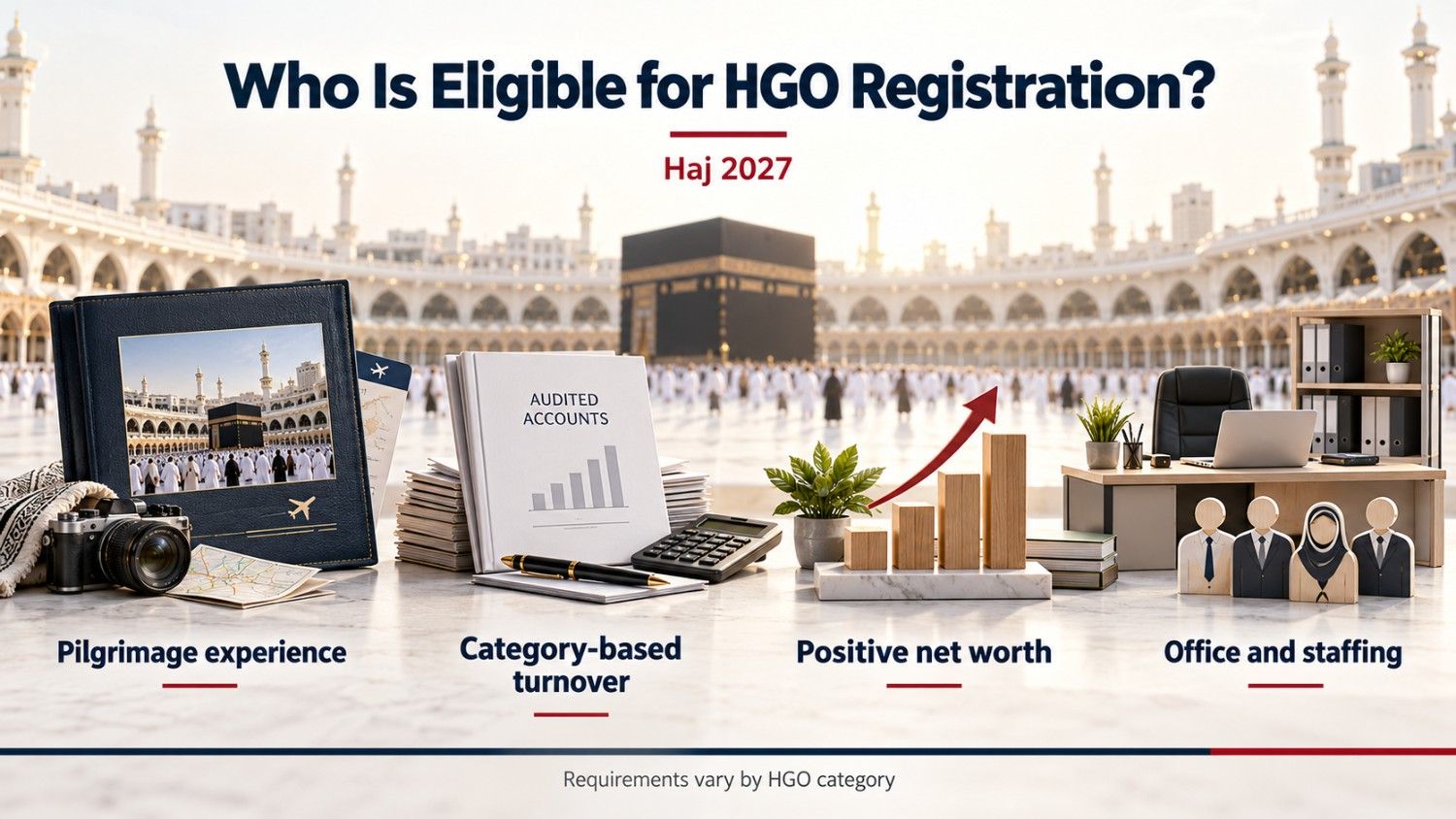
Lead applicants additionally need experience in at least two of the preceding three Haj years and average Haj/Umrah turnover of at least ₹6.5 crore over the preceding three financial years in which Haj was conducted.
All individual entities need positive net worth under their audited FY 2024–25 financials. The 16 July 2026 clarification permits the specified substitute financial years, FY 2019–20, FY 2023–24 and FY 2024–25, where Haj was not conducted, or quota was curtailed, with corresponding supporting records.
The policy requires active tax registration evidence. Review your GST registration requirements before assembling the application.
Read Also: Overseas Recruitment Agent License (RA License) In India
What Office and Staffing Requirements Apply?
The Haj tour operator licence requirements include measurable office capacity, not simply a correspondence address.
- Lead applicants need two offices in different cities, each with at least 500 square feet of carpet area and five employees.
- Non-Lead applicants need at least 400 square feet and eight employees.
- Category 1 applicants need at least 200 square feet and five employees.
- Both Category 2 groups need at least 200 square feet. Their category table does not prescribe the same employee minimum as Category 1.
The policy specifies certified office layouts and supporting staff records. Where applicable, Shop Act registration records can support the establishment evidence, alongside the other documents prescribed for the applicant.
Which Documents Are Required for HGO Registration?
Build the file around the applicant’s legal identity and the category being claimed. HGO registration documents must match the applicant’s name and address, with the policy’s prescribed dating and certification requirements.
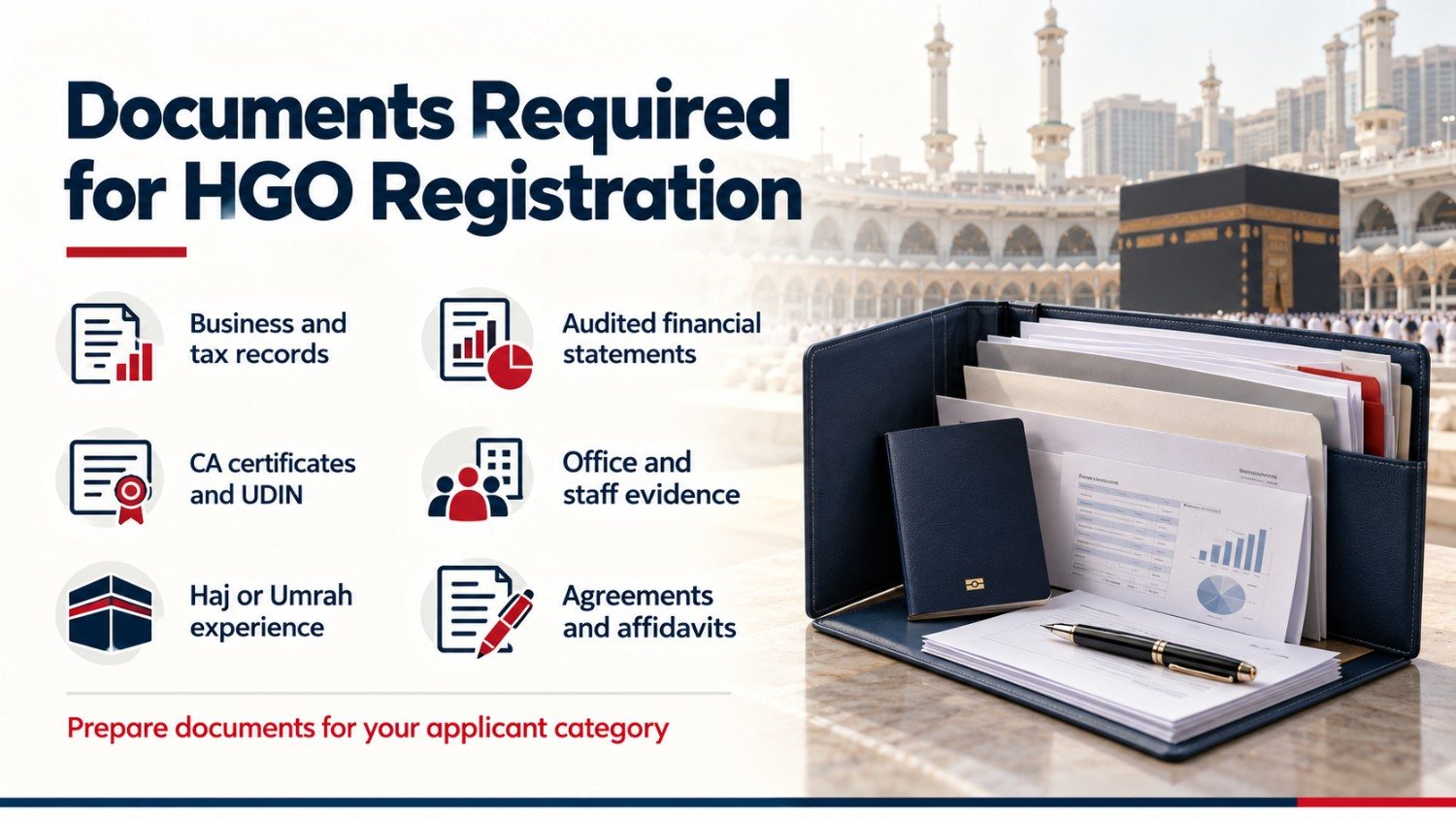
Prepare the following applicable records:
- Business constitution records, PAN and active GST/TCS registration details.
- Audited balance sheets, profit and loss accounts, tax audit reports and income tax returns with acknowledgements.
- CA certificates for pilgrimage turnover, net worth and taxes collected and deposited, carrying valid UDINs.
- Certified office layout, address declaration and applicable employee evidence.
- Previous HGO registration certificates and year-wise quota evidence for experience claimed.
- Munazzam cards and relevant Haj visa pages for the claimed years, plus prescribed identity details.
- Accommodation permits and receipts with English translations and Gregorian dates, including acceptable e-Haj/Nusuk records.
- Applicable Saudi Umrah agreements, ticket invoices, accommodation evidence and authorised payment records.
- Required affidavits concerning litigation, insolvency, family overlap, multiple applications and acceptance of feedback requirements.
Check CA documents against the UDIN verification guide before upload. Missing or unverifiable UDINs can affect scrutiny.
Keep income tax filing acknowledgements with the matching accounts, rather than treating an unsigned draft return as filing evidence.
The policy requires specified fresh declarations and certificates to be signed and sealed within its 30-day window. Historical experience records remain historical evidence. The July clarification also distinguishes records retained under Annexure I, point 8, from documents normally demanded at initial application, while allowing additional evidence where complaints, court proceedings or doubts arise.
What Are the Haj Tour Operator Licence Fees and Deposits?
For Haj 2027, the non-refundable application fee is ₹20,000 per individual HGO applicant, payable at Stage 1. It is separate from the security deposit and from any professional assistance charges.
| Applicant category | Individual security deposit |
| Category 1* Lead | ₹50 lakh |
| Category 1* Non-Lead | ₹40 lakh |
| Category 1 Experienced | ₹30 lakh |
| Category 2 Experienced | ₹20 lakh |
| Category 2 New | ₹20 lakh |
The 16 July clarification moved individual security-deposit submission to Stage 2 for eligible applicants, together with their CHGO applications. It also permits existing fixed deposit receipts or bank guarantees deposited with the Ministry to be used with the bank’s extension certificate, valid up to 31 December 2027. A higher category requires the corresponding additional deposit.
The policy permits submission of a physical demand draft for the application fee. Check the current notice for payment instructions and retain proof of payment. Do not confuse this operator fee with amounts paid by individual pilgrims under the Haj Committee route.
The policy specifies scheduled commercial bank fixed deposits in favour of the Haj Committee of India. After incorporation, the CHGO must provide an additional ₹50 lakh security deposit from its own account, also valid through 31 December 2027.
A Haj tour operator licence budget must therefore distinguish the ₹20,000 fee, individual security, group security and operating expenses. These cannot be presented as one government fee. The reviewed policy does not promise an automatic deposit refund date, and deposit validity is not a refund guarantee.
How Does the Haj Tour Operator Registration Process Work?
The steps below explain the published framework. As checked on 21 October 2026, Haj 2027 had already reached final group and quota allocation, so these steps must not be read as an invitation to submit a fresh application now.
1. Check the Haj Year and Applicant Category
Read the current policy together with subsequent clarifications on the Ministry’s HGO registration portal. For Haj 2027, applications began on 3 July 2026, followed by extension and selection notices. Compare your evidence with the exact category requirements before paying the application fee.
2. Reconcile Financial and Experience Records
Match the turnover certificate to audited accounts, tax records and pilgrimage payments. The policy distinguishes a tour operator’s gross receipts, including applicable taxes, from a travel agent’s ticketing commission after netting purchases against sales. Reliable business accounting services can help organise these reconciliations without changing the eligibility test.
3. Submit the Individual Application and Fee
Create the portal credentials, complete the application and upload legible documents in the specified format. Submit the signed acknowledgement and application-fee evidence physically as directed by the applicable notice. HGO registration is not completed by creating a login, and an online submission does not remove prescribed physical-document obligations.
4. Answer Scrutiny Queries and Check the Result
Monitor the portal and answer requests for clarification within the prescribed period, which can be 72 hours. Support tax explanations with matching payment records and GST return filing evidence. The result can accept the claimed category, assign a lower category or find the applicant ineligible, with the policy providing a three-day representation window.
5. Join the Approved CHGO Structure
Eligible operators proceed through a Lead HGO, the prescribed MoU and group application. Each CHGO needs the required category representation, including a Lead, a Non-Lead and a new Category 2 member, with the policy’s cumulative annual Haj/Umrah turnover requirement of at least ₹75 crore for the preceding two financial years. Individual eligibility does not cure a defective group application.
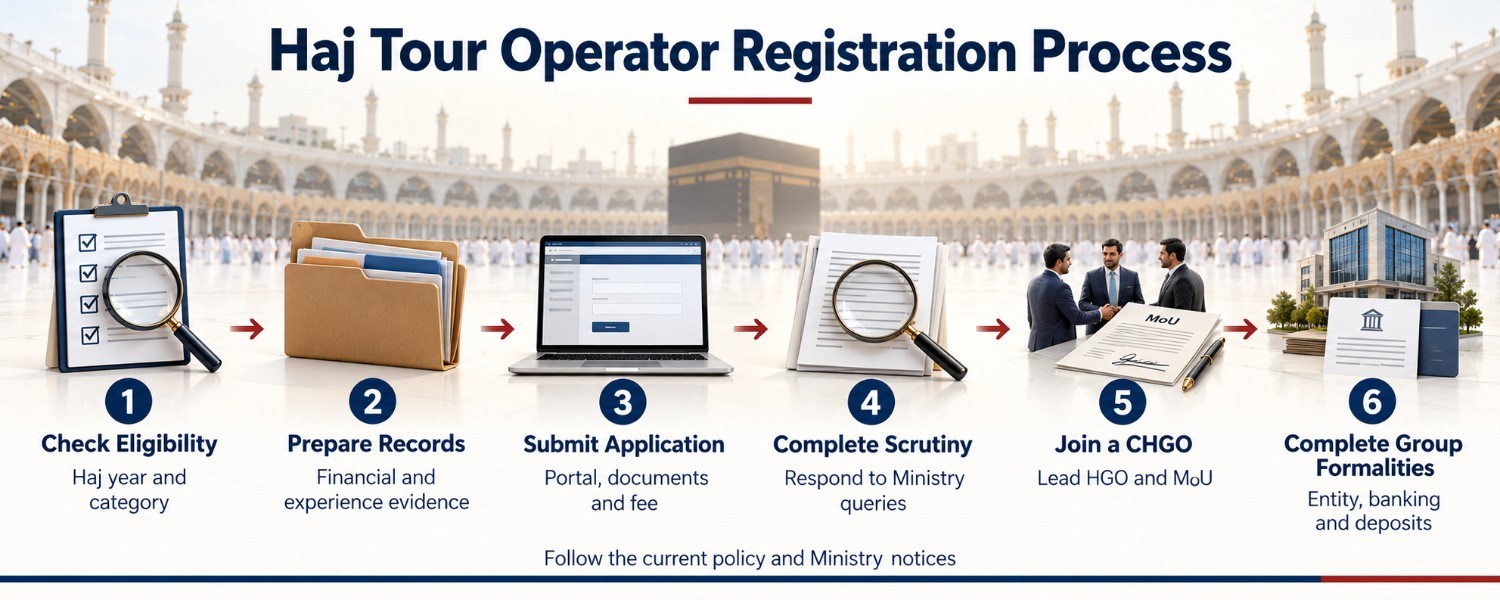
6. Complete Group Entity and Deposit Requirements
The policy allows the CHGO to become a company, LLP, registered partnership or society. If the group chooses an LLP, review the LLP registration process while preparing the statutory documents. The policy provides two weeks for legal-entity details and requires PAN, GST, banking details and the additional group security.
For a partnership structure, the partnership firm registration requirements need separate attention. Follow later notices where they set specific submission deadlines. The 1 October 2026 notice required the executed MoU and other prescribed records within three working days and declared the published composition and quota final.
How Is Quota Allocated After HGO Registration?
For Haj 2027, the category allocation ratio is 5:4:2:1:1, rather than the older fixed-seat approach. The 26 September notice selected 939 HGOs and initially calculated category quotas using X equal to 37.
The 1 October notice then distributed residual seats and published final constituent allocations within 26 CHGOs, totalling 52,507 pilgrims. Therefore, a Haj tour operator licence does not mean an operator can sell an assumed number of seats. Check the final allocation against the exact HGO identity and group.
What Must Approved Operators Do for Pilgrims?
HGO registration carries continuing service and payment duties. Individual HGOs and their CHGO must sign a tripartite agreement with each pilgrim specifying services and charges.
The agreement must address insurance, accommodation and mosque distance, flights, transport, stay duration, orientation, Saudi service-provider details and package price. Operators must upload prescribed pilgrim information and agreements, comply with medical requirements and ensure pilgrims are not stranded.
The policy also requires pilgrim identity cards and feedback within a week of return. Missing, unusually low or adverse feedback on matters within an operator’s control can affect future consideration, subject to the scrutiny and response process. Keep the service evidence alongside the agreement, rather than relying only on a signed booking form.
CHGOs must not take advances before quota allocation. Package payments must reach the firm’s account through individual pilgrims’ bank accounts or other RBI-authorised channels, with receipts retained.
For overseas payments, FEMA compliance guidance provides supporting context. It does not replace the specific banking evidence and payment directions under the Haj policy.
How Long Is Approval Valid and What Can Cause Cancellation?
The Haj tour operator licence framework is tied to the relevant Haj season. Do not advertise Haj 2027 approval as permanent authority or assume automatic renewal for the following year. The FDR validity date of 31 December 2027 is a security requirement, not a universal licence-expiry rule.
False declarations can lead to at least five subsequent years of debarment and forfeiture. Selling or transferring quota is prohibited and attracts the policy’s ten-year blacklisting and deposit-forfeiture provision. Group failure to complete entity or security requirements can also cause quota forfeiture.
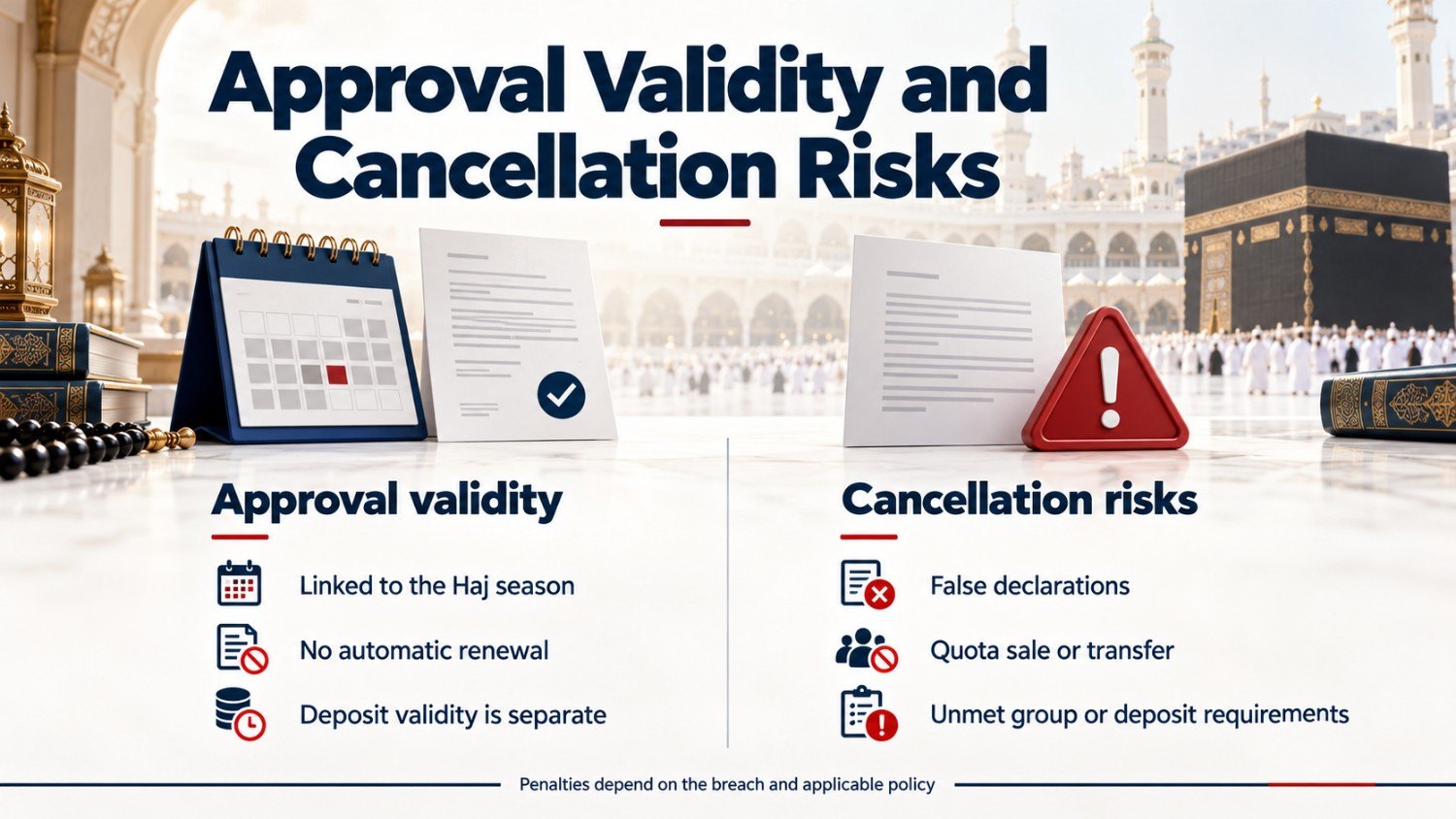
The policy’s broader punitive provisions allow debarment or blacklisting up to 15 years for specified violations. Its blacklisting provisions require an opportunity to show cause. An operator should therefore address the exact allegation and retain its response evidence, rather than assuming every breach attracts the same sanction.
Conclusion
Haj tour operator registration requires verified experience, sound financial records, the correct deposits and participation in the approved CHGO framework. A Haj tour operator licence should always be checked against the relevant season and final quota, rather than an old MEA notice or a previous year’s certificate. Prepare accurate records first and follow the Ministry’s current notices before accepting pilgrim payments.
FAQs About Haj Tour Operator Registration
Can a spouse submit a separate application through another firm?
The policy generally permits only one member of a family to qualify, defining family as spouse and dependent children. Incorporating another firm does not remove that restriction. The prescribed declarations and preference rules must be applied to the actual individuals involved.
Can a proprietor use a personal PAN for HGO registration?
Yes, the policy accepts the proprietor’s PAN for a proprietorship concern. Other entity types must provide the entity’s PAN and the prescribed PAN details of partners, directors, trustees or management. Keep the legal identity consistent throughout the application.
What if a show-cause notice has already been answered?
The 16 July clarification allows consideration where the applicant responded to the Ministry’s notice and no further decision or examination was communicated. This is a specific clarification to the exclusion clause. It does not override an actual blacklisting or debarment order.
Can TIDS registration support a Haj tour operator licence application?
TIDS travel agency identification is separate from the Ministry’s Haj approval. Possessing that code does not replace the required pilgrimage experience, turnover or selection. An applicant must establish the HGO category independently, even if it already holds travel-industry credentials.
Can a New Firm Obtain a Haj Tour Operator Licence Through a Group?
No, individual applicants are evaluated before the group process. A CHGO’s collective capacity does not replace the constituent’s own category requirements. A business without qualifying experience should prepare for a future policy cycle instead of relying on another member’s record.
Can the same Munazzam appear in two HGO applications?
The policy requires a declaration that the Munazzam has not applied in more than one HGO application. Check the named group leader’s other commitments before submitting their identity and experience evidence. Resolve any overlap before making the declaration.
Is a pilgrim’s refund automatically covered by the operator’s deposit?
The policy does not establish a universal automatic refund entitlement against the security deposit. The deposit is held under the Ministry’s compliance framework and can be forfeited. Pilgrims should obtain written cancellation and refund terms and retain the agreement and payment evidence.
What if the office address differs from the GST record?
The policy requires the declared office address to match the relevant principal or additional place of business in supporting records. Check whether a GST registration amendment is needed before submission. An explanation alone should not be treated as correction of an inaccurate statutory record.
What if the annual GST return is not yet due?
The policy permits applicable monthly or quarterly returns with an authorised-signatory reconciliation confirming payment of statutory pilgrimage-business dues. This addresses the situation where the annual return is not yet due or has not been filed. Review the applicable GST annual return obligations separately rather than assuming the alternative evidence waives them.
How many days does Haj tour operator registration take?
The policy does not publish a guaranteed overall approval period. Selection depends on the seasonal schedule, scrutiny, representations and group completion. Short query-response and representation deadlines should not be confused with a promise of approval within those periods.
You may also like

What Should Taxpayers Know About Income Tax Rules 2026?
The Income Tax Rules 2026 have changed the working language, form numbers and r