
GSTR-9 Filing Guide: Eligibility, Due Date, Documents and Late Fees
The GST Annual Return, filed as Form GSTR-9, is a yearly summary every regular GST taxpayer with turnover above Rs 2 crore must submit, combining a full year of GSTR-1 and GSTR-3B data. It is due by 31 December after the financial year ends, and once filed, it cannot be revised.
That last part catches people off guard more than anything else. You get one shot at GSTR-9 for each financial year. Get the turnover figure wrong, miss an ITC reversal, or forget an advance adjustment, and there is no edit button waiting for you next week.
This guide breaks down exactly who needs to file, the real deadline for this year, the documents to keep ready, and the mistakes that trip up even experienced accountants.
What Is GSTR-9, the GST Annual Return?
GSTR-9 consolidates everything you reported through the year in GSTR-1 and GSTR-3B into one document. Think of it as a report card for your GST compliance, covering outward supplies, inward supplies, input tax credit claimed, tax paid, and any refunds or demands during the financial year.
It is filed under Section 44 of the CGST Act, 2017, once for each financial year, separately for every GSTIN you hold. If your business runs GST registrations in three states, you file three separate GSTR-9 returns, even though the underlying company is the same.
The form itself is detailed. It runs across 6 parts and 19 tables, and most of the numbers auto-populate from your GSTR-1 and GSTR-3B filings. Auto-populated does not mean correct, though. The GST department expects you to check every figure against your books before you submit, not just accept whatever the portal fills in.
Who Must File GSTR-9, and Who Is Exempt?
Filing GSTR-9 is mandatory once your aggregate turnover for the financial year crosses Rs 2 crore. Below that threshold, filing is optional, though many accountants still recommend it, since a filed GSTR-9 becomes useful proof of turnover for loan applications and due diligence later.
A few categories do not need to file GSTR-9 at all, regardless of turnover:
-
Casual taxable persons
-
Non-resident taxable persons
-
Input Service Distributors (ISD)
-
Persons required to deduct TDS under Section 51
-
Persons required to collect TCS under Section 52
If none of these apply to you and your turnover has crossed Rs 2 crore for the year, GSTR-9 is not optional. It is worth checking your exact status through your GST registration details if you are unsure which category your business falls under.
What Is the Turnover Limit for GSTR-9 and GSTR-9C?
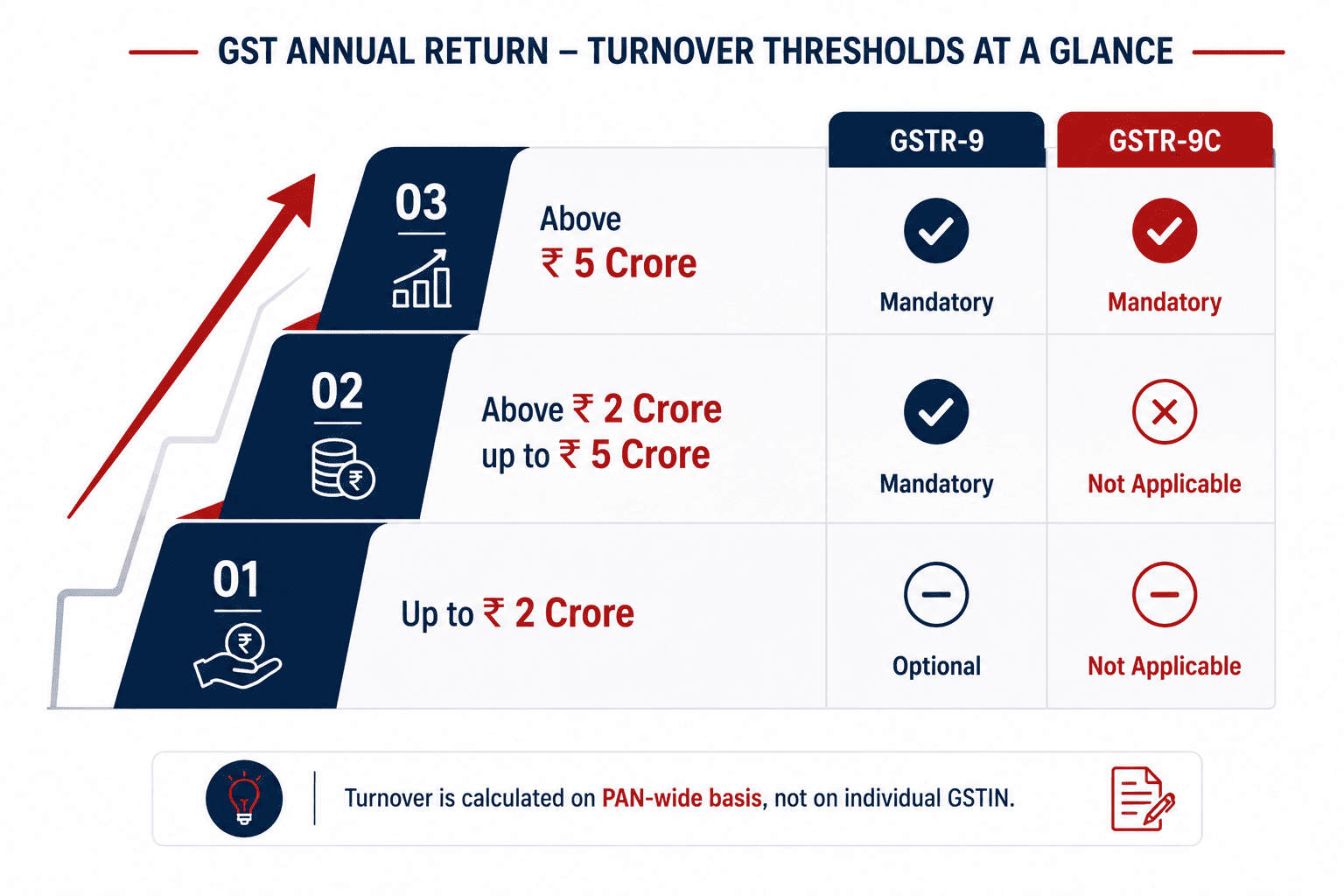
Two different turnover thresholds decide your obligations, and mixing them up is one of the most common errors businesses make.
|
Aggregate Turnover (PAN-wide) |
GSTR-9 |
GSTR-9C |
|
Up to Rs 2 crore |
Optional |
Not applicable |
|
Above Rs 2 crore, up to Rs 5 crore |
Mandatory |
Not applicable |
|
Above Rs 5 crore |
Mandatory |
Mandatory |
Here is the part that surprises people. Both thresholds are tested on your aggregate turnover across your entire PAN, not on the turnover of a single GST registration. Say your business holds four GST registrations in four different states, each doing Rs 1.5 crore a year. None of them individually crosses Rs 5 crore, but added together across the PAN, that is Rs 6 crore. Every single one of those four registrations now needs to file GSTR-9C, even the smallest one.
This trips up multi-state businesses more often than genuine tax evaders. A finance team tracking turnover state by state, without ever adding the numbers across the PAN, can walk straight into a GSTR-9C obligation it never saw coming.
Is GSTR-9A or GSTR-9B Still Applicable?
Short answer: no, and this is where a lot of GST guides online get it wrong.
GSTR-9A was the annual return for composition scheme taxpayers, but it was withdrawn after FY 2018-19. From FY 2019-20 onwards, composition taxpayers file GSTR-4 annually instead, and there is no separate GSTR-9A filing to worry about. If someone tells a composition dealer to file GSTR-9A today, they are working off outdated information.
GSTR-9B was notified for e-commerce operators who collect TCS, but the actual filing requirement has never been switched on. E-commerce operators continue filing GSTR-8 monthly for TCS, without a separate GSTR-9B annual filing sitting on top of it.
Knowing which forms are actually live saves you from chasing a compliance requirement that does not exist anymore, which happens more often than you would expect with GST forms that were notified years ago and quietly shelved.
What Is the Due Date for GST Annual Return Filing This Year?
The standard due date for GSTR-9 is 31 December, following the close of the financial year. For FY 2025-26, that means your GSTR-9 is due by 31 December 2026.
Due dates for GSTR-9 have been extended in several past years, sometimes because the form itself changed mid-cycle, sometimes because of technical issues on the portal. Tax practitioner bodies asked for an extension for FY 2024-25 too, citing multiple notifications that reshaped the reporting tables partway through the year. That history is worth knowing, but it should not change how you plan. Treat 31 December as a hard deadline, and treat any extension as a bonus if it comes.
There is a bigger deadline hiding behind the annual one that most businesses have not caught up with yet. Starting from the July 2025 tax period, the GST portal permanently blocks the filing of any return, including GSTR-9, once three years have passed from its original due date. This is not a late fee anymore. It is a locked door. If a GSTR-9 has been sitting unfiled from several years back, that filing window is closing for good, and there is currently no process to reopen it once it shuts.
One more wrinkle for FY 2025-26 specifically. GST rates changed mid-year, on 22 September 2025, as part of the broader rate rationalisation. Businesses filing GSTR-9 for FY 2025-26 will need to reconcile supplies made under two different rate structures within the same financial year, which is not something most filers have had to handle before.
What Documents Do You Need Before You Start Filing GSTR-9?
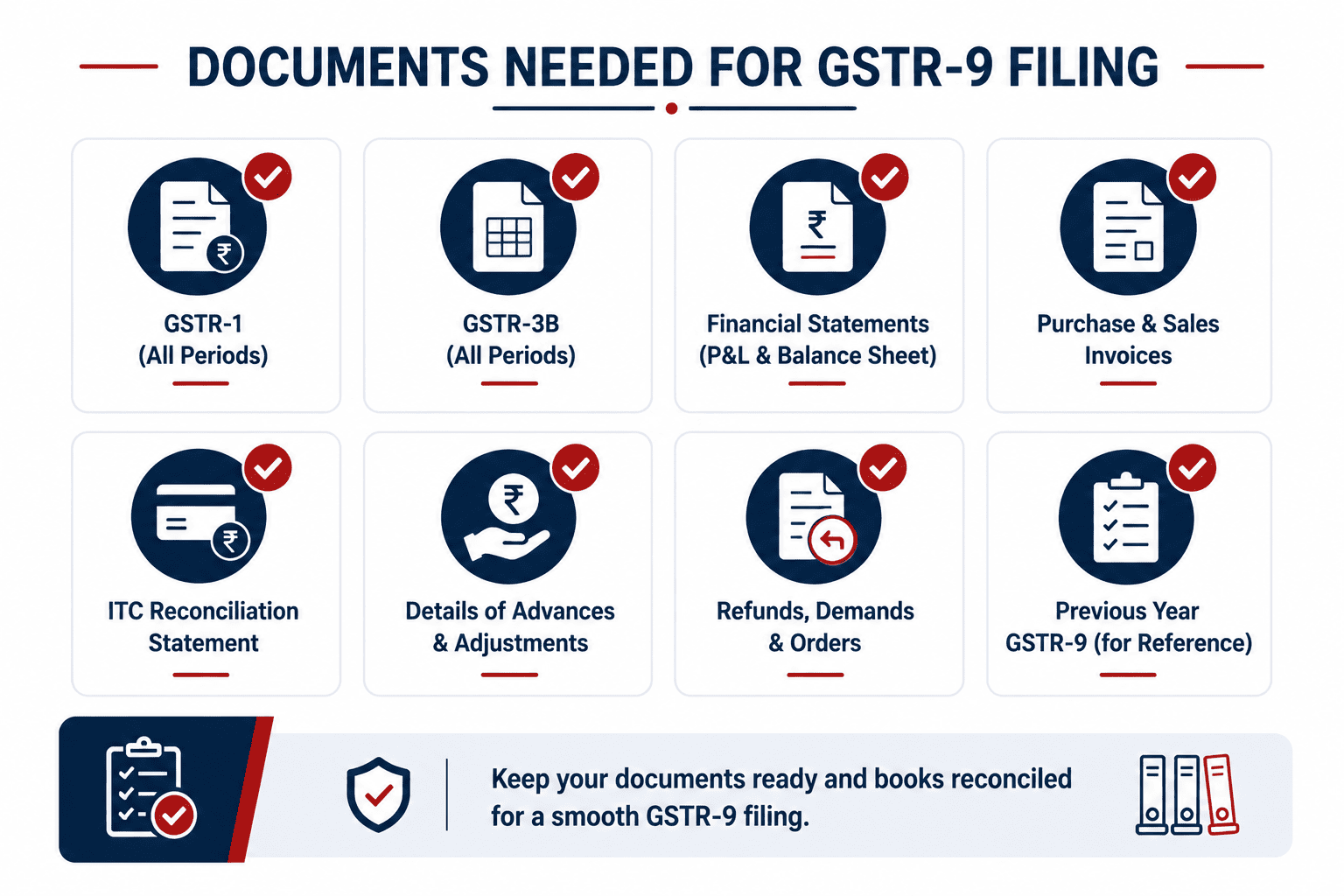
Gather these before opening the GSTR-9 form, not while filling it out. Switching between tabs looking for a missing invoice halfway through is how small errors creep in.
-
All GSTR-1 returns filed for the financial year
-
All GSTR-3B returns filed for the financial year
-
Purchase and sales registers for the full year
-
ITC reconciliation, comparing GSTR-2A/2B against what was actually claimed in GSTR-3B
-
E-way bill records, if the business moves goods
-
Details of advances received and adjusted during the year
-
HSN-wise summary of outward and inward supplies
-
Audited financial statements, if turnover crosses Rs 5 crore and GSTR-9C applies
One more thing worth confirming before starting. The GSTR-9 filing option does not even become available on the portal until every GSTR-1 and GSTR-3B for that financial year has been filed. If even one monthly or quarterly return is still pending, close that out first through regular GST filing, then come back to the annual return.
How Do You File GSTR-9 on the GST Portal?
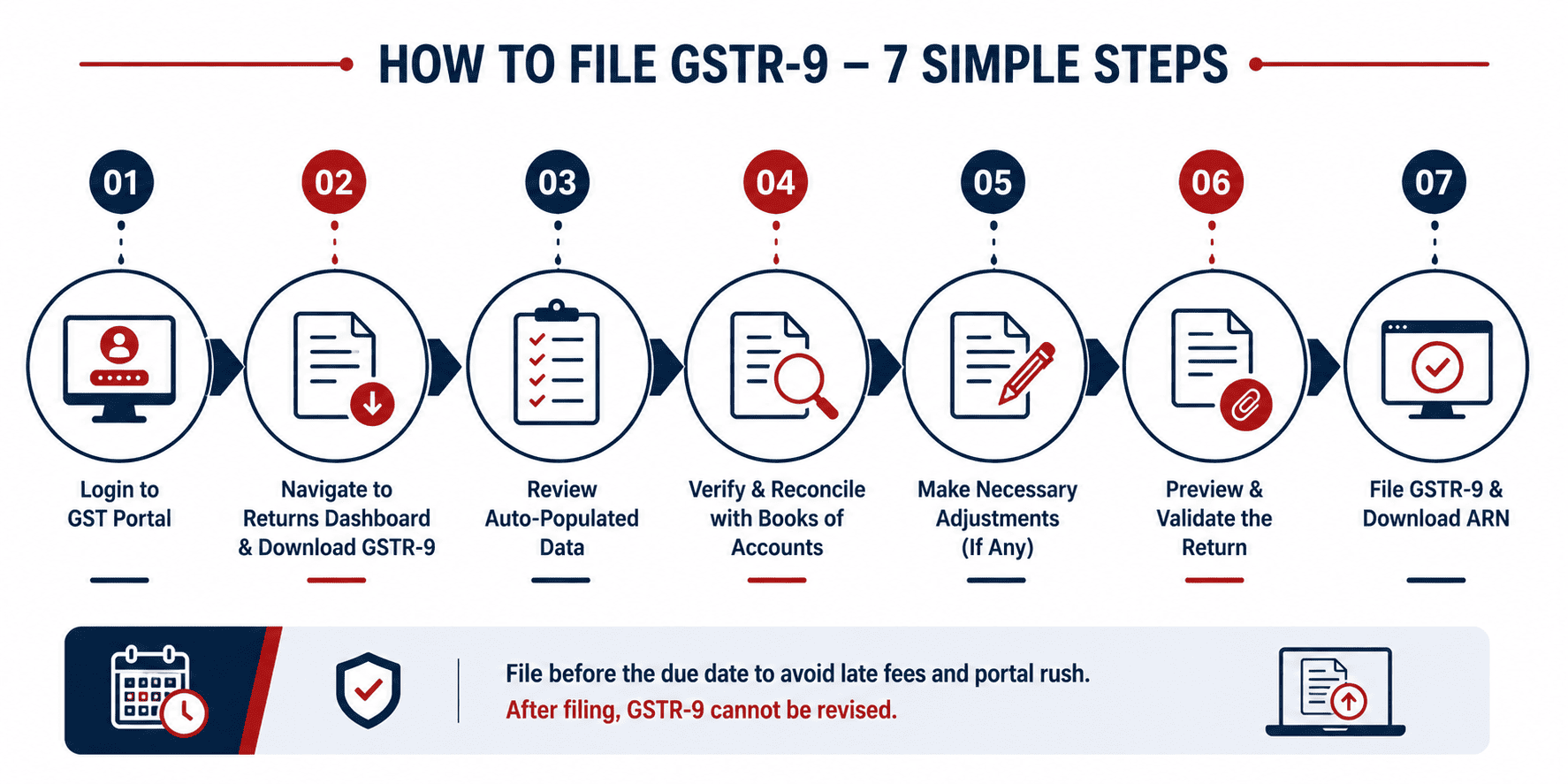
Step 1 - Confirm All Regular Returns Are Filed Check that every GSTR-1 and GSTR-3B for the financial year has actually gone through. GSTR-9 will not open on the portal otherwise.
Step 2 - Log In and Navigate to Annual Return Go to www.gst.gov.in, log in with your GSTIN, then head to Services, Returns, Annual Return, and select the correct financial year.
Step 3 - Review the Auto-Populated Data The portal fills in figures from your GSTR-1 and GSTR-3B automatically. Check every table against your books rather than assuming the auto-fill is accurate.
Step 4 - Fill In the Gaps Complete the sections the portal cannot auto-populate, including ITC reversals, adjustments carried from the previous year, and demand or refund details.
Step 5 - Reconcile Before You Compute Cross-check the draft against your books one more time. Click Compute Liabilities to see if any additional tax is due.
Step 6 - Pay Any Shortfall Through DRC-03 If the computation shows tax payable, clear it through Form DRC-03 before filing. Submitting with a known shortfall left unpaid only invites a notice later.
Step 7 - Preview, Then File Download and read the draft GSTR-9 in full. Once confident it is accurate, submit it using a DSC or EVC. This is the only chance at this return for the year, so the preview step is not optional.
What Happens If You File GSTR-9 Late, or Not at All?
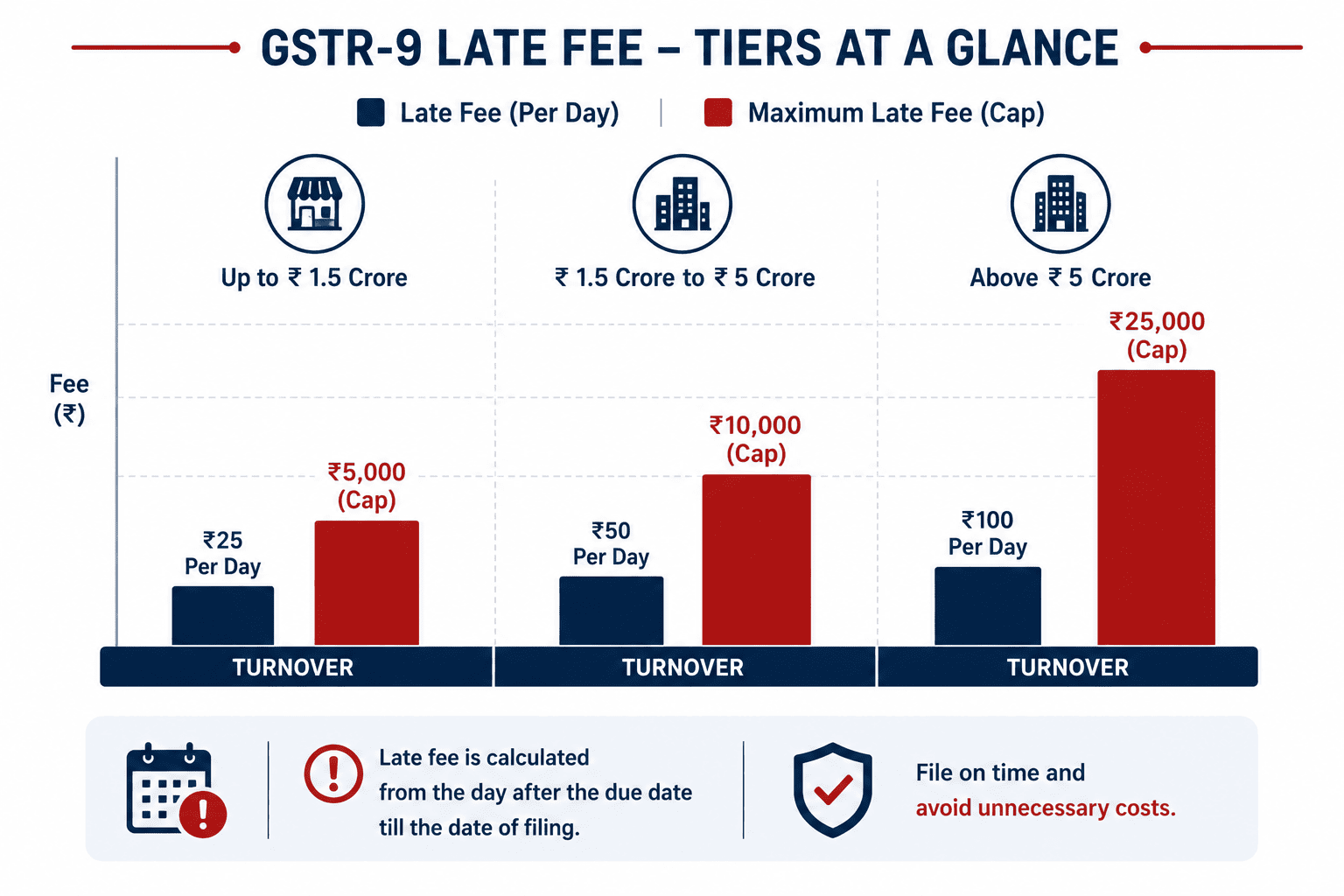
Missing 31 December does not mean the return disappears. It means the cost starts climbing every single day.
|
Form |
Late Fee Per Day |
Maximum Cap |
|
GST APL-01 |
Rs 50 (Rs 25 CGST + Rs 25 SGST) |
0.04% of turnover in that state/UT |
|
GST APL-05 |
Rs 100 (Rs 50 + Rs 50) |
0.04% of turnover in that state/UT |
|
Writ or statutory appeal |
Rs 200 (Rs 100 + Rs 100) |
0.50% of turnover in that state/UT |
This structure has applied since FY 2022-23, under Notification 07/2023-Central Tax, replacing a flatter, more expensive rate that used to apply to every taxpayer regardless of size. A few things worth knowing about how this actually plays out:
-
The cap is based on turnover in that specific state or union territory, not the company's total turnover across India.
-
Late fees have to be paid in cash. Input tax credit sitting in the electronic credit ledger cannot be used to clear them.
-
GSTR-9C does not carry its own daily late fee, but skipping it when turnover crosses Rs 5 crore can attract a general penalty of up to Rs 25,000 under Section 125.
-
If GSTR-9 reveals a genuine tax shortfall, interest at 18% per year applies separately from the late fee, calculated from the original due date.
Late or inaccurate annual returns also tend to invite closer attention from the department. A mismatch between GSTR-9 figures and GSTR-1, GSTR-3B, or audited financials is one of the more common reasons businesses end up with a scrutiny notice. If that happens, notice reply draft services can help put together a proper, evidence-backed response instead of guessing through it alone.
What Are the Most Common Mistakes Businesses Make in GSTR-9?
A few errors show up again and again, across businesses of every size.
-
Trusting the auto-populated figures blindly. The portal pulls numbers from GSTR-1 and GSTR-3B, but it cannot tell if those returns themselves had errors. Reconcile against the books regardless.
-
Getting confused by Table 4F. This table asks for tax paid on advances where no invoice was issued yet, and it trips up even experienced filers because it needs data pulled from two tables built for monthly reporting, not annual reporting.
-
Missing ITC reversals for the 180-day rule. If a supplier has not been paid within 180 days of the invoice, the ITC claimed on that purchase needs to be reversed. Businesses that do not track vendor payment timelines closely tend to miss this every year.
-
Assuming a small state-wise turnover means no GSTR-9C. As covered earlier, the threshold is tested on PAN-wide turnover, not the number for one registration alone.
-
Not reconciling GSTR-1 against GSTR-3B before filing. Differences between declared liability in GSTR-1 and what was actually paid in GSTR-3B need to be resolved and explained, not carried forward silently.
-
Leaving the HSN summary incomplete. Tables 17 and 18 ask for HSN-wise details of supplies, and this section gets skipped more often than any other part of the form.
None of these mistakes are exotic. They come from treating GSTR-9 as a data-entry task instead of a reconciliation exercise, which is exactly the mindset that gets businesses into trouble.
What Is the Difference Between GSTR-9 and GSTR-9C?
|
Point of Comparison |
GSTR-9 |
GSTR-9C |
|
What it is |
Annual return |
Reconciliation statement |
|
Who files it |
All eligible regular taxpayers |
Only taxpayers above Rs 5 crore turnover |
|
What it compares |
Returns filed through the year |
GSTR-9 figures against audited financial statements |
|
Certification |
Self-certified |
Self-certified (CA/CMA certification dropped from FY 2020-21) |
|
Filed separately or together |
Can stand alone |
Filed alongside GSTR-9, not on its own |
People sometimes assume GSTR-9C is a government audit. It is not. Since FY 2020-21, businesses certify GSTR-9C themselves, comparing their own filed figures against their own audited books. A CA can still help prepare it accurately, but the government no longer requires a CA's signature on it.
Can You Revise or Correct GSTR-9 After Filing?
No. Once GSTR-9 is filed, there is no revision option on the GST portal, and this catches out more taxpayers than almost any other rule in this article.
If an error surfaces after filing, whether it is a missed ITC reversal or an understated tax liability, the fix happens through the next available return rather than by editing the one already filed. A genuine shortfall can be paid voluntarily through Form DRC-03, along with interest, and kept on record with a clear explanation in case the department asks about it later.
This is exactly why the reconciliation step matters more than the filing step itself. Rushing a GSTR-9 to beat the deadline, without a proper reconciliation against the books, is how a fixable discrepancy turns into a permanent entry on the compliance record.
Should You File GSTR-9 Yourself or Get Expert Help?
A straightforward business with clean monthly filings, minimal ITC reversals, and turnover well under Rs 5 crore can often manage GSTR-9 with careful in-house reconciliation.
Once GSTR-9C enters the picture, or once ITC claims involve reversals, cross-year adjustments, or reverse charge transactions, professional review starts paying for itself. An error here does not just cost a late fee. It can trigger a scrutiny notice months later, at which point the business is defending a filing it can no longer edit.
If the books need cleaning up before confident reconciliation is even possible, LegalBabu's accounting services for small businesses close that gap first. And if a GSTR-9 mismatch has already brought a notice to a GST portal account, LegalBabu's notice reply draft services can help draft a proper response instead of an anxious, hurried one.
FAQS
Have questions about GST Annual Return?
We have you covered:
-
Can I revise or correct GSTR-9 after I have already filed it?
No. GSTR-9 cannot be revised once submitted. If an error is found afterward, pay any shortfall voluntarily through Form DRC-03 along with interest, and keep the correction documented for future reference.
- My turnover is close to Rs 2 crore. How do I know if GSTR-9 is mandatory or optional for me this year?
- I have GST registrations in more than one state under the same PAN. Do I check the Rs 5 crore GSTR-9C limit state-wise or for the whole company?
- What happens if my supplier did not file their GSTR-1, and my ITC in GSTR-2B does not match what I actually claimed?
- Do composition scheme taxpayers still need to file GSTR-9A?
- Is a GST audit still required before filing GSTR-9C?
- What happens if I discover a tax shortfall while preparing GSTR-9, before I file it?
- Can I file GSTR-9 if I have not filed all my GSTR-1 and GSTR-3B for that year yet?
- Is there a point after which I can no longer file a pending GSTR-9 at all?
- Will filing GSTR-9 late automatically trigger a GST notice?


