
GST Amendment: Complete Guide to Process, Forms and Documents
A GST Amendment updates the details on your GST registration. This covers things like your business name, address, partners, or bank account. You file it using Form GST REG-14. Non-core fields get approved right away. Core fields need officer approval, usually within 15 working days.
Running a business means things change. You hire a new partner. You shift your shop to a bigger space. You switch your current account to a new bank. Each of these events leaves your GST registration out of date. A GST Amendment is how you fix that gap.
This isn't paperwork you can push to next month. An outdated GSTIN record can hold up an e-way bill. It can confuse a vendor doing due diligence. It can also invite a mismatch notice from the department later. This guide covers who can file a GST Amendment. It explains core and non-core fields, the documents you need, and the exact steps on the GST portal. It also covers what happens if your application gets rejected.
What Is GST Amendment and When Do You Need One?
A GST Amendment updates the details you gave at the time of GST registration. The legal basis sits in Section 28 of the CGST Act, 2017. Rule 19 of the CGST Rules, 2017 sets out the process. You file every amendment through Form GST REG-14 on the GST portal.
You need to file a GST amendment when any of these change:
-
Legal or trade name of the business
-
Principal place of business, or an additional place of business
-
Addition, removal, or resignation of a partner, director, or Karta
-
Mobile number or email of the authorised signatory
-
Bank account details
-
Business activities, or the HSN and SAC codes you use
-
Business structure, such as moving from a proprietorship to a partnership
Here's a real example. Rina runs a boutique in Indore. She registered it under GST as a sole proprietorship. Six months in, business picks up. She moves to a bigger shop two streets away. That new address has to reach her GST registration within 15 days of the move. If it doesn't, every invoice from the new shop technically won't match her registered address.
Who Can File a GST Amendment?
Every type of GST-registered taxpayer can file a GST Amendment. This covers regular taxpayers and composition scheme taxpayers. It also covers Input Service Distributors, TDS and TCS deductors, non-resident taxable persons, and casual taxable persons within their registration period.
There's one exception. If your GSTIN is already cancelled, you cannot file a GST Amendment on it. You would first need GST revocation to reactivate the registration. Only then can you submit an amendment.
Who can actually click submit? The authorised signatory can. So can an existing partner or director on the registration. A GST practitioner can too, once you authorise them on the portal.
What Are Core Fields and Non-Core Fields in GST Amendment?
This is the most important split in the whole GST Amendment process. It decides how long your update takes. It also decides whether an officer reviews it at all.
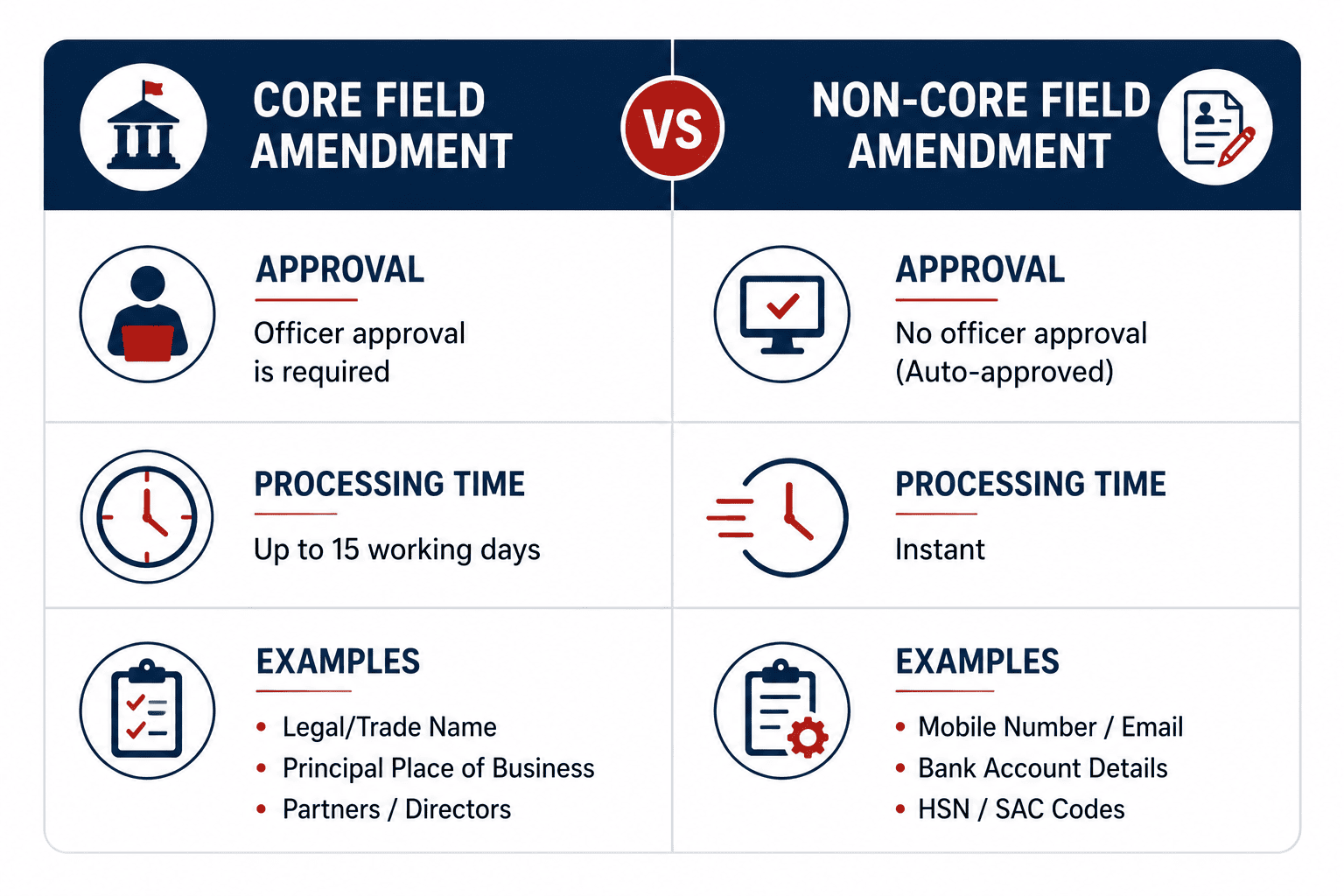
Core fields cover details that shape the legal identity of the business. Any change here goes through a check. A jurisdictional officer has to approve it before it takes effect.
Non-core fields cover details that don't change who the business legally is. These update automatically the moment you submit them. No officer gets involved.
|
Parameter |
Core Field Amendment |
Non-Core Field Amendment |
|
Officer approval |
Required |
Not required, auto-approved |
|
Processing time |
Up to 15 working days |
Instant |
|
Form used |
GST REG-14 |
GST REG-14 |
|
Typical examples |
Legal name, business address, partners/directors |
Mobile number, email, bank account, HSN/SAC codes |
|
Supporting documents |
Usually needed |
Minimal or none |
|
Rejection risk |
Yes, officer can reject or ask questions. |
No |
Fields Classified as Core
-
Legal name of the business, where the PAN stays the same
-
Principal place of business (address and state)
-
Adding a new place of business
-
Adding, removing, or retiring partners, directors, Karta, or trustees
-
A change in the Managing Committee of a society or trust
Fields Classified as Non-Core
-
Trade name
-
Mobile number and email of the authorised signatory
-
Bank account details
-
Goods and services supplied, including HSN and SAC codes
-
Details of an authorised representative
-
Some state-specific fields
Here's how this plays out. Say an LLP brings on a new partner. That's a core field change. It needs the new partner's PAN, Aadhaar, and photo. A GST officer has to review it before the partner shows up on the certificate. Now compare that to the same LLP updating its bank account after a switch. That's non-core. It shows up on the portal within minutes.
What Documents Do You Need for a GST Amendment?
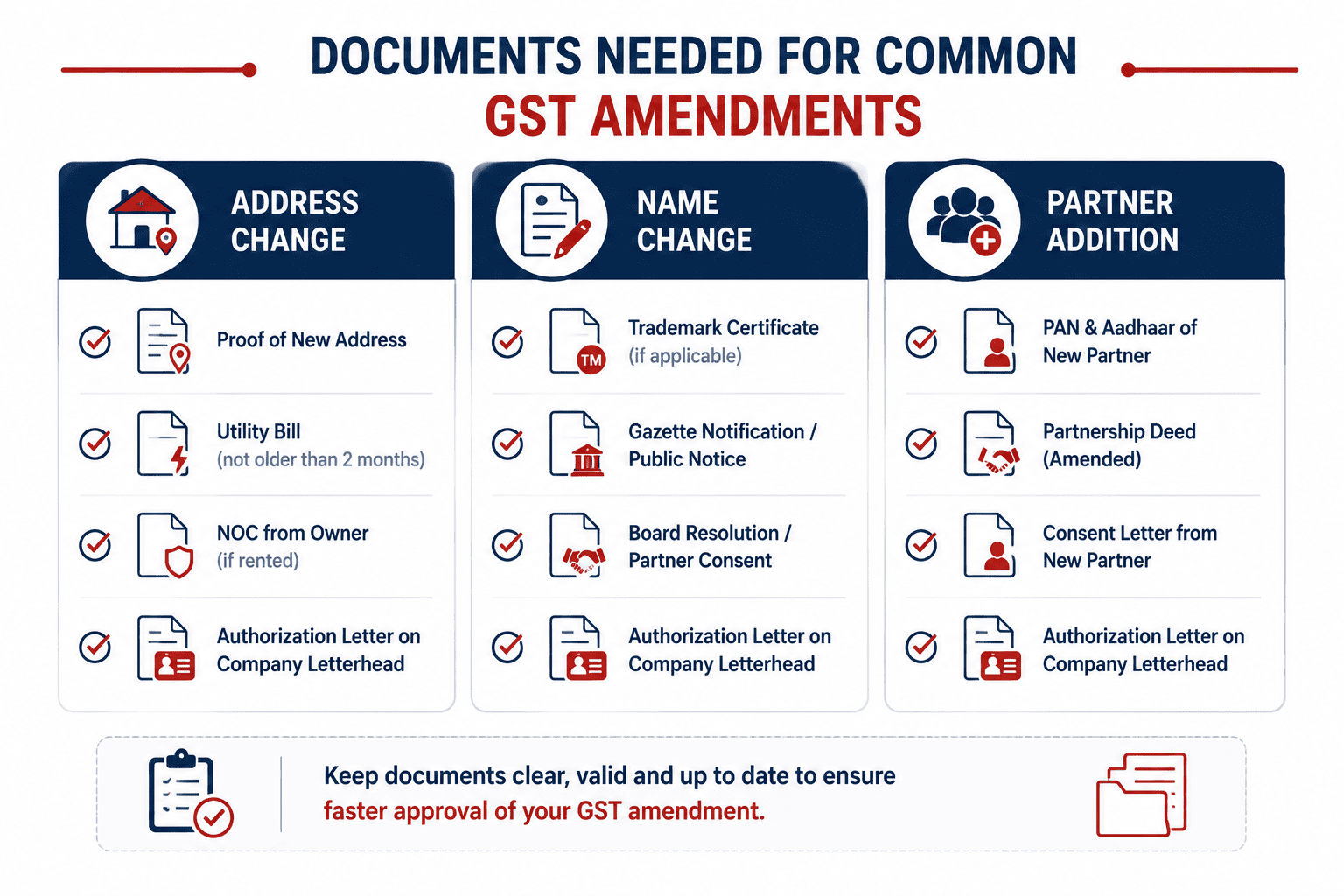
The documents you need depend on the field you're changing. Address and name changes need the most paperwork. Most non-core updates need little to none.
|
Amendment Type |
Documents Required |
|
Certificate of Incorporation, amended Partnership Deed, or updated trade licence |
|
|
Latest electricity bill, rent or lease agreement, property tax receipt, or NOC from the owner |
|
|
PAN, Aadhaar, and photo of the new partner or director |
|
|
Change in business structure |
Partnership deed, MOA, AOA, or Certificate of Incorporation, based on the new structure |
|
New business place |
Address proof of that place, such as an electricity bill or rent agreement |
|
Bank account update |
Cancelled cheque, bank statement, or the first page of the passbook |
Here's a tip from experience. Address-change applications get rejected the most often of any core amendment. The usual reason is simple. The name on the electricity bill or rent agreement doesn't match the applicant's name exactly. Check that your ownership document and your GST records use the same spelling before you upload anything.
How Do You File a GST Amendment Online?
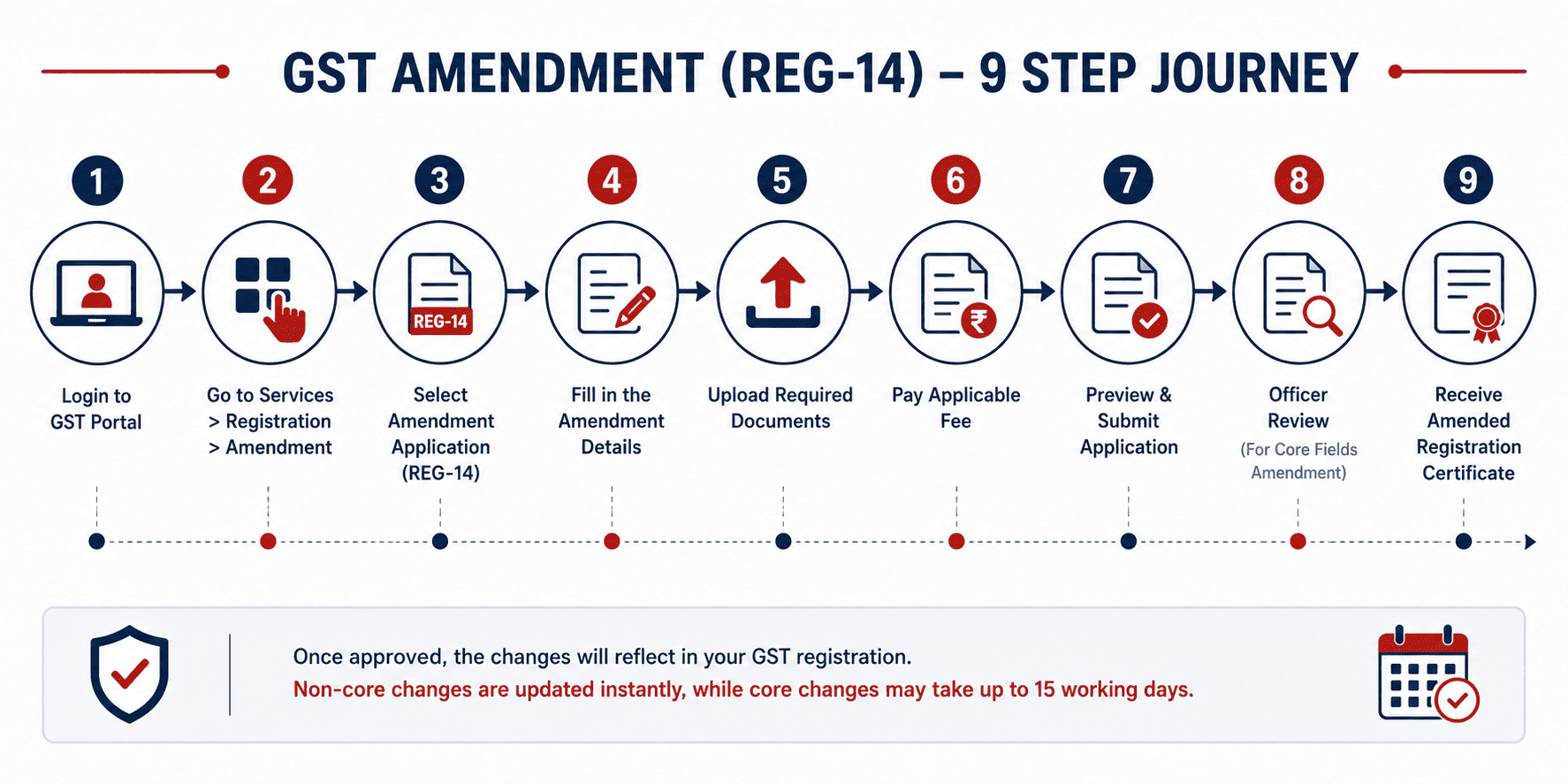
Filing Form GST REG-14 follows the same basic flow for core and non-core fields. The screens differ a bit, but the steps stay the same.
Step-by-Step GST Amendment Process
-
Log in to the GST portal at www.gst.gov.in with your GSTIN credentials.
-
Go to the amendment section. Click Services, then Registration, then either "Amendment of Registration Core Fields" or "Amendment of Registration Non-Core Fields."
-
Pick the right tab, such as Business Details, Principal Place of Business, or Promoter/Partners.
-
Edit the field with the correct, updated information. Add the date and reason for the change.
-
Upload your documents for that field.
-
Preview everything. Check each change carefully. Small typos here cause rejections later.
-
Submit using DSC or EVC. This is the same method you used for your original registration.
-
Note your ARN. This Application Reference Number lands in your email and phone right away.
-
Wait for approval if it's a core field. You'll get Form GST REG-15 once approved, and your certificate updates on its own.
Here's a detail most guides skip. If you start an amendment and save it as a draft without submitting, the portal deletes that draft after 15 days. Don't let a half-finished draft sit too long, or you'll start over.
What Is the Time Limit for a GST Amendment?
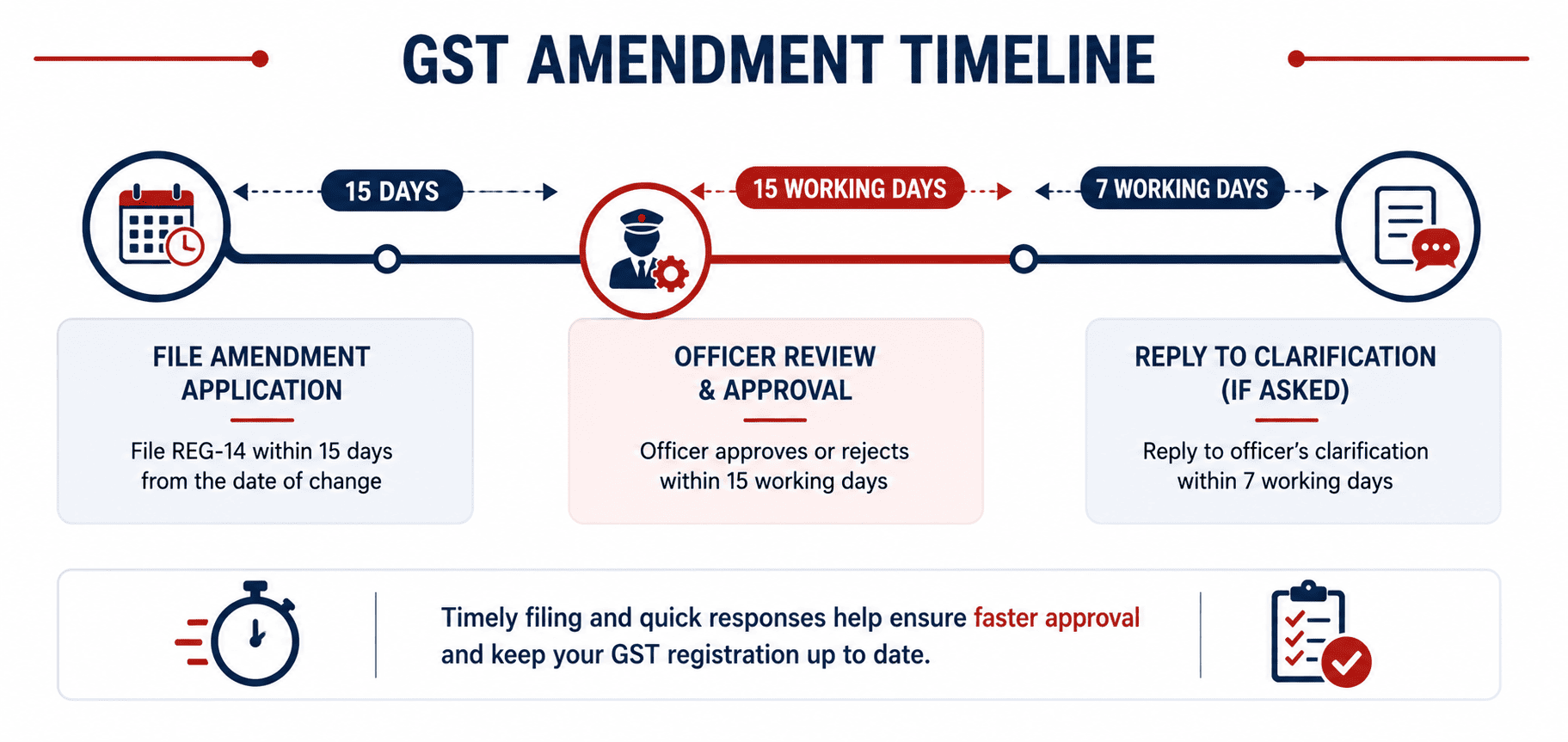
Timing matters more here than most taxpayers think. It matters for filing, and it matters for how the department replies.
|
Stage |
Timeline |
|
Filing after a change happens |
Within 15 days |
|
Non-core field approval |
Instant, auto-approved |
|
Core field officer approval |
Up to 15 working days |
|
Officer's clarification notice (if any) |
Form GST REG-03 |
|
Your reply to that notice |
Within 7 working days, via Form GST REG-04 |
|
Officer's decision after your reply |
Within 7 working days |
|
No officer action by the deadline |
Amendment is deemed approved |
Missing the 15-day window doesn't trigger an instant penalty. But a big gap between the change and the date you report it can raise questions later. It's simpler to file the same week the change happens than to explain a six-month delay.
What Happens If Your GST Amendment Is Rejected or Queried?
Not every application sails through. If the officer finds the documents thin or the reason weak, you'll hear about it first, before any outright rejection.
-
Officer issues Form GST REG-03. This is a notice asking for clarification or more documents.
-
Read the notice closely. Know exactly what the officer wants. A vague reply rarely helps.
-
File Form GST REG-04. Submit your clarification within 7 working days, with any extra documents.
-
Officer reviews your reply. They either approve it through Form GST REG-15 or reject it through Form GST REG-05, with reasons stated.
-
Re-file if rejected. This isn't the end. Fix what the officer flagged and submit again.
Does your business keep replying to GST department queries? These could be about an amendment, a mismatch, or a show-cause notice. Get a proper GST notice reply drafted instead of answering informally. A weak reply to REG-03 can read like an admission you never meant to make. That can cost you the whole amendment.
What Changes Cannot Be Made Through GST Amendment?
Form GST REG-14 has real limits. A few changes simply can't go through amendment, no matter how you frame the request.
-
Change in PAN: GST registration runs on PAN. A new PAN means a fresh registration, not an amendment.
-
A structure change that changes the PAN: Turning a proprietorship into a private limited company usually creates a new PAN. That rules out amendment.
-
Shifting the business to another state: GST registrations are state-specific. Moving your main operations to another state means a new registration there. If you stop operating in the old state entirely, you'll also need to cancel that GSTIN.
If any of this applies to you, get a fresh GST registration for the new structure or state. Then cancel the old GSTIN once the shift is complete.
How Does GST Amendment Differ from the New GST Registration Rules?
CBIC issued Notification No. 18/2025-Central Tax on 31 October 2025. It brought in Rule 9A and Rule 14A of the CGST Rules, effective 1 November 2025. These rules speed up new GST registrations. Low-risk applicants now get electronic approval within 3 working days. There's also a simplified route for small taxpayers whose monthly output tax stays under Rs. 2.5 lakh.
It's easy to assume this changed the amendment process too. It hasn't. Rule 19, which covers GST Amendment, still works the same way. The 2025 update touches how new taxpayers register. It doesn't touch how existing GSTIN holders update their details. If you already hold a GSTIN, Form GST REG-14 and the core versus non-core rules above still apply in full.
What Penalties Apply If You Don't Amend Your GST Registration on Time?
There's no fixed late fee written just for a delayed GST Amendment. That's different from the late fee for missed GST returns. But delaying still carries risk.
-
Section 125 (general penalty): Breaking Rule 19(1) or Section 28, where no other penalty applies, can draw a penalty of up to Rs. 25,000.
-
Section 122(1): Giving false or wrong details on your GST registration can draw a penalty of Rs. 10,000, or the tax amount involved, whichever is higher.
-
Section 126 (proportionality): In practice, officers must apply penalties fairly. A small, easily fixed error made without any intent to evade tax, where the tax involved is under Rs. 5,000, usually draws no penalty at all.
The bigger cost, in most real cases, isn't the penalty itself. It's the disruption that follows. Think of a mismatched address flagged during an audit. Or a vendor who won't process payment because your GSTIN details don't match your invoice. A timely update avoids all of this.
What Are Common Mistakes to Avoid During GST Amendment?
-
Waiting past the 15-day window because the change felt small at the time
-
Uploading documents with mismatched names, especially for address proof
-
Filing a new core amendment while an older one is still pending. The portal usually won't let you until the first one is resolved.
-
Letting a saved draft expire after 15 days of no activity
-
Updating GST but forgetting related records elsewhere. This includes a company name change with the MCA, a director appointment or resignation, or a registered office change. These are separate filings from your GST Amendment, but they often need to happen around the same time.
-
Ignoring a GST REG-03 notice. Miss the 7-day reply window, and the application gets rejected automatically.
GST Amendment Checklist Before You Apply
-
Confirm whether the change is a core field or a non-core field
-
Match names across all documents exactly, including spacing and abbreviations
-
Keep scanned copies of address proof, ID documents, and bank proof ready before you start
-
File within 15 days of the actual change, not 15 days from when you get around to it
-
Avoid starting a second amendment while an earlier one is still pending
-
Check whether the same change also needs an update with the MCA, your bank, or other regulators
-
Keep your pending GST Filing up to date. A clean compliance record makes officer approval smoother.
Staying on top of your GST records shouldn't feel like a side project. Do your amendments keep stalling because your books aren't current? LegalBabu's accounting services for small businesses can close that gap. Our full range of tax compliance services covers everything from filing to notice response, all in one place.
FAQS
Have questions about GST Amendment?
We have you covered:
-
Can I file a GST Amendment if I have pending GST returns?
There's no specific rule that blocks an amendment just because returns are pending. That said, officers reviewing a core field change do look at your compliance history. Clear your pending returns first. It makes approval smoother and avoids extra questions.
- Does a GST Amendment change my GSTIN number?
- Can I use GST Amendment to move my business to another state?
- How many times can I amend the same field in my GST registration?
- Is there any government fee for filing a GST Amendment?
- What happens if I submit wrong information by mistake?
- Do I need a Digital Signature Certificate for every GST Amendment?
- Can a GST practitioner file the amendment on my behalf?
- What if my new business address doesn't have a rent agreement yet?
- Do the new GST registration rules from November 2025 affect my existing GSTIN's amendment process?


