

GST Filing is a periodic compliance duty for a person holding a GST registration. It reports outward supplies, eligible input tax credit, tax liability and payment through the form assigned to that taxpayer category. A registered person may still need to file a return when there are no sales or purchases during the period.
This GST return filing online guide covers regular, composition and special registrants. Because a notification can extend a standard deadline, check the date displayed for the relevant GSTIN and period.
How Does GST Filing Work for Registered Taxpayers?
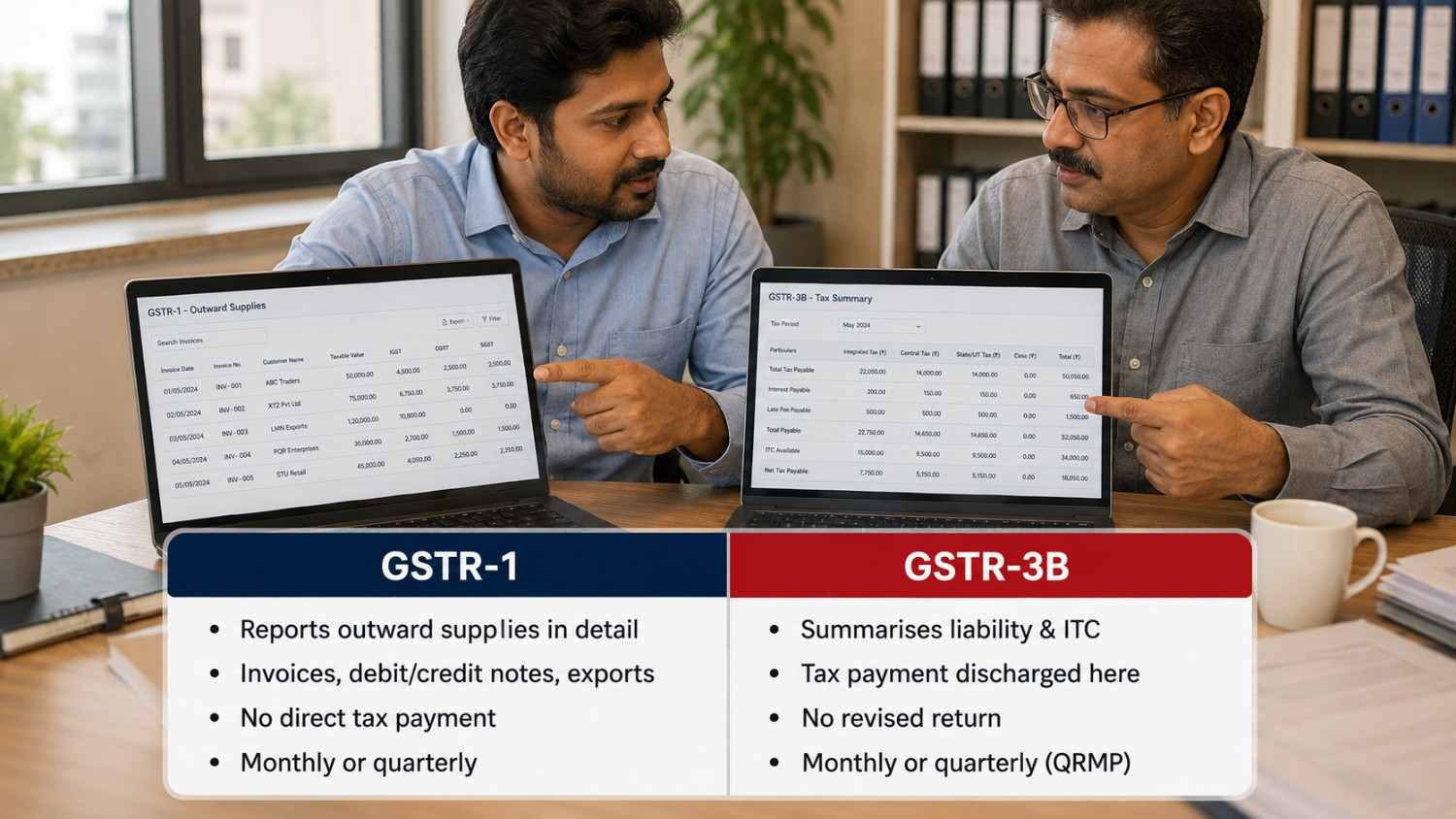
A GST return converts transaction records into a statutory declaration. GSTR-1 reports outward supplies, while GSTR-3B summarises liability, eligible credit and payment. GSTR-2B supports input tax credit reconciliation; the recipient does not file it as a return.
If a business has not yet obtained a GSTIN, the first step is the GST registration process. Registration and return filing are separate activities: obtaining a GSTIN creates the continuing obligation to furnish the applicable returns until cancellation or another lawful change in status.
Who Must File GST Returns?
Every registered person must furnish the form applicable to their registration type, subject to specific exemptions. Categories include regular and composition taxpayers, non-resident taxable persons, input service distributors, GST TDS deductors, e-commerce operators collecting TCS and specified overseas online service providers.
Important points include:
-
A nil return may be required even when the business had no transactions.
-
Separate GST registrations normally require separate filings for each GSTIN.
-
A person must use the form assigned to the taxpayer category; GSTR-1 and GSTR-3B do not apply to every registrant.
-
Filing continues for applicable periods until cancellation takes effect and final obligations are completed.
Difference Between GSTR-1 and GSTR-3B
|
Point |
GSTR-1 |
GSTR-3B |
|
Main purpose |
Detailed outward-supply reporting |
Summary liability, ITC and tax payment |
|
Typical data |
Invoices, debit notes, credit notes, exports and amendments |
Taxable supplies, reverse charge, eligible ITC, reversals and payment |
|
Tax payment |
Not normally discharged through this statement |
Liability is offset through cash and eligible credit |
|
Frequency |
Monthly or quarterly |
Monthly or quarterly under QRMP |
|
Correction route |
Optional GSTR-1A for the same period before GSTR-3B; later amendments where permitted |
No revised return; eligible corrections are adjusted through later returns or other prescribed forms |
GST Return Types and Due Dates
The following GST return due dates are the standard dates, not period-specific extensions.
|
Form or facility |
Who uses it |
Normal frequency |
Standard due date |
|
GSTR-1 |
Regular taxpayers reporting outward supplies |
Monthly |
11th of the following month |
|
GSTR-1 |
Eligible QRMP taxpayers |
Quarterly |
13th of the month after the quarter |
|
IFF |
QRMP taxpayers reporting eligible B2B documents for months 1 and 2 |
Optional monthly facility |
13th of the following month |
|
GSTR-1A |
Regular or QRMP taxpayer correcting or adding same-period outward-supply details |
Optional, once per period |
After GSTR-1 filing or its due date, whichever is later, and before GSTR-3B filing |
|
GSTR-3B |
Regular monthly filer |
Monthly |
20th of the following month |
|
GSTR-3B |
QRMP taxpayer |
Quarterly |
22nd or 24th of the month after the quarter, based on State or Union Territory |
|
PMT-06 |
QRMP taxpayer paying tax for months 1 and 2 |
Monthly payment challan |
25th of the following month |
|
CMP-08 |
Composition taxpayer |
Quarterly statement and payment |
18th of the month after the quarter |
|
GSTR-4 |
Composition taxpayer |
Annual |
30 April after the financial year |
|
GSTR-5 |
Non-resident taxable person |
Monthly or final period |
13th of the following month; final return within seven days after registration expiry |
|
GSTR-5A |
Non-resident OIDAR service provider |
Monthly |
20th of the following month |
|
GSTR-6 |
Input Service Distributor |
Monthly |
13th of the following month |
|
GSTR-7 |
GST TDS deductor |
Monthly |
10th of the following month |
|
GSTR-8 |
E-commerce operator collecting GST TCS |
Monthly |
10th of the following month |
|
GSTR-9 |
Applicable regular taxpayers |
Annual |
31 December after the financial year |
|
GSTR-9C |
Taxpayers whose aggregate turnover exceeds ₹5 crore |
Annual, with GSTR-9 |
31 December after the financial year |
|
GSTR-10 |
Registrant whose GST registration is cancelled or surrendered |
Once |
Within three months from the cancellation date or order date, whichever is later |
|
GSTR-11 |
UIN holder claiming eligible refunds |
After the relevant quarter |
No fixed due date; it may be filed after the relevant quarter ends |
For GST annual return filing requirements from FY 2024-25 onward, Notification No. 15/2025–Central Tax exempts a registered person with annual aggregate turnover up to ₹2 crore. GSTR-9C is a self-certified reconciliation statement where turnover exceeds ₹5 crore, not a separate CA-certified GST audit. CBIC explains its relationship with GSTR-9 in Circular 246/03/2025-GST.
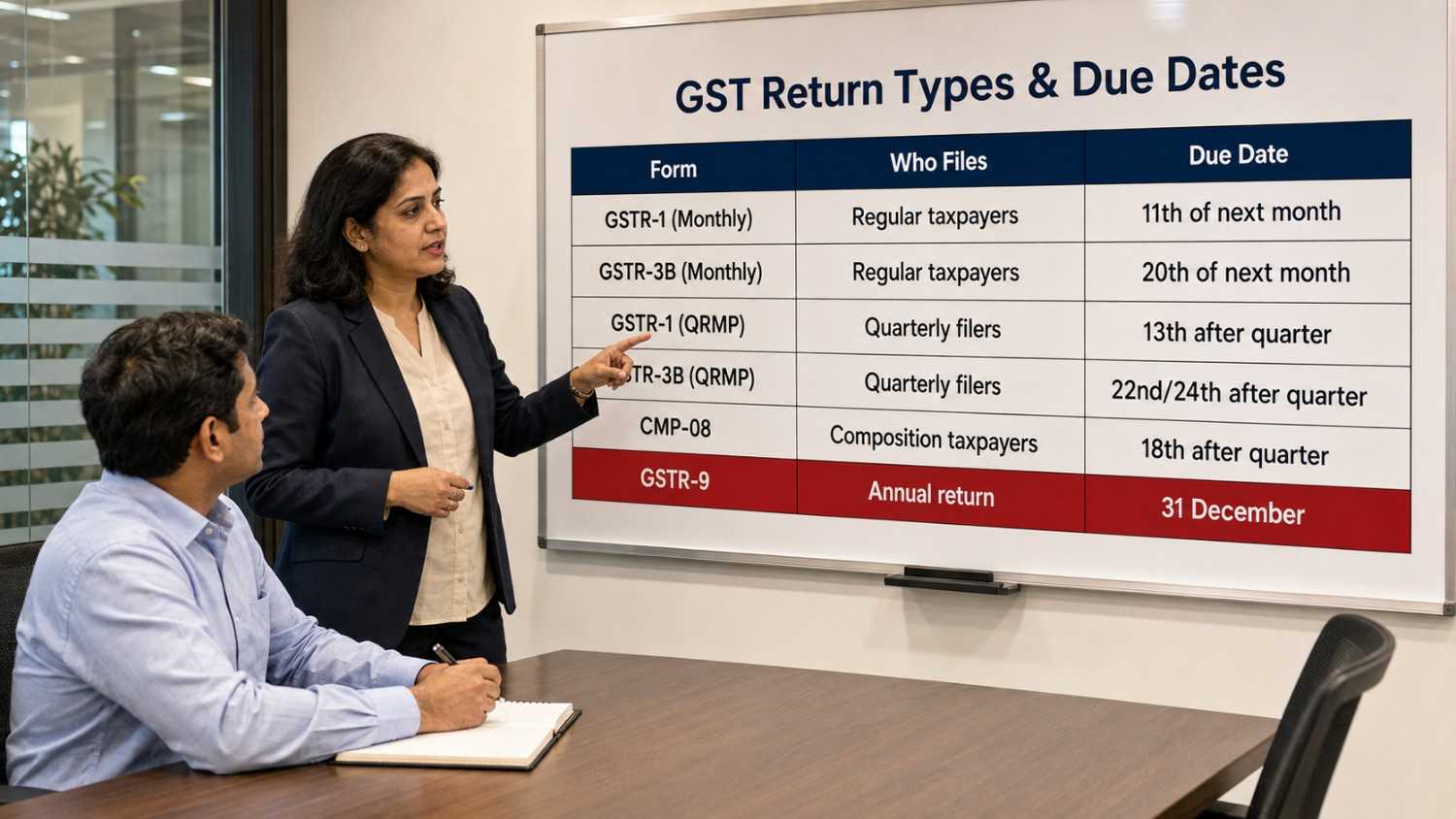
The GST annual return is distinct from ROC annual return filing and income tax return filing. GST TDS deductors must also track separate TDS filing due dates.
Documents Required for GST Filing
The documents required for GST return filing vary by form. A regular taxpayer should keep:
-
GSTIN, portal credentials and authorised-signatory access for DSC or EVC;
-
sales invoices, revised invoices, debit notes and credit notes;
-
purchase invoices and the relevant GSTR-2B download;
-
HSN or SAC classifications, place of supply and tax-rate working;
-
export, SEZ, e-invoice and e-way bill data, where applicable;
-
reverse-charge transactions, advances and adjustment records;
-
ITC reversal and re-claim workings;
-
electronic cash ledger, electronic credit ledger and challan details; and
-
previous filed returns, ARN records and mismatch explanations.
Exporters should keep GST invoice and shipping data aligned with their IEC Code registration records. Consistent small-business accounting services can also help close books and reconcile transactions before a return is prepared.
How to File GST Returns Online
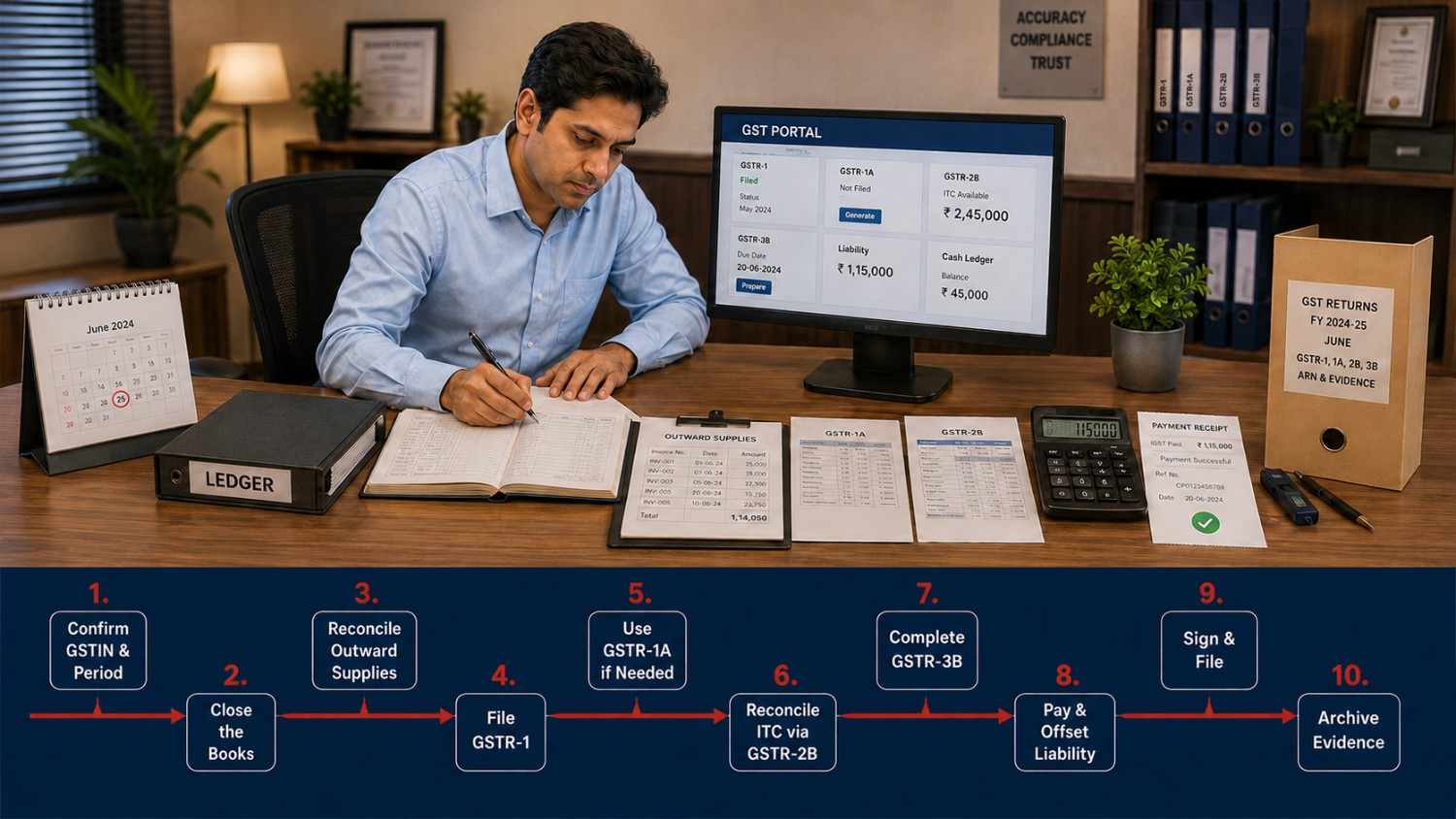
The GST filing process should follow a controlled sequence. The GST return filing process step by step below shows how to file GST return online in India. Use the official GST return manuals for current portal fields.
-
Confirm the GSTIN, form and period: Check frequency, open periods and pending earlier returns.
-
Close the books: Record sales, purchases, notes, advances, reverse charge and adjustments.
-
Reconcile outward supplies: Match books with e-invoices, e-way bills and marketplace reports. A GST amount calculator can assist basic working, but classification and place of supply still need review.
-
Complete GSTR-1 filing: Upload data, generate the summary, review it and authenticate the statement.
-
Use GSTR-1A if needed: Add or correct same-period outward supplies once, before that period’s GSTR-3B.
-
Reconcile ITC: Compare purchase books, GSTR-2B and Invoice Management System actions, identify eligible credit, reversals and follow-ups.
-
Complete GSTR-3B filing: Review auto-populated liability, ITC and other tables; responsibility remains with the taxpayer.
-
Pay and offset liability: Use eligible credit and deposit the cash balance. Interest and late fee are paid in cash.
-
Preview, sign and file: Use DSC or EVC as applicable and confirm that an ARN is generated.
-
Archive evidence: Download the return, challan, ledger extracts and reconciliation for later review.
Businesses with several GSTINs may use virtual CFO compliance support to set common close dates and review controls.
Monthly Filing or QRMP Scheme?
|
Point |
Monthly filing |
QRMP scheme |
|
Turnover condition |
Mandatory when the taxpayer is not eligible for or does not use QRMP |
PAN-based aggregate annual turnover up to ₹5 crore, subject to conditions |
|
GSTR-1 |
Monthly |
Quarterly |
|
GSTR-3B |
Monthly |
Quarterly |
|
Tax payment |
With monthly GSTR-3B |
Monthly; PMT-06 generally applies for months 1 and 2 |
|
B2B invoice reporting |
Through monthly GSTR-1 |
Optional IFF for months 1 and 2 |
|
Main benefit |
Monthly reporting visibility |
Fewer returns, but not fewer monthly tax checks |
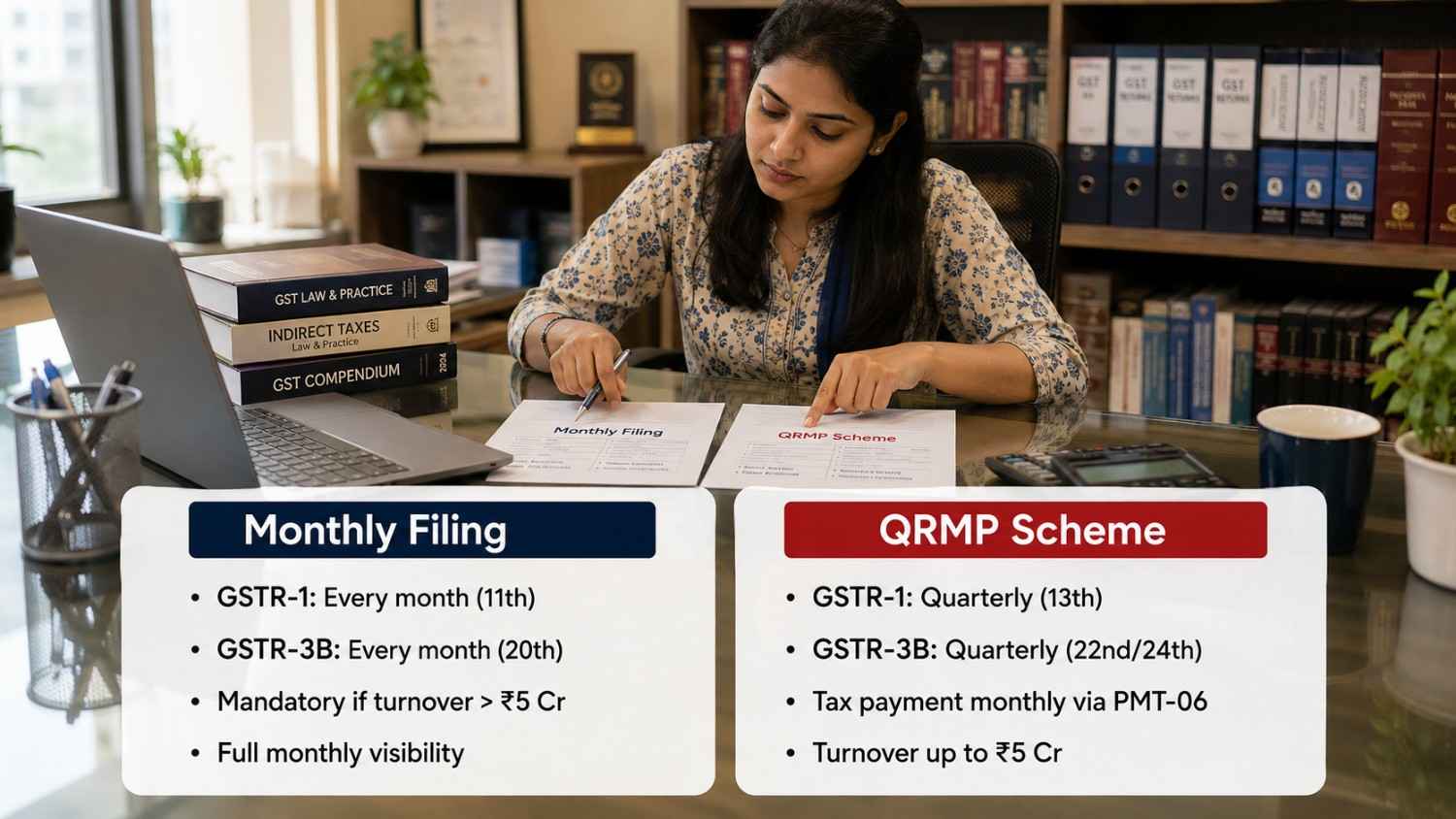
The official QRMP scheme confirms the ₹5 crore ceiling, quarterly GSTR-1 and GSTR-3B, monthly payment and optional IFF. The option applies GSTIN-wise.
GST Late Fees and Interest
A late fee relates to delayed filing. Interest relates to delayed payment of tax. They are separate amounts, and neither should be confused with a penalty imposed through an adjudication proceeding.
Common rationalised late-fee limits
|
Return and case |
Combined daily late fee |
Common maximum per return |
|
Nil GSTR-1 or nil GSTR-3B |
₹20 |
₹500 |
|
Non-nil GSTR-1 or GSTR-3B; turnover up to ₹1.5 crore |
₹50 |
₹2,000 |
|
Non-nil GSTR-1 or GSTR-3B; turnover above ₹1.5 crore and up to ₹5 crore |
₹50 |
₹5,000 |
|
Non-nil GSTR-1 or GSTR-3B; turnover above ₹5 crore |
₹50 |
₹10,000 |
|
Nil annual GSTR-4 |
₹20 |
₹500 |
|
Other annual GSTR-4 |
₹50 |
₹2,000 |
These combined figures reflect CGST plus the corresponding SGST or UTGST amount under the rationalisation notifications listed in the GST Council notification directory. Other returns, annual returns and notified relief periods can have different rates or caps. Always rely on the liability computed for the correct form and period on the portal.
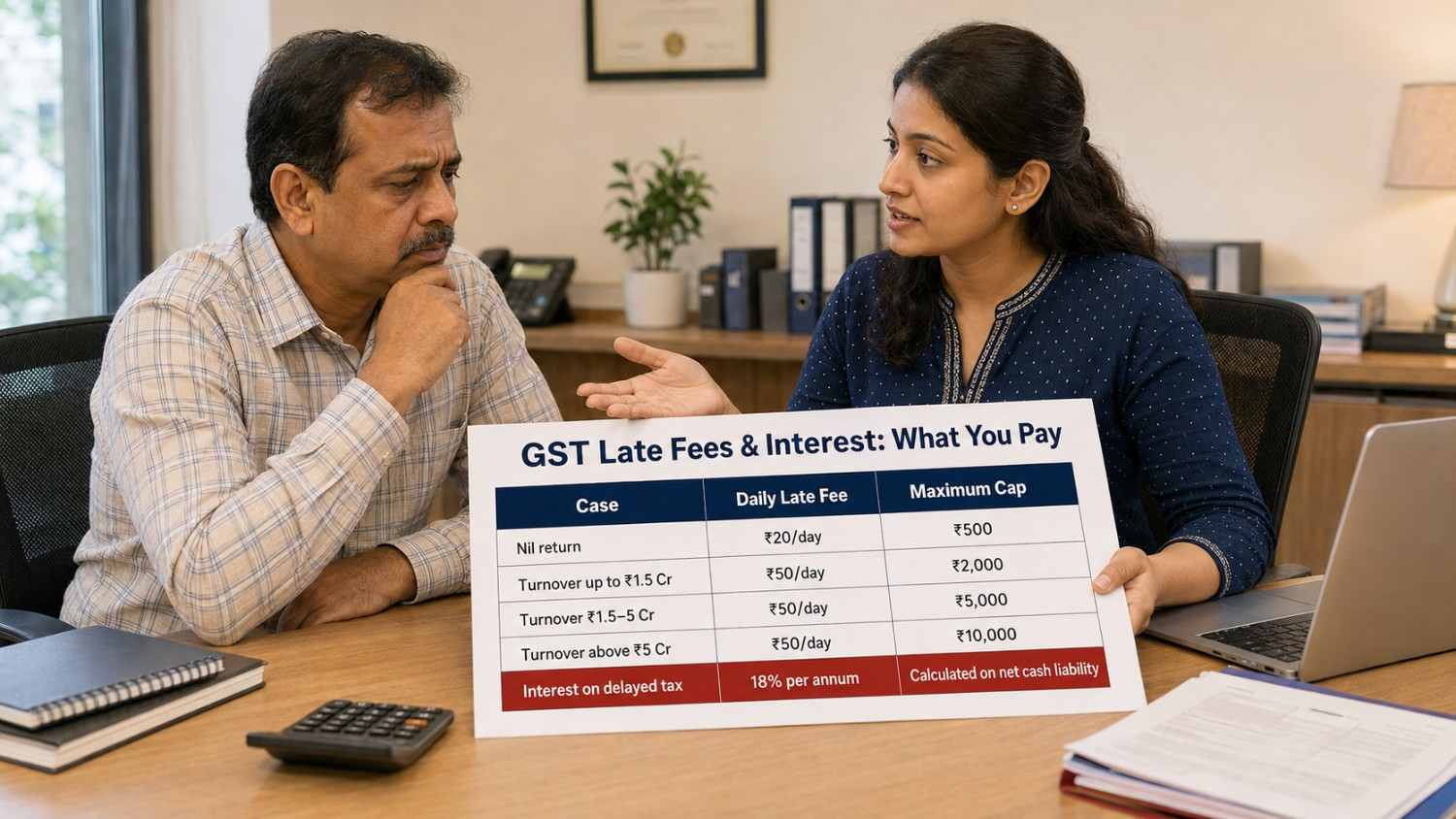
Delayed tax payment generally attracts interest at 18% per annum on the net cash tax liability for the period of delay. For example, ₹1,20,000 paid 15 days late produces indicative interest of about ₹888: ₹1,20,000 × 18% × 15 ÷ 365. The portal calculation and applicable legal rounding should be checked before payment.
Can a Filed GST Return Be Corrected?
A filed GST return generally cannot be revised by reopening it. GSTR-1A allows an optional same-period correction after GSTR-1 and before GSTR-3B, and it can be filed only once for that period. Other permitted outward-supply errors may be amended in a later GSTR-1 within the statutory time limit.
GSTR-3B is not revised. Eligible errors are addressed through a later return, tax payment, ITC reversal, or Form DRC-03, depending on the issue. A professional review is advisable where the correction changes tax, interest, place of supply or another person’s ITC.
The law also restricts furnishing specified returns after three years from their due date. It covers statements or returns under sections 37, 39, 44 and 52, subject to any permitted relaxation. Do not treat the three-year limit as extra filing time, because late fee, interest, notices and sequential filing blocks can arise much earlier.
Common GST Return Filing Mistakes
-
Filing GSTR-1 without matching sales books, e-invoices and credit notes.
-
Claiming ITC from purchase books without checking GSTR-2B and eligibility rules.
-
Treating GSTR-2B as a return or assuming every auto-populated figure is final.
-
Missing reverse-charge liability, ITC reversals, exports or advances for services.
-
Selecting the wrong GSTIN, return period, place of supply, HSN or tax rate.
-
Filing a nil return when auto-populated data, liability or transactions exist.
-
Assuming cancellation removes all pending returns and final-return duties. Review the GST registration cancellation guide before closing a GSTIN.
-
Waiting until the due date and losing time for reconciliation, payment or portal errors.
GST Filing Cost and Completion Time
There is no separate government charge merely for filing an on-time return. The payable amount may include output tax, reverse-charge tax, interest, late fees, or other liabilities. Software and professional fees vary with transaction volume, number of GSTINs, reconciliation work and the return type; there is no universal government-approved professional rate.
GST return filing is a self-declaration, not an approval application. A valid filing normally generates an ARN, but later scrutiny remains possible. Preparation time depends on record quality and transaction complexity.
Conclusion
Accurate GST Filing begins before the portal is opened. Select the correct form, close the books, reconcile outward supplies and GSTR-2B, review tax and ITC, pay the cash liability, and retain the filed return with its ARN.
Due dates, exemptions and portal controls can change through notifications. A monthly compliance calendar and documented review process make GST return filing more reliable and reduce avoidable late fees, interest and correction work.
FAQS
FAQs About GST Filing
-
What is GST Filing in India?
GST Filing is the online submission of prescribed GST returns or statements for a registered person. The forms report information such as outward supplies, tax liability, eligible input tax credit and payment. The correct form and frequency depend on the registration category, turnover and scheme selected.
- Is GST Filing mandatory when there are no sales?
- What is the difference between GSTR-1 and GSTR-3B?
- What is the GST return filing due date for regular taxpayers?
- What documents are required for GST return filing?
- Can GST returns be revised after filing?
- What is the late fee for delayed GST return filing?
- Who can use the QRMP scheme?
- Must returns be filed after GST registration cancellation?
- Can a GST return older than three years be filed now?


