
What Should Taxpayers Know About Income Tax Rules 2026?
- by kapil
- Updated October 13, 2026
- 14 mins read

The Income Tax Rules 2026 have changed the working language, form numbers and reporting framework for Indian direct-tax compliance from 1 April 2026. CBDT notified the rules on 20 March 2026 under the Income Tax Act 2025, together with redesigned forms intended to standardise reporting. Taxpayers should not assume, however, that every return filed during 2026 automatically falls under the new law.
Returns for financial year 2025–26, pending proceedings and earlier-year corrections may continue under the Income-tax Act, 1961. This guide explains the effective date, old-to-new form transition, records to prepare, filing workflow, costs, deadlines and practical checks needed for tax compliance in 2026.
What Changed Under the Income Tax Rules 2026?
The Income-tax Act, 2025 replaced the Income-tax Act, 1961 from 1 April 2026. CBDT notified the corresponding Income Tax Rules 2026 on 20 March 2026, and they also took effect on 1 April 2026. The official notification describes them as rules made under section 533 of the new Act.
The reform primarily reorganises and simplifies the law rather than announcing an entirely new tax policy. The official CBDT commencement release says the framework uses simpler language, a streamlined structure and redesigned forms without changing the underlying tax policy merely because the legislation has been rewritten.
For taxpayers, the visible operational changes include:
- A single “tax year” concept for periods beginning on or after 1 April 2026
- Renumbered and standardised statutory forms
- Consolidation of selected forms that previously required separate reports
- Structured disclosures designed to align forms with the new Act
- New section and rule references across certificates, applications and reports
- Separate transition treatment for earlier years and pending matters
The practical significance is larger than a change in numbering. Payroll systems, return-preparation software, engagement letters, internal checklists and document names must point to the correct law. A taxpayer using an old label may understand the transaction correctly but still select the wrong compliance route. Check out this Income Tax Calculator also.
When Do the New Income Tax Rules 2026 Apply?
The first question is not when a document is uploaded. It is which period or proceeding the document concerns.
| Compliance situation | Governing framework to check |
| Tax year beginning on or after 1 April 2026 | Income Tax Act 2025 and Income Tax Rules 2026 |
| FY 2025–26 return filed in 2026 | Income-tax Act, 1961 and notified AY 2026–27 return forms |
| FY 2025–26 tax audit report | Existing Forms 3CA, 3CB and 3CD under the old framework |
| Tax Year 2026–27 tax audit report | Form 26 under the CBDT Income Tax Rules |
| Earlier-year assessment, appeal or reassessment | Generally continues under the 1961 Act, subject to the saving provisions |
| Valid earlier option or declaration | Continues only where the saving clause and corresponding provision preserve it |
This distinction prevents one of the most likely tax compliance 2026 mistakes. A return submitted after 1 April 2026 may still concern FY 2025–26 and therefore use the applicable AY 2026–27 return form under the old Act. By contrast, income earned in Tax Year 2026–27 falls within the Income Tax Act 2025.

Do not replace “assessment year” with “tax year” across historical files mechanically. Earlier proceedings remain linked to the terminology and provisions that governed the relevant period. Keep workpapers labelled with both the financial period and the governing legislation.
How Have Income Tax Forms 2026 Been Reorganised?
The new income tax forms use serial numbers, and several familiar numbers have changed. Taxpayers should use the form’s stated purpose and statutory reference, not rely only on memory.
| Earlier form | Form under the 2026 rules | Main purpose |
| Forms 3CA, 3CB and 3CD | Form 26 | Unified tax audit report and particulars for Tax Year 2026–27 onward |
| Form 49A | Form 93 | PAN application |
| Form 60 | Form 97 | Declaration for specified transactions by a person without PAN |
| Form 61 | Form 98 | Half-yearly statement of Form 97 declarations received |
| Form 35 | Form 99 | Appeal to the prescribed income-tax appellate authority |
| Forms 10A and 10AB | Forms 104 and 105 | Specified NPO registration or approval applications |
| Forms 15G and 15H | Form 121 | Declaration for receipt of specified income without tax deduction |
| Form 12BB | Form 124 | Employee statement supporting deduction claims |
| Form 16 | Form 130 | Salary, pension or specified senior-citizen TDS certificate |
| Form 16A | Form 131 | TDS certificate for covered non-salary payments |
This table is a navigation aid, not a complete substitute for the notified form and instructions. The Income Tax Forms 2026 include many specialised reports, applications, declarations, certificates and statements. CBDT also provides form-by-form guidance and an old-to-new mapping.
Tax teams should maintain a controlled form register containing the old number, new number, purpose, tax year, due date, responsible person and portal utility status. That simple control reduces the chance that a familiar form number is used for the wrong period.
Which Taxpayers Need to Review Their Compliance Process?
The Income Tax Rules 2026 do not create one universal application. They prescribe different forms and procedures according to the taxpayer, transaction and statutory obligation.
Salaried individuals and pensioners
Employees should check the certificate and deduction-support forms applicable to the relevant tax year. Form 130 replaces the earlier Form 16 within the new framework, while Form 124 corresponds to the earlier Form 12BB. Employees comparing deductions should remember that a form redesign does not itself make a deduction available.
Businesses and professionals
Businesses must update accounting mappings, audit schedules and statutory references. Section 63 of the Income Tax Act 2025 governs tax-audit requirements, while new Form 26 consolidates the earlier 3CA, 3CB and 3CD formats for Tax Year 2026–27. The official guidance states that the business and professional audit thresholds continue, so the change in law does not by itself remove an existing audit obligation. Eligible ventures should assess any startup tax exemption separately from the form transition.

Employers and other deductors
Deductors must map salary and non-salary certificates, declarations, lower-deduction applications and periodic statements to the correct forms. A current TDS rate reference can support the review, but teams must verify the tax year, recipient type and nature of payment before changing payroll or vendor processes.
Non-profit organisations
The new income tax forms include renumbered applications, orders, accumulation statements, audit reports and donation statements for NPOs. Registration, approval, reporting and audit are separate obligations. An organisation should not assume that an earlier approval eliminates the need to examine transition rules, the corresponding new provision or the form required for a later tax year.
Banks, reporting entities and transaction recipients
Entities receiving declarations from persons without PAN must note the move from Form 60 to Form 97 and from Form 61 to Form 98. Reporting entities should update counterparty instructions, validation rules, retention practices and half-yearly reporting workflows.
What Records Should Taxpayers Prepare?
There is no single document checklist for all CBDT Income Tax Rules because the evidence depends on the return, claim, transaction or report. A practical compliance file should begin with the following core records where relevant:
- PAN, Aadhaar and verified contact details
- Salary or pension certificate and perquisite information
- Annual Information Statement and Form 26AS reconciliation
- Bank-interest certificates and account summaries
- Capital-gain statements and acquisition-cost evidence
- House-property income, rent, municipal tax and loan-interest records
- Business books, invoices, expense support and audit records
- TDS and TCS certificates, challans and statement acknowledgements
- Deduction receipts, policy records and prescribed identification details
- Foreign income, foreign asset and tax-credit documentation
- Prior returns, orders, notices, options and declarations
Before using new income tax forms, reconcile names, PANs, transaction values and withholding data across source records. A portal-prefilled figure can assist filing, but taxpayers remain responsible for verifying completeness and accuracy.
For business taxpayers, create a cross-reference between ledger accounts and form disclosures. This is especially important where the new Form 26 aligns tax-audit disclosures with the return framework. If the return, audit report and books use inconsistent classifications, the change may create an avoidable query even when the total amount is correct.
How Should Taxpayers Implement the New Framework?
Below are the steps for this process:
Step 1: Identify the relevant period
Write down the transaction period, financial year, assessment year or tax year before selecting any form. Determine whether the matter began before or after 1 April 2026. For an earlier-year matter, review the saving and transition provisions before adopting the new form.
Step 2: Map the obligation to the new law
Identify the relevant provision under the Income Tax Act 2025 and the corresponding rule. Use the official comparison utility where an old section or rule reference appears in contracts, software or workpapers. Record the mapping so another reviewer can reproduce the decision.
Step 3: Select the correct notified form
Search by the purpose of the compliance, then confirm the form number and description. The official forms and guidance directory provides the new number, corresponding old form and guidance for the Income Tax Forms 2026. Do not use a draft form or a third-party copy when a final notified version is available.
Step 4: Reconcile source information
Match income, deductions, tax payments, TDS, TCS and reported transactions against the available statements and supporting records. Resolve name, PAN, amount or period mismatches before submission. A written reconciliation should explain every material difference instead of merely overriding prefilled data.
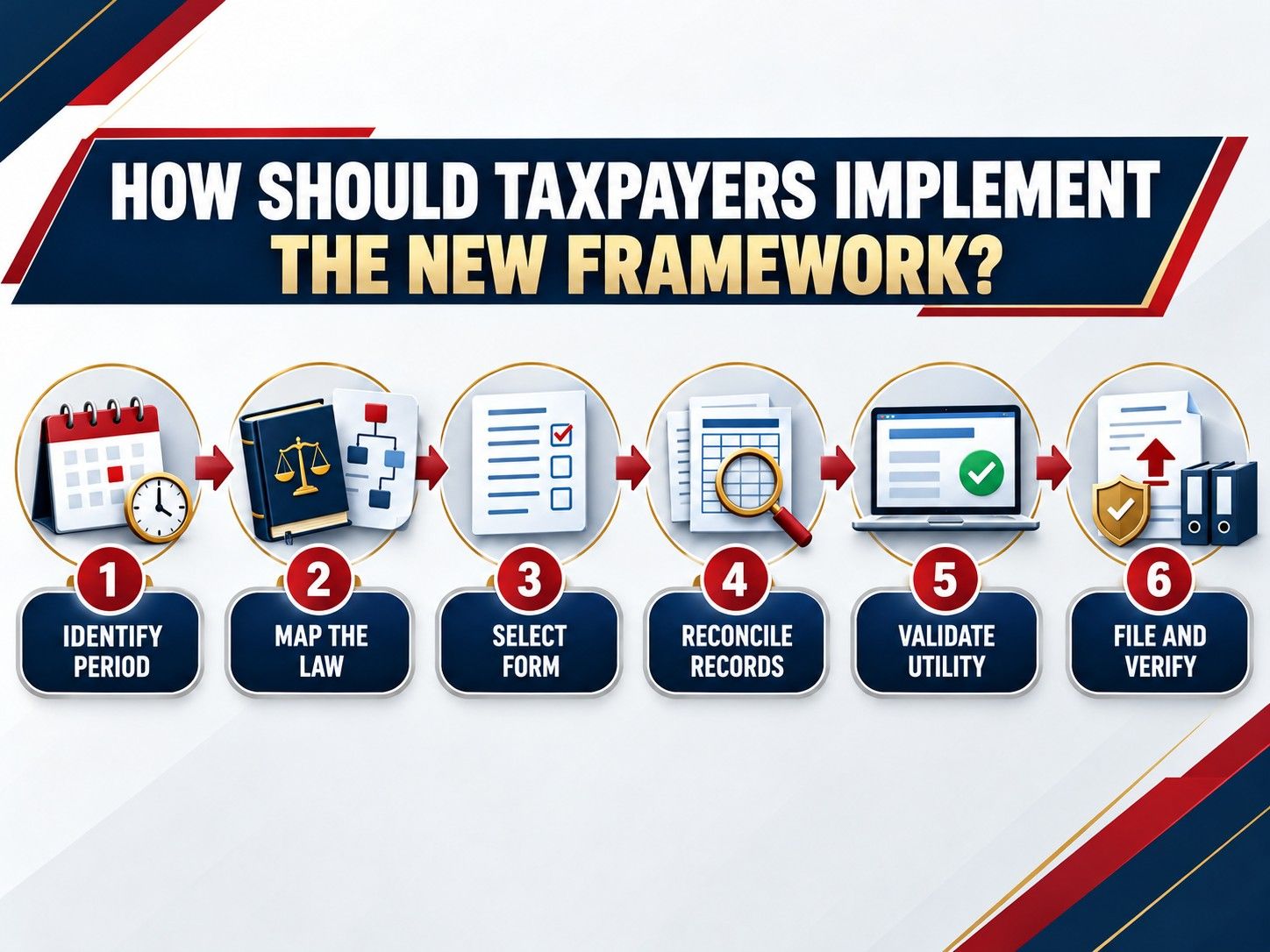
Step 5: Check the portal utility and validation rules
CBDT has rolled out forms and utilities in phases. Confirm that the relevant online or offline utility applies to the required Act and tax year. Update software, schema and digital-signature components only from authorised sources, then run the available validations.
Step 6: File, verify and preserve evidence
Submit through the prescribed channel and complete verification or authentication within the applicable time. Save the acknowledgement, submitted form, computation, payment proof and evidence pack. Also record any later correction, response or revised filing so the audit trail remains complete.
What Fees and Payments Apply?
There is no government “application fee” merely for becoming subject to the new Income Tax Rules 2026 or for using the standard e-filing portal. Tax liability, interest, late-filing fee and other amounts arise from the applicable law and the taxpayer’s facts, not from the renumbering of a form.
| Payment | When it may arise | Official position |
| Income tax or self-assessment tax | Where the computation shows tax payable | Amount depends on taxable income, regime and credits |
| Advance tax | Where statutory conditions are met | Pay by the applicable instalment dates |
| Interest | Where payment or filing defaults trigger it | Calculated under the governing provision |
| Late-filing fee | Where a return is filed after the prescribed due date | Depends on the applicable provision and facts |
| Professional fee | If a taxpayer hires an adviser | Private charge, not a CBDT filing fee |
Never send tax to a personal account or pay an unofficial “form activation” charge. Generate the appropriate challan through the authorised tax-payment facility, verify the assessment or tax year and preserve the payment reference. A TDS calculation tool may assist an initial check, but it does not replace the applicable law. If a demand appears, compare it with the order and portal record before paying.
Which Mistakes Could Cause Delay or Incorrect Filing?
The most serious risks under tax compliance 2026 arise from applying the correct information to the wrong legal period or form.
- Using a draft version after final Income Tax Forms 2026 were notified
- Applying a new form to FY 2025–26 without checking the transition guidance
- Continuing an old form number for Tax Year 2026–27 because internal software was not updated
- Treating a form renumbering as a change in tax rate, deduction eligibility or audit threshold
- Failing to reconcile AIS, Form 26AS, books and withholding certificates
- Copying old section references into board papers, certificates or audit workpapers
- Ignoring a preserved option, pending proceeding or earlier-year right under the saving clause
- Selecting a form by number without confirming its purpose and applicable tax year
- Assuming portal prefill transfers responsibility for incorrect information to CBDT
- Missing verification after uploading a return or form
Where a filed form contains an error, use only the correction, revised-return, rectification or response route legally available for that situation. These remedies are not interchangeable. First identify whether the error is in the taxpayer’s submission, a reporting entity’s data or an order issued by the department.
What Should a Tax Compliance 2026 Checklist Include?
| Control question | Evidence to retain |
| Which law governs the period? | Dated applicability note |
| Is the form final and current? | Notified form or current portal utility |
| Has the old number been mapped? | Form-transition register |
| Do source records agree? | AIS, Form 26AS and ledger reconciliation |
| Is payment mapped correctly? | Challan and payment reference |
| Was filing verified? | Acknowledgement and verification record |
| Are later changes tracked? | Revision or correction log |
Businesses should assign an owner for each row and test the checklist before the first due date. Individual taxpayers can use the same approach on a smaller scale. The goal is to demonstrate why a particular law and form were used, not merely that something was uploaded.

Conclusion
The Income Tax Rules 2026 make India’s direct-tax framework easier to navigate only when taxpayers manage the transition carefully. The Income Tax Act 2025 applies from 1 April 2026, but earlier periods and proceedings may remain governed by the old law.
The safest approach is to identify the relevant year, confirm the final form, reconcile official records, complete verification and preserve a clear audit trail. Taxpayers should review CBDT updates before every material filing because utilities, procedures and form instructions can be amended even after the core rules take effect.
FAQs About Income Tax Rules 2026
Do the Income Tax Rules 2026 apply to the return for FY 2025–26?
Not automatically. The return for FY 2025–26 relates to AY 2026–27 and uses the return forms notified for that year under the applicable older framework. The Income Tax Act 2025 governs tax years beginning on or after 1 April 2026, so taxpayers must distinguish filing date from income period.
Should I use Form 26 for the tax audit of FY 2025–26?
No. Official guidance states that FY 2025–26 tax audits continue through Forms 3CA, 3CB and 3CD, with the stated audit-report due date of 30 September 2026. Form 26 applies to the audit report for Tax Year 2026–27 under the new Income Tax Rules 2026, for which the official guidance states 30 September 2027.
Has Form 16 been abolished under the new framework?
The salary TDS certificate has not disappeared, but its number changes to Form 130 under the Income Tax Forms 2026. Employers and employees should confirm which tax year the certificate covers. They should also verify the income, deductions and tax figures rather than relying on the label alone.
What replaces Form 60 for a person who does not have a PAN?
Form 97 replaces Form 60 for the specified transactions covered by rule 159(2). The recipient of such declarations must furnish the prescribed half-yearly statement in Form 98, which corresponds to the former Form 61 process. The scope of covered transactions should be checked under the current rule before accepting the declaration.
Are old options and declarations cancelled from 1 April 2026?
No blanket cancellation applies. A valid election, declaration or option under the repealed Act may continue where the saving clause protects it and a corresponding provision exists in the Income Tax Act 2025. Taxpayers should document the original option and verify its mapping instead of assuming automatic continuation.
Will a pending appeal for an earlier assessment year shift to the new Act?
Generally, proceedings concerning tax years before 1 April 2026 continue under the Income-tax Act, 1961. The transition FAQs explain that pending assessments, appeals, reassessments and related proceedings are preserved by the saving provisions. The specific proceeding and limitation position should still be reviewed on its facts.
Do the CBDT Income Tax Rules change tax rates by themselves?
The renumbering or redesign of a form does not by itself change a tax rate. Rates, deductions and charging provisions must be checked under the applicable Act and Finance legislation. Taxpayers should therefore separate a compliance-form change from a substantive tax-policy change.
Can I keep using old accounting or tax software after 1 April 2026?
Only if it supports the applicable Act, tax year, final schema and form validation. A package that recognises old numbers but not the Income Tax Forms 2026 may create an incorrect filing or export. Confirm the software version, utility release and mapping before submitting live data.
Is there a government fee for downloading or filing the new income tax forms?
CBDT does not charge a separate fee merely to download the forms or use the normal e-filing service. Tax, interest or a statutory late-filing fee may still be payable according to the taxpayer’s facts. Fees charged by a chartered accountant, tax return preparer or software provider are private service charges.
What should I do if AIS or Form 26AS does not match my records?
Compare the entry with bank statements, invoices, certificates and the relevant reporting party’s details. Use the available feedback or correction process and ask the reporting entity to correct its statement where necessary. Do not omit genuine income merely because it is missing from a prefilled statement, and do not accept an incorrect entry without retaining a reconciliation.
You may also like

What Does Project Logistics Alliance Membership Offer?
Project Logistics Alliance membership offers an Indian project cargo business a