Why IMCA Membership Matters for Maritime Businesses
- by kapil
- Updated October 3, 2026
- 14 mins read
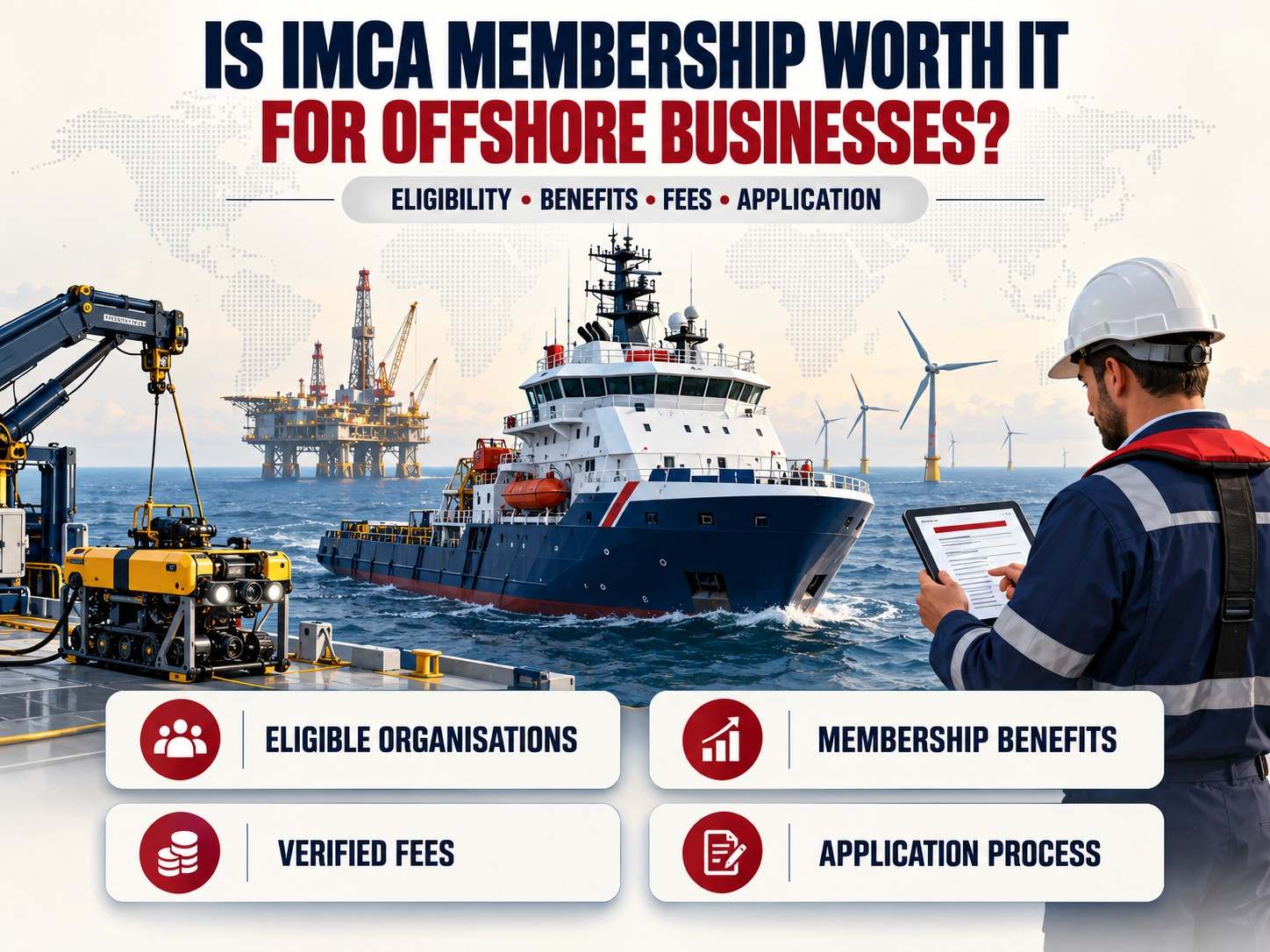
IMCA membership can give offshore contractors, vessel operators, suppliers and training providers access to technical guidance, industry forums and professional networks. The International Marine Contractors Association states that it represents more than 800 organisations and offers members access to over 460 guidance and information notes.
For an Indian maritime business, the real question is not whether membership looks credible, but whether the company fits the correct category and can support its application with operational evidence. IMCA membership is voluntary trade-association membership. It is not an Indian statutory licence, tender guarantee or automatic approval of every service, vessel or training course.
This guide explains eligibility, categories, documents, application fees, review stages, timelines, renewal obligations and the changes taking effect from 1 January 2027. It also shows how IMCA differs from cargo licences and other industry memberships, helping applicants decide whether the cost and compliance effort match their offshore activities before applying.
What Does IMCA Membership Actually Mean?
The International Marine Contractors Association is a global trade association for contractors and supply chains supporting offshore oil, gas and renewable energy. Its work covers safety, efficiency and risk reduction across diving, dynamic positioning, remote systems and offshore survey.
In this context, IMCA registration means admission to an international trade association, not a statutory maritime licence or government approval.
The official IMCA membership overview describes access to its technical library, regional meetings, committees, safety information, events and industry programmes. It does not mean IMCA guarantees that member’s work, certifies every vessel or confirms suitability for a particular tender.
IMCA membership does not replace incorporation, tax registrations, port permissions, vessel approvals, labour compliance or activity-specific Indian licences. Customers and tendering authorities may still conduct separate technical, financial, safety and vendor due diligence.
Which Organisations Can Apply for IMCA Membership?
IMCA membership requirements begin with the nature of the applicant. The Articles of Association make membership available to companies and organisations rather than private individuals. An applicant must be active in offshore, marine or underwater engineering as a contractor, vessel owner, equipment or service supplier, training provider, offshore operator or another eligible organisation.
A conventional freight forwarder without offshore construction or engineering activity should not assume it fits this scope. Depending on its business, FFFAI membership in India or FIATA association membership may be more relevant.
| Membership route | Generally suitable for | Important point |
| Contractor | Offshore marine contractors and qualifying vessel owners, operators or charterers | The current application page refers to offshore vessels exceeding 500 gross tonnage |
| Supplier | Equipment manufacturers, technology businesses, consultants, service providers and other supply-chain companies | The business must show meaningful involvement in offshore energy activities |
| Training Provider | Training schools and organisations delivering offshore construction-related courses | Membership and IMCA course approval are separate, although some course routes require both |
| Energy Company | Offshore oil, gas, wind, tidal and other operators, developers or co-ventures | The route covers companies developing or operating offshore energy assets |
| Associate | Eligible registered consultants, academic bodies and commercial research organisations under the new structure | It is not intended as individual professional membership |
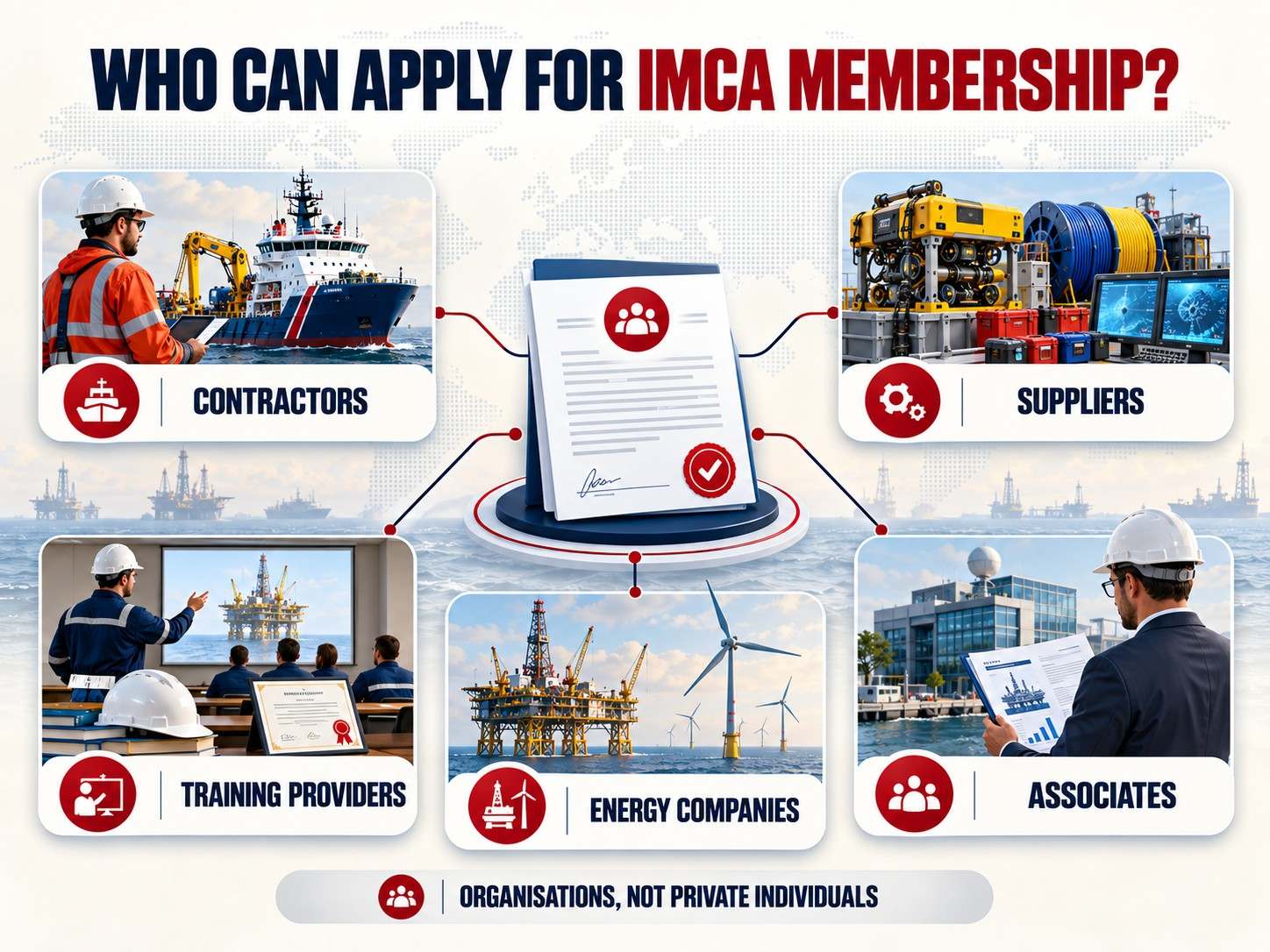
Contractors and vessel operators
A contractor should show its offshore vessel operations, operating regions and relevant technical disciplines. Where vessels are involved, IMCA asks about fleet size, ownership or charter arrangements, vessel types, representative names and IMO numbers.
Suppliers and training providers
Suppliers include manufacturers, technical service companies, research organisations and specialist advisers. Membership does not make every training course IMCA approved. Maritime training providers must complete the applicable evidence, assessment and audit process. A marine supplier focused on vessel provisioning may instead need a ship chandler licence.
Energy companies and specialist organisations
Offshore energy operators and developers may use the Energy Company route. A fuel supplier serving vessels or offshore platforms should separately examine bunker supplier registration. From 2027, eligible registered consultants and commercial research organisations gain a clearer Associate route.
Why Can IMCA Membership Matter to a Marine Business?
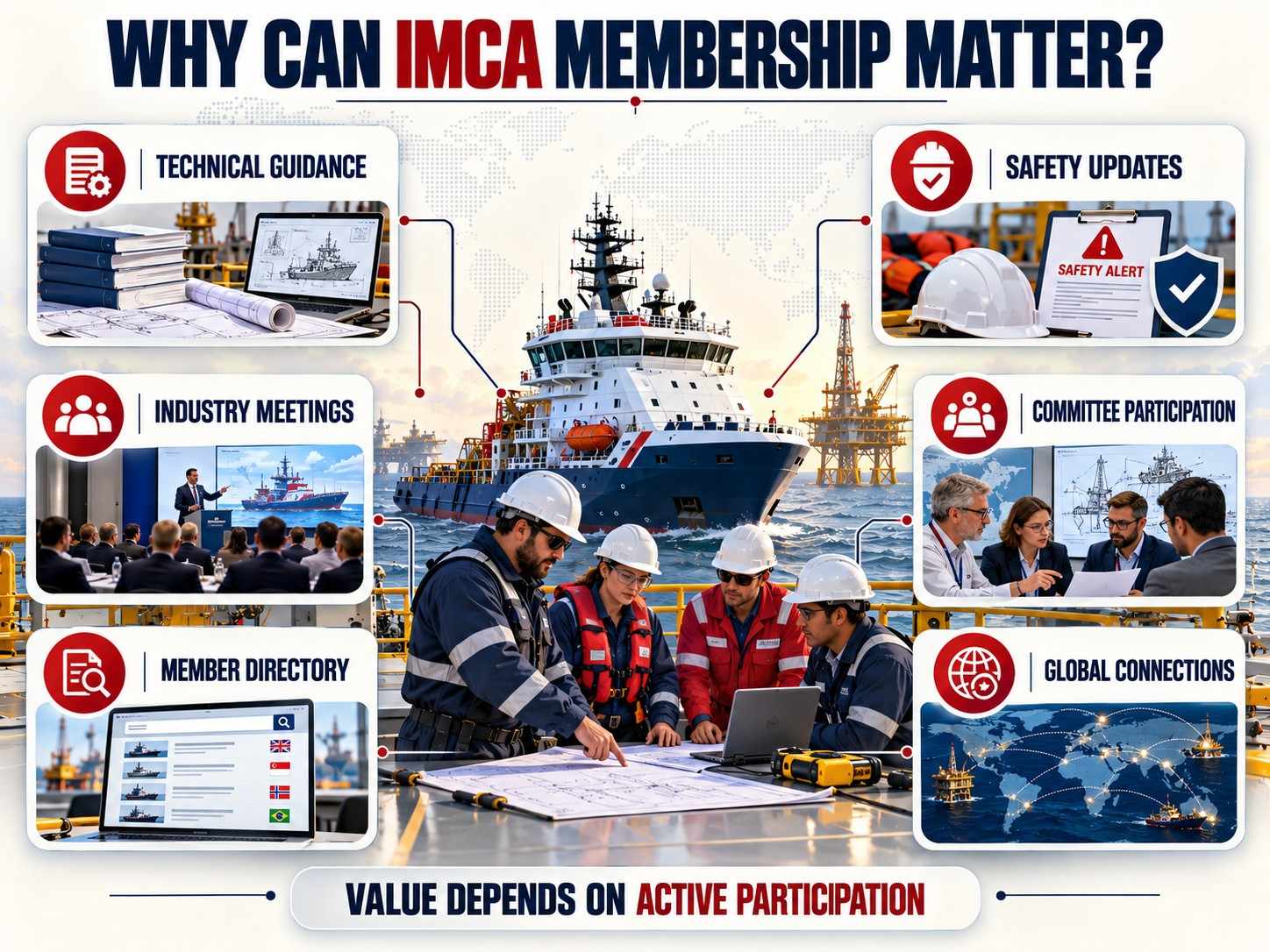
The strongest IMCA benefits are operational. Its technical library can support safety, marine assurance and tender teams, while each company remains responsible for safe execution.
Membership can also provide:
- Access to more than 460 technical guidance documents and information notes
- Free attendance at IMCA regional and technical meetings for company personnel
- Discounts for seminars, conferences and the IMCA Global Summit
- Opportunities to contribute to committees and future technical guidance
- Safety flashes, industry updates, market intelligence and certification programmes
- A searchable member-directory presence showing the accepted category, region and disciplines
- Engagement with contractors, suppliers, operators and specialists across offshore energy markets
Value grows when teams apply the guidance, attend meetings and follow relevant safety updates.
Businesses mainly seeking overseas forwarding partners should separately compare WCA network registration and World Freight Network membership. Those private forwarding networks serve a different purpose from IMCA’s offshore technical framework.
What Information and Documents Should Applicants Prepare?
The checklist varies by category, activity, division and any additional approval sought.
Prepare the following before starting an IMCA application:
- Full legal entity name, website, telephone number and registered business address
- Company registration number, tax registration number and billing details
- Ownership structure and beneficial owners for privately held companies
- Stock exchange and ticker details for listed companies
- Revenue and global workforce ranges requested in the form
- A concise description of offshore business activities supported by project references or brochures
- Business-sector details covering marine services, diving, survey, ROV, renewables, equipment or related work
- Fleet details and relevant classification society records, including ownership or charter status, vessel names, types and IMO numbers
- Information on quality, environmental and occupational safety systems
- Formal sustainability, ethics and compliance policies, or an explanation of equivalent controls
- Disclosures concerning material litigation, dishonesty, bribery, corruption, sanctions or restrictions
- Details of the global coordinator and required technical-division representatives
- Authority for the person submitting the application to bind the applicant company
Diving contractors and training providers need further evidence. A full diving contractor application requires operational and management-system material specified in IMCA’s diving assessment procedure, including evidence connected with offshore project planning and execution. A training provider seeking course approval needs a separate course application and evidence portfolio, followed by the required assessment and audit stages.
Names, ownership details, vessel records, policies and website descriptions should match across the submission. Inconsistencies can trigger clarification requests.
How Does the IMCA Application Process Work?
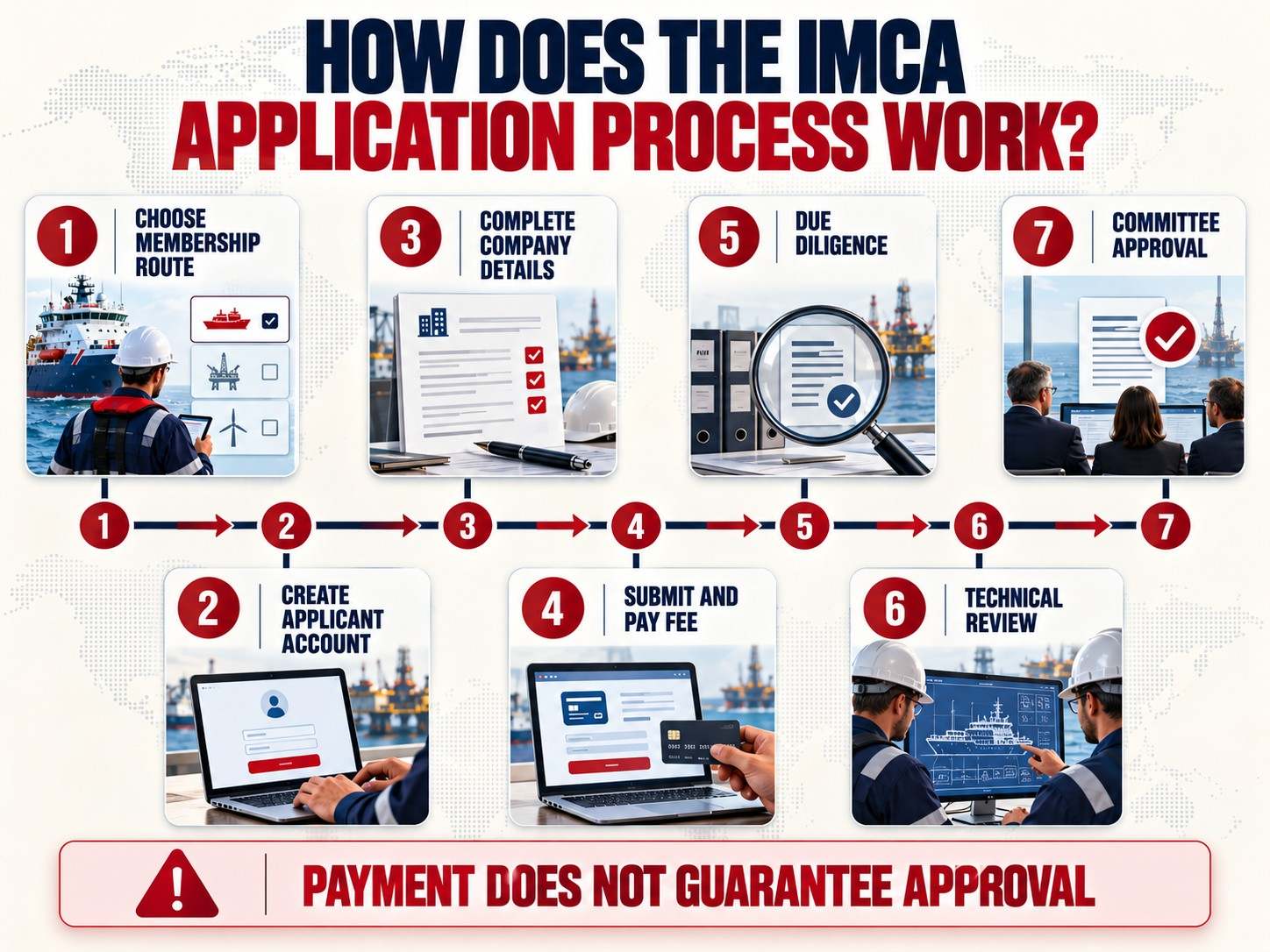
The IMCA registration process begins with selecting the correct membership route and preparing evidence that matches the company’s actual offshore activities.
Step 1: Choose the correct membership route
Match the legal entity’s activities with the category, region and technical disciplines. An Indian entity normally selects Middle East and India unless another route is confirmed. Diving applicants must address Diving Division requirements first. New entrants may map separate domestic obligations through maritime technical consultancy.
Step 2: Create the applicant account
Apply through the online portal because the preparation PDF is not an application form. Identify the authorised submitter, global coordinator and required technical contacts.
Step 3: Complete the company profile and declarations
Enter the requested registration, ownership, revenue-range, workforce, sector, fleet and management-system information. Answer sanctions and material-conduct questions directly. Supporting links do not replace required responses.
Step 4: Submit the application and pay the fee
Use the official IMCA application page to access the online process. IMCA issues an invoice for the applicable non-refundable application or re-application fee. The official preparation notes state that payment must be made directly by the applicant company through electronic transfer, not through an intermediary, before review begins.
Step 5: Complete administrative due diligence
IMCA checks identity, ownership and due-diligence information. Missing beneficial-owner details, inconsistent legal names or unanswered sanctions questions can hold the file. IMCA may request further business information.
Step 6: Pass technical and management review
This stage tests whether activities and management arrangements fit the selected category and disciplines. Diving and approved-training applications may require portfolios, desktop reviews and audits. Applicants must meet stated response deadlines.
Step 7: Obtain committee approval and activate membership
The final general stage is Operations Committee approval. An approved applicant pays the annual subscription before activation. Paying application or review fees does not guarantee approval.
What Does IMCA Membership Cost?
IMCA uses annual subscriptions that vary by category and, under the current structure, the applicable membership scope. Its public application page distinguishes flexible annual fees for contractors and certain suppliers from fixed annual fees for specified training providers and energy companies. Applicants should confirm the exact current subscription shown for their chosen route before authorising payment.
| Payment | When payable | Verified official position |
| Standard new-application fee | Before IMCA begins reviewing most new applications | £1,200, non-refundable |
| Diving contractor application fee | Before review of a new diving contractor application | £2,700, non-refundable |
| Former-member re-application fee | When a former member applies again | £2,500 |
| Annual membership subscription | After approval and during renewal | Varies by category and membership scope |
| 2027 subscription change | Applies to 2027 membership fees | IMCA has approved a 3% increase |
Training course approval charges are separate from ordinary membership dues. The official schedule states £2,000 for each listed new course audit other than Diver Medic, which is £3,000. It also states that applicable auditor travel, accommodation and subsistence are charged at cost plus 5%. Indian institutes should also treat DG Shipping course approval fees as a separate domestic expense. A training business should obtain a written breakdown before committing funds.
Membership uses annual subscriptions and renewals. IMCA’s public material does not state one universal certificate period for every newly admitted company, so applicants should confirm the activation and renewal dates shown on their invoice and certificate. IMCA says 2027 renewals will be invoiced in November 2026.
How Long Can Approval Take?
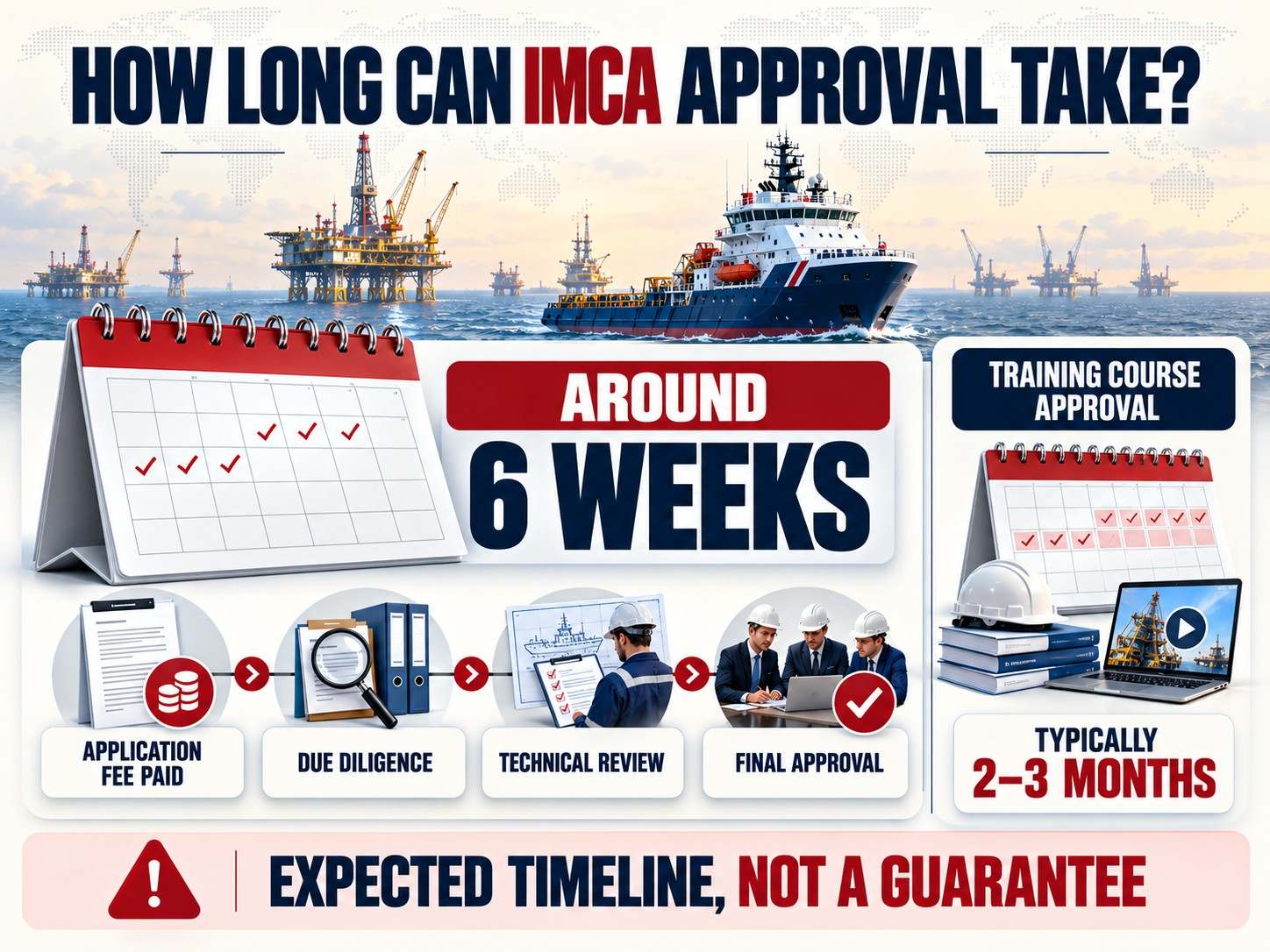
IMCA states that a standard membership process is expected to take around six weeks from payment of the application fee to final approval and membership. This is an expected period, not a guaranteed deadline, and busy periods can extend it. The sequence includes due diligence, technical and management review, Operations Committee approval and payment of the annual subscription.
Training course approval can take longer. IMCA’s training assessment procedure says two to three months is normal, subject to workload, evidence quality and the audits required. Diving applications can also extend beyond the general estimate because the evidence portfolio and audit findings must be completed satisfactorily.
What Common Problems Can Delay or Defeat an Application?
Most avoidable difficulties arise from weak preparation rather than the online form itself. Applicants should watch for:
- Choosing a category or division that does not reflect actual business activities
- Providing a generic profile without clear offshore marine involvement
- Omitting beneficial ownership or sanctions information needed for due diligence
- Using inconsistent legal names, addresses, tax details or fleet information
- Claiming policies or certifications without supporting evidence
- Failing to provide the end-client recommendation or operational records required for full diving membership
- Submitting an incomplete training evidence portfolio or failing to close identified non-conformances
- Allowing requested clarification deadlines to pass
- Assuming payment guarantees approval
- Advertising IMCA approval before the certificate or formal approval has been issued
IMCA has publicly reported rejecting a diving applicant where certificate-authentication procedures failed its audit. This illustrates why evidence quality, document verification and honest disclosure matter more than the volume of documents uploaded.
How Does IMCA Fit With Indian Maritime and Logistics Compliance?
IMCA membership deals with offshore marine contracting standards, industry engagement and technical disciplines. It is not interchangeable with Indian permissions for moving cargo, handling customs work, operating under multimodal documentation or chartering certain vessels.
For example, IATA cargo accreditation relates to air-cargo agency operations, where ACAAI membership serves a different association role. Indian multimodal operators can use the registered MTO directory when checking operators, while customs-facing activity may require a separate customs broker licence.
Sea-cargo reporting and consolidation can separately involve SCMTR registration or consol agent registration. None of these approvals is replaced by IMCA membership.
A business should map each membership, accreditation and licence to the activity it actually performs rather than collecting credentials with overlapping names.
What Changes From 1 January 2027?
IMCA has announced a simplified structure that takes effect on 1 January 2027. Four core categories will be Contractor, Supplier, Training Provider and Energy Company. A separate Associate route will support eligible registered independent consultants and academic or research organisations undertaking commercial work.
The technical access model will use two administrative groups:
- Diving Group, covering Diving and common IMCA activities
- Marine Group, covering Marine, ROV, Offshore Survey, dynamic positioning and common activities
Groups determine administrative access and pricing, while formal recognition within a technical division remains separate. Access to documents from an additional discipline will not automatically add that discipline to the membership certificate. IMCA is also introducing a case-by-case Small Contractor pathway and has confirmed a 3% fee increase for 2027.
Companies applying late in 2026 should check which structure and fee schedule will apply to their admission and first renewal. Existing members retain their current division recognition under the transition, while Affiliate membership is scheduled for separate changes from 2028.
Conclusion
IMCA membership can be valuable when an offshore business intends to use the association’s guidance, meetings, committees and technical resources as part of its operating system. The application requires more than a company profile and payment. Category selection, ownership transparency, offshore evidence, management controls and accurate disclosures all influence the review. Indian companies should also keep IMCA separate from statutory licences and cargo-sector memberships required for other activities.
Before filing an IMCA application, confirm the correct category, current annual subscription, evidence requirements and any extra diving or training assessments in writing. That approach gives management a realistic view of the cost, timeline and practical IMCA benefits.
FAQs About IMCA Membership
Can an individual marine professional apply for IMCA membership?
IMCA’s Articles state that membership is open to companies and organisations, not private individuals. From 2027, an independent consultant may be eligible for Associate membership if operating as a registered company and supporting offshore construction. Employees of a member company may access relevant company membership benefits according to IMCA’s arrangements, but they do not become individual members merely through employment.
Does an IMCA directory listing approve every service offered by a member?
No. The directory records the accepted membership category, region and relevant technical divisions, but membership is not a guarantee of every operation a company performs. Customers should check the exact entity, current status, recognised disciplines and any separate course or certification approval before relying on a listing.
Can a small offshore start-up apply from 2027?
Yes, IMCA has announced a dedicated Small Contractor pathway from 1 January 2027. The membership team will assess eligibility case by case based on the company’s operations and circumstances. A start-up should discuss the route early rather than assume that company size alone qualifies it.
Can a subsidiary use its parent company’s membership certificate?
Membership is non-transferable, so a group company should not assume that one certificate automatically covers every legal entity. Existing affiliate arrangements have their own assessment requirements, and IMCA has announced further changes from 2028. The subsidiary should obtain written confirmation from the membership team about the correct structure before presenting itself as a member.
What happens if company details change before renewal?
IMCA asks members to review organisational and contact information so renewal records remain accurate. Changes to the legal entity, ownership, billing information, operational scope or recognised disciplines should be reported through the prescribed process. A company should not wait until a customer identifies a mismatch in the directory or certificate.
Can a resigning member receive a refund of its annual subscription?
The Articles allow a member to resign by giving written notice to the CEO. A member that has already paid its subscription does not qualify for a rebate when resigning partway through the year. The member also remains liable for the applicable proportion of the annual subscription described in the Articles.
What happens when an IMCA subscription remains unpaid?
A voting member that misses the due date loses its voting right until payment is made. The Articles also permit expulsion where a subscription remains unpaid for 90 days after the invoice date, at least one formal reminder has been sent and no reasonable explanation is provided. Companies should resolve invoice or purchase-order issues before they affect membership standing.
Can an unsuccessful training provider immediately submit a new application?
No. IMCA’s training course approval terms state that an unsuccessful applicant may not reapply for six months after receiving the decision. The applicant may submit a written appeal within 30 days, subject to the applicable appeal rules. Before reapplying, it should address the stated evidence gaps and non-conformances rather than resubmit the same material.
Can a training provider advertise IMCA approval while its assessment is pending?
It should not describe a course as approved before formal approval is issued. During assessment, trainees must be told when recognition remains conditional, and a certificate is issued only after the required stages and payments are complete. For Indian statutory approvals, the maritime training institute directory is a separate check.
Does Marine Group document access add ROV or Survey recognition in 2027?
No. IMCA states that broader Group access to guidance and publications is different from formal recognition within a Division. A company that wants an additional discipline shown on its membership certificate must contact the membership team and satisfy the relevant requirements.
You may also like
What GLA Membership Can Mean for Logistics Businesses
GLA Membership can help a logistics business find overseas partners, but the de