
ACAAI Membership: Your Gateway to India’s Air Cargo Network
- by kapil
- Updated September 13, 2026
- 14 mins read

ACAAI Membership gives eligible air cargo businesses membership in the Air Cargo Agents Association of India, but it is not a government licence or a substitute for IATA cargo agency approval. This matters because an applicant seeking active membership must already hold IATA cargo agency registration and must have completed one year from the approval date. The association provides separate forms for branch offices of active members and for commercial applicants.
This guide explains which category fits your organisation, the active membership eligibility rule, required documents, proposer and seconder conditions, form disclosures, application review, payments and continuing obligations.
What is ACAAI Membership?
The Air Cargo Agents Association of India is a national trade association for the Indian air cargo sector. The official ACAAI website states that the association was founded in 1970, has more than 600 members and operates through its head office in Mumbai and eight regional offices.
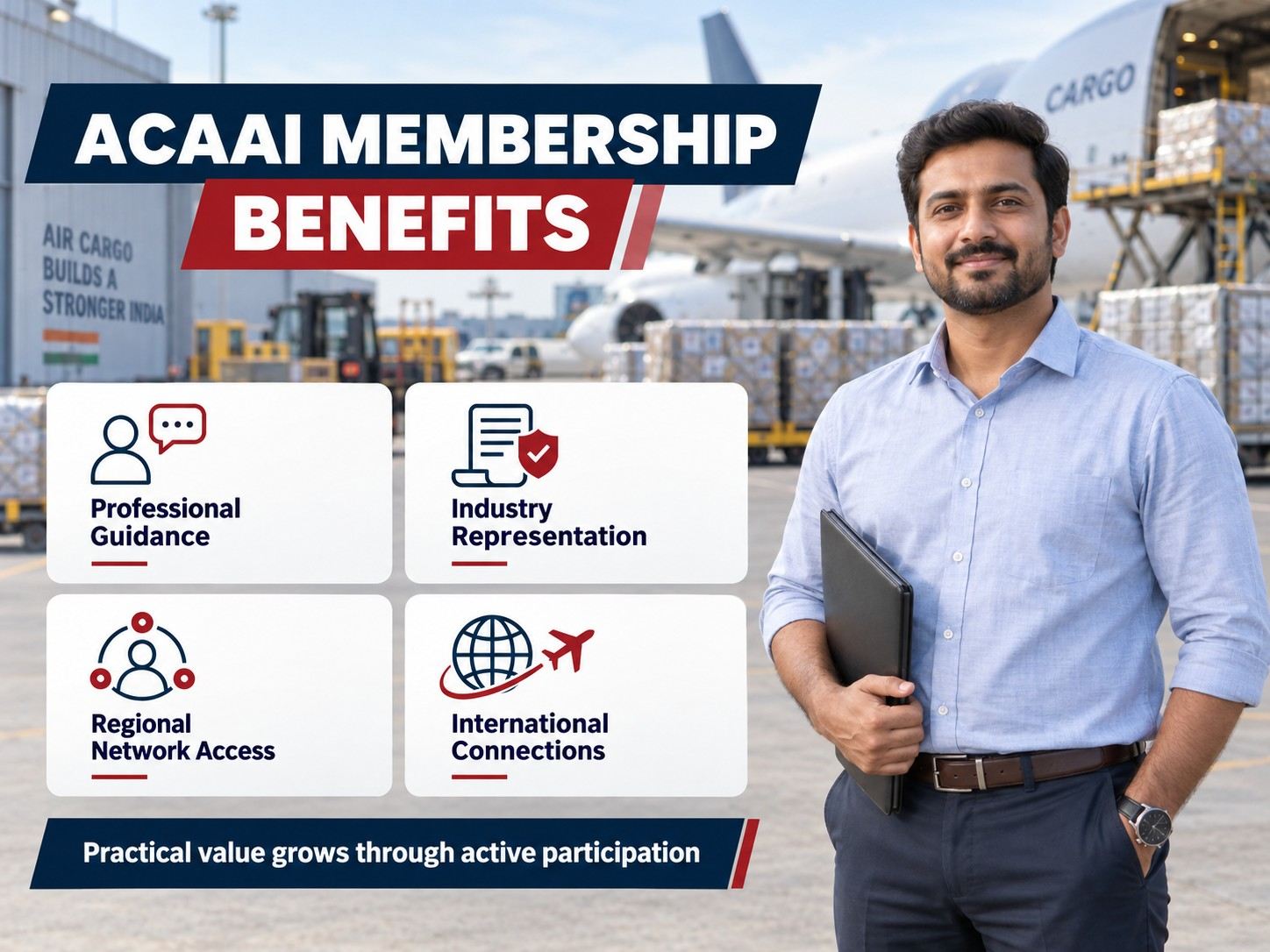
Membership connects an eligible organisation with an industry body that engages with government ministries, airlines, airport operators, freight forwarders and international associations. ACAAI also identifies professional guidance, industry representation, regional access and international network access among its member benefits.
The word “registration” can be misleading here. ACAAI registration means admission to a private membership association. It does not itself authorise a company to act as an IATA cargo agent, customs broker, multimodal transport operator or any other regulated business.
Which ACAAI Membership Category Fits Your Business?
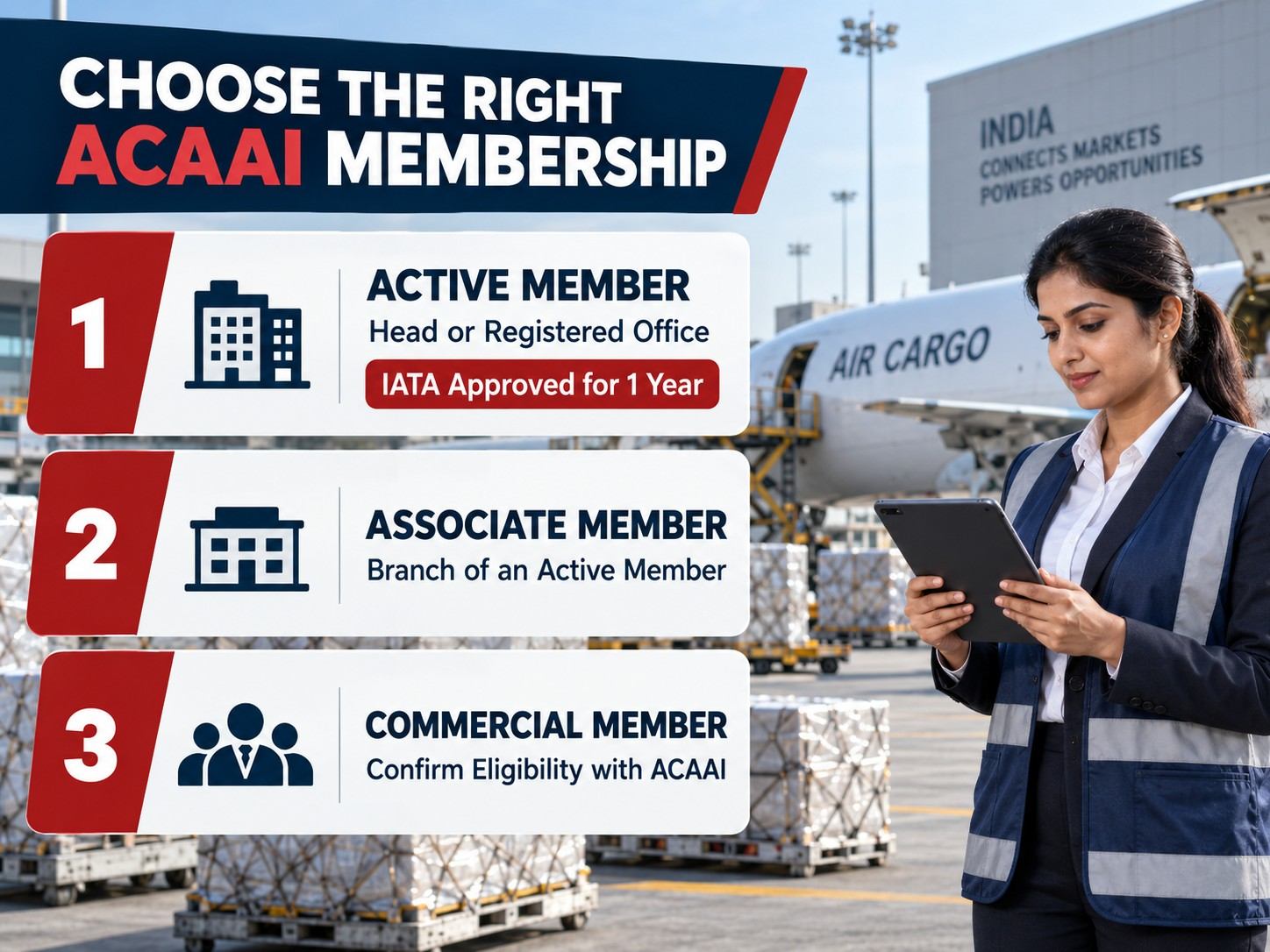
ACAAI provides forms for active, associate and commercial membership. Each route serves a different organisational position.
| Membership category | Who the official material covers | Key point before applying |
| Active membership | A cargo agency holding IATA cargo agency registration for at least one year | Available for the applicant’s head office or registered office |
| Associate membership | A branch office of an organisation already enrolled as an active member | The head office must first hold active membership |
| Commercial membership | Organisations seeking the commercial category | The public form requests detailed business, financial and operational information, but the website does not publish a complete eligibility test |
Active membership
Active membership is the primary route for an IATA-registered cargo agency. The one-year period runs from the IATA approval date, not company incorporation.
Only the head office or registered office is enrolled through this category. Businesses still working towards cargo accreditation should complete the separate IATA registration process and allow the required one-year period to finish before applying for active membership.
Associate membership
Associate membership is designed for a branch of an existing active member. It is not an alternative route for an independent cargo agency that does not meet active membership eligibility.
The associate form asks about the head office, branch operations, staff, cargo and Dangerous Goods training, premises, sales, insurance and earlier applications.
Commercial membership
ACAAI publishes a commercial membership form but no complete public eligibility test for this category. The form asks about entity type, principal business, capital, offices, employees, memberships, bankers and turnover.
It also asks activity-specific questions of clearing and forwarding agents, airlines and transport operators. Obtain written confirmation that this is the correct category before arranging endorsements or payment.
ACAAI Membership Eligibility for Active Applicants
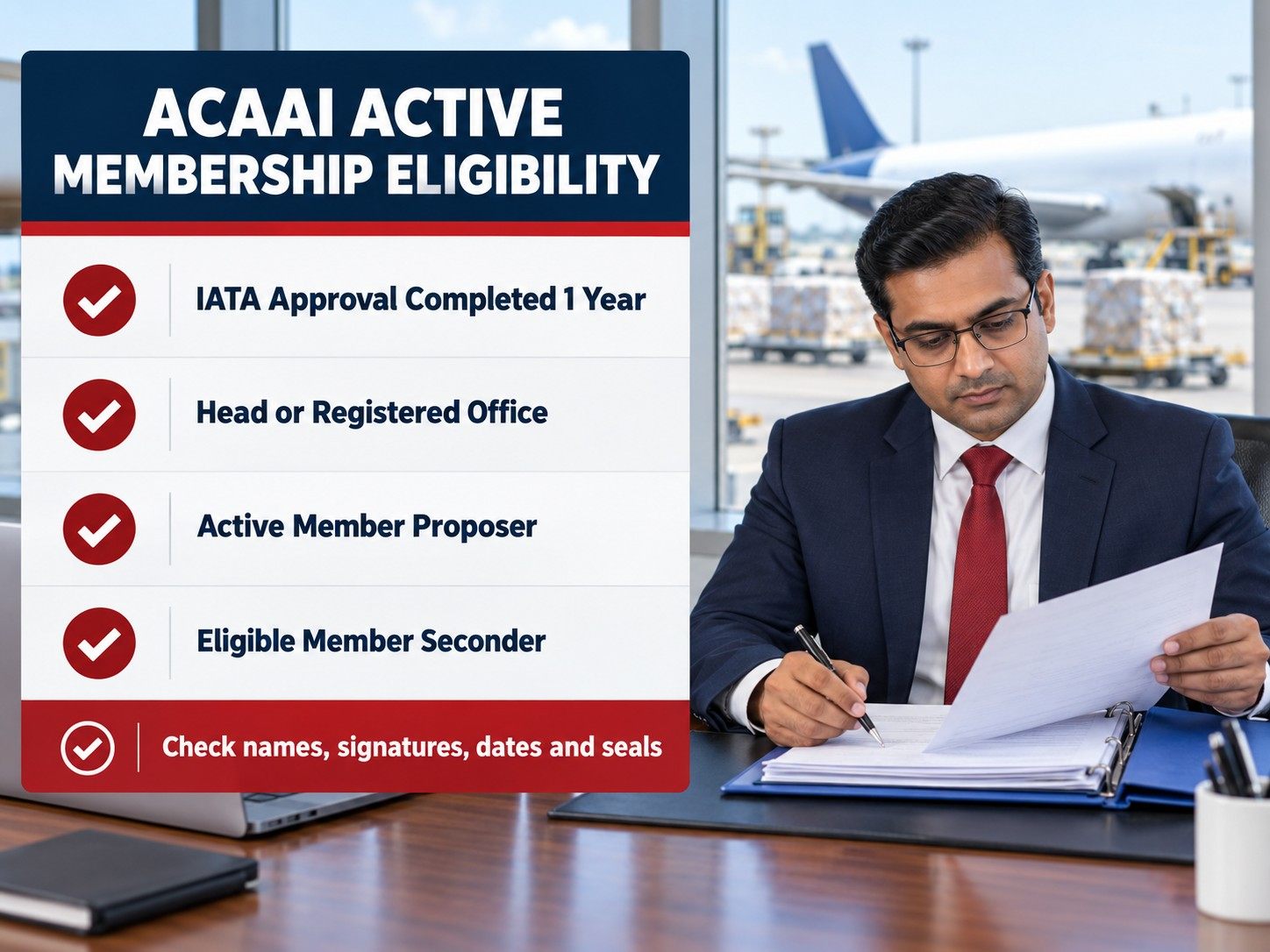
An active applicant must satisfy the conditions published by ACAAI and ensure that the names, offices and signatories across the application are consistent.
One completed year of IATA approval
The cargo agency must have completed at least one year from its IATA approval date. A pending IATA application, a travel-only credential or an approval that has not completed one year does not meet the published active membership condition.
Eligible head office or registered office
The active application must relate to the eligible agency’s head office or registered office. Branches can be considered through the associate route after the organisation becomes an active member.
Correct proposer
The proposer must be an active ACAAI member. The proposer’s declaration must be signed by its accredited representative, so a company seal alone or a signature from another employee may leave the endorsement incomplete.
Correct seconder
The seconder may be an active or associate ACAAI member. An accredited representative signs for an active-member seconder, while an authorised representative may sign for an associate-member seconder.
Complete and consistent declarations
Complete every relevant box. The applicant, proposer and seconder must add the required names, seals, dates, places and signatures. Blank answers, mismatched names or unsigned declarations can interrupt regional review.
Documents Required for ACAAI Active Membership
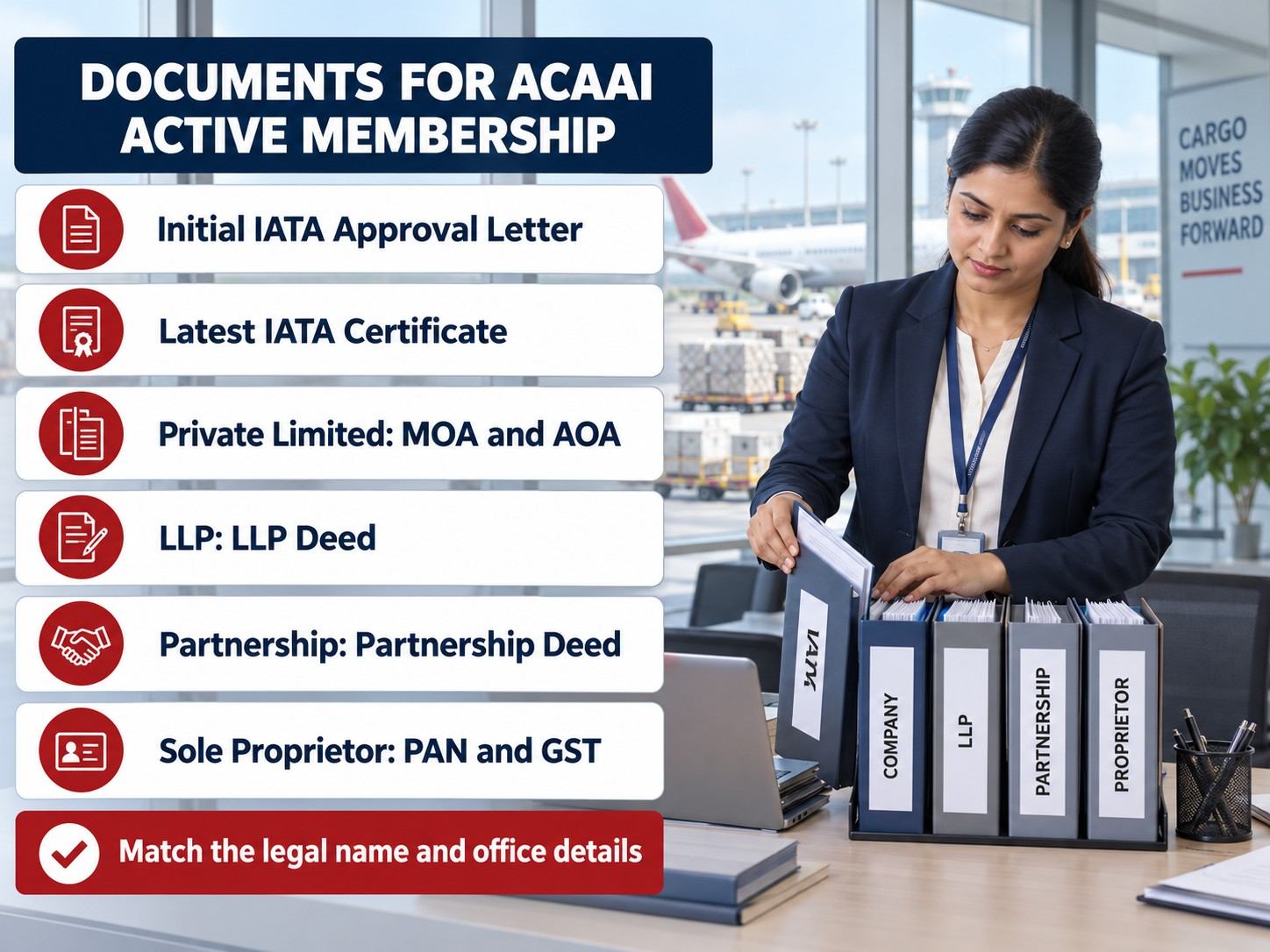
The published checklist for active membership is short, but each item must match the applying entity and office.
| Applicant type or purpose | Officially listed document |
| Proof of original IATA approval | Copy of the initial IATA Cargo Agency Registration approval letter |
| Proof of current IATA status | Copy of the latest IATA Certificate of Registration for the head office or registered office |
| Private limited company | Self-attested Memorandum of Association and Articles of Association |
| Limited liability partnership | LLP deed |
| Partnership firm | Partnership deed |
| Sole proprietorship | PAN card and GST registration certificate copies |
The questionnaire also requests GSTIN, earlier names, ownership changes after IATA approval, customs broker licence details if held, cargo activities, capital, premises, staff, training, sales, branches, bankers, guarantees, insurance and earlier applications.
Do not turn these questions into an invented universal document list. Keep supporting records ready and ask ACAAI which additional attachments it wants.
How Does the ACAAI Application Process Work?
The current process is document-led. ACAAI instructs applicants to download the applicable form and to send the completed application, along with the required documents, to its head office.
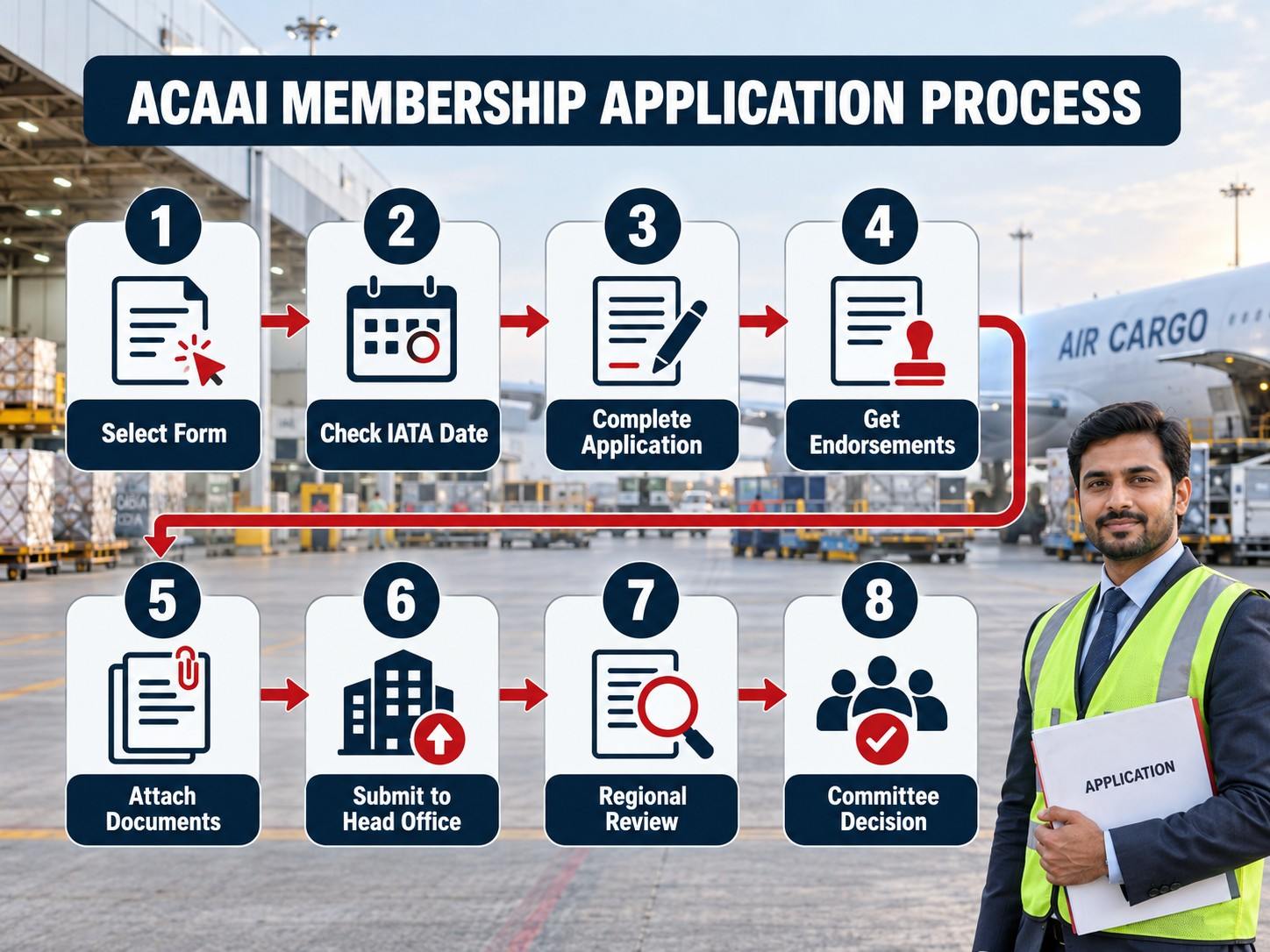
Step 1: Select the correct membership form
Identify whether the applicant is a head office, an active member’s branch or a commercial applicant. Download the corresponding form. An incorrect category raises avoidable questions about eligibility and office status.
Step 2: Check the active membership threshold
Verify the date on the initial IATA approval letter. One full year must have passed. The latest IATA certificate should name the same head office or registered office shown in the application.
Step 3: Complete the form and covenant
Answer every applicable question and mark genuinely irrelevant fields as “not applicable”. Read the covenant because it covers ACAAI rules, IATA resolutions, ethical conduct, reporting changes and dues. The authorised proprietor, partner or director should sign and seal it where required.
Step 4: Obtain the required endorsements
An active applicant needs an active-member proposer and an eligible active or associate-member seconder. Confirm each organisation’s status and signatory. The commercial form requires an active-member proposer and seconder, while the associate form uses head-office and branch certification.
Step 5: Assemble the supporting papers
Attach both IATA records and the documents applicable to the entity. Match the legal name, address and dates across every record. Explain any name or ownership change and keep approvals ready.
Step 6: Send the application to ACAAI
The official membership application page directs applicants to send the form and documents to the Hon. Secretary General at ACAAI Head Office, 28-B, Nariman Bhavan, Nariman Point, Mumbai 400021. Retain a scanned copy and delivery proof. Follow that instruction unless ACAAI confirms another submission route.
Step 7: Regional verification and recommendation
The relevant region may recommend, not recommend or defer the case and attach a confidential report. Submission does not itself create membership. Answer requests for corrections or evidence promptly.
Step 8: Await the Managing Committee’s decision
The Managing Committee may admit the applicant, decline admission or seek regional reconsideration. ACAAI publishes no guaranteed approval period. Treat unofficial timelines as estimates unless confirmed for the relevant meeting cycle.
Membership Payment Terms
ACAAI determines its membership fees and other applicable dues from time to time. Applicants should therefore confirm the current charges for their chosen membership category during the application process.
After submitting the relevant form and supporting documents, ask the ACAAI Head Office for the latest fee communication or invoice. This will help the applicant understand the applicable subscription, additional dues and payment instructions before completing the transaction.
The official Active Membership application form requires subscription fees and other dues to be paid within 30 days of receiving the invoice. Before making the payment, confirm:
- Applicable membership category
- Subscription and other charges
- GST or applicable tax treatment
- Accepted payment method
- Invoice date and payment deadline
- Terms applicable to application reconsideration or withdrawal
Applicants should retain the ACAAI communication, invoice and payment acknowledgement with their membership records. This provides a clear record of the charges accepted and payment completed during the ACAAI application process.
Processing Time, Validity, Renewal and Exit Rules
ACAAI does not publish a standard processing time for membership applications. The form shows that regional review occurs before the Managing Committee decision, so timing can depend on verification, missing information and the relevant meeting schedule. Applicants should ask for an acknowledgement and a current review estimate after delivery.
The current public material also does not state a fixed membership validity period, annual renewal date, grace period or late-payment charge. The active covenant does confirm that subscription and other dues must be paid within 30 days of invoice receipt.
Detailed resignation, cancellation, suspension, reinstatement and refund rules are not displayed on the public application page. The active covenant allows ACAAI or its Managing Committee to suspend or expel a member through decisions taken in line with natural justice. Obtain the current Articles, bye-laws and invoice terms before joining so your organisation understands the complete exit and disciplinary framework.
ACAAI Membership Benefits and Their Practical Value
ACAAI officially highlights professional assistance, industry representation, regional-office access and international network access. Its published activities also include training in job-related subjects such as basic cargo and Dangerous Goods Regulations. The association’s website carries industry news, newsletters, meetings and regional updates.
Benefits require participation. Assign a representative to monitor updates, attend meetings, use training and raise issues through the regional channel. A logo or directory entry is not a promise of enquiries, revenue, credit protection or preferred airline rates.
Evaluate the membership against specific business needs:
- Access to discussions affecting Indian air cargo operations
- Relevant training and current industry information
- Regional contact with cargo-sector participants
- Representation of shared industry concerns
- Relationships with organisations across the cargo ecosystem
Ask which benefits are included in the subscription and which events, training programmes or conventions cost extra.
ACAAI Membership is Not IATA or MTO Registration
The three credentials solve different problems. ACAAI is an industry association, IATA cargo agency registration is the stated entry condition for active ACAAI membership, and MTO registration concerns regulated multimodal transport activity.
| Credential | Main role in this context | Can ACAAI replace it? |
| ACAAI membership | Trade association participation and member support | Not applicable |
| IATA cargo agency registration | Prior credential required for active ACAAI membership | No |
| MTO registration | Separate approval for applicable multimodal transport operations | No |
An air cargo agency that also undertakes multimodal transport should assess the separate MTO registration requirements. Membership does not grant MTO status or authority to issue multimodal transport documents.
When selecting a multimodal counterparty, the registered MTO directory can help identify operators for further verification. Do not treat an ACAAI listing as proof of a separate MTO registration.
Common Reasons an Application May Be Delayed
ACAAI does not publish a formal rejection list, but its instructions and forms show where an incomplete file can stall. These are document-control risks, not unofficial admission rules.
- The active applicant has not completed one year from IATA approval
- The IATA certificate relates to a different office or an outdated legal name
- The wrong membership category or form has been used
- Required fields, dates, places, signatures or company seals are missing
- The proposer is not an active member or the wrong representative signs
- The seconder’s status and signatory authority are not correctly recorded
- The entity document does not match the applicant’s legal structure
- Ownership or name changes are disclosed without a clear supporting trail
- Prior applications, insurance, guarantees or branch details are left unanswered
Run a line-by-line check before dispatch. A clean file is easier for the regional reviewer to verify and place before the Managing Committee.
Read Also: NVOOC License
Conclusion
ACAAI Membership can give an eligible air cargo agency a structured connection with India’s national cargo association, but a well-prepared application begins with the correct distinction. Active membership requires at least one completed year of IATA cargo agency registration and applies to the head office or registered office. Branches follow the associate route, while commercial applicants should confirm their category directly.
Check the official documents, endorsements and disclosures carefully. Exact fees, timing, validity, renewal and refund rules are not publicly disclosed, so obtain them in writing before payment.
FAQs About ACAAI Membership
What should I do if the IATA letter shows the company’s old name?
Disclose the earlier name in the active application because the form specifically asks about name changes. Attach or keep ready the corporate name-change record and any corresponding IATA confirmation so the reviewer can connect the old approval with the current entity. Ask ACAAI in writing which supporting documents it wants before dispatching the file.
Can I apply after a change in ownership following IATA approval?
The active form asks whether ownership changed after IATA approval and whether IATA approved that change. It does not state that every ownership change automatically blocks ACAAI Membership. Give complete details and include the relevant IATA approval evidence rather than leaving the reviewer to reconcile the change.
Is a customs broker licence compulsory for active membership?
The active application asks whether the applicant holds a customs broker licence and requests its number, issue date and validity if the answer is yes. ACAAI’s published active eligibility rule, however, is based on at least one year of IATA cargo agency registration. Do not claim a licence you do not hold and ask ACAAI if your operating model needs any additional evidence.
Must the office and warehouse premises be owned?
The active form asks whether the office and warehouse are rented or owned and requests their areas. The public eligibility notes do not state that ownership is compulsory. Report the actual arrangement and keep reliable occupancy records ready if the regional reviewer asks for verification.
Is there a published minimum annual air cargo turnover?
The active questionnaire requests international and domestic gross air cargo sales for the last financial year. ACAAI’s public eligibility page does not publish a minimum turnover threshold for active applicants. Provide accurate figures from your records and avoid inserting an estimated amount merely to complete the form.
Are two cargo-trained and two DGR-trained employees mandatory?
The active form asks about two people holding an IATA or FIATA introductory diploma or equivalent course and two people holding valid recognised DGR training certificates. The public membership notes do not separately label these questions as fixed admission thresholds. Answer accurately, list the trained employees where applicable and obtain ACAAI’s written view if your staffing pattern does not match the questionnaire.
Does the applicant need cargo or forwarder’s liability insurance?
The active form asks about cargo insurance or forwarder’s liability cover. The published eligibility notes set no minimum policy amount or universal insurance condition. Disclose the actual cover and review separate MTO insurance requirements if your operations include regulated multimodal transport.
Can a previous unsuccessful applicant apply again?
The active and associate questionnaires ask whether the applicant has previously applied and request details of the earlier application. They do not publish a permanent bar on reapplication. Give the earlier date, outcome and any corrections made, then ask ACAAI if it requires a waiting period or further documents in the particular case.
Will ACAAI membership itself bring cargo enquiries?
ACAAI officially offers representation, guidance, regional access and network connections, but its public material does not promise leads or revenue. The practical return depends on the company’s participation, service quality and ability to build relationships. Assess the fee against the benefits your team will actively use, not an assumed volume of nominated shipments.
Must a member report later changes to its business?
Yes, the active-member covenant requires the member to inform ACAAI of a change in status, constitution or corporate character within 30 days of the change taking effect. The form also requires compliance with applicable ACAAI decisions and rules. Keep the head office informed and retain proof of each notification sent.
You may also like
NVOCC License in India: Know What You Actually Need
Searching for an NVOCC License in India often leads to one confusing assumptio