
Consol Agent Registration allows an eligible freight intermediary to operate under India’s Sea Cargo Manifest and Transhipment Regulations through ICEGATE. For a consol agent, freight forwarder, NVOCC or customs broker, the SCMTR entity type is Authorised Notified Carrier, identified by the code ANC. Approval matters when the business wants to submit house-level cargo information as a Cargo Summary Notification and pass the accepted reference to a consolidator or vessel operator.
This guide explains the correct role, eligibility, documents, ₹5 lakh bond and security, ICEGATE application sequence, validity, amendments and checks needed before filing. It also identifies issues that commonly delay approval or disrupt cargo linkage later.
What is Consol Agent Registration Under SCMTR?
Consol Agent Registration is the trade-facing name for authorisation that lets an eligible consolidator transact under SCMTR. The current ICEGATE SCMTR guidance maps a consol agent to the Authorised Notified Carrier role, or ANC. ICEGATE material sometimes spells the trade role as “Consol Agent”, but the function concerns cargo consolidation.
An ANC can submit its part of the cargo declaration as a Cargo Summary Notification. The accepted reference can be used by the next consolidator or vessel operator when building the sea manifest. The Authorised Sea Carrier or Authorised Sea Agent remains responsible for the vessel-level manifest.
A registered forwarder can send house bill data directly to Customs instead of relying entirely on the vessel operator. Registration does not prove that a CSN was accepted, linked correctly or filed before the cut-off.
Who Issues Consol Agent Registration in India?
Consol Agent Registration is submitted through ICEGATE and examined by the proper Customs officer under the jurisdictional Commissioner of Customs selected in the application. ICEGATE provides the online filing and communication channel, while Customs approves.
Registration granted at one Customs station is deemed valid at other Customs stations. However, the selected station remains responsible for verification, application queries, security documents and regulatory action.
ANC, CSN, PCIN and MCIN: Know the Difference
These terms describe different parts of the SCMTR chain and should not be used interchangeably.
|
Term |
Meaning for a consol agent |
|
ANC |
The SCMTR entity role for other notified carriers, including consol agents, freight forwarders, NVOCCs and eligible customs brokers |
|
CSN |
The Cargo Summary Notification containing cargo details linked to a transport document such as a bill of lading |
|
PCIN |
The Primary Cargo Identification Number for cargo covered by one transport document and, for exports, cargo under one shipping bill |
|
MCIN |
The Master Cargo Identification Number created for multiple cargoes grouped under a consolidated bill of lading |
|
SAM or SDM |
The vessel-level sea arrival or departure manifest filed by the authorised sea carrier or sea agent |
A CSN is not the final vessel manifest. It supplies cargo information that can be referenced in the next declaration, preserving responsibility across the house bill, master bill and vessel levels.
Is CSN Self-Filing Mandatory for Every Consol Agent?
No. SCMTR allows a registered ANC to file house-level cargo information through a Cargo Summary Notification, but self-filing is not compulsory in every shipment arrangement. The vessel operator may file the CSN when it possesses the complete transport-document information.
When the consol agent files independently, it must receive a successful ICEGATE acknowledgement and pass the accepted CSN or Cargo Identification Number to the next consolidator or vessel operator. Filing a CSN does not transfer responsibility for the vessel-level Sea Arrival Manifest or Sea Departure Manifest to the ANC.
Who Should Apply for Consol Registration in India?
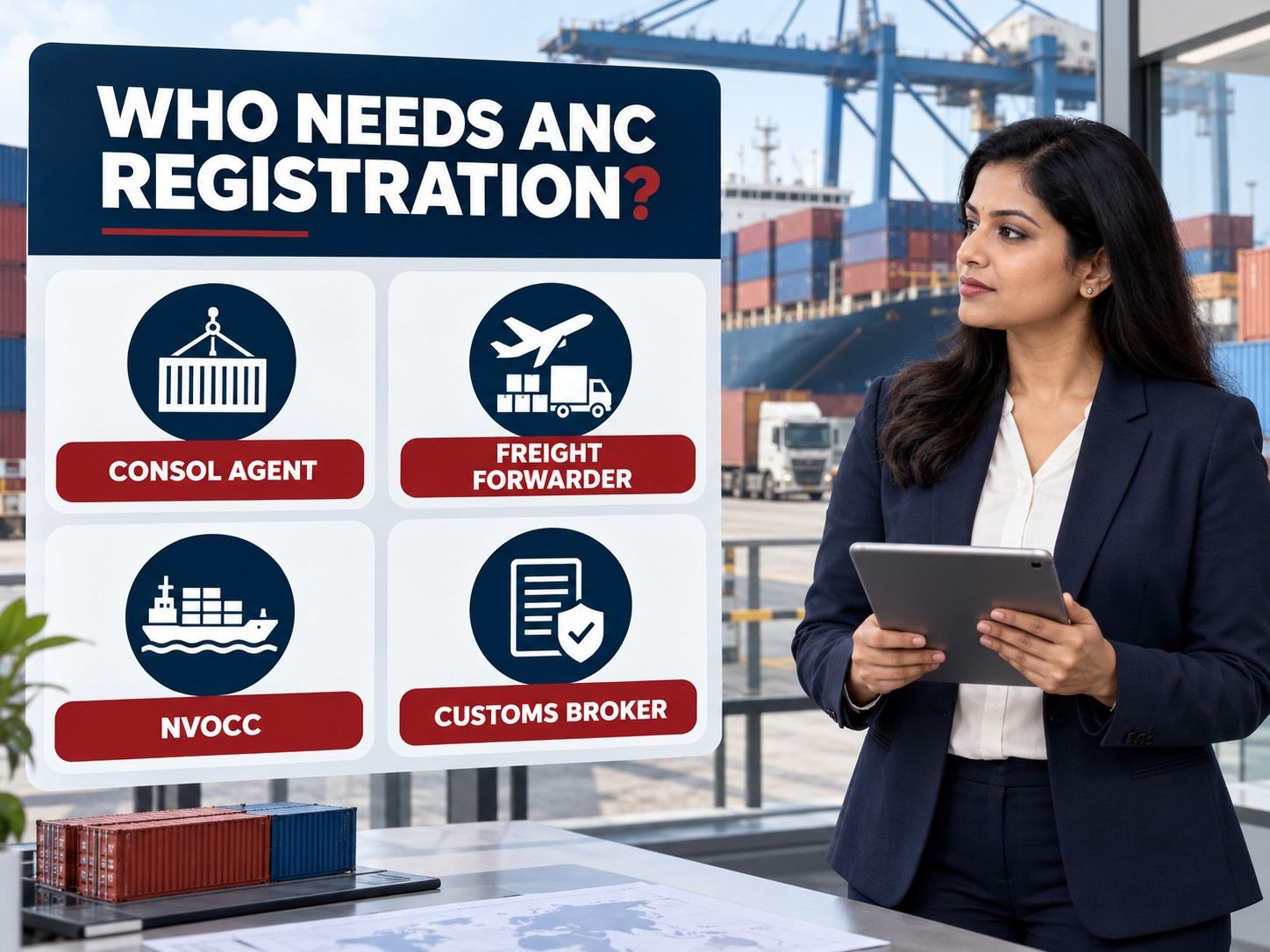
The ANC mapping covers a consol agent, freight forwarder, NVOCC or customs broker in the transport-document chain. Official guidance refers to persons who are parties to a bill of lading and issue a delivery order. The applicant needs the appropriate ICEGATE registration before SCMTR approval.
A business should consider ANC registration when it intends to:
-
Issue or manage house bills under a consolidated master bill
-
Submit house-level cargo data directly as a CSN
-
Receive and pass accepted CSN or cargo identification references
-
Reduce dependence on another party for entering its transport-document data
-
Maintain a direct audit trail for its SCMTR declarations
Consol registration is role-specific. A shipping line uses ASC, a shipping agent ASA, a custodian ACU, and a transhipper ATP. ANC does not grant those roles.
What Consol Agent Registration Does Not Replace
An ANC approval permits transactions assigned to that SCMTR role. It does not authorise every activity that a logistics company may advertise.
Moving goods under one multimodal transport contract is separate from ANC registration. A company acting as a multimodal transport operator should examine the applicable MTO registration requirements independently. Businesses looking for operating partners can also review the registered MTO company directory and verify the selected operator’s current certificate before agreeing.
Air cargo accreditation remains separate from Consol Agent Registration. A freight company handling airline cargo should review the applicable IATA registration requirements based on its services. Vessel chartering and permissions involving foreign-flagged vessels are also independent matters, as explained in the foreign vessel chartering guide.
Eligibility and Pre-Application Requirements
SCMTR does not publish a turnover threshold or minimum operating history for ANC approval. The application centres on entity data, authorised people, operations, Customs history and Regulation 3 security.
Before opening the SCMTR form, the applicant should have:
-
An ICEGATE parent or master registration in the correct existing role
-
The entity’s legal name, PAN, registered address and GSTIN aligned across records
-
A chosen port or Customs station of registration
-
Authorised people who are registered with ICEGATE and can be added to the application
-
Accurate branch or operation details, including GSTIN and location coordinates where requested
-
A valid Digital Signature Certificate for signing supporting PDFs and electronic submissions
-
The applicable Form XI bond and security arrangement, or evidence supporting an exemption
Documents Required for ICEGATE Consol Registration
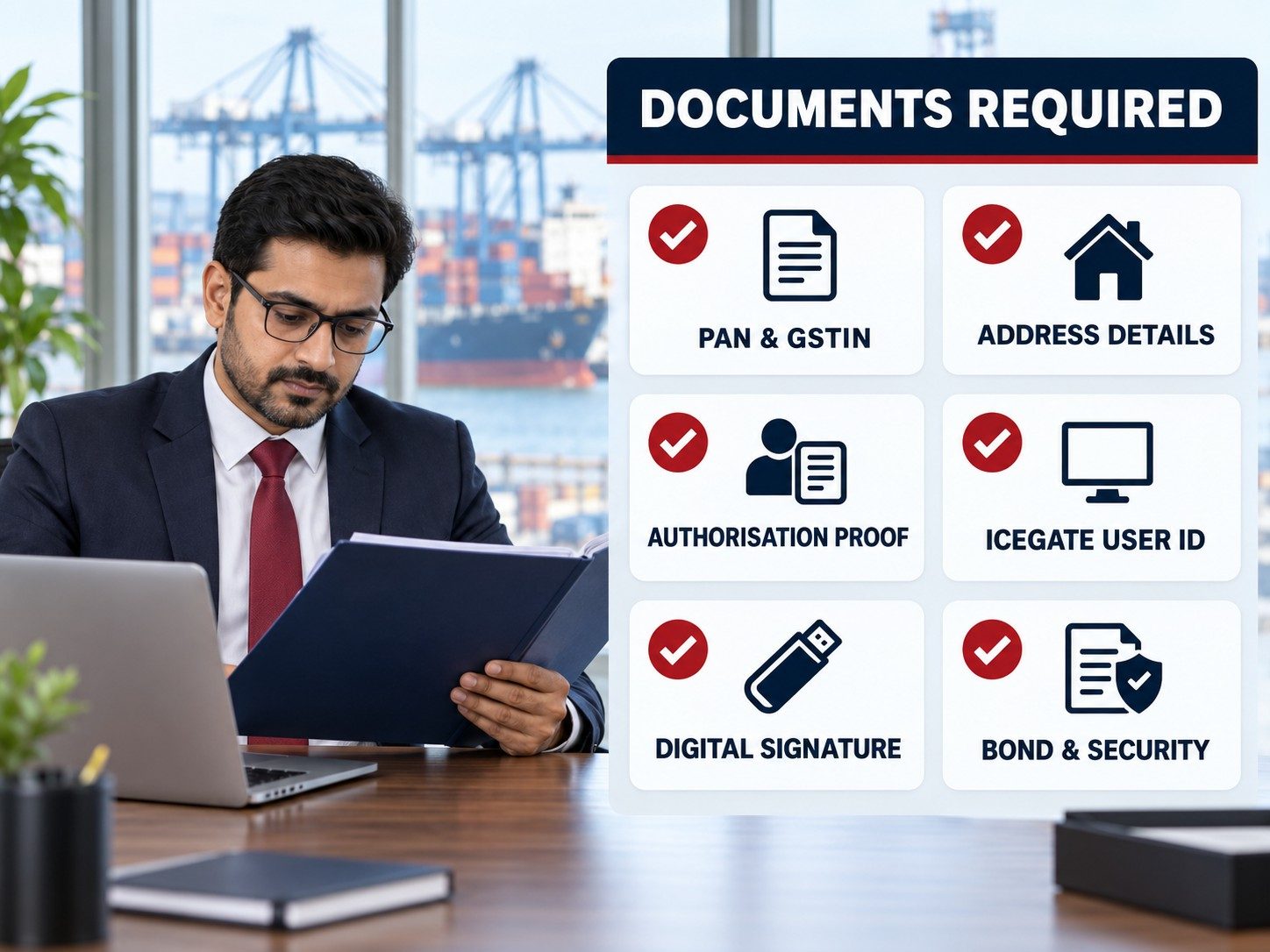
Upload prompts depend on the entity profile and live ICEGATE form. The following items come from Form I and official registration guidance.
|
Document or information |
What must be checked |
|
Entity PAN and legal details |
Name and PAN must match the ICEGATE profile and supporting records |
|
Registered address and GSTIN |
Address, state, postcode and GSTIN should be consistent |
|
Authorisation evidence |
Board resolution, authority letter or other proof showing who may act for the entity |
|
Authorised-person records |
Personal PAN, date of birth, address, contact details, ICEGATE ID and accepted identity proof |
|
Operations details |
Operation type, PAN-based commercial code for a consol agent, GSTIN and geographical coordinates |
|
Customs-case declaration |
Details of cases booked, or the prescribed self-declaration where no case exists |
|
Contract, MoU or agreement |
Form I refers to the relevant arrangement with a foreign authorising agent where applicable |
|
Bond and security evidence |
Form XI bond, financial-security instrument, or evidence supporting the permitted exemption |
ICEGATE identifies document code 022CO1 for the Customs-cases declaration. PDFs must meet the file size and format limits and be digitally signed. Always check the current upload screen.
Consol Agent Registration Process on ICEGATE
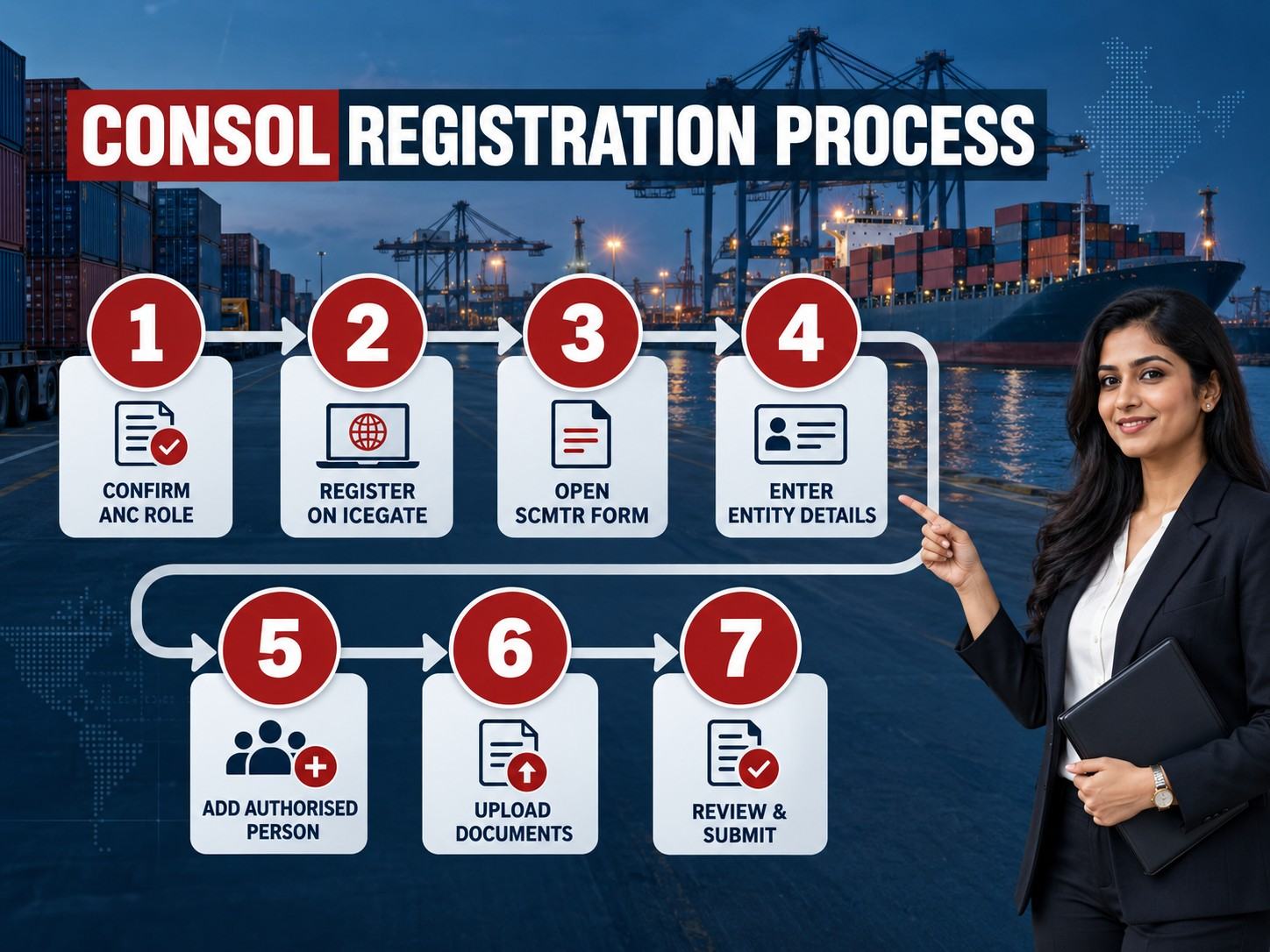
Below are the steps for the consol agent registration process:
Step 1: Confirm the ANC Role
Check the activity the business will perform and the existing ICEGATE role. Consol agents, freight forwarders, NVOCCs and customs brokers are mapped to ANC for SCMTR purposes. Do not choose ASC or ASA merely because the business works with a shipping line.
Step 2: Complete ICEGATE User Registration
Obtain the parent or master ICEGATE ID before starting the application. Each authorised individual should also hold the appropriate ICEGATE user registration. Verify mobile and email details because queries appear through the account.
Step 3: Open the SCMTR Registration Form
Log in and open the SCMTR enablement or registration option. The portal may prefill profile information. Verify every entry.
Step 4: Enter Entity and Operation Details
Choose the port of registration and confirm the entity name, PAN, address, GSTIN and contact details. Add each authorised operation separately. For the consol-agent operation, the commercial code is the entity PAN, while the GSTIN and location data must correspond to that operation.
Step 5: Add Authorised People
Enter each authorised person’s ICEGATE ID, personal PAN, identity details and contact information. Upload the identity and authority evidence requested by the form. A person’s data should match the ICEGATE profile because a mismatch may trigger a jurisdictional query.
Step 6: Upload Signed Supporting Documents
Attach the Customs-case declaration and the other evidence applicable to the entity. Use the document codes, PDF limits and digital-signing function shown on the live portal. Confirm that each attachment is legible and connected to the correct entity, operation or authorised-person section.
Step 7: Review and Submit the Application
Compare the preview with PAN, GSTIN, address, authorisation and bond records. Submit it to the jurisdictional officer. The officer may approve, reject or query the file, so monitor the dashboard and respond accurately.
Current Fee Position and Financial Security
Official ICEGATE material reviewed for this article states no separate ANC application fee. The main financial requirement is Regulation 3(1A) security, not a purchase price for approval.
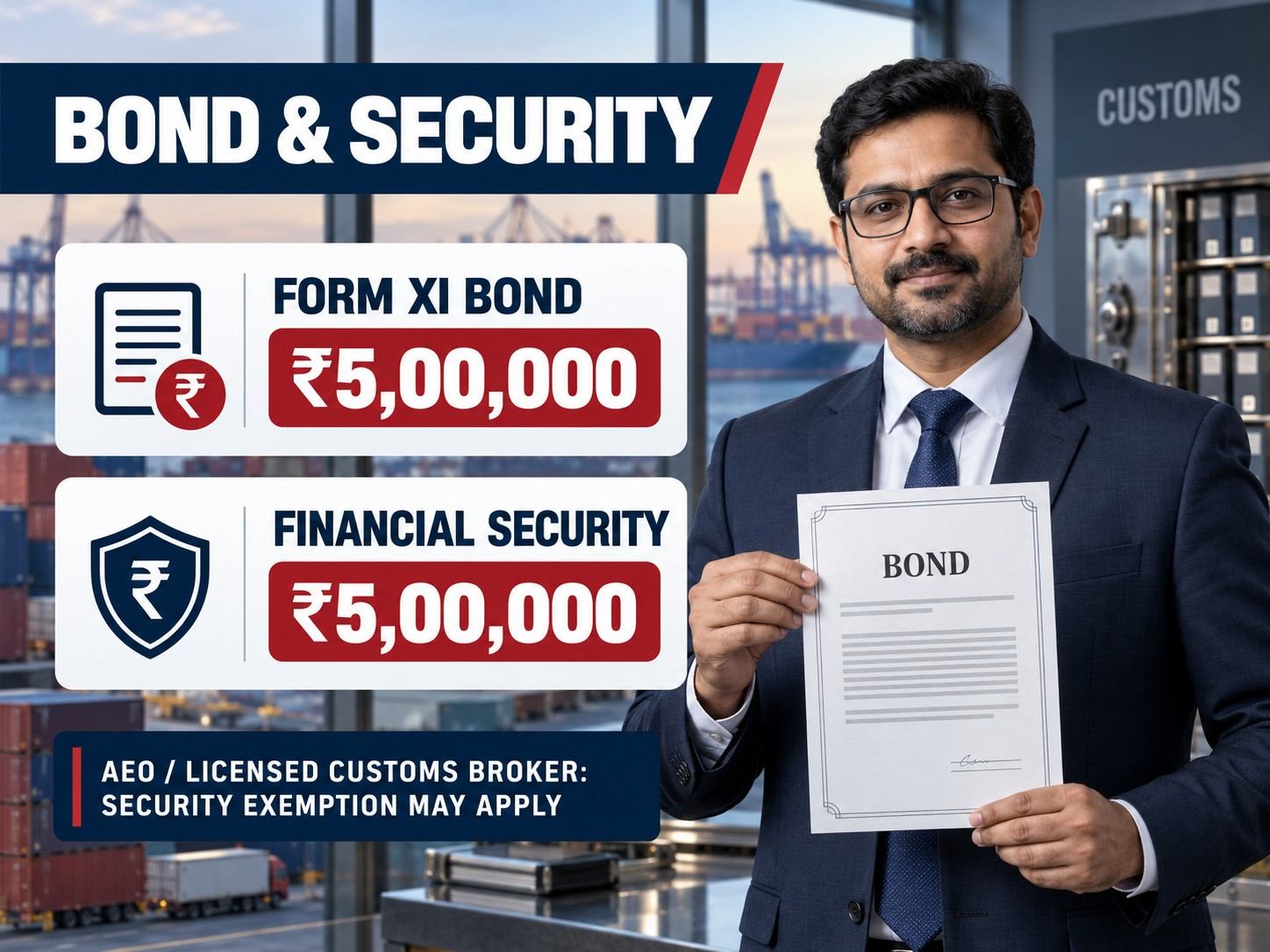
Official Customs guidance on ANC registration records ₹5,00,000 for the Form XI bond and the corresponding bank guarantee, postal security, National Savings Certificate or fixed deposit receipt. The instrument must be in the Commissioner of Customs’ name as prescribed.
|
Payment or obligation |
When applicable |
Verified official position |
|
SCMTR application fee |
At online application |
No separate amount is publicly stated in the official material reviewed |
|
Form XI bond |
With registration under Regulation 3(1A) |
₹5,00,000 bond obligation |
|
Financial security |
With the bond where the exemption does not apply |
₹5,00,000 through an accepted instrument |
|
AEO or customs-broker exemption |
When the applicant meets the stated category |
Exemption applies to the fresh financial-security instrument, not automatically to every registration requirement |
|
Bank or documentation charges |
When arranging an instrument or executing documents |
Not fixed by CBIC and must be obtained in writing from the provider |
An entity holding AEO registration in India and a customs broker licensed under the Customs Brokers Licensing Regulations, 2018 may receive the stated exemption from providing a fresh security instrument. The exemption does not remove the requirement to obtain the correct SCMTR role or comply with filing obligations.
Where a bank-backed instrument is required, the bank guarantee process guide can help the applicant understand the banking arrangement. However, acceptance of the instrument for SCMTR registration remains subject to Customs requirements.
No standard refund schedule for bank charges is published in the official material reviewed. Obtain the provider’s charges, margin, expiry and cancellation terms in writing. Customs directions govern security acceptance and release.
Processing Period, Validity and Renewal
ICEGATE does not publish a guaranteed approval period for Consol Agent Registration. Timing depends on completeness, officer verification and query responses. A promised approval date is not an official timeline.
Registration under Regulation 3 is initially valid for three years from issue. The jurisdictional Commissioner reviews it before expiry and may extend it for five years at a time. For an AEO, the extension may be for ten years.
Track the certificate, security, DSC, authorised users and contacts before expiry. No universal online renewal checklist is published for every ANC profile, so follow the current dashboard and jurisdictional instructions.
Getting Ready for CSN Filing After Approval
Approval does not prepare shipment data automatically. Test the current message structure and set a cut-off before handling live cargo.
Build a House-to-Master Data Check
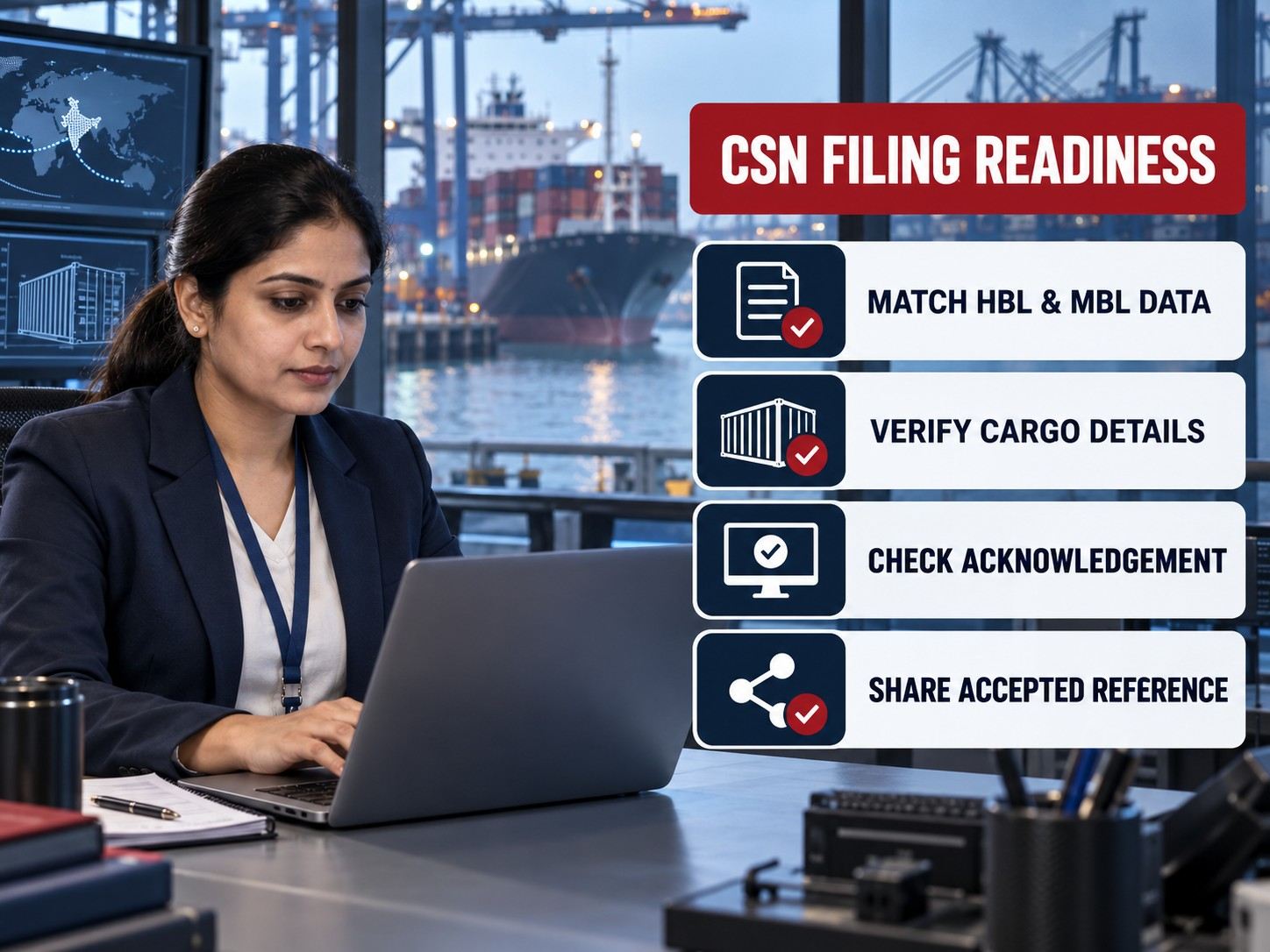
Match house and master bill details before filing. Check voyage, ports, party identifiers, goods, packages, weight, containers and every mandatory field. A valid value can still fail when it conflicts with carrier data.
File and Read the Acknowledgement
Submit and digitally sign the CSN through a supported ICEGATE mode. Read the acceptance or error acknowledgement before passing a CSN number to the carrier.
When Should the CSN Be Filed?
The ANC should submit the CSN early enough to receive a successful ICEGATE acknowledgement and provide the accepted reference to the next consolidator or vessel operator before its manifest cut-off. Carrier or port cut-offs may be earlier than the applicable regulatory milestone, so obtain the operational timeline in writing.
An upload receipt or error acknowledgement should not be treated as an accepted filing. Pass the CSN or Cargo Identification Number only after ICEGATE confirms successful processing.
Control Amendments
Control changes to bill numbers, party identifiers, packages, weight and containers. Once a manifest uses the reference, a correction can affect more than the original CSN.
Companies undertaking multimodal carriage should align declaration controls with their MTO insurance obligations. Insurance does not replace accurate SCMTR filing.
Common Reasons for Delay or Filing Failure
Most avoidable problems begin with inconsistent identity data or an incomplete setup.
-
Wrong entity role: The applicant chooses a carrier or agent role that does not match its transport-document function.
-
PAN or GSTIN mismatch: The legal name, PAN, address, or GSTIN differs between ICEGATE, the application and uploaded proof.
-
Unregistered authorised person: A proposed signatory has no usable ICEGATE ID or their personal details do not match.
-
Invalid attachment: A PDF exceeds the portal limit, is unreadable, lacks a digital signature or is tagged to the wrong section.
-
Missing Customs declaration: The applicant omits case details or the prescribed no-case declaration under document code 022CO1.
-
Security record problem: The bond, financial instrument or exemption evidence is missing, expired or not recognised by the jurisdictional office.
-
Unanswered officer query: The dashboard is not monitored, or the reply does not correct the underlying mismatch.
-
No filing test: Approval is obtained, but the team has not tested the current CSN message, DSC or acknowledgement workflow.
-
House-master inconsistency: Bill numbers, packages, weights, identifiers or container details differ from the carrier’s records.
Keep one controlled entity master and a separate shipment checklist. This reduces reuse of old attachments or shipment values.
Amendment, Suspension and Cancellation Rules
ICEGATE permits amendment of a submitted SCMTR application. The registration guidance states that entity type and entity PAN cannot be changed through the amendment option. A fundamental change to either field may therefore require directions from Customs rather than an ordinary profile edit.
The jurisdictional Commissioner may revoke registration for SCMTR non-compliance. Another station’s Commissioner may suspend local operations on reasonable revenue grounds. The regulations provide a hearing and revocation procedure.
An authorised carrier’s contravention can attract a penalty of up to ₹50,000 under Regulation 13. This is separate from the ₹5 lakh bond or security. Errors can also delay or disrupt manifest linkage.
Voluntary Surrender of ANC Registration
Official public guidance does not prescribe one universal online surrender process for every ANC. A business discontinuing its notified activity should write to the jurisdictional Commissioner for directions concerning registration closure, pending declarations and release of the security instrument. Inactivity should not be treated as automatic cancellation.
Conclusion
Consol Agent Registration is the SCMTR route for an eligible consolidator, freight forwarder, NVOCC or customs broker needing the ANC role. Match ICEGATE, PAN, GSTIN, user, operation and security records. After approval, test CSN messages, control acknowledgements and coordinate with the vessel operator.
Registration enables a role. It does not replace other permissions or prove that a cargo declaration is accurate. Use verified house and master data, current ICEGATE instructions and shipment cut-offs.
FAQS
FAQs About Consol Agent Registration
-
What file format should an ANC use for an SCMTR declaration?
SCMTR message specifications use JSON for electronic declarations. The ANC should build its file against the current ICEGATE message implementation guide and applicable CSN schema, rather than copying an old sample unchanged. Passing a format check does not confirm that shipment facts or carrier references are correct.
- Does ICEGATE acknowledge every CSN submission?
- Who acts as the sea carrier under a vessel-sharing arrangement?
- Does consol registration need to be taken at every Indian port?
- What happens if two parties submit the same house bill details?
- Can the PAN or ANC entity type be changed after submission?
- Is the ?5 lakh amount a Consol Agent Registration fee?
- Does a licensed customs broker need a fresh ?5 lakh bank guarantee?
- How long does ICEGATE take to approve ANC registration?
- Can Customs suspend or cancel an ANC registration?


