
GST Revocation: Complete Guide to Restore a Cancelled GSTIN
GST Revocation is how you restore a GST registration that a tax officer cancelled on their own. You file Form GST REG-21 within 90 days of the cancellation order, after clearing pending returns and dues. If the officer approves it, your GSTIN becomes active again through Form GST REG-22.
One day your GSTIN works fine. The next day it's cancelled, and you can't raise an invoice or claim input tax credit. This happens more often than people expect, usually after a few missed GST returns pile up. GST Revocation is the legal fix for this exact situation.
This isn't a request you can send in casually. It runs on strict deadlines, mandatory return filing, and a form that needs to be filled correctly the first time. This guide covers who can apply for GST Revocation and the documents you need. It walks through the exact steps on the GST portal, and what to do if your application gets rejected.
What Is GST Revocation and When Do You Need It?
GST Revocation is the process of reversing a GST cancellation order. It's governed by Section 30 of the CGST Act, 2017. Rule 23 of the CGST Rules sets out the procedure. You apply using Form GST REG-21 on the GST portal.
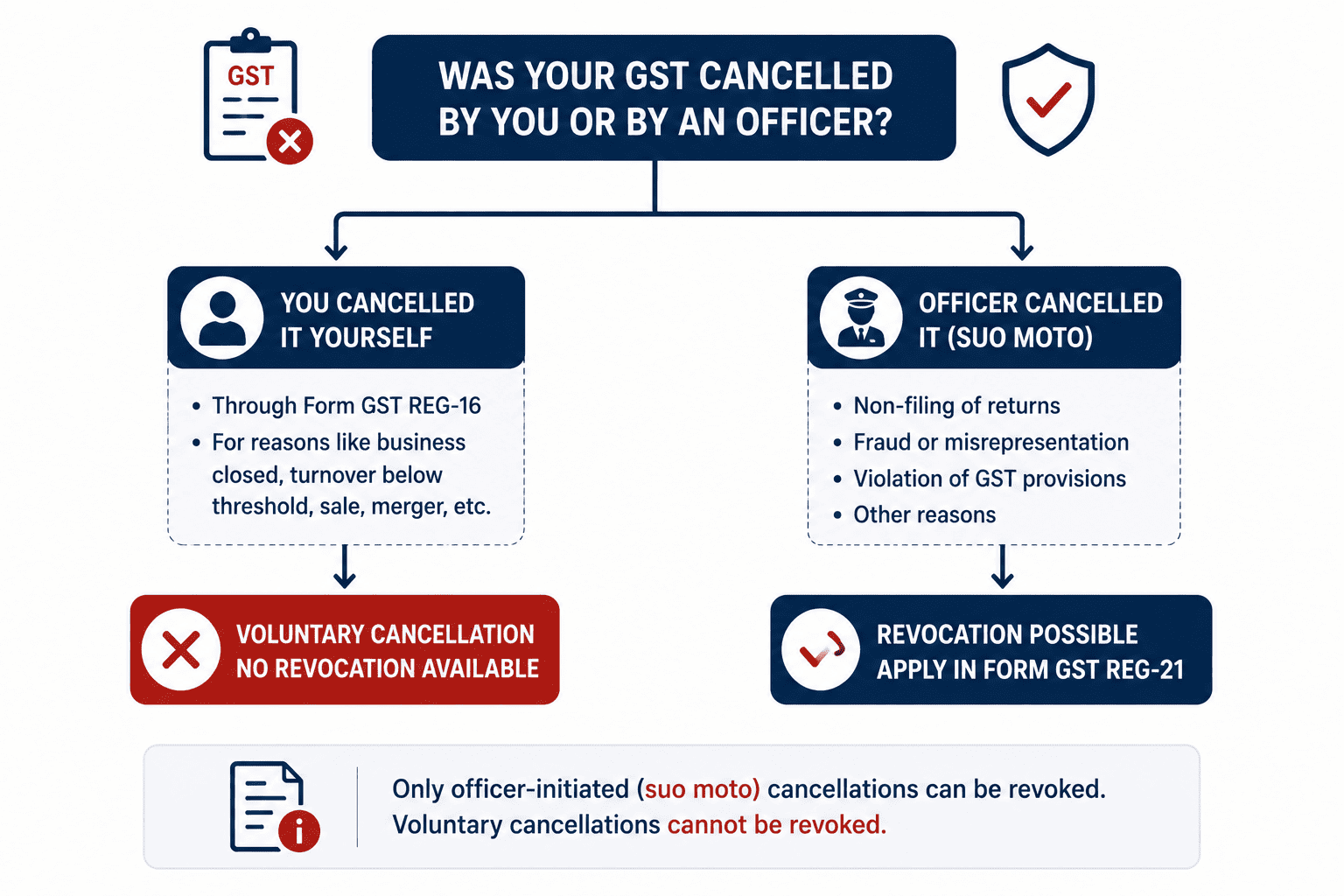
Here's the part most people miss. GST Revocation only applies when a tax officer cancelled your registration on their own initiative. This is called a suo moto cancellation. If you cancelled your own GST registration voluntarily, through Form GST REG-16, you cannot use revocation to reverse it. You would need a fresh registration instead.
Officers usually cancel registration suo moto for reasons like these:
-
Not filing GST returns for six straight tax periods (three periods for composition taxpayers)
-
Not conducting any business from the declared place of business
-
Issuing invoices or bills without an actual supply of goods or services
-
Violating anti-profiteering provisions
-
Obtaining registration through fraud or wilful misstatement
Here's an example. Suresh runs a small trading firm in Bhopal. He fell behind on his GSTR-3B filings for seven months while dealing with a family emergency. The GST officer issued a show-cause notice, and when Suresh didn't respond in time, the department cancelled his registration. Once he was back on his feet, he filed every pending return, cleared his dues, and applied for GST Revocation. His GSTIN came back active within a few weeks.
Who Is Eligible for GST Revocation?
Not every cancelled GSTIN qualifies. Eligibility depends heavily on why and how the registration was cancelled.
|
Reason for Cancellation |
Type |
Can You Revoke It? |
|
Non-filing of GST returns |
Officer-initiated (suo moto) |
Yes |
|
Fraud or misrepresentation |
Officer-initiated |
Yes, with strong justification |
|
Violation of GST provisions |
Officer-initiated |
Yes |
|
Business permanently closed |
Voluntary (REG-16) |
No |
|
Turnover fell below threshold |
Voluntary (REG-16) |
No |
|
Business sold, merged, or transferred |
Voluntary (REG-16) |
No |
Beyond the cancellation type, a few other conditions apply:
-
You must not hold another active GST registration for the same business on the same PAN.
-
All pending GST returns, up to the date of cancellation, must be filed first.
-
All outstanding tax, interest, penalty, and late fees must be paid before you apply.
-
If the department cancelled your registration for fraud, you'll need solid documentary proof to support your case.
What Documents Do You Need for GST Revocation?
Getting your documents in order before you start saves you from a clarification notice later.
|
Document |
Why It's Needed |
|
Copy of the GST cancellation order |
Confirms the order you're asking to reverse |
|
Written explanation or justification letter |
States why the cancellation should be revoked |
|
Proof of all pending returns filed |
Shows compliance is now current |
|
Proof of tax, interest, and late fee payment |
Confirms no dues remain outstanding |
|
PAN of the business or proprietor |
Identity verification |
|
Aadhaar of the authorised signatory |
Mandatory for authentication since January 2022 |
|
Cancelled cheque or bank account proof |
Confirms active banking details on record |
A tip worth remembering: officers reject far more revocation applications for incomplete return filing than for any other reason. Before you touch Form GST REG-21, log in and check every single return from the cancellation date backward. One missed quarter is enough to stall the whole application.
What Is the Time Limit for Filing GST Revocation?
Timing is the single biggest factor that decides whether your application even gets considered.
|
Stage |
Timeline |
|
Standard filing window |
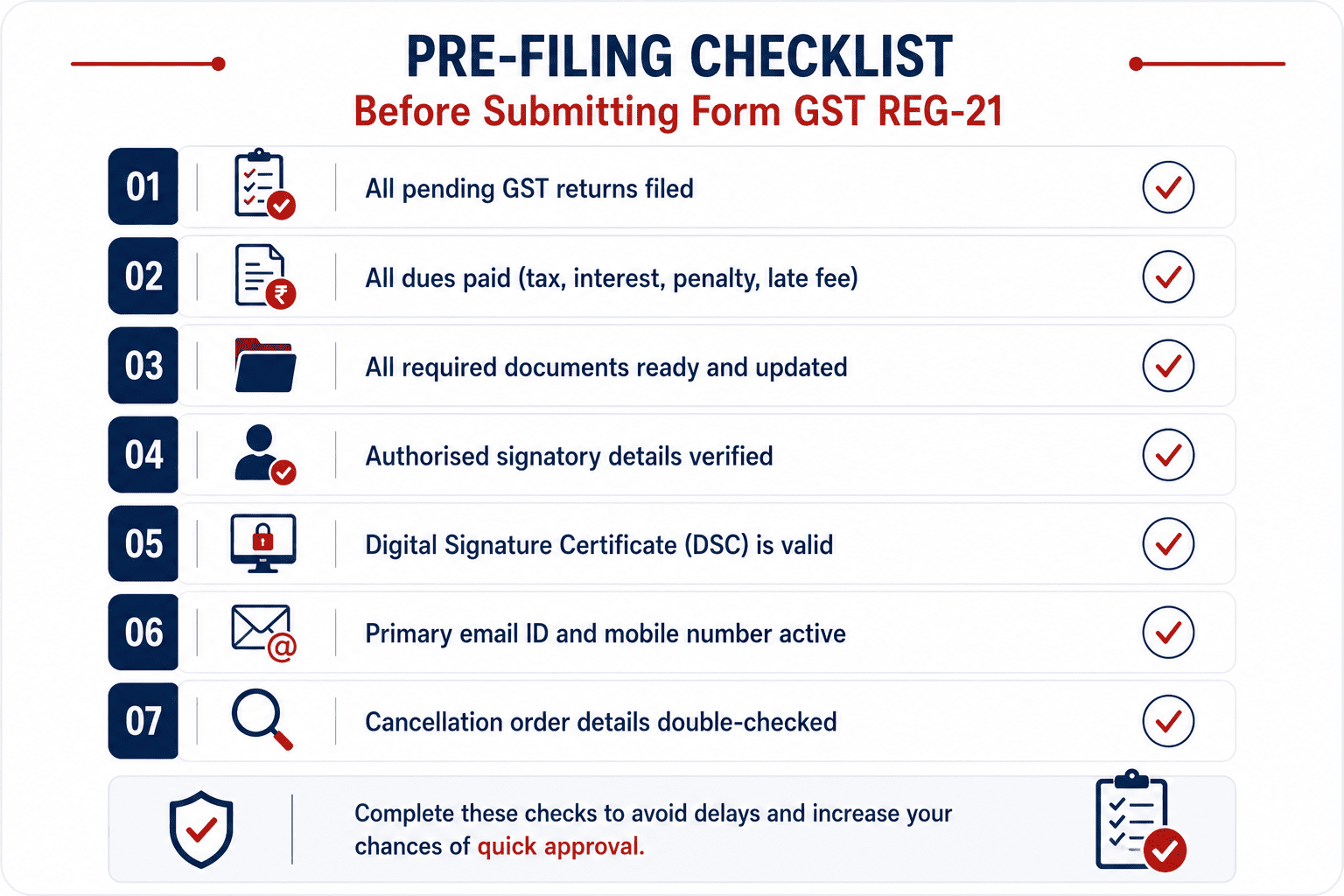
Within 90 days of the cancellation order |
|
Extension by Additional/Joint Commissioner |
Up to a further 180 days, on valid grounds |
|
Extension by Commissioner |
Up to a total of 270 days, on valid grounds |
|
Officer's decision (if satisfied) |
Within 30 days of receiving your application |
|
Officer's clarification notice (if any) |
Form GST REG-23 |
|
Your reply to that notice |
Within 7 working days, via Form GST REG-24 |
|
Officer's final decision after your reply |
Within 30 days of receiving your reply |
This 90-day window is the current rule, effective from 1 October 2023, up from the original 30-day limit. Past 270 days, Section 30 generally stops being an option. At that point, you have three realistic paths. Apply for a fresh GST registration. File an appeal. Or wait for a future amnesty window, if the government announces one. The government has run one-time amnesty schemes for revocation before. The most recent one closed on 30 June 2023. No such scheme is active right now. Always check the GST portal directly before assuming an extended deadline applies to you.
How Do You File GST Revocation Online?
Filing Form GST REG-21 involves more prep work than most GST forms. That's because your compliance has to be fully current before the portal even lets you submit.
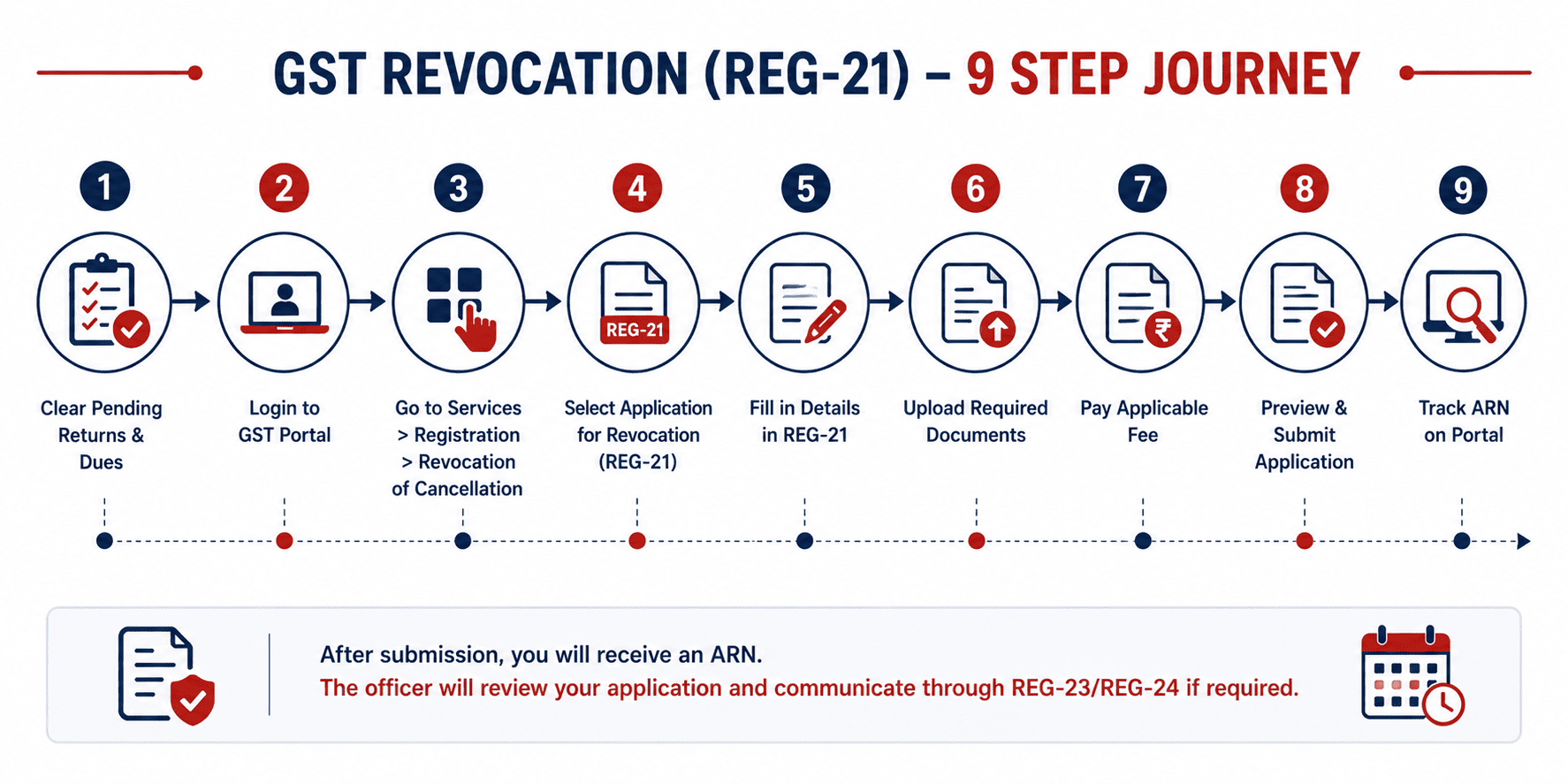
Step-by-Step GST Revocation Process
-
Clear every pending return first. File all GSTR-1 and GSTR-3B returns due up to the cancellation date. The portal blocks REG-21 submission if this isn't done.
-
Pay all outstanding dues. Settle any pending tax, interest, penalty, or late fee before you proceed.
-
Log in to the GST portal at www.gst.gov.in using your GSTIN and password. Yes, you can still log in even after cancellation, specifically to file this application.
-
Go to Services, then Registration, then "Application for Revocation of Cancelled Registration."
-
Fill Form GST REG-21 with the reason for revocation and any supporting details.
-
Upload your documents, including the cancellation order and proof of return filing.
-
Complete Aadhaar authentication for the authorised signatory, along with DSC or EVC verification.
-
Submit the application and note your ARN (Application Reference Number) for tracking.
-
Track your status under Services, then Registration, then Track Application Status.
Here's something most guides leave out. You can still access the GST portal to file this specific application. This holds even though your GSTIN shows as cancelled everywhere else. That confuses a lot of taxpayers, who assume a cancelled account means no portal access at all.
What Happens After You Submit the Revocation Application?
Once your ARN is generated, the ball moves to the officer's court.
-
Officer reviews your application. They check your return filing history, your payment record, and your stated reason for revocation.
-
If satisfied, they approve it. You'll receive Form GST REG-22, and your GSTIN goes back to active status.
-
If not satisfied, they issue Form GST REG-23. This is a show-cause notice asking why your application shouldn't be rejected.
-
You reply within 7 working days. File Form GST REG-24 with a clear explanation and any extra documents the officer needs.
-
The officer decides again. Based on your reply, they either approve it through Form GST REG-22 or reject it through Form GST REG-05, stating their reasons.
How Is GST Revocation Different from Getting Cancellation Proceedings Dropped?
This trips up a lot of taxpayers, so it's worth spelling out clearly.
Say your registration is still active. An officer has issued a show-cause notice proposing cancellation. That's an earlier stage entirely. You reply to that notice using Form GST REG-18. The officer may accept your explanation. Or you file your pending returns and clear dues in time. Either way, the officer drops the cancellation proceedings using Form GST REG-20. Your GSTIN never actually stops working.
GST Revocation only comes into play after cancellation has already happened. That means the officer has already issued the final cancellation order through Form GST REG-19. At that point, REG-18 and REG-20 aren't available to you anymore. Your only route back is Form GST REG-21 under Section 30.
Knowing which stage you're in matters more than people realise. Responding with the wrong form is a common trap. So is missing the REG-18 window because you assumed you'd deal with it "later" through revocation. Either mistake can turn an easy fix into a much harder one.
What Happens If Your GST Revocation Is Rejected?
A rejection through Form GST REG-05 isn't automatically the end of the story.
-
File an appeal with the Appellate Authority under Section 107 of the CGST Act, generally within 3 months of the rejection order, with a possible 1-month condonation if you can show sufficient cause for the delay.
-
Escalate further if needed. If the appeal is also rejected, the next options are the GST Appellate Tribunal or the High Court, depending on your case.
-
Apply for a fresh GST registration if reviving the old GSTIN is no longer realistic. This is often the more practical route once too much time has passed.
Are you dealing with a rejection order or a REG-23 clarification notice? A properly drafted GST notice reply makes a real difference here. A rushed, informal reply to REG-23 is one of the most common reasons genuine revocation cases get rejected.
What Happens to Your Returns and ITC After Revocation Is Approved?
Getting your GSTIN back doesn't close the file completely. A few obligations follow right after approval.
-
File every pending return for the entire gap between your cancellation date and your revocation date, not just the returns due before cancellation.
-
Resume normal invoicing once your GSTIN shows active again on the GST portal.
-
Don't assume ITC restores automatically. Input tax credit for the gap period depends on proper return filing and the usual time limits under the CGST Act. It isn't handed back just because your registration is active again.
-
Keep proof of everything you filed during the revocation process, since officers sometimes revisit these records during later assessments.
What Are Common Mistakes to Avoid During GST Revocation?
-
Applying before clearing pending returns. The portal will block your REG-21 submission until every return up to the cancellation date is filed.
-
Missing the 90-day window because you didn't realise extensions need officer approval, not automatic entitlement.
-
Confusing REG-20 with REG-21. If your registration was never actually cancelled, you don't need revocation at all.
-
Writing a vague justification letter. A one-line reason rarely satisfies an officer reviewing a suo moto cancellation case.
-
Ignoring a GST REG-23 notice. Miss the 7-working-day reply window, and rejection through Form GST REG-05 usually follows.
-
Skipping GST Filing discipline after revocation, which risks landing you right back in the same cancellation cycle.
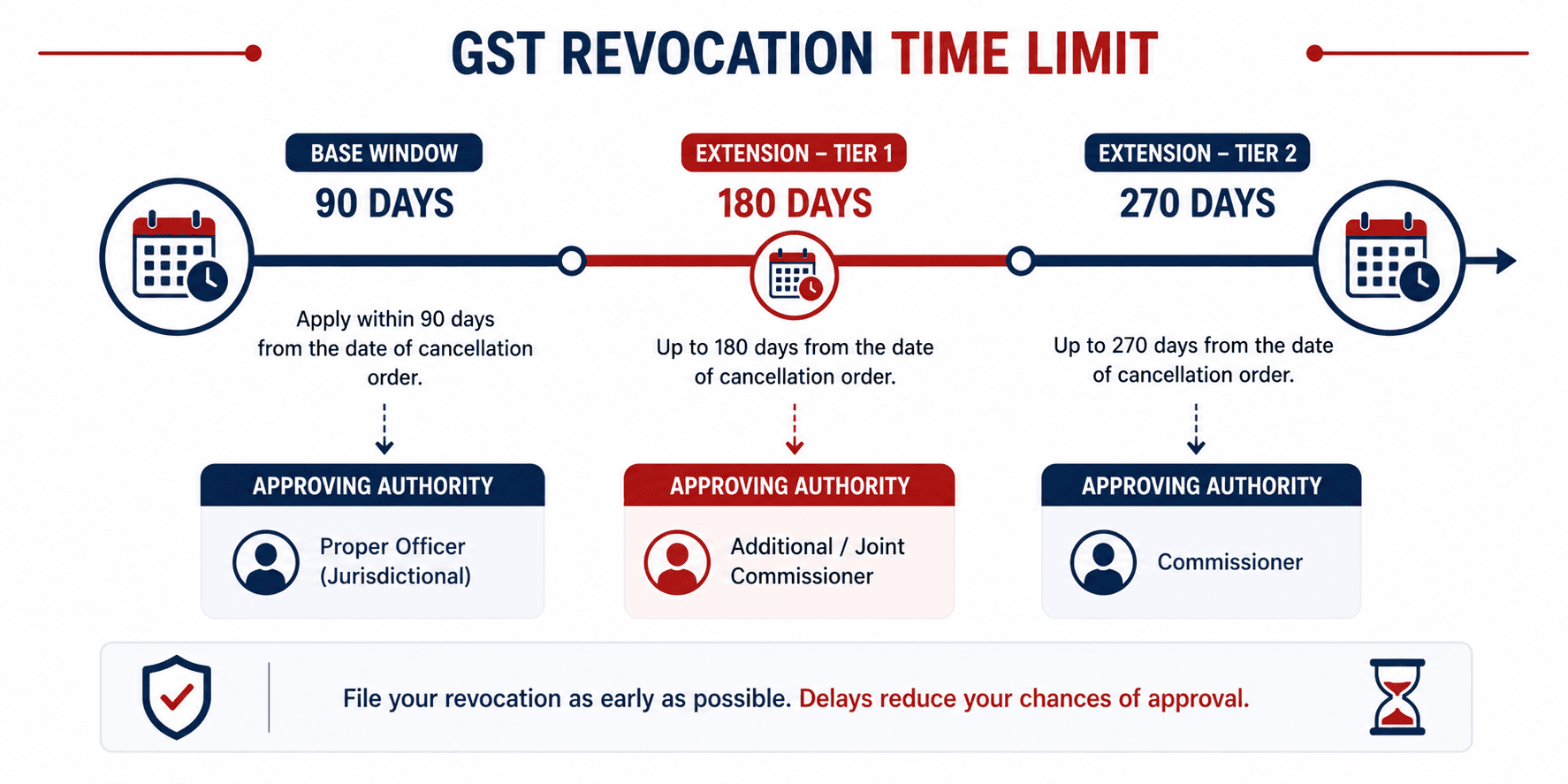
GST Revocation Checklist Before You Apply
-
File every pending GST return up to the cancellation date
-
Pay all outstanding tax, interest, penalty, and late fees in full
-
Keep your Aadhaar authentication ready for the authorised signatory
-
Draft a clear, specific reason for revocation, not a generic one-liner
-
Confirm you don't hold another active registration on the same PAN for the same business
-
Check your application status regularly using the ARN after submission
-
Set a reminder well before the 90-day window closes, since extensions need officer approval and aren't guaranteed
Getting a GSTIN cancelled once is stressful enough. Landing back in the same situation because your returns slipped again is avoidable. LegalBabu's accounting services for small businesses keep your filings current after revocation. Our tax compliance services cover everything from routine GST Filing to responding when the department sends a notice. Is cancellation the better route for your business right now? Our guide to GST registration cancellation walks through that process instead.
FAQS
Have questions about GST Revocation?
We have you covered:
-
Can I still apply for GST Revocation if it's been more than 90 days since cancellation?
Yes, but you'll need officer approval for an extension. An Additional or Joint Commissioner can extend the window by up to 180 more days, and a Commissioner can extend it further, up to a total of 270 days from the cancellation order. Beyond that, Section 30 generally doesn't apply, and a fresh registration becomes the more realistic path.
- Do I need Aadhaar authentication to file a GST Revocation application?
- Can I file GST Revocation myself, without hiring a CA or lawyer?
- What if my GST Revocation application gets rejected a second time?
- Is there a government fee for filing Form GST REG-21?
- Can GST Revocation be filed against a retrospective cancellation order?
- What if I already took a new GST registration after my old one was cancelled?
- Does GST Revocation automatically restore my Input Tax Credit?
- How do I check the status of my GST Revocation application?
- Can I access the GST portal to file for revocation if my GSTIN already shows as cancelled?


