
How to Get GST Registered as a Foreigner: A Step-by-Step Guide
GST registration for foreigners is mandatory before any non-resident business or individual supplies goods or services in India, even for a single event. There is no turnover threshold involved. You apply as a Non-Resident Taxable Person using Form GST REG-09, at least five days before starting business and deposit an advance tax estimate upfront.
Not every foreign entity falls into this category, though. A foreign company that sets up a subsidiary or a branch office in India and operates continuously registers under GST the same way an Indian business does. The non-resident route exists specifically for occasional, time-bound activity, and confusing the two paths is one of the most common mistakes foreign businesses make.
This guide covers who actually needs this registration, how it differs from the setup for foreign digital service providers, the documents and deposit involved, and what happens once the temporary window runs out.
What Is GST Registration for Foreigners?
GST registration for foreigners is the process through which a non-resident individual or foreign business obtains a temporary GST Identification Number (GSTIN) to legally supply goods or services in India. It is built around a specific legal category called a Non-Resident Taxable Person, or NRTP.
Section 2(77) of the CGST Act, 2017 defines an NRTP as any person who occasionally undertakes transactions involving the supply of goods or services in India, as principal, agent or in any other capacity, but who has no fixed place of business or residence in the country. Section 24 makes this registration compulsory, with no minimum turnover threshold, and Section 27 lays out how long the registration stays valid.
In practice, most foreign businesses that end up needing this are doing something short and specific: exhibiting at a trade fair, running a pop-up store, performing at an event, or executing a defined scope of work for a few weeks. It is not meant for a foreign company that wants to build a lasting, ongoing presence in India. That situation calls for a different route entirely, which we get to later.
Who Actually Needs GST Registration for Foreigners?
You need to register as an NRTP if you meet all three of these conditions:
-
You are supplying taxable goods or services within India.
-
You have no fixed place of business or residence in India.
-
The activity is occasional rather than continuous, even if it runs for a few weeks.
Example: A German machine-tool manufacturer flies in to exhibit at an industrial expo in Delhi and books orders on the spot from Indian buyers. It has no office anywhere in India. This is a textbook NRTP situation, and registration is required before the expo begins, not after the first sale.
Example: A Dubai-based fashion label runs a three-week pop-up store in a Mumbai mall to test the Indian market before deciding whether to commit long-term. Even though the activity is temporary, it still counts as a taxable supply, so NRTP registration applies here too.
You generally do not need this registration if:
-
Your supply is exempt from GST altogether.
-
You are a foreign diplomatic mission or a UN body covered under a specific exemption.
-
You are setting up a genuine, ongoing business presence in India through a company, branch office, or project office, in which case GST registration happens the regular way, tied to that entity's PAN.
Is There a Difference Between a Non-Resident Taxable Person and a Casual Taxable Person?
Yes, and mixing these up is a common source of confusion, since both categories share the same 90-day validity structure.
|
Point |
Non-Resident Taxable Person (NRTP) |
Casual Taxable Person (CTP) |
|
Who it applies to |
A foreign business or individual with no presence in India |
An Indian resident business operating temporarily outside its home state |
|
PAN requirement |
Not required for the entity itself; passport or foreign TIN used instead |
PAN is mandatory |
|
Registration form |
GST REG-09 |
GST REG-01, with casual taxpayer flagged |
|
Advance tax deposit |
Mandatory, based on estimated liability |
Mandatory, based on estimated liability |
|
ITC eligibility |
Restricted to tax paid on imported goods |
Full ITC available like any regular taxpayer |
|
Validity |
90 days, extendable by another 90 |
90 days, extendable by another 90 |
Think of a CTP as an Indian sweets manufacturer from Kolkata setting up a stall at a trade fair in Bengaluru for ten days. The business already exists in India, just not in that particular state. An NRTP, by contrast, has no footprint in India at all.
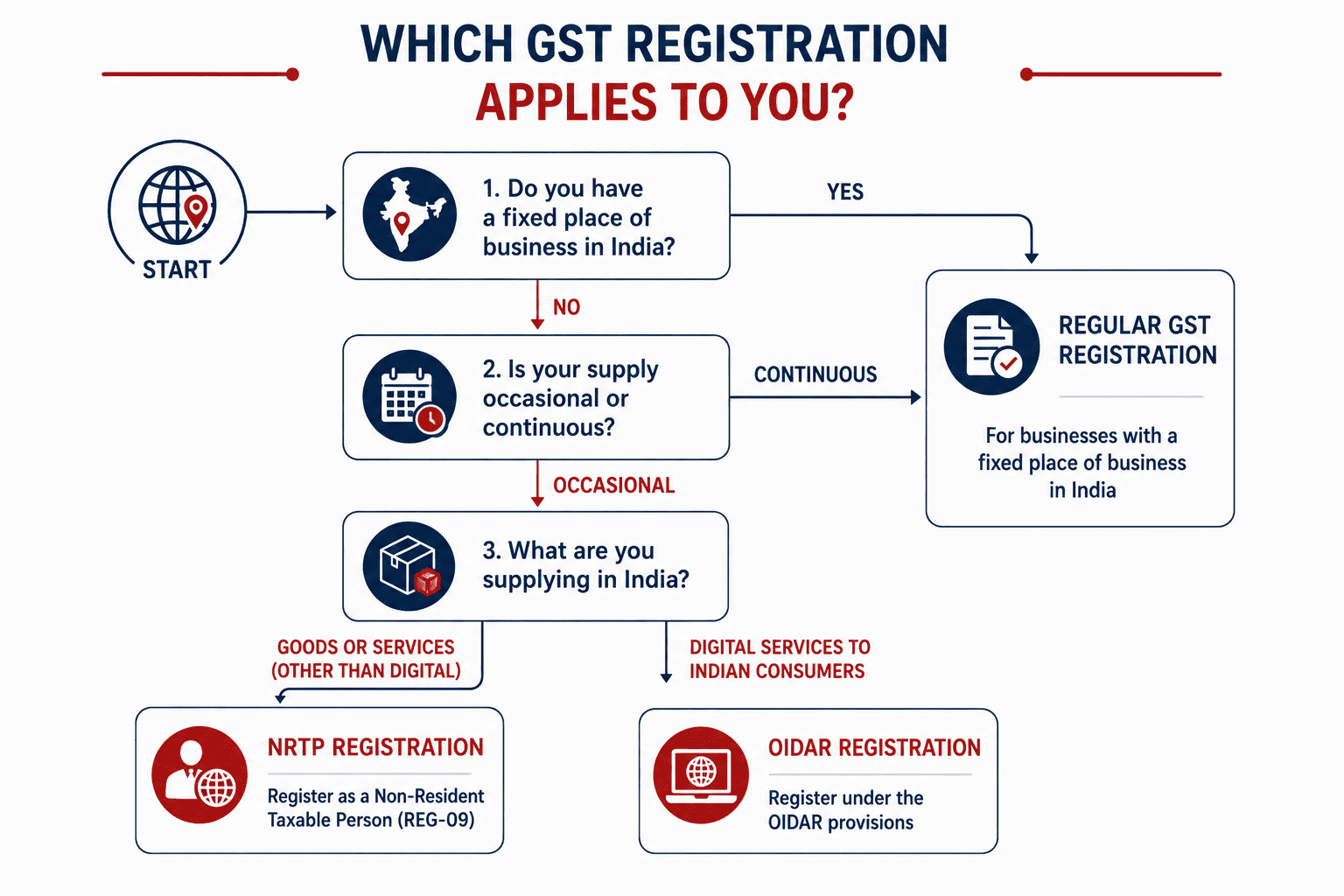
What About Foreign Companies Selling Digital Services in India?
This is where a lot of articles blur two genuinely different registration paths, and it matters because the compliance burden is quite different.
A foreign SaaS company, a streaming platform, or a cloud storage provider selling to Indian consumers is not an NRTP in the traditional sense. These businesses fall under OIDAR, or Online Information Database Access and Retrieval services, and they follow a separate, simplified registration under Form GST REG-10.
Example: A US-based project management software company sells monthly subscriptions to individual freelancers across India. Since the buyers are unregistered consumers rather than GST-registered businesses, the American company itself is liable to register under the OIDAR framework and charge 18% IGST on those subscriptions.
|
Point |
NRTP (REG-09) |
OIDAR (REG-10) |
|
Typical business |
Physical presence at events, temporary trading, on-ground services |
Streaming, SaaS, cloud storage, e-books, digital ads, online gaming |
|
Legal basis |
Section 24 and Section 27, CGST Act |
Section 24 CGST Act and Section 14, IGST Act |
|
Advance tax deposit |
Mandatory before registration |
Not required |
|
Registration scope |
State-specific, tied to the location of activity |
Single centralised registration valid across India |
|
Return filed |
GSTR-5, monthly |
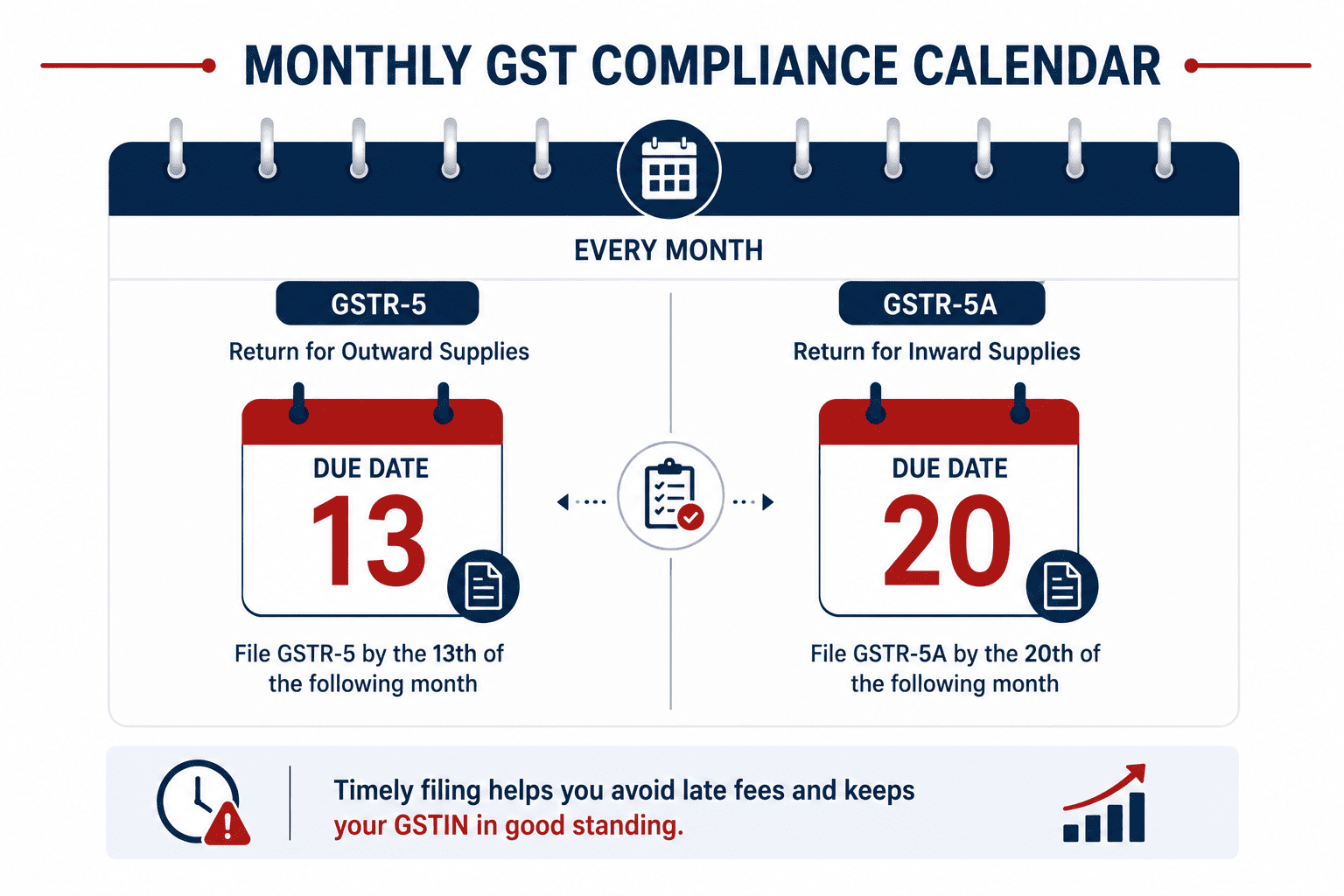
GSTR-5A, monthly, nil filing mandatory even with zero sales |
|
Return due date |
13th of the following month, or within 7 days of expiry, whichever is earlier |
20th of the following month |
|
B2B supplies |
Not applicable in the same way |
Reverse charge applies; the Indian recipient pays GST directly |
If your Indian customers are GST-registered businesses rather than individual consumers, reverse charge usually shifts the GST liability to them, and you may not need OIDAR registration at all for those particular transactions. Getting this classification wrong is one of the more expensive mistakes a foreign digital business can make, since the wrong registration path means filing the wrong returns for months before anyone notices.
What Documents Do You Need for GST Registration as a Foreigner?
|
Document |
Applies To |
Notes |
|
Valid passport |
Foreign individuals |
Acts as the primary identity proof instead of PAN |
|
Tax identification number from home country |
Foreign companies |
Equivalent to a PAN issued by the foreign government |
|
Certificate of incorporation |
Foreign companies |
Proof that the business legally exists in its home jurisdiction |
|
Authorised signatory details |
All applicants |
PAN, Aadhaar and address proof of a resident Indian representative |
|
Authorisation letter or board resolution |
All applicants |
Formally appoints the Indian representative to act on the applicant's behalf |
|
Proof of business address in India |
All applicants |
Even a temporary venue, stall or event address qualifies |
|
Indian bank account details |
All applicants |
Usually the representative's account, used for tax payment and refunds |
|
Advance tax deposit challan |
All applicants |
Generated after estimating liability and depositing funds in the electronic cash ledger |
A genuinely useful observation here: the Indian authorised signatory is not a formality. This person signs the application, is legally answerable for GST compliance during the registration period, and needs to actually understand the business well enough to respond to any query the department raises. Choosing this person carelessly, just because they happen to live in India, causes real delays later.
How Do You Apply for GST Registration as a Foreigner?
-
Appoint an Indian authorised signatory. This has to happen before anything else, since their PAN and details go into the very first step of the application.
-
Estimate your GST liability for the period you plan to operate in India, and deposit that amount in advance through the electronic cash ledger.
-
Log in to the GST portal at gst.gov.in and go to Services, then Registration, then New Registration.
-
Select Non-Resident Taxable Person as the taxpayer type from the dropdown.
-
Complete Form GST REG-09 with passport details, business information, and the Indian address where activity will take place.
-
Upload supporting documents, including the authorisation letter, passport or TIN, and the advance tax challan.
-
Verify and submit using a Digital Signature Certificate for companies and LLPs, or an Electronic Verification Code for other applicant types.
-
Receive your GSTIN, typically issued once the officer is satisfied with the application and the deposit is confirmed.
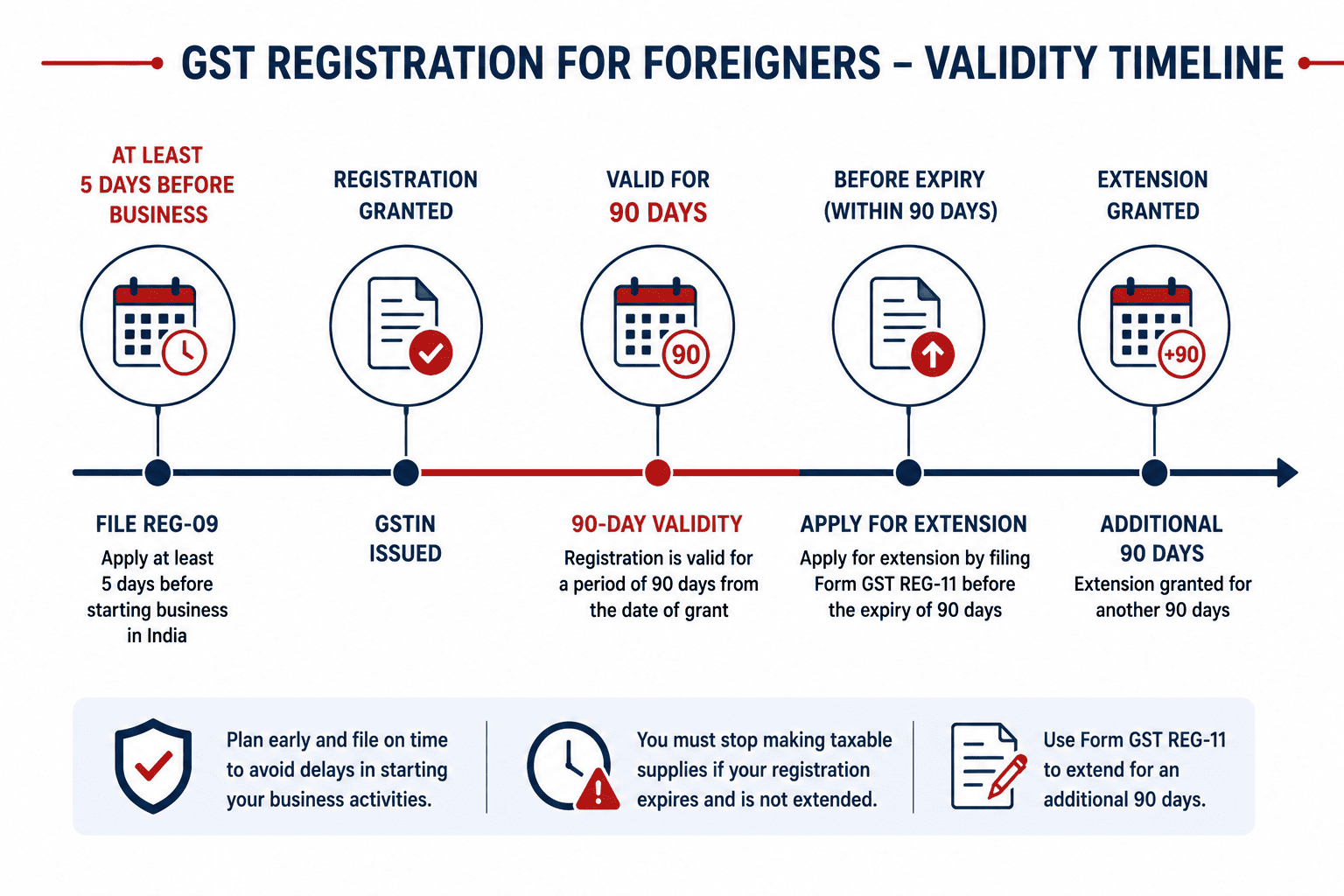
Apply with enough runway. The five-day rule is a legal minimum, not a realistic processing target. Officers can raise queries, and a foreign applicant without a PAN often takes a little longer to verify than a routine domestic application.
How Much Advance Tax Do You Need to Deposit?
Every NRTP must deposit an amount equal to their estimated tax liability for the entire period they expect to be registered, before the registration is even granted. There is no fixed formula published by the department. You calculate this yourself, based on your projected sales and the applicable GST rate, and pay it into the electronic cash ledger using the standard GST payment challan.
This deposit is not a fee. It sits in your ledger and gets adjusted against your actual tax liability as you file GSTR-5 each month. If your real sales come in higher than estimated, you owe the difference. If they come in lower, the excess can eventually be claimed as a refund, though only after all the returns due for that registration period have actually been filed.
Example: A UK-based event production company registers as an NRTP to run a two-month exhibition circuit across three Indian cities, estimating ₹40 lakh in taxable supplies at 18% GST. It deposits roughly ₹7.2 lakh in advance tax before the GSTIN is issued, then reconciles the actual figure through GSTR-5 filings as the events happen.
How Long Is the Registration Valid, and Can It Be Extended?
The initial registration is valid for 90 days from the effective date, or for the period specified in the application, whichever is shorter. If your activity is going to run longer, you file Form GST REG-11 for an extension before the original period expires. This buys you another 90 days, taking the maximum possible validity to 180 days.
Extension is not automatic. You need to submit a fresh advance tax deposit covering the additional period before the extension is granted. If neither the extension nor the closing formalities are completed, the registration simply lapses at the end of its validity, which does not erase any pending compliance obligations tied to it.
For anything genuinely expected to run past six months, applying for temporary registration twice is rarely the efficient path. At that point, setting up a proper Indian entity, whether that is a subsidiary, a branch office, or a project office for a specific contract, tends to work out cheaper and more stable than repeated NRTP cycles.
What Are the Ongoing Compliance Requirements After Registration?
Once registered, an NRTP has a genuinely light compliance calendar compared to a regular taxpayer, but it is unforgiving on deadlines.
-
File GSTR-5 monthly, due on the 13th of the following month, or within 7 days of the registration expiring or the business closing, whichever comes first.
-
Claim input tax credit only on imported goods. Domestic purchases made in India do not qualify for ITC under this framework, unlike a regular GST registration.
-
Issue GST-compliant invoices for every taxable supply made during the registration period.
-
Apply for a refund of unused advance tax, if applicable, only after every GSTR-5 return due for that period has been filed.
-
Respond promptly to any GST notice. A late GSTR-5 or a mismatch between estimated and actual tax can trigger a scrutiny query, and given how short the NRTP compliance window already is, a proper notice reply drafting service is often faster than trying to interpret an unfamiliar Indian tax notice from abroad.
What Happens If a Foreigner Doesn't Register or Files Late?
Operating without the required registration is treated the same way under GST law regardless of nationality. The consequences include:
-
A penalty of 10% of the tax due, or ₹10,000, whichever is higher, for genuine non-compliance, rising sharply if the department views the non-registration as deliberate.
-
Interest at 18% per annum on any tax that should have been paid but was not.
-
Blocked or delayed refunds of the advance tax deposit, since a refund cannot be processed while returns for the period remain unfiled.
-
Difficulty re-entering India for future business, since Indian counterparties and event organisers increasingly ask for proof of GST compliance before dealing with a foreign supplier again.
-
A formal GST notice, most commonly a scrutiny query or a show cause notice, if the mismatch between deposited advance tax and actual filed liability is significant.
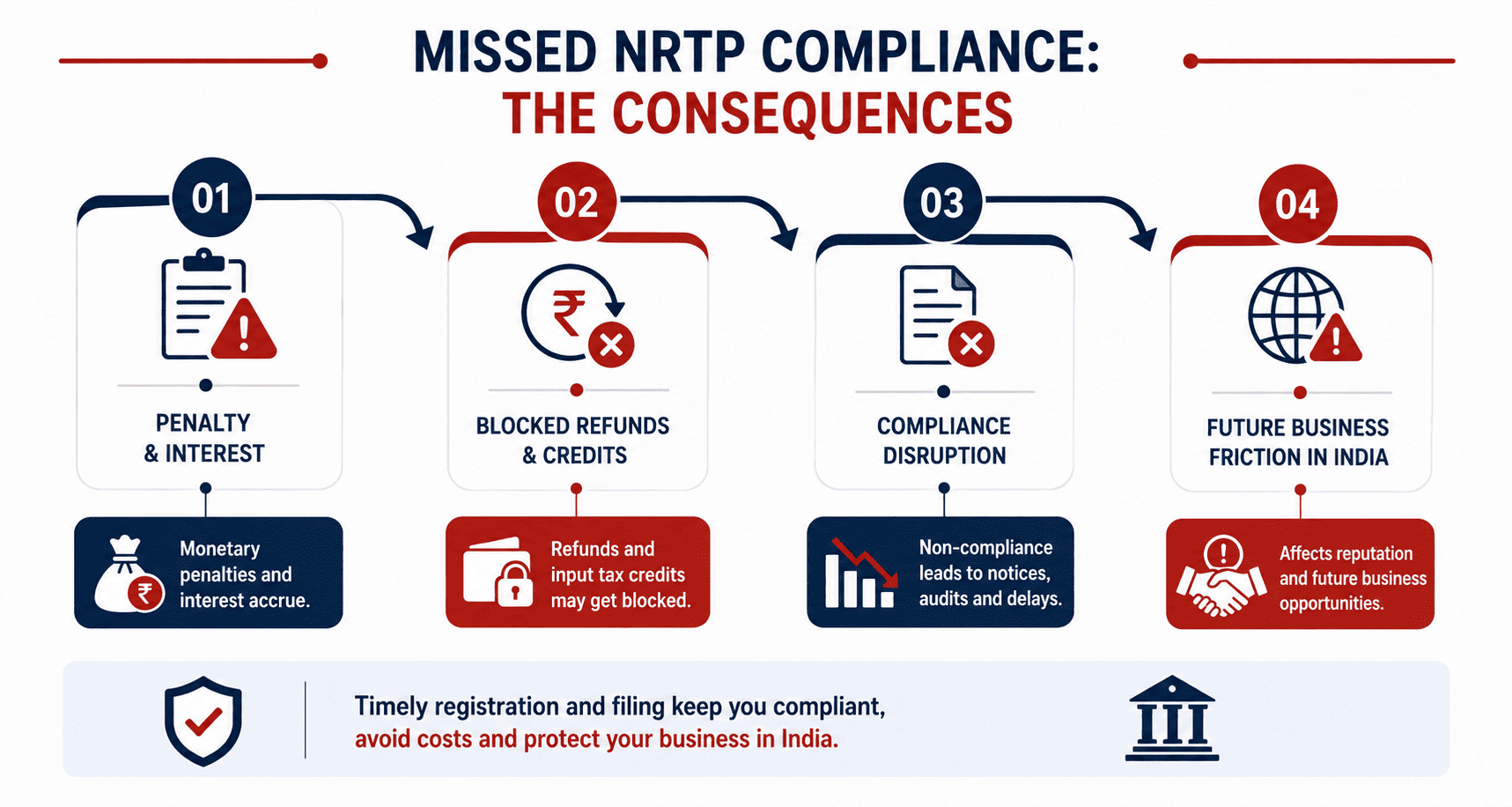
None of this is unique to foreigners. It simply lands harder on non-resident businesses, since they are managing an unfamiliar tax system from a different time zone, often through a representative rather than in person.
Should You Register as an NRTP or Set Up a Permanent Business in India Instead?
This decision comes down to one honest question: is your presence in India actually temporary, or are you just hoping it stays small?
NRTP registration makes sense for a defined, short engagement with a clear end date. A permanent structure makes more sense once you are looking at repeat visits, a growing customer base, or any activity that starts resembling an ongoing Indian operation rather than a one-off. At that point, options include full company incorporation for foreigners, a liaison office for non-commercial representation, or a branch office if the parent company wants a direct commercial presence.
Businesses that plan to import goods into India as part of this activity should also look into IEC code registration, since GST registration alone does not authorise import or export activity.
Common Mistakes Foreign Businesses Make With GST Registration
-
Registering as an NRTP for what is actually an ongoing business. If you keep renewing every 90 days for over a year, that pattern itself can invite scrutiny.
-
Underestimating the advance tax deposit. A low estimate that falls well short of actual sales creates a liability gap that shows up the moment GSTR-5 is filed.
-
Choosing an authorised signatory who does not understand the business. This person has to respond to queries in real time, often without the foreign promoters immediately available.
-
Confusing NRTP with OIDAR. Selling a physical product at an Indian trade fair and selling a software subscription to Indian consumers are governed by two different forms, two different deposit rules, and two different returns.
-
Forgetting the refund is conditional. Assuming the advance deposit will simply be refunded automatically, without first filing every GSTR-5 due for the period, leads to unnecessary delays.
-
Leaving the extension too late. Form GST REG-11 has to be filed before the original 90 days runs out, not after.
FAQS
Have questions about GST Registration for Foreigners?
We have you covered:
-
Can a foreigner get a permanent GST registration instead of a temporary one?
Not under the NRTP category, since it is specifically designed to be time-bound. A foreigner who wants permanent registration needs to first establish an Indian legal presence, such as a subsidiary company or a branch office, and then register under GST the regular way, tied to that entity's PAN.
- Does a foreign tourist or visitor need GST registration?
- Can an NRTP apply for a composition scheme to simplify compliance?
- What happens to the advance tax deposit if I never actually start business in India?
- Is a separate Indian bank account mandatory for NRTP registration?
- Can one Indian representative act as the authorised signatory for multiple foreign businesses?
- How is GST charged if I sell through an Indian e-commerce platform instead of directly?
- What if my home country doesn't issue anything equivalent to a tax identification number?
- Can I apply for GST registration for foreigners without visiting India in person?
- Does GST registration for foreigners require a local office address, or can I use a virtual office?


