
GST Notice in India: What It Means, How to Reply and What Happens Next
A GST notice is an official communication from the GST department about a return mismatch, a missed filing, a refund issue or a suspected tax discrepancy. Most GST notices give you between 7 and 30 days to reply through the GST portal in the prescribed form. Miss that window, and the department can move to a best judgment assessment, recovery action or cancellation of your registration.
Not every notice means trouble. Some are routine system-generated reminders about a mismatch of a few thousand rupees. Others are formal show cause notices that can lead to a demand running into lakhs. The right response depends entirely on which one landed in your GST portal account, so the first job is always to work out exactly what you received.
This guide walks through the common types of GST notices, the reply window attached to each, how the department serves them, and the process for drafting a reply that actually holds up.
What Is a GST Notice?
A GST notice is a formal communication issued by a central or state GST officer under the CGST Act, 2017, or the matching SGST Act, to a registered taxpayer. It can flag anything from a small filing gap to a suspected case of tax evasion. Officers upload every notice to the GST portal, and many also go out by email or SMS to the registered contact details.
Only a business that holds a valid GST registration can receive one of these notices in the first place, since every notice ties back to a GSTIN.
A notice is not automatically a penalty. Categories like a scrutiny notice or a mismatch intimation exist purely to get an explanation before the department decides whether to act further. Ignoring one, though, almost always makes the outcome worse than answering it honestly and on time.
In practice, most small businesses receive the quieter, system-generated notices: a GSTR-1 versus GSTR-3B mismatch, an input tax credit gap against GSTR-2B, or a scrutiny query on a filed return. The dramatic Section 74 fraud notices that make news headlines are far less common than routine reconciliation issues.
Why Do Businesses Receive a GST Notice?
Most GST notices trace back to a handful of recurring triggers:
-
Mismatch between GSTR-1 and GSTR-3B. The tax declared as payable in GSTR-3B does not match the outward supply value reported in GSTR-1.
-
Excess input tax credit claimed. The ITC claimed in GSTR-3B is higher than what shows up in the auto-generated GSTR-2B.
-
Non-filing or late filing of returns. GSTR-3B, GSTR-1, GSTR-4 or the annual return has not been filed for one or more periods. Staying on top of GST return filing due dates is the simplest way to avoid this trigger completely.
-
Refund-related discrepancies. A refund application does not match the supporting documents, or the officer proposes to reject it in part or in full.
-
E-way bill and invoice mismatches. Goods movement recorded in e-way bills does not line up with what shows in the returns.
-
Registration-related concerns. The business is not found operating at its declared address, or documents submitted at registration need further clarification.
-
Selection for audit or scrutiny. Returns get picked up under Section 61 scrutiny or a departmental audit under Section 65.
Here is something worth knowing from experience: a small trader rounding off figures across GSTR-1 and GSTR-3B by a few thousand rupees can trigger an automated mismatch intimation within days of filing. The GST system does not wait for a human officer to review that gap before flagging it. That is exactly why reconciliation before filing matters more than fixing things after a notice shows up. Keeping monthly books reconciled with proper accounting support for small businesses closes this gap before it ever becomes a notice.
What Are the Different Types of GST Notices?
GST notices range from a soft, auto-generated intimation to a formal show cause notice with real legal consequences. The table below covers the notices a registered taxpayer is most likely to actually receive.
|
Notice / Form |
Issued Under |
Why It Is Issued |
Reply Form |
Reply Window |
|
GSTR-3A |
Section 46, Rule 68 |
Non-filing of GSTR-3B, GSTR-4 or the annual return |
File the pending return |
15 days |
|
GST REG-03 |
Rule 9 |
Clarification sought during registration |
GST REG-04 |
7 working days |
|
ASMT-10 |
Section 61, Rule 99 |
Discrepancy found during scrutiny of filed returns |
ASMT-11 |
Up to 30 days |
|
DRC-01B |
Rule 88C |
GSTR-1 liability exceeds GSTR-3B by more than ₹1 lakh or 20% |
Part B of DRC-01B |
7 days |
|
DRC-01C |
Rule 88D |
GSTR-3B ITC exceeds GSTR-2B ITC by more than ₹1 lakh or 20% |
Part B of DRC-01C |
7 days |
|
DRC-01A |
Rule 142(1A) |
Pre-notice intimation of tax, interest and penalty ascertained |
Part B of DRC-01A |
Before the formal show cause notice is issued |
|
DRC-01 |
Section 73 / 74 / 74A |
Formal show cause notice for demand of tax |
DRC-06 |
30 days (60 days under Section 74A) |
|
REG-17 |
Rule 22 |
Proposed cancellation of GST registration |
REG-18 |
7 working days |
|
RFD-08 |
Rule 92(3) |
Proposed rejection of a refund claim |
RFD-09 |
15 days |
|
CMP-05 |
Rule 6(5) |
Alleged violation of composition scheme conditions |
CMP-06 |
15 days |
|
ADT-01 |
Section 65, Rule 101 |
Initiation of a departmental GST audit |
Appear with records |
As specified in the notice |
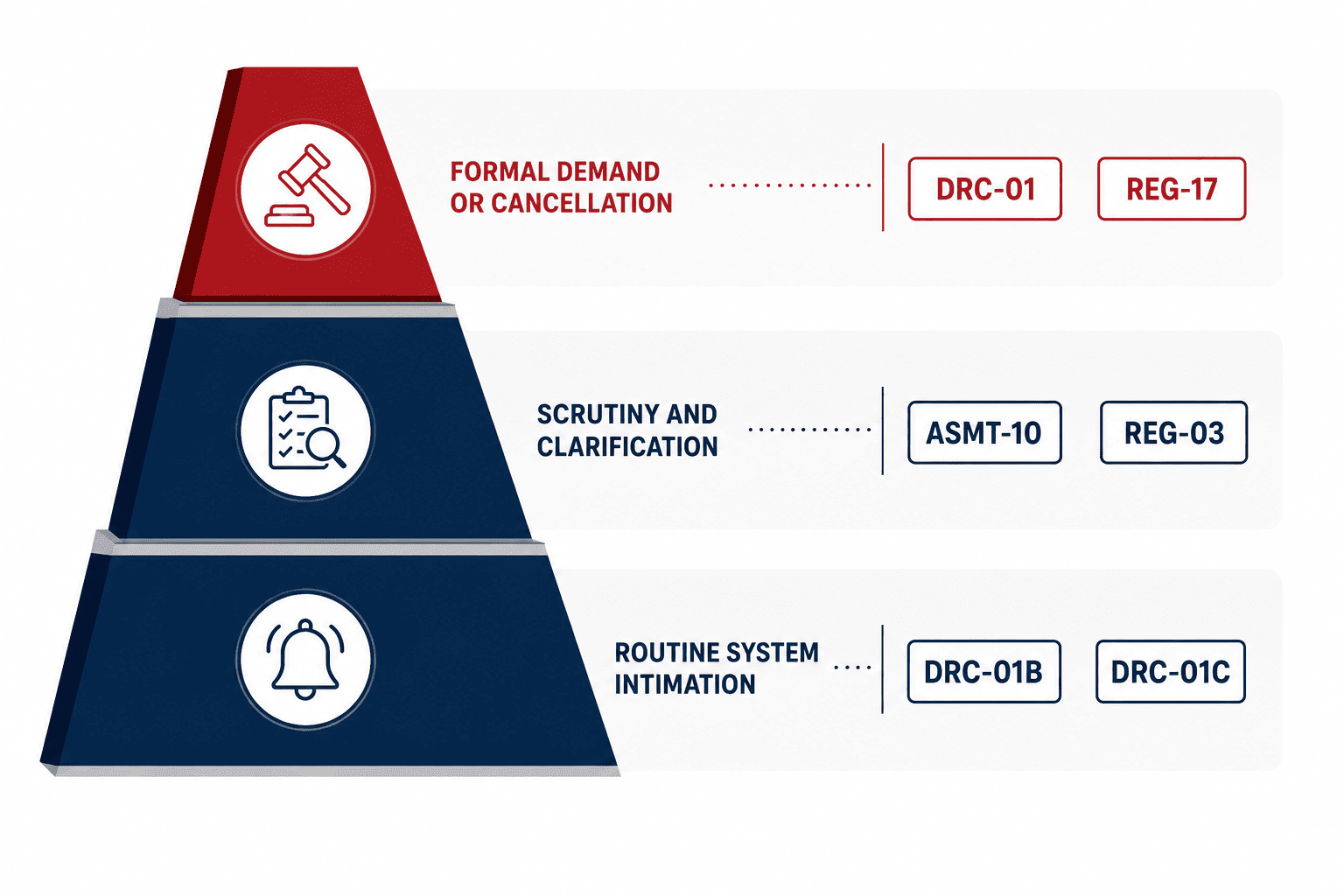
A quick way to gauge urgency: any notice starting with DRC-01B, DRC-01C or REG-17 gives you a week or less to respond. Everything else generally runs 15 to 30 days, though the exact figure printed on your specific notice always controls over anything in this table.
How Are GST Notices Served, and Where Should You Look for Them?
Section 169 of the CGST Act lists the valid ways a notice can be served: handing it over directly, registered or speed post with acknowledgment, email to the address given at registration, uploading it to the GST portal, publishing it in a newspaper, or affixing it at the taxpayer's last known place of business. A notice counts as served the moment any one of these methods is completed, whichever the officer chooses to use.
Portal upload is by far the most common route, and this is where taxpayers often get caught out. Until early 2026, the GST portal split communications across two separate tabs: "Notices and Orders" and a lesser-known "Additional Notices and Orders" tab. Show cause notices, audit notices and appeal-related orders often landed in that second tab, and plenty of businesses genuinely never saw them, which led to one-sided orders that later got challenged in court. In February 2026, GSTN merged both tabs into a single "Notices and Orders" section for exactly this reason. If you are dealing with an older notice issued before that merger, it is still worth checking which tab it originally sat in, since some courts have accepted that confusion as grounds for a fresh hearing.
The practical takeaway: check the portal directly under Services > User Services > View Notices and Orders on a regular basis. Do not rely on email alone. A notice uploaded to the portal counts as legally served even if the email copy never reaches your inbox.
How Long Does the GST Department Have to Issue a Notice?
The department cannot raise a demand whenever it likes. The CGST Act sets a limitation period, and which provision applies depends on the financial year involved.
|
Provision |
Applies To |
Notice Time Limit |
Order Time Limit |
Penalty Range |
|
Section 73 (no fraud) |
Up to FY 2023-24 |
3 years from the annual return due date |
Within 3 years |
10% of tax or ₹10,000, whichever is higher |
|
Section 74 (fraud or suppression) |
Up to FY 2023-24 |
5 years from the annual return due date |
Within 5 years |
Up to 100% of tax, reduced substantially if paid early |
|
Section 74A (unified) |
FY 2024-25 onward |
42 months from the annual return due date |
Within 12 months of the notice |
Same tiered structure, based on whether fraud is involved |
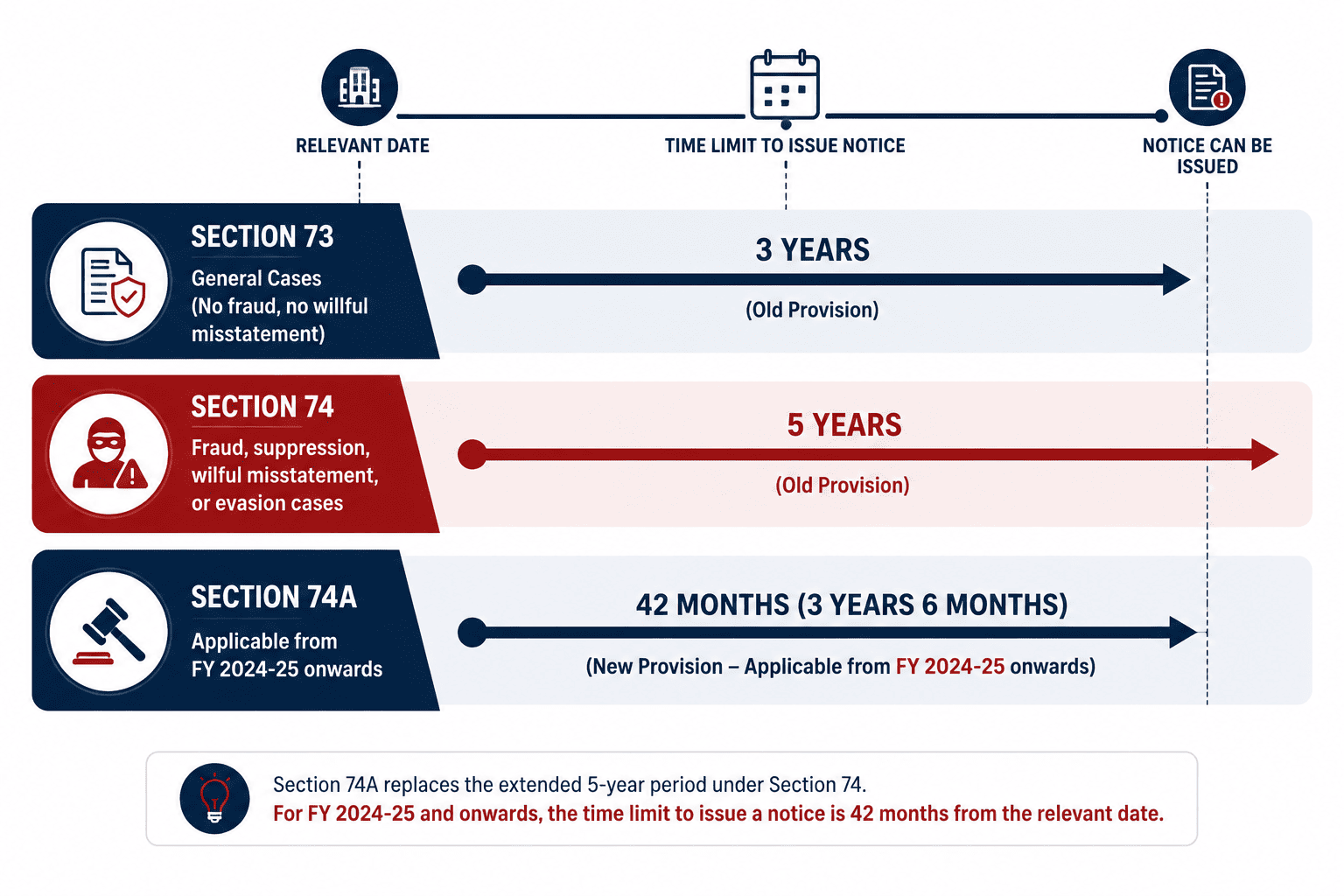
Section 74A took effect from 1 November 2024 and folds the old fraud and non-fraud tracks into one 42-month clock, so officers no longer need to settle the "intent" question just to pick a section. Two details worth knowing if a notice under this section reaches you: the department cannot issue one for a differential tax amount under ₹1,000, and the window to pay up and earn a reduced penalty has been extended from 30 days to 60 days, both before and after the formal notice.
Cases relating to FY 2023-24 and earlier still run on the older Section 73 and Section 74 timelines, so do not assume Section 74A automatically applies just because a notice arrived in 2026.
How Do You Check and Download a GST Notice Online?
-
Log in to the GST portal at gst.gov.in using your GSTIN and password.
-
Go to Services, then User Services, then View Notices and Orders. This single tab now covers everything, including what used to sit under the old additional tab.
-
Select the relevant financial year and scan for pending action items.
-
Open the notice and note the reference number, the section it cites, and the reply deadline.
-
Download the PDF and save it before you start drafting a response.
-
Cross-check your registered email for a parallel copy. A mismatch between the two can sometimes point to a service issue worth raising later.
Set a recurring reminder to check this section every couple of weeks, even in months when you are not expecting anything. Deemed service happens on upload, not on the day you happen to log in and notice it.
How Should You Reply to a GST Notice?
A reply that actually protects you needs more than a one-line denial. It has to address every point the notice raises, back each point with a document, and go in through the correct form.
Documents to keep ready before drafting a reply:
-
A clear copy of the notice itself
-
GST registration certificate and GSTIN details
-
The relevant returns: GSTR-1, GSTR-3B, GSTR-2A or 2B, and GSTR-9
-
Sales and purchase invoices for the disputed period
-
Bank statements supporting the transactions in question
-
E-way bills, where the notice concerns goods movement
-
Any earlier correspondence with the department on the same issue
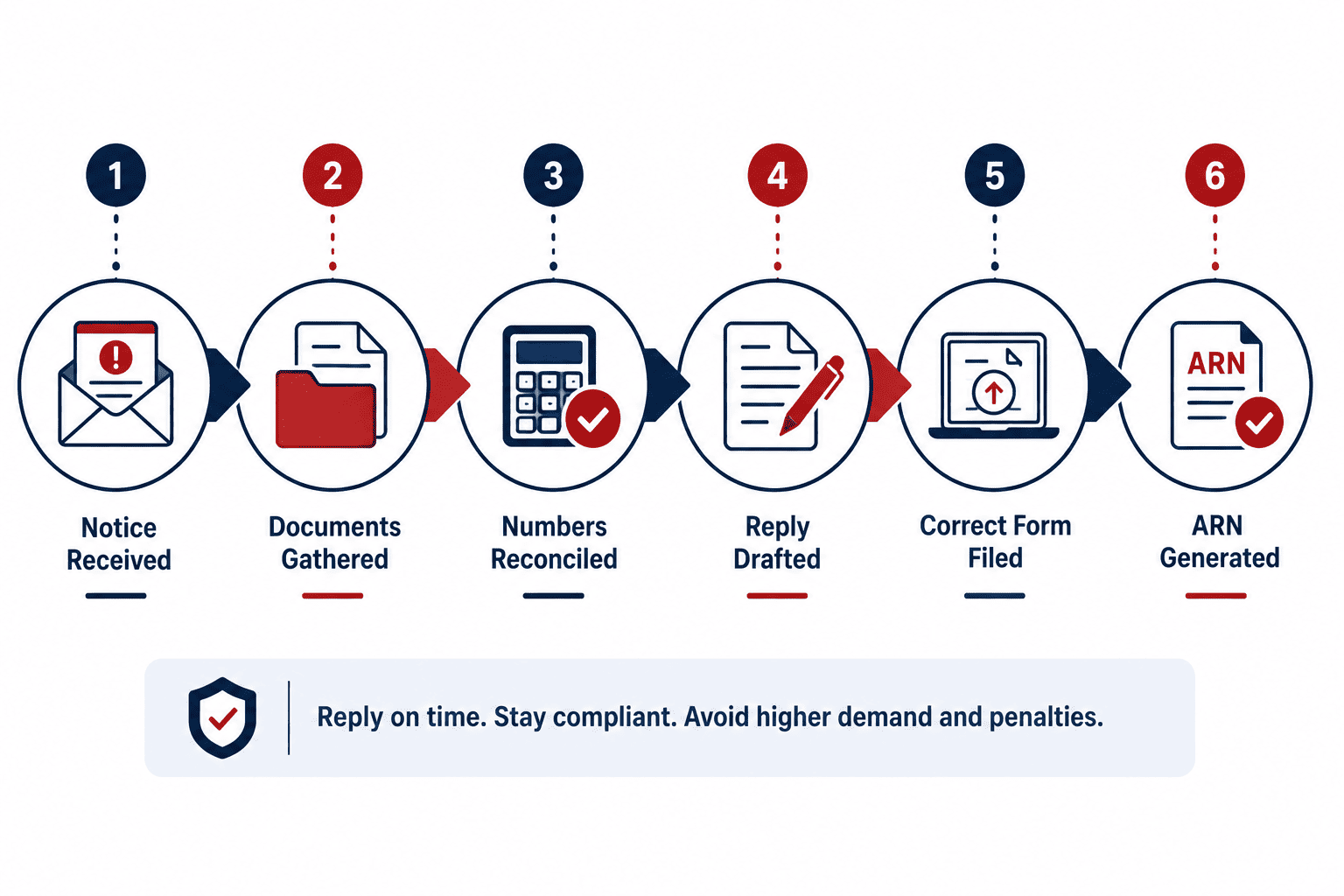
Step-by-step reply process:
-
Read the notice line by line and identify the exact section and sub-clause it cites. This decides which form your reply goes into.
-
Work out the real deadline. Count from the date of service, not the date you happened to open it, and flag it immediately if it falls inside a week.
-
Reconcile the numbers first. Match the disputed figures against your books and returns before writing a single word of explanation.
-
Draft a para-wise reply. Address each allegation separately, cite the supporting document for each point, and avoid vague language that could later read as an admission.
-
Decide on payment versus contest. Where the discrepancy is genuine, paying through DRC-03 at this stage usually reduces the eventual penalty. Where you disagree, say so clearly and back it up with evidence.
-
File through the correct form, such as ASMT-11, DRC-06, REG-18, RFD-09 or the applicable Part B, using a digital signature or EVC as required.
-
Download the ARN generated after filing and keep it with the full submission for your records.
If the notice is a straightforward scrutiny query and your records are clean, drafting the reply yourself is often manageable. Once the amount involved runs into lakhs, or the notice cites Section 74 or 74A, it is worth getting the draft reviewed by someone who reads these for a living. LegalBabu's Notice Reply Draft Services cover GST notices specifically, from ASMT-10 scrutiny queries to REG-17 cancellation notices, with a section-wise reply built around your actual documents instead of a generic template.
What Happens If You Ignore a GST Notice?
Silence gets read as acceptance in most GST proceedings, and the consequences build quickly:
-
Best judgment assessment. Under Section 62 for non-filers, or Section 63 for unregistered persons, the officer can assess your liability using whatever data is available, with no further input from you.
-
Recovery proceedings. Section 79 lets the department recover confirmed dues directly, including attaching bank accounts or receivables, without waiting for fresh adjudication.
-
Blocked return filing. An unanswered DRC-01B or DRC-01C can block your ability to file the next period's GSTR-1 or IFF.
-
Registration suspension or cancellation. An unanswered REG-17 typically ends in cancellation through REG-19. If cancellation is unavoidable or intentional, reviewing the GST registration cancellation process beforehand helps you avoid surprises, since pending return obligations continue even after the GSTIN is cancelled.
-
Loss of the right to be heard. Once an order is passed, contesting the underlying facts becomes far harder than it would have been at the notice stage.
-
Prosecution in serious cases. Large-scale fraud under Section 132 can lead to arrest, though this is reserved for high-value, deliberate evasion rather than routine mismatches.
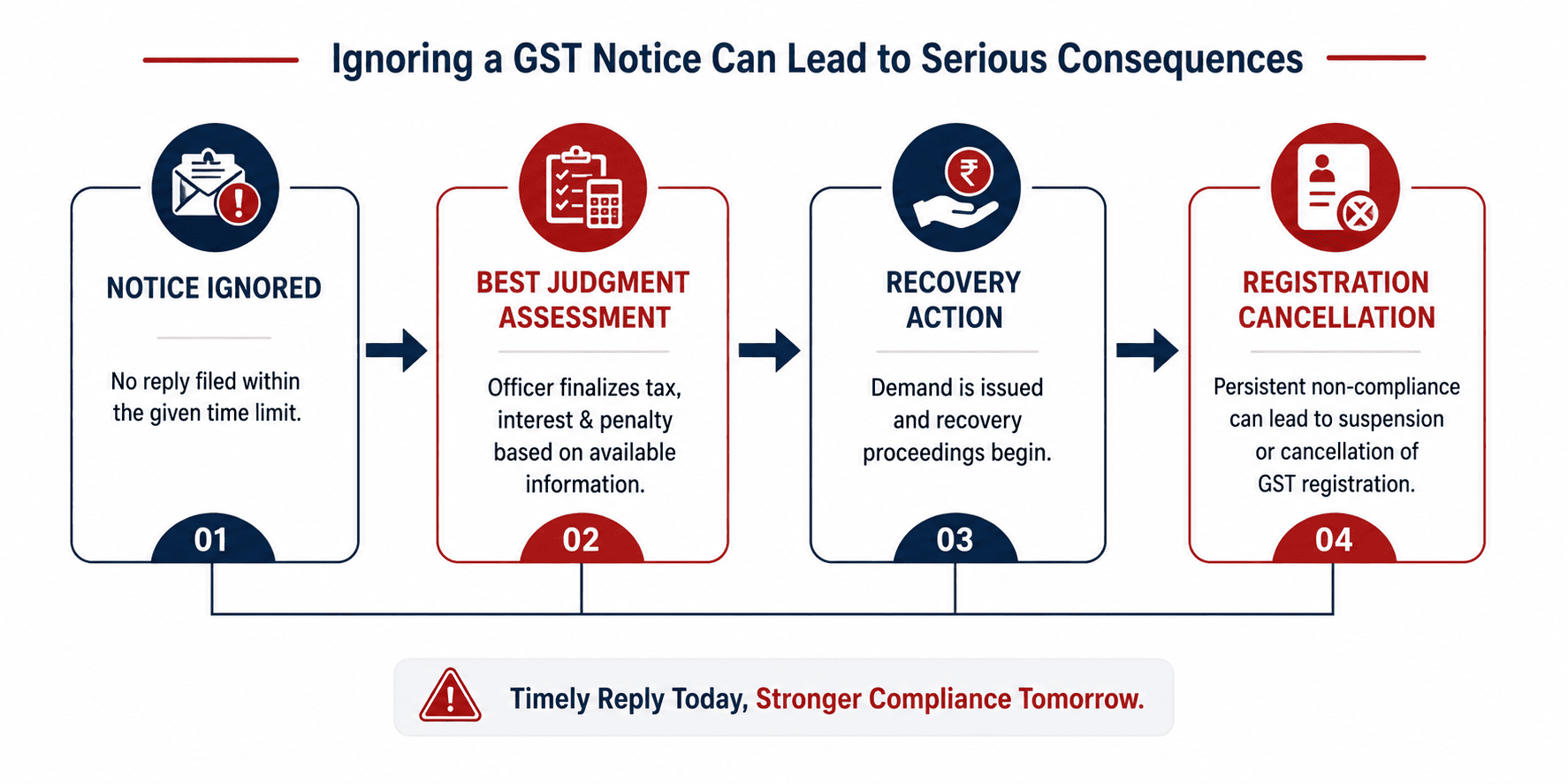
None of this is meant to alarm anyone into panic. It simply reflects how the statute is built. The burden sits with the taxpayer to respond, not with the department to keep chasing.
What Penalties and Interest Apply to a GST Notice?
Interest and penalty are calculated separately, and one never substitutes for the other.
Interest: Delayed tax payment attracts interest at 18% per annum under Section 50, calculated from the day after the original due date until the date of actual payment. For example, ₹1,20,000 paid 15 days late works out to roughly ₹888 in interest, calculated as ₹1,20,000 x 18% x 15 divided by 365.
Penalty for genuine errors under Section 73, or the non-fraud track of Section 74A, sits at 10% of the tax involved or ₹10,000, whichever is higher.
Penalty for fraud, wilful misstatement or suppression under Section 74, or the fraud track of Section 74A, scales from 15% if paid before the show cause notice up to 100% if the dues are settled only after an order is passed. Paying early genuinely reduces what you owe here.
Late fees for delayed returns generally run ₹20 per day for a nil return and ₹50 per day for others, subject to caps that vary by turnover slab and return type. A GST calculator can help you work out the base tax figure before interest and penalty get added on top.
Can You Appeal Against a GST Notice or Order?
Yes, and the appeal path now has a functioning second stage that did not exist for most of GST's history.
|
Stage |
Forum |
Form |
Deadline |
Pre-Deposit |
|
First appeal |
Joint or Additional Commissioner (Appeals) |
GST APL-01 |
3 months from the order, condonable by 1 month |
10% of the disputed tax |
|
Second appeal |
GST Appellate Tribunal (GSTAT) |
GST APL-05 |
3 months from the first appellate order |
20% of the disputed tax, on top of the first deposit |
|
Beyond GSTAT |
High Court, then Supreme Court |
Writ or statutory appeal |
As per court rules |
As directed by the court |
GSTAT became genuinely operational in 2026 after almost nine years of existing on paper without functioning benches. The Principal Bench in New Delhi started hearing cases on 16 February 2026, and state benches have been rolling out in phases through the year. A one-time window for appealing older orders, specifically those communicated before 1 April 2026, was originally set at 30 June 2026 and later extended to 31 July 2026 because of heavy portal traffic. If that window has already passed for your case, GSTAT can still condone a delay of up to three months where there is a genuine reason, though this is discretionary rather than automatic, so it pays to act quickly rather than assume more time will be granted.
Common Mistakes to Avoid When Replying to a GST Notice
-
Waiting until the last few days. Weekends, document collection and portal glitches eat into a 7 or 15-day window faster than most people expect.
-
Reusing a generic reply template. Every notice cites a specific discrepancy figure and section. A mismatched template can weaken a reply more than a short, honest one would.
-
Admitting liability casually. A line like "we will look into it" in a formal reply can later get read as an acknowledgment of the discrepancy.
-
Skipping the pre-notice stage. A DRC-01A intimation is often the cheapest point to resolve a demand. Several High Courts have gone as far as quashing later orders where officers skipped this step, but that protection only helps if you actually engage with it when it does arrive.
-
Not asking for a personal hearing. Most show cause notices allow this option, and it is one of the few chances to clarify facts directly before an order is passed.
-
Losing the acknowledgment. Always keep the ARN generated after filing. It is the only proof that a reply was actually submitted on time.
FAQS
Have questions about GST Notice?
We have you covered:
-
I received a GST notice by email but cannot find it on the portal. What should I do?
Log in and check under Services, then User Services, then View Notices and Orders, since this now covers what used to be split across two separate tabs. If it still does not appear, contact the GST helpdesk with the reference number from the email, since portal upload, not the email copy, is what counts as legal service.
- Can I get more time to reply if I am going to miss the deadline?
- Is GSTR-3A a penalty notice or just a reminder?
- What is the real difference between ASMT-10 and DRC-01?
- Does receiving a GST notice mean I will definitely be penalized?
- Can a GST notice be issued for a return I filed years ago?
- What is the
- Can I withdraw or edit my reply after submitting it on the GST portal?
- Do I need a lawyer or a CA to reply to a GST notice?
- What if the notice was sent to my old registered address or a closed email account?


