
GST Rule 14A Explained: Eligibility, Limit & Risks
- by kapil
- Updated September 1, 2026
- 14 mins read
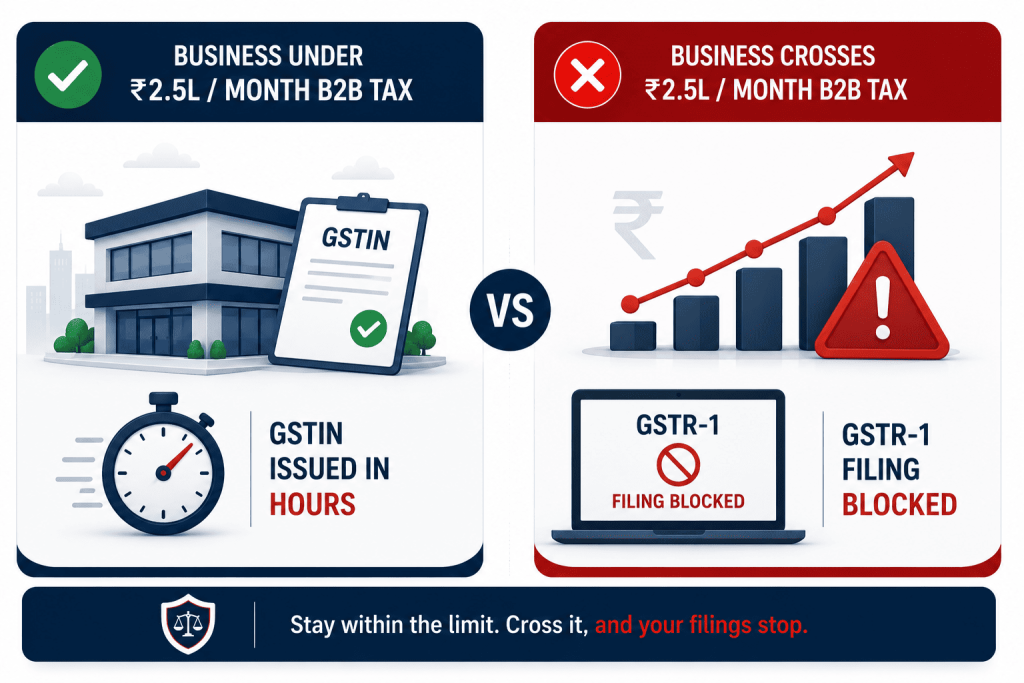
GST Rule 14A is an optional fast-track registration route that can get you a GSTIN in as little as a few hours through Aadhaar authentication, but only if your monthly B2B output tax liability stays within ₹2.5 lakh. Cross that limit even once, and the portal blocks your GSTR-1 filing until you formally withdraw from the scheme. It sounds simple. It is not always applied that way.
What Is GST Rule 14A?
Rule 14A sits inside the CGST Rules, 2017, and it did not exist before November 2025. The Central Board of Indirect Taxes and Customs added it through Notification No. 18/2025 – Central Tax, dated 31 October 2025, as part of the Fourth Amendment Rules. The change came into force from 1 November 2025.
The idea behind it is straightforward. Small businesses that mostly sell to other registered businesses (B2B) can get a GSTIN faster than the normal 7 to 30 day route, as long as they declare, at the time of applying, that their monthly output tax liability on B2B sales will not cross ₹2.5 lakh. Say yes to that condition, complete Aadhaar verification, and the system usually grants registration within three working days. Many applicants see it approved within 4 to 5 hours once Aadhaar authentication clears.
Understanding this cap properly, before you apply, matters more than the registration speed itself. Businesses that run into trouble with Rule 14A almost always do so for the same reason: they treat it purely as a faster registration option without checking whether their near-term B2B volume actually fits inside the ₹2.5 lakh ceiling. A business growing quickly can cross that line within its first few months of operation, well before anyone would call it a “large” taxpayer.
Who Is Eligible to Register Under GST Rule 14A?
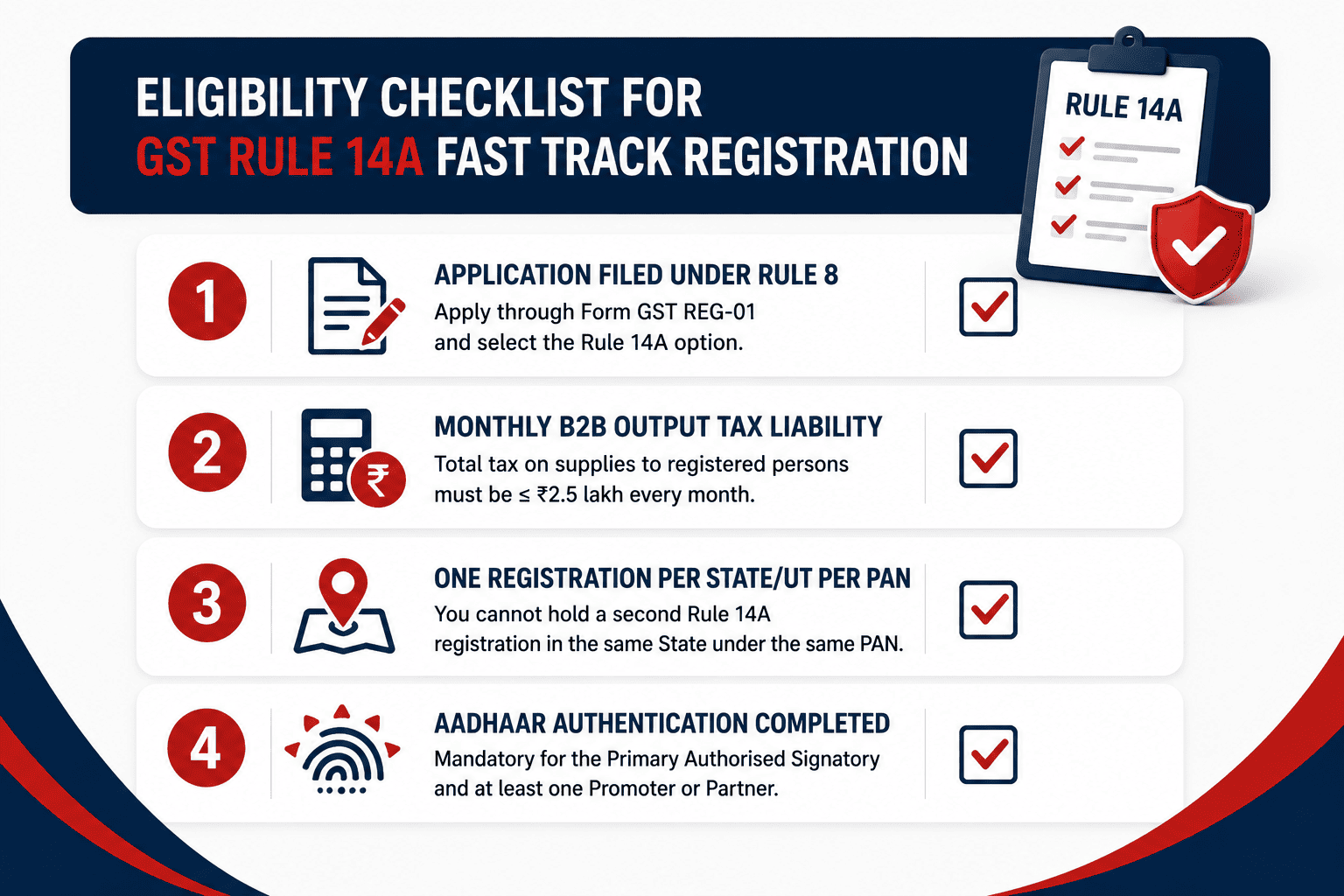
Not every applicant can opt for this route. Four conditions apply together, not in isolation.
| Condition | What It Means |
| Application filed under Rule 8 | You apply through the standard Form GST REG-01, then select the Rule 14A option inside it |
| Monthly B2B output tax liability ≤ ₹2.5 lakh | Total tax on supplies to registered persons (CGST + SGST/UTGST + IGST + cess combined) must stay within this figure every month |
| One registration per State/UT per PAN | You cannot hold a second Rule 14A registration in the same state under the same PAN |
| Aadhaar authentication completed | Mandatory for the Primary Authorised Signatory and at least one Promoter or Partner |
B2C sales do not count toward the ₹2.5 lakh figure at all. A business that sells heavily to end consumers and only occasionally to registered buyers can still qualify, since the cap looks only at the B2B slice of output tax.
If your business does not meet all four conditions, or if you would rather avoid the compliance cap altogether, the standard GST registration process remains open to you with no B2B ceiling attached.
How Does the ₹2.5 Lakh Monthly B2B Limit Actually Work?
This is where most of the confusion starts. The ₹2.5 lakh figure is not your turnover. It is your tax liability.
That distinction matters more than it looks. A business paying 5% GST can generate a much larger B2B turnover before hitting the cap than a business paying 28% GST, because the ceiling is measured in rupees of tax, not rupees of sales.
| GST Rate | Approximate Monthly B2B Turnover Before Hitting the ₹2.5 Lakh Tax Cap |
| 5% | ~₹50 lakh |
| 12% | ~₹20.8 lakh |
| 18% | ~₹13.9 lakh |
| 28% | ~₹8.9 lakh |
We are rounding these figures for clarity. Your actual position depends on your exact product mix, applicable cess, and how CGST, SGST, and IGST split across your invoices. A GST calculator can help you work out your own tax liability before you commit to this route, and it is worth running the numbers for a realistic growth month, not just your current month.
This is also why a business projecting steady, fast growth runs into trouble under Rule 14A far sooner than the owner expects. Liability scales with revenue. A company doing ₹15 lakh in B2B sales at 18% is already brushing against the cap, well before anyone thinks of it as a “large” business.
Does a Same-Day Approval Under Rule 14A Mean Anything Unusual Happened?
No. A common assumption is that a same-day or same-morning GST approval means someone influenced the process informally. In reality, the speed comes from how the system is built, not from any officer bypassing standard procedure.
CBIC’s same amendment also introduced Rule 9A, a broader electronic, risk-based registration process available to a wider set of applicants under Rules 8, 12, or 17, not just small B2B suppliers. Rule 14A works alongside it. Once you tick the Rule 14A box and clear Aadhaar authentication successfully, the system routes you through this faster electronic channel with minimal manual scrutiny, because you have declared a low-risk profile. A quick approval is simply the system working as designed.
What genuinely goes wrong is different. It happens when a consultant selects the Rule 14A checkbox purely for speed, without checking whether the client’s real, near-term business volume fits inside the ₹2.5 lakh cap. The registration itself is legitimate. The mismatch between the option chosen and the business’s actual scale is the problem.
What Really Happens When You Cross the ₹2.5 Lakh Limit?
The moment your B2B output tax liability for a month exceeds ₹2.5 lakh, the GST portal will not let you file that month’s GSTR-1. You will see an on-screen error stating that the summary cannot be generated because reported B2B supplies exceed the threshold permitted under your Rule 14A registration, and that you must withdraw from Rule 14A under sub-rule 5 to report supplies without restriction.
This is not a soft warning. It is a hard block. Practically, that means:
- You cannot report that month’s B2B invoices in GSTR-1 at all, unless you file it as Nil
- Your buyers cannot see those invoices reflected in their GSTR-2B, so they cannot claim input tax credit on time
- Escalations, portal grievances, or visits to a GST office will not lift the restriction, because it is a system-level rule, not an officer’s discretionary call
- The only way out is completing the formal withdrawal process
This last point is the one that catches people off guard. No amount of follow-up with the department changes a rule-based system restriction. The fix has to go through the correct form, not a phone call or an in-person request.
How Do You Withdraw From Rule 14A Using Form GST REG-32?
Withdrawal is deliberately not instant, and the portal will not even let you start the process until your compliance is current.
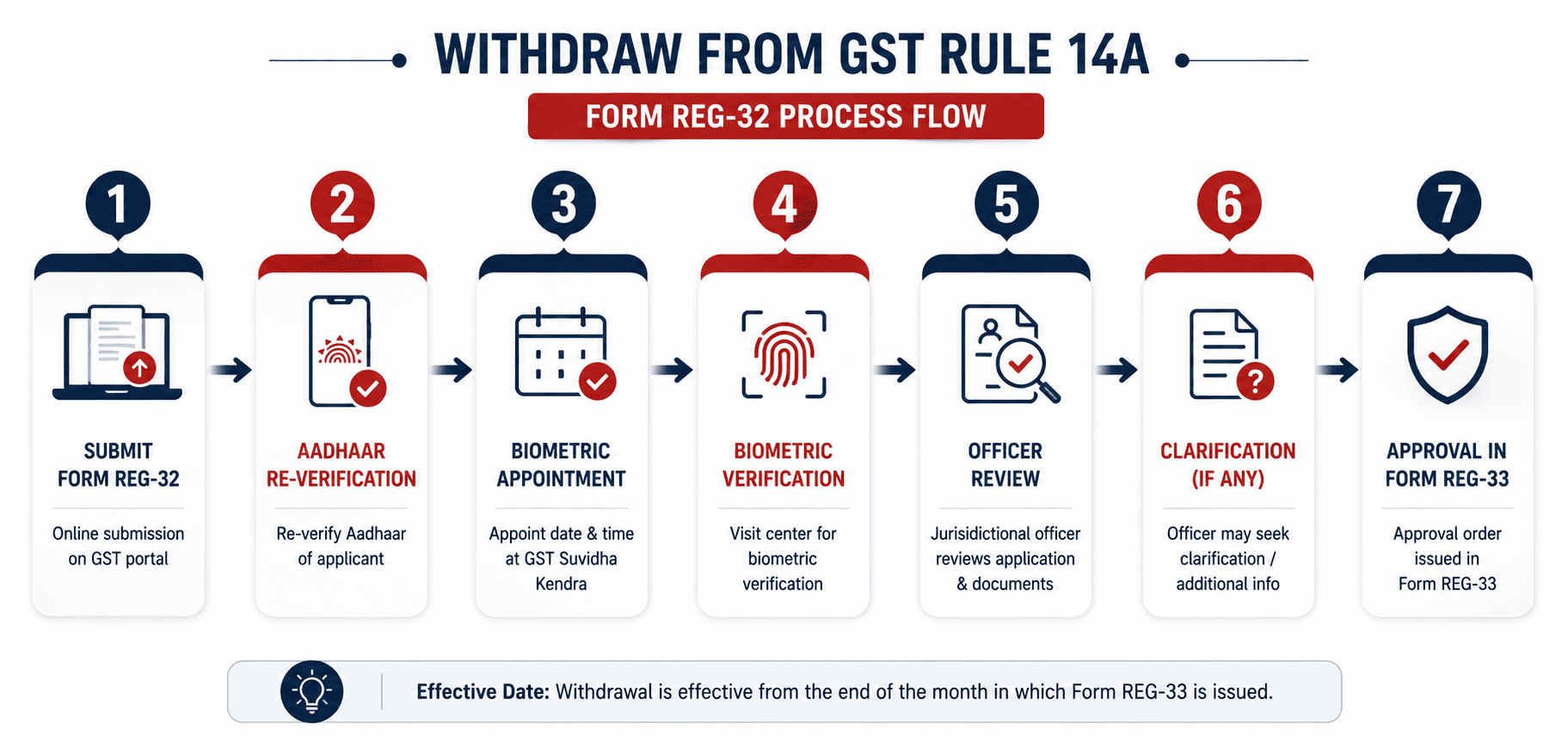
- Clear all pending returns first. As of April 2026 onward, you need at least one tax period’s return filed (one month for monthly filers, one quarter for QRMP filers) before the withdrawal form will accept your application. Before that date, the requirement was three months of filed returns. If you are unsure which threshold applies to your filing cycle, it is worth confirming through your GST filing advisor rather than guessing.
- Log in and navigate to the withdrawal application. Go to Services, then Registration, then Application for Withdrawal from Registration under Rule 14A.
- Select “No” for the Rule 14A option in your business details and pick the reason for withdrawal, typically that your B2B liability has exceeded or is expected to exceed ₹2.5 lakh.
- Complete Aadhaar authentication again. The Primary Authorised Signatory and at least one Promoter or Partner must re-verify.
- Submit and track the ARN. You will usually receive an intimation for biometric authentication or document verification at a GST Suvidha Kendra, so it helps to nominate in advance the person who will attend that appointment.
- Respond to any officer query promptly. If the officer needs more information, they can issue Form GST REG-03, and you get a limited window to reply through Form GST REG-04. A vague or late reply is one of the more common reasons these applications stall. A properly drafted GST notice reply, or professional help through notice reply drafting services, genuinely improves your odds here.
- Wait for the officer’s order. Approval comes through Form GST REG-33. Rejection comes through Form GST REG-05, with reasons stated.
Note that if cancellation proceedings under Section 29 have already been initiated against your GSTIN, you cannot apply for a Rule 14A withdrawal at that point. That situation calls for a different fix, closer to what our guide on GST revocation covers.
When Does the Withdrawal Actually Take Effect?
This is a detail that surprises a lot of business owners. Approval of your REG-32 application does not lift the restriction immediately. You are treated as a normal GST registrant only from the first day of the following month.
For example, if your withdrawal is approved sometime in June, you become a normal taxpayer effective 1 July. That means the June GSTR-1, filed in the first half of July, is the first return where you can report B2B liability above ₹2.5 lakh without a block.
There is a practical workaround worth knowing. If you had invoices from earlier months that got stuck because of the restriction, you can typically report those older invoices in the first GSTR-1 you file after your withdrawal becomes effective, even though they belong to a prior tax period. This does not undo the delay your customers already experienced, but it does mean the invoices are not permanently lost from the system. No new GSTIN gets issued during this process either. Your existing GST number simply gets reclassified as a normal registration.
Rule 14A vs Normal GST Registration: Which One Fits Your Business?
| Feature | Rule 14A Registration | Normal Registration |
| Approval time | Statutory max 3 working days, often 4 to 5 hours | 7 or more working days, plus manual scrutiny if flagged |
| Monthly B2B tax limit | Capped at ₹2.5 lakh | No limit |
| Verification method | Online Aadhaar authentication | Aadhaar plus biometric or physical verification if flagged |
| Best suited for | New, small, low-volume B2B suppliers just starting out | Established or fast-scaling B2B businesses |
| Risk if business grows quickly | GSTR-1 blocking, ITC delays for buyers | None related to output tax liability |
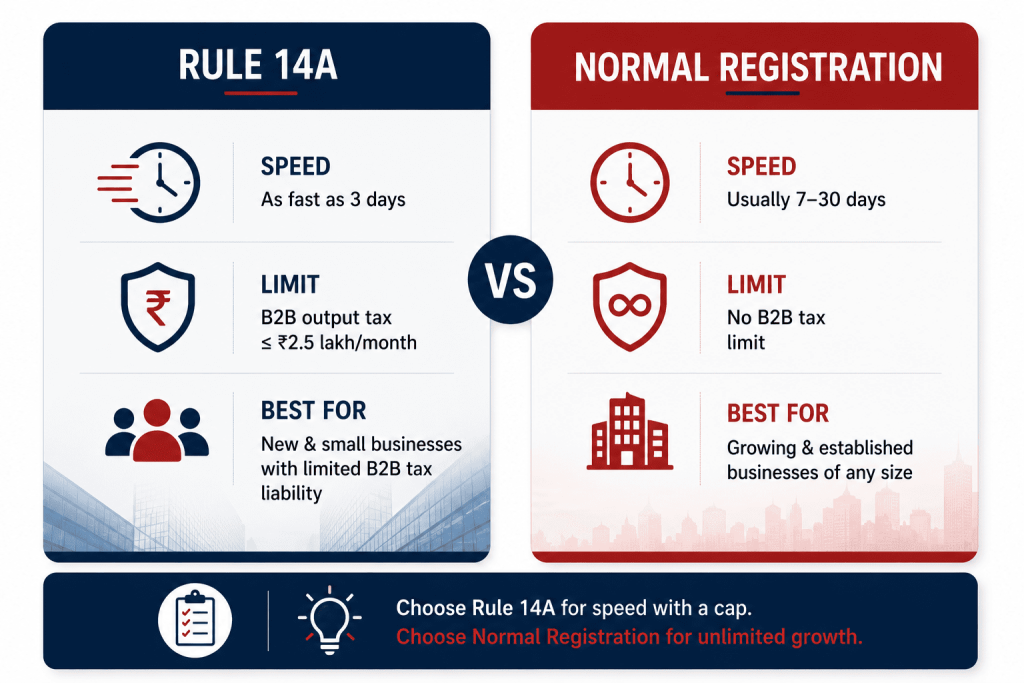
If you are a freelancer, a small consultancy, or a new supplier who genuinely expects to stay under ₹2.5 lakh in monthly B2B tax for the foreseeable future, Rule 14A can save real time and paperwork. If you are launching with investor backing, entering a high-ticket B2B segment, or expect to scale within your first two or three quarters, the standard registration route avoids the whole problem from day one.
What Mistakes Should You Avoid Before Opting for Rule 14A?
The businesses that get burned by this rule almost always share the same pattern. It is rarely about the rule itself being unfair. It is about the option being chosen without a proper projection of near-term volume.
- Do not let a consultant tick the Rule 14A box on your behalf without first estimating your likely tax liability three to six months out, not just at the point of application
- Do not assume “fast approval” and “unrestricted registration” mean the same thing. They are different features of the same form
- Do not wait until GSTR-1 is due to check whether you are close to the ₹2.5 lakh line. Track your running monthly B2B tax liability the same way you track revenue
- Do not treat withdrawal as something you can do overnight if you are already over the limit. Build in the lag between crossing the threshold and the withdrawal actually taking effect
- Do not skip reading the fine print on Form GST REG-01 before signing off. The Rule 14A checkbox looks minor, but it changes your compliance profile permanently until you withdraw
Can You Still Recover ITC and Business Relationships After a GSTR-1 Block?
Yes, but it takes deliberate follow-through, not just patience. Once withdrawal is approved and takes effect the following month, you can file the delayed invoices in that return cycle, and your buyers can then claim ITC on them, subject to the usual time limits under the CGST Act. The credit is not gone, but it is delayed, and delayed credit has a real cost to your buyers’ cash flow. That is usually the part that damages a business relationship more than the compliance issue itself.
If a buyer has already sent a formal query or a notice about missing credit, responding with a clear, factual explanation matters. Vague reassurances rarely satisfy an accounts team that is missing lakhs in expected credit. If your own GSTIN also picks up scrutiny as a result of the delayed filings, proper GST amendment or return correction, done correctly the first time, prevents a second round of the same problem.
And if things escalate to actual cancellation proceedings, understand that revocation and Rule 14A withdrawal are two different processes entirely, with different forms and different timelines. Businesses that keep clean, current GST filing records, supported by proper accounting services, rarely find themselves stuck in this position for long, because they catch the ₹2.5 lakh threshold before it becomes a filing block.
Frequently Asked Questions
Is registering under GST Rule 14A compulsory for small businesses?
No. It is entirely optional. It is offered as a checkbox inside the standard Form GST REG-01 application. You can always choose the normal registration route instead, which carries no B2B tax ceiling but generally takes longer to process.
Can I switch out of Rule 14A voluntarily even if I have not crossed the ₹2.5 lakh limit?
Yes. Withdrawal through Form GST REG-32 is available whether you are exiting because you have exceeded the limit or simply because you no longer want the restriction attached to your registration. The prerequisite return-filing conditions apply either way.
Does the ₹2.5 lakh limit apply per GSTIN or across my whole PAN?
It applies per GSTIN, based on that specific registration’s monthly B2B output tax liability. Separately, the rule also caps you to one Rule 14A registration per State or Union Territory under the same PAN, so a multi-state business could have a Rule 14A registration in one state and a different registration type elsewhere.
What happens to ITC my buyers already claimed if my GSTR-1 gets blocked later in the year?
Credit already reflected in your buyers’ GSTR-2B from returns you filed before hitting the cap is not affected retroactively. The block only stops you from reporting new B2B invoices going forward until withdrawal takes effect, at which point the delayed invoices can be reported and the corresponding credit becomes available to your buyers, subject to normal ITC time limits.
Can a service exporter or an SEZ supplier use Rule 14A?
The cap is specifically tied to output tax liability on B2B supplies made to registered persons. Since exports and SEZ supplies are typically zero-rated, they usually do not push you toward the ₹2.5 lakh limit on their own. That said, eligibility still depends on your overall applicant category, so it is worth getting this confirmed for your specific business structure before applying.
Is there a penalty specifically for crossing the Rule 14A limit?
Rule 14A itself does not prescribe a separate monetary penalty for exceeding ₹2.5 lakh. The consequence is procedural, your GSTR-1 filing gets blocked until you withdraw. However, normal late fee and interest provisions under the CGST Act continue to apply if the resulting delay causes you to miss standard filing deadlines.
Can I hold Rule 14A registrations in two different states under the same PAN?
Yes, the one-registration restriction applies per state, not across your entire PAN. A business with B2B operations in Maharashtra and Gujarat, for instance, could register under Rule 14A separately in each state, provided each registration independently meets the eligibility conditions.
Does my GST certificate look different if I am registered under Rule 14A?
No. The GSTIN format and certificate appearance are identical to a normal registration. The distinction exists at the system level, tied to the option you selected in your original REG-01 application, not as a visible marking on any document.
If I exceed ₹2.5 lakh in just one unusual month, is that a permanent problem?
It creates an immediate filing block for that month, but it is not permanent in the sense of being unfixable. You would still need to go through the standard Form GST REG-32 withdrawal to clear the restriction and resume normal filing, even if your liability drops back below ₹2.5 lakh the following month.
Can a CA or GST practitioner complete the Rule 14A withdrawal application on my behalf?
Yes. Most businesses use a tax professional for this, largely because the Aadhaar re-authentication, biometric appointment coordination, and any officer query through Form GST REG-03 need to be handled carefully and within tight timelines to avoid rejection.
You may also like


What Does Project Logistics Alliance Membership Offer?
Project Logistics Alliance membership offers an Indian project cargo business a