
EPF vs PPF vs SPF vs NPS: Eligibility, Contributions, Returns and Withdrawal Rules
- by kapil
- Updated August 29, 2026
- 13 mins read

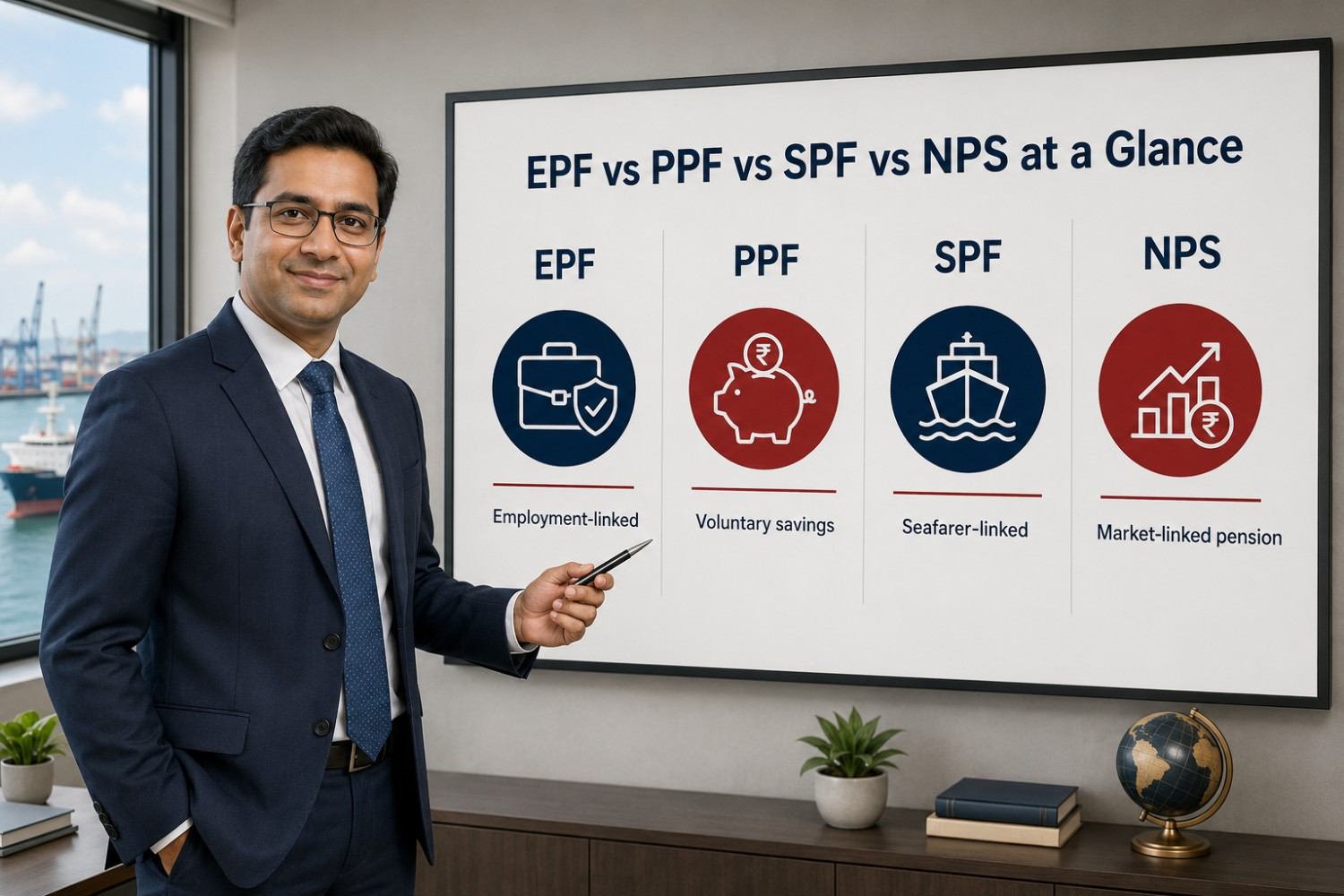
Choosing a retirement fund is not only about comparing interest rates. EPF vs PPF vs SPF vs NPS differ in eligibility, contribution source, return method, access and tax treatment. Here, SPF means the Seamen’s Provident Fund for eligible Indian merchant navy seafarers.
EPF serves covered employees, PPF is a voluntary public savings account, and NPS is a market-linked pension system. This updated guide compares current 2026 rules, including SPFO contributions and claims, revised EPF withdrawals and current NPS exits. It helps seafarers, salaried workers and other savers decide which account, or combination, fits their retirement plan.
EPF vs PPF vs SPF vs NPS at a Glance
Below is the table explaining the schemes at a glance:
| Factor | EPF | PPF | SPF | NPS Tier I |
| Full name | Employees’ Provident Fund | Public Provident Fund | Seamen’s Provident Fund | National Pension System |
| Who can use it | Employees covered by EPF rules | Eligible resident individuals, including a guardian for a minor | Seafarers employed in the Indian Merchant Navy and admitted to SPFO membership | Eligible Indian citizens, NRIs and OCIs aged 18–85, subject to KYC |
| Who contributes | Employee and employer | Account holder or permitted depositor | Seafarer and employer | Individual; employer may contribute in government or corporate models |
| Return basis | Annual EPF rate | Government-notified quarterly rate | Annual rate declared for SPFO balances | Market-linked pension-fund performance |
| Main exit | Retirement or another permitted event | After 15 financial years | SPFO final withdrawal, transfer or death claim | Regulated pension exit; annuity may be compulsory |
The EPF contribution calculator, PPF maturity calculator and NPS retirement calculator illustrate possible outcomes, not guaranteed rates, returns or annuity income.
What does SPF mean?
SPF means the Seamen’s Provident Fund created under the Seamen’s Provident Fund Act, 1966. It is administered by the Seamen’s Provident Fund Organisation under the Ministry of Ports, Shipping and Waterways. It is not the General Provident Fund, and it is not an account the general public can open.
The official SPFO portal provides separate seafarer and employer access. SPFO membership is automatic for seafarers employed in the Indian Merchant Navy and continues until final withdrawal. A member’s Continuous Discharge Certificate, or CDC, is central to account and claim verification.
SPF is a retirement provident fund, not a substitute for every maritime welfare benefit. Eligible seafarers and families should separately check current SWFS welfare schemes for specified death, disability, medical and other support.
Who Can Use Each Retirement Option?
Depending on the eligibility criteria the person can choose their retirement options.
EPF eligibility
EPF generally covers eligible employees of establishments to which the scheme applies. Coverage commonly starts at 20 employees, and compulsory contributions ordinarily use the ₹15,000 monthly wage ceiling.
A new employee above the ceiling who was never an EPF member may be treated differently, so employers should verify membership history before exclusion. The PF registration rules for employers explain establishment coverage and registration.
PPF eligibility
A resident individual can open one PPF account in their own name and may operate one for a minor as guardian. Joint and HUF accounts are not permitted. An NRI cannot open a new PPF account but may continue an account opened while resident until maturity.

SPF eligibility
SPFO states that all seafarers employed in the Indian Merchant Navy automatically become members. The Act links membership to a seafarer holding a CDC and being admitted to the Fund.
NPS eligibility
Under the current PFRDA All Citizen Model, eligible Indian citizens, NRIs and OCIs aged 18–85 may join subject to KYC. Tier I is the pension account.
How Contributions and Returns Differ
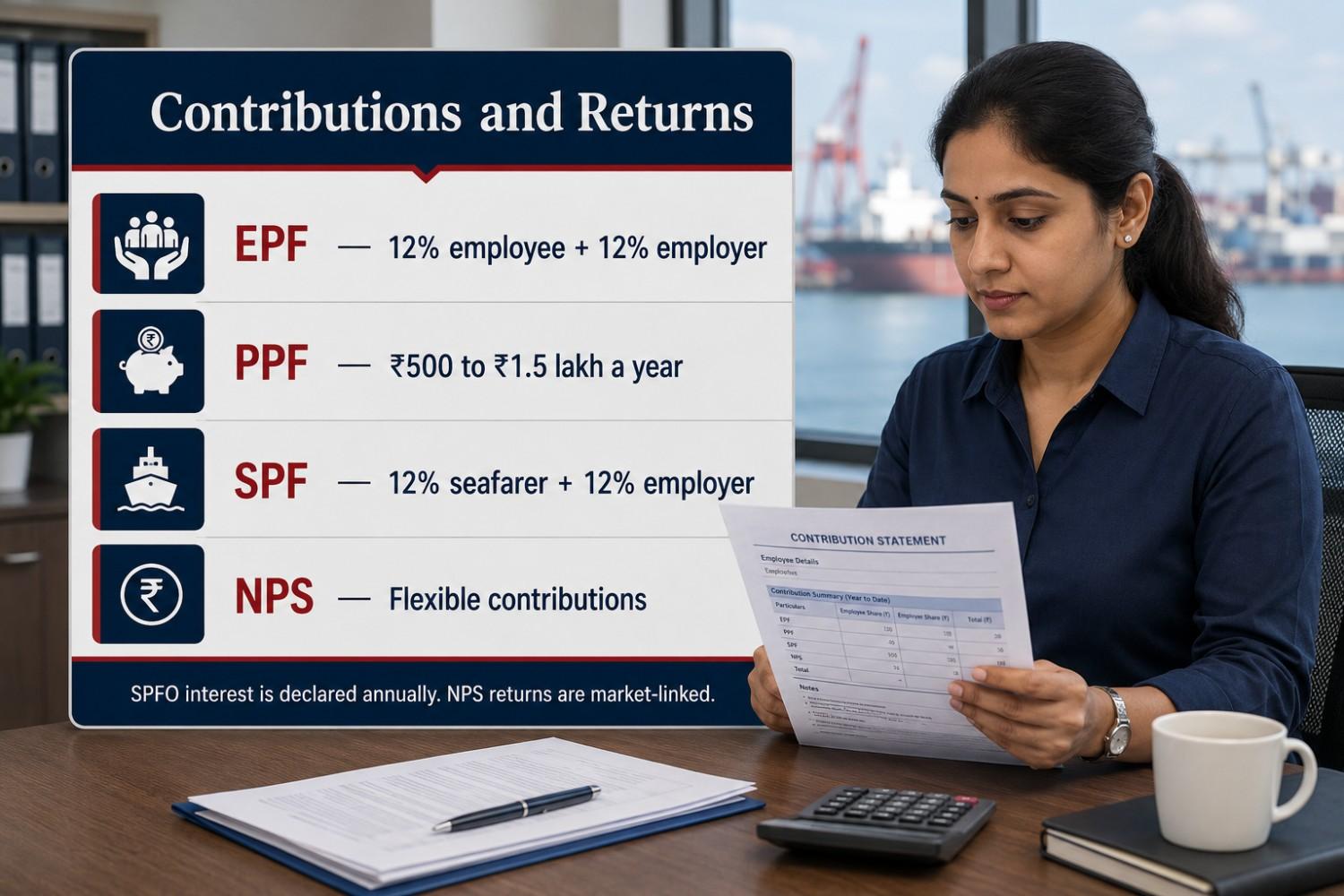
| Option | Contribution rule | Current return position |
| EPF | Employee and employer normally contribute 12% of eligible wages. On the ₹15,000 ceiling, each side’s gross share is ₹1,800, though the employer share is allocated between EPF and pension components as applicable. | 8.25% was recommended for FY 2025–26; final credit follows the notified annual process. |
| PPF | Minimum ₹500 and maximum ₹1.5 lakh in a financial year, including deposits counted across the individual’s own and qualifying minor accounts. | 7.1% for July–September 2026; reviewed quarterly and compounded annually. |
| SPF | Seafarer contributes 12% of wages and the employer matches 12%. Shipping companies remit voyage-linked contributions and account details to SPFO. | Interest is credited at the annual rate declared for SPFO. Do not use an old year’s rate as the current rate unless confirmed in the member statement or latest SPFO circular. |
| NPS | The subscriber chooses contributions; employer terms depend on the government or corporate model. | No fixed return. Performance depends on asset allocation, pension fund, charges and markets. |
SPFO operational material also refers to a 5% administration charge paid by shipping companies. It should not be presented as a deduction from the seafarer’s account balance. Shipping and RPSL businesses can review RPSL annual compliance responsibilities when mapping SPF and other seafarer-related remittances.
Employers should reconcile EPF wage, UAN and payment data through the PF filing process and due dates.
SPF Withdrawal Limits and Claim Process
SPFO allows final withdrawals and specified non-refundable withdrawals, or NRWs. The August 2026 revised checklist provides these practical limits:
| SPF claim ground | Main limit or condition |
| Unemployment | After five years’ membership and more than six months’ unemployment; 10% of the member’s own accumulation |
| Illness | 25% of the member’s own accumulation; generally available once in two years with medical evidence |
| House or flat purchase/construction | After five years’ membership; lower of 36 months’ pay plus leave pay or 75% of member and employer accumulations |
| House repair or renovation | 25% of the member’s own accumulation, subject to the specified gap after an earlier housing withdrawal |
| Marriage or higher education | 50% of the member’s own accumulation; not more than two such withdrawals during membership |
For a living member below 60 seeking final withdrawal, SPFO asks for a CDC cancellation order or a letter from the Shipping Master. A member above 60 can claim on retirement, voluntary retirement or being medically unfit. A deceased member’s nominee or claimant must include the death certificate and claimant bank proof.
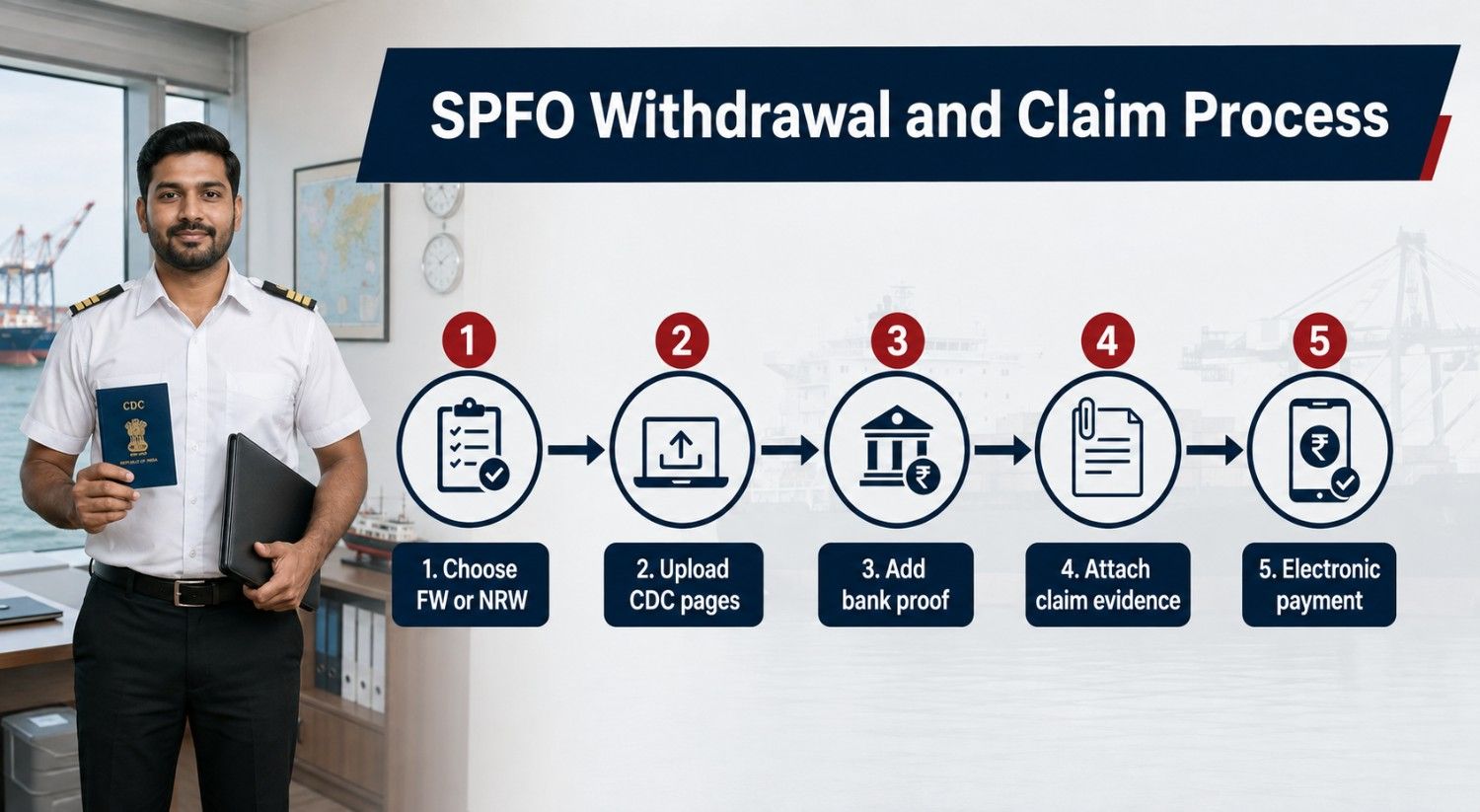
Current SPFO claim checklist
- Apply online through the SPFO seafarer portal and select final withdrawal or the correct NRW ground.
- Upload self-attested copies of all pages of the old and new CDC books, as applicable. The CDC application and records guide explains why this booklet is the seafarer’s core service record.
- Upload a cancelled cheque or a bank passbook copy. The account may be singly operated by the seafarer or jointly held with the nominee.
- Make sure the name on the CDC and bank account matches. Attach address proof when the address differs from SPFO records.
- Add the ground-specific evidence, such as a doctor’s certificate, housing records, CDC cancellation order or death certificate.
SPFO now disburses provident fund dues electronically. A mismatch in the CDC name, bank name, or address, or incomplete pages, can delay verification.
EPF, PPF and NPS Withdrawal Rules Compared
| Option | Early access | Normal exit |
| EPF | Purpose-based partial withdrawals apply. Current rules generally preserve 25% of the balance; during unemployment, 75% may be withdrawn immediately. | Full balance is available on retirement and specified exits. The remaining 25% after unemployment is generally available after one year. |
| PPF | Loans are available from the third to sixth financial year. One partial withdrawal per financial year is available from the seventh year under the prescribed balance formula. | Matures after 15 financial years; withdrawal, continuation or five-year extension may be chosen. |
| NPS | Permitted partial withdrawal is capped at 25% of the subscriber’s own contributions. Before 60 it is allowed up to four times with a four-year gap; after 60, a three-year gap applies without a lifetime count. | Non-government normal exit permits up to 80% lump sum and at least 20% annuity, subject to corpus-band alternatives. Government-sector normal exit generally retains 60:40. |
Premature NPS exit above the prescribed small-corpus limit generally permits only 20% lump sum and requires at least 80% annuity.
Tax Treatment Needs a Separate Check
Tax relief depends on the tax regime, contribution source and exit facts.
- Under the old regime, eligible own contributions to EPF, PPF, SPF and NPS use the shared ₹1.5 lakh deduction ceiling. Eligible NPS contributions may also receive the additional deduction within the separate ₹50,000 limit.
- Employer NPS contribution may qualify separately within the applicable percentage and combined employer-contribution limits. Own contributions generally do not receive the same benefit under the new regime.
- PPF interest and eligible maturity proceeds are exempt.
- The Seamen’s Provident Fund Act deems SPF to be a recognised provident fund. Tax on withdrawal therefore depends on recognised-PF conditions, including qualifying service and the reason for exit; SPF should not be labelled universally tax-free without checking the claim facts.
- Interest attributable to employee provident fund contributions above ₹2.5 lakh a year is taxable where the employer also contributes. The threshold is ₹5 lakh where there is no employer contribution.
- NPS partial withdrawal within the permitted 25% limit is exempt. At final exit, the exemption remains capped at 60% of corpus even though a non-government subscriber may be allowed to take up to 80% as lump sum; annuity income is taxable when received.
Compare the applicable regime with an income tax calculator before contributing only for a deduction.
Can a Seafarer Hold SPF, EPF, PPF and NPS Together?
An SPF member may also open PPF or NPS if independently eligible. A seafarer who later takes a covered shore job may become an EPF member; the accounts do not automatically become one.
Section 19 of the Seamen’s Provident Fund Act permits an SPF balance transfer when the seafarer leaves the profession with no present intention of returning and takes employment covered by EPF. The member must request it, and the receiving provident-fund rules must permit the transfer. Check both authorities before assuming a routine UAN transfer will work.
Which Retirement Option Should You Choose?
| Situation | Practical starting point |
| Active eligible seafarer | Treat SPF as the employment-linked base. Verify voyage contributions and nomination, then consider PPF for stable savings or NPS for market-linked retirement exposure. |
| Private employee covered by EPF | Preserve and transfer EPF across jobs. Add PPF or NPS only after keeping an emergency fund. |
| Self-employed saver | EPF and SPF are unavailable without qualifying employment. Compare PPF’s fixed structure with NPS market risk and pension lock-in. |
| Seafarer moving permanently ashore | Check the statutory SPF-to-EPF transfer route before requesting final withdrawal. Tax and continuity can differ from a cash settlement. |
| Saver needing short-term liquidity | Do not use any of these as the only emergency reserve. Every option has withdrawal conditions or long lock-in. |
Start with years to retirement, emergency savings, expected pension needs and risk capacity. A retirement planning calculator can test contribution scenarios, while a salary and take-home calculator can show the monthly effect of employment-linked deductions.

Mistakes That Can Delay Claims or Reduce Value
- Reading SPF as Statutory Provident Fund: For this comparison it means Seamen’s Provident Fund.
- Using an old SPFO interest rate: Confirm the declared year and member statement before comparing returns.
- Ignoring voyage entries: Match CDC service, employer remittance and SPFO balance periodically.
- Submitting mismatched bank records: The CDC and bank-account names should agree for an electronic claim.
- Treating SPF and SWFS as the same: They cover different benefits and use different claim conditions.
- Applying NPS 80:20 to tax: Withdrawal permission and tax exemption are separate rules.
Conclusion: Build Around Eligibility First
The EPF vs PPF vs SPF vs NPS decision starts with employment. SPF is the Seamen’s Provident Fund for eligible merchant-navy seafarers; EPF serves covered employees; PPF is voluntary and stable; NPS is market-linked and pension-focused. Preserve employer contributions, check liquidity and then compare returns and tax.
Seafarers should keep CDC, nomination, bank and voyage records consistent and use the statutory transfer route when moving permanently to covered shore employment. Add PPF or NPS only when the extra lock-in fits the wider retirement plan.
FAQs About EPF vs PPF vs SPF vs NPS
What should I do if two UANs were created after changing jobs?
An employee should normally have one permanent UAN covering different employment-related Member IDs. Transfer the balance from the previous Member ID to the active EPF account instead of submitting separate withdrawal claims. If Aadhaar, name, date of birth or other details do not match, correct the records first and use EPFiGMS if the transfer remains blocked.
Can I stop EPF contributions after my salary exceeds ₹15,000?
An existing EPF member cannot normally discontinue membership while remaining in covered employment. The ₹15,000 wage ceiling affects how the statutory contribution may be calculated; it does not automatically end membership when salary increases. EPFO specifically states that discontinuing membership during employment is not permissible.
Is VPF the same as PPF?
No. Voluntary Provident Fund, or VPF, is an additional employee contribution made through an existing EPF account, and the employer is not required to match the voluntary excess. PPF is a separate individual account with its own ₹1.5 lakh annual limit, deposit conditions and 15-financial-year maturity structure.
Should I invest in PPF if my EPF contribution already exhausts the Section 80C limit?
An additional PPF deposit will not create another deduction beyond the combined Section 80C limit under the old tax regime. However, a person may still use PPF for government-backed, tax-exempt long-term debt allocation. The decision should depend on liquidity and portfolio requirements rather than the deduction alone.
What happens if I forget to deposit ₹500 in my PPF account for one year?
The PPF account becomes discontinued when the prescribed minimum annual deposit is not made. It may be revived during its maturity period by paying ₹50 for each default year and depositing the required minimum amount for every missed year. Regular withdrawal and loan facilities may remain restricted until revival under the Public Provident Fund Scheme.
Must a PPF deposit be made before 5 April?
Depositing before 5 April is not an eligibility requirement, but it can maximise interest when making a yearly lump-sum deposit. PPF interest is calculated using the lowest balance between the close of the fifth day and the end of each month. The amount must therefore be credited to the PPF account by the fifth day to earn interest for that month.
Can an EPF balance be transferred into SPF when someone returns to seafaring?
The Seamen’s Provident Fund Act expressly provides a conditional route for transferring SPF into EPF when a seafarer permanently moves to covered shore employment. It does not provide an equivalent routine EPF-to-SPF transfer route. A returning seafarer should keep the accounts separate and obtain written guidance from SPFO and EPFO before attempting any withdrawal or transfer.
Does an NPS subscriber need a new PRAN after changing jobs?
No. The Permanent Retirement Account Number is portable across employers, locations and eligible NPS models. A corporate subscriber may need the new employer or Central Recordkeeping Agency to update the employment association, but opening another PRAN is generally unnecessary.
Must an individual contribute to NPS Tier I every month?
NPS Tier I does not require an individual subscriber to contribute every month. The official NPS FAQ currently specifies a minimum contribution of ₹500 per transaction and a minimum total contribution of ₹1,000 in a financial year. Corporate or government payroll contributions may follow a different schedule based on the applicable employment model.
Is the NPS annuity rate the same as the return earned before retirement?
No. The NPS corpus grows according to market-linked pension-fund performance, while the annuity is purchased separately at exit. The pension amount depends on the prevailing annuity rate, subscriber’s age, selected provider and options such as spouse pension or return of purchase price. PFRDA advises subscribers to compare the rates and conditions offered by different annuity service providers.
You may also like


What Should Taxpayers Know About Income Tax Rules 2026?
The Income Tax Rules 2026 have changed the working language, form numbers and r