

Hotel Registration is an important part of opening a hotel, but the first check should concern the property itself. Before committing to a lease or renovation, establish whether the building can lawfully accommodate your proposed rooms, kitchen, restaurant and other facilities. Registering a company cannot resolve an unauthorised floor or missing occupancy permission.
Hotel Registration in India involves several separate decisions. Hotel business registration identifies the operator, local approvals cover the premises and activities, and Ministry of Tourism classification assesses facilities and service standards.
This guide explains the hotel registration process, documents, food and fire approvals, published fees and ongoing responsibilities. It also distinguishes NIDHI registration from permission to operate, helping you identify which applications belong in your opening plan and which assessments serve a different purpose.
Is Hotel Registration Enough to Open Your Hotel?
No. Hotel Registration in India is an umbrella expression for approvals that serve different purposes. There is no single national hotel licence in India that automatically covers the operator, building, kitchen and every additional facility.
Start by identifying the permissions for your property and business model. An accommodation-only guesthouse, a hotel serving breakfast and a resort with a bar require different assessments of hotel licence requirements.
|
Registration or approval |
What it addresses |
|
Hotel business registration |
The identity and structure of the operator |
|
Local trade or tourism approval |
The specified activity under applicable local or state rules |
|
Food registration or licence |
Food preparation, service, storage or sale |
|
Fire NOC for hotels |
Applicable fire and life safety requirements |
|
A tourism-unit record and unique identification |
|
|
Hotel classification in India |
Facilities and service standards under the Ministry's voluntary scheme |
The hotel registration process should therefore begin with an approval checklist. Record the authority, prerequisite documents and decision needed for each application. For the ownership decision, LegalBabu's business structure comparison guide explains the available structures.
Which Hotel Registration Requirements Apply to Your Property?
Your hotel registration requirements depend on the location, approved use, accommodation category and services offered. For Hotel Registration in India, establish these details before purchasing equipment or accepting a promised opening date.
Confirm permitted use and building approvals
When assessing a hotel licence in India, obtain the sanctioned plans, land-use permission and occupancy records applicable to the premises. Compare the approved floors and layout with the proposed guest rooms, kitchen, exits and public areas.
For example, a floor shown as parking on the approved plan needs attention before it becomes guest accommodation. Hotel licence requirements cannot be assessed from the lease alone. Keep these property records with your hotel registration documents.
Identify the operator and local licensing route
Hotel business registration should identify the person or entity that will hold the approvals. Match that identity across the lease, PAN and applications. If you choose a company, review LegalBabu's private limited company registration service separately from premises permissions.
For a hotel licence in India, check the municipality, tourism department and other competent authorities. LegalBabu's local trade licence guide explains this premises-level permission.
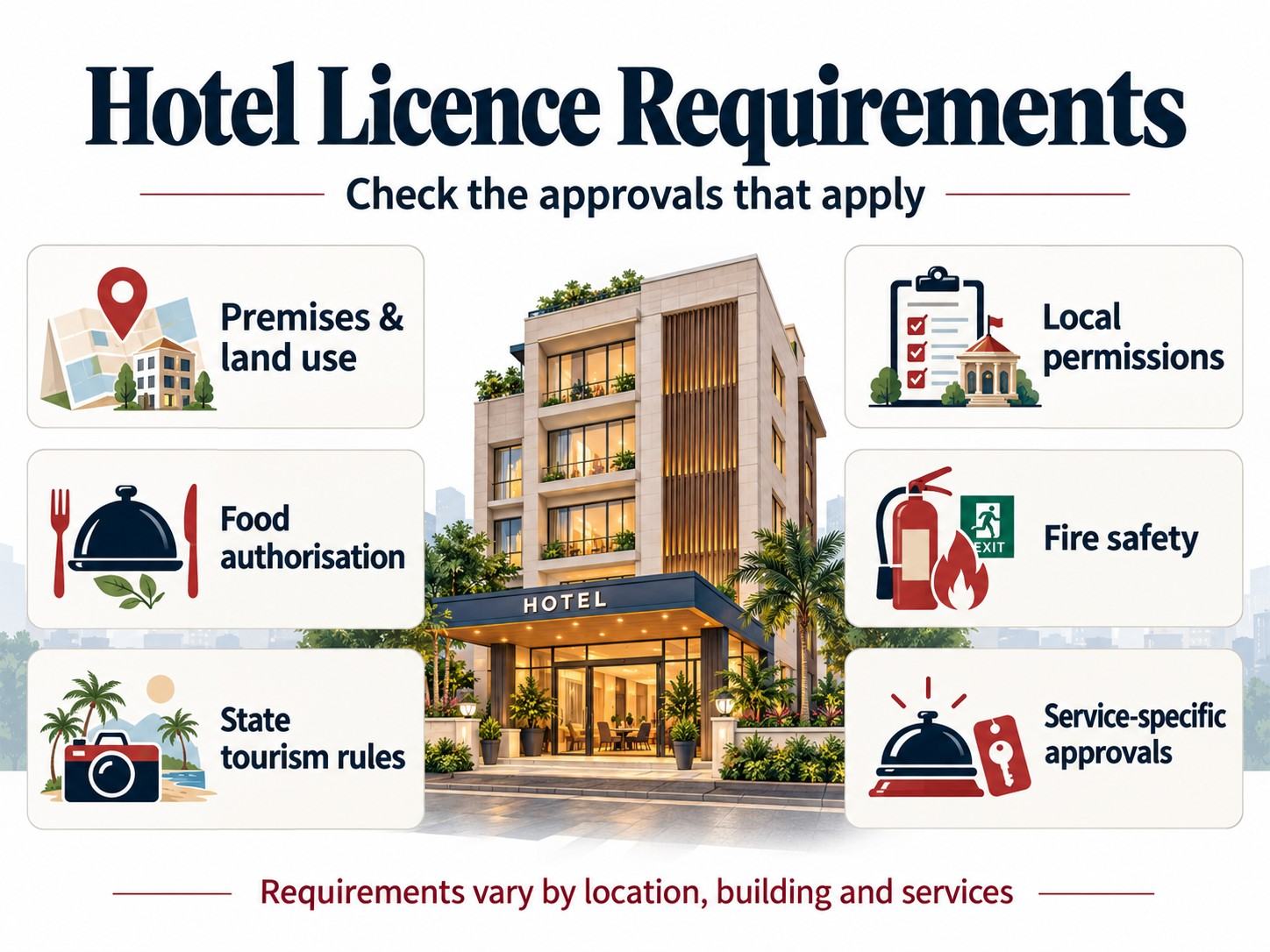
Local reforms matter too. MCD's current orders provide a deemed health-trade-licence arrangement for specified FSSAI-covered food businesses. That arrangement retains other statutory obligations and should not be treated as clearance for every lodging activity. Use the current trade category when checking hotel registration requirements.
Assess fire safety, lifts and environmental permissions
A fire NOC for hotels concerns the building and its prescribed safety measures. Delhi Fire Service describes separate stages for plan recommendations and the final certificate for covered buildings. Installing extinguishers alone does not complete that assessment.
Where lifts are installed, check installation permission, inspection and operating authorisation. LegalBabu's lift installation licensing guide covers that separate requirement.
Check wastewater, sewage treatment, generator emissions and location-specific environmental conditions. In Maharashtra, assess consent applicability through the pollution board's current classification and procedures. LegalBabu's MPCB consent application guide explains Consent to Establish and Consent to Operate.
Assess an FSSAI licence for hotels if food is prepared, stored, served or sold. A bar, swimming pool or other additional facility may introduce further hotel licence requirements. NIDHI registration does not settle these permissions.
How Do NIDHI Registration and Hotel Classification Differ?
NIDHI registration records the establishment on the National Integrated Database of Hospitality Industry. The Ministry describes PAN verification, email and mobile OTP authentication, applicable FSSAI verification and State Nodal Officer verification before issuing the unique identification.
Use contact details you control when completing NIDHI registration. An online entry awaiting verification should not be described as completed Ministry classification.
Hotel classification in India assesses an operational hotel's facilities and service standards under a voluntary Ministry scheme. It is separate from state tourism registration and a hotel licence in India.
The official NIDHI portal confirms that voluntary construction-stage project approvals ended on 16 March 2026, with pending applications closed. Older project-approval instructions should not be used for a fresh application.
The standard operational classification checklist specifies at least ten lettable rooms with outside windows or ventilation. That is a criterion for hotel classification in India, rather than a national minimum for every guesthouse. Smaller properties should examine the appropriate accommodation scheme and local hotel registration requirements.
Which Hotel Registration Documents Should You Prepare?
Prepare hotel registration documents against each authority's current checklist. The following groups help organise the file, but they are not a universal statutory list for Hotel Registration in India.
|
Document group |
Records to check |
|
Operator |
PAN, identity records, incorporation or partnership papers and applicant authorisation |
|
Premises |
Ownership evidence or executed lease, owner consent and property-tax records where requested |
|
Building |
Site plan, approved construction plan, land-use and occupancy permissions |
|
Safety and services |
Applicable fire NOC for hotels, health clearances, lift records and environmental permissions |
|
Food business |
Application details and supporting records for the applicable FSSAI licence for hotels or registration |
|
Classification |
Room details, facilities, services and evidence supporting the category sought |
Goa's published checklist includes public-liability insurance and house-tax evidence. For rented premises, it lists an executed lease or rent agreement and owner NOC. Specified residential units used for tourism also require society or association consent.
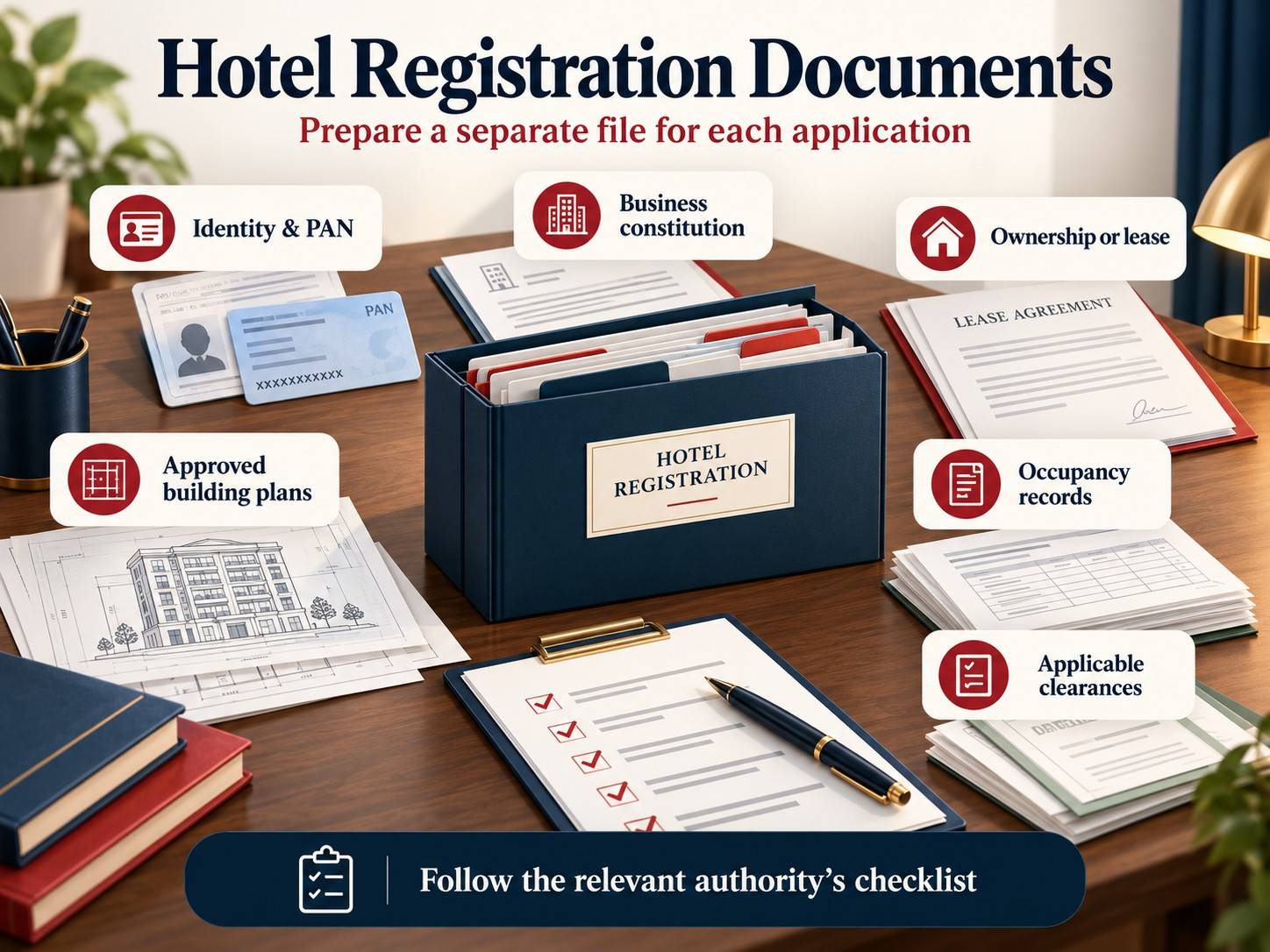
These examples show why hotel registration documents must follow the jurisdiction. Keep hotel business registration papers consistent with the named applicant. LegalBabu's essential business documents guide covers supporting agreements and records.
How Does the Hotel Registration Process Work?
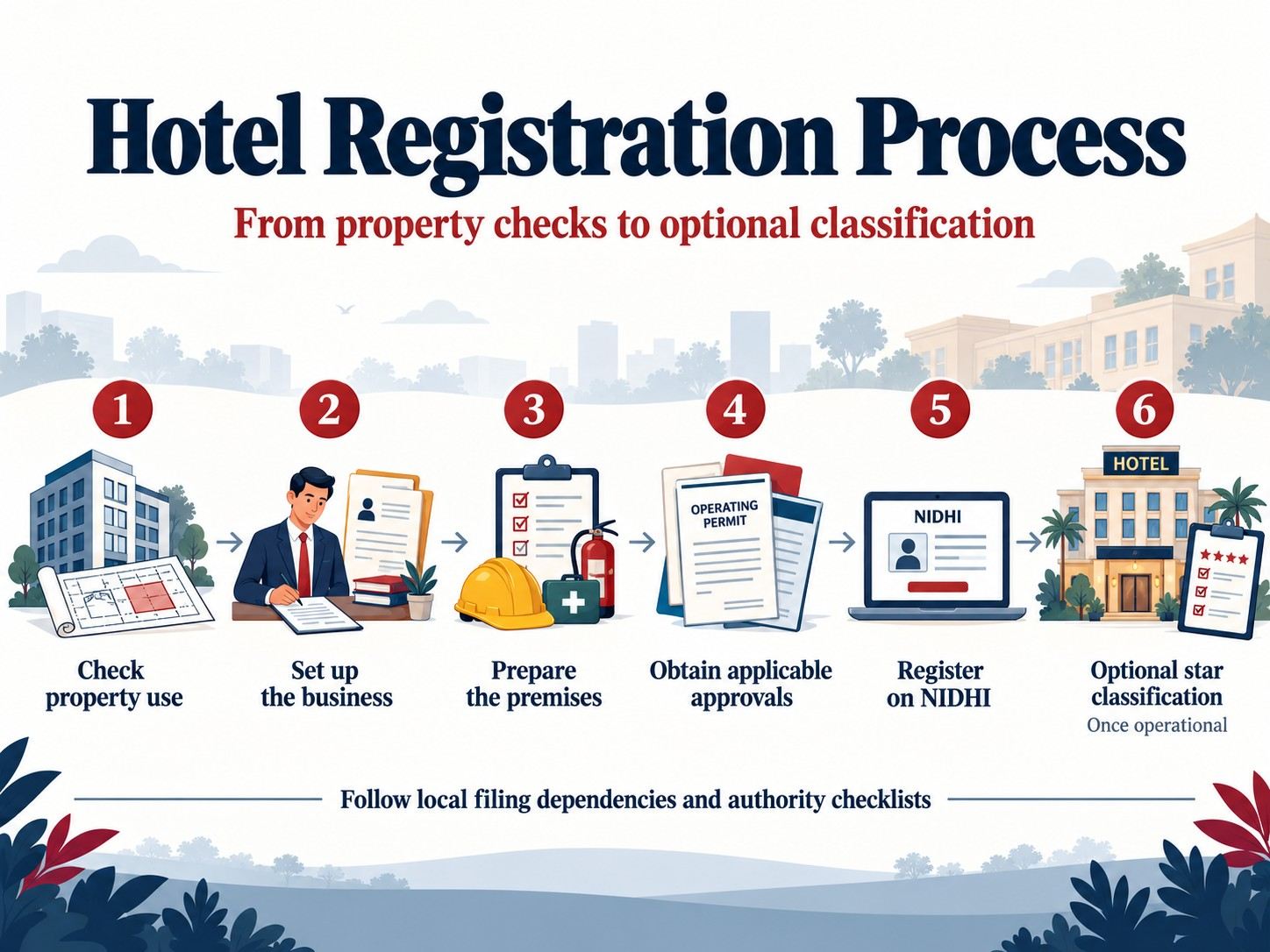
The hotel registration process follows the dependencies of the applicable authorities. The sequence below is a planning framework, with Goa's published tourism workflow illustrating the filing stage.
1. Check the property before committing funds
Collect the sanctioned plans, occupancy evidence and premises documents. Identify alterations or uses that need the competent authority's attention. Establish the hotel registration requirements for the actual property before finalising renovation plans.
2. Establish the applicant and approval checklist
Complete the relevant hotel business registration arrangements and identify the authorised applicant. Map the hotel licence requirements to each department and proposed activity. Check that names, addresses and premises descriptions match across the applications.
3. Complete prerequisite works and clearances
Address the recommendations needed for a fire NOC for hotels and other applicable building or environmental approvals. Keep evidence of completed work and inspection responses. Update hotel registration documents whenever the approved layout changes.
4. File the local tourism and food applications
Goa's portal directs applicants through Services, All Services and Tourism to the relevant accommodation-registration service. Select the accommodation type, enter the details, upload self-attested records and retain the acknowledgement. The published workflow provides for a decision notification and certificate download after successful fee payment.
Apply separately for the appropriate FSSAI licence for hotels or registration through FoSCoS. LegalBabu's food business licensing guide explains that authorisation.
5. Complete the tourism database verification
For NIDHI registration, provide accurate operator and establishment details. Complete OTP authentication and the applicable verification requirements. Track this record separately from permission to operate under local rules.
6. Apply for classification when operational
For hotel classification in India, select the appropriate operational category and prepare its evidence. Submit the prescribed application and fee, then remain ready for assessment by the Hotel and Restaurant Approval and Classification Committee. A pending application does not establish an awarded star category.
Which FSSAI Licence for Hotels Applies in 2026?
Choose an FSSAI licence for hotels using the current hotel-specific eligibility schedule. Do not copy an old restaurant turnover table into your hotel registration process.
FoSCoS's published hotel schedule, updated on 1 April 2026, lists the following categories and annual government fees:
|
Hotel schedule entry |
Authorisation |
Annual fee |
|
Five star and above |
Central licence |
₹7,500 |
|
Up to four star |
State licence |
₹5,000 |
|
Annual turnover up to ₹1.5 crore |
Registration, where eligible |
₹100 |
Apply the hotel's actual activities and category when resolving the correct route. The registration band should not be read in isolation from the hotel-specific licensing entries.
The official FSSAI reform FAQs explain the 2026 transition and perpetual validity. Authorisations issued on or after 1 April 2026 have perpetual validity unless suspended, cancelled or surrendered. Annual fees and food-safety obligations continue.
Existing operators should follow FoSCoS migration instructions rather than assume that a fresh FSSAI licence for hotels is needed. Keep the food-authorisation record within your hotel registration documents.
An FSSAI hygiene rating assessment evaluates hygiene practices under a separate voluntary scheme. Likewise, HACCP food safety certification addresses food-safety controls. Neither replaces the applicable food authorisation or other hotel licence requirements.
What Does Hotel Registration in India Cost and How Long Does It Take?
There is no single government fee for a hotel licence in India. Separate hotel business registration, local permissions, food authorisation and optional classification when reviewing a quotation.
The Ministry's operational scheme publishes these application fees for hotel classification in India:
|
Category |
Classification or reclassification fee |
|
One star |
₹6,000 |
|
Two star |
₹8,000 |
|
Three star |
₹10,000 |
|
Four star |
₹15,000 |
|
Five star |
₹20,000 |
|
Five-star deluxe |
₹25,000 |
These amounts were checked on 29 October 2026. They are classification application fees, not the total cost of Hotel Registration in India. The scheme prescribes electronic payment with the application.
Goa publishes ninety days for its accommodation-registration service, while DNH and DD's published hotel-registration procedure specifies twenty-one days. Neither period represents the complete hotel registration process, including prerequisite approvals.
Request separate entries for government fees, professional charges, inspection-related work and recurring payments. Identify any charge quoted for NIDHI registration separately. Do not assume that an FSSAI licence for hotels or fire NOC for hotels is included unless the scope expressly covers it.
What Must You Maintain After Opening?
Hotel registration requirements continue beyond the initial certificate. Assign responsibility for expiry dates, reporting, staff records and changes to the premises.
Track validity and changes
Hotel classification in India is valid for five years under the operational guidelines. Complete reclassification documentation at least six months before expiry. Delhi's fire-safety certificate for hotels has three-year validity unless cancelled earlier, with renewal applications required at least six months before expiry.
These are specific schemes, not one national renewal period. Review the conditions of your fire NOC for hotels, local certificates and hotel registration documents individually. Perpetual food-authorisation validity does not extend another approval.
Keep tax and employment compliance separate
Hotel business registration does not settle GST liability. Review the applicable GST registration application requirements and arrange GST return filing support where needed. Do not use a Ministry star category as a substitute for checking tax rules.
Check state labour-registration coverage through the Shops and Establishments guide. Assess employer provident fund registration and employee state insurance registration against the applicable coverage conditions. Plan attendance, wage and employment records through a labour law compliance review before recruitment begins.
Prepare reception and protect the hotel name
Current foreign-guest reporting uses Form III, earlier called Form C. Rule 17 of the Immigration and Foreigners Rules, 2025 requires electronic reporting within twenty-four hours of arrival and departure. The framework includes OCI cardholders.
Arrange portal access and a responsible reception employee before accepting these guests. Separately, review Class 43 hospitality trademarks when protecting the hotel's name. LegalBabu's trademark protection in India guide explains the wider brand-protection issues. Trademark registration serves a different purpose from operating permission.
What Can Delay Approval or Lead to Regulatory Action?
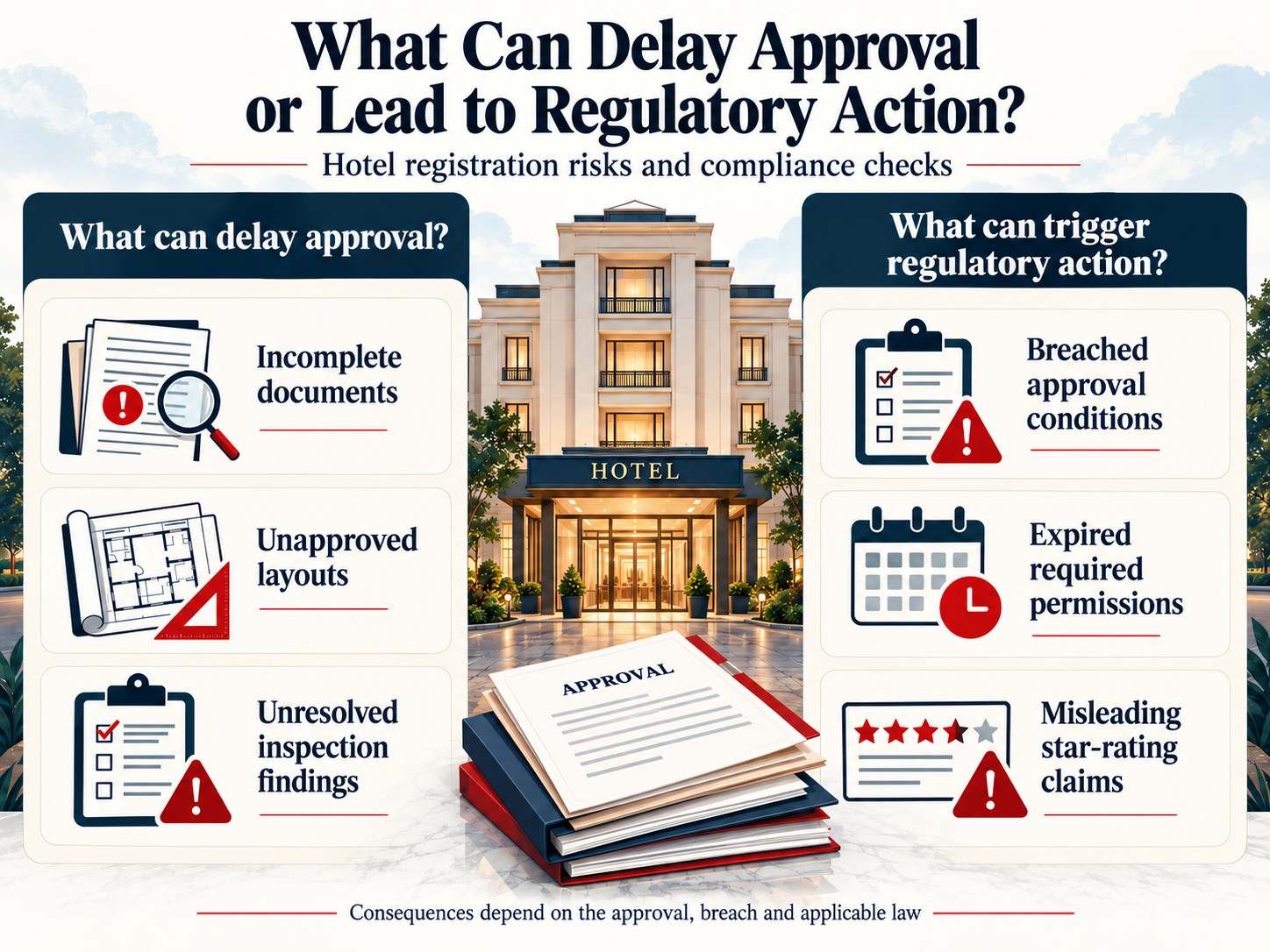
A hotel licence in India can involve several dependent decisions. An incomplete lease file, inconsistent plans or unresolved inspection findings need correction before the next application can progress.
-
Match hotel registration documents to the operator and actual premises.
-
Confirm current hotel licence requirements after adding rooms, food service or a bar.
-
Respond to inspection observations with the specific evidence requested.
-
Check approval and payment status before paying again.
-
Keep claims about classification consistent with the awarded status.
The Ministry's classification guidelines provide for rejection if required deficiencies are not rectified within the specified period, which cannot exceed three months. Serious complaints can also result in withdrawal of Ministry approval. Local licensing and food-safety action follow their own governing provisions.
There is no reliable nationwide penalty figure for every failure in Hotel Registration in India. Identify the breached approval, authority and applicable law before assessing the consequence.
Conclusion
Hotel Registration should begin with a practical check of the property and proposed operation. Establish the hotel registration requirements before fixing the opening date, then organise the hotel licence requirements and evidence for each authority.
Keep hotel business registration, local operating approvals, NIDHI registration and hotel classification in India distinct. A useful hotel registration process closes identifiable gaps, including missing occupancy records, incomplete safety work and inconsistent hotel registration documents. After opening, maintain the conditions attached to each approval and update affected records when the business changes.
FAQS
FAQs About Hotel Registration
-
Can I complete Hotel Registration in India for a rented property?
Yes, published state checklists provide for leased premises. Goa requests an executed lease or rent agreement, owner NOC and house-tax evidence. Confirm the remaining hotel registration requirements because tenancy evidence alone does not establish building or operating approval.
- Does a small hotel need a star certificate for food licensing?
- Can I appeal a Ministry star-classification decision?
- Does an accommodation-only property need an FSSAI licence?
- Can I use the previous operator's fire certificate after takeover?
- What if my NIDHI application remains unverified?
- What if payment succeeds but the certificate is unavailable?
- Must every hotel obtain a police licence?
- What should I update if the hotel's legal name changes?
- Does paying several years of FSSAI fees renew my other approvals?


