
An FSSAI Hygiene Rating can be worthwhile when your food business wants customers to see independently assessed hygiene standards and your team will act on the findings. Its value comes from verified kitchen practices, rather than simply displaying a certificate. The FSSAI Hygiene Rating Scheme covers eligible food outlets and remains voluntary under the national scheme. Importantly, the current official portal has removed the business self-inspection stage, placing the inspection process with audit agencies.
This guide explains eligibility, preparation records, agency selection, application steps, scoring, costs and validity. It also shows how to judge whether the audit is a sensible investment for your restaurant, bakery, sweet shop or meat retail outlet.
Is an FSSAI Hygiene Rating Worth It for Your Business?
Yes, if you want a structured assessment of food hygiene and can maintain the practices afterwards. The FSSAI Hygiene Rating Scheme is intended to help consumers make informed choices and encourage outlets to improve standards. It does not promise additional sales, delivery orders or a particular return on your spending.
For an owner considering hygiene rating for restaurants, the practical benefit is a clear record of what needs attention. You can use the findings to assign cleaning responsibilities, strengthen food handling and check whether staff follow procedures during busy shifts.
The food hygiene rating India’s scheme provides is evidence about an assessment, rather than a taste review. Before paying for FSSAI hygiene certification, consider whether you have the budget to correct the issues an audit may identify. FSSAI recognised audit agencies assess compliance, rather than sell a guaranteed score.
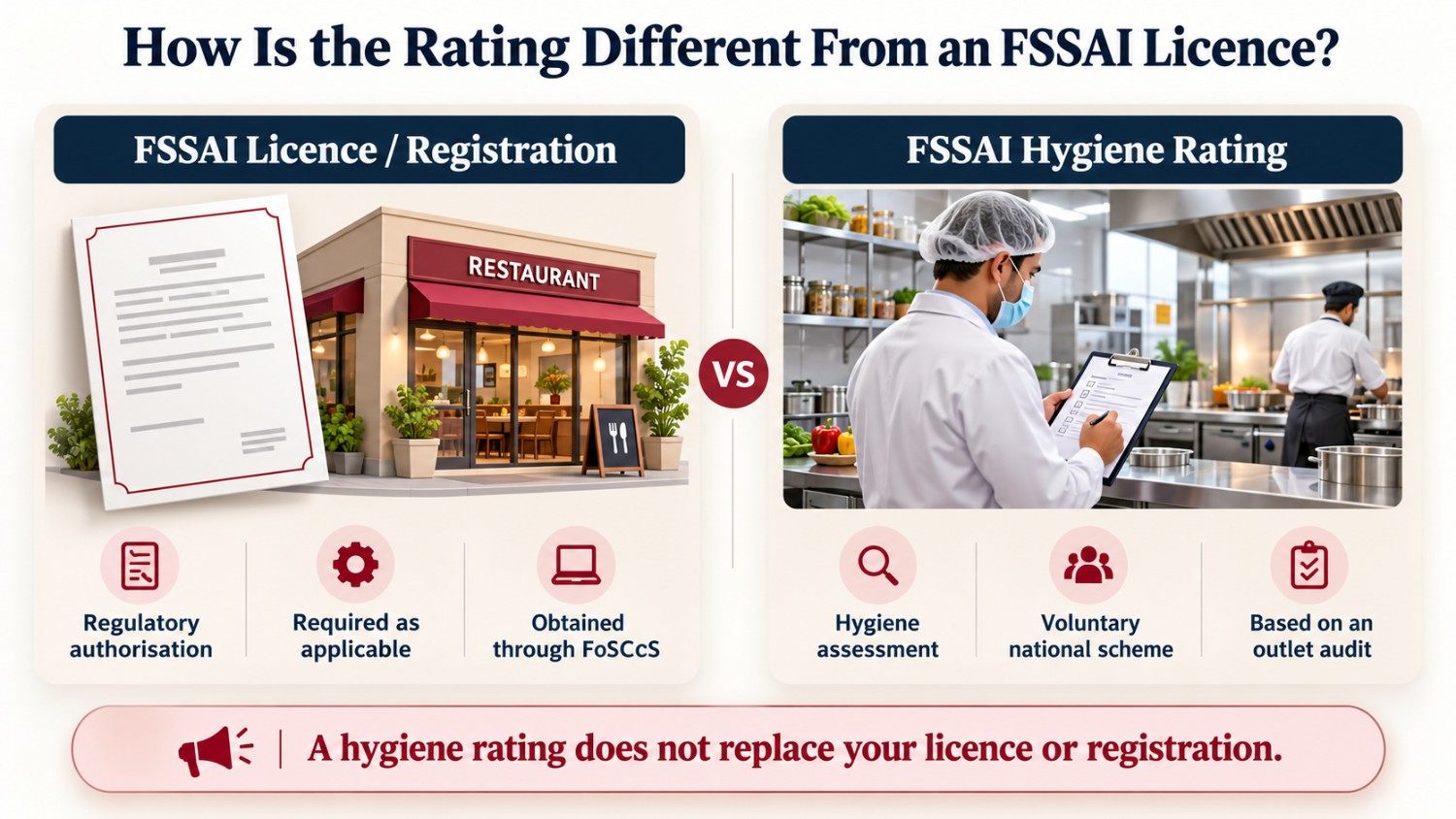
How Is the Rating Different From an FSSAI Licence?
The two serve different purposes. Your FSSAI food licence guide explains the underlying licensing route, while the rating evaluates hygiene conditions at the outlet.
|
Requirement or assessment |
What it addresses |
|
FSSAI licence or registration |
The food business’s regulatory licensing or registration status |
|
Hygiene rating |
Hygiene and food safety conditions observed at assessment |
|
ISO 22000 certification |
A food safety management system assessed against the standard |
“FSSAI hygiene certification” is a common search expression, but identify the actual scheme before purchasing any service. A FoSTaC training certificate, laboratory report and hygiene rating certificate are different documents.
A rating also does not replace a separately mandated third-party food safety audit. If a buyer requires ISO food safety management, confirm that requirement independently. Hygiene rating for restaurants should not be offered as a substitute for another specified certification.
For premises-level permissions, review the trade licence requirements guide separately when checking your outlet’s wider compliance needs.
Which Food Businesses Can Apply?
The FSSAI Hygiene Rating Scheme identifies these categories:
-
Food service establishments, including hotels, restaurants, cafeterias and dhabas
-
Bakeries
-
Sweet shops
-
Meat retail shops
Both FSSAI-licensed and registered outlets can participate when the prerequisites apply. The FSSAI Hygiene Rating Scheme is not described as a blanket certification route for every food manufacturer or warehouse. Check any current state-specific direction or buyer condition separately from the national scheme’s voluntary status.
For a cloud kitchen or mixed manufacturing-and-retail business, ask a Hygiene Rating Audit Agency to confirm the category and checklist before booking. An FSSAI hygiene rating application should identify the actual premises and activity being assessed.
Businesses comparing FSSC food safety certification should assess that separate scheme against their operations and buyer requirements. Do not assume that buying FSSAI hygiene certification automatically meets them.
What Requirements and Records Should You Prepare?
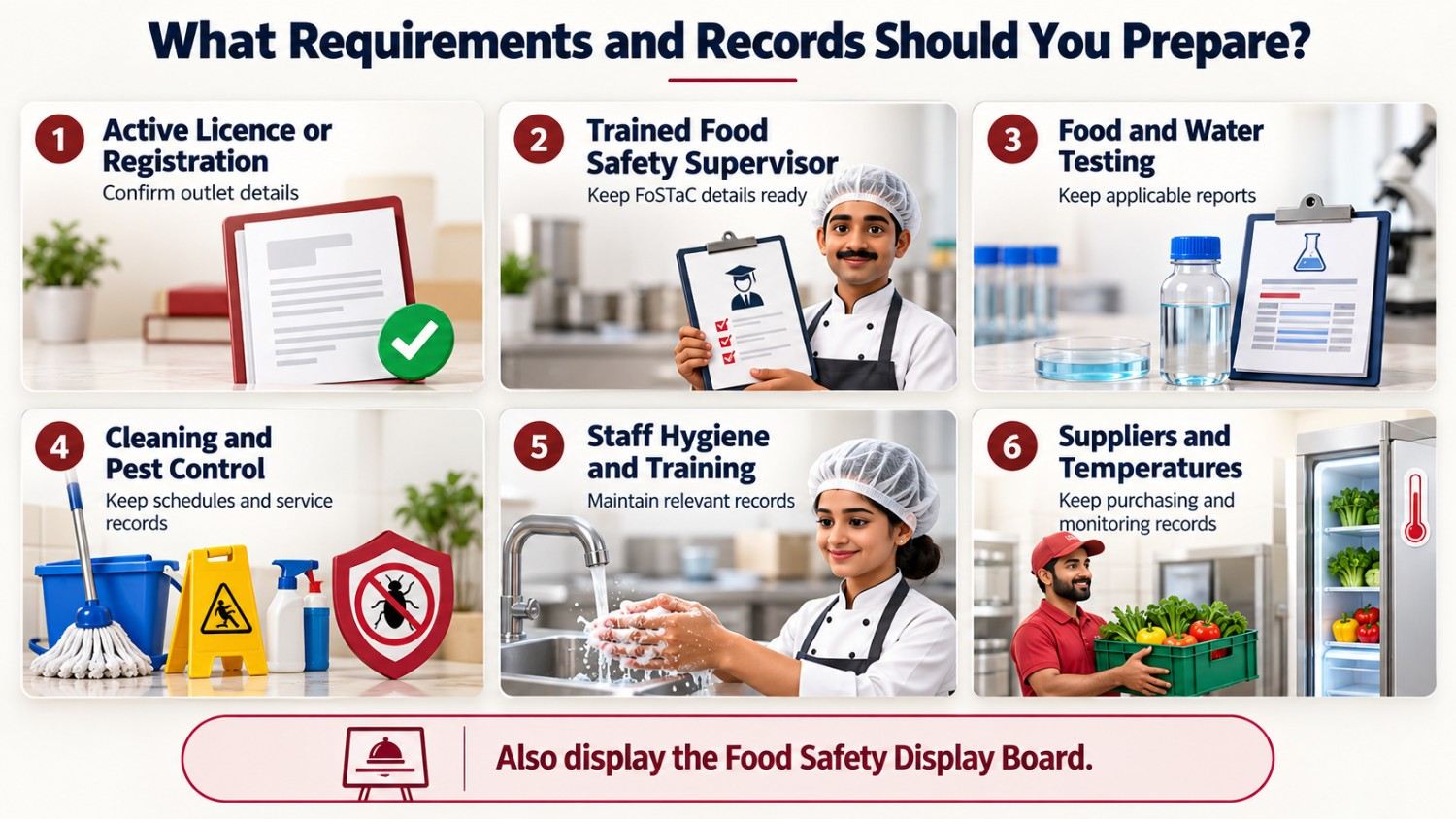
The current FSSAI portal requires an active licence or registration, compliance with Schedule 4, Food Safety Display Boards and FoSTaC-trained Food Safety Supervisors. Periodic food and water testing is specified for licensed food businesses.
FSSAI’s FoSTaC guidance specifies at least one trained and certified supervisor for every 25 food handlers, or part thereof, at each centrally or state-licensed premises. The supervisor should train food handlers, so a certificate held by an absent employee is not a useful preparation strategy.
Before an FSSAI hygiene audit, organise the following information and evidence:
-
Licence or registration number, outlet name, address and business details
-
Supervisor’s FoSTaC certificate number and course details
-
Applicable food and water test reports
-
Cleaning schedules, pest-control records and equipment maintenance records
-
Food-handler training and medical examination records
-
Supplier information, purchasing records and temperature-monitoring records
-
Complaint records and evidence of action on earlier findings
These are preparation records drawn from the official guidance and checklists, rather than a claim that every item is a compulsory online upload. Ask your HRAA which documents it needs before the visit.
When reviewing an ingredient supplier, use the supplier and vendor assessment guide to plan checks beyond collecting invoices. Keep the supplier’s credentials and your purchasing records together for review.
For hygiene rating for restaurants, check the working kitchen as carefully as the paperwork. The Good Hygiene Practices guide provides related reading, but a separate GHP certificate is not listed as a prerequisite for this rating.
The food hygiene rating India’s customers see should be supported by practices staff can demonstrate. Review receiving, storage, cooking, cleaning and waste handling during normal operations. Use the Good Manufacturing Practices guide for related preparation where your activity includes food production.
How Should You Choose a Hygiene Rating Audit Agency?
Start with the official recognised agency list. It provides agency names and contact information, allowing you to verify the organisation you are dealing with.
The portal permits registration by QCI-recognised Hygiene Rating Audit Agencies or FSSAI-recognised agencies. A consultant’s website or an unrelated ISO certificate is not sufficient evidence of authorisation for the FSSAI Hygiene Rating Scheme.
Ask your proposed HRAA to confirm the outlet category, assigned auditor, audit scope, quotation and reporting arrangements. Contact FSSAI recognised audit agencies using independently checked details before making payment.
A Hygiene Rating Audit Agency and its auditor have different roles. The agency allocates the audit and approves the report, while the auditor visits the premises and assesses compliance. Compare FSSAI recognised audit agencies on the clarity of their scope and quotation, rather than promises of five smileys.
How Does the FSSAI Hygiene Rating Application Process Work?
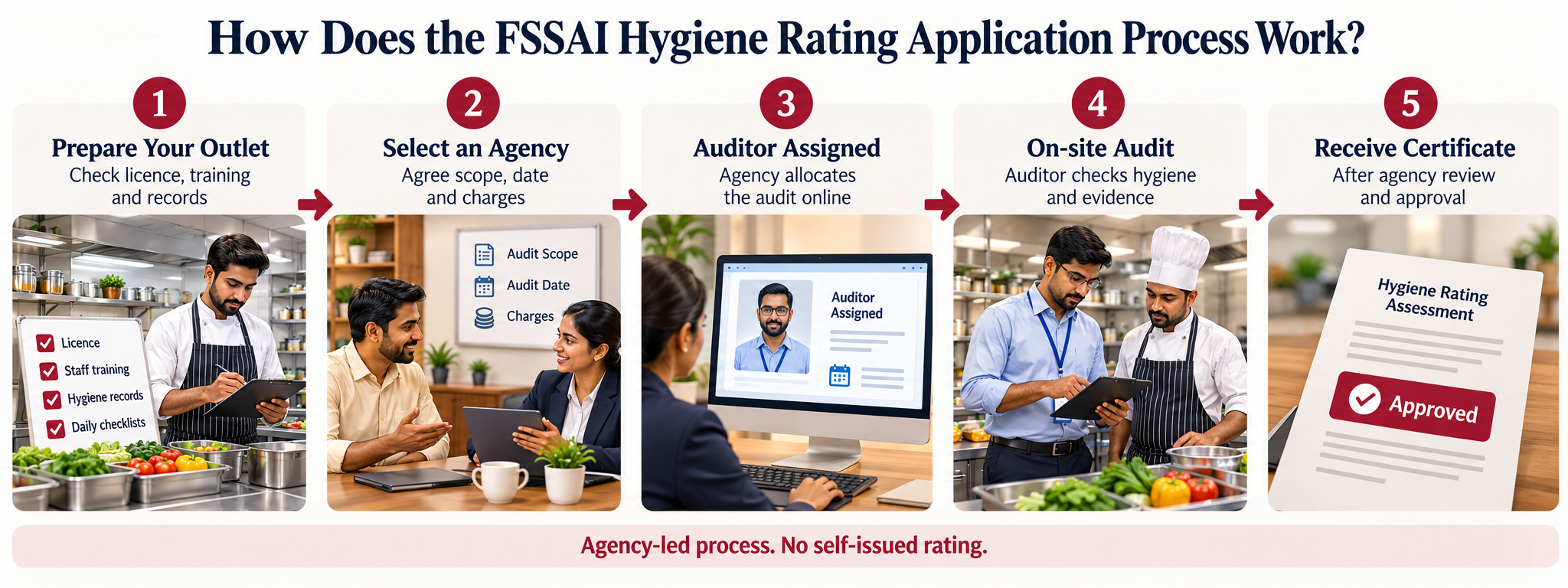
The official Hygiene Rating portal announces that business self-inspection has been removed. An internal readiness review remains useful, but it does not generate your official rating.
1. Confirm Your Outlet’s Readiness
Check your licensing status, supervisor details and applicable checklist before starting the FSSAI hygiene rating application. Review actual operations and collect the evidence described above. Address obvious gaps before scheduling an assessment, especially those involving safe water, food handling or pest activity. If you outsource pest management, consult the pest control licensing guide when checking the contractor’s credentials.
2. Select the Agency and Agree the Audit
Choose from FSSAI recognised audit agencies and agree the visit with your selected HRAA. Confirm the premises, scope, charges and person responsible for coordination. Put the agreement in writing so the FSSAI hygiene audit is booked for the correct outlet.
3. Have the Agency Allocate an Auditor
The Hygiene Rating Audit Agency updates the audit details and assigns an auditor through the portal. Provide accurate outlet and FoSTaC information to support this stage. Ask your HRAA for confirmation that your FSSAI hygiene rating application has been taken up, rather than relying only on a payment receipt. Retain a copy of the submitted FSSAI hygiene rating application and agency correspondence.
4. Complete the On-site Assessment
The auditor visits the premises and checks compliance against the scheme requirements. Make operational areas, relevant staff and records available for the FSSAI hygiene audit. Ask for clarification of findings and retain evidence relevant to any factual disagreement.
5. Receive the Approved Report and Certificate
The auditor submits the report to the Hygiene Rating Audit Agency, which reviews and approves it. After approval, the agency can download and send the hygiene rating certificate to the business. Check the hygiene rating certificate’s outlet details and rating, and ask your HRAA to resolve errors before you display it.
What Does the Audit Check and How Is the Score Calculated?
An FSSAI hygiene audit examines premises and facilities, operational controls, sanitation, personal hygiene, training and records. The checklist goes beyond a clean dining area to include matters such as contamination prevention and temperature control.
For hygiene rating for restaurants, applicable checklist marks are converted into a percentage. Items accepted as not applicable are excluded from the relevant total. Follow the current category checklist rather than assuming every outlet has the same maximum marks.
|
Percentage score in FSSAI guidance |
Rating |
Description |
|
81–100 |
5 |
Excellent |
|
61–80 |
4 |
Very Good |
|
41–60 |
3 |
Good |
|
21–40 |
2 |
Needs Improvement |
|
20 or below |
1 |
Urgent Improvement |
Critical questions marked with an asterisk require particular attention. FSSAI states that failure to comply with these leads to non-issuance of ratings. A high overall percentage cannot override that condition.
The food hygiene rating India’s portal records should therefore be read alongside the findings. For deeper hazard-control planning, the HACCP certification process guide explains a related approach, rather than another name for this rating.
What Will You Pay and How Long Does It Take?
A uniform nationwide outlet audit price and an end-to-end processing period were not publicly specified in the current scheme pages reviewed on 22 October 2026. Do not treat a private quotation as an official government fee for the FSSAI hygiene rating application.
Ask the Hygiene Rating Audit Agency for a written quotation covering:
-
The assessment and report
-
Applicable taxes and agreed travel or accommodation expenses
-
Any revisit or reassessment charge
-
Payment milestones, cancellation terms and refund conditions
-
Expected scheduling and report-review dates
FSSAI guidance says auditors should not demand travel or accommodation reimbursement beyond the audit fee unless agreed with the business. Confirm these arrangements with your HRAA before booking your FSSAI hygiene audit.
FSSAI’s e-payment fee master includes a ₹1,500 entry described as agency empanelment. That description does not establish an outlet application fee. Ask for the official basis of any charge presented to you as a government payment.
Laboratory testing, training, repairs and optional consultancy are separate cost items. For FSSAI hygiene certification, pay against an itemised scope and retain the invoice. FSSAI recognised audit agencies should be asked to distinguish their audit charges from any separately offered services.
How Long Is the Rating Valid and Can It Be Improved?
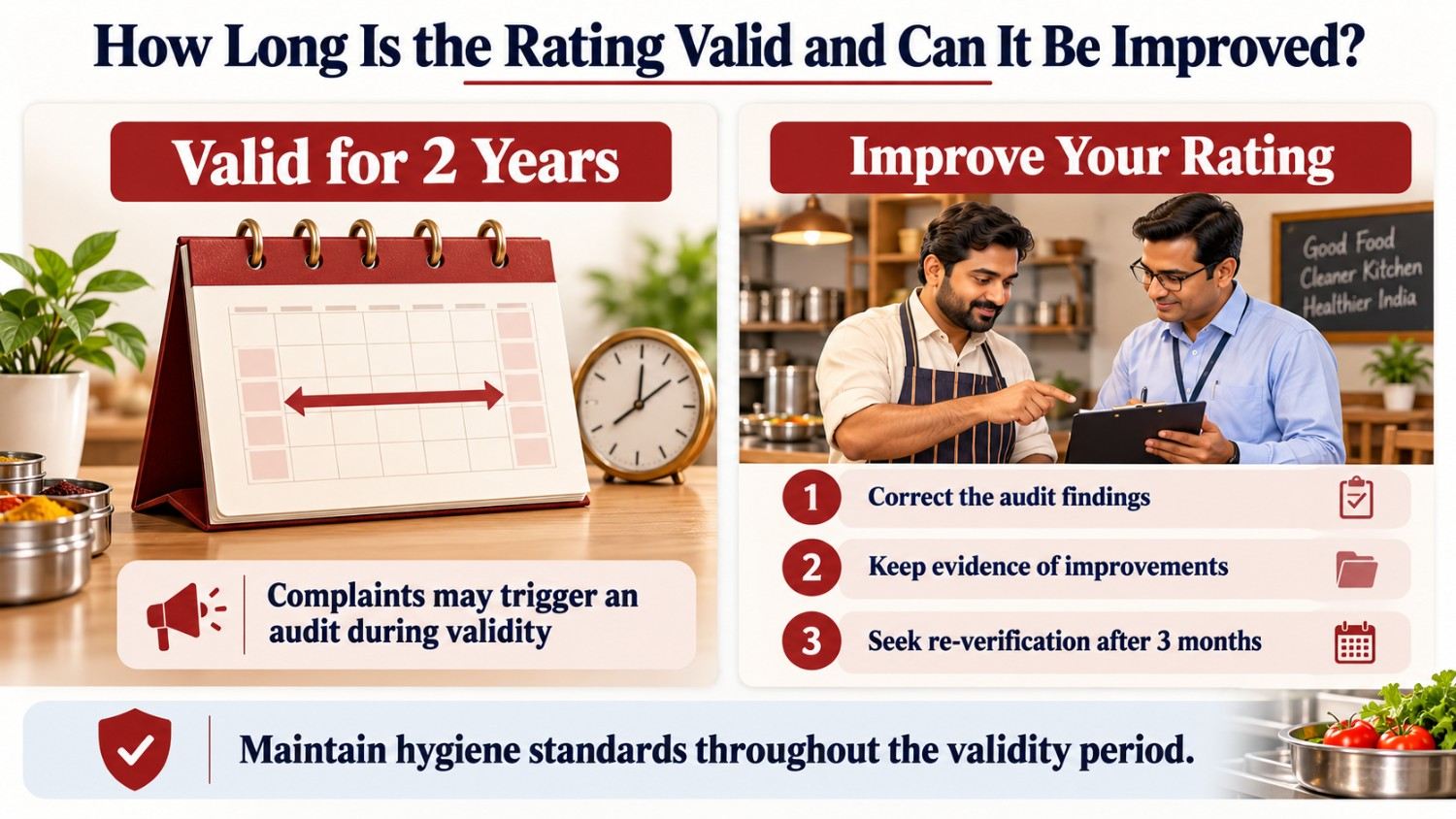
FSSAI guidance gives the rating a two-year validity. A complaint can lead to an audit during that period, so the hygiene rating certificate is not protection against further scrutiny.
The guidance allows re-verification after three months where improvements have been made. It directs outlets with ratings of 3, 4 or 5 to display their certificates, while lower-rated outlets should improve and reapply. Repeated low scores can be reported to the food safety department.
A low rating is not itself an automatic licence cancellation. Section 32 of the Food Safety and Standards Act separately provides for improvement notices and, where its conditions are met, licence suspension or cancellation. Correct unsafe practices promptly rather than treating the reassessment interval as permission to continue them.
Ask your HRAA about the reassessment arrangements and charges. Do not assume that renewal of FSSAI hygiene certification is automatic or that a better rating can be purchased immediately. Reassessments still involve a Hygiene Rating Audit Agency.
The food hygiene rating India’s diners rely on needs continuing operational support. Keep the expiry date visible in your compliance calendar and arrange the next assessment in good time. The FSSAI Hygiene Rating Scheme does not remove your continuing food safety obligations.
How Can You Judge the Business Value After the Audit?
Review what changed after the FSSAI hygiene audit, rather than counting only certificate displays. Record whether identified problems were corrected, staff received practical instruction and monitoring records are now completed consistently.
For hygiene rating for restaurants, useful internal measures include repeated hygiene complaints, unresolved audit findings and missed cleaning checks. These are suggested management measures, not government promises of commercial performance.
The food hygiene rating India’s scheme offers can support a clearer conversation with customers. Explain what was assessed, show the correct outlet’s certificate and avoid suggesting that the rating guarantees every future meal.
Treat FSSAI hygiene certification as a reason to maintain evidence throughout the year. An FSSAI hygiene audit is worth more when the findings remain part of daily supervision.
Conclusion
An FSSAI Hygiene Rating is worth considering when your eligible outlet wants independently assessed hygiene information and will maintain the underlying practices. The FSSAI Hygiene Rating Scheme offers a structured assessment, rather than guaranteed business growth. Approach FSSAI-recognised audit agencies with a clear description of your outlet and its readiness.
Before seeking FSSAI hygiene certification, prepare your evidence, choose a verified agency and agree the scope and charges. Hygiene rating for restaurants becomes more useful when owners act on findings instead of treating the hygiene rating certificate as the final objective. The food hygiene rating India’s consumers can trust depends on an honest assessment and consistent follow-through.
FAQS
FAQs About FSSAI Hygiene Rating
-
Does one FSSAI Hygiene Rating cover every branch of my restaurant?
The food hygiene rating India’s scheme awards relates to an outlet, and the certificate identifies its name and location. Do not present one branch’s result as proof that all branches were assessed. Confirm the assessment scope for each premises with your Hygiene Rating Audit Agency.
- Does an FSSAI hygiene audit approve every menu item?
- What if my application was pending on the older portal?
- Can I download a certificate completed on the older system?
- Can customers check the rating without contacting my business?
- Is municipal water treated the same as privately supplied water?
- How do I check whether a laboratory report covers the right tests?
- What if my trained Food Safety Supervisor leaves?
- Is a delivery app’s customer rating the same assessment?
- Can I challenge a checklist item marked incorrectly?


