
A Factory License is essential where your unit falls within the applicable factory licensing provisions, but approval alone does not keep the premises compliant. The authority must assess the activity, location, workforce, installed power and safety arrangements.
The Occupational Safety, Health and Working Conditions Code, 2020 took effect on 21 November 2025. Final Central Rules were notified on 8 May 2026, while applicable state procedures and saved provisions still require examination.
This guide explains Factory License registration through practical decisions about factory type, site suitability, capacity, documents, inspection, fees and continuing duties. It also separates factory approval from a product manufacturing licence.
Does a Factory License Make Your Unit Fully Compliant?
No. Factory License registration addresses factory operations under the applicable labour and safety framework. It does not replace pollution consent, building permissions or a product manufacturing licence.
For Factory License in India, distinguish establishment registration, site/plan approval and permission to operate. Sections 3, 79 and 119 of the Occupational Safety, Health and Working Conditions Code address different parts of this framework.
Factory registration also differs from incorporation. Records from private company registration establish the entity, while factory permissions concern its manufacturing premises. Factory License registration remains useful only alongside compliance with operating conditions.
The Code identifies the State Government as the appropriate government for factory occupational safety. The final Central Rules therefore do not, by themselves, establish one universal state factory form, fee or renewal procedure. Saved earlier rules apply only so far as consistent and until superseded.
Who Needs Factory Registration Under the Current Framework?
The starting thresholds for Factory License in India under the Code are:
|
Manufacturing arrangement |
Factory threshold |
|
With the aid of power |
20 or more workers |
|
Without the aid of power |
40 or more workers |
The test covers any day in the preceding twelve months. Count qualifying workers across groups and relays in a day, including qualifying contract workers. For example, 14 different qualifying workers on one shift and 12 on another total 26, rather than 14.
Factory License requirements include important exceptions. Section 2(1)(w) preserves a different pre-existing state-law threshold until amended by the competent legislature. Section 81 permits notified coverage below the ordinary threshold. Establishment registration under Chapter II can apply at ten workers even where the factory threshold is unmet.
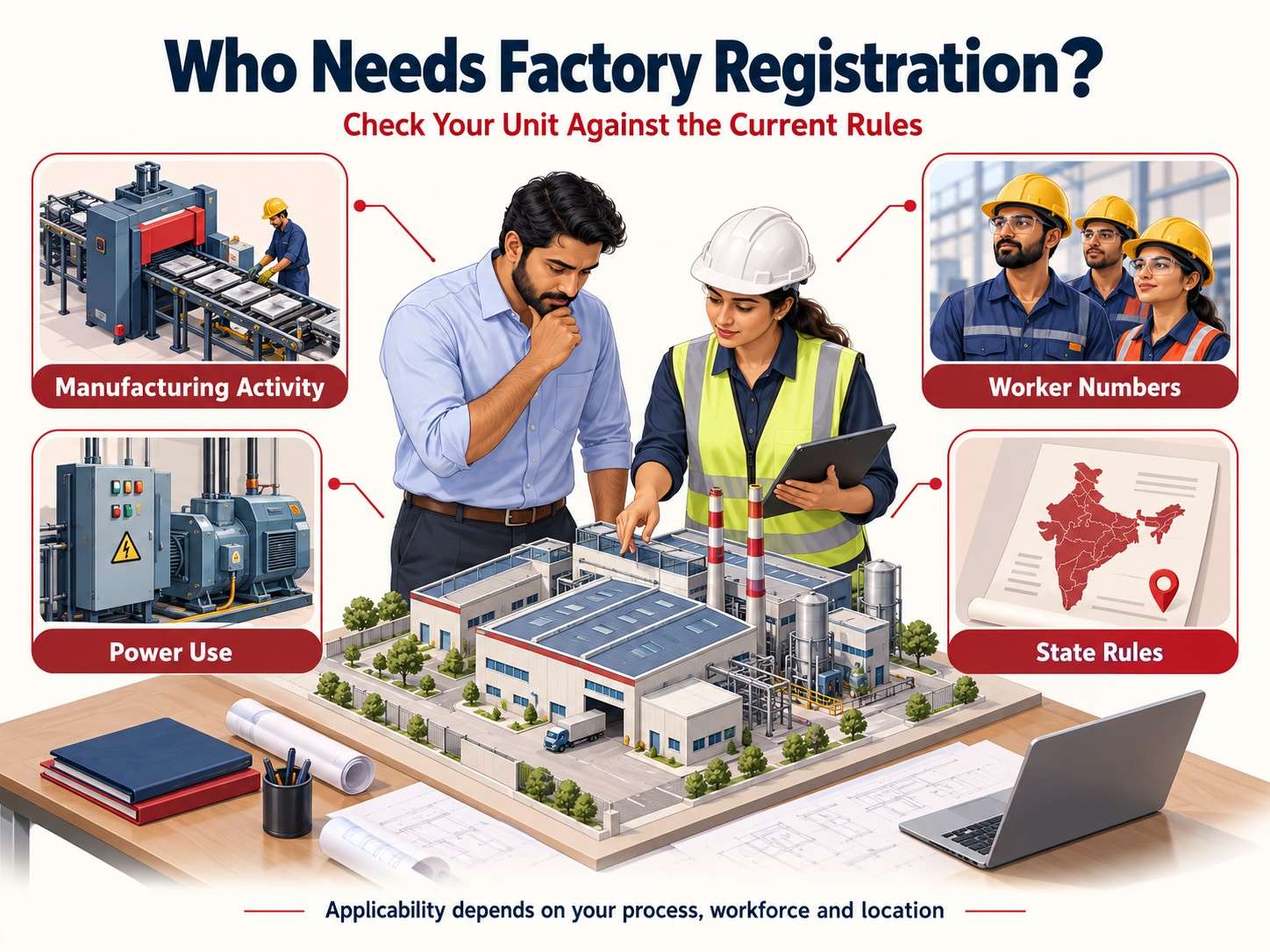
Consequently, factory registration cannot be decided solely from MSME status. Manufacturing includes activities such as repairing, finishing, packing, printing and cold storage. Factory License registration should follow the actual process, even if invoices describe the business as a service.
Which Factory Types and Activities Need Different Checks?
Factory License in India requires separate assessments of process risk and application type. “Small”, “medium” and “large” are not universal factory licensing categories.
|
Classification |
Additional assessment |
|
Non-hazardous factory |
Site, machinery layout, worker protection and prescribed facilities |
|
Hazardous-process factory |
Statutory process classification, site appraisal, risk disclosure and emergency planning |
|
Major Accident Hazard installation |
Chemical identities and quantities against applicable hazardous-chemical thresholds |
|
New grant, amendment or renewal |
Whether the request concerns a new operation, changed particulars or expiring permission |
A hazardous-process factory and a Major Accident Hazard installation are not interchangeable. Assess Factory License requirements for the process separately from pollution-board colour categories.
For chemical units, record substances and maximum storage quantities before assessing Factory License requirements. LegalBabu’s chemical business requirements explain the different operating models. A separate manufacturing licence may apply to regulated products.
Can Your Proposed Location Qualify for Approval?
Check Factory License requirements before committing to the premises. A landlord’s consent or an electricity connection does not establish lawful industrial use.
Verify:
-
Industrial land use, allotment conditions and any required conversion permission.
-
Building permission, occupied floors and structural suitability for machinery.
-
Access roads, emergency exits, ventilation and clear machinery passages.
-
Pollution-board siting restrictions and hazardous-site appraisal where applicable.
Delhi’s published guidance restricts ordinary factories to conforming industrial areas, with specified public-utility exceptions. Apply that example to Delhi, rather than assuming an identical national location rule.
Factory License documents must identify the actual plot, building and occupied area. In shared premises, assess common access and emergency arrangements as well as each unit’s factory registration. Factory License registration does not authorise occupation beyond the approved premises.
How Do Workforce, Power and Production Capacity Differ?
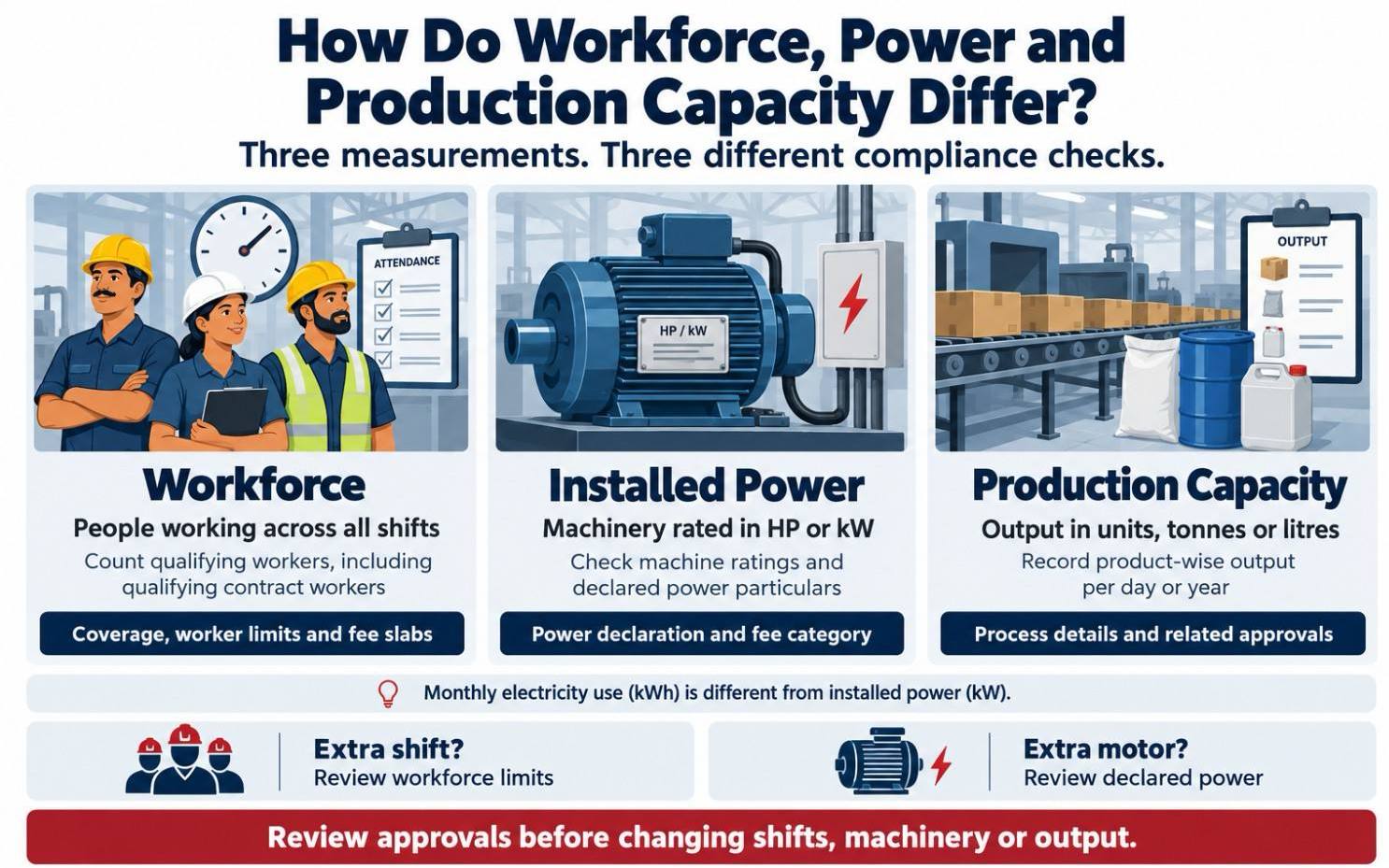
Factory License requirements involve several measurements that must remain consistent across records.
|
Measurement |
What to record |
Practical consequence |
|
Workforce |
Maximum qualifying daily headcount across shifts |
Coverage, licensed limits and fee slab |
|
Machinery power |
Machine-wise HP/kW and relevant sanctioned-load evidence |
Declared power and fee category |
|
Production capacity |
Product-wise tonnes, litres or units per day/year |
Process, pollution and product-approval consistency |
|
Chemical inventory |
Substance, maximum quantity and storage arrangement |
Hazard classification and emergency controls |
For Factory License in India, production tonnage does not replace the worker-and-power coverage test. Electricity consumption in monthly units also differs from installed motor power.
For example, adding a second shift can change worker limits without adding machinery. Installing another motor can change declared power without increasing workers. Review factory registration, pollution consent and any manufacturing licence before implementing either change.
Which Permissions Must Accompany Factory Approval?
Factory License registration does not consolidate every regulator’s permission. Assess the following against the actual activity:
-
Pollution consent and waste authorisation, where required.
-
Fire/building approvals and covered boiler or petroleum-storage permissions.
-
Product-specific licensing or compulsory certification.
For Maharashtra units requiring consent, MPCB specifies Consent to Establish before establishment works and Consent to Operate before production, including trials. LegalBabu’s MPCB consent requirements explain this separate approval sequence.
Food processors should assess food business licensing. Cosmetic producers need the appropriate manufacturing licence from the State Licensing Authority, covered in the cosmetic manufacturing licence guide.
An Ayurvedic medicine manufacturing licence follows its own product regime, discussed under AYUSH manufacturing requirements. For goods covered by an effective Quality Control Order, check BIS product certification separately. None replaces factory registration.
Which Factory License Documents Should You Prepare?
For Factory License in India, use the current state checklist for the service selected. Factory License documents commonly found in published state procedures include:
-
Occupier/manager identification and constitution documents.
-
Director/partner details and the prescribed occupier nomination.
-
Ownership, allotment or lease evidence.
-
Site, building and machinery plans with exits and passages.
-
Process flow, raw materials, finished products and capacity details.
-
Machinery power, electricity evidence, required approvals and payment receipt.
For hazardous operations, Factory License documents can include safety data sheets, risk information and emergency plans. Obtain stability and equipment-examination evidence where prescribed.
Reconcile names, addresses and machinery particulars before the Factory License application. LegalBabu’s business legal documents guide helps organise supporting entity records. Factory License documents for another unit cannot establish your premises’ compliance.
How Do You Submit a Factory License Application?
Below is the process for application:
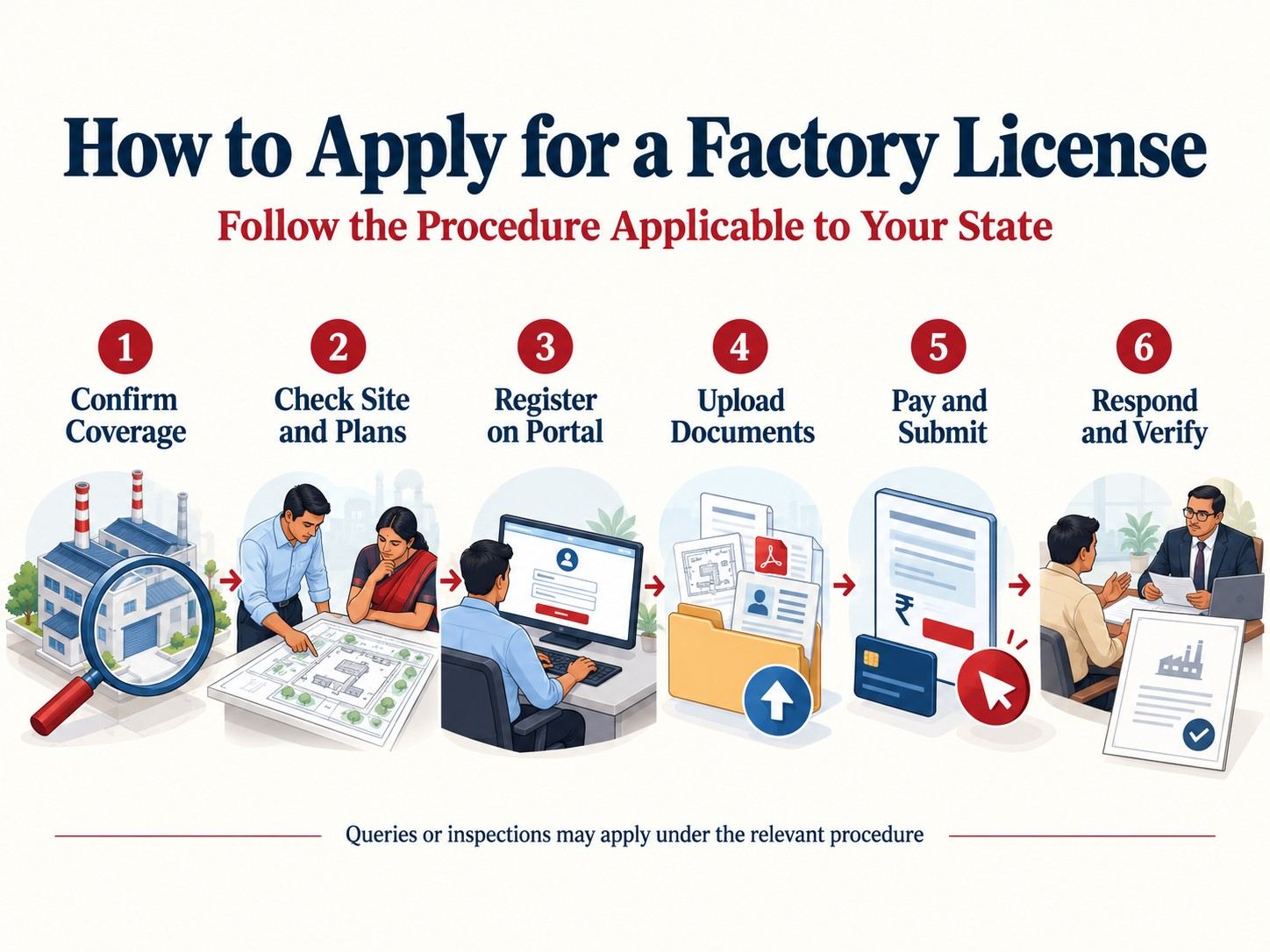
1. Establish coverage and nominate the occupier
Assess process, workers, power and state-specific Factory License requirements. For a company, the Code identifies a director other than an independent director as the deemed occupier. An ordinary manager cannot replace that statutory position by signing the Factory License application.
2. Secure the required site and plan permissions
Submit the prescribed drawings before construction or extension where previous permission applies. Resolve location objections before installing a production line. Check that the layout also suits the proposed manufacturing licence and pollution controls.
3. Select the notified portal and service
Use the responsible state authority’s service for new grant, amendment or Factory License renewal. West Bengal’s published SOP routes licensing through Silpasathi. Its signing stage makes the digital signature certificate relevant to completing that particular workflow.
4. Submit consistent particulars and documents
Enter the premises, activity, headcount and power correctly. Upload legible Factory License documents and preview the completed form against the portal’s Factory License requirements. A form number copied from another state may select the wrong Factory License application.
5. Pay and confirm successful submission
Check the applicable slab and licence period before paying. Preserve the Factory License application, acknowledgement and payment reference. In West Bengal’s published workflow, payment is followed by digitally signing and uploading the CAF, so payment alone does not complete submission.
6. Resolve scrutiny and inspection findings
Respond to deficiencies within the communicated deadline and provide corrective evidence. Complete an inspection where the applicable service requires it. After Factory License registration, check the issued address, process, worker/power limits and conditions against the factory registration records.
What Government Fees and Processing Rules Apply?
There is no single national charge for Factory License in India. The Delhi factory fee schedule publishes these one-year examples:
|
Installed power |
Maximum workers |
Published annual fee |
|
Up to 10 HP |
Up to 20 |
₹200 |
|
Above 10–50 HP |
21–50 |
₹600 |
|
Above 50–100 HP |
51–100 |
₹1,200 |
Its published notes apply year-multiples for longer grant/renewal periods and ₹100 for each specified amendment. Verify the operative schedule and portal demand before paying, particularly during transition. These published amounts were checked on 29 October 2026.
Government charges exclude professional fees, drawings, testing and a separate manufacturing licence. Obtain a written service quotation identifying inclusions and additional charges.
Section 119 provides a 45-day licensing framework with deemed issuance. Section 79 separately addresses site/construction/extension permission within the prescribed period, not exceeding 30 days. Neither makes an incomplete Factory License application proof of approval.
What Will Inspectors Examine at the Premises?
Factory License requirements must be demonstrable on site. The official March 2026 OSH FAQ explains that randomised inspections can coexist with complaint-based inspections authorised by the competent authority.
Maharashtra’s published inspection materials identify concrete checks:
|
Inspection area |
Evidence to keep ready |
|
Approved premises |
Licence, plans, stability evidence and actual machinery layout |
|
Physical safety |
Guards, electrical fittings, exits, ventilation and fire arrangements |
|
Equipment condition |
Prescribed pressure-vessel and lifting-equipment examination reports |
|
Worker protection |
Attendance, overtime, leave, health and accident records |
|
Hazardous processes |
Risk studies, emergency plan, drill records and corrective-action reports |
Keep Factory License documents accessible and nominate staff who can explain the process. Record each deficiency, the action taken and supporting evidence rather than merely replying “complied”.
LegalBabu’s factory EHS audits can support preparation. A private audit does not replace statutory inspection or prevent enforcement.
Which Factory License Requirements Continue After Approval?
Factory License registration begins an operating responsibility. Maintain machine protection, safe material handling, instruction, supervision, sanitation and emergency access.
Maintain the prescribed working-hours, overtime, leave, incident and return records. The Code provides overtime at twice the wage rate. LegalBabu’s labour law compliance page covers the wider employment framework.
For welfare planning, Section 24 provides for canteens at 100 ordinarily employed workers, including contract labour, and prescribed welfare-officer arrangements at 250. Section 22 requires safety officers at 500 workers in ordinary factories and 250 in hazardous-process factories. Apply the relevant detailed rules and counting basis.
Hazardous-process duties include risk disclosure, an approved on-site emergency plan and health records. The official OSH FAQ confirms pre-employment and periodic medical examinations irrespective of age, with Section 85 intervals not exceeding twelve months.
An occupational safety management system can organise controls. Certification does not replace Factory License renewal or a manufacturing licence.
When Are Renewal, Amendment and Fresh Permission Needed?
The correct route for Factory License in India depends on the licence’s age and state. Factory License renewal must follow the applicable state procedure and issued term. Section 119(5) preserves pre-Code licences for their issued period and requires them to be obtained afresh after expiry. Do not assume that Factory License renewal remains the correct service for every legacy licence.
Before Factory License renewal, compare the occupier, address, activity, layout, workers and power with current operations. Factory License renewal does not automatically approve additional floors, another production line or relocation. Submit the prescribed amendment or fresh filing when required.
Keep revised Factory License documents supporting those changes. Set separate reminders for pollution consent and product permissions. Check the actual Factory License renewal deadline rather than assuming a universal annual filing date.
What Penalties and Cancellation Risks Should You Know?
Factory License in India involves offence-specific consequences under the Code:
|
Contravention |
Statutory consequence |
|
General breach without a specific penalty, Section 94 |
₹2–3 lakh, plus up to ₹2,000 daily for continuation after conviction |
|
Required records/returns omitted, Section 96(1) |
₹50,000–₹1 lakh |
|
Wilful inspection obstruction or required-document refusal, Section 95(1) |
Up to three months’ imprisonment, or fine up to ₹1 lakh, or both |
|
Duty breach causing death, Section 103(1)(a) |
Up to two years’ imprisonment, or fine of at least ₹5 lakh, or both |
These are not interchangeable “late renewal fines”. Liability depends on the provision and circumstances.
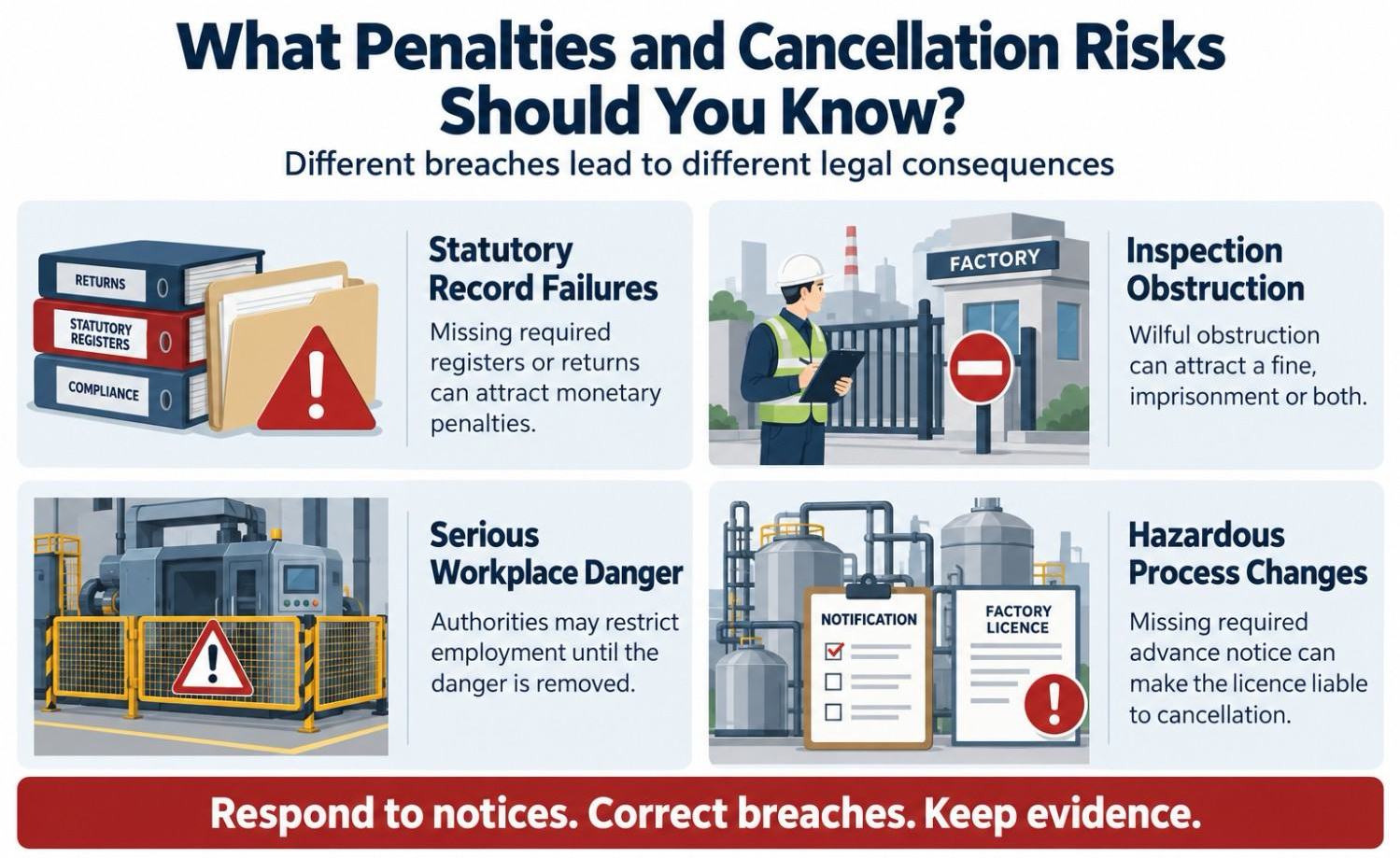
Section 38 permits restriction of employment where serious hazard or imminent danger exists. Under Section 84, advance notification of a newly introduced hazardous process is required 30 days before commencement. Contravention can make the factory licence liable to cancellation.
Conclusion
Factory License registration supports lawful operation when the site, activity, workforce, power and safety conditions match the permissions held. Review those particulars before starting production or expanding. Keep factory registration, Factory License renewal, pollution consent and product approvals under continuing review rather than treating the certificate as the end of compliance.
FAQS
FAQs About Factory License
-
Does repacking bought-in goods need a Factory License in India?
Packing can fall within the manufacturing definition even when you did not make the goods. Assess the actual operation and applicable coverage conditions. Describe the packing stages accurately in your Factory License application. Packaged-product businesses should also examine Legal Metrology requirements separately.
- Does a municipal factory licence replace labour-department approval?
- Can two companies share a shed under one approval?
- Can I use a loan licence instead of owning a cosmetic factory?
- Does a temporary workforce reduction remove coverage immediately?
- Should I pay again if the bank debits money but submission fails?
- Is the application fee refunded after rejection?
- Can unchanged particulars qualify for automatic renewal?
- Can I challenge a licensing refusal?
- What must I do when permanently closing the factory?


